
Universidade de Aveiro Departamento deElectr´onica, Telecomunica¸c˜oes e Inform´atica, 2015
N´
adia Filipa
de Jesus Soares
Aprendizagem Autom´
atica de Comportamentos
para Futebol Rob´
otico
Universidade de Aveiro Departamento deElectr´onica, Telecomunica¸c˜oes e Inform´atica, 2015
N´
adia Filipa
de Jesus Soares
Aprendizagem Autom´
atica de Comportamentos
para Futebol Rob´
otico
Automated Behavior Learning for Robotic Soccer
Disserta¸c˜ao apresentada `a Universidade de Aveiro para cumprimento dos requisitos necess´arios `a obten¸c˜ao do grau de Mestre em Engenharia de Computadores e Telem´atica, realizada sob a orienta¸c˜ao cient´ıfica de Prof. Doutor Nuno Lau e Prof. Doutor Lu´ıs Seabra Lopes, do Departamento de Electr´onica, Telecomunica¸c˜oes e Inform´atica da Universidade de Aveiro
o j´uri / the jury
presidente / president Doutor Manuel Bernardo Salvador Cunha
Professor Auxiliar da Universidade de Aveiro
vogais / examiners committee Doutor Jos´e Nuno Panelas Nunes Lau
Professor Auxiliar da Universidade de Aveiro (orientador)
agradecimentos / acknowledgements
Agrade¸co `as v´arias pessoas que me apoiaram neste ´ultimo ano e que, de uma forma ou de outra, tornaram este trabalho poss´ıvel.
Aos meus orientadores, professores Nuno Lau e Lu´ıs Seabra Lopes pelo apoio e disponibilidade que sempre tiveram e aos restantes membros da equipa CAMBADA que de alguma forma contribu´ıram para este trabalho.
Ao meu namorado, Paulo Soares, pelos conselhos, motiva¸c˜ao e paciˆencia durante este ano.
Aos meus amigos por estarem sempre l´a quando era preciso.
Aos meus colegas de equipa na PT Inova¸c˜ao por aturarem os meus hor´arios estranhos e as alturas em que pedi dias de f´erias em cima da hora para me poder dedicar exclusivamente a este trabalho.
Por ´ultimo, e porque o mais importante fica para o fim, `a minha m˜ae, Dulce Soares, pelo apoio incondicional e incentivo durante estes anos.
Resumo No desenvolvimento de um agente inteligente ´e necess´ario criar um conjunto de comportamentos, mais ou menos complexos, para que o agente possa escolher o que achar mais adequado para utilizar a cada instante. Com-portamentos simples podem ser facilmente programados “`a m˜ao”, mas, `
a medida que se tentam criar comportamentos mais complexos esta ta-refa pode tornar-se invi´avel. Isto pode acontecer, por exemplo, em casos onde o espa¸co de estados, o espa¸co de a¸c˜oes e/ou o tempo tomam valores cont´ınuos. ´E esse o caso no futebol rob´otico, onde os robˆos se movem num espa¸co cont´ınuo, com velocidades e em tempo cont´ınuos.
A aprendizagem por refor¸co permite que seja o agente a aprender um com-portamento atrav´es da sua experiˆencia ao interagir com o mundo. Esta t´ecnica baseia-se num mecanismo que ocorre na natureza, uma vez que imita a forma como os animais aprendem, mais concretamente, observando o estado do mundo, tomando uma a¸c˜ao e observando as consequˆencias dessa a¸c˜ao. A longo prazo, e com base nas consequˆencias das a¸c˜oes toma-das, o animal aprende se, nessas circunstˆancias, a sequˆencia de a¸c˜oes que o levaram a esse ponto ´e boa e pode ser repetida ou n˜ao.
Para que o agente aprenda da mesma forma, ´e preciso que consiga perceci-onar o valor que as suas a¸c˜oes tˆem a longo prazo. Para isso, ´e-lhe dada uma recompensa ou um castigo quando faz uma a¸c˜ao desejada ou indesejada, respetivamente.
Comportamentos aprendidos podem ser usados em situa¸c˜oes em que ´e invi´avel escrevˆe-los `a m˜ao, ou para criar comportamentos com melhor de-sempenho uma vez que o agente consegue derivar fun¸c˜oes complexas que descrevam melhor a solu¸c˜ao do problema.
No contexto desta tese foram desenvolvidos 3 comportamentos no contexto da equipa de futebol rob´otico CAMBADA da Univeridade de Aveiro. O primeiro comportamento, o mais simples, consistiu em fazer o robˆo rodar sobre si pr´oprio at´e estar virado para uma dada orienta¸c˜ao absoluta. O segundo permitia que o robˆo, com a bola na sua posse, a driblasse numa dire¸c˜ao desejada. Por fim, o terceiro comportamento permitiu que o robˆo aprendesse a ajustar a sua posi¸c˜ao para receber uma bola que pode vir com mais ou menos velocidade e descentrada em rela¸c˜ao ao receptor.
Os resultados das compara¸c˜oes feitas com os comportamentos desenvolvi-dos `a m˜ao que j´a existiam na CAMBADA, mostram que comportamentos aprendidos conseguem ser mais eficientes e obter melhores resultados do que os explicitamente programados.
Abstract While developing an intelligent agent, one needs to create a set of behav-iors, more or less complex, to allow the agent to choose the one it believes to be appropriate at each instant. Simple behaviors can easily be developed by hand, but, as we try to create more complex ones, this becomes imprac-ticable. This complexity may arise, for example, when the state space, the action space and/or the time take continuous values. This is the case of robotic soccer where the robots move in a continuous space, at continuous velocities and in continuous time.
Reinforcement learning enables the agent to learn behaviors by itself by ex-periencing and interacting with the world. This technique is based on a mechanism which happens in nature, since it mimics the way animals learn, more precisely, observing the world state, taking an action and then ob-serve the consequences of that action. In the long run, and based on the consequences of the actions taken, the animal learned if, in those circum-stances, the sequence of actions which led it to that state is good and may be repeated or not.
To make the agent learn in this way, it must understand the value of its actions in the long run. In order to do that, it is given a reward or a punishment for doing a desired or undesired action, respectively.
Learned behaviors can be used in cases where they are too complex to be written by hand, or to create behaviors that can perform better than the hand-coded ones, since the agent can derive complex functions that better describe a solution for the given problem.
During this thesis, 3 behaviors were developed in the context of the robotic soccer CAMBADA team from University of Aveiro. The first behavior, the most simple, made the robot rotate about itself until it had turned to a given absolute orientation. The second one, allowed a robot that possessed the ball to dribble it in a desired direction. Lastly, the third behavior allowed the robot to learn to adjust its position to receive a ball. The ball can come at a high or low speed and may not be centered in relation to the receiver. The results of comparing the learned behaviors to the already existing hand-coded ones showed that the learned behaviors were more efficient and ob-tained better results.
Contents
Contents i
List of Figures iii
List of Tables v
List of Acronyms vii
1 Introduction 1
1.1 Motivation . . . 1
1.2 Objectives . . . 2
1.3 Thesis outline . . . 3
2 Robotic Soccer and the CAMBADA Platform 5 2.1 Introduction . . . 5
2.2 Robotic Soccer . . . 5
2.3 RoboCup . . . 7
2.3.1 Middle Size League (MSL) . . . 14
2.4 The CAMBADA Platform . . . 15
2.4.1 General Architecture . . . 17 2.4.2 Hardware . . . 19 Robot base . . . 19 Movement . . . 20 Grabber . . . 21 Kicker . . . 22 Vision system . . . 23 2.4.3 Software . . . 23 Agent process . . . 26
Changes in the new platform . . . 26
2.5 Summary . . . 26
3 Reinforcement Learning 27 3.1 Reinforcement learning problems . . . 28
3.2 Markov Decision Processes . . . 29
3.3 Value Iteration . . . 30
3.4 Q-Learning . . . 32
3.6 Batch Reinforcement Learning . . . 34
3.6.1 Batch RL Framework . . . 34
3.6.2 Fitted Q-Iteration . . . 36
3.6.3 Neural Fitted Q-iteration . . . 36
3.6.4 Q-Batch update rule . . . 37
3.7 Practical issues in Reinforcement Learning . . . 38
3.8 Existent Applications . . . 39
3.8.1 Reinforcement Learning applications . . . 39
3.8.2 Batch Reinforcement Learning applications . . . 39
3.8.3 Reinforcement Learning in robotic soccer . . . 40
3.9 Summary . . . 41
4 Learned behaviors in CAMBADA 43 4.1 Introduction . . . 43
4.2 Behaviors in CAMBADA . . . 43
4.3 Rotate to a given absolute position . . . 45
4.4 Dribble . . . 47
4.5 Receive Pass . . . 49
4.6 Pass the ball . . . 52
5 Results 53 5.1 Introduction . . . 53
5.2 Learning environment . . . 53
5.3 Results . . . 54
5.3.1 Rotate to absolute position . . . 54
5.3.2 Dribble the ball . . . 55
5.3.3 Receive a pass . . . 56
6 Conclusions and future work 59
List of Figures
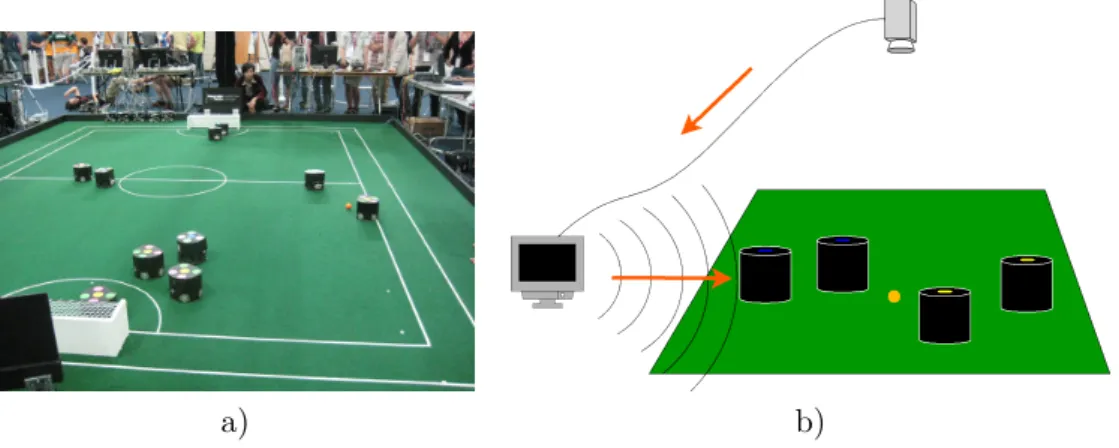
2.1 Scene from a Small Size League game in a) and, in b), the scheme used to obtain information about the state of the game, process it and make decisions (done by the central computer) and distribute commands to the robots on the
field. The later was taken from [7] . . . 8
2.2 Different leagues of the humanoid soccer competition. a) shows robots com-peting in the kid size league, b) the teen size and c) the adult size. . . 10
2.3 NAO robots playing in the Standard Platform League . . . 11
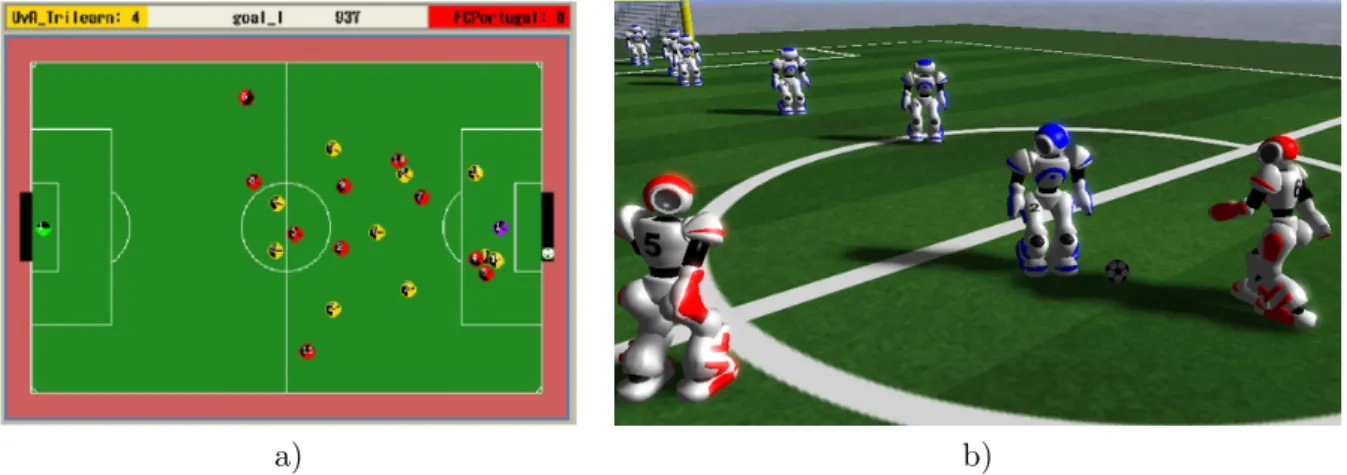
2.4 Simulation leagues: a) shows a 2D Simulation game, and b) shows a situation from a 3D game. . . 11
2.5 shows a rescue situation from a Robot Rescue League competition . . . 12
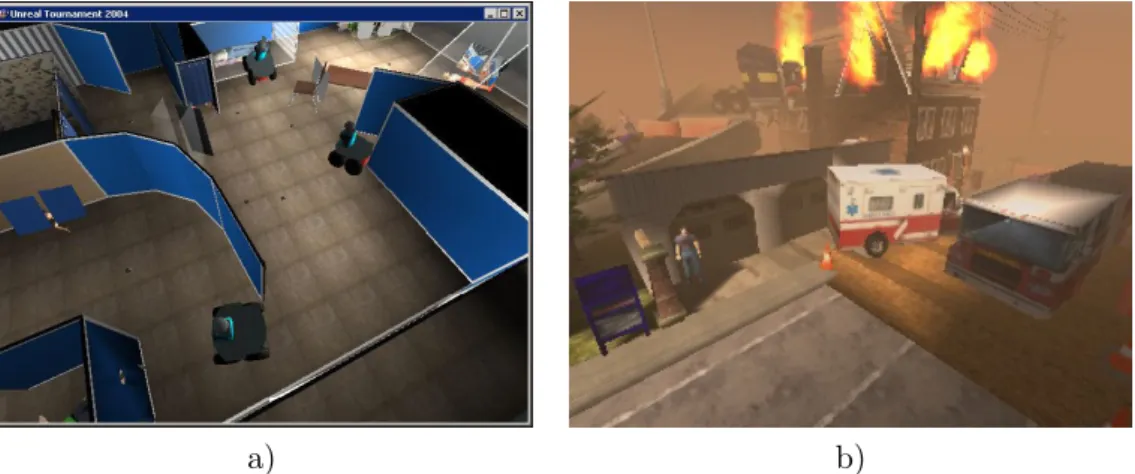
2.6 shows, respectively, the agent competition and the virtual robot competition. 12 2.7 shows AMIGO, one of the service robots of the Tech United team from Eind-hoven University of Technology . . . 13
2.8 show a robot executing its task at an @Work competition. . . 13
2.9 Field measurements and important points for the MSL, taken from [8] . . . . 15
2.10 Picture of a MSL game in IranOpen2014. Taken from [11] . . . 16
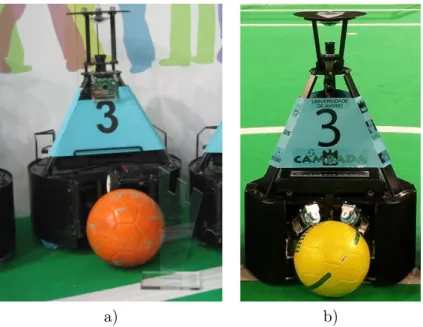
2.11 The two versions of the CAMBADA robot. In a) the old version, used between 2009 and 2012 and in b) the newest version of the platform, which has been in use since 2013. . . 17
2.12 The biomorphic architecture of the CAMBADA agents. Taken from [1]. . . . 18
2.13 The CAMBADA platform low-level hardware architecture. Taken from [10] . 18 2.14 Layered software architecture of CAMBADA players, adapted from [1]. . . . 19
2.15 Representation of the bottom layer and the plate of the middle layer in a) and all three layers in b). Adapted from [17]. . . 20
2.16 The top images show the mechanical drawings of the old robots in a) and new robots in b). Taken from [18] and [17] respectively. In the bottom, c) and d) show the real images of the base of each platform. Taken from [19] and [1], respectively . . . 21
2.17 Image of the mechanical drawing of the new wheels. Taken from [17] . . . 22
2.18 Grabber of the old CAMBADA platform . . . 22
2.19 Grabber of the new CAMBADA platform . . . 22
2.20 Positions the kicker can take. a) shows the metalic bar in use to kick the ball to the air, while b) shows the bar pushed aside to allow the solenoid to kick the ball through the floor. . . 23
2.21 Images obtained using the CAMBADA vision system. a) shows the image outputted by the camera (a view from the hyperbolic mirror) with a grid superimposed to it. The grid is used by an image processing algorithm running at the laptop to obtain the image presented in b) which is easier to use since coordinates in the images are directly mapped to the real world. Adapted from
[13] . . . 24
2.22 The omnidirectional vision system. Taken from [1] . . . 25
2.23 Basestation application . . . 25
3.1 Agent-Environment Interface. Taken from [22] . . . 28
3.2 Schema of the different ways to categorize reinforcement learning algorithms. Taken from [26] . . . 34
3.3 The Batch Reinforcement Learning Framework, taken from [25] . . . 35
4.1 Class diagram showing all the methods in the Behaviour class. . . 44
4.2 Set of actions available to the agent when learning the Rotate behavior. Taken from [1] . . . 46
4.3 Reward function. Taken from [1]. . . 46
4.4 Representation of the set of actions used to learn the dribble behavior. Taken from [1]. . . 48
4.5 By representing robot coordinates using the axis relative to its position, the XX axis is parallel to the ball movement while the YY axis is perpendicular to it. This allows us to use smaller state action spaces. Taken from [1]. . . 50
4.6 Possible actions for the pass behavior. . . 52
5.1 Flowchart describing the automation of the learning process. . . 54
5.2 Comparison between the learned behavior to rotate to an absolute target lo-cation and its hand-coded version. . . 55
List of Tables
3.1 Skills learned by the Brainstormers 2D Simulation League team and/or the Brainstormers Tribots Middle Size League team using NQF [61]. Filled dots represent behaviors used in competitions and empty circles, behaviors success-fully learned but not used in competitions. Taken from [1] . . . 42
List of Acronyms
• CAMBADA: Cooperative Autonomous Mobile roBots with Advanced Distributed Ar-chitecture
• MSL: Middle Size League
• IEETA: Institute of Electronics and Informatics Engineering of Aveiro • IRIS: Intelligent Robotics and Intelligent Systems
• RTDB: Real-Time Database • MDP: Markov Decision Process • ML: Machine Learning
• RL: Reinforcement Learning • FQI: Fitted Q Iteration
• NFQ: Neural Fitted Q Iteration • MLP: Multi-Layer Perceptron
Chapter 1
Introduction
1.1
Motivation
Robotics and Artificial Intelligence are fields of study which can, potentially, lead to important applications to help or substitute human beings in many different tasks. These research topics deal with hard problems and involve many different variables and uncertainties at the hardware and/or software level, making them challenging research topics.
Robotic soccer has established itself as an interesting research topic to explore these fields since, by providing a benchmark, it allows to manage complexity and explore increasingly bigger issues. RoboCup is an international project which uses robotic soccer as the main research problem. Teams from universities and research groups develop robots and/or simu-lated agents to participate in different competitions managed by this project. This creates a challenging environment which motivates researchers to innovate and take their research to the next level with the end goal of applying the lessons learned to socially relevant problems in the future.
RoboCup consists of different competitions, leagues and challenges, each one dealing with different problems (hardware, software with single or multiple agents, cooperative and com-petitive). The Middle Size League (MSL) is one of the most challenging. In MSL, two teams of 5 robots with dimensions that cannot exceed 50cm × 50cm × 80cm and 40Kg in weight compete using an adaptation of the official FIFA rules.
CAMBADA, Cooperative Autonomous Mobile roBots with Advanced Distributed Archi-tecture, is the MSL robotic soccer team from University of Aveiro, responsibility of the IRIS research group within IEETA. It was founded in 2003 and, since then, it has established itself as a major competitor at a world level. Some of its achievements have been the first place in the worldwide competition RoboCup in 2008 (Suzhou, China), the third place in 2009 (Aus-tria), 2010 (Singapure), 2011 (Turkey), 2013 (Netherlands) and 2014 (Brazil). Furthermore, it has been National Champion seven times in a row from 2007 to 2013, in the Portuguese Robotics Open.
To perform the several needed tasks on a robotic soccer match, the agent must be capable of executing several different behaviors, which, hopefully, allow it to choose an efficient action at each step. Manually coding behaviors is a demanding task and it requires that many parameters are configured and optimized. The results obtained from manually coding and configuring behaviors do not come close to those that a learning agent can infer by interacting with its environment and analysing the results of its actions [1]. There are several ways in
which intelligent agents can experiment with their environment to develop an understanding of their surroundings and come up with a good choice for its actions.
For instance, in supervised learning, the agent builds a model of the environment using a given dataset containing characteristics of the world and the efficient action to be taken in those conditions. This dataset containing the features of the world and the desired action is called the training set. It has to be given to the agent in order for it to derive the model of the world. All this information is expensive due to the cost of labeling each experience with the target action.
A more nature-based way would be to use the mechanism that animals use to learn, that is, by trial-and-error. When presented with a choice, an animal can choose either some action to which it knows the probable outcome or it can experiment. By experimenting and analyzing what happens in those conditions it builds up its knowledge of the world and of how its choices impact it. If the outcome is a positive thing for the animal or agent, it will learn that taking that action in those circumstances is a good thing and vice-versa.
The sub-field of machine learning that draws inspiration from the animal learning processes is called reinforcement learning. These techniques have been established as valuable tools to learn behaviors in the context of autonomous robots, since it allows the agent to learn and improve its behavior as it experiences and interacts with the world, which is a vital characteristic for autonomous robots to have.
A previous work [1] has focused on creating a framework for the use of reinforcement learning techniques in the CAMBADA soccer robots. The work included the development of learning tasks for the soccer robot and the implementation of the behaviors that execute the learning procedure and use the learned model. Also, some comparisons between hand-coded and learned behaviors have been drawn. The CAMBADA platform has been recently upgraded and some changes have been made to some of the key hardware components and to the software architecture. For this reason, the developed behaviors must be redone and relearned for the new platform, to adapt both the code to the new agent architecture and the learning parameters to take advantage of the more powerful hardware.
1.2
Objectives
This thesis focus on the implementation of reinforcement learning technique on the new framework of the CAMBADA Middle Size League team. This work was the adaptation the reinforcement learning behaviors developed in a previous project developed in the CAMBADA team [1], to the new platform. This previous project has concluded that reinforcement learning behaviors perform superiorly to the old explicitly programmed ones. It also mentioned the gains obtained by using the Q-Batch update rule [2] instead of the well known Q-Learning algorithm. The aim of this thesis can be summarized as follows:
1. Study the existing body of knowledge on Reinforcement Learning methods and work previously done in the field;
2. Apply Reinforcement Learning techniques to the context of robotic soccer, specifically the new CAMBADA robots to:
(a) Adapt and train previously developed learning behaviors to the new CAMBADA robots;
(b) Develop and train new learning behaviors;
3. Compare the performance of the learned behaviors with the explicitly programmed ones.
1.3
Thesis outline
The remaining of this thesis is composed of 7 more chapters.
Chapter 2 is an introduction to robotic soccer, the RoboCup project and the CAMBADA team. Both the hardware and software platforms are described, with an emphases to key components for this work and highlighting the differences between the old and new platforms. Chapter 3 reviews the key concepts of reinforcement learning. It starts by explaining how a reinforcement learning problem can be defined using Markov Decision Processes and then introduces online algorithms like Value iteration and Q-Learning and exposes their draw backs for this type of problem. To solve those draw backs, the batch reinforcement learning framework is introduced by detailing the Fitted Q Iteration (FQI). A more specific version of this algorithm, the Neural Fitted Q Iteration (NFQ), that uses a Multi-Layer Perceptron (MLP) as a function approximator to fit a Q-function, is also described. The last algorithm to be described is an update rule to be used in NFQ, instead of Learning. It is called Q-Batch and it takes advantage of the fact that the gathered experiences are episodic, meaning, they may be related to one another and sequential in some way. During this discussion, a comparison between online and batch methods is performed and it is explained why batch methods were chosen for this problem. It also describes some related work that make use of reinforcement learning as a valuable tool for learning in autonomous and adaptive agents. This description narrows down to applications of batch reinforcement learning methods and, more specifically, to the use of this technique in robotic soccer.
Chapter 4 describes the behaviors developed in this thesis. It starts by introducing the CAMBADA behavior architecture and how learning behaviors can be integrated into it. It then specifies each learned behavior, describing the approach taken in each problem.
Chapter 5 presents the testing environments, describing both how to execute learning experiences in the simulator (and the changes made to it) and in the real robots. Then it presents the setups used and the results obtained in each of the learning tasks.
Chapter 6 concludes by discussing the results obtained and presenting suggestions for future work.
Chapter 2
Robotic Soccer and the
CAMBADA Platform
2.1
Introduction
This chapter gives an overview of robot soccer as a testbed for artificial intelligence and robotics developments, and in particular it describes the RoboCup competition, giving special attention to the Middle Size League, where the CAMBADA team plays. Later, the current stage of the CAMBADA robots is described drawing a comparison with the previous version of the platform and explaining how those changes had an impact in the behaviors learned during this thesis.
2.2
Robotic Soccer
While doing research on robotics it is useful to have relevant, motivating and challenging benchmarks. These testbeds are problems made up by researchers, which pose issues that the community must solve. The advantage is that those issues are presented in a smaller scale than in a real application since researchers can tackle with the problem to erase sub-problems that are too difficult to solve for now, and leave only those that are fundamental and just challenging enough to be solved and to drive the research forward. In other words, a testbed can be adapted to the current state of the art and to the actual problems in the field allowing teams to drive forward scientific and engineering knowledge easier than if they were to approach real world complex problems at once.
As previously stated, there are several tools and environments designed to test and ex-periment while doing developments in machine learning and reinforcement learning [3][4]. In the case of multi-agent robotic systems and artificial intelligence, several benchmarks exist, some more suited to some specific needs and problems. One of these benchmarks is robotic soccer.
Robotic Soccer is a collective game, and so, there is the opportunity for improvements in several areas of multi-agent research, as strategy or communication, but, at the same time, each agent deals with its individual problems, as location, object identification and behavior execution.
The environment is dynamic and adversarial which forces the teams to develop sophisti-cated robots employing and giving rise to state of the art techniques. This kind of competitive
environment gives rise to challenges and keeps teams motivated. Research and development thrive in this conditions and the tight timings for the competitions make the teams work during each year to improve their platform and try to win over the competition.
In addition to that, soccer is a popular sport around the world and the general public care about it. Robotic soccer can therefore be accessible and enjoyable for the masses, and become a source of entertainment, generating an industry of its own.
Aside from these aspects, it is used because of the challenges and technical issues that this complex problem brings to the research communities involved. Many issues will arise that must be resolved in order to make the agents aspire to win matches and the knowledge developed from solving those problems can then be employed on other practical applications, like, for instance, providing help for elderly people [5].
To be able to execute a task, an agent (robotic, simulated or even a human being) must possess some specific basic abilities for the given task. To play soccer, the agent has to be able to perceive its surroundings and identify the relevant objects present (namely the field lines, the soccer ball and obstacles like other robots). It also has to move around the field, orient itself inside it and transport the ball by kicking or dribbling it to the desired position. To respect the rules of the game and avoid penalties, it has to be able to sense the state of the game and compare it with the set of rules.
All these low-level abilities create a soccer-playing robot but they are not enough to make it, and the team, play intelligently. For that, it is necessary to have more complex and higher-level abilities like keeping a formation, following a strategy, and adapting to the opposing team’s strengths and weaknesses. It is relatively simple for a human to perform these abilities but they prove to be very challenging for robots.
Besides all those ability requirements, in a soccer game, the agents have to be able to cope and interact with an environment with the following characteristic [6]:
• Partially observable: An agent has to work with limited data since it can not perceive all the relevant information of its surroundings with accuracy. This is due to the fact that the sensors are imperfect, their signals have noise and their range is finite. Noise is any signal that obscures the signal to be observed (in this case, the output from the sensors), making it hard to analyse it. It creates ambiguity in the sense that more than one interpretation of the signal can be made. So, as any other, the CAMBADA robots’ sensors have a limited range and can not obtain information about the entire game field. The robots do have access to the sensor information of their teammates but there may be information missing. For instance, if all robots are turned in one direction there is no up-to-date information from the vision system about the opposite direction.
On the other hand, teams do not know their opponents’ immediate intentions, possible actions and decision making process. It is possible to observe and model the adversary’s behavior to try to estimate and predict its actions but there is always some degree of uncertainty.
• Multi-agent: Robotic soccer is simultaneously cooperative and adversarial: teams are composed of several agents cooperating with each other, but at the same time, competing against their opponents;
• Stochastic: In this type of environment, the outcomes of actions taken by the robot cannot be perfectly predicted. This may be due to actuators with a low degree of
accuracy, actions that are too complex, or the fact that the outcome of the actions can be modified by other players, be they teammates or adversaries;
• Sequential: Actions are not isolated from each others and the game ends up in one state as a consequence of the past states and the actions taken.
Each action taken within the game can have long-term consequences, leading the team closer to a desired state, or contributing to a bad outcome. This makes it even more important for a soccer agent to take the best possible action at each step;
• Dynamic: The environment is constantly changing in unpredictable ways due to the opponents’ actions.
In game situations, agent cannot pause to carefully analyse and choose the best possible action. Other players will not wait for it to be done reasoning before carrying on. In a dynamic environment, other robots are rapidly interfering with the world state and if an agent takes too long to decide, it may end up deciding too late and its action may be inadequate for the new world state.
• Continuous: State, actions and time are not discrete but continuous, since they are dependent upon continuous variables like position or velocity. For example, the distance between a robot and the ball or to the goal is continuous, the position within the field is measured in continuous coordinates, and the speeds the robots can move are also within a continuous range.
2.3
RoboCup
RoboCup is an international research project, formed in 1997, to promote research and education in the fields of Artificial Intelligence (AI), Robotics and related areas. It sponsors an annual competition with the same name aimed at driving forward scientific progress in those fields. Soccer was chosen as one of the main problems to focus on. This way, a challenging environment was created to find and solve issues and, eventually, leading to the achievement of the long term goal which is to, by 2050, have developed a fully autonomous humanoid team capable of playing and winning against the latest human world champion soccer team, complying with the official FIFA rules.
To deal with such a difficult goal, researchers need to break it down into smaller sub-goals. To abstract some of the unwanted complexity the official rules have been modified, making it easier to approach the project in its early stages and allowing researchers to focus on simpler and feasible problems. Then, as solutions to those problems become available, the rules can be incrementally changed to introduce the avoided complexities. An example of this is the choice of the ball to be used in the Middle Size League games. Until 2010 the RoboCup rules stated that the color of the ball had to be orange, allowing the robots to distinguish it by color. Nowadays, any standard FIFA ball can be used, except if its main colors are white, green or black because those are, respectively, the colors of the lines, the field and other robots. This is still a simplification of the official rules, but constraints have been dropped.
Also to facilitate the fulfillment of this goal and to drive AI and robotics research in other domains and applications, RoboCup is divided in various competitions which are further divided into leagues. The competitions have different aims and apply robotics to different problems. While leagues tackle with different issues of the competition’s main goal. Some
leagues deal only with software, others require the development of the hardware platform. Some are more focused on single agent research, others on multiple agents, cooperative and competitive.
• RoboCup Soccer - Soccer has been the initial competition in RoboCup and it still being its main focus. Its research goals are related to cooperative multi-agent systems in a dynamic and adversarial environments. There are five leagues in RoboCup Soccer each concerning different aspects that sum up to achieve the main goal. A common factor in the all the leagues is that there are two teams of fully autonomous agents compete against each other in a soccer environment using an adaptation of the rules of the real game.
– Small Size League Small Size robot soccer is also known as F180 and each team is composed of six robots that must fit within circle of 180 millimeters in diameter and with a maximum height of 150 millimeters. The field is green carpeted of 6.05 meters by 4.05 meters and the ball is an orange golf ball.
The images from two cameras located 4m above the field are fed to a standardized vision system that tracks all objects on the field.
Off-field computers are used to communicate referee commands and position infor-mation to the robots. These computers perform most of the processing required for coordination and control of the robots.
Thus, this league focuses on the problem of intelligent multi-agent cooperation and control in a highly dynamic environment with a hybrid centralized/distributed system.
a) b)
Figure 2.1: Scene from a Small Size League game in a) and, in b), the scheme used to obtain information about the state of the game, process it and make decisions (done by the central computer) and distribute commands to the robots on the field. The later was taken from [7]
– Middle Size League: In this league, teams are composed of up to 5 robots which must fit inside a 50cm × 50cm × 80cm box and cannot weight more than 40Kg. The field is 12 by 18 meters, and a regular sized FIFA approved soccer ball is used. All sensors must be mounted on the robots. Wireless communication between players is allowed to enable coordination and cooperative behavior. Additionally,
robots can also communicate with an external entity, the “coach” which is an autonomous agent with no sensors of its own, which can use sensor information relayed by players to make decisions and facilitate coordinated behavior. The rules of the game are adapted from the official FIFA rules, and are enforced by a human referee and one or more assistant referees.
– Humanoid League Humanoid league uses robots with human-like shape and with equivalent sensors.
Since the main goal of the soccer competition is to have robots playing as humans would, perception and world modelling are not simplified by using non-human-like sensors like usually happens in applications outside the league.
The main research issues are dynamic walking, running and kicking without losing balance, self-localization within the field, visual perception to detect other players, field markings and the ball and teamwork with other teammates.
This league is further divided in three sub-leagues:
∗ Kid Size: teams of three robots with 30 to 60 cm of height; ∗ Teen Size: teams of two robots of 100 to 120 cm of height;
∗ Adult Size: two robots of 130 cm and taller compete against each other indi-vidually. The robots play in striker versus goalkeeper situations, exchanging roles after each play.
• Standard Platform League: The teams in this league are made up of identical robots, hence the name “Standard Platform”. Since the platform is the same and already built, researchers can abstract the issues of developing an efficient physical robot and without the development of hardware in the way, they can focus on software only.
Currently, the standard platform in use is the humanoid NAO created by Aldebaran Robotics. Previously there was a “Four-Legged League” which used Sony’s AIBO dog robots.
• Soccer Simulation League: In this league, players are not physical robots but simu-lated agents, playing on a simusimu-lated environment. This allows this league’s main focus to be artificial intelligence and team play. It is subdivided into the following sub-leagues: – 2D Simulation: The main characteristic of this sub-league, where the teams are composed of eleven agents each, is that the virtual world and the agents are represented using 2 dimensions and are managed and simulated by a central server, called SoccerServer. The server knows everything about the game, i.e. the position of the players and the ball and so on. The game relies on the communication between the server and each agent. Players receives relative and noisy input of his virtual sensors (visual, acoustic and physical) and may perform commands (like dashing, turning or kicking) by sending them to the server.
The big challenge in the Simulation League is to conclude the best possible action to execute from all possible world states.
– 3D Simulation: This sub-league increases realism by using 3 dimensions to model the world, but in turn, that increases complexity bringing the simulation closer to real world situations. Additionally, the virtual body of the agents are models of
a) b)
c)
Figure 2.2: Different leagues of the humanoid soccer competition. a) shows robots competing in the kid size league, b) the teen size and c) the adult size.
the NAO humanoid robots which are also used in the Standard Platform League. This means researchers can test algorithms in this platform before using them on the real NAO robots. Unlike in the 2D Simulation League, there is less focus on high-level behaviors and team-play, and more on low level abilities humanoid robots need to master to play soccer, such as walking, running, kicking, etc. In consecutive years, the number of robots was increased continuously and in 2012 it reached 11 vs 11. In 2013, there has been the first competition using heteroge-neous robot types, meaning that teams could use variations of the standard NAO robot.
Competitions other than robotic soccer are: • RoboCup Rescue:
Rescue operations and disaster relief are areas that can benefit greatly from the use of robotic systems. They can be used to assist humans or even substitute them in scenarios where it is too dangerous or impossible for people to intervene.
RoboCup Rescue deals with research and development in robotics applied in search and rescue situations. The main areas of research within this competition are multi-agent
Figure 2.3: NAO robots playing in the Standard Platform League
a) b)
Figure 2.4: Simulation leagues: a) shows a 2D Simulation game, and b) shows a situation from a 3D game.
systems, information systems for collecting, treating, summarizing and disseminating relevant information, decision support systems for planners, reliable simulators and benchmarks to evaluate rescue strategies and integrated robotic systems.
This competition is divided in two leagues: – Robot League
The objective of this league is to create a robot capable of intervening autonomously in emergency situations. It must be able to assess the situation, navigate and act on their own in environments were humans may not be able to go, like the wreckage of a burned building. The idea is to apply advanced robotic capabilities to develop robots that can assist us in emergency situations.
– Rescue Simulation League
Rescue operations after a disaster are, in general, a problem that cannot be solved by a single agent. What is needed is an heterogeneous team that dynamically combines individual capabilities in order to solve the task using cooperation and
Figure 2.5: shows a rescue situation from a Robot Rescue League competition
coordination. This is because a disaster area is a very diversified place where there are many possible situations that the agent must be able to perceive, identify and act upon. All this must be done in a quick and reliable way if the agent is to provide help in difficult situations and not cause more damage.
Summing up, the focus of this league is to make agents cooperate and use their individual capabilities in a complex scenario.
This league has three competitions: ∗ The agent competition
∗ The infrastructure competition ∗ The virtual robot competition
a) b)
Figure 2.6: shows, respectively, the agent competition and the virtual robot competition.
• RoboCup@Home: At home, there are situations in which robotic systems can be used to bring help and improve people’s quality of life. Robots could be used to provide
physical help to elderly or reduced mobility individuals, or they could perform or assist humans with everyday chores. Therefore, domestic situations present an opportunity to apply the knowledge developed in other RoboCup competitions.
It aims to develop service and assistive robots that contribute to the future of personal domestic applications.
This competition presents a set of benchmark tests and an open challenge in a real-istic home environment which changes each year, to evaluate the robots’ abilities and performance.
The main research areas include topics like computer vision, object manipulation, human-robot interaction, localization, navigation, mapping, adaptive behaviors, am-bient intelligence and system integration.
Figure 2.7: shows AMIGO, one of the service robots of the Tech United team from Eindhoven University of Technology
• RoboCup@Work: This is a competition that explores the use of robots in scenarios that simulate working environments.
The focus here is to develop and enable the use of innovative mobile robots equipped with advanced manipulators that can be used in industrial applications and allow robots and human workers to cooperate in complex tasks ranging from manufacturing, automation, and parts handling up to general logistics.
• RoboCup Logistics League The RCLL deals with logistics applications that hap-pen in factories, aiming at facilitating scientific work to, using coordinated teams of autonomous mobile robots, achieve a flexible solution that provides material and infor-mational flow within industrial production.
More concretely, robots have to fetch raw materials from a storage, transport them in dynamic sequences between machines, handling production at these machines, and finally deliver them. A team consists of three standardized Festo Robotino robots that can be extended with sensors and computing devices.
• RoboCupJunior: This educational competition was created to introduce and excite young people to the field. The participants can learn programming, robotics, electronics and experience working in a team, while competing against their peers.
This competition is divided by local, regional and international levels and has four leagues:
– Soccer League – Dance League – Rescue League – CoSpace League
Since the beginning of the RoboCup competition, other smaller contests have emerged at a country or international level. They allow teams to better prepare for the challenges they may face at RoboCup. Examples are Rob´otica, the Portuguese Robotics Open where both Portuguese and some international teams compete. The Dutch Open and the German Open are international competitions with the same goals.
2.3.1 Middle Size League (MSL)
The Middle Size League (MSL) is, as previously said, one of the leagues in the RoboCup soccer competition and, in particular, it is the one in which the CAMBADA team plays, and thus, the one in which this work focus on.
As previously said, this league follows an adaptation of the official FIFA rules for soccer. This intends to make the game possible for the actual state of the art of robotics and AI development. This constraints are dropped as new developments and improvements are made, to progressively make the robotic game more similar to the real soccer game. This is because the main goal of RoboCup is to have the Robocup champion team beating the human world champion team in a normal match by the year 2050. An example of a restriction that was dropped is the color of the ball. Since 2010 edition, the ball can be a generic FIFA approved ball, but before that, it had to be orange. This was a restriction added to the FIFA rules to make the development possible given the state of the art in computer vision, and was dropped creating a new challenge for the teams by forcing them to use more information to recognize the ball other than its color. In turn this led to developments in object recognition.
The rest of the environment is well defined by colors, such as green for field, white for lines and mainly black for robots.
The field is 12m x 18m and its marks are shown in Figure 2.9.
Each team can have up to 5 robots with dimensions that cannot exceed 50cmx50cmx80cm and 40Kg in weight. They are expected to operate completely autonomously using on-board
Figure 2.9: Field measurements and important points for the MSL, taken from [8]
sensors to perceive their surroundings. The cooperative behavior of the team is achieved using wireless communication between the robots, both between team-mates and a coach agent. The coach is an autonomous entity that deals with the strategic decision making. Usually it is an external computer, without sensors and it is responsible for deciding and forwarding commands to the team players using the information captured by their sensors. The referee is the human decider who enforces the game rules.
A game of the MSL has 2 parts of 15 minutes each.
Besides the soccer tournament, there are two additional challenges in RoboCup with spe-cial requirements: the Scientific and Technical Challenges. The Scientific Challenge requires teams to do a small pitch about the developments done during the work in the context of MSL. Then, the other teams evaluate it using a set of criteria.
The Technical Challenge is an opportunity for teams to test, improve and show their coordination abilities since this challenge has been focused on a sequence of tasks that require multiple robots. In 2014, the Technical Challenge involved being able to play in an uneven terrain, with the objective of letting teams do some experiments in different terrains and understand how difficult it was for them. In 2015, two robots had to make passes in an artificial grass field without using wireless communications. All wireless communications have been disabled and two black obstacles with similar size to a MSL robot, have been placed in at random positions, one on each side of the field. A robot would then pass the ball to the other and then they would swap positions. The team received one point per valid pass (the ball was passed aligned with the receiver and did not pass by it) plus one point per each correct swapping of positions [9].
2.4
The CAMBADA Platform
The CAMBADA acronym stands for Cooperative Autonomous Mobile roBots with Ad-vanced Distributed Architecture and it is the team competing for the RoboCup Middle Size League (MSL) from the University of Aveiro, Portugal. The project is developed by re-searchers from the IRIS (Intelligent Robotics and Intelligent Systems) lab at IEETA (Institute of Electronics and Informatics Engineering of Aveiro).
There are people from several areas involved in this project for developing the different parts of the robots be they hardware or software components or the mechanical parts.
The team has won several competitions since October 2003 when its development offi-cially started. Since then, there has been a steady evolution in the robots’ structure to face new challenges and more difficult goals. It has been in multiple national and international competitions and has won several positions in the podium. Namely, it has participated in the RoboCup world championships, were it won 5th place in 2007, 1st in 2008, 3rd in 2009, 2010, 2011, 2013 and 2014, in the European RoboLudens, German Open were it on 2nd place in 2010, the Dutch Open, won 3rdplace in 2012, and it has been an assiduous participant in the annual Portuguese Open Robotics Festival were it earned the 3rd place in 2006, 1st in 2007, 2008, 2009, 2010, 2011, 2012 and 2nd in 2013, 2014 and 2015.
CAMBADA also has had great results in the technical challenges, including the 2nd place in 2008 and 2014 and the 1st place in 2009, 2012 and 2013 [10].
In the scientific challenge, the team achieved the 1st place in 2011 and 2014, 2nd in 2012 and 2015 and were the 3rd in 2013.
Figure 2.10: Picture of a MSL game in IranOpen2014. Taken from [11]
These achievements of the CAMBADA team confirm the efficiency of the proposed ar-chitecture. Nevertheless, some of its components needed some modifications or a completely new approach in order to make the entire platform more efficient. For example, to give them the ability to move faster than 3m/s top speed and the ability to actively control the ball in a more efficient way.
For that reason, the team felt that, to continue being competitive and at the top of the game, they needed to develop a new platform, making some profound changes in certain hardware and software components. This work was finished in 2013 and the changes made can be summarized as follows [10][12]:
• new geometric shape for the base of the robot, with an asymmetrical hexagon to exploit side dribbling;
• new power transmission system; • new motor control boards;
• new ball handling mechanism based on a double active handler using omni wheels; • new kicker device with improved efficiency and better force and aim control;
• new support for the vision system using a much stronger structure of titanium bars to interconnect the catadioptric set.
In terms of software, there has been a refactor of the agent architecture. All these changes created the need to adapt the reinforcement learning behaviors, making changes to code, changing the learning parameters when needed and training them to the new platform.
a) b)
Figure 2.11: The two versions of the CAMBADA robot. In a) the old version, used between 2009 and 2012 and in b) the newest version of the platform, which has been in use since 2013.
Next, the main idea behind the general architecture of the robots is presented. It is then explained in more detail as we present how the hardware and software components work and how they get together to obtain the desired architectural decisions. Each component is described in detail, specially, those that are the most relevant for this thesis, and the differences they suffered in the transition to the new platform are highlighted.
2.4.1 General Architecture
The CAMBADA robots’ architecture is described in [13][14][10][15][16]. It follows a biomorphic paradigm as shown in Figure 2.12, meaning that, just like human beings, each robot has a main processing unit and a network of smaller peripheral processing units. The
former, the “central nervous system”, is a laptop that sits in the center of the robot and is responsible for the coordination of high level behaviors, and therefore, it is also called coordi-nation layer. Its other functions are handling external communication with the other robots (teammates and coach) and receiving and processing information from the high bandwidth sensors, typically the vision system. It also receives information from low bandwidth sensors and sends commands to the actuators to control the robot.
A distributed network of low-level sensors and actuators form the “peripheral nervous system”, also known as the low-level control layer. It follows a distributed model implemented as a network of micro-controllers, each encapsulating basic functions of the robot. To comply with the real-time requirements of this network, a variant of the Controller Area Network (CAN) is used. Figure 2.13 shows the low-level hardware architecture.
Figure 2.12: The biomorphic architecture of the CAMBADA agents. Taken from [1].
Figure 2.13: The CAMBADA platform low-level hardware architecture. Taken from [10]
Figure 2.14 shows how the coordination layer works around the Real-Time Database (RTDB). The “brain” contains the local state of the robot as well a remote copy of a subset of the other robots’ states. The Wireless communications process, which handles communica-tions, uses the RTDB to update the information about the teammates. Then, other processes are responsible for, at each instant and also using the RTDB, defining a specific robot behav-ior and generating commands to be sent to the low-level control layer which in turn executes them.
Figure 2.14: Layered software architecture of CAMBADA players, adapted from [1].
2.4.2 Hardware
With the new platform, 6 new robots were built from scratch and completely designed and built in-house. Since some of the concepts from the previous platform were proven to work, they were integrated into the new one. This was the case of the modular structure of the robots, which allows for a better access to the individual components either to repair, or substitute them. This is a very modular approach since the parts can easily be replaced by equivalent ones. This structure is decomposed in three main physical layers.
The lowest layer, the closest to the ground, has two triangular shaped aluminum plates that hold three omni-wheels, three motors (one to give power to each wheel), batteries and the kicker and grabber systems.
On top of that is the middle layer which has another plate that holds the laptop (the robot’s “brain”). The plates from these two layers are triangular with a cut-out section in the front where the ball fits.
The highest layer extends close to the maximum height of 80 centimeters. It holds the components of the vision system (a camera and a hyperbolic mirror), and an electronic com-pass.
Figure 2.15 shows a mechanical drawing of the layers and it is possible to see how they are assembled on top of each other forming the structure of the CAMBADA robot.
Robot base
In the old platform, the robot base had one circular aluminium chassis supporting three motors (one for each wheel), an electromagnetic kicking device and three batteries. The new platform has a triangular shape where the motors and wheels, now completely disconnected from the motor axis, are supported by two aluminium plates. This “extra” plate allows a
a) b)
Figure 2.15: Representation of the bottom layer and the plate of the middle layer in a) and all three layers in b). Adapted from [17].
decoupling of the locomotion mechanics and electronics from the rest of the mechanics and control electronics, making the new platform even more modular.
The idea behind the triangular format (more precisely, an asymmetrical hexagon) is to use the lateral, flat surface to divert the ball and to allow side dribbling. This opens new possibilities of plays where the robot does not have control of the ball to change its direction to an intended place, making them faster to intervene and more difficult to predict, since a robot does not have to grab the ball to be actively playing.
Movement
The robots are capable of omnidirectional movement, meaning that they can move in any direction without having to turn and can rotate about themselves. This allows them to quickly change direction, which in turn makes them more aggressive.
This type of movement is adequate to soccer robots since their target (the ball), their adversaries and teammates are always in motion and may change direction at any moment. Having the ability to move in any direction, without wasting time turning around, allows them to quickly change its approach and follow a new direction. For instance, if the ball is kicked and changes direction, the robots can easily follow it.
To allow that, the robots use holonomic motion, accomplished through the use of three omni-wheels (also called swedish wheels), located at the vertices of an equilateral triangle centered on the center of the robot. Figure 2.16 shows the positioning of the wheels in both versions of the robot.
This wheels roll like normal wheels but also have small bearings all around them that roll in the direction perpendicular to the motion of the wheel. Since the three wheels are positioned in a 120o angle from the others, it is possible to move in all directions or rotate around the robot’s center by playing with the possibilities of letting some wheels roll (and by varying the power fed to each wheel) and stopping other wheels, letting the bearings roll.
The new wheels are custom made and based on an aluminum 3 piece sandwich structure. Figure 2.17 shows the mechanical drawing of the new wheels.
a) b)
c) d)
Figure 2.16: The top images show the mechanical drawings of the old robots in a) and new robots in b). Taken from [18] and [17] respectively. In the bottom, c) and d) show the real images of the base of each platform. Taken from [19] and [1], respectively
Grabber
The grabber is the element placed at the front of the robot to allow it to catch, hold and dribble the ball. The rules dictate that the robot cannot apprehend the ball. It must be easily released if another robot tries to steal it. The rules also say that, if the robot moves while in possession of the ball, the later must be allowed to roll on the floor. The robot can control and direct it, but it cannot grab it completely indefinitely, otherwise, a fault is signalled.
The grabber was one of the main elements leading to the need for the creation of the new platform. As Figure 2.18 shows, the grabber on the old platform had only a motor and a wheel. The wheel, rolling vertically above the ball, was used to secure it close to the robot body while letting it roll. A robot with control of the ball could only move forward or slowly rotate about himself, since more complex movements, like moving fast in a curved trajectory, or moving backwards or sideways, would highly increase the risk of losing the ball. The ball reception was also problematic since there was no way to absorb the ball and grab it. A faster ball or a ball slightly misaligned with the centre of the receiving robot would easily be lost.
Instead of the one motor, one vertical wheel setup, the new grabber has two motors controlling two omnidirectional wheels, almost perpendicular to the ball as is shown in Figure 2.22. The motors work as arms that force the wheels against the ball. The force is controlled by a spring that holds the motors. This is called a double active handler. Using omni-wheels increases the ability to control of the forces applied to the ball.
This solution allows the robots to receive balls which are not completely centered or that were kicked at higher speeds since the spring absorbs the force of the ball and the wheels,
Figure 2.17: Image of the mechanical drawing of the new wheels. Taken from [17]
Figure 2.18: Grabber of the old CAMBADA platform
rolling to the inside, direct the ball to the center of the grabber.
This new solution allows the team to explore possibilities like moving backwards or to the sides while in control of the ball.
Figure 2.19: Grabber of the new CAMBADA platform
Kicker
The kicker is the component that allows the robot to shoot the ball. The new kicker uses the same construction as the old one, more precisely, it is based on an electromagnetic solenoid actuator and a vertical metal bar.
a magnetic field when a current is applied, making the vertical iron move on the direction of the ball. This solution, was developed by the CAMBADA team and is known as an electromagnetic kicker.
Depending on the desired type of kick (pass or shot) the robot can execute a direct or lobbed kicking: for direct kicks the metal bar is pulled to the side and the solenoid hits the ball directly sending it through the floor, whereas for lob kicks the solenoid pushes the bar, which lifts the ball off the ground sending it in a parabola shaped trajectory. Figure 2.20 shows both setups of the kicker.
a) b)
Figure 2.20: Positions the kicker can take. a) shows the metalic bar in use to kick the ball to the air, while b) shows the bar pushed aside to allow the solenoid to kick the ball through the floor.
The new kicker device has improved efficiency and better force and aim control over the ball.
Vision system
The robot has the ability to see in all directions no matter were it is facing. This is provided by the omnidirectional vision system possible by the use of a catadioptric system, an optical system composed of a lenses (dioptrics) and curved mirrors (catoptrics). The catadioptric system used by the CAMBADA robots are composed of a regular video camera pointed to and capturing the images reflected by a hyperbolic mirror which is facing the floor. These images need a great deal of processing since the hyperbolic mirror returns a rounded image were distances are not directly mapped to the real world coordinates as happens in a regular image. As previously said, the video camera is a high bandwidth sensor so it is attached to the main processor unit, i.e. the laptop, which is responsible for running the image processing algorithms.
There is also a frontal vision system, a “secondary” vision system, consisting of a camera pointing forward. It is used only for checking for the ball when it is not visible by the omni-directional system, particularly when it is not on the ground [11].
2.4.3 Software
The CAMBADA software was built on the principles that the robots must be autonomous and be able to communicate with each other to cooperate in pursuit of the teams goals.
a) b)
Figure 2.21: Images obtained using the CAMBADA vision system. a) shows the image outputted by the camera (a view from the hyperbolic mirror) with a grid superimposed to it. The grid is used by an image processing algorithm running at the laptop to obtain the image presented in b) which is easier to use since coordinates in the images are directly mapped to the real world. Adapted from [13]
Much like its hardware, the CAMBADA software was constructed using a distributed and modular approach as shown in Figure 2.14.
The software is distributed among the various computational units. High level functions are executed on the PC, while low level functions run on the micro controller network.
Low level software runs, as previously said, on a network of micro-controllers connected using an adaptation of the CAN protocol. It is responsible for gathering perception data, used by the high level software to make decisions, and executing the actions it transmits.
High level software was developed to run on a GNU/Linux platform, more precisely, for the Ubuntu distribution, and is deployed in the processing unit, i.e. the laptop. Since it resides in the coordination layer, it is sometimes referred to as the coordination layer itself.
It is made of a set of processes that run concurrently and share resources. These resources are managed by a software component, the RTDB, which is the foundation of the coordination layer since it works as a repository of sensor data gathered by all the agents (cooperative sensing) [16][20][21]. It is, basically, a data structure where the robots share their world models. It is updated and replicated in all players in real- time.
High-level software is constituted by the processes
• vision process interpreting and processing information from the vision system • hwcomm process handling low-level communications with the micro-controller
net-work
• comm transmitting and receiving wireless communications with RTDB information relevant to/from other robots
• agent process dealing with intelligence and coordination
• monitor process constantly verifying if all the other processes are still running Other software applications exist that are not part of the CAMBADA robots but are important for its development. Those include the config application, the camera calibration, the basestation and the simulator.
Figure 2.22: The omnidirectional vision system. Taken from [1]
In particular, the basestation is an application used for monitoring. It allows users to manipulate the playing agents in order to better experiment parameters, behaviors, roles and strategy. It shows some parameters of the internal state of the agents, like, for instance, the active role and behavior, the agents’ position and velocity and some low-level information like the battery charge. It allows to send the Start or Stop signals to each individual agent and to assign roles to them manually. This is a very important feature for testing specific situations. During matches, the basestation receives the referee commands from the “referee box” and transmits them to the agents. Together with the simulator, the basestation had a vital role while training the behaviors learned in this thesis. Figure 2.23 shows the layout of the basestation application.
Agent process
The agent architecture of the CAMBADA robots is flexible and modular so that it is easy to develop and integrate new behaviors to it, including learned ones.
The agent process is responsible for decision making. It uses the gathered information about the state of the world and interprets the data to reach a current state representation. It also communicates with its teammates and the “coach” to achieve a coordinated and cooperative behavior.
A robot chooses an action based on its role and behavior. Behaviors are basic skills such as kicking, dribbling, moving to a given location and orientation, etc. Roles represent higher-level expectations such as acting as a striker, which means the agent needs to dribble the ball to the opponent team’s goal and, when in range, shoot. Roles are related to the part the robot is currently taking on the team formation, which is what dictates the movement model for each agent on the field [13]. Together with automatic role assignment, this leads to a coordinated gameplay.
Changes in the new platform
Over the last years, there has been a fast evolution in development of the CAMBADA software which led to some outdated modules and unused portions of code. This made the team rethink the high-level software architecture. Most of the code was simply adapted but some weak points were more carefully addressed. Examples were the lack of behavior history, non-smooth transitions and the decisions being based just on the current agent cycle.
In such a dynamic environment it is very important to be able to predict the near future. Making decisions based only on the last available information is not very effective since there are delays in inter robot communication and because the opponents move fast and the entire world changes rapidly. The solution adopted in the new platform was to evolve the agent to make it capable of making decisions based both on priorities and a set of utilities but also on simple conditions. This made the algorithms of the roles simpler, since it is given an array of different choices of behaviors, each with some prior conditions and a given priority [10].
2.5
Summary
In short, robotic soccer is an interesting and motivating way to develop and test new developments in artificial intelligence and robotics. RoboCup is the international competition organized for the several teams to compete against each other and it works as a showcase of the developments the teams have made during the year. It has several competitions and leagues that focus on different research problems and different applications of the developed techniques.
The CAMBADA team competes in the MSL league, where 5 physical robots of, at most, 50cm × 50cm × 80cm and 40Kg of weight play against another team of 5 using an adaptation of the FIFA rules.
CAMBADA robots have a biomorphic architecture where a laptop is used as the “brain” and a network of micro-controllers, attached to its sensors and actuators, as the “peripheral nervous system”.
In the previous years the platform has been remade and some features that proved not to be the best choice were changed and improved.
Chapter 3
Reinforcement Learning
Machine learning algorithms fall into one of three types of learning:
• Supervised Learning concerns itself with approximating a function that can best describe a model. For that, a dataset is given to the learning algorithm which contains a set of inputs paired to a set of outputs. If the function to approximate is a discrete one - the possible outputs are discontinuous values -, then it is a classification problem. On the other hand, if it is continuous - the outputs are described by a continuous function - it becomes a regression problem. Datasets usually do not contain all the possible combinations of inputs and outputs for the given problem. Thus, the task of the algorithm is to find a model that maps (most of) the inputs present on the training set to its outputs, but which is also general enough to be able to predict the outputs of examples that it has not seen. These methods are, basically, function approximators. • Unsupervised Learning tries to describe the given examples just using their common
characteristics. Unlike supervised learning, where each given training sample is accom-panied by its correct result, in unsupervised learning the targets of the samples are not given. The algorithm must then find a function that describes the examples. Usually, they are grouped together by using their similarities to create clusters. New examples are then inserted into one of the learned clusters.
• Finally, in a Reinforcement Learning problem the agent obtains a set of experiences by observing its state, interacting with the environment and observing the new state of the world to see how its actions affected it. The agent is given a reward or punishment at each time step. This reward is not directly a consequence of the previously taken action, it depends on the sequence of n previous state-action pairs. This means that actions taken long ago may have a big impact on the reward received, sometimes, even bigger than the impact from the most recent actions. This makes Reinforcement Learning problems particularly tough.
Reinforcement learning is a mechanism used for decision making so it is a good choice to employ in the context of robotic soccer since it allows the agent to be autonomous by exploring the environment and recording the consequences of its interactions. The learning agent tries to improve its behavior by taking actions in its environment and receiving rewards or punishments which allows it to learn whether the action taken was a good choice or not, and thus, learning autonomously from its experience.
3.1
Reinforcement learning problems
A reinforcement learning problem, is made up of the set of states the agent can be in, the set of actions it can take at each state, a model of the world, also called a transition model, and a reward function.
A state is perceived by the agent and is made up of the variables that describe the environment which are relevant to the task at hand. Some states, called terminal states, may cause the learning episode to end. Those states may be, for instance, goal states, where the desired outcome is reached and thus the episode can end, or states where some undesired condition is met and the episode ends giving the agent a great punishment.
An action describes how the agent will affect the environment at the current time step, and it is made up of the values to pass to the actuators in order to make the desired changes in the world. The set of possible actions is a function of the state since each state may have a different actions available, but it can be thought of simply as a set, A, of all possible actions where, if one action is not possible in a state, it will have no effect. Both the set of states and the set of actions can be discrete or continuous.
The transition model is a function that describes how the world evolves with the agent’s actions. It may be deterministic or stochastic, if there is uncertainty, in which case, the result of taking an action may vary - an action a taken twice at the same state s may result in the agent ending up in two different states.
Finally, the reward function describes the reward or punishment the agent will get, which depends on, at least, some of the variables that make up the state, the action and/or the resulting state.
At each time step, the agent observes the state of the environment and decides which action to take. This action will take the agent to a new state based on the model of the world. Then, depending on the present state, on the chosen action and the new state, the agent will receive a reward.
Figure 3.1: Agent-Environment Interface. Taken from [22]
Figure 3.1 shows the Agent-Environment Interface [22], depicting the cycle of interactions of the agent on the environment. It shows that the agent observes the state of the world, acts on it and observes the new state to determine how valuable its actions were and collect a reward.


![Figure 2.9: Field measurements and important points for the MSL, taken from [8]](https://thumb-eu.123doks.com/thumbv2/123dok_br/15821382.1081810/35.892.268.635.163.403/figure-field-measurements-important-points-msl-taken.webp)
![Figure 2.10: Picture of a MSL game in IranOpen2014. Taken from [11]](https://thumb-eu.123doks.com/thumbv2/123dok_br/15821382.1081810/36.892.174.733.484.813/figure-picture-msl-game-iranopen-taken.webp)
![Figure 2.12: The biomorphic architecture of the CAMBADA agents. Taken from [1].](https://thumb-eu.123doks.com/thumbv2/123dok_br/15821382.1081810/38.892.226.676.436.596/figure-biomorphic-architecture-cambada-agents-taken.webp)
![Figure 2.14: Layered software architecture of CAMBADA players, adapted from [1].](https://thumb-eu.123doks.com/thumbv2/123dok_br/15821382.1081810/39.892.289.609.158.500/figure-layered-software-architecture-cambada-players-adapted.webp)
