Integration of reaction and separation with lipases: An overview
’Ana L. Paiva, F. Xavier Malcata
*Escola Superior de Biotecnologia, Uniuersidade Catblica Portuguesa, 4200 Pot-to, Portugal
Abstract
Integration of reaction and separation steps in processes involving lipases is currently undergoing fast progress because it provides a convenient way to alleviate limiting kinetic factors that are common in biological reactions, viz. decreased product inhibition, increased product solubility, shifted chemical equilibria, increased selectivity, and reduced number of downstream unit operations and process streams (with concomitant increases in the efficiency of separation). It is the aim of this work to briefly review the processes that have been developed to achieve integration of lipase-catalytic action with separation. These processes fall within one of the following categories: solid/liquid systems (e.g. membrane reactors for microencapsulated lipases in reversed micelles), solid/j&d systems (e.g. supercritical reaction/extraction processes). solid/liquid/uapour systems (e.g. reactive distillation), and solid/Lupour systems (e.g. evaporative esterification).
Kqword.st Enzyme; Catalysis; Separation; Integration
1. Introduction
The use of biotechnological routes to achieve results that have traditionally been obtained only via bulk chemical processes has been expanding steadily. One of the most important examples is the use of enzyme-catalyzed reactions, which occur to high rates at room temperature and
pressure, conditions that minimise thermal
degradation of labile compounds and avoid use of chemicals with a potential for pollution. Fur- thermore, enzyme-mediated processes allow one to obtain qualitatively more pure compounds than chemical syntheses because the latter are often unspecific and generate a variety of by-
* Corresponding author.
’ Part of the information conveyed in this paper was presented in the International Workshop on Microbial Lipases in the Bio- catalysis. Rome (Italy), April 1 l-13, 1996.
products. However, two major drawbacks are
associated with enzymatic processes: conversion is usually not high, and so dilute product solu- tions are obtained; and intrinsically low produc- tivities are often achieved because crude (com-
mercial) enzyme preparations are employed
rather than pure (analytical) enzymes. These drawbacks arise from low concentrations of ac- tive enzyme, kinetic and thermodynamic inhibi- tion of the enzyme by reactant(s) and/or prod- uct(s), and degradation of the enzyme either by heat (thermal deactivation) or by compounds present in the reaction mixture (chemical deacti- vation). In order to avoid the problem of low
concentrations of enzyme in the reaction
medium, immobilization has become a common
practice; genetic manipulation has also allowed design of enzymes with enhanced activity and
stability which can be overproduced by mi-
croorganisms at relatively high purity. However, 138 1-l 17/97/$17.(K) Copyright 0 1997 Elsevier Science B.V. All rights reserved
100 AL Paiva, F.X. Malcata/ Journal of Molecular Catalysis B: Enzymatic 3 (1997) 99-109
the problem of reactant and/or product inhibi- tion is more difficult to solve, even though improvement of existing, and introduction of novel, separation techniques have been at- tempted consistently in the near past.
Traditionally, separation processes have been carried out whenever a reaction, due either to kinetic or thermodynamic constraints, does not approach the extension desired within a given time frame, or when products obtained do not have the degree of purity required by the preset specifications. Separation at the post-reactional level often requires considerable amounts of energy and a set of cascaded steps. In order to improve effectiveness of separation and hence reduce costs, the possibility of continuously re- moving the product(s) formed during reaction has been under scrutiny. This approach allows achievement of higher yields by preventing thermodynamic equilibria to be attained, and higher rates by not allowing product(s) that contribute to enzyme inhibition/deactivation to be present at high concentrations. Such in situ separation of products from unreacted reactants, although positive from the point of view of commercial feasibility of enzyme-catalyzed pro- cesses, adds considerably to the technical com- plexity of the process and so makes modelling and prediction more difficult.
Lipases are hydrolases which (apparently) have been tailored by nature to hydrolyse unsol- uble triglycerides with concomitant production of free fatty acids and glycerol. However, such enzymes also catalyze the reverse reaction (esterification) and, in general, display catalytic activity towards ester bonds involving a large variety of alcohols and carboxylic acids. Inte- gration of separation with reaction catalyzed by lipases is relevant because accumulation of wa- ter as reaction product (thermodynamically) pre- vents extensive esterification and also promotes deactivation of the lipase, whereas accumulation of free fatty acids as reaction products (kineti- cally) inhibits hydrolysis. Integration of reaction and separation in non-conventional biocatalytic systems (i.e. microaqueous mixtures) with li-
pases as catalysts is thus particularly interesting due to the catalytic behaviour of these enzymes, and has consequently been undergoing fast progress; advantages claimed for such integra- tion include decrease of product inhibition, in- crease of product and substrate solubilities via use of multiphasic systems, shift of chemical conversion in the esterification direction, in- crease of selectivity towards a desired product taking advantage of the conformational role of organic solvents upon lipases, and dramatic re- duction of the number of downstream separation operations and process streams.
It is the aim of this paper to critically review and discuss processes encompassing integration of separation with reaction catalyzed by lipases, a general family of nonconventional innovative processes termed extractive biocatalysis.
2. Integrated reaction/separation processes with lipases
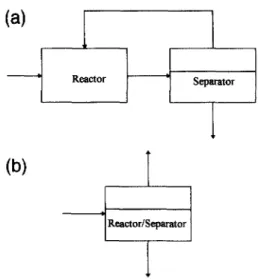
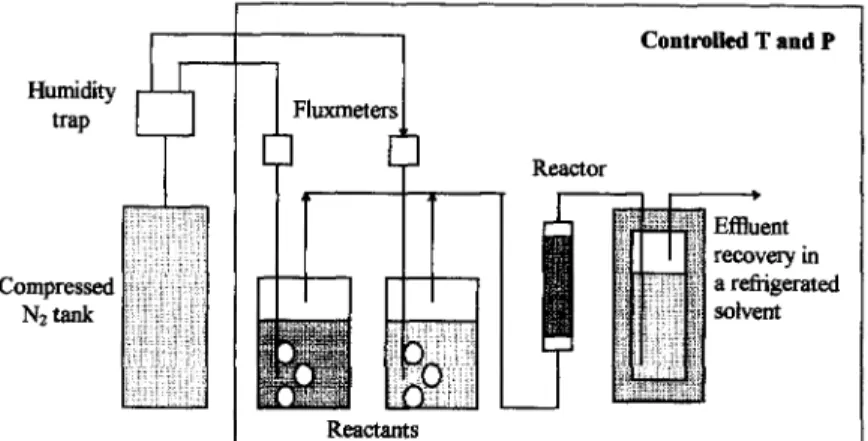
Native (and recombinant) lipases catalyze hy- drolysis and its reverse, esterification, as well as sequential combinations thereof generally termed interesterifications (acidolysis, alcoholy- sis, and transesterification). Integrated processes which have to date used lipases fall within one of the following categories: solid/liquid sys- tems (e.g. membrane reactors for microencapsu- lated lipases in reversed micelles), solid/fluid systems (e.g. supercritical reaction/extraction processes), solid/Ziquid/vupour systems (e.g. biocatalytic distillation), and soZid/vupour sys- tems (e.g. evaporative esterification). These four types of systems are depicted in Fig. 1, whereas integrated processes are compared with classical unit operation processes in Fig. 2.
2.1. Solid/liquid systems
Use of membrane reactors constitutes an at- tempt to integrate catalytic conversion, product separation, and product enrichment steps into one single apparatus, thus resulting in greater productivity and lower costs [l].
A.L. Paiva, F.X. Malcata / Joumal of Molecular Catalysis B: Enqmtic 3 (1997) 99-109 101
There is a large variety of synthetic mem- branes commercially available with suitable specifications for use in membrane bioreactors. Semi-permeable membranes may be used to retain the enzyme (by plain mechanical confine- ment due to size exclusion, or actual immobi- lization due to adsorption or covalent binding), and thus separate it from the reactants/products at the reactor outlet. Membranes may also be designed for selective removal of one product relative to others or to reactant [2]. Important characteristics to be taken into account when
choosing a membrane include morphology,
porosity, pore size distribution, molecular weight cut-off, chemical resistance, biological inert- ness, tolerance to temperature, pH and pressure, and price [3]. Several membrane modules can be found in the market: flat-sheet (straight laid out and spiral wound), tubular, and hollow fibers [4]. The type of membrane reactors using li- pases and their applications have been reviewed elsewhere [5], as well as the strategies for mod- elling of such reactors [1,6].
Most reactions catalyzed by lipases are car- ried out in biphasic media due to the low solu- bilities of reactants and/or products in conven- tional aqueous media. An alternative approach is encapsulation of lipases in reversed micellar media (e.g. Refs. [1,7-201) followed by suspen- sion in organic solvents where those reactions can be carried out in a “pseudo” uniphasic system.
Encapsulation consists on confinement of the
Fig. 1. Schematic representation of the multiphasic nature of integrated reaction/separation processes with lipases.
(a)
(I
(b)
Fig. 2. Schematic representation of (a) a classical unit operation process; (b) an integrated reaction/separation process.
lipase solution within small capsules enclosed by a polymer or a surfactant, whose diameters can range from 0.01 up to 300 pm [21-231. Such capsules provide an aqueous environment for the lipase thus reducing the problem of interfacial denaturation that prevails in two- phase systems. They also possess the advan- tages of a potentially high inter-facial specific area (which is kinetically stable and hence does not require mechanical input for maintenance), and a facilitated enzyme recovery (since the lipase is contained in capsules). Permanent and non-permanent polymeric membranes can offer wide ranges of surface area and reactant speci- ficity because, in some cases, the membrane can be manufactured so as to admit only some substrates and, thus, selectively exclude others. The encapsulation membrane creates an extra resistance to mass-transfer, and so the ‘effecti- veness factor’ for encapsulated lipases may be quite small unless capsules with a very small diameter can be produced (as in the case of reversed micelles). On the other hand, encapsu- lation is not applicable when the size of the substrate molecule approaches that of the lipase
La.
Reversed micelles are aqueous dispersions stabilized in an organic solvent by a surfactant
102 AL Paiua, F.X. Malcata/ Journal of Molecular Catalysis B: Enzymatic 3 (1997) 99-109
which can either be cationic, anionic or non- ionic, and usually has a polar head and a nonpo- lar tail; in this type of liquid immobilization, the lipase remains in the aqueous core of the re- versed micelle while the substrates and products partition between the aqueous and the organic phases. The amphiphilic nature of the surfactant
molecule causes its self association in a
reverse-micellar solution with the polar head of the surfactant directed towards the aqueous core of the micelle and the hydrophobic tail extend- ing into the continuous organic phase. The es- sentially spherical semipermeable membranes of reversed micelles have pores which allow small substrates and product molecules to enter and leave the capsule, respectively, but prevent li-
pases and large molecules from permeating
[21,22,24]. The size and structure of reverse micelles make them attractive for integrated processes [25,26], and several reviews on re- versed micellar systems using enzymes that are concerned with structural and catalytic proper- ties are available [27-381. Major disadvantages of using reversed micelles are that: (i) only low molecular weight substrates can be considered; (ii) occasionally inactivation of enzyme occurs during the immobilization procedure; (iii) a high enzyme concentration is required for micelle formation; (iv) the enzyme may actually be- come incorporated into the membrane wall; and (v) it is difficult to recover the product(s) from
the surfactant-containing organic solvent.
Therefore, and despite its intrinsic potential for continuous operation, catalysis in reversed mi- cellar systems has been mainly performed in batch type reactors; exceptions encompass im- mobilization of a lipase in liposomes which, in turn, were solubilized in reversed micelles and used for the continuous glycerolysis of olive oil in an ultrafiltration cell [39].
Development of reactor designs which enable continuous reaction and product separation is hence one of the current critical issues in re- versed micelle technology [1,40]. Several at- tempts have been made to use membrane reac- tors to carry out enzymatic reactions with re-
versed micelles [39-471; however, the mem-
branes used were not capable of completely retaining the surfactant monomers and the hy- drated micelles, therefore allowing contamina- tion of the product streams [40-421, an observa- tion that is not surprising if one considers the specific dynamic characteristics of reversed mi- cellar systems. Even if size exclusion of whole reversed micelles seems reasonable, retention of the rather small surfactant monomers usually found in dynamic equilibrium with micelles by an ultrafiltration membrane is highly improba- ble. Additionally, it is necessary to consider the stability of reversed micelles to shear forces usually found in membrane apparata; deforma- tion of the micellar structure, or even eventual destruction, will decrease their retention by ul- trafiltration [40]. Nevertheless, ultrafiltration membrane reactors seem to be the most appro- priate reactor configuration for the confinement of encapsulated lipases in reversed micellar me- dia and simultaneous (partial) product separa- tion [5,39,40,45,48-521.
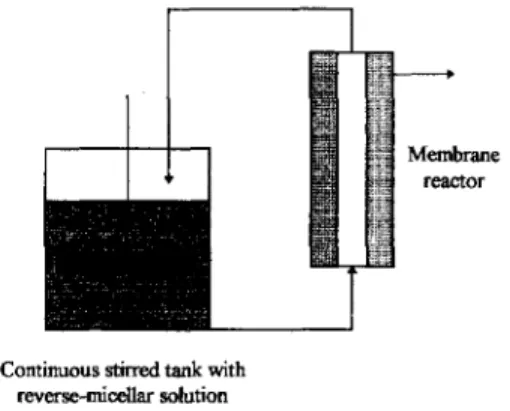
One of the most effective membrane bioreac- tor for simultaneous reaction catalyzed by a lipase and separation of products in a reversed micellar medium has been proposed by Prazeres et al. [12,40,51,52] (see Fig. 3). The main goal was to confine the encapsulated lipase in the retentate side of the membrane where reaction occurs, and to concomitantly recover products on the permeate side; Chromobacterium visco-
Continuous stirred tank with reverse-micellar solution
Fig. 3. Continuous reaction and separation in reversed micelle/membrane systems.
A.L. Pa&a, F.X. Malcata / Journal of Molecular Catalysis B: Enzymatic 3 (19971 99- 109 103 sum lipase encapsulated in AOT (dioctyl sodium
sulfosuccinate)/isooctane reversed micelles was thus successfully used for hydrolysis of tri- olein/olive oil mixtures. The substrate/product pair (water/glycerol) is located inside the mi- celles while the other substrate/product pair (triolein/oleic acid) is dispersed in the organic solvent and merged as cosurfactant in the AOT shells of the micelles [9,10]. An ultrafiltration
tubular membrane module (operated either in
batch or continuous mode) was then used to retain the lipase-filled micelles and separate the reaction products. The organic solvent compati- bility of the membrane used, its successful re- generation with fresh lipase after each opera- tion, complete retention of lipase, and almost complete separation of oleic acid were the ma- jor advantages of this membrane system. Since partial adsorption of lipase onto the membrane was observed, one concluded that a great part of the reaction actually occurred in the vicinity of the membrane [ 1,401 rather than in the bulk retentate side. Continuous operation of such type of reactor proved to be feasible as long as water-filled micelles were supplemented to the reactor together with the substrate/solvent solu- tion [ 12,40,41,52]. Permeation by distorted re- versed micelles and substrate were noticed as drawbacks for successful operation of the reac- tor; in fact, presence of AOT in the permeate stream makes it more complex to further sepa- rate products [53] but is essential for separation of glycerol and for control of its content under continuous operation conditions [40].
2.2. Solid /fluid systems
Supercritical fluids, SCF or simply jluids,
form a special class of non-conventional sol- vents. A fluid is called supercritical when both its temperature and its pressure are above their critical values, a state where such interfacial properties as surface tension vanish. In this state, fluids have transport properties that are intermediate between those of a gas and those of a liquid; e.g. fluids possess liquid-like solvent
strength but gas-like mobility, permeation abil- ity, diffusivity, and viscosity. When the reduced temperature of a fluid is slightly above unity and its reduced pressure ranges from 1 to 6, the density of the fluid changes sharply from low
gas-like values (at low pressures) to high
liquid-like values (at higher pressures). Such high density values explain the solvent strength of a SCF, while the easiness of retrograding between low and high densities via changes in pressure explains the usefulness of SCF Extrac- tion (SCFE) as a separation process.
Since SCFE with common fluids is usually performed at low temperatures (a very signifi- cant parameter for thermosensitive molecules such as lipases and reactants/products thereof). the associated consumption of thermal energy is low; solvents can be easily recovered from the mixture for reuse due to their high volatility; high selectivity towards different solutes can be modelled via changes in processing conditions; and most SCF used as solvents are non-toxic. There are, however, several disadvantages asso- ciated with SCFE, viz. the high operating pres-
sures required (which demand powerful com-
pressors and thus high fixed costs), the flamma- bility of some SCF (e.g. propane), the need for batch operation mode (which leads to a multi- plicity of extractors in order to achieve high productivity), and the still essentially empirical selection of solvents and cosolvents.
A large number of applications in the food, pharmaceutical, and polymer industries exist for SCFE [54] since thermosensitive and highly pure products (with a high market value) are ubiqui- tously involved. However, use of SCF is not restricted to separation processes; such reaction
processes as production of polymers and
biomolecules in SCF allow not only running the reaction in a single homogeneous phase (thus eliminating interfacial mass-transfer limitations) but also controlling the reaction extent via ad- justment of temperature or pressure (thus chang-
ing the equilibrium constant and/or the equilib- rium conversion). The use of lipases acting as catalysts in non-aqueous media (such as those
104 AL Paiva, F.X. Malcata/ Joumal of Molecular Catalysis B: Enzymatic 3 (1997) 99-109
provided by SCF) has been described in the literature since they exhibit certain advantages, viz. low rates of thermal decay, extensive solu- bilization of hydrophobic compounds, and ef- fective shifting of conversion towards synthesis rather than hydrolysis [54].
Lipase reactions in supercritical carbon diox- ide (SCCO,), the most commonly employed SCF, have been first studied by Nakamura et al. in 1985 [55] for the case of interesterification of triglycerides, and have more recently received the attention of several other researchers [55- 641. However, there is stiI1 a major lack of fundamental information pertaining to bio- catalysis in supercritical fluids to permit one to rationally (and a priori) select a SCF for a desired enzymatic reaction [65].
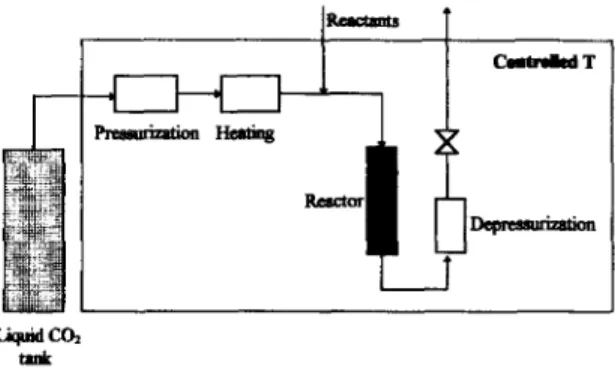
Nowadays a trend exists towards use of su- per-critical fluids to bring about reaction coupled with separation. Experiments performed under supercritical conditions in well-stirred reactors [66] and in fixed bed reactors [67] provide mass transfer rates that are much greater than in standard liquid-solid or gas-solid systems, probably because of the favourable contribution arising from natmal convection in supercritical fluids. A unique advantage of integrating reac- tion and separation in SCF pertains to variable selectivity towards recovery; after reaction, crit- ically located sequential depressurization stages allow products and non-reacted substrates to be obtained independently and without any trace of solvent. Combes [68] has developed a continu- ous reaction/separation process carried out in SCCO, for the synthesis of ethyl oleate from oleic acid and ethanol catalyzed by a lipase from Mucor miehei immobilized by ion ex- change onto a macroporous resin (see Fig. 4). The loss of activity after 6 d (ca. 20% at 60°C) was approximately the same in SCCO, and n-hexane, and the effect of temperature in SCCO, was consistent with the classical ther- mal denaturation scheme. No effect of pressure in the range 13- 18 MPa on deactivation could be detected, which thus created expectancy of operating a continuous reactor for long periods
T
I
1
C-Tt+idcol
td
Fig. 4. Continuous reaction and separation in supe.rcritical carbon
diOXi&.
of time. A continuous reaction/separation pro- cess with solvent recycling using a tubular packed reactor has been successfully operated over a period of 15 h at 40°C and 15 MPa, with about 95% oleic acid esterified with ethanol in ca. 1 h [69,70]. Performance of the same model reaction in SCCO, and n-hexane indicated that the solvents are similar from the point of view of enzyme activity, but SCCO, is better in terms of post-reactional separation.
2.3. Solid / liquid / vapour systems
Another process that integrates reaction and separation is reactive distillation. This concept was first applied in 1923 [71,72] for the contin- uous production of ethyl acetate using sulfuric acid as homogeneous catalyst. Two main rea- sons accounted for development of such process for performance of esterification: (i) low molec- ular weight esters are, in general, much more volatile than the alcohol and carboxylic acid involved in their synthesis, and (ii) separation of esters from the reaction medium is often diffi- cult by simple distillation because of formation of azeotropes. Employment of reactive distilla- tion for reactions using a solid catalyst which can be confined to the distillation column by physical methods for reuse and, hence, will not appear in the product stream, is a more recent development [73].
The impetus for integration of reaction with separation conveyed by distillation when per-
A.L. Paiua, F.X. Malcatu/JoumaI of Molecular Caralysis B: Enzymatic 3 (1997) 99-109 105
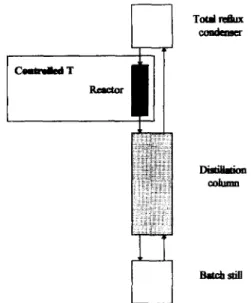
forming lipase-mediated transformations (using the enzyme as a solid catalyst) in esterification reactions has derived from realization that accu- mulation of water as reaction product, apart from contributing to deactivation of the enzyme, favours the undesired reverse reaction (hydroly- sis). Since in synthesis of low molecular weight esters water is, in general, less volatile than both the alcohol and the ester involved as reactants, its fractional removal from the reaction medium may be achieved by preferential vaporization at room pressure and performance of the chemical reaction onto the condensed liquid obtained therefrom rather than onto the full reaction medium. The operation of a distillation column as a chemical reactor offers distinctive advan- tages over the usual process of a reactor fol- lowed by a distillation column since, in this integrated unit, two processes are occurring si- multaneously in a single piece of equipment with concomitant reduction of capital and opera- tion costs (due to partial elimination of pump ing, piping, and instrumental devices) and in- crease in overall conversion due to in situ re- moval of reaction products while reaction is still in progress [74]. Paiva and Malcata [74,75] have reported use of a batch still to which a distilla- tion column was co~ected; on the top of the distillation column, a total condenser was fitted, and the liquid reflux coming therefrom (richer in the more volatile compounds than the mix- ture in the still) then passed to a packed bed reactor where a lipase from Mucor miehei, immobilized by ion-exchange onto a macrop- orous resin was located; the outlet liquid stream from the reactor was then recirculated to the top of the distillation column (see Fig. 5).
This particular configuration overcomes the problem of the high temperatures usually in- volved in distillation processes carried out at room pressure (and consequent high rates of lipase deactivation), as well as the problem of catalyst dilution (via enzyme immobilization). By using this innovative reaction/separation system, the authors concluded that conversion constraints were reduced to a great extent; con-
Bat&stiu
Fig. 5. Continuous rewtion and separation in biiytic distilla- tion.
versions were higher when amounts of acid in the initial mixture were larger, and lower tem- peratures led to higher conversions to esters (the magnitude of this effect increased as the molar fraction of acid in the initial mixture increased). The higher productivities observed with this solid/liquid/vapour system result probably from alleviation of equilibrium constmints (e.g. preferential removal of water tends to shift the reaction in the hydrolysis direction) and k&tic constraints (e.g. preferential removal of acetic acid tends to decrease inhibition of enzyme action).
2.4. Solid/ vapour systems
Despite the fact that organic solvents solubi- lize essentially apolar compounds and often de- crease their viscosity, they may be considered as a con taminant or even a pollutant in the final productstrear&inaddi~toactingasdenatu-
rants for enzymes in the case they are not strictly hydrophobic. Therefore, solvent-free al- ternatives have been sought. One such altuna- tive encompasses use of a gas-s&d system for single-step biotransformations [76-90). Par- varesh et al. [84] mported use of this new technique with a lipase as a lyolpailiaed powder
106 A.L. Paiva, F.X. Malcata/ Journal of Molecular Catalysis B: Enzymatic 3 (1997) 99-109 Humidity @aP Compressed N2-k Contdled T and P Reactor
Fig. 6. Continuous reaction and separation in evaporative esterification.
for the performance of transesterification reac- tions on substrates in vapour form (see Fig. 6). Such type of integrated reactor/separator pre- sents several advantages, viz.: (i) operation in a continuous mode is possible and, therefore, sub- strates can enter and products leave the reactor in a continuous fashion; (ii) there is no addition of solvents and, therefore, no need for solvent recycling; (iii) pure products are easily collected by split recondensation, and hence it is possible to reuse untransformed substrates; (iv) previous immobilization of the biocatalyst is not neces- sary since it is used in a precipitated form; (v) the inlet stream to the reactor is enriched in the more volatile substrates; (vi) enzymes in a de- hydrated form are more resistant to thermoinac- tivation, thus allowing use of higher tempera- tures with concomitant substantial increase in reaction rates; (vii> the absence of water makes it possible to perform unconventional reactions catalyzed by hydrolases (due to their modified selectivity); and (viii) operation at relatively high temperatures prevents microbial contami- nation and hence the need for sterilization.
Experiments with porcine pancreatic lipase and Fusarium solani cutinase (a lipase ana- logue) in catalysis of transesterification reac- tions between various gaseous substrates in such continuous packed bed gas-solid reactor permit- ted one to conclude that enzyme activity de- pends on the nature of the esters and on the chain lengths of the alcohols (i.e., the reaction
rate is higher when the chain length is shorter, but the enzyme stability is higher when the chain length is longer) [84]. In order to access the effect of humidity on performance of lipases (recall that these enzymes require interfacial activation), experiments using glass beads coated with lipases and suspended in mixtures of sub- strate and water vapours over a range of humid- ity from 56 to 100% suggested the following order of reaction rates at decreasing water activ- ity levels: hydrolysis > alcoholysis > transesterification > esterification [90]. Such studies have shown that lipases are active on gaseous substrates even at hydration levels be- low the monolayer coverage of the protein. However, there is an antagonistic effect con- cerning water activity: the higher the water activity, the higher the enzyme-catalyzed reac- tion rate, but also the higher the enzyme deacti- vation rate. The major problem for this configu- ration is that most substrates suitable for such process exhibit rather high boiling points (250- 300°C) at normal pressure, which are incompat- ible with the heat lability of those compounds and of lipase itself.
3. Thermodynamic and kinetic assessments
of integrating reaction and separation
The issue of extractive reaction, or reaction coupled with separation, has been claimed to
A.L. Paiua, F.X. Malcata / Journal of Molecular Catalysis B: Enzymatic 3 (1997) 99-109 107
provide kinetic and thermodynamic enhance-
ments in the case of biochemical processes (e.g. Refs. [91,92]). However, the terminology used to express possible increases in product yields is often misleading.
Paiva and Malcata [93] tackled the topic of
thermodynamic enhancement of integration via
consideration of a theoretical cascade of reac- tors and separators taken to the limit of an infinite number of units coupled with assump- tion of the simple model system of a binary ideal reactant/product mixture at constant pres- sure and temperature. Under these postulates,
they proved that no thermodynamic improve-
ment of the overall process is brought about by
integration of reaction and separation when
compared with the classical unit operation ap- proach. Such conclusion, which pertains solely to compositional changes, was reached based on either calculation of the price in Gibbs’ free energy currency that must be paid by the sur- roundings to the system in order to recover an extra mole of pure product or calculation of the income of the surroundings in (overall) Gibbs’ free energy currency per unit amount of (sep- aration) Gibbs’ free energy invested by the sur- roundings in the system. This conclusion can be extrapolated for multicomponent ideal solutions and binary (and multicomponent) non-ideal so- lutions.
Using a similar theoretical rationale, Paiva et al. [94] investigated the effect of kinetic im-
provement on the chemical processing of an
ideal binary mixture when enzyme-catalyzed re- action is integrated with physical separation. The objective function was the reduction in total processing time (i.e. the sum of the time re- quired by chemical reaction to occur in the whole set of reactors with the time required by the partial separation to occur in the whole set of separators) brought about by integrating reac- tion and separation steps with respect to a tradi- tional system for a predefined final conversion; the model selected was a reversible Uni-Uni
reaction following the classical Michaelis-
Menten mechanism, and the separation process
was assumed to be controlled by mass transport and provide a constant degree of purification. The kinetic enhancement associated with inte- gration of reaction and separation depends on the values of the equilibrium constant (K,, a measure of the degree of thermodynamic inhibi- tion), the final conversion of substrate desired ( XJ), the Michaelis-Menten constant for the product
(
K,, a measure of the degree of ki- netic inhibition), the extent of separation in a single step (0, and the ratio of time scales for molecular transport and chemical reaction ( H ). It was claimed that integration is not advisable under strong kinetic and/or thermodynamic in- hibition since it leads to higher processing times than the unit operation approach does. In gen- eral, integration provides decrease in overall processing time when K,, decreases and/or 3 decreases and/or 5 decreases and/or K,, in- creases and/or xr increases. Parameter 5 did not seem to play a major influence in the gen- eral shape of the curve of total time versus theremaining parameters, except when K, and
K mp are large. It was interesting to note that
cascading (or partially integrating) the
reaction/separation system with similar values of 5 brings about higher degrees of product recovery from the binary mixture. On the other
hand, intermediate conversions coupled with
large 8, large Keq, small K, and small 6
give rise to the existence of an optimum (finite) degree of cascading, thus providing evidence that full integration may not be the best option in terms of overall processing time
Acknowledgements
Partial funding for this research was provided
through grant PRAXIS/2/2.l/BI0/34/94
(Portugal, Project Process Integration: Extruc-
tive Biocatulysis). Funding for author A.L.P.
was provided through a Ph.D. Fellowship by
JNICT (Portugal, CIENCIA BD/2081/92 - IF
108 AL Paiua, F.X. Malcata/Joumd of Molecular Catalysis B: Enzymatic 3 (1997) 99-109 References 111 Dl [31 [41 [51 161 [71 [81 [91 [lOI [ill ml [131 [141 1151 1161 [I71
D.M.F. Prazeres, F. Lemos and J.M.S. Cabral, in: A.R. Moreira and K.K. Wallace (Eds.), Computer and Information Science Applications in Bioprocess Engineering (Kluwer Academic Publishers, Dordrecht, 1996) p. 191.
A. van der Padt and K. van ‘t Riet, in: CA. Costa and J.M.S. Cabral (Eds.), Chromatographic and Membrane Processes in Biotechnology (Kluwer Academic Publishers, Dordrecht, 1991) p. 443.
J.R. Hildebrandt, in: C.A. Costa and J.M.S. Cabml (Eds.), Chromatographic and Membrane Processes in Biotechnology (Kluwer Academic Publishers, Dordrecht, 1991) p. 363. J.A.L. Santos, M. Mateus and J.M.S. Cabral, in: C.A. Costa and J.M.S. Cabral (Eds.), Chromatographic and Membrane Processes in Biotechnology (Kluwer Academic Publishers, Dordrecht, 1991) p. 177.
D.M.F. Prazeres and J.M.S. Cabral, Enzyme Microb. Tech- nol. 16 (1994) 738.
F.X. Malcata, Trends Chem. Eng. 1 (1993) 359.
D. Han, D.Y. Kwon and J.S. Rhee, Agric. Biol. Chem. 51 (1987) 615.
D. Han, J.S. Rhee and S.B. Lee, Biotechnol. Biceng. 30 (1987) 381.
D.G. Hayes and E. Gulari, Biotechnol. Bioeng. 35 (1990) 793.
D.G. Hayes and E. Gulari, Biotechnol. Biceng. 38 (1991) 507.
E.A. Malakhova, B.I. Kurganov, A.V. Levashov, I.V. Berezin and K. Martinek, Appl. B&hem. Biotechnol. 12 (1983) 182. D.M.F. Prazeres, F. Lemos, F.A.P. Garcia and J.M.S. Cabral, J. Chem. Technol. Biotechnol. 53 (1992) 159.
S.W. Tsai and C.L. Chiang (1991). Biotechnol. Bioeng. 38 (1991) 206.
P.D.I. Fletcher, B.H. Robinson, R.B. Freedman and C. Old- field, J. Chem. Sot. Faraday Trans. I 81 (1985) 2667. P.S. Chang and J.S. F&e, Biocatalysis 3 (1990) 343. P.K. Schmidli and P.L. Luisi, Biocatalysis 3 (1990) 367. R. Scartazzini and P.L. Luisi, Biocatalysis 3 (1990) 377. [18] D. Han, P. Walde and P.L. Luisi, Biocatalysis 4 (1990) 153. [19] A. Hochkoeppler and S. Pahnieri, Biocatalysis 3 (1990) 357. [20] J.P. Chen and H. Pai, J. Food Sci. 56 (1991) 234.
[21] J.M.S. Cabral, in: B. Mattiasson and 0. Holst (Eds.), Extrac- tive Bioconversions (Marcel Dekker, New York, 1991) p. 207.
1221 J.F. Kennedy and J.M.S. Cabral, in: W.H. Scouten (Ed.), Solid Phase Biochemistry: Analytical Synthetic Aspects (Wi- ley, New York, 1983) ch. 7, p. 253.
[23] H. W. Blanch, Proc. Int. Workshop on Biocatalysis in Non- conventional Media, Athens, 19-30 Oct., 1992
[24] M. Masoom, A. Mamen and A. Townshend, J. Chem. Sot. Pak. 11 (1989) 81.
[25] J.W. Shield, H.D. Ferguson, A.S. Bomman ‘us and T.A. Hat- ton, Ind. Eng. Chem. Fundam. 25 (1986) 603.
[26] K. Markinek, I.V. Bemzia, Y.L. Khmelnitski, N.L. Klyachko and A.V. Levashov, COB. Czech. Chem. Commun. 52 (1987) 2589.
[27] H.F. Eicke, Top. Curr. Chem. 87 (1980) 85.
[281 [291 [301 I311 [321 [331 [341 I351 [361 [371 [381 [391 I401 1411 [421 [431 WI [451 WI [471 [481 I491 1501 [511 1521 [531 [541
D. Balasubmmanian, J. Indian Chem. Sot. 58 (1981) 633. J.T.G. Overbeek, Proc. Kon. Ned. Akad. Wetenschap. B 89 (1986) 61.
P.L. Luisi, M. Giomini, M.P. Pileni and B.H. Robinson, Biochim. Biophys. Acta 947 (1988) 209.
P.L. Luisi and L.J. Magid, CRC Crit. Rev. B&hem. 20 (1986) 409.
K. Martinek, A.V. Levashov, N.L. Klyachko, Y.L. Khmelnit- ski and I.V. Berezin, Eur. J. B&hem. 155 (1986) 453. Y.L. Khmelnitski, A.V. Levashov, N.L. Klyachko and K. Martinek, Russ. Chem. Rev. 53 (1984) 319.
P.L. Luisi, Angew. Chem. Int. Ed. Engl. 24 (1985) 439. M. Waks, Proteins Structure Function Genetics 1 (1986) 4. P.L. Luisi and B. Steinmann-Hofmann, in: K. Mosbach (Ed.), Methods in Enzymology, Vol. 136 (Academic Press, New York, 1987) p. 188.
Y.L. Khmelnitsky, A.V. Kabanov, N.L. Klyachko, A.V. Levashov and K. Martinek, in: M.P. Pileni (Ed.), Structure and Reactivity in Reverse Micelles Studies in Physical and Theoretical Chemistry, Vol. 65 (Elsevier, Amsterdam, 1989) p. 230.
M.P. Pileni, in: M.P. Pileni (Ed.), Structure and Reactivity in Reverse Micelles Studies in Physical and Theoretical Chem- istry, Vol. 65 (Elsevier, Amsterdam, 1989) p. 44.
P.S. Chang, J.S. Rhee and J.J. Kim, Biotechnol. Bioeng. 38 (1991) 1159.
D.M.S. Prazeres, F.A.P. Garcia and J.M.S. Cabral, Biotech. Bioeng. 41 (1993) 761.
D.M.S. Prazeres, F.A.P. Garcia and J.M.S. Cabral, in: J. Tramper, M.H. Vermue, H.H. Beeftink and U. Stockar @Is.), Biocatalysis in Nonconventional Media (Elsevier, Amster- dam, 1992) p. 713.
D.M.S. Prazeres, F.A.P. Garcia and J.M.S. Cabral, Bioproc. Eng. 10 (1994) 21.
M.L. Serralheiro, D.M.F. Prazeres and J.M.S. Cabral, Enz. Microb. Technol., in press.
C.L. Chiang and S.W. Tsai, J. Chem. Tech. Biotechnol. 54 (1992) 27.
P. Luthi and P.L. Luisi, J. Am. Chem. Sot. 106 (1984) 7285. C.L. Chiang and S.W. Tsai, J. Chem. Tech. Biotechnol. 54 (1992) 249.
Y.L. Khmelnitsky, A.K. Gladilin, V.L. Roubailo, K. Mar- tinek and A.V. Levashov, in: J. Tramper, M.H. Vermue, H.H. Beeftink and U. Stockar (Eds.), Fundamentals of Bio- catalysis in Non-Conventional Media (Elsevier, Amsterdam, 1992).
D.K. Eggers and H.W. Bloch, Bioprocess Eng. 3 (1988) 83. P.L. Luisi, P. Luthi, I. Tomka, J. Prenosil and A. Pande, Ann. N.Y. Acad. Sci. 434 (1988) 549.
P. Luthi and T.A. Hatton, Bioseparation 2 (1991) 5. D.M.F. Prazeres, F. Lemos, F.A.P. Garcia and J.M.S. Cabral, Biotech. Bioeng. 42 (1993) 759.
D.M.F. Prazeres, F. Lemos, F.A.P. Garcia and J.M.S. Cabral, Biotech. Bioeng. 42 (1993) 765.
Y.L. Khmelmtsky, A.V. Levashov, N.L. Klyachko and K. Martinek, Enz. Microb. Technol. 10 (1988) 710.
K. Magoulas and D. Tassios, Proc. Int. Workshop on Bio- catalysis in Non-conventional Media, Athens, 19-30 Oct., 1992.
AL Puiua, F.X. Malcata/ Journal of Molecular Catalysis B: Enzymatic 3 (1997) 99-109 109 [55] K. Nakamura, Y.M. Chi and Y. Yamada, Chem. Eng. Com- neering of/with Lipases (Kluwer Academic Publishers, Dor-
mun. 4.5 (1985) 207. drecht, 1996) p. 597.
[56] T.W. Randolph, H.W. Blanch, J.M. Prausnitz and C.R. Wilke, Biotechnol. Len. 7 (1985) 325.
[57] D.A. Hammond, M. Karel and A.M. Klibanov, Appl. B&hem. Biotechnol. 11 (1985) 393.
[58] Y.M. Chi and K. Nakamura, Agric. Eng. Chem. 52 (1988) 1541.
[75] A.L. Paiva and F.X. Malcata, Biotechnol. Techn. 8 (1994) 629.
[76] T.H. Ching, Appl. Microb. Technol. 19 (1984) 1. [77] J.A.M. De Bont and C.G. van Ginkel, Enz. Microb. Technol.
5 (1983) 55.
[59] A.M.M. van Eijs, J.P.L. de Jong, H.J. Doddema and D.R. Lit&boom, Proc. of the Int. Symp. on Supercritical Fluids, Nice, France, 1988, p. 933.
[78] F. Parvaresh, G. Vie, D. Thomas and M.D. Legoy, Ann. N.Y. Acad. Sci., in press.
[60] D.A. Hammond, M. Karel and V.J. Krukonis, Appl. B&hem. Biotechnol. 11 (1985) 393.
[61] A. Marty, W. Chulalaksnanukal, J.S. Condoret, R.M. Wille- mot and G. Durand, Biotechnol. Len. 12 (1990) 11. [62] P. Pasta, G. Mazzola, G. Carrea and S. Riva, Biotechnol.
Lett. 2 (1989) 643.
[79] S. Pulvin, F. Parvaresh, D. Thomas and M.D. Legoy, Ann. N. Y. Acad. Sci. 542 (1988) 434.
[80] S. Pulvin, M.D. Legoy, R. Lottie, M. Pensa and D. Thomas, Biotechnol. Lett. 8 (1986) 783.
[81] E. Barxana, A. Klibanov and M. Karel, Appl. B&hem. Biotechnol. 15 (1987) 25.
[63] T.W. Randolph, D.S. Clark, H.W. Blanch and J.N. Praunitz, Science (1988) 387.
[64] M. Taniguchi, M. Kamihira and T. Kobayashi, Agric. Biol. Chem. 51 (1987) 593.
[65] M. Perrut, in: C. Balny, R. Hayashi, K. Heremans and P. Masson @is.), High Pressure and Biotechnology, Colloque INSERM/John Libbey Eutotext, Vol. 224 (1992) p. 401. [66] D. Combes and J.S. Condoret, Proc. Int. Workshop on
Biocatalysis in Nonconventional Media, Athens, 19-30 Oct., 1992
[82] S. Pulvin, M.D. Legoy, R. Lortie, M. Pensa and D. Thomas, Biotechnol. Len. 8 (1986) 783.
[83] S. Pulvin, F. Parvaresh, D. Thomas and M.D. Legoy, Ann. N.Y. Acad. Sci. 545 (1988) 434.
[84] F. Parvaresh, H. Robert, D. Thomas and M.D. Legoy, Biotechnol. Bioeng. 39 (1992) 467.
[85] H. Robert, S. Lamare, F. Parvaresh and M.D. Legoy, Prog. Biotechnol. 8 (1992) 23.
[86] S. Lamare and M.D. Legoy, Trends Biotechnol. 117 (1993) 413.
[87] S. Lamare and M.D. Legoy, Biotechnol. Bioeng. 45 (1995) 387.
[67] G.B. Lim, G.D. Holder and Y.T. Shah, in: K.P. Johnston and J.M.L. Penninger @Is.), Supercritical Fluid Science and Technology (1989) p” 379.
[88] S. Lamare and M.D. Legoy, Biotechnol. Tech. 9 (1995) 127. 1891 E. Barzana, A. Klibanov and M. Karel, Appl. Biochem.
Biotechnol. 1s (1987) 25. 1681 D. Combes, in: F.X. Malcata (Ed.), Engineering of/with
Lipases (Kluwer Academic Publishers, Dordrecht, 1996) p. 613.
[90] S. Lamare, in: F.X. Malcata (Ed.), Engineering of/with Lipases (Kluwer Academic Publishers, Dordrecht, 1996) p. 357.
1691 A. Marty, D. Combes and J.S. Condoret, Biotechnol. Biceng. 43 ( 1994) 497.
[70] D. Combes, in: F.X. Malcata (Ed.) Engineering of/with Lipases (Kluwer Academic Publishers, Dordrecht, 1996) p. 289.
[91] C. Laane, J. Tramper and M.D. Lilly @is.), Biocatalysis in Organic Media (Elsevier, Amsterdam, 1987).
[92] J. Tramper, M.H. Vermue, H.H. Beeftink and U. von Stockar @ds.), Biocatalysis in Non-conventional Media (Elsevier, Amsterdam, 1992).
[71] Anonymous, U.S. Patent 1.454462 (1923). [72] Anonymous, U.S. Patent L454.463 (1923).
1731 K. Sennewald, K. Gehrmann and S. Schafer, U.S. Patent
[93] A.L. Paiva and F. X. Malcata, Chem. Eng. Sci., 52 (1997) 449.
3,579,309 (1971).
[94] A.L. Paiva, D. van Rossum and F.X. Malcata, B&catalysis and Biotransformation, submitted.