IAEA Nuclear Databases for Applications
Otto Schwerer
Nuclear Data Section, International Atomic Energy Agency, Vienna, Austria
Received on 30 October, 2002
The Nuclear Data Section (NDS) of the International Atomic Energy Agency (IAEA) provides nuclear data services to scientists on a worldwide scale with particular emphasis on developing countries. More than 100 data libraries are made available cost-free by Internet, CD-ROM and other media. These databases are used for practically all areas of nuclear applications as well as basic research. An overview is given of the most impor-tant nuclear reaction and nuclear structure databases, such as EXFOR, CINDA, ENDF, NSR, ENSDF, NUDAT, and of selected special purpose libraries such as FENDL, RIPL, RNAL, the IAEA Photonuclear Data Library, and the IAEA charged-particle cross section database for medical radioisotope production. The NDS also co-ordinates two international nuclear data centre networks and is involved in data development activities (to create new or improve existing data libraries when the available data are inadequate) and in technology transfer to de-veloping countries, e.g. through the installation and support of the mirror web site of the IAEA Nuclear Data Services at IPEN (operational since March 2000) and by organizing nuclear-data related workshops. By en-couraging their participation in IAEA Co-ordinated Research Projects and also by compiling their experimental results in databases such as EXFOR, the NDS helps to make developing countries’ contributions to nuclear science visible and conveniently available. The web address of the IAEA Nuclear Data Services is http://www-nds.iaea.org and the NDS mirror service at IPEN (Brasil) can be accessed at http://www-nds.ipen.br/
I
Nuclear data types and data centers
I.1 What are nuclear data?
Nuclear data are quantitative results of scientific inves-tigations of the nuclear properties of matter. They describe properties of atomic nuclei and the fundamental physical re-lationships governing their interactions, thereby characteriz-ing the physical processes underlycharacteriz-ing all nuclear technolo-gies. Examples of nuclear data include cross sections, half-lives, decay modes and decay radiation properties, and γ
-rays from radionuclides. The scope of the data collections includes all 85 natural elements with 290 stable isotopes and more than 2500 radionuclides.
Applications of nuclear data include all areas of nuclear science and technology, covering energy applications (fis-sion reactor design; nuclear fuel cycles; nuclear safety; re-actor monitoring and fluence determination; waste disposal and transmutation; accelerator driven systems; fusion de-vice design and plasma processing technologies) as well as non-energy applications (cancer radiotherapy; production of radioisotopes for medical and industrial applications; per-sonnel dosimetry and radiation safety; nuclear safeguards; environmental monitoring and clean-up; materials analysis and process control; radiation damage studies; detection of concealed explosives and illegal drugs; exploration for oil and other minerals) and basic research (e.g. nuclear
astro-physics) and education. A recent review of nuclear data for applications can be found in Ref.[1].
I.2 The role of the IAEA Nuclear Data Section
The Nuclear Data Section (NDS) of the International Atomic Energy Agency (IAEA) carries out IAEA activities concerning the development and dissemination of nuclear and atomic data for applications. In addition, the NDS is involved in technology transfer activities to assist scientists of developing countries within this area of expertise.
Main tasks of thedata centerinclude compilation of new data in the databases EXFOR and CINDA (in cooperation with other participating data centers, see below), collection and maintenance of general-purpose and specialized evalu-ated data libraries, online and off-line nuclear data services with particular emphasis on the needs of developing coun-tries, and co-ordination of nuclear data center networks.
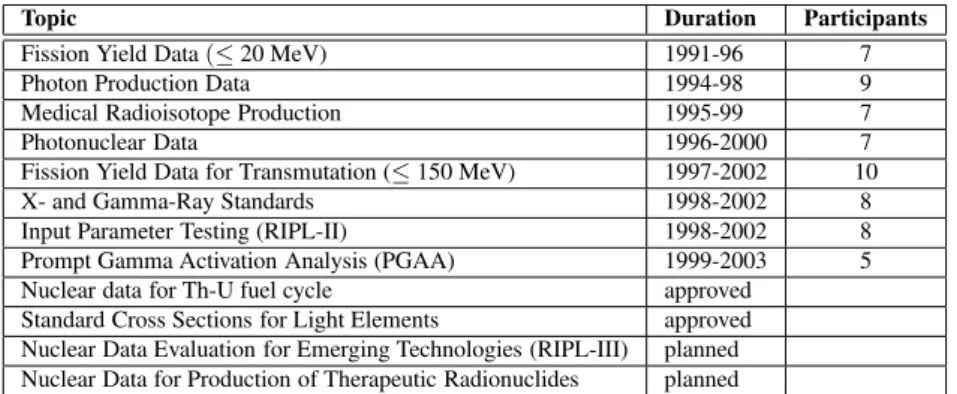
Topic Duration Participants
Fission Yield Data(≤20 MeV) 1991-96 7 Photon Production Data 1994-98 9 Medical Radioisotope Production 1995-99 7 Photonuclear Data 1996-2000 7 Fission Yield Data for Transmutation (≤150 MeV) 1997-2002 10 X- and Gamma-Ray Standards 1998-2002 8 Input Parameter Testing (RIPL-II) 1998-2002 8 Prompt Gamma Activation Analysis (PGAA) 1999-2003 5 Nuclear data for Th-U fuel cycle approved
Standard Cross Sections for Light Elements approved Nuclear Data Evaluation for Emerging Technologies (RIPL-III) planned Nuclear Data for Production of Therapeutic Radionuclides planned
Table 1. Recent nuclear data related Co-ordinated Research Projects
Technology transfer to developing countries is car-ried out in several ways: through Technical Co-operation projects, such as the recent “Latin American Mirror Server Project” providing online nuclear data service to Latin American countries with insufficient Internet connection to the NDS, by installing a mirror server in Brazil, or the instal-lation of a “mini data center” on a workstation in Ghana. In addition, nuclear data workshops are organized on a regular basis, usually held at the Abdus Salam International Cen-tre for Theoretical Physics in Trieste, Italy. Topics include “Nuclear Reaction Data and Nuclear Reactors: Physics, De-sign and Safety” (even years) and “Nuclear Data for Science and Technology” (odd years, with changing special topics such as medical physics, accelerator driven waste incinera-tion, and materials analysis).
TheAtomic and Molecular Data Unitof the NDS keeps databases for fusion energy, plasma research and other ap-plications, such as ALADDIN (numerical data) and AMB-DAS (bibliographic data), and issues specialized publica-tions (e.g. CIAMDA). The databases are kept on a separate server [2]. The remainder of this lecture deals only with the
nucleardata services of NDS.
I.3 Nuclear data types
Nuclear data are commonly categorized in two main groups: nuclear reaction data, describing the interactions of various projectiles such as neutrons, protons or photons with target nuclei, and nuclear structure and decay data, de-scribing nuclear levels, half-lives and radioactive decay radi-ations. For both groups, the type of information given can be experimental data or evaluated data (both numeric) or bibli-ographic.
• Bibliographic data: References with some
descrip-tion of the contents, but no numerical data. Examples are CINDA (Computer Index of Neutron Data) and NSR (Nuclear Science References).
• Experimental data: Results of individual
measure-ments as reported by the authors. The most important example is EXFOR/CSISRS, the library for experi-mental nuclear reaction data.
• Evaluated datalibraries contain recommended data
based on all data available from experiments and/or theory, arrived at after critical analysis of experimen-tal data and their uncertainties, inter- and extrapo-lation, and/or nuclear model calculations. They are stored in strictly defined formats such as ENDF-6 (the international format for evaluated nuclear reac-tion data) or ENSDF (the format of the Evaluated Nu-clear Structure Data File). The main cross section li-braries in ENDF format usually contain also the rele-vant decay data needed in the main applications.
• Nuclear reaction datainclude cross sections, angular
and energy distributions of secondary particles, reso-nance parameters, and related quantities. For neutron-induced reactions up to 20 MeV, the libraries are rather complete; the coverage for higher energies is less complete but improving. Experimental data are found in EXFOR, the related bibliography in CINDA; several evaluated data libraries exist up to 20 MeV or higher. For charged-particle induced and photonu-clear reactions, selected experimental data are com-piled in EXFOR and few evaluations exist. Heavy-ion data are partly compiled in EXFOR.
• Nuclear structure and decay data: half-lives,
de-cay schemes, nuclear level properties, energies and intensities of γ-rays and emitted particles, atomic
masses. The major database is ENSDF, while related bibliographic data are contained in NSR. There are many other nuclear structure and decay data libraries, mostly derived from or related to ENSDF; some of these are listed in Section 2 below, others - not avail-able from NDS - include theTable of Isotopes[3], the
Isotope Explorer[4], a computer program for viewing ENSDF and for interactive access to nuclear structure and decay data, and NUBASE [5], a library of nuclear and decay properties.
I.4 Nuclear data center networks
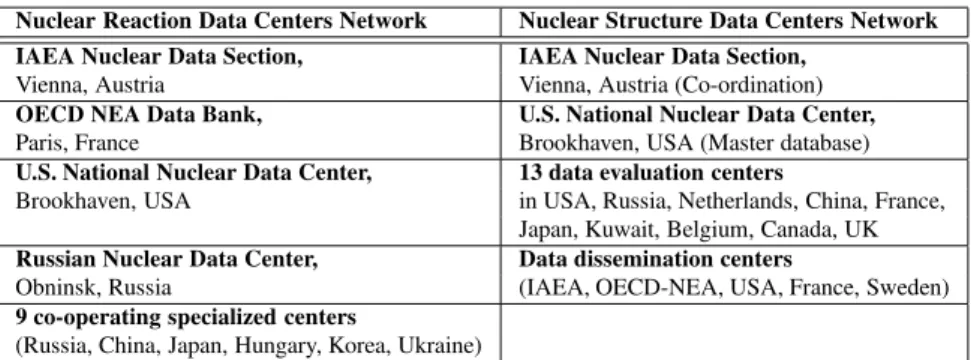
Reaction Data Centers [6] and the Nuclear Structure and De-cay Data Network [7] (see Table 2). The data centers partici-pating in these networks are involved in the various stages of data preparation between measurement and application (i.e. compilation, review and/or evaluation, processing, distribu-tion).
Specialized data centers cooperate with the major
cen-ters in the various data center functions (in particular data compilation and evaluation). The sharing of work on a world-wide basis in the various areas of work, including data distribution, is defined partly geographically and partly by data types (scope), and is coordinated by the IAEA Nuclear Data Section.
Nuclear Reaction Data Centers Network Nuclear Structure Data Centers Network IAEA Nuclear Data Section, IAEA Nuclear Data Section,
Vienna, Austria Vienna, Austria (Co-ordination)
OECD NEA Data Bank, U.S. National Nuclear Data Center,
Paris, France Brookhaven, USA (Master database)
U.S. National Nuclear Data Center, 13 data evaluation centers
Brookhaven, USA in USA, Russia, Netherlands, China, France, Japan, Kuwait, Belgium, Canada, UK
Russian Nuclear Data Center, Data dissemination centers
Obninsk, Russia (IAEA, OECD-NEA, USA, France, Sweden)
9 co-operating specialized centers
(Russia, China, Japan, Hungary, Korea, Ukraine)
Table 2. Nuclear data center networks
II
Overview of data libraries at IAEA
The IAEA Nuclear Data Section holds a total of about 100 nuclear data libraries, representing enormous economic and scientific value. All libraries and the related documentation are available free of charge to scientists in IAEA member states. An overview is given in the documentIndex of Nu-clear Data Libraries available from the IAEA NuNu-clear Data Section[8]. Brief descriptions of contents and/or format for most libraries are published in the IAEA-NDS- report series [9].
II.1 General purpose libraries
• Nuclear Wallet Cards [10]: Basic properties of
ground and metastable states, available as pocket booklet (from US-NNDC) and online.
• NuDat [11]: User-friendly extract of most
impor-tant data (for applications) from ENSDF, plus thermal neutron data (cross sections and resonance integrals). Available online.
• MIRD [12] - “Medical Internal Radiation Dose”:
Based on ENSDF, data processed with code “RADLST”. Tables include intensities, energies and doses of all produced radiations, including X-rays, Auger electrons, etc., and decay scheme plots, for the selected nuclide. Available online.
• ENSDF[13] (Evaluated Nuclear Structure Data File)
is the “master library” for structure and decay data, re-sulting from a continuous international evaluation ef-fort coordinated by the IAEA. The master file is main-tained by the US-NNDC, and contains evaluated ex-perimental data for most known nuclides in the mass
range 1 - 277. The evaluations are individually under-taken for mass chains (e.g. A=235) and are published in the journalNuclear Data Sheets. Available online.
• NSR [14] (Nuclear Science References):
Biblio-graphic database for low and intermediate energy nu-clear physics. This is the main bibliography for struc-ture and decay data and for non-neutron reaction data, and covers the literature from 1910 to present. Pub-lished regularly in the journalNuclear Data Sheets (Recent References). Available online.
• CINDA[15] (Computer Index of Neutron Data):
Bib-liography of neutron data literature, covering also un-published reports and computer files; also includes (γ,n), (γ,f) and spontaneous fission data. References
describing the same experiment are listed together. An extension of the database to include charged-particle induced and all photonuclear reactions is un-der preparation. Available online, as a book in several volumes, and on CD-ROM.
• EXFOR(called CSISRS in the USA): Experimental
all cross section evaluations), for applied users if no evaluation is available, and for researchers measuring or calculating cross section data. Available online and on CD-ROM [16].
• Evaluated cross section data libraries in ENDF-6
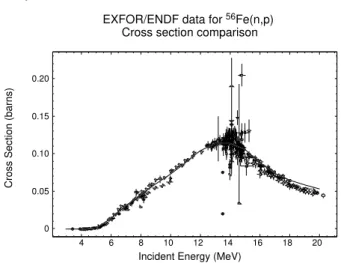
format [17]: the major “general purpose” evaluated li-braries ENDF-B/VI (USA), BROND-2 (Russia), JEF-2 (Europe), JENDL-3 (Japan), CENDL-JEF-2 (China) are available online (“ENDF” database) and on CD-ROM [18]. All of these libraries cover the neutron energy range from10−5 eV to 20 MeV, with some evalua-tions extending to higher energies (partly up to 1 GeV) and also including some charged-particle induced re-actions. Output is available in several formats in-cluding plots, and software packages (Pre-Processing and Utility codes [19]) are available for data treat-ment. Since the original evaluations use resonance parameter representation, derived pointwise data are also available [20]. Online comparisons of evaluated and experimental cross sections can be done using the package ZVView [21] (see Fig. 1).
• Atomic Masses 1995[22], a mass evaluation for more
than 2900 nuclides. Available online.
II.2 Selected special data libraries
In addition to the general purpose libraries listed above, the IAEA Nuclear Data Section holds many specialized li-braries and databases. A selection of important examples is briefly described below.
EXFOR/ENDF data for 56Fe(n,p)
Cross section comparison
Incident Energy (MeV)
Cross Section (barns)
4 6 8 10 12 14 16 18 20 0
0.05 0.10 0.15 0.20
Figure 1. Online comparison of evaluated and experimental data using the package ZVView.
II.2.1 Specialized libraries: IAEA products
The following databases were developed or co-ordinated through IAEA projects.
• FENDL-2[23]: Comprehensive cross section library
for fusion and other applications, resulting from a
worldwide effort including extensive testing, coor-dinated by IAEA. Consists of several sublibraries for transport calculations, activation, fusion reactions, etc. Available online and on CD-ROM.
• IAEA Photonuclear Data Library[24]: Evaluated
photonuclear cross sections for 164 isotopes for ener-gies up to 140 MeV (most isotopes), up to about 25 MeV for others; for shielding, medical and other ap-plications. Available online.
• Charged Particle Cross Section Databasefor
Med-ical Radioisotope Production [25]: Production cross sections forγ-emitters, positron emitters and for
mon-itor reactions, for incident protons throughα-particles
up to about 30 MeV. Available online.
• RNAL[26] (Reference Neutron Activation Library):
Evaluated cross sections for 255 neutron-induced re-actions leading to radioactive products, for activation analysis and various other applications. The evalu-ations were extracted from various regional and na-tional projects. Available online and on CD-ROM.
• RIPL [27] (Reference Input Parameter Library):
Database and handbook for nuclear model calcula-tions of nuclear reaction data, available online and on CD-ROM.
• NMF-90[28] (Neutron Metrology File): Integrated
database for neutron spectrum adjustment (unfolding) calculations. Available online or on diskettes.
• XG Standards[29] (X-ray and γ-ray standards for
detector calibration): This database of selected nu-clides contains their half-lives and the energies and emission probabilities of γ-rays and X-rays
suit-able for detector efficiency calibration. Availsuit-able on diskette and online. An update is in preparation.
• NGATLAS[30]: Atlas of neutron capture cross
sec-tions for 739 targets from10−5eV to 20 MeV. Avail-able as a handbook (plots only) or online.
• SGNucDat[31] (Nuclear Data for Safeguards): PC
database (also available online and as a handbook) containing nuclear data for the development and ap-plication of nuclear material accounting techniques.
II.2.2 Examples of other specialized libraries available from IAEA
• EPDL97[32] (Evaluated Photon Data Library):
Pho-ton interaction data from 1 eV to 100 GeV from Lawrence Livermore National Laboratory, available on CD-ROM.
• Thermal Neutron Capture Gamma Rays[33]:
Ta-bles of energies and intensities of γ-rays produced
in thermal neutron capture, by target or byγ-energy.
• RRDF-98 [34] (Russian Reactor Dosimetry File):
Neutron cross sections for 22 dosimetry reactions. Available online.
• MENDL-2 and MENDL-2P [35]: Activation cross
sections for 505 stable and unstable targets between Al and Po for incident neutrons up to 100 MeV and incident protons up to 200 MeV, for transmutation and other applications. Available by FTP.
• WINDand WIND-2 [36]: Cross sections for U, Np,
and Pu isotopes for waste incineration, including neu-tron cross sections up to 100 MeV, proton cross sec-tions for238U, and neutron activation data for239Pu up to 2 GeV.
• “Maslov”library [37]: Evaluated neutron cross
sec-tions for Np, Pu, Am and Cm isotopes.
III
Data access and services
The main method of distributing numerical nuclear data in the early 21st century is via the Internet, and therefore the IAEA Nuclear Data Section offers a variety of electronic services. At the same time, conventional mail services such as: sending customized retrievals or complete libraries on magnetic tape, CD-ROM, diskettes, hardcopy, or by e-mail, have been maintained for the convenience of users with varying needs and technical infrastructures. Users are kept up to date about new data libraries and other developments through the IAEA’sNuclear Data Newsletter[38].
III.1 Online services
• Worldwide Web (WWW): The IAEA Nuclear Data
Services web page can be found at the web address (URL) http://www-nds.iaea.or.at (IAEA Vienna) or
http://www-nds.ipen.br(IPEN) and contains interac-tive access to the major databases as well as an overview of all nuclear data libraries and databases available from the IAEA (IAEA Nuclear Data Guide), access to various reports, documents and manuals, nu-clear data utility programs, the IAEA’s Nunu-clear Data Newsletter, and a link to the Telnet-based nuclear data service NDIS.
• FTP: The IAEA Nuclear Data Section keeps
sev-eral accounts for file transfer requiring no password (all accessible by the FTP addressesiaeand.iaea.or.at
andwww-nds.ipen.br, respectively): ANONYMOUS contains several complete libraries, utility codes and documents for public use; FENDL2 and RIPL permit access to the respective data libraries; NDSONL con-tains files saved by users of the Telnet-based online system “NDIS” (Nuclear Data Information System) to “local area”; NDSOPEN is used for bilateral file exchange.
• TELNET service (“NDIS”): The starting command
is telnet iaeand.iaea.org ortelnet www-nds.ipen.br, then the usernameiaeandshas to be entered. A de-tailed manual is available online in PostScript or as a hardcopy [39]. This type of online service has lost importance due to the rapidly expanding WWW tech-nology but may still be useful in certain situations. NDIS provides access to the main interactive nuclear databases (CINDA, EXFOR, ENSDF, NUDAT, NSR, ENDF) as well as to PostScript documents and utility programs.
III.2 Computer programs
Under most circumstances, nuclear data related com-puter codes are distributed by the OECD NEA Data Bank [40] in Paris, France to scientists from IAEA member states, or, for codes of US origin, by the Radiation Shielding In-formation Computational Center (RSICC) [41], Oak Ridge, USA (a handling fee may be charged). However, some util-ity programs and PC packages are available directly from NDS, online, by FTP or on CD-ROM.
III.3 Documents
Hardcopy documents published by NDS include hand-books, research and meeting reports (INDC report ries), data library documentations (IAEA-NDS report se-ries), and the Nuclear Data Newsletter. Most new re-ports are also made available electronically on the WWW in PDF format. NDS can be contacted by e-mail under
[email protected]to request hardcopy documents, other mail services, or other nuclear data related informa-tion.
III.4 Trends
Improvement of the nuclear data services has started on a network-wide basis. To make the service more user-friendly and, at the same time, extend the retrieval possibilities, de-velopment of a combined nuclear reaction database is un-der way, using advanced database software, with which the EXFOR, CINDA and ENDF libraries will appear as one database to the user. To improve services for users without good Internet connections to the IAEA, the NDS is pursu-ing two further developments: distribution of databases on CD-ROM, potentially with a web-type user interface and the possibility of automatic updates through the Internet; and the creation of additional regional copies of the “Nuclear Data Services” website (“mirror sites”).
References
[1] D.D. Sood, P. Obloˇzinsk´y, M. Herman and O. Schwerer, Nuclear Data for Applications, J. Radioanal. Nucl. Chem.
243, 227 (2000)
[3] R.B. Firestone, V.S. Shirley, S.Y.F. Chu, C.M. Baglin, and J. Zipkin, (ed.),Table of Isotopes, 8th edition (1996), John Wiley and Sons, New York
[4] S.Y.F. Chu, H. Nordberg, R.B. Firestone and L.P. Ekstr¨om, Isotope Explorer, see
http://ie.lbl.gov/isoexpl/isoexpl.htm
[5] G. Audi, O. Bersillon, O., J. Blachot and A.H. Wapstra, The NUBASE evaluation of nuclear and decay properties, Nucl. Phys.A624, 1-124 (1997). The database is available in electronic form from the Atomic Mass Data Center, see http://csnwww.in2p3.fr/amdc/.
[6] V.G. Pronyaev (ed.), The network of nuclear reaction data centers,Report INDC(NDS)-401, Rev.3, July 2000 (IAEA, Vienna, Austria)
[7] V.G. Pronyaev (ed.), Nuclear Structure and Decay Data (NSDD) Network, Report INDC(NDS)-421, February 2001 (IAEA, Vienna, Austria)
[8] O. Schwerer, H.D. Lemmel, (ed.),Index of Nuclear Data Li-braries available from the IAEA Nuclear Data Section, Re-port IAEA-NDS-7, July 2002 (IAEA, Vienna, Austria). See alsohttp://www-nds.iaea.or.at/reports/nds-7.pdf
[9] H.D. Lemmel, O. Schwerer, (ed.), Index to the IAEA-NDS Documentation Series, Report IAEA-IAEA-NDS-0, July 2002 (IAEA, Vienna, Austria). See also http://www-nds.iaea.or.at/nds-0.html
[10] J.K. Tuli (ed.),Nuclear Wallet Cards,Sixth edition, January 2000 (National Nuclear Data Center, Brookhaven, USA)
[11] C.L. Dunford and T.W. Burrows,NuDat System for Access to Nuclear Data,Report IAEA-NDS-205 (Revision 98/7), July 1998 (IAEA, Vienna, Austria)
[12] MIRD - Medical Internal Radiation Dose, available through http://www-nds.iaea.or.at/formmird.html.
[13] Seehttp://www-nds.iaea.or.at/ensdf/
[14] Seehttp://www-nds.iaea.or.at/nsr/
[15] CINDA 2000, The Index to Literature and Computer Files on Microscopic Neutron Data(IAEA, Vienna, Austria, Novem-ber 2000)
[16] Seehttp://www-nds.iaea.or.at/exfor/. For an introduction, see V. McLane,EXFOR Basics: A Short Guide to the Nuclear Reaction Data Exchange Format,Report BNL-NCS-63380, BNL, Brookhaven, 1999
[17] V. McLane (ed.),ENDF-102 Data Formats and Procedures for the Evaluated Nuclear Data File ENDF-6, Report BNL-NCS-44945-01/04-Rev., April 2001
[18] H.D. Lemmel, Index to BROND-2, CENDL-2, ENDF/B-6, JEF-2, JENDL-3, IRDF, EFF-2.4 and FENDL/E, Report IAEA-NDS-107 (Revision 11), March 1996 (IAEA, Vienna, Austria)
[19] Seehttp://www-nds.iaea.or.at/ndspub/endf/prepro/and http://www-nds.iaea.or.at/ndspub/endf/utility/
[20] Seehttp://www-nds.iaea.or.at/endf/endfframe.htmlfor point-wise cross sections at 300 K temperature from sev-eral main libraries. In addition, the database “point2000” CONTAINS POINTWISE CROSS SECTIONS FROM endf/b-vi AT 8 TEMPERATURES, SEE http://www-nds.iaea.or.at/point2000/
[21] V. Zerkin,ZVView: Graphic Software for Nuclear Data Anal-ysis, see
http://www-nds.iaea.or.at/ndspub/zvview/
[22] G. Audi and A.H. Wapstra,The 1995 Update to the Atomic Mass Evaluation, Nucl. Phys.A595, 409-480 (1995). See also Report IAEA-NDS-47 (Revision 3), November 1995 (IAEA, Vienna, Austria)
[23] A.B. Pashchenko, H. Wienke and D.W. Muir,FENDL-2: An improved nuclear data library for fusion applications, in: Proceedings of International Conference on Nuclear Data for Science and Technology, Trieste, Italy, 19-24 May 1997, ed. by G. Reffo, A. Ventura and C. Grandi, (Italian Physical So-ciety, Conference Proceedings Vol. 59, Bologna, 1998) pp. 1150 - 1154
[24] Handbook on Photonuclear Data for Applications, IAEA-TECDOC-1178, October 2000 (IAEA, Vienna, Austria)
[25] Charged-Particle Cross Section Database for Medical Ra-dioisotope Production, IAEA-TECDOC-1211, May 2001 (IAEA, Vienna, Austria)
[26] Seehttp://www-nds.iaea.or.at/ndspub/rnal/www/
[27] Handbook for Calculations of Nuclear Reaction Data (Refer-ence Input Parameter Library),IAEA-TECDOC-1034, Au-gust 1998 (IAEA, Vienna, Austria). See also http://www-nds.iaea.or.at/ripl and CD-ROM (IAEA-NDS-CD-02, Vi-enna, May 1998)
[28] E.M. Zsolnay, E.J. Sz¨ondi and H.J. Nolthenius, The Neu-tron Metrology File NMF-90,Report IAEA-NDS-171, Rev. 1, January 1999 (IAEA, Vienna, Austria)
[29] X -ray and gamma-ray standards for detector calibration, IAEA-TECDOC-619, September 1991 (IAEA, Vienna, Aus-tria). Data available on the WWW through
http://www.nucleartraining.co.uk/iaea/index.htm
[30] Atlas of Neutron Capture Cross Sections,ed. by J. Kopecky, graphs published in Report INDC(NDS)-362, April 1997 (IAEA, Vienna, Austria). Numerical data as well as plots are available online throughhttp://www-nds.iaea.or.at/ngatlas2/
[31] N. Kocherov, M. Lammer and O. Schwerer, Handbook of Nuclear Data for Safeguards,Report INDC(NDS)-376, De-cember 1997 (IAEA, Vienna, Austria). See also http://www-nds.iaea.or.at/sgnucdat/sgnuc.html
[32] EPDL97 - The Evaluated Photon Data Library, ’97 version, by D.E. Cullen, J.H. Hubbell and L. Kissel, LLNL (USA). For summary documentation of contents see V.P. Pronyaev and P.K. McLaughlin (ed.), Report IAEA-NDS-196, August 1998 (IAEA, Vienna, Austria)
[33] Thermal Neutron Capture Gamma Rays,available through http://www-nds.iaea.or.at/wallet/tnc/capgam.shtml
[34] K.I. Zolotarev, A.V. Ignatyuk, V.N. Manokhin and A.B. Pashchenko,RRDF-98. Russian Reactor Dosimetry File, Re-port IAEA - NDS - 193, March 1999 (IAEA, Vienna, Aus-tria). Data available online under
http://www-nds.iaea.or.at/reports/nds-193.htm
[36] A.Yu. Konobeyev et al., WIND, Evaluated neutron cross-section data up to 100 MeV for incineration of actinides. With one data file of proton-induced reactions for U-238. Report IAEA-NDS-143, March 1995 (IAEA, Vienna, Austria) [37] V. Maslov et al., Evaluated neutron reaction data for Np,
Am, Cm and Pu isotopes. Summary documentation: Report IAEA-NDS-164 (Revision 3), February 1998 (IAEA, Vienna, Austria)
[38] Nuclear Data Newsletter (IAEA, Vienna, Austria).
Is-sued 2 times per year. Also available through http://www-nds.iaea.or.at/newslett.html
[39] C.L. Dunford and T.W. Burrows,Online Nuclear Data Ser-vice, Report IAEA-NDS-150 (Revision 99/3), March 1999 (IAEA, Vienna, Austria)
[40] Seehttp://www.nea.fr/html/dbprog/