Problem posing based on investigation activities by university students1
João Pedro da Ponte
Instituto de Educação, Universidade de Lisboa [email protected]
Ana Henriques
CINAV, Escola Naval e Unidade de Investigação do Instituto de Educação, Universidade de Lisboa [email protected]
Abstract This paper reports a classroom-based study involving investigation activities in a university numerical analysis course. The study aims to analyze students’ mathematical processes and to understand how these activities provide opportunities for problem posing. The investigations were intended to stimulate students in asking questions, to trigger their thinking processes, to promote their ability to investigate and to support them learning numerical analysis concepts and procedures. The results show that the investigations provided opportunities for students to experience mathematical processes, including posing questions, formulating and testing conjectures and, to some extent, proving results. They also provide some understanding about the role of problem posing in these processes. Posing questions occurred mainly in an implicit way, in the interpretation of tasks and in identifying regularities, analyzing graphs and testing cases. The conjectures were often based on pattern identification or data manipulation and the students tended to accept them without testing or proving. The students also proposed alternative formulations for the initial questions and posed new problems from their explorations and attempts to refine previous conjectures.
Keywords Problem-posing, Investigation activities, Mathematical processes, Reasoning. 1 Introduction
Mathematics may be regarded as a body of knowledge or as a human activity (Freudenthal, 1973; Pólya, 1945). Whereas the notion of body of knowledge leads to the notion of mathematics teaching as a transmission process, the notion of mathematical activity suggests that students may be actively involved in doing mathematics (NCTM, 1989). Pólya (2002) underlines the importance of such activity when he says: “To understand mathematics means to be able to do mathematics” (p. 7). At the heart of doing mathematics is posing problems and solving them (Brown & Walter, 1990).
Problem posing may be regarded as emphasising the formulation of a key problem that hopefully will trigger an extended and productive mathematical activity, leading to its solution. But problem posing may also be regarded as the constant process of posing questions, that permeates any authentic mathematical activity, and that generates both key and subsidiary questions. One must note that sometimes subsidiary questions become central and sometimes key questions become dead ends. Adopting this second view, we see mathematical investigations as providing particularly rich opportunities for problem posing (Ponte & Matos, 1992). The close relation to problem posing and the increasing visibility of such activities in curriculum documents (such as NCTM, 2000) and in teachers’ practices (Ruthven, Hofmann & Mercer, 2011), make them an interesting and potentially fruitful field of study.
This paper identifies the mathematical processes used by university students exploring investigations in the classroom, in order to analyse how these activities contribute for students’ problem posing processes, from the interpretation of the situations to the justification of results.
1
Ponte, J. P., & Henriques, A. (2013). Problem posing based on investigation activities by university students. Educational Studies in Mathematics, 83(1), 145-156.
2 Problem posing and investigation activities
In teaching and learning contexts, students may work in a similar way to professional mathematicians. Such is the view of Hadamard (1945): “Between the work of the student who tries to solve a problem in geometry or algebra and a work of invention, one can say that there is only a difference of degree, a difference of level, both works being of a similar nature” (p. 104). Working on mathematical investigations provides students with the opportunity to experience important mathematical processes. Ernest (1991) points out problem posing as a first distinctive feature of mathematical investigations, as their statement often is not fully explicit and precise, requiring students to pose their own questions and to establish their own objectives. After exploring the situation, it is necessary to pose questions about the data, frequently based on the identification of patterns, and to formulate and test conjectures (Ponte et al., 1998). This may show the need to collect more data, to drop the initial conjectures and to formulate new ones. The analysis of the situation may lead to modify the initial questions (Silver, 1994) or to change some of the conditions to raise new problems. Then, one must establish plausible arguments and formal proofs to reject or validate this guesswork. The conjectures that resist the tests gain credibility, stimulating proofs that, once achieved, yield mathematical validity. Ernest (1991) emphasizes that investigations provide stimulus to the students to justify and prove their conjectures and to explain mathematical arguments to their colleagues and to the teacher. Also, the processes of generalization and specialization may be sources not only of solutions but of new problems as well (Pólya, 1981). After obtaining a solution for a particular problem, a student can also “look back” to see how the solution may be affected by changes in the problem (Pólya, 1945). Thus working on investigations students are led to formulate questions and conjectures, conduct tests and refutations, and also present results, discuss and argue with their colleagues and the teacher (Ponte, Brocardo & Oliveira, 2003). An additional feature of this process is that new questions arise along the way.
Carrying out mathematical investigations may contribute significantly to the understanding and consolidation of concepts and to the development of students’ mathematical thinking (Henriques & Ponte, 2008; Ponte, 2007). Ponte et al. (1998) also argue that mathematical investigations provide students with a more complete view of mathematics, thus opposing the narrow view of this subject as just carrying out procedures and algorithms. Moreover, investigations give students many opportunities to pose new problems (English, 2003; Kilpatrick, 1987). Those may arise prior to problem solving when students generate problems from a particular situation or after solving a problem when the goals or conditions of a solved problem are modified or applied to new situations. In addition, problem posing could occur during problem solving when the individual intentionally changes their goals while in the process of solving the problem (Silver, 1994).
Previous studies examined the conceptual benefits of problem posing. Silver (1994) argues that problem posing promotes students’ mathematical thinking. English (1997) also points out that problem posing, reinforcing and enriching students basic mathematics concepts, generates a more diverse and flexible thinking and improves their ability to solve problems. Moreover, Silver (1994) and English (1997) indicate that students who work on problem posing develop a more positive attitude towards mathematics, becoming more responsible and motivated for their learning. From a teaching perspective, problem posing can also become an useful assessment tool enabling teachers to develop a better understanding of students’ cognitive processes, to
find possible misconceptions early in time, and to obtain information on levels of students’ learning to adjust their teaching processes (English, 1997). In spite of this, few studies have examined the cognitive processes involved when students generate their own problems in the course of their problem-solving activity or about instructional strategies that can effectively promote productive problem posing. Cai and Cifarelli
(2005) explained several characteristics of the students’ mathematical explorations in
open-ended problem situations with particular emphasis on how students formulated and solved new problems that arose during their problem-solving activity. The results obtained (also extended in Cifarelli & Cai, 2005) suggest a preliminary model of mathematical exploration processes that the authors consider needs further refinement. In this paper we seek to develop a more elaborated view concerning the mathematical processes used by students when exploring investigations and address in a particular way how they contribute for university students’ problem-posing processes.
3 Methodology
The methodological framework of this study is based on the interpretative research paradigm (Bogdan & Biklen, 1994). Examples in this paper come from an extended classroom based study supported by investigation activities, conducted in the first semester of 2008/09 in a numerical analysis course taught by the 2nd author, in order to promote students’ experience of doing mathematics and learning of numerical analysis concepts and procedures. The participants were all of the 36 second year university students of Escola Naval, who had no prior experience in such activities.
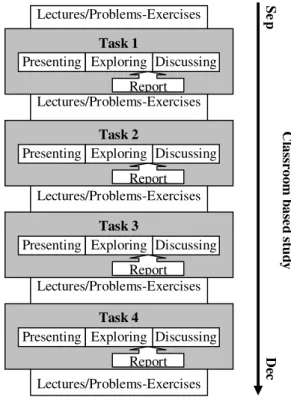
The study offered a different (unusual) approach to a numerical analysis course. Classroom work included the realization of four investigation tasks, which took over a significant part of the class time organized in three main moments: (1) presenting tasks, (2) exploring, and (3) presenting and discussing students’ conclusions (Ponte et al., 1998). Each task focused on a different numerical analysis topic (interval arithmetic, non-linear equations, curve fitting, and numerical integration). Students were proposed situations for which they had neither theory nor routine processes to handle and therefore were challenged to pose their own questions and to develop and defend their own strategies.
The tasks were presented to the students through a written statement. They worked in self-selected pairs or small groups, constituted at the beginning of the semester and could use graphic calculators, if they wanted. Upon finishing the exploration of the task, the students presented their work orally to the class. These discussions were important learning opportunities. The students presented their conclusions and explained their ideas and strategies, and, prompted by their colleagues and the teacher’s strong questioning, they sought for justifications and discussed aspects to which they had only given little thought. These moments also provided the opportunity to introduce new topics progressively and to respond to students’ questions, probing the understanding of the procedures of their colleagues and asking them to explain their reasoning. Between stages (2) and (3), outside the classroom, the students wrote a group report, explaining their strategies and presenting and justifying their conclusions. Doing this report encouraged students’ reflection, since it requires to articulate ideas, to explain procedures, and to review the processes used and the results obtained.
The investigation tasks were alternated with other classes, with lectures to address theoretical aspects of numerical analysis arising during the tasks or to present other topics (numbers and errors, interpolation and differential equations). The
classroom work also included moments for solving problems and doing practical exercises for consolidation of concepts and algorithms (see Fig.1).
Fig. 1 – The classroom based study
Due to the complexity of the complete study (Henriques, 2010), the results here reported focus on three students (Carlos, Gonçalo and Luís) working on two tasks, conveniently chosen in order to illustrate a variety of interesting aspects of problem-posing processes.
Since the teacher was also a researcher, several difficulties and conflicts could arise from that dual role. Following the educational research ethical principles, the teacher-researcher informed all the students of the reseach goals and intended activities, asked their agreement to participate, keeping their identities confidential, and assured students that the research would not bring harm to any student in the classroom.
Data collection methods included observation of students exploring tasks, collection of their written reports (labelled WR#), and audio recording interviews after the exploration of each task (E#). The interviews were based on issues that emerged from the analysis of written reports in order to understand students’ thinking processes and to provide data to clarify ambiguous issues.
For each task, we described the students’ work and documented it via a set of comments made by them indicating both the students’ goals as well as the subsequent actions oriented towards the solution. Mathematical processes addressed in Ponte et al. (2003), such as the formulation of questions, the formulation of particular/specific conjectures and their generalization to more general cases, the test of conjectures and their posterior justification, provided the basis for categorizing the mathematical processes used by the students during the task exploration. We also analysed students’ actions to identify other instances that could be considered problem-posing processes, such as posing questions about data, generating partial problems from a larger one, or modifying the initial goals or conditions of an already solved problem.
Lectures/Problems-Exercises Lectures/Problems-Exercises Lectures/Problems-Exercises Lectures/Problems-Exercises Lectures/Problems-Exercises Task 1 Report Presenting Exploring Discussing
Task 2
Report Presenting Exploring Discussing
Task 3
Report Presenting Exploring Discussing
Task 4
Report Presenting Exploring Discussing
C la ss r o o m b a se d s tu d y S e p D ec
4 Students’ mathematical processes
Task 1 was a starting point for the development and formalization of numerical methods for solving nonlinear equations. In particular, we intended to create an opportunity to discuss the bisection method, designing procedures (algorithms) for solving nonlinear equations and understanding their rationale.
The three students begin exploring the task by observing the sequence of consecutive intervals and looking for regularities. Gonçalo explains it in his report: “We tried to find a pattern and understand what was really happening from one interval to another” (WR1). However, the students faced some difficulties since they did not use all of the information available (as the root of f): “Initially, we were a little unmotivated because we could not find a relationship that seemed valid to us” (Gonçalo,WR1). To solve the original problem, Gonçalo formulated two more accessible subproblems: (1) Is there any decreasing pattern in the width of the intervals of the sequence? (2) What is the rule to find the interval bounds? The observation of the sequence of intervals leads to a first conjecture based on the correct identification of a decreasing pattern of interval widths: “We realized immediately that the intervals were getting smaller and smaller, i.e., the width of the next interval is always half of the previous one and that happens for all intervals” (Gonçalo,E1).
Carlos and Luís also begin to pose a simpler question, trying to identify a pattern for interval widths but they did not seek to identify a pattern for interval bounds. They calculated the range of each interval and correctly identified a decreasing pattern, formulating a first conjecture: “By looking at the sequence we found that the interval width decreases by half regarding the previous one” (Luís,WR1).
The formulation of a criterion for deciding on which interval endpoint should be reduced raises some questions to the students that do not recognize any regularity by observation. Carlos indicated that he and his colleagues made several attempts: “Several ideas came up till we got one that seemed correct” (E1). During this process, the students posed several questions that led them to formulate conjectures about the pattern of interval bounds, most of which were based on counting the number of times each endpoint changed or remained constant:
In these three that kept the upper endpoint of the interval, the lower bound was always decreasing. Three times. Then, it changed and it was the upper endpoint, twice. Thus, for the general case [a, b], the minimum (a) varies in three intervals while the maximum (b) had the same value in two consecutive intervals, and then, in the next interval, had another value. (Luís,E1)
However, these strategies were based on simple observations and counting, and did not allow the students to formulate a correct identification of a rule for the sequence of intervals since they did not use the necessary information about the root of f. Carlos and Luís did not test their conjectures and did not realize that these were incorrect. Only when the students were induced to a closer reading of the task statement, could they Consider the function f(x) = ln(x) - e-x. Look at the following sequence of real number intervals which included the root of f,
[1.000, 2.000] [1.000, 1.500] [1.250, 1.500] [1.250, 1.375] [1.250, 1.313] [1.281, 1.313] What is the next interval of the sequence? Explain clearly how you got that conclution.
verify, through experimentation, that the intervals that they constructed did not verify all the given conditions: “Only from this reasoning we found that the root of f(x) was not contained in all intervals” (Luís, E1). This test of their conjecture prompted a reformulation:
It’s the element of the interval (maximum or minimum) that was farthest from the root value that varies, while the other remains constant. Following this reasoning, the next interval (…) is: 1.313 - 1.281 = 0.032, so in the following interval will be half of that width, i.e. 0.016. The farthest element from the root value, i.e. 1.281, will be added in 0.016 resulting 1.297 and this being translated into [1.297, 1.313]. (Carlos,WR1)
The students now proceeded to verify this conjecture but only to the sequence of intervals presented in the task. However, they did not feel any need to justify it Gonçalo also formulated his conjecture based on a counting scheme, considering the conditions given in the task:
In the interval 2 it was to be added, in the intervals 3 and 4 it was to be subtracted, in the intervals 5, 6 and 7 it was to be added again, so, I thought we have the following sequence (…)
1 2 3 4 5 6 7 8 9 10 11
- + - - + + + - - - - (Gonçalo,E1)
Unlike his colleagues, Gonçalo tested his conjecture and realized that it was incorrect. He used his knowledge on functions to identify the regularity: “As we know that the zero of the function is within the interval, from one interval to the next, we drop the half that does not contain our zero” (E1). Thus, this test allowed him to formulate a new conjecture.
Once the exploration of this task had been completed for the particular case of the given function, the next natural step would be to pose similar questions for any function. In the given function, from one interval to the next, a transformation occurred according to a rule consistent with some conditions. For Carlos and Luís, the generalization of this rule reflected, in part, the previous exploratory work. They considered this process a mere formalization and described their conjecture in symbolic notation:
From what I said earlier, we can define the following rule: If x – max > (f(x) = 0) then the next interval is [min, x - max] or [x + min, max] if and only if x-max <(f (x) = 0). (Luís,WR1)
The students did not realize that their conjecture depended on an unknown root (of this specific function). They felt no need to justify that rule—doing it would facilitate their generalization. And, therefore, they did not realize that their rule applied only to their particular case but not to the general case.
Gonçalo, in turn, realized that he must return to the previous questions for any function in general. Thus, he presented a rule for constructing intervals in an algorithmic form, with the elements of the sequence defined by recurrence, which would apply to any continuous function on a range with unknown roots:
As a rule and taking into account how we get the next intervals, given the interval [a, b] we perform the following steps:
1st - Find the midpoint, vmed = (a + b) / 2 2nd - Find f(vmed)
If f(vmed) > 0 then we get the next interval [a, vmed]
If f(vmed) < 0 then we get the next interval [vmed, b]. (Gonçalo,RT1)
Gonçalo seemed to understand that a generalization of this conjecture must be applicable to any function. He justified his algorithm when he described the rule for constructing intervals of the sequence based on known mathematical properties and theorems, including the Bolzano theorem and its corollaries: “As the function is continuous and f(a) < 0 and f (b) > 0, we only had to maintain the [images of the] bounds of the intervals with opposite signs so that the next interval also contains the zero. As vmed is always an extreme it is enough to confirm the sign of f(vmed)” (E1). Thus, intuitively, he built the bisection method for solving nonlinear equations.
In summary, the mathematical processes used by the students in exploring this task included looking for regularities, formulating and testing conjectures, generalizing these conjectures and justifying them. All students formulated initial questions on given intervals, formulating conjectures involving patterns from data observation or manipulation. Some difficulties arose in identifying patterns, as they did not take into account all information available. Only Gonçalo formulated a more general conjecture concerning all possible functions, and he was also the only one to produce justifications. Students’ work on this task included the formulation of questions in an implicit way, identified by their conjectures. These questions arose when students formulated conjectures from examples, generated subproblems from a major problem and, in the case of Gonçalo, when he tried to generalize his conjecture to obtain a general solution.
In task 2, multiple sets of data, provided in tables, represented different behaviours to be modelled by different functions. Students were required to analyze and identify these trends and then to define criteria in order to complete some missing values in the tables, using known mathematical models (e.g., linear, quadratic or exponential), together with what they just learned about interpolation.
Carlos and Luís began by asking themselves about the behaviour of the data. They calculated the differences between the values of the first table to identify a pattern:
From three distinct monitoring stations we obtained some data on the evolution of a population of anaerobic bacterias in a lake, with which we intend to describe mathematically the growth of that population. Station 1 t (hours) 2 3 4 5 6 8 p (×105) 90 140 --- 240 --- 390 Station 2 t (hours) 1 2 3 4 5 6 8 p (×105) 40 85 --- 220 210 --- 400 Station 3 t (hours) 2 3 4 5 6 7 p (×105) 85 140 --- 250 380 600
a) There are some missing values corresponding to the records of a few of the hours. How did you complete the above tables?
b) Investigate what mathematical models could be adequate to describe the bacterial population evolution in the considered period of time.
“Looking at the table station 1(...) we can realize that [the growth of bacterial population, p] is a linear function. The slope is constant
140 90 240 140 390 140
3 2 5 3 8 3
− − −
= =
− − −
” (Luís,E2). Based on these calculations, the students conjectured that these values were from a linear function. So, they posed another question: Assuming this linear behaviour for data, how do we find the missing values? For that, they choose to “use the rule of three” (Carlos,WR2). The students justified the conjecture when they just referred to the slope.
Luís, working with his colleagues on station 1, believed that he could also use his recent knowledge about interpolation to find the missing values: “We think that one could also find the missing values by a polynomial interpolation method” (WR2). The student posed a question about whether Lagrange’s method of (linear) polynomial interpolation would yield the same results. He comparesd them with the previous computations obtained with the rule of three: “We solved a problem with Lagrange’s interpolation. We also used the rule of three to check whether there were differences but no, it gave the same” (E2). The analysis of his group work show that the students also considered other possible explorations: “We can use any of the learned methods for polynomial interpolation. One can use either Newton's method with divided differences or the Lagrange’s method” (WR2).
Gonçalo started exploring the task assuming that the data were in any position and therefore the missing values could be found by polynomial interpolation. He tried to find the missing values in station 1 by constructing a 4th degree Newton’s polynomial function based both on known properties of polynomials and on the idea (not always correct) that the greater the degree of the polynomial, the better the approximation to the data: “We used the four points because it’s all we had. Moreover, the idea I had is that the more points we use more...” (E2). The choice of Newton's polynomial interpolation method with divided differences also drew on his recently acquired knowledge: “The nodes were not all at the same distance” (E2). The student explored the other tables in the same way and assumed that the constructed polynomials were suitable to represent data and to calculate the missing values but did not make any test, possibly because he believed that he created a suitable option. Thus, he did not realize that some of the values obtained were hardly justifiable given the general behaviour of the data.
For the other two tables (stations 2 and 3), Carlos and Luís wonder again about the behaviour of data but, calculating the differences between each two values, they verify that there is not a linear relationship:
For the tables station 2 and 3 we tried to apply the same as for table station 1. But: 85 40 220 40 210 85 2 1 4 1 5 2 − − − ≠ ≠ − − − and 600 250 380 140 140 85 7 5 6 3 3 2 − − − ≠ ≠ − − − .
So, they are not linear functions (...). (Luís,WR2)
These students choose using the polynomial interpolation to find the missing values and, from this point on, reasoned very much like Gonçalo. However, before finishing the exploration of this task, Carlos proposes to his group a new problem assuming other conditions – to construct an algebraic expression for a 2nd degree polynomial. He took into account the data behaviour to pose this question and formulated a conjecture related to the degree of the polynomial. Then, he interpolated the function at 3 in station 2: “We obtained the algebraic expression of the polynomial:
p2(x) = 22,5x + 7,5x2 + 10” (WR2). He also considered “improving” their conjecture using different polynomials to describe the data trend, instead of the single expression previously found. His decisions on the degree of the polynomials to be used were based on identifying patterns in the data behaviour, the number and the monotony of the available values:
Looking at the data, I found 3 values growing up, a decreasing trend at 5 and then at 8 the values grow up again. Obviously the values could still be falling at 6, but we do not know... In this case, I thought I would get a function defined by three branches at the intervals, [1, 4[, [4, 5[, [5, 8[. (Carlos,E2)
When Carlos felt the need to justify their results, he tried to check whether they agreed with the expected ones and with the reasoning developed. He used a sophisticated graphical representation and properties of functions (monotony and derivative):
It was a kind of checking, if these polynomials were good for that range of values. (…) I even did a sketch here... It was through the observation of the table (...). It was growing from here to there (...).Therefore the polynomials had to be increasing or decreasing and their derivatives had to be positive or negative (...). (Carlos,E2)
An interesting extension of this question was raised by Luís when he wondered if, after obtaining an interpolated value, he could add this new data to the table and thus get a higher-degree polynomial to find the remaining missing values: “To discover the value of t = 6 [in station 2] we could now include the value of p(3) we have just found and so the error was smaller” (E2). Here we see an attempt to pose new questions.
In this task, students formulated conjectures about the most appropriate computation methods based on different assumptions about the data. They did not feel the need to test their results. However, raising questions on the global behaviour of data may lead to using different methods with quite different results. Students’ problem posing is visible at several stages of their exploration. Initially, Carlos and Luís questioned themselves about the behaviour of data and, based on the identified pattern, formulated conjectures. They also posed questions when selecting the appropriate methods to find the missing values, taking into account the data, when they sought to compare different methods. Before they finished, students still posed new problems considering the results or modifying the initial conditions to refine the previous formulations. Gonçalo, in turn, did not pose explicit questions about the data behaviour since he assumed that polynomial interpolation was the appropriate approach. However, even if only implicitly, he also posed questions about the appropriate polynomial to represent the data (degree and method).
5 Conclusion
During the study, the students were challenged to carry out investigation activities very different from the usual university mathematical tasks. This led them to experience mathematical processes such as looking for regularities, posing questions, formulating and testing conjectures, generalizing and providing justifications. These results extend to the classroom setting previous research by Cifarelli and Cai (2005). Furthermore,
they show that, besides formulating conjectures and generalizing, students also engage in other mathematical processes.
Looking for regularities was based, mainly, on the observation of examples in visual and numerical diagrams or through counting or computation. As in former research by Silver (1994), the students’ sketches were very important to help in formulating conjectures. Difficulties in this process arose when they did not take into account all the available (and necessary) information.
All students posed questions as they formulated initial questions about the data provided and sought to identify patterns that yielded conjectures. Sometimes, they also posed questions to simplify the original problem. However, in many cases, the posed questions are just implicit being identifiable from the conjectures.
The students mostly formulated conjectures based on identifying patterns from data observation or manipulation. However, they also drew on mathematical properties. Their conception of solving a task as a process of getting a result led them to formulate conjectures as statements, confirming the findings of Ponte and Matos (1992), and to accept them as conclusions, feeling no need for testing or proving. This result, also observed by Ponte et al. (1998), seems to be more related to students’ inexperience in conducting this type of task and to the challenge of understanding the nature of the investigation process than to mathematical difficulties in testing or proving.
The work on the proposed tasks led the students to understand the importance of testing their conjectures and this became a constant concern. Most of the time, testing conjectures was done through experimentation (often with the examples available in the statement). However, sometimes the test was based on graphic representations and on mathematical concepts and properties. In these cases, the test of conjectures coincided with the process of justifying them. When they explained their reasoning, the students unintentionally gave justifications based on mathematical properties or deductive reasoning. When, through testing, students refuted a conjecture, they tried to reformulate it. In that way, the process of testing conjectures allowed not only its verification but also problem posing, reinforcing the perspective of Cifarelli and Cai (2005) of mathematical activity as a recursive process wherein students’ reflection on the results can provide them with opportunities to formulate new problems to explore and solve.
An important step in the exploration of some tasks was the generalization of the initial conjectures, i.e., the formulation of a more general conjecture, which led to posing new questions. Carlos and Luís seemed to be unaware that their conjectures might be valid for particular cases but not for the general case, and tended to consider the generalization a simple process of formalization. Rather, Gonçalo returned to questions previously raised and broadened the scope of his conjectures to obtain a general solution. The process of generalization carried out by this student resulted also in the construction of the bisection method. In a different way, Carlos and Luís also suggested possible extensions of the proposed questions. After obtaining a first solution, they posed new questions and formulated new conjectures, or refined existing ones by changing the initial conditions (as suggested by Ponte et al., 1998 and Silver, 1994).
The results of this study highlight the potential of investigation tasks to promote problem posing and suggest they may be used in university mathematics courses. Students do engage in problem posing when carrying out such tasks. This process occurs when they pose questions concerning the given data, look for regularities and formulate conjectures from a series of examples, generate more accessible subproblems from a larger problem, test their conjectures and reformulate them, try to generalize and/or refine their conjectures to obtain a general solution and propose alternative
questions, expanding their explorations by changing the initial conditions. Thus, students’ problem-posing processes apear to permeate the problem-solving activity, as suggested by Brown and Walter (1990) and Cifarelli and Cai (2005). As a key feature of authentic mathematical activity, our study shows that problem-posing processes seem to be stimulated when students get involved in investigation activities.
References
Bogdan, R., & Biklen, S. (1994). Investigação qualitativa em educação. Porto: Porto Editora.
Brown, S., & Walter, M. (1990). The art of problem posing (2nd ed.). Hillsdale, NJ: Lawrence Erlbaum.
Cai, J., & Cifarelli, V. V. (2005). Exploring mathematical exploration: How two college students formulated and solved their own mathematical problems? Focus on Learning Problems in Mathematics, 27(3), 43–72.
Cifarelli, V. V., & Cai, J. (2005). The evolution of mathematical explorations in open-ended problem-solving situations. Journal of Mathematical Behavior, 24, 302-324.
Ernest, P. (1991). The philosophy of mathematics education. New York, NY: Falmer. English, L. (1997). The development of fifth-grade children’s problem-posing abilities.
Educational Studies in Mathematics, 34(3), 183–217.
English, L. D. (2003). Problem posing in elementary curriculum. In F. Lester & R. Charles (Eds.), Teaching Mathematics through Problem Solving. Reston, VA: National Council of Teachers of Mathematics
Freudenthal, H. (1973). Mathematics as an educational task. Dordrecht: Reidel.
Hadamard, J. (1945). Psychology of invention in the mathematical field. Princeton, NJ: Princeton University Press.
Henriques, A., & Ponte, J. (2008). Actividades de investigação na aprendizagem de Análise Numérica. Revista de Educação, 16(2), 5–32.
Henriques, A. (2010). O pensamento matemático avançado e a aprendizagem da análise numérica num contexto de actividades de investigação (Doctoral dissertation, University of Lisbon, available at http://repositorio.ul.pt/)
Kilpatrick, J. (1987). Problem formulating: Were do good problems come from? In A. H. Schoenfeld (Ed.), Cognitive science and mathematics education (pp. 123–
147). Hillsdale, NJ: Lawrence Erlbaum.
National Council of Teachers of Mathematics (1989). Curriculum and evaluation standards for school mathematics. Reston, VA: NCTM.
National Council of Teachers of Mathematics (2000). Principles and standards for school mathematics. Reston, VA: NCTM.
Pólya, G. (1945). How to solve it. Princeton, NJ: Princeton University Press.
Pólya, G. (1981). Mathematical discovery: On understanding, learning and teaching problem solving. New York, NY: Wiley.
Pólya, G. (2002). The goals of mathematical education. Mathematics Teaching, 181, 6–
7, 42-43.
Ponte, J. (2007). Investigations and explorations in the mathematics classroom. ZDM, 39, 419–430.
Ponte J., Brocardo J., & Oliveira, H. (2003). Investigações matemáticas na sala de aula. Belo Horizonte: Autêntica.
Ponte, J., Ferreira, C., Brunheira, L., Oliveira, H., & Varandas, J. (1998). Investigating mathematical investigations. Proceedings of CIEAEM-49 (pp. 3–14), ESE Setúbal.
Ponte, J., & Matos, J. F. (1992). Cognitive processes and social interactions in investigation activities. In J. Ponte et al. (Eds.), Mathematical problem solving and new information technologies: Research in contexts of practice (pp. 239–
254). Berlin: Springer.
Ruthven, K., Hofmann, R., & Mercer, N. (2011). A dialogic approach to plenary problem synthesis. In B. Ubuz (Ed.), Proceedings of the 35th Conference of the International Group for the Psychology of Mathematics Education (pp. Vol. 4, pp. 81–88). Ankara, Turkey: PME.
Silver, E. (1994). On mathematical problem posing. For the Learning of Mathematics. 14(1), 19–28.