Study conducted at the Graduate Program in Communication Disorders, Universidade Tuiuti do Paraná – UTP – Tuiuti (PR), Brazil (1) Postgraduate Program in Communication Disorders, Universidade Tuiuti do Paraná – UTP – Tuiuti (PR), Brazil.
(2) Graduate Program (Masters) in Communication Disorders, Universidade Tuiuti do Paraná – UTP – Tuiuti (PR), Brazil. Conflict of interests: No
Authors’ contributions: ABML principal researcher, research development, schedule development, survey of literature, collection and analysis of data, article drafting, article submission and procedures; VMNS coauthor, research development, schedule development, survey of literature, collection and analysis data, article drafting; CGOG and FCL coauthors, data collection, approval of the final version.
Correspondece address: Adriana Bender Moreira de Lacerda. R. Sydnei Antonio Rangel Santos, 238, Santo Inácio, Curitiba (PR), Brazil, CEP: 82010-330. E-mail: [email protected]
Received: 11/6/2012; Accepted: 7/23/2013
Educational workshops as a strategy to promote hearing
heath in adolescents: an exploratory study
Oficinas educativas como estratégia de promoção da saúde
auditiva do adolescente: estudo exploratório
Adriana Bender Moreira de Lacerda1, Vania Muniz Néquer Soares1, Cláudia Giglio de Oliveira Gonçalves1,
Flavia Conceição Lopes2
ABSTRACT
Purpose: Develop and evaluate educational workshop on hearing health and noise exposure adolescents, students of public school. Methods: Intervention study involving 91 adolescents. Educational activity was conduce based on the problem-posing education and as a methodolo-gical resource group work in the form of workshops in which young people were invited to reflect on the hearing health and noise exposure in cultural activities (leisure),and environmental education. Was used differents strategies playful and dialogical as: theater, music, conversa-tion wheel, making mural. For evaluaconversa-tion of the workshop were applied two questionnaires, one questionnaire before and another after the workshop aimed at identifying and understandingc an change attitudes of young people against the noise, and the other on the development of the workshop. Results: After the workshops, was observed changes in the understanding of young people, considering the noise as something bad and harmfulto health, however significant differences were observed, the necessary care with hearing related to cultural activities. The students’ perceptions related to the dynamics used in the workshops was very good or goodby more than 80% of the evaluations. Conclusion: The educational workshops showed to be appropriate for health education of hearing students. Changes were observed in the understanding of teenagers, especially the effect of noise on cultural activities. The playful and dialogical strategies proposed in the workshop were accepted and appreciated by adolescents.
Keywords: Health education; Hearing; Hearing loss, Noise-induced; Student health services; Adolescent
RESUMO
Objetivo: Desenvolver e avaliar oficinas educativas sobre saúde auditiva e exposição a ruídos de adolescentes escolares da rede pública de ensi-no médio. Métodos: Estudo de intervenção, com a participação de 91 adolescentes. Foi realizada ação educativa, tendo como base a pedagogia problematizadora e, como recurso metodológico, o trabalho em grupo na forma de oficinas, nas quais os jovens foram convidados a refletir sobre a saúde auditiva e exposição a ruídos nas atividades culturais (lazer), escolares e ambientais. Foram utilizadas diferentes estratégias lúdicas e dialógicas, como teatro, música, roda de conversa, confecção de mural. Para avaliação das oficinas foram aplicados dois questionários: um ques-tionário antes e outro depois das oficinas, visando identificar a mudança na compreensão dos jovens frente ao ruído, e outro sobre a dinâmica das oficinas. Resultados: Após as oficinas, foram observadas mudanças na compreensão dos jovens, que passaram a considerar o ruído como algo ruim e danoso à saúde. Diferença significativa foi observada com relação aos cuidados necessários com a audição nas atividades culturais. A percepção dos alunos relacionada à dinâmica utilizada nas oficinas foi muito boa ou boa em mais de 80% das avaliações. Conclusão: As ofi-cinas educativas demonstraram-se apropriadas para educação em saúde auditiva de escolares. Foram observadas mudanças na compreensão dos jovens, sobretudo quanto ao efeito do ruído nas atividades culturais. As estratégias lúdicas e dialógicas propostas nas oficinas foram aceitas e apreciadas pelos adolescentes.
INTRODUCTION
The development of an adolescent’s lifestyle is crucial, not only for the individual, but also for future generations. Brazil is experiencing the so-called demographic dividend, when the age structure of the population acts to facilitate economic growth, in other words, there is a large contingent of young people in the population and a smaller number of elderly people and children. The country had in 2009, 34.5 million adolescents, 92% of them attending schools(1). Thus,
the school is a privileged space for the implementation of public policies, especially health education, enabling, among other health actions, hearing health promotion and the pre-vention of hearing loss in adolescents.
Among the programmed actions directed at promoting hearing health and the specific protection of adolescents, are programs to promote hearing health supported on three major axes: situational analysis of hearing health determinants, audio-logical profile analysis, and speech-therapy intervention related to hearing health education(2). In this context, we highlight the
importance of educational activities based on attitudes and behavior related to hearing habits of children and adolescents(3).
Thus, we can act more objectively when considering the pre-vention of damage due to exposure to environmental noise and leisure activities in order to prevent noise-induced hearing loss (NIHL) in adolescents.
Under the assumption that one of the most significant components in the development of adolescents is related to group trends, in a search for identity outside the family, where young people tend to feel protected, safe, encouraged, and understood(4), group activities for Health Education methods
should take precedence for adolescents(5).
Group work in the form of workshops, or others, enables the breakdown of the traditional vertical relationship that exists between the health professional and the subject, and is a strategy for facilitating individual and collective expression of the needs, expectations, and life circumstances that influence health. The group space for mediated dialogue between health professionals and individuals or the community, allows for the construction of a collective consciousness and of reflection with action. The dialogue is the way by which men gain significance, as subjects, and conquer the world for their liberation, autonomy and transformation, which are the foundations of the problem--posing educational model(5-7).
This educational model, which originated with the edu-cational method of Paulo Freire, has emerged as a method of teaching and learning for different population groups. Its as-sumptions are: dialogue, the appreciation of knowledge, and the reality of life for the student, offering meaningful information that aims to empower individuals and communities, as well as the active participation of the student in finding solutions for health problems(6,7).
The processes for educational groups, in the problem-posing
model, may contribute to the development of an adolescent’s autonomy, in relation to actions with his own body, and promote self-esteem and motivation in broader actions at school and in the community, among others(5-7).
However, in speech, problem-posing education is still not often adopted in the educational process for Hearing Health Education for teenagers. In this context, the aim of this study was to develop and evaluate educational workshops on hearing health and noise exposure in adolescent students in public schools.
METHODS
This is an interventional study, conducted with 91 adoles-cents who attended high school at a public school in the city of Curitiba, Paraná. Of this total, 41% were female and 59% male, 11% under 15 years of age and 89% between 15 and 19 years of age. In the sample, students from three classes of the second and third years of high school in the morning were invited and agreed to participate in the workshop on hearing health education were included. Students were divided into two groups, due to the large number of subjects, and were put into two workshops with the same content and methodology.
The workshops were aimed at group reflection on hearing health care and noise exposure during leisure activities and in the school environment. Each workshop lasted two hours and was based on the assumptions of problem-posing education. The workshops were moderated by two speech-language pa-thology instructors and two nursing instructors, and using the following strategies:
1. Introduction of youths and workshop moderators (teachers of undergraduate nursing and speech-language pathology at the University) and the purpose of the workshops, soliciting the active participation of the young people in the activities. 2. Dramatization of a play, developed by students of the
Undergraduate Nursing program, entitled “In the Bouncing Bus” which focuses on the conversation of two young peo-ple who are on a bus going to school and listening to loud music with headphones (Appendix 1).
3. Organization of a round of conversation, using the dyna-mics of hot potato to motivate a dialogue on the subject (five strips of paper with questions in an opaque cloth bag, which circulated from hand to hand among young people, while a song was played. When the song was interrupted, the teenager who was with the cloth bag (hot potato), remo-ved a question and tried to answer it. Other young debated the topic with the help of the moderators). The questions posed were: What are the sources of noise? What are the effects of noise on humans? Is noise-induced hearing loss (NIHL) irreversible? How can noise-induced hearing loss (NIHL) affect your life? What can we do to prevent and protect ourselves from the effects of noise?
noise risks, aiming to warn other students who did not participate in the workshops. For this activity, the students were divided into four groups, using the “candy technique” group formation (different types of candies were placed in a bag, according to the number of participants and groups that were formed. After all the teens had selected a candy, they were asked to form into groups according to the candy chosen). Each group prepared and presented a poster on the topic and at the end of the presentation, and the posters were put up on a wall in the school, where they remained for two months.
5. Close: Students were encouraged to sing the song “Funk do Ruído” (Noise Funk) after the lyrics were passed out, produced by teenagers from a school in the State of Santa Catarina (Appendix 2).
To evaluate the effectiveness of this intervention, two questionnaires were applied: a questionnaire entitled “Youth Attitudes toward Noise”, which was answered before and after the workshops (87 valid questionnaires were obtained for analysis, four questionnaires were excluded due to the era-sures or incomplete filling), and another questionnaire called “Assessment of Developed Educational Activities” (completed by 91 adolescents).
The survey “Youth Attitudes toward Noise” was adapted to Brazilian Portuguese(8) from the questionnaire in English, Youth
Attitude to Noise Scale (YANS) that was originally developed by international researchers(9). The purpose of this tool is to
explore the attitudes of adolescents with respect to noise, on a scale dealing with different types of common sounds in their environment. The issues are measured following the Likert scale with five levels: 1 - “strongly disagree”, 2 - “partially disagree”, 3 - “agree”, 4 - “partially agree”, and 5 - “strongly agree”. There are 19 questions, and questions 1, 3, 4, 7, 12, 13, 15, 18 and 19 are classified with the descending scale of values (5-1 from “strongly agree” to “strongly disagree”) and the remaining scale ascending (1-5 from “strongly disagree” to “strongly agree”).
Later, as proposed in this methodology(9), the questions
were distributed according to four factors: culture (F1), daily noise (F2), noisy environments (F3) and influencing the sound environment (F4). Questions that factor in “culture” are those that characterize the attitudes of young people towards noise associated with cultural elements, such as going clubbing (F1 questions: 1, 4, 9, 10, 12, 15 and 18). The questions that factor in “daily noise” are those featuring young people’s attitudes in relation to the daily noise, such as traffic noise (F2 ques-tions: 8, 11, 14, 16, 17 and 19). Questions that factor in “noisy environments” are those that feature the ability to concentrate in noisy environments, such as listening to music while doing homework (F3 questions: 2, 5:13). Questions that factor in “ambient sound” are those that characterize the attitudes that influence the sound environment, such as making the sound environment more comfortable (F4 questions: 3, 6 and 7).
For data analysis, we calculated the average scores of the Likert scale and the responses before and after the workshop. For the statistical analysis we used the Student’s t-test, with a significance level of 0.05%.
The answers to the open questions in the second question-naire, “Evaluation of Activities Developed in the Workshop” were categorized, and show in the results some expressions that youths use to exemplify the categories, for example, their perceptions of the educational activity.
This study was approved by the Ethics Committee of the Hospital do Trabalhador in Curitiba (PR), under number 384/2011 and all participants signed an Informed Consent Form (ICF).
RESULTS
For questions on the attitudes of adolescents toward noise, it was observed that, after the workshops, there was some improvement in the understanding of the effects of noise on 13 questions (questions 1, 2, 3, 4, 8, 9, 10, 12, 13, 14, 15, 18 and 19). One question remained unchanged (number 5) and for 10 questions, the number of undefined answers was reduced (questions 1 to 8, 12 and 18) (Table 1).
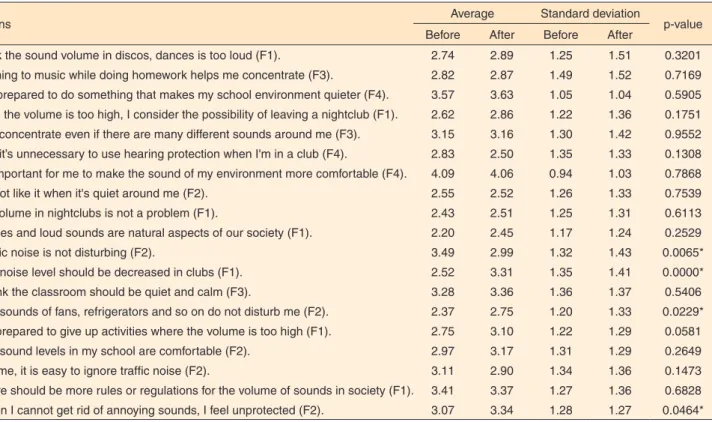
For the analysis of the scores of questions on the attitudes of young people toward noise, before and after the workshops, the average scores closest to five (the higher scores) represented more positive attitudes towards hearing health promotion. The results after the workshops showed that in 13 questions, there were positive changes in the understanding of young people, who began to consider noise as something bad and harmful to their health. A difference was observed (p<0.05) in questions related to the factors of “culture” (question 12) and “daily noise” (questions 11, 14 and 19) (Table 2).
For the question scores, before and after the educational workshop, according to the factors (culture, daily noise, ability to concentrate in noisy environments, and intent to influence the sound environment), differences were observed between the average for the “culture” factor (p=0.0247), which characterize changes in the attitudes of young people in relation to noise, associated with cultural elements, especially in leisure activities with music (Table 3).
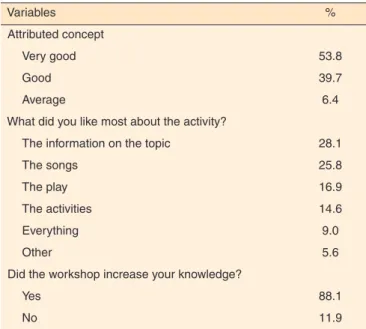
The results on the perception of adolescents with respect to educational activity which used a workshop as a methodological resource, and problem-posing education as a methodological model, showed that students found the activity very good or good in over 80% of assessments; asserting that the educational activity contributed to their expansion of knowledge on the sub-ject. The youth reported having enjoyed the activities proposed, highlighting what they like most in the workshop (Table 4).
Table 1. Comparison of the results of the questions on the attitudes of adolescents toward noise before and after the workshops
Questions
Agree Disagree Unsure Blank
Before After Before After Before After Before After
1. I think the sound volume in discos, dances is too loud (F1). 33.3 44.5* 60.0 48.9 6.7 3.3* 0.0 3.3
2. Listening to music while doing homework helps me concentrate (F3). 51.1 47.8 41.1 43.3* 7.8 5.6* 0.0 3.3
3. I am prepared to do something that makes my school environment quieter (F4). 56.7 58.9* 15.6 12.2 27.8 25.6* 0.0 3.3
4. When the volume is too high, I consider the possibility of leaving a nightclub (F1). 26.7 37.8* 53.3 43.3 18.9 15.6* 1.1 3.3
5. I can concentrate even if there are many different sounds around me (F3). 38.9 38.9 50.0* 50.0* 11.1 7.8* 0.0 3.3
6I think it’s unnecessary to use hearing protection when I'm in a club (F4). 50.0 57.8 36.7 28.9 11.1 8.9* 2.2 4.4
7. It is important for me to make the sound of my environment more comfortable (F4).
82.2 78.9 6.7 10.0 11.1 7.8* 0.0 3.3
8. I do not like it when it's quiet around me (F2). 57.8 61.1 24.5 25.6* 17.8 8.9* 0.0 4.4
9. The volume in nightclubs is not a problem (F1). 64.5 60.0 26.7 27.8* 8.9 8.9 0.0 3.3
10. Noises and loud sounds are natural aspects of our society (F1). 73.3 57.8 16.7 24.5* 10.0 14.4 0.0 3.3
11. Traffic noise is not disturbing (F2). 28.9 44.5 61.1 42.2 8.9 10.0 1.1 3.3
12. The noise level should be decreased in clubs (F1). 25.6 57.8* 60.0 27.8 14.4 11.1* 0.0 3.3
13. I think the classroom should be quiet and calm (F3). 51.1 51.2* 33.3 27.8 15.6 15.6 0.0 4.4
14. The sounds of fans, refrigerators and so on do not disturb me (F2). 66.7 50.0 23.3 28.9* 10.0 17.8 0.0 3.3
15. I'm prepared to give up activities where the volume is too high (F1). 34.5 41.1* 47.8 34.4 17.8 20.0 0.0 4.4
16. The sound levels in my school are comfortable (F2). 40.0 33.3 43.3 41.1 16.7 22.2 0.0 3.3
17. For me, it is easy to ignore traffic noise (F2). 40.0 44.5 53.3 41.1 6.7 11.1 0.0 3.3
18. There should be more rules or regulations for the volume of sounds in society (F1).
54.4 53.3 27.8 31.1* 17.8 11.1* 0.0 4.4
19. When I cannot get rid of annoying sounds, I feel unprotected (F2). 43.3 48.9* 41.1 27.8 15.6 20.0 0.0 3.3
* Significant values (p<0.05) - Student’s t test
Note: F1 = culture; F2 = daily noise; F3 = noisy environments; F4 = sound environment
Table 2. Comparison of the scores of questions on attitudes of young people toward noise before and after the workshop
Questions Average Standard deviation p-value
Before After Before After
1. I think the sound volume in discos, dances is too loud (F1). 2.74 2.89 1.25 1.51 0.3201
2. Listening to music while doing homework helps me concentrate (F3). 2.82 2.87 1.49 1.52 0.7169
3. I am prepared to do something that makes my school environment quieter (F4). 3.57 3.63 1.05 1.04 0.5905
4. When the volume is too high, I consider the possibility of leaving a nightclub (F1). 2.62 2.86 1.22 1.36 0.1751
5. I can concentrate even if there are many different sounds around me (F3). 3.15 3.16 1.30 1.42 0.9552
6I think it’s unnecessary to use hearing protection when I'm in a club (F4). 2.83 2.50 1.35 1.33 0.1308
7. It is important for me to make the sound of my environment more comfortable (F4). 4.09 4.06 0.94 1.03 0.7868
8. I do not like it when it's quiet around me (F2). 2.55 2.52 1.26 1.33 0.7539
9. The volume in nightclubs is not a problem (F1). 2.43 2.51 1.25 1.31 0.6113
10. Noises and loud sounds are natural aspects of our society (F1). 2.20 2.45 1.17 1.24 0.2529
11. Traffic noise is not disturbing (F2). 3.49 2.99 1.32 1.43 0.0065*
12. The noise level should be decreased in clubs (F1). 2.52 3.31 1.35 1.41 0.0000*
13. I think the classroom should be quiet and calm (F3). 3.28 3.36 1.36 1.37 0.5406
14. The sounds of fans, refrigerators and so on do not disturb me (F2). 2.37 2.75 1.20 1.33 0.0229*
15. I'm prepared to give up activities where the volume is too high (F1). 2.75 3.10 1.22 1.29 0.0581
16. The sound levels in my school are comfortable (F2). 2.97 3.17 1.31 1.29 0.2649
17. For me, it is easy to ignore traffic noise (F2). 3.11 2.90 1.34 1.36 0.1473
18. There should be more rules or regulations for the volume of sounds in society (F1). 3.41 3.37 1.27 1.36 0.6828
19. When I cannot get rid of annoying sounds, I feel unprotected (F2). 3.07 3.34 1.28 1.27 0.0464*
*Significant values (p<0.05) - Student’s t test
“It helped to clarify my uncertainties on the subject” “It informed me about noise prevention/ risk”
“I liked learning about noise in general and that it causes health problems”
“I understood more about noise pollution”
“I enjoyed the fun way everyone was involved, and about something that is very important”
“Having addressed this little discussed issue”
“I liked the University professors’ initiative in coming to our school”
“Congratulations for the dynamic activities, for me they achieved their goals”
“I learned a lot, because I liked to listen to loud music with the earphones at full volume”
“Very good work that will contribute to attitude changes” “I really liked that it increased my knowledge and concern for my health and my future generations”
“They could come more often and bring different s ubjects”
DISCUSSION
Studies show that hearing loss among teenagers may be caused by conditioning factors such as habits and attitudes/ behaviors developed by this group, making actions that provide clarification on this issue necessary. Noise-induced hearing loss (NIHL) can cause problems in the lives of young people regarding school performance, social impairment, and future professional life(8-12).
In this context, promoting hearing health means allowing for better quality of life and well-being for populations served by Speech-Language Pathology(13-16).
The results of this study showed that adolescents had ha-bits and attitudes/ inappropriate behavior that can be harmful and cause damage to their health (Table 1). In a comparative national study(8), habits and attitudes/ behaviors of adolescents
assessed by the authors were similar to the adolescents in the present study.
According to the authors, the most common habit among participants is listening to music with personal listening devi-ces (MP3, MP4 and iPod®), and that girls have more negative
attitudes towards noise than boys(8). The authors(8,12,17-19) report
that the concepts of adolescence and loud music are usually associated. Listening to loud music is a common habit among young people. The results of the study(12) related to the attitudes
of adolescents toward noise present in different locations, su-ggest that the current culture of youth does not seem to worry about the harmful effects of loud music.
However, as in the developed educational activity, changes were observed in the understanding of youth (Tables 1 and 2), who began to consider noise as something bad and harmful to their health. It can be inferred that a lack of information and interesting educational activities for young people contribute to inappropriate attitudes regarding hearing health and the effects of noise.
Significant differences in responses, before and after the workshops, were observed regarding “cultural” and “daily noise” (Table 2) and on scores of questions related to the “cultural” factor (Table 3). These results may have occurred through the dynamics of the workshops, where there was gre-ater interest among young people about clarification related
Table 3. Comparison of scores from questions before and after the workshops
Factors n Average Standard deviation p-value
Before After Before After
Culture (F1) 84 3.07 3.23 0.52 0.64 0.0247*
Daily noise (F2) 85 3.08 3.17 0.50 0.66 0.2348
Noisy environments (F3) 86 3.10 3.09 0.72 0.84 0.9392
Sound environment (F4) 84 3.62 3.71 0.72 0.67 0.3072
*Significant values (p<0.05) - Student’s t test
Note: The values of “n” ranged, varied because the test could only be applied when all questions were answered. Thus unanswered (blank) questions were excluded from this table
Table 4. Perception of adolescents about the educational activity (n=91)
Variables %
Attributed concept
Very good 53.8
Good 39.7
Average 6.4
What did you like most about the activity?
The information on the topic 28.1
The songs 25.8
The play 16.9
The activities 14.6
Everything 9.0
Other 5.6
Did the workshop increase your knowledge?
Yes 88.1
No 11.9
to leisure activities with music (loudness of clubs, concerts, personal listening devices, etc.), and daily noise (nuisance to neighbors, traffic, etc).
The perception of adolescents showed that the evaluation of the workshops was positive and the method was considered very good or good (Table 4). On that basis, the proposal of educational action with group participation was based on the recommendations of the Health Department(5), stating that
groups are special spaces for health promotion and disease prevention. This strategy is in accordance with the needs of the age group of adolescents, such as being part of a group, being heard and respected. It is also in this space of attention that a social safety net, which guarantees the rights of these individuals(5), can be built.
Problem-posing education as a method of hearing health education was chosen for being an active/ reflective method. Active, because it gives the group the opportunity to express thoughts and personal experiences; reflective, because to talk about their reality, solve a problem or defend an idea, the group needs to analyze, judge, propose solutions, and use their mental abilities to take care of their own health(6,7).
Thus, problem-posing education attempts to overcome the limitations of the traditional method or transmission of knowledge through lectures and standardized guidelines, as well as overcome the limitations of the conditioning method of dictating formulas/ rules of behavior(6,7,20-23), the latter two
traditionally being methods widely used in speech therapy. The interdisciplinary team mediating the workshops, con-tributed significantly to the success of the actions. The contri-bution in the field of nursing in relation to the problem-solving method and the contribution of hearing health in speech therapy were essential to the success of the educational workshops.
Moreover, the participation of nursing students in the theater aroused adolescents’ interest in the topic, influencing them in thinking about healthier habits. The foundations of social cognitive theory(24) reinforce behaviors that are learned and
adapted from interpersonal relationships with others and with the environment in a reciprocal model, in which the subjects can understand and anticipate the results of a prescribed behavior. In this perspective, actions for promotion and prevention are recommended, involving healthy young people, with a proper lifestyle, able to influence others(25).
The speech of interviewed teenagers about their perception of the dynamics of the workshops showed appreciation and approval of the proposed activities. For authors(26-29), health
education, in working with adolescents, should understand the development of actions that democratize access to information. Such access is necessary to provide them with health and other social rights. They are actions that should contribute to the formation of critical awareness and encourage the exercise of social control and the development of solidarity and justice, which are converging aspects for health and education.
Although this educational activity was performed in two
workshops, being a possible limitation of the study, the results showed that there was transformation, because the students took a position that they didn’t have before and reworked their knowledge using different ways of speaking. They demons-trated attitudes of support and affection with each other, and said they gained new knowledge about the effects of noise. It is recommended that this intervention model be replicated in other schools and revalidated in other studies.
It should be pointed out that the program to promote health and prevent hearing loss continued throughout the school year at the school, with a situational analysis of the determinants of health and students’ audiological profile analysis. Another step developed in the school was youth leadership in health(30),
encouraging and educating young people as hearing health agents to continue the educational activities in school.
With this in mind, we encourage speech-language patho-logists and other professionals to develop programs aimed at the promotion and protection of health in schools, and to use the strategy of problem-posing education in educational workshops. We suggest that hearing health and quality of life be in the focus of adolescent health promotion.
The educational sector, for its comprehensiveness and sco-pe, is an important ally to the achievement of health promotion actions aimed at strengthening the capacities of individuals, making decisions favorable to their health and the health of the community. It allows for the creation of healthy environments, and consolidation of inter-sector policy aimed at quality of life, based on respect for the individual and focusing on the construction of a new health culture.
For a more efficient operation, there is a need to train pro-fessionals focused on health promotion and problem-posing education so that these professionals can contribute more effectively to improve adolescents’ quality of life and enhance their training as citizens.
CONCLUSION
Changes were observed in the understanding of young people, especially on the effects of noise on cultural activities. The playful and dialogical strategies proposed in the work-shops were accepted and appreciated by the teenagers. The educational workshops proposed are appropriate for adolescent hearing health education.
REFERENCES
1. Brasil. Instituto Brasileiro de Geografia e Estatística. Pesquisa Nacional de Saúde do Escolar (PeNSE) 2009. Rio de Janeiro: IBGE; 2009. [Internet]. [acesso em: 2011 dez]. Disponível em: http://www. ibge.gov.br/home/estatistica/populacao/pense/
3. Morata TC. Young people: their noise and music exposures and the risk of hearing loss. Int J Audiol. 2007;46(3):111-2.
4. Araújo A, Rocha RL, Armond LC. Da tendência grupal aos grupos operativos com adolescentes: a identificação dos pares facilitando o processo de orientação e educação em saúde. Revista Médica de Minas Gerais. 2008;18(4-S1):123-30.
5. Brasil. Ministério da Saúde. Secretaria de Atenção em Saúde. Departamento de Ações Programáticas Estratégicas. Área Técnica de Saúde do Adolescente e do Jovem. Diretrizes nacionais para a atenção integral à saúde de adolescentes e jovens na promoção, proteção e recuperação da saúde. Série A. Normas e Manuais Técnicos. Brasília: Ministério da Saúde; 2010.
6. Kruschewsky JE, Kruschewsky ME, Cardoso JP. Experiências
pedagógicas de educação popular em saúde: a pedagogia tradicional versus a problematizadora, um estudo de revisão. Rev Saúde Com. 2008Jul/Dez;4(2):160-76.
7. Alvim NAT, Ferreira MA. Perspectiva problematizadora da educação
popular em saúde e a enfermagem. Texto Contexto Enferm. Florianópolis. 2007Abr-Jun;16(2):315-19.
8. Zocoli AMF, Morata TC, Marques JM. Adaptação para o português
brasileiro do questionário Youth Attitude to Noise Scale (YANS). Rev Bras Otorrinolaringol. 2009;75(4):485-92.
9. Olsen SE. Psychological aspects of adolescents’ perceptions and habits in noisy environments [tese]. Sweden: Departament of Psycology - Göteborg University; 2004.
10. Serra MR, Biassoni EC, Richter U, Minoldo G, Franco G, Abraham S, et al. Recreational noise exposure and effects on the hearing of adolescents. Part I: An interdisciplinary long-termstudy. Int J Audiol. 2005Feb;44(2):65-73.
11. Serra MR, Biassoni EC, Hinalaf M, Pavlik M, Villalobo JP, Curet C et al. Program for the conservation and promotion of hearing among adolescents. Am J Audiol. 2007Dec:16(2):158-64.
12. Lacerda ABM, Gonçalves CGO, Zocoli A, Dias C, Paula K. Hábitos auditivos e comportamento de adolescentes diante das atividades de lazer ruidosas. Rev CEFAC. 2011;13(2):322-9.
13. Penteado RZ, Servilha EAM. Fonoaudióloga em saúde publica/ coletiva: compreendendo a prevenção e o paradigma da promoção da saúde. Distúrb Comun. 2004;16(1):107-16.
14. Lipay MS, Almeida EC. A fonoaudiologia e sua inserção na saúde pública. Rev Ciênc Méd. 2007Jan-Fev;16(1):31-41.
15. Almeida SMVT, Reis RA. Políticas públicas de saúde em fonoaudiologia. In: Fernandes FDM, Mendes BCA, Navas ALPGP (Orgs.). Tratado de fonoaudiologia. 2a. ed. São Paulo: Roca; 2009. p.640-55.
16. Chum RYS. Promoção da saúde e a produção do cuidado em fonoaudiologia. In: Fernandes FDM, Mendes BCA, Navas ALPGP (Orgs.). Tratado de Fonoaudiologia. 2a.ed. São Paulo: Roca; 2009. p. 605-11.
17. Soares VNM, Lacerda ABM, Lopes FC, TestoniRI. Perfil de saúde, comportamentos e hábitos auditivos de escolares em Curitiba.Tuiuti: Ciência e Cultura, Curitiba. 2013;46:137-49.
18. Samelli AG, Schochat E. Perda auditiva induzida por nível de pressão sonora elevado em um grupo de músicos profissionais de rock-and-roll. Acta AWHO. 2000Jul-Set;19(3):136-43.
19. Luz TS, Borja ALVF. Sintomas auditivos em usuários de estéreos pessoais. Int Arch Otorhinolaryngol. 2012;16(2):163-9.
20. Bordenave JED. Alguns fatores pedagógicos. Revista Interamericana de Educação de Adultos. 1983;(3):1-2.
21. Ferreira MA. Educação na adolescência: grupo de discussão como estratégia de pesquisa e cuidado-educação. Texto & contexto enferm. 2006Abr-Jun;15(2):205-11.
22. Campos JDB, Zuanon ACC. Educação em saúde: aspectos relevantes apontados por adolescentes. Ciênc Odontol Braz. 2004Abr-Jun;7(2):55-60.
23. Souza AC, Colomé ICS, Costa LED, Oliveira DLLC. A educação em saúde com grupos na comunidade: uma estratégia facilitadora da promoção da saúde. Rev Gaúcha Enferm. 2005Ago;26(2):147-53. 24. Bandura A. Social foundations of thought and action: a social
cognitive theory. Engle Wood Cliffs: Prentice Hall. 1986
25. Sobel J, Meikle M. Applying health behavior theory to hearing-conservation interventions. Semin Hear. 2008;29(1):81-9.
26. Camargo M. Oficina de educação em saúde com adolescentes: relações de trocas interindividuais no contexto das interações. Cadernos de Aplicação. 2008;21(2):571-79.
27. Horta NC, Sena RR. Abordagem ao adolescente e ao jovem nas políticas públicas de saúde no Brasil: um estudo de revisão. Physis. 2010;20(2):475-95.
28. Horta NC, Lage AMD, Sena RR. Produção científica sobre políticas públicas direcionadas para jovens. Rev Enferm UERJ. 2009;17(4):538-43.
29. Santos AAG, Silva RM, Machado MFAS, Vieira LJES, Catrib AMFJ, Herla MF. Sentidos atribuídos por profissionais à promoção da saúde do adolescente. Cien Saude Colet. 2012;17(5):1275-84.
Appendix 1. Play about noise risks
(Narrator) You will now watch the play: “In the swing of the bus”
(Narrator): John Victor takes the bus Inter II in Curitiba, and finds his friend Carlos.
(Trying to talk to Carlos, John Victor, talking loudly, who already
has hearing loss because is always listening to loud music on his earphones, was enjoying a song and shrugging as if they were dancing
1. John Victor: So Carlos, how’s it going? (High fiving in a boisterous greeting)
1. Carlos: Cool.
2. John Victor: Yeah, this week will be the royal wedding (London)
2. Carlos: What are you talking about, man?
3. John Victor: I also enjoy soft bedding.
3. Carlos: (looks at his friend, as if expecting some comment, for
not listening to what was said) (exchanges some positive signs and facial expressions)
4. John Victor: And are you still dating Jennifer?
4. Carlos: Yeah, and she has the most beautiful pair of legs I’ve ever
seen.
5. John Victor: You walk with her to see eggs? It is better to go to the movies, and such.
PASSENGER: COMPLAINS ABOUT THE LOUD NOISE DRIVER: BRAKES – GET OUT OF THE WAY, DOG
5. Carlos: Yeah ... Jennifer is very special, she always listens to me and besides being my date she is my friend.
6. John Victor: Don’t let it be the end. Stay with her, she’s a cool girl. 6. Carlos: Can’t talk to you man, I think you are crazy.
7. John Victor: Yeah, it’s getting hazy out.
7. Carlos: John Victor, can you hear what I say? 8. John Victor: Yeah, (nods) it is a nice day?
8. Carlos: I didn’t say anything like that. I think you’re going deaf. 9. John Victor: What about death? I don’t follow you, man.
PASSENGER: COMPLAINS ABOUT THE LOUD NOISE
DRIVER: HEY! A SPEED BUMP.
9. Carlos: I said you’re deaf. You don’t hear anything I say.
10. John Victor Oh! If she thinks about death all day, you shouldn’t
even go out with her anymore.
10. Carlos: I said you’re going deaf, not that other stuff.
11. John Victor: Yeah, it is a tough thing to do.
11. Carlos: (vehement, already losing patience) Damn dude, it’s
impossible to talk with you, you’re deaf as a door.
12. John Victor: You keep wanting more? You need to see a doctor
then. Get some help.
12. Carlos: (now losing it, takes his friend’s phone) Dude, pay attention,
that’s not what I said (speaking calmly, articulating his words to make
his friend read his lips). I said you’re going deaf.
13. John Victor: Wait man, there’s still music left, sure. Let me change
the song. Something that will calm you down. Something so loud that
it makes your heart vibrate.
13. Carlos: Boy, I’ll tell you something serious, if you are not careful,
your poor hearing will hurt you bad.
14. John Victor: Yeah, if you break up with her, it will make her mad.
14. Carlos: Dude, this ain’t working. Ever since you started listening to
that music full blast on your ultra-mega-hyper-potent MP3 player, it’s
not possible to have a conversation with you. (Leaves without saying
good bye, gesturing angrily)
15. John Victor: (turning to audience) There are people who cannot
enjoy the finer things in life. But ... wait?? I think I lost another friend???
I’m getting off .... out of the way guys!!! (Turns, leaving the scene)
Appendix 2. Song about noise-rhythm Funk
Funk of noise
I am MC John
I come to tell you
One important thing
That everyone should know
The issue is noise
It does us so much harm
Be sure, be sure
Because you don’t hear the same no more
Chorus: Boys, boys it’s the funk of noise, Boys, boys it’s the funk of noise
We made this funk
For you to be aware
That the health of ears
We must also take care
But if you do not know how
We will teach you
Lower the volume
When you are listening
Chorus: Boys, boys it’s the funk of noise, Boys, boys it’s the funk of noise
And the noise does not choose
Neither person nor age
Every day, every hour
Take our freedom away
But we have the right
To put an end to it
Just put in the ear plugs
All need to start wearing it