Mestre em Bioengenharia
Development of an integrated process of
membrane filtration for harvesting microalgae
and recovery of high-value compounds
Dissertação para obtenção do Grau de Doutor em Engenharia Química e Bioquímica
Orientador: Carla Maria Carvalho Gil Brazinha de Barros
Ferreira, Investigadora de Pós-doutoramento, Faculdade
de Ciências e Tecnologia – Universidade Nova de Lisboa
Co-orientador: João Paulo Serejo Goulão Crespo,
Professor Catedrático, Faculdade de Ciências e
Tecnologia – Universidade Nova de Lisboa
Júri:
Presidente: Prof. Doutor José Paulo Barbosa Mota Arguente(s): Prof. Doutora Susana Luque Rodríguez
Prof. Doutora Maria João Filipe Rosa
Vogais: Doutor Luís Filipe Amaro da Costa Prof. Doutora Isabel Maria Rôla Coelhoso
i
Development of an integrated process of membrane filtration for harvesting microalgae and recovery of high-value compounds
Copyright © Joana Isabel Carvalho do Monte, Faculdade de Ciências e Tecnologia, Universidade NOVA de Lisboa.
A Faculdade de Ciências e Tecnologia e a Universidade Nova de Lisboa têm o direito, perpétuo e sem limites geográficos, de arquivar e publicar esta dissertação através de exemplares impressos reproduzidos em papel ou de forma digital, ou por qualquer outro meio conhecido ou que venha a ser inventado, e de a divulgar através de repositórios científicos e de admitir a sua cópia e distribuição com objetivos educacionais ou de investigação, não comerciais, desde que seja dado crédito ao autor e editor.
iii
v
ACKNOWLEDGMENTS
A realização desta tese contou com importantes incentivos e contributos, sem os quais não se teria tornado possível e aos quais estarei eternamente grata.
Ao terminar esta importante jornada gostaria de agradecer, em primeiro lugar, aos meus orientadores, a Doutora Carla Brazinha e o Professor João Paulo Crespo, por me darem a conhecer o mundo das membranas e por me terem ensinado tanto e dado a oportunidade de colaborar no Projeto Europeu. Agradeço o tempo e interesse que dispensaram comigo durante estes anos e por me terem sempre incentivado a fazer mais e melhor. Agradeço ainda por me terem dado a oportunidade de participar em diversas conferências e colaborações de modo a divulgar o meu trabalho e a aprender sempre mais. Gostaria de agradecer de forma especial à Carla, pelo apoio nas fases mais complicadas do trabalho, pelas horas desgastantes durante o Projeto e por me incentivar quando parecia mais desanimada. Obrigada pelo acompanhamento contínuo ao longo do doutoramento. Ao Professor, agradeço pelas discussões e por trazer sempre um ponto de vista científico diferente que me fazia questionar e repensar no trabalho de forma mais criativa.
Agradeço à Doutora Cláudia Galinha, à Doutora Vanessa Pereira e à Professora Susana Casal, que me ajudaram no desenvolvimento do trabalho. Obrigada pela vossa simpatia, disponibilidade, generosidade e paciência.
Agradeço ainda ao Programa Europeu de Investigação “FP7 – D-Factory” que me concedeu a bolsa para o desenvolvimento do trabalho e por me ter dado a oportunidade de trabalhar com diversas Instituições Europeias.
Um agradecimento especial à A4F – Algae for Future, e a todos os colaboradores que trabalharam comigo durante estes anos, em especial ao Doutor Luís Costa, à Celina Parreira, à Joana Galante, à Ana Rita Serra e à Cláudia Ribeiro. Obrigada pela partilha de conhecimentos e por terem colaborado neste projeto.
Agradeço à D. Maria José e a D. Palminha pela forma como sempre me ajudaram, com boa disposição e um sorriso.
Obrigada a todo o grupo de membranas e ao BioEng, em especial à Carla Martins, ao Usman, à Paloma, à Mariella e à Virgínia. Obrigada por terem tornado esta minha jornada menos difícil e pela partilha de bons momentos.
Obrigada Rita, pela tua amizade sincera, pelas conversas, pelos desabafos, pela ajuda, pelos risos e pelos choros. Obrigada por estares sempre presente e pelo teu apoio incondicional. Agradeço à Maria João, por se ter tornado uma amiga e confidente e por ser um exemplo de força e determinação. Obrigada à Mafalda, por sempre me ter dado força quando mais precisava, pelos cafés que partilhamos
vi e pela amizade. Obrigada à minha grupeta de almoço: ao Jorge, à Sofia, à Inês, à Carmo e à Mafalda Lopes, por se terem tornado bons amigos e pelos almoços descontraídos em tempos atribulados. A todos vocês, vou levar-vos no coração.
Obrigada à Ana, à Cató, à Catarina, ao Miguel, ao João P., ao José, à Maria e ao João A., os meus amigos de sempre e para sempre!
À Ana, um agradecimento especial e sincero, por ter sido a minha família em Lisboa. Obrigada pelas longas conversas, pelos conselhos, pelos ensinamentos, pelas gargalhadas, pelo carinho e por se ter tornado uma pessoa tão essencial na minha vida. Já estou com saudades!
Muito obrigada à minha família, por nunca me ter cobrado as ausências nas datas mais importantes. Obrigada aos meus avós, tios e primos. Obrigada em especial à minha mãe e ao meu pai, que sempre me incentivaram na decisão de fazer o doutoramento, e me deram o suporte emocional e a força para nunca desistir. Obrigada às minhas irmãs, a Helena e a Marta, que apesar da distância, sempre estiveram comigo e me deram coragem em momentos difíceis. Obrigada também à minha irmã emprestada, a Ritinha. Obrigada pelo apoio e amor incondicional de todos vocês, sem isso, tudo seria muito mais difícil.
Por fim, mas não menos importante, obrigada ao Nelson, por ter sido o meu apoio incondicional, por me ajudar a lutar pelos meus objetivos e por nunca me deixar desistir. Obrigada pelo amor, pelo companheirismo, pela paciência e por me fazeres rir nos momentos menos bons. Contigo tudo se tornou mais simples!
vii
ABSTRACT
The work presented in this PhD thesis aims at developing an integrated method for harvesting Dunaliella salina, both in the non-carotenogenic and in the carotenoid-rich phases, using membrane processes and centrifuges. Additionally, the ultimate goal is the recovery of high-value compounds for application in the food, cosmetic and pharmaceutical industries. Dunaliella salina is a halotolerant green microalga, which under low nitrogen and high salinity conditions, produces carotenoids. This microalga is very fragile due to lack of a rigid cell wall and, consequently, can be easily ruptured when an excessive shear stress is applied.
Firstly, the pre-concentration of Dunaliella salina by membrane filtration prior to a final harvesting step by centrifugation was performed. The aim of the integrated harvesting process was to minimise the overall energy expenditure and reduce capital costs, while assuring a minimal loss of cell integrity. For the harvesting experiments the main parameters were optimised, namely: cross-flow velocity (vcross-flow), transmembrane pressure (TMP), membrane molecular weight cut-off (MWCO), backflush protocol and permeate volumetric flux (JV). The harvesting of non-carotenogenic Dunaliella salina by ultrafiltration, under controlled transmembrane pressure, allowed a final concentration factor of 5.9 and an average permeate flux of 31 L/(m2.h). The harvesting of carotenoid-rich Dunaliella salina, under controlled permeate flux, reached a concentration factor of 10, at a permeate volumetric flux of 21 L/(m2.h). The integrated process led to a reduction of Total Cost of Ownership (TCO) and energy consumption of 70% and 76%, respectively, when comparing with harvesting only with centrifuges (one-step approach). Additionally, several oxidation processes were studied for treatment of the permeate recovered, after membrane harvesting, in order to assess its recycle as cultivation medium for Dunaliella salina. The permeate was treated either by ozonation or by UV radiation, and the different types of permeate were tested as cultivation media. The results obtained indicate that the permeate treated by UV with addition of H2O2 was best suited for the growth of carotenoid-rich Dunaliella salina. Nevertheless, the use of untreated permeate seems a reasonable alternative, considering that it might be the most cost efficient solution.
Finally, a Dunaliella salina biorefinery process was developed for the recovery and fractionation of added-value compounds, with a particular focus on the recovery of polar lipids. This work combined extraction with REACH solvents, a saponification reaction and organic solvent nanofiltration processes to obtain distinct fractions of compounds. Overall, high recoveries were obtained (85% of carotenoids, 86% of glycerol, 94% of polar lipids and 95% of proteins), as well as fractions with high product enrichment in polar lipids and in glycerol.
Keywords: Dunaliella salina, Membrane harvesting, Permeate recycling, Microalgae biorefinery,
ix
RESUMO
O trabalho apresentado nesta tese de doutoramento tem como objetivo desenvolver um método integrado de colheita de Dunaliella salina, quer em fase não-carotenogénica como em fase rica em carotenoides, utilizando processos de membranas e centrífugas. O objetivo final é a recuperação de compostos de valor acrescentado para utilização nas indústrias alimentar, cosmética ou farmacêutica. A Dunaliella salina é uma microalga verde halotolerante que, sob condições de baixo teor em azoto e elevada salinidade, produz carotenoides. Esta microalga é muito frágil devido à ausência de parede celular rígida e pode ser facilmente rompida quando uma tensão de corte excessiva é aplicada. Em primeiro lugar, foi realizada a pré-concentração de Dunaliella salina por filtração com membranas, de forma a facilitar a sua concentração final por centrifugação. O objetivo do processo integrado de colheita é minimizar os gastos de energia e reduzir os custos de capital, assegurando uma perda mínima de integridade celular. Os estudos de colheita celular foram realizados com o objetivo de otimizar os parâmetros operacionais mais relevantes, nomeadamente: a velocidade de escoamento (vcross-flow), a pressão transmembranar (TMP), o limite de corte da membrana (MWCO), o procedimento de retro-lavagem in-situ e o fluxo volumétrico de permeado (JV). A colheita de Dunaliella salina não carotenogénica por ultrafiltração, a pressão transmembranar controlada, atingiu um fator de concentração de 5.9 e um fluxo médio de permeado de 31 L/(m2.h). A colheita de Dunaliella salina rica em carotenoides, realizada sob condições controladas de fluxo de permeado, atingiu um fator de concentração de 10, com um fluxo volumétrico de permeado de 21 L/(m2.h). O processo integrado conduziu a uma redução do custo total de propriedade (TCO) e do consumo de energia de 70% e 76%, respetivamente, quando comparado com a colheita realizada apenas por centrifugação.
Adicionalmente, foram estudados vários processos de oxidação para o tratamento do permeado, após a colheita por membranas, de modo a avaliar a sua reutilização como meio de cultivo de Dunaliella salina. O permeado foi tratado alternativamente por ozonação e por radiação UV, e os diferentes tipos de permeado foram testados como meio de cultivo. Os resultados obtidos indicam que o permeado tratado por UV com adição de H2O2 foi o mais adequado para o crescimento de Dunaliella salina rica em carotenoides. No entanto, o uso de permeado não tratado parece ser igualmente uma alternativa razoável, visto ser a solução mais económica.
Finalmente, foi desenvolvido um processo integrado de biorefinaria de modo a recuperar e fracionar compostos de valor acrescentado, nomeadamente lípidos polares. Este trabalho combinou a extração com solventes REACH, uma reação de saponificação e processos de membranas resistentes a solventes de forma a obter frações enriquecidas em compostos distintos. No final, foram obtidos graus elevados de recuperação (85% de carotenoides, 86% de glicerol, 94% de lipídios polares e 95% de proteínas), além de frações com elevado enriquecimento em lípidos polares e em glicerol.
Palavras-chave: Dunaliella salina, Colheita por membranas, Reutilização do permeado, Biorefinaria
xi
CONTENTS
Acknowledgments ... v Abstract ... vii Resumo ... ix Contents ... xiList of Figures ... xvii
List of Tables ... xxi
List of Acronyms ... xxiii
1 Background and Motivation ... 1
1.1 Background and Motivation ... 1
1.2 Research strategy and Objectives ... 5
1.3 Thesis Outline ... 7
2 Harvesting of non-carotenogenic Dunaliella salina by membrane filtration at pilot scale ... 11
2.1 Summary ... 11
2.2 Introduction ... 11
2.3 Materials and Methods ... 13
2.3.1 Materials ... 13
2.3.2 Membrane experimental set-up and operation at pilot scale ... 14
2.3.3 Operating conditions ... 14
2.3.4 Characterisation of the biomass ... 16
2.3.5 Integrated membrane pre-harvesting with Spiral Plate centrifugation units ... 16
2.4 Results and Discussion ... 16
2.4.1 Preliminary tests for evaluating the effect of cross-flow velocity on the pre-concentration of Dunaliella salina ... 16
2.4.2 Effect of different operating conditions on the pre-concentration of Dunaliella salina . 17 2.4.2.1 Effect of membrane pore size ... 18
2.4.2.2 Effect of backflush intervals ... 19
2.4.2.3 Effect of transmembrane pressure ... 20
xii
2.4.4 Chemical cleaning ... 22
2.4.5 Comparison of energy and Total Cost of Ownership of an integrated membrane pre-harvesting with Spiral Plate centrifugation and of a stand-alone Spiral Plate centrifugation process ... 23
2.5 Conclusions ... 24
3 Development of an integrated process of membrane filtration for harvesting carotenoid-rich Dunaliella salina at laboratory and pilot scales ... 27
3.1 Summary ... 27
3.2 Introduction ... 27
3.3 Materials and Methods ... 29
3.3.1 Culture of carotenoid-rich Dunaliella salina ... 29
3.3.2 Pre-concentration by membrane processing of carotenoid-rich phase Dunaliella salina ... 29
3.3.3 Membrane set-up for cross-flow experiments at laboratory and pilot scale ... 29
3.3.4 Operating conditions ... 30
3.3.5 Characterisation of the biomass ... 31
3.3.6 Integrated harvesting process with membrane filtration and Spiral Plate centrifugation . ... 32
3.4 Results and Discussion ... 32
3.4.1 Effect of cross-flow velocity ... 32
3.4.2 Selection of operational parameters on the membrane pre-concentration ... 33
3.4.2.1 Selection of membrane molecular weight cut-off (MWCO) ... 33
3.4.2.2 Evaluation of relaxation cycles ... 35
3.4.2.3 Selection of the imposed volumetric permeate flux (JV) ... 36
3.4.3 Pilot scale studies ... 37
3.4.4 Comparison of the economic evaluation of the integrated process and the stand-alone Spiral Plate Technology centrifuge ... 38
3.5 Conclusions ... 40
4 Recycling of Dunaliella salina cultivation medium by integrated membrane filtration and advanced oxidation ... 41
4.1 Summary ... 41
xiii
4.3 Materials and Methods ... 43
4.3.1 Materials ... 43
4.3.2 Dunaliella salina culture with fresh cultivation medium ... 44
4.3.3 Harvesting of Dunaliella salina: pre-concentration by membrane processing ... 44
4.3.4 Oxidation and photodegradation treatments – small scale preliminary optimisation experiments ... 46
4.3.4.1 Ozonation treatment ... 46
4.3.4.2 UV treatment ... 47
4.3.5 Production of treated permeate with optimised conditions – scale-up experiments .... 47
4.3.5.1 Ozone treatment with addition of H2O2 ... 48
4.3.5.2 UV treatment with addition of H2O2 ... 48
4.3.6 Dunaliella salina cultivation using differently treated recycling media ... 48
4.3.7 Analytical methods ... 48
4.3.7.1 Characterisation of the treated permeates ... 48
4.3.7.2 Culture characterisation ... 49
4.4 Results and Discussion ... 49
4.4.1 Optimisation of oxidation and photodegradation treatments at small scale – Ozonation and UV radiation ... 49
4.4.1.1 Evaluation of the ozone treatment at small scale conditions ... 49
4.4.1.2 Evaluation of the UV treatment at small scale ... 51
4.4.2 Scale-up of the oxidation treatments – Ozonation with H2O2 and UV radiation with H2O2 ... 52
4.4.3 Dunaliella salina cultivation using different recycled media after treatment ... 53
4.5 Conclusions ... 57
5 Biorefinery of Dunaliella salina: sustainable recovery of carotenoids, polar lipids and glycerol .... ... 59
5.1 Summary ... 59
5.2 Introduction ... 59
5.3 Materials and Methods ... 61
5.3.1 Materials ... 61
xiv
5.3.3 Experimental procedure ... 61
5.3.3.1 Cell disruption procedure ... 62
5.3.3.2 Solvent extraction ... 62
5.3.3.3 Experimental procedure for saponification of the n-heptane extract from Dunaliella salina ... 63
5.3.3.4 Membrane processing ... 63
5.3.4 Analytical methods ... 63
5.3.4.1 Quantification of Carotenoids ... 63
5.3.4.2 Quantification of glycerides and free fatty acids (FFAs) ... 64
5.3.4.3 Quantification of glycerol, proteins and carbohydrates ... 64
5.3.4.4 Quantification of Polar Lipids ... 65
5.4 Results and Discussion ... 65
5.4.1 Design of a biorefinery based on carotenoid-rich Dunaliella salina ... 65
5.4.2 Organophilic route for the recovery of carotenoids and free fatty acids (FFAs) ... 66
5.4.2.1 Optimisation of saponification of the n-heptane extract for the recovery of carotenoids and free fatty acids (FFAs) ... 66
5.4.2.2 Separation of carotenoids from free fatty acids (FFAs) by organic solvent nanofiltration (OSN) ... 67
5.4.3 Hydroethanolic route for the recovery of glycerol, polar lipids, proteins and carbohydrates ... 69
5.4.3.1 Separation of glycerol from the proteins and carbohydrates by organic solvent nanofiltration (OSN) ... 69
5.4.3.2 Separation and purification of polar lipids from the proteins and carbohydrates ... 70
5.4.4 Recovery of added-value compounds from Dunaliella salina biomass ... 70
5.4.5 Economic evaluation ... 73
5.5 Conclusions ... 75
6 Conclusions and Future work ... 77
6.1 General conclusions ... 77
6.2 Future Work ... 78
Bibliography ... 81
xv A.1. Supplementary Material for the biorefinery of Dunaliella salina (Chapter 5) ... 93
xvii
LIST OF FIGURES
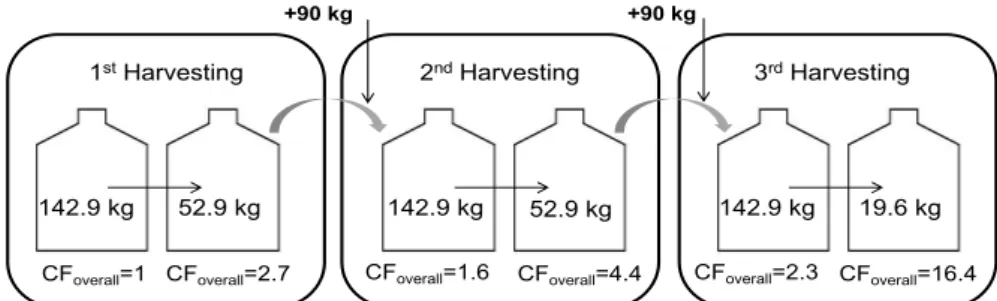
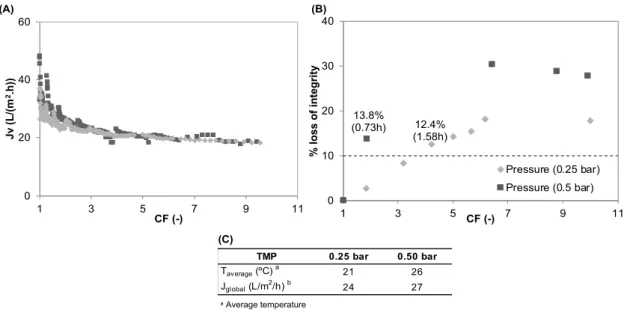
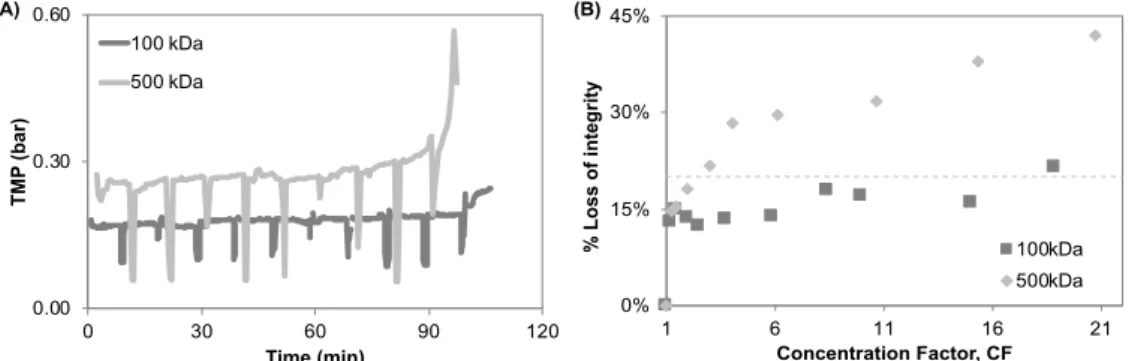
Figure 1.1. Schematic representation of the downstream processing of a microalgae biorefinery, including the main steps, compounds and applications. ... 5 Figure 1.2. Schematic representation of several tasks involved in this PhD work. ... 7 Figure 2.1. Representation of Liqoflux pilot unit, from Turbin. ... 14 Figure 2.2. Schematic representation of the procedure used during the consecutive harvesting batches. ... 15 Figure 2.3. Comparison of (A) volumetric permeate flux and (B) percentage of Dunaliella salina loss of integrity along the harvesting process, plotted against the concentration factor, CF. The dashed horizontal line on (B) refers to 10% of loss of integrity. (C) Average temperatures and global average fluxes for the microfiltration and the ultrafiltration studies. ... 18 Figure 2.4. Comparison of (A) volumetric permeate flux and (B) percentage of Dunaliella salina loss of integrity plotted against the concentration factor, CF. The dashed horizontal line on (B) refers to 10% of loss of integrity. (C) shows the average temperatures and the overall average flux for the two backflushing intervals (6 and 20 minutes). ... 19 Figure 2.5. Comparison of (A) volumetric permeate flux and (B) percentage of Dunaliella salina loss of integrity plotted against the concentration factor, CF. The dashed horizontal line on (B) refers to 10% of loss of integrity. The average temperatures and overall average fluxes at the transmembrane pressures of 0.25 bar and 0.50 bar are shown in (C). ... 20 Figure 2.6. Consecutive green Dunaliella salina harvesting steps. (A) Evolvement of volumetric permeate flux and (B) of percentage of Dunaliella salina loss of integrity during the harvesting process, plotted against the concentration factor, CF. The dashed horizontal line on (B) refers to 10% of loss of integrity. (C) Average temperature and overall average permeate fluxes during the three consecutive harvestings. ... 22 Figure 3.1. Scheme of laboratory and pilot scale membrane units used for carotenoid-rich Dunaliella salina harvesting (dark arrows represent the feed recirculation and dashed arrows correspond to the permeate flow). ... 30 Figure 3.2. Graphical representation of (A) transmembrane pressure (TMP, bar) plotted against time and (B) percentage of loss of integrity during the membrane harvesting using membranes with different MWCO, plotted against the concentration factor, CF (-). ... 34 Figure 3.3. Graphical representation of (A) transmembrane pressure (TMP, bar) plotted against time and (B) percentage of loss of integrity during the membrane harvesting with 100kDa membrane with relaxation and without relaxation cycles, plotted against the concentration factor, CF (-). ... 35
xviii Figure 3.4. Graphical representation of (A) transmembrane pressure (TMP, bar) plotted against time and (B) percentage of loss of integrity during the membrane harvesting at different volumetric permeate fluxes (JV = 10, 25 and 30 L/(m2.h)), plotted against the concentration factor, CF (-). ... 36 Figure 3.5. Microscopic observation of Dunaliella salina cells after pre-concentration experiments until a concentration factor of 5 (A) and until a concentration factor of 10 (B). ... 38 Figure 3.6. Flowchart of the harvesting of Dunaliella salina. Flow rates of the different streams for processing 151 m3/h of culture using (A) a one-step approach with Evodos 50 centrifuges and (B) a two-step approach integrating membrane processing (with a CF of 10) and Evodos 50 centrifuges. . 38 Figure 4.1. Representation of the small pilot membrane unit for Dunaliella salina harvesting. ... 44 Figure 4.2. Schematic representation of the procedure used during the consecutive harvesting batches. ... 45 Figure 4.3. Ozone concentration (in mg O3/L) in the permeates treated by: ozonation; ozonation with the addition of H2O2; ozonation after an initial pH adjustment to pH 9. Measurements were performed every 20 minutes. Data shown as mean ± standard deviation (n=3). ... 50 Figure 4.4. Glycerol normalised concentration (A) and nitrate content (B) (mg/L) measured in the permeates treated by ozonation, ozonation with the addition of H2O2 and ozonation after an initial pH adjustment to pH 9. Measurements were performed every 20 minutes. Data shown as mean ± standard deviation (n=3). ... 50 Figure 4.5. Glycerol normalised concentration (A) and nitrate content (B) (mg/L) measured in the permeates treated by UV, UV with addition of H2O2 and UV after an initial pH adjustment to pH 9. Measurements were performed every 1 hour. Data shown as mean ± standard deviation (n=3). ... 51 Figure 4.6. Glycerol normalised concentration (A) and nitrate content (B) measured in the permeates treated by UV with addition of H2O2 and ozonation with addition H2O2, during a 6 hour experiment at scale-up conditions. Measurements were performed every 1 hour. Data shown as mean ± standard deviation (n=3). ... 52 Figure 4.7. Dunaliella salina DF40 recycled medium trial in orange growth phase with (A) Fresh cultivation medium (negative control); (B) untreated permeate; (C) permeate treated by UV with addition of H2O2 and (D) permeate treated by ozonation with addition of H2O2. The recycling medium experiments were performed in triplicate. ... 54 Figure 4.8. Overall (A) culture growth and the corresponding Car/Chl ratio and (B) carotenoid volumetric concentration for the Dunaliella salina DF40 recycled medium trial in orange growth stage. The bars correspond to (A) Car/Chl ratio and (B) carotenoids volumetric concentration and the symbols correspond to cell density. Data shown as mean Å} standard deviation (n=3). ... 56 Figure 4.9. Qualitative bacterial load throughout the Dunaliella salina DF40 recycled medium trial in orange growth stage. Cultivation in each medium regime was conducted in triplicate and the observed bacterial load was consistent in each measurement of the replicates. ... 57
xix Figure 5.1. Scheme of the main processing steps of Dunaliella salina, considering the biorefinery scheme proposed in this work. Legend: FFAs (free fatty acids). ... 62 Figure 5.2. Flow chart of the biorefinery proposed for the production of target compounds from Dunaliella salina biomass (a detailed flow chart, which includes the process for solvent recovery is shown in the Appendix A.1). ... 65 Figure 5.3. Scheme of the proposed biorefinery, including a characterisation of the Dunaliella salina biomass and the composition of the process streams of the organophilic route in terms of carotenoids, FFAs and glycerides (mono-, di- and triglycerides). The global and effective yields of the recovery for each class of the compound are also presented. ... 71 Figure 5.4. Scheme of the proposed biorefinery, including a characterisation of the Dunaliella salina biomass and the composition of the process streams of the hydroethanolic route. The global and effective yields of recovery for each class of compound are also presented. ... 72 Figure A.1. Percentage of DPPH radical scavenging effect plotted against the concentration factor, CF (-), of the saponified extracts processed with Puramem280 and PuramemS600. ... 95 Figure A.2. Overlaping of FTIR analysis of (A) PuraMem 280 and PuraMem S600 and (B) DuraMem 300 and DuraMem 500. ... 96 Figure A.3. 3D images of atomic force microscopy of the surface of (A) DuraMem 300, (B) DuraMem 500, (C) PuraMem 280 and (D) PuraMem S600. ... 97 Figure A.4. Schematic flow chart of the biorefinery process for the recovery of target compounds from Dunaliella salina biomass. Solvent recovery after extraction and membrane processing is also shown. ... 98
xxi
LIST OF TABLES
Table 1.1. Description of the main microalgae harvesting processes, their advantages and disadvantages. ... 2 Table 2.1 Operating parameters tested during the pre-concentration studies of green Dunaliella salina by membrane processing at pilot scale at cross-flow velocity of 0.6 m/s, previously optimised. ... 15 Table 2.2. Effect of the cross-flow velocity (preliminary tests) on the harvesting of Dunaliella salina: feed flow rates Qfeed (m3/h), cross-flow velocities vcross-flow (m/s), Reynolds number Re (-) and wall shear stress twall (Pa) at each fibre of the membrane. Cell integrity was characterised by optical microscopy observation. ... 17 Table 2.3. Economic evaluation of the harvesting process calculated for 350 days/year and 22h/day. ... 24 Table 3.1. Operating factors evaluated in the harvesting experiments of carotenoid-rich Dunaliella salina at laboratory scale by membrane filtration, at a vcross-flow of 0.35 m/s, optimised previously (see section 3.4.1). ... 31 Table 3.2. Summary of cross-flow velocities tested on the pre-concentration of carotenoid-rich Dunaliella salina. Feed flow rate Qfeed (mL/min), cross-flow velocity vcross-flow (m/s), number of Reynolds Re (-), wall shear stress tangential to the membrane surface twall (Pa), cell integrity (%) and cell observation are presented. ... 32 Table 3.3. Operating parameters optimised during the pre-concentration studies of carotenoid-rich Dunaliella salina by membrane processing at laboratory scale, at a cross-flow velocity of 0.35 m/s, previously defined. ... 37 Table 3.4. Comparison of economic analysis of the microalgae harvesting process with the different approaches presents. ... 39 Table 4.1. Elemental analysis results of fresh and recycled media, with and without permeate treatment. ... 54 Table 5.1. Properties of the membranes tested in this work (provided by Evonik). ... 61 Table 5.2. Concentration of carotenoids and DPPH radical scavenging effect (%) for the Dunaliella salina biomass (C1) and for samples before (C4) and after saponification (C8). ... 67
Table 5.3. Global rejection, R (%), and adsorptions (%) of carotenoids, glycerides and free fatty acids (FFAs) for the membranes tested at 35 bar. Average permeate flux JV (L/(m2.h)) obtained with PuraMem 280 and PuraMem S600. ... 68
xxii Table 5.4. Global rejections, R(%), and adsorptions (%) of glycerol, proteins and carbohydrates for the membranes tested at 30 bar (DuraMem 300) and 15 bar (DuraMem 500). Average permeate flux, JV (L/(m2.h)), for the membranes tested. ... 69 Table 5.5. Characterisation and identification of the main polar lipids present in Dunaliella salina biomass (dry weight), by LC-MS. ... 70 Table 5.6. (A) Equipment used in the biorefinery, sizing and cost of each equipment, (B) solvents and reagents cost and (C) final products selling price used for the economic assessment. ... 73 Table 5.7. Economic assessment of the Dunaliella salina biorefinery. CAPEX (capital expenditure), OPEX (operational expenditure, ROI (Return of Investment), IRR (Internal Rate of Return) and pay-back (years) calculated for 350 day/year and 22h/day of biorefinery operation. ... 74 Table A.1. Ultrasonication cycles tested and carotenoids recovered (%w/w) with extraction of biomass with n-heptane. ... 93 Table A.2. Percentage of triglycerides (TG), diglycerides (DG), monoglycerides (MG) and free fatty acids (FFAs) for different saponification reaction times. ... 94 Table A.3. Comparison of the concentration of compounds extracted from wet and from lyophilised biomass. ... 97
xxiii
LIST OF ACRONYMS
AbbreviationsAFDW – Ash-free dry weight
AOPs – Advanced oxidation processes BSA – Bovine serum albumin
CF – Concentration factor CAPEX – Capital expenditure
Car/Chl ratio – Carotenoids/chlorophylls ratio DG – Diglycerides
DPPH - 2,2-diphenyl-1-picrylhydrazyl
EFSA – European Food and Safety Authority EPS – extracellular polymeric substances FDA – Food and Drug Administration FFAs – Free fatty acids
HPLC – High performance liquid chromatography
HPSEC – high performance size exclusion chromatography ICP-MS – Inductively Coupled Plasma Mass Spectrometry LC-MS – Liquid Chromatography with Mass Spectrometry LP – Low-pressure
MBRs – Membrane bioreactors MF – Microfiltration
MG - Monoglycerides MP – Medium pressure
OPEX – Operational expenditure
Ozonation+H2O2 – Ozonation with the addition of hydrogen peroxide PDA – Photodiode array
PES – Polyethersulfone PS – Polysulfone RI – Refractive index
xxiv SPT – Spiral plate technology
TCO – Total cost of ownership TG - Triglycerides
UF – ultrafiltration
UV+H2O2 – UV with the addition of hydrogen peroxide UV+pH9 – UV with an initial pH adjustment to 9
Variables
A – membrane area (m2) b – length of UV-cell (cm)
JV – Volumetric permeate flux (L/(m2.h)) m0 – initial mass (kg) or (g)
mpermeate – mass of permeate (kg) or (g) MWCO – molecular weight cut-off (kDa) P – permeability (L/(m2.h.bar))
O3 – concentration of ozone (mg/L)
Qfeed – feed flow rate (m3/h) or (m3/day) or (m3/year) QV – volumetric flow rate (L/min)
Re – Reynolds number (-)
TMP – Transmembrane pressure (bar) vcross-flow – cross-flow velocity (m/s) t – time (h) or (s)
T – temperature (ºC)
V – volume of the sample (L)
ΔAbs – variation of absorbance between the blank and the sample (nm)
Greek symbols
r - density (kg/m3) t - shear stress (Pa)
1
1.1 Background and Motivation
Microalgae are a promising feedstock as a source of biofuels, proteins and other bioactive compounds, which may contribute to address the problem of growing demand for renewable sources, in response to the increase of world population and the need for sustainable sources of energy and food. Microalgae are important photosynthetic organisms that convert sunlight, CO2 and inorganic compounds, into food, feed, biofuels and other products, contributing to the sequestration of CO2. Although microalgae have been mostly applied in biofuel and bioenergy processes, these fields are not yet economically viable nor competitive [1].
A considerable interest has been raising on their use for the production of compounds for nutraceutical, food, feed, chemical, pharmaceutical and cosmetic applications [2]. So far, the food industry is the largest application of microalgae. The Food and Drug Administration (FDA) and the European Food and Safety Authority (EFSA) have recognised several microalgae as safe for food use [3]. Animal feed and fertilizers are also fields of interest for microalgae.
Microalgae are able to growth in diverse environments under wide range of values of pH, temperature and nutrients. Also, microalgae may be found / cultivated in different ecosystems such as oceans, lakes and non-arable lands [4]. The main disadvantages of using microalgae are their low biomass productivity, low efficiency of harvesting processes and relatively high costs of production [5,6]. There is an huge potential in the exploitation of green halotolerant microalgae Dunaliella salina, which grows in extreme saline conditions, from 0.05 to 5.0 M NaCl [7]. This microalga is very fragile and shear sensitive due to lack of a rigid cell wall [8,9]. In hypersaline conditions, low nitrogen and high light intensity, Dunaliella salina presents a red colour, due to the accumulation of β-carotene, which may represent up to 10% of its dry weight [10]. The most abundant stereoisomers of β-carotene present are: all-trans and 9-cis-β-carotene. β-carotene is an essential nutrient and its market has increased due to the use as a natural colourant, food and vitaminic supplement and cosmetic additive [8]. The carotenoids’ market was estimated at $1.24 billion in 2016 and it will reach $1.53 billion by 2021 [11]. This PhD thesis addresses the downstream processing of this microalga, which cost may represent up to 70-80% of the overall cost of production of a target compound [12,13].
The downstream processing comprises cell harvesting, cell disruption, extraction of target compounds and their fractionation and purification. The harvesting of microalgae should be economically viable and enabling for the recycling of the cultivation medium [14]. However, this process is commonly considered has a major bottleneck for the economic viability of microalgae production. It may represents up to 20-30% of the total production cost [15,16], due to the low cell concentration, small size and similar density to water [17]. Several mechanical, biological, chemical and electrical processes have been applied for microalgae harvesting, such as: flocculation, flotation, sedimentation, filtration and centrifugation [15,16,18–20]. For large scale applications, the most common and efficient method is centrifugation
1. BACKGROUND AND MOTIVATION
2 [15–17,21], but it requires high capital and energy costs. The other harvesting methods are time consuming and require the use of chemical products, with the exception of membrane filtration. Table 1.1 presents the most common microalgae harvesting processes, their advantages and disadvantages.
Table 1.1. Description of the main microalgae harvesting processes, their advantages and disadvantages.
Harvesting method
Description Advantages Disadvantages References
Flocculation • Microalgae cells form aggregates, which can be separated by gravity sedimentation. • Technique used in wastewater treatment
• Simple method
• Low or no energy required
• Use of chemicals
•Might be toxic to microalgae • Difficult to apply in larger scales
• Contamination of microalgae biomass
• Interfere with food or feed applications [17,22,23] Sedimentation • Microalgae in suspension settled through gravitational forces
• Simple and inexpensive • Energy efficient
• Time consuming • Biomass deterioration • Low concentration achieved • Requires large areas
[17,22,24,25]
Flotation • Use air or gas bubbles as lifting force for cell/particle separation
• Low space required • Short operation time
• Not suitable for large scale • High cost and energy intensive
[26–28]
Electrical based processes
• Apply an electric field for the concentration of the algal cells
• No chemical addition • Environmental compatibility
• High power consumption • High electrode cost • Not suitable for large scale
[27,29]
Filtration • Separation of algae cells through pressure-driven processes
• Easy to scale-up • Low energy required • Simple and efficient method • Separation of shear sensitive species
• Membrane fouling
• Not suitable for high biomass concentration
• Membrane replacement represent the major costs
[15,19,21,30]
Centrifugation • Use centrifugal forces • Very efficient • Simple method
• Suitable for large scale application
• High energy cost • High capital cost
[15,24,31]
There is a key challenge on microalgae harvesting: the development of an efficient and economic process. Membrane technology may play an important role in microalgae harvesting [32–34]. This technology presents important advantages in relation to other microalgae harvesting processes: continuous and simple operation, environmental friendly and safe, and does not require the addition of chemical additives [35]. Also, the membranes market price is decreasing, turning this technique very appealing for microalgae harvesting at industrial level [36].
Most of the industrial systems use centrifugation for microalgae harvesting [37]. However, this process is only suitable for the recovery of high added-value compounds, due to the high investment and
3 operating costs. Therefore, it is worth to consider the possibility to combine membrane filtration, for pre-concentration of the dilute microalgae cultivation stream, with a final pre-concentration step by centrifugation. In the first-step, most of the water is removed from the cultivation medium by membrane filtration and then, the concentrated stream is further processed by centrifugation allowing for achieving the required biomass concentration. Considering the volume reduction achieved in the first step, the number of centrifuges required for a given production capacity is significantly reduced, as well as the associated costs [21].
Besides the harvesting process, the cultivation costs represent a significant charge in the microalgae production, namely to the large amount of water and nutrients required [14]. The recycling of water and nutrients may represent a relevant saving, with a direct impact on the process economy and sustainability [38,39]. After the harvesting process, around 85% of water is discarded, which represents a high impact in terms of the water footprint [40]. The water removed during the harvesting is characterised by the presence of important nutrients for microalgae cultivation. Therefore, the recycling of the permeate recovered during the first stage of harvesting, by membrane filtration, may represent an attractive way to reduce the consumption of fresh water and nutrients [39,41]. The production of microalgae biomass has been estimated to consume about one metric ton of water per kg of biomass produced [39]. Moreover, 1 ton of microalgae biomass demands 200 ton of CO2, 10 ton of nitrogen (N) and 1 ton of phosphorus (P) [42]. Yang et al. reported that 3.73 m3 of water, 0.33 kg of nitrogen and 0.71 kg of phosphate are required for the production of 1 kg of microalgae biodiesel [40].
The recycling of culture medium after microalgae harvesting has been studied by several authors [40,43–45]. Harvesting by membrane filtration and recycling of the water recovered are advantageous because the water collected as permeate is free of chemicals, which is not true if flocculation or coagulation are used as harvesting processes [21]. Microfiltration and ultrafiltration membranes completely retain the microalgae cells [44,46], and produce a clear permeate which might be used directly / after post treatment as a recycled medium.
Previous work demonstrated that recycling medium can reduce the water demand and save nutrients. The recycling of cultivation medium for Chlorella vulgaris enables a reduction of 55% of nitrogen and phosphorous used [40]. Another work [47] reported that Chlorella vulgaris was able to grow in the recycled culture broth and the productivity of carbohydrates, proteins and lipids increased. A membrane photobioreactor (MBR) was tested for both harvesting and permeate recycling of Chlorella vulgaris, and this system enabled a reduction of 77% of water footprint, with no negative impact on microalgae growth [44]. Likewise, the halotolerant microalgae Tetraselmis could grow in recycled medium with no negative influence on biomass productivity [48].
Although the numerous studies performed with medium recycling, with a positive impact on microalgae cultivation, the excreted metabolites may hinder the process due to their progressive accumulation. The presence of extracellular compounds in the recycled medium may inhibit microalgae growth and potentiate the growth of other microorganisms, such as bacteria [43,49,50]. Therefore, besides microalgae cultivation with a direct water recycling, it is worth to assess the post-treatment of the recycled water and its impact. Membrane filtration, centrifugation and adsorption in activated carbon
1. BACKGROUND AND MOTIVATION
4 have been proposed for water recycling treatment [43,44,51,52]. The permeate recovered from microalgae harvesting by membrane filtration is free from large molecular weight contaminants, which is advantageous from a recycling point of view. However, the permeate may contain other nutrients, cell debris and excreted organic compounds [43,53]. Consequently, the need for further treatment of the permeate before being recycled has to be evaluated.
Ozonation and UV radiation are the most common methods used for disinfection and water treatment [52,54,55]. Ozone is a very selective and powerful oxidant, that reacts with some water matrix components [56]. The main drawback is the formation of undesired by-products due to the reaction of matrix components with OH radicals and ozone. Depending on the water compounds, the main ozonation inorganic by-products identified are bromate, iodate, sulfate, chloride and nitrate [54,57]. Also, some organic by-products have been described, such as: alcohols, esters, ketones, carboxyl acids and aldehydes [57]. Previous studies demonstrated that ozonation may be applied for water recycling of Nannochloropsis gaditana, maintaining the quality of the biomass culture [52]. Regarding the UV application, it is mainly used for disinfection in water treatment plants, lowering the concentration of chlorine applied as final disinfectant and consequently the levels of chlorination by-products formed [55]. Besides disinfection, UV technology may also degrade organic compounds by direct and indirect photolysis. Additionally, advanced oxidation processes (AOPs) can be applied. These processes involve the formation of extremely reactive OH radicals, enhancing the reactivity and shortening the reaction times [54], which can be performed by increasing the pH or by addition of H2O2.To the best of our knowledge, there are no studies using advanced oxidation processes, aiming the recycling of the culture medium for Dunaliella salina cultivation.
Microalgae have a high potential to be used as feedstock for biorefineries, aiming the production of several compounds of interest. There is an important economic need to turn microalgae biorefineries into profitable processes, moving away from microalgae cultivation for solely biofuel, aiming a portfolio of products, including added-value compounds. The microalgae biofuel approach is not economically viable at the moment, unless other added-value compounds are produced [58].
Biorefinery is described as a process that transforms biomass and biomass wastes into commodities such as biofuel, energy, plastics, chemicals and also high-value products [30,59–61]. Microalgae biorefineries are emerging and there are several microalgae biorefineries described on the literature [1,2,5,62,63]. However, the downstream processing of microalgae greatly influences the sustainability and the efficiency of the biorefinery [2,64].
Microalgae can synthesise numerous bioactive compounds, such as: pigments (carotenoids and chlorophylls), lipids, proteins and carbohydrates, which may be applied in food, feed, cosmetic and pharmaceutical applications (see Figure 1.1) [5,59]. Nevertheless, the biochemical composition is dependent on the microalgae species and cultivation or environmental conditions, such as temperature, pH, salinity, light intensity and nutrients [58]. The cultivation conditions can be tuned in order to favour the content in specific target compounds [65].
5 For the development of a sustainable biorefinery, it is essential to focus on the main added-value compounds that could be recovered at relative abundance, in order to overcome the production costs [66]. The first step of the microalgae biorefinery is the cell disruption, for releasing of compounds, and then, the extraction and fractionation / purification of target compounds. For the fractionation of value-added compounds, one of the most promising techniques is membrane processing. Membrane technology is widely used in several areas and industries. However, the membrane application in biorefinery processes is a novel area and there are only a few examples of microalgae downstream processes using membranes [30,60,63]. In some biorefineries, there is a need to use organic solvents, therefore membrane processes can be applied, namely using organic solvent resistant membranes, which is an emerging technology.
It is therefore necessary to turn the microalgae biorefinery into more sustainable and economic processes, focusing on the recovery of added-value products, improving significantly the revenues of the microalgae industry. Dunaliella salina has been extensively studied due to the high production of β-carotene (up to 10% of dry weight) [10], and glycerol (50% of its dry mass) [67,68], to maintain the osmotic balance [8]. However, few studies are reported on the development of Dunaliella salina biorefineries [69–72]. Currently, Dunaliella salina is centrifuged, washed and spray-dried, for further solvent extraction (hexane). After extraction, membrane filtration is used to recover the hexane, and the retentate (rich in carotenoids) is processed by vacuum distillation to purify the β-carotene and enable hexane recycling [72]. This microalgae biorefinery is mainly focus on β-carotene and the remaining solid residue is used as fertilizer. Nevertheless, more valuable products should be recovered from this microalgae biorefinery, in order to turn the microalgae production economically viable.
1.2 Research strategy and Objectives
This PhD thesis was carried out within the context of an European Project entitled “D-factory: the microalgae biorefinery”. The aim was to set a world benchmark for a sustainable biorefinery based on Dunaliella salina biomass.
The research strategy of this PhD project comprises the development of a membrane filtration process combined with centrifugation, which enables the harvesting of both non-carotenogenic and carotenoid-rich Dunaliella salina. These strains present similar morphologic characteristics: small size (10-12 µm)
Downstream processing within a microalgae biorefinery concept
Concentrated microalgae biomass Cell disruption: • Beal mil • High pressure homogenization • Ultrasonication Extraction methods: • Solvent extraction • Supercritical fluid extraction • Surfactants • Chemical hydrolysis • Alkali extraction Fractionation / Purification techniques: • Membrane processes • Chromatography Lipids Proteins Carbohydrates Pigments Fuel Food Pharmaceutical Cosmetic Chemical Compounds Application Product stabilization: • Encapsulation • Drying
Figure 1.1. Schematic representation of the downstream processing of a microalgae biorefinery, including the main steps, compounds and applications.
1. BACKGROUND AND MOTIVATION
6 and lack of a rigid cell wall. However, they produce different valuable compounds: peptides and enzymes for non-carotenogenic Dunaliella salina and carotenoids and glycerol for carotenoid-rich Dunaliella salina. Furthermore, cells of carotenoid-rich Dunaliella salina are more sensitive to shear than non-carotenogenic cells.
Therefore, for non-carotenogenic Dunaliella salina a membrane harvesting process was studied for pre-concentrating cells under controlled transmembrane pressure conditions. In the case of carotenoid-rich Dunaliella salina, the harvesting process was performed under controlled permeate flux, using mild operating conditions suitable for these cells. The harvesting of carotenoid-rich Dunaliella salina by cross-flow ultrafiltration under controlled transmembrane pressure conditions was also performed but it showed a modest performance, due to a severe loss of cell integrity (data not shown in the thesis). After optimisation of membrane harvesting, a large amount of permeate was produced. Therefore, the strategy was to use the permeate produced as a cultivation medium for carotenoid-rich Dunaliella salina. Several oxidation techniques were assessed for post-treatment of the permeate, due to the presence of organic compounds released during the harvesting step. The use of recycling medium can reduce the cultivation of microalgae costs and also reduce the water footprint.
Finally, a biorefinery concept based on carotenoid-rich Dunaliella salina is proposed, based on a downstream process where different compounds are targeted. Two main routes were established: an organophilic route and a hydroethanolic route. In the first one, through the combination of a saponification reaction and membrane processing, distinct fractions enriched in carotenoids and free fatty acids (FFA) were produced. Regarding the hydroethanolic route, two strategies were applied: 1) performing an organic solvent nanofiltration for the recovery of an enriched fraction of glycerol and 2) performing an acetone extraction for the recovery and purification of polar lipids.
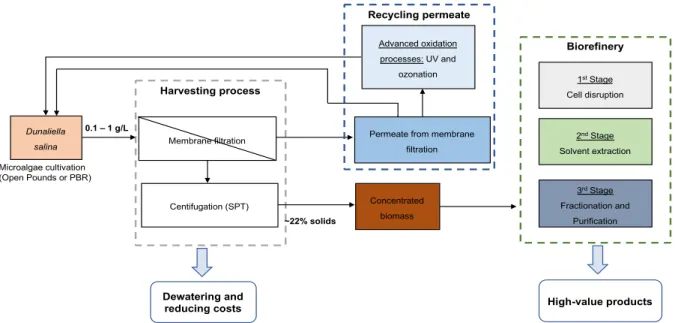
This work demonstrates the importance of the harvesting process in order to reduce energy and capital costs, using an integrated process of membrane filtration coupled with centrifugation. This procedure also offers the potential advantage of minimising the loss of added-value compounds, using mild conditions during harvesting. Furthermore, the importance of reducing the harvesting costs is demonstrated. A strategy for the recycling of cultivation medium is presented in order to reduce the water footprint associated with microalgae production. Finally, this work discusses the potential of using Dunaliella salina as a feedstock for the production of different compounds, improving the revenues of the microalgae industry. Figure 1.2 shows the main processing steps discussed in this PhD work.
7 The main objectives of this work are:
I. Study the pre-concentration of Dunaliella salina biomass (non-carotenogenic and carotenoid-rich) by membrane filtration prior to centrifugation, in order to reduce the overall energy and capital costs. Additionally, maximise the volumetric fluxes while maintaining cell integrity at high concentration factors.
II. Evaluate the permeate produced during harvesting of carotenoid-rich Dunaliella salina to be used as cultivation media, in order to reduce the microalgae production costs, specifically the high costs associated with the cultivation medium. Particularly, the assessment of the permeates to be recycled as cultivation media, comparing different ways of post-treatment.
III. Design and propose a sustainable biorefinery scheme, starting from carotenoid-rich Dunaliella salina, aiming the recovery of distinct fractions of compounds.
1.3 Thesis Outline
The work performed during this PhD is organised in the following way: a first chapter where the thesis background, motivation and outline is presented, followed by four chapters that correspond to scientific original papers accepted or submitted for publication, which describe the experimental work performed and the results obtained, and finally a chapter that presents the overall conclusions of the work and suggestions for future work.
Additionally, along this manuscript there are several denominations related with the microalga under study. The first part of the work was performed with non-carotenogenic Dunaliella salina, which for simplicity sometimes is named “green” Dunaliella salina, due to the low carotenoids’ content and the green colour presented. Then, carotenoid-rich Dunaliella salina was used, and for simplicity it is denominated “orange” Dunaliella salina, associated with the high concentration of carotenoids and the orange colour.
Figure 1.2. Schematic representation of several tasks involved in this PhD work.
Harvesting process Dunaliella salina Microalgae cultivation (Open Pounds or PBR) Membrane filtration Concentrated biomass 0.1 – 1 g/L ~22% solids Centifugation (SPT) Biorefinery
Permeate from membrane filtration Advanced oxidation processes: UV and ozonation Recycling permeate 1stStage Cell disruption 2ndStage Solvent extraction 3rdStage Fractionation and Purification High-value products Dewatering and reducing costs
1. BACKGROUND AND MOTIVATION
8 A summary of the content of each chapter is described below:
Chapter 1: Background and Motivation – Describes the background and motivation for this PhD, the
main objectives and finally describes the thesis outline.
Chapter 2: Harvesting of non-carotenogenic Dunaliella salina by membrane filtration at pilot scale – Describes an integrated method using membrane filtration and centrifuges for the harvesting
of “green” Dunaliella salina at pilot scale. For the optimisation of the membrane harvesting process, operating at constant transmembrane pressure, several parameters were evaluated, namely: cross-flow velocity, transmembrane pressure, backflush protocol and molecular weight cut-off of the membrane. Furthermore, a consecutive harvesting approach was assessed in order to reach higher concentration factors. Additionally, a techno-economic analysis of the integrated process was performed. The content of this chapter was published in “Separation and Purification Technology (2018), Vol. 190, 252-260”.
Chapter 3: Development of an integrated process for harvesting carotenoid-rich Dunaliella
salina at laboratorial and pilot scales – Reports the pre-concentration of carotenoid-rich Dunaliella
salina (“orange”) by membrane filtration prior to a final concentration step by centrifugation. The relevant operating parameters, namely: cross-flow velocity, molecular weight cut-off, relaxation protocol and volumetric permeate flux were assessed in order to select the optimal operating conditions. The harvesting of Dunaliella salina by membrane filtration under controlled permeate flux was performed at laboratorial and pilot scales. Finally, the comparison of the Total Cost of Ownership (TCO) and the consumption of energy were performed for the two-step approach (membrane processing prior to centrifugation) and the one-step approach (centrifugation). The content of this chapter was submitted to the journal “Separation and Purification Technology”.
Chapter 4: Recycling of Dunaliella salina cultivation medium by integrated membrane filtration and advanced oxidation – Presents several oxidation processes for the treatment of permeate
produced during the membrane harvesting of carotenoid-rich Dunaliella salina. The permeate was treated either with UV radiation or by ozonation, and the most relevant operating variables (namely the increase of pH and the addition of H2O2) were studied. Untreated and treated permeates were assessed as a cultivation medium for carotenoid-rich Dunaliella salina, evaluating the cell growth, the carotenogenesis process, and the chemical and microbiological quality of the resulting cultivation medium. The content of this chapter was published in “Algal Research (2019), Vol. 29, 101460”, (available online).
Chapter 5: Dunaliella salina based biorefinery: sustainable recovery of carotenoids, polar lipids and glycerol – Describes a sustainable process for the production of several fractions produced from
Dunaliella salina biomass, namely fractions rich in carotenoids, polar lipids, glycerol and proteins. The biorefinery scheme proposed integrates solvent extraction (REACH solvents) and membrane filtration, in order to recover different classes of compounds. Additionally, a techno-economic assessment of the biorefinery proposed was performed.
9
Chapter 6: Conclusions and Future Work - Presents the overall conclusions and results of this PhD
11
SALINA BY MEMBRANE FILTRATION AT PILOT SCALE
Published as: Joana Monte, Marta Sá, Cláudia F. Galinha, Luís Costa, Herre Hoekstra, Carla Brazinha, João G. Crespo, “Harvesting of Dunaliella salina by membrane filtration at pilot scale”, Separation and Purification Technology (2018), Vol. 190, p. 252-260.
The author was involved in planning and performing the experiments, as well as on the discussion and interpretation of the results and preparation of the manuscript.
2.1 Summary
The microalga Dunaliella salina is industrially produced due to its high content in carotenoids induced by low nitrogen and high salinity conditions. Dunaliella salina with low carotenoids content also produces other added-value compounds, however its recovery has hardly been studied. This work aims to examine the potential of pre-concentrating Dunaliella salina by membrane processing prior to a final harvesting step by low-shear centrifugation. The aim is to minimise the overall energy expenditure and reduce capital costs, while assuring a minimal loss of cell integrity. This task is challenging, considering the sensitivity of Dunaliella salina to shear. Harvesting of Dunaliella salina by ultrafiltration allowed reaching a final concentration factor of 5.9, with an average permeate flux of 31 L/(m2.h). The Total Cost of Ownership and energy consumption for harvesting are respectively 52% and 45% lower when applying a two-step approach with pre-concentration (ultrafiltration) compared to only harvesting by centrifugation.
2.2 Introduction
Dunaliella salina, a halophilic microalga, is a unicellular biflagellate [73] which grows in salinities ranging from 0.05M to 5M NaCl [68,74]. This microalga is very fragile due to lack of rigid cell wall [9], and can be easily ruptured when an excessive shear stress is applied. Dunaliella salina is produced industrially due to its high content in carotenoids, which market estimation is around $1428.12 million in 2019 [11]. The carotenoids of Dunaliella salina are induced by low nitrogen and high salinity conditions in a process that has been extensively studied [67,75,76]. Cells are commercialised as a dried algal supplement for food application [67], without fractionation and purification of any intracellular compound. Currently, during the harvesting of Dunaliella salina, its intracellular content is partially released into the aqueous cultivation medium due to the high shear conditions applied, including high value enzymes and, under high salinity, glycerol. The recovery of enzymes, peptides and other valuable compounds from Dunaliella salina has not been studied thoroughly. Carbonic anhydrase (involved in microalgae CO2 uptake [9,77]) and glycerol 3-phosphate dehydrogenase (involved in the glycerol biosynthesis [78]) are commercially interesting enzymes present in Dunaliella salina. Carbonic anhydrase and glycerol 3-phosphate dehydrogenase are overexpressed in Dunaliella salina with low
2. HARVESTING OF GREEN DUNALIELLA SALINA BY MEMBRANE FILTRATION AT PILOT SCALE
12 carotenoids’ content respectively at pH 8-9 [9] and high salinity (4.5 M NaCl) conditions [78]. For simplicity, Dunaliella salina with low carotenoids’ content will be named green Dunaliella salina along this manuscript.
Microalgae harvesting may contribute to about 20-30% of the total cost of microalgae production [15,16]. In fact, microalgae harvesting involves high energy costs due to the low biomass concentration, their small size (3–30 µm) and similar density to water. Several harvesting techniques have already been used, such as centrifugation, flocculation, flotation, sedimentation and filtration [15,16,18–20]. Centrifugation is the fastest and most common and efficient harvesting technology [15–17,21], especially suitable for concentrated biomass. However, centrifugation requires high capital investment and energy costs. In order to increase the microalgae concentration up to 22% dry weight, the energy demanded reaches 8 kWh/m3 [79]. Using a Spiral Plate Technology (SPT) a reduction in energy of centrifugation can be achieved. On average, a SPT centrifuge has an energy consumption of 2.5 kWh/m3. Besides the lower energy consumption, the SPT centrifuge also reduces the shear on the algae. For very fragile algae like the Dunaliella salina strain this is a very important advantage [80]. Power consumption of SPT is built up of the energy for the pumps and the energy needed for acceleration of the water in the rotating drum. In the SPT, the feed flows into a rotating drum, the algae settle on the plates in the rotating drum due to centrifugal forces and the effluent flows out of the drum. Membrane processes may play a relevant role in microalgae harvesting [32–34]. Membrane technologies are quite suitable for processing Dunaliella salina, as its culture (with around 0.1 g/L of dry weight of algae) is even more diluted than other common microalgae cultures, such as Chlorella vulgaris (0.4 g/L) or Nannochloropsis oculata (8.4 g/L) [20]. Membrane technologies can also be operated under gentle transmembrane pressure and moderate cross-flow velocity, in order to keep low shear conditions for fragile cells [15]. In Rose et al., the harvesting of orange Dunaliella salina by cross-flow ultrafiltration was performed producing concentrates using a polyethersulfone membrane (with not specified pore size), although no results of cell integrity were shown [81]. Pumping energy required for cross-flow membrane filtration is in general 0.5 – 1.5 kWh/m3 of algal medium [82]. Considering the difficulties of membrane processing to bring microalgae concentration from extremely low values up to a 22% dry weight, membrane technology should be regarded as a potential alternative for microalgae pre-harvesting prior to concentration by centrifugation. Integration of microalgae pre-pre-harvesting and concentration by centrifugation may lead to a decrease of the overall energy demand and investment cost [20,21]. Energy consumptions of integrated membrane-centrifugation systems and of traditional centrifugation were estimated respectively as 0.169 kWh/kg and 0.5 kWh/kg of dry weight of algae [20]. The increase in microalgae concentration, achieved by harvesting with membranes, has no impact on the SPT power consumption.
In this work, the pre-concentration of green Dunaliella salina by membrane processing prior to centrifugation is evaluated. This procedure offers also the potential advantage of minimizing the loss of high added-value compounds present in green biomass, such as enzymes with commercial interest and bioactive peptides. This study aims at pre-concentrating green Dunaliella salina with reduced
13 energy expenditure, at high permeate fluxes and concentration factors, while maintaining cell integrity, which is challenging due to the shear stress sensitivity of Dunaliella salina.
Green Dunaliella salina was processed in a pilot membrane cross-flow unit. The relevant operating conditions were studied – cross-flow velocity (vcross-flow), transmembrane pressure (TMP) and backflushing interval – as well as the molecular weight cut-off (MWCO) of the membrane. The overall efficiency of the process was quantified by the volumetric permeate flux (JV) and loss of cell integrity. In addition, the pre-concentration of Dunaliella salina in three consecutive batches was also performed, with the optimised operating conditions previously determined, aiming at achieving cell integrity at higher concentration factors.
In order to compare Total Cost of Ownership (TCO) and energy consumption between harvesting with pre-concentration and harvesting with only centrifuges, extra measurements have been done, where a 14-membrane element unit (Liqoflux LF14AL22) was installed in combination with a Spiral Plate Technology centrifuge (Evodos 25 SPT).
2.3 Materials and Methods 2.3.1 Materials
Green Dunaliella salina was originally isolated from open ponds of NBT Natural Beta Technologies, Ltd (Israel) by MBA Marine Biological Association of the United Kingdom and it was scaled-up and provided by A4F - Algae for Future (Portugal). Fresh green algae cultures with high N concentration (corresponding to biomass with low carotenoids’ content, particularly with a ratio of carotenoids/chlorophylls below 0.5), 1.5M NaCl and pH between 7 and 8 in the culture medium were sampled at different initial concentrations from 2x10⁵ to 3x10⁵ cells/mL, for the different experiments performed. In the case of consecutive harvesting batches, the initial algal concentration was 4x10⁵ cells/mL. For optimisation of the microalgae pre-concentration, a membrane unit from Liqoflux was used where two types of asymmetric polyethersulfone (PES) capillary membranes, with the active layer inside the fibres, were tested. The PES membranes, provided by Liqoflux, were an ultrafiltration membrane with a nominal molecular weight cut-off (MWCO) of 150 kDa and a microfiltration (MF) membrane with a nominal pore size of 0.1 µm. The membrane permeability of clean water was 320 and 1070 L/(m2.h.bar) for ultrafiltration and microfiltration, respectively. Each type of membrane elements comprised 832 fibres with a length of 0.42 m, an internal diameter of 2.2 mm, and a total filtration area of 2.4 m2. Filtration was performed inside-out under a controlled transmembrane pressure mode. For the comparison of the Total Cost of Ownership and energy consumption between harvesting with pre-concentration and harvesting with only centrifuges, a 14 element (Liqoflux LF14AL22) unit from Liqoflux with a nominal molecular weight cut-off (MWCO) of 150 kDa was used. A solution of 500 ppm of sodium hypochlorite, NaOCl, 13% active chlorine (Quicelplas, Portugal) was used for membranes cleaning.