Objectives: To identify studies that evaluated psychometric properties of functional capacity tests in children and adolescents, and to verify which of these have satisfactory properties of measurement.
Data sources: Searches on MEDical Literature Analysis and Retrieval System Online (MEDLINE), Cumulative Index to Nursing and Allied Health Literature (CINAHL) and Scientific Electronic Library Online (SciELO) databases without limiting period or language. Two investigators independently selected articles based on the following inclusion criteria: children and/or adolescent population (healthy or with cardiorespiratory diseases); and assessment of psychometric properties of functional capacity tests. Studies with (I) adult samples, (II) sample with neurological diseases, and (III) on reference values or prediction equations only were excluded.
Data synthesis: From the total of 677 articles identified, 11 were selected. These evaluated the psychometric properties of the following tests: 6‑minute walk test (6MWT) (n=7); 6MWT and the 3‑minute step test (3MST) (n=1); and Incremental Shuttle Walk Test (ISWT) (n=3). Reproducibility and reliability were good for 6MWT and ISWT, and moderate for 3MST. The ISWT showed high validity measures for both healthy children and children with chronic respiratory disease. The validity of 6MWT varied across studies, and should be analyzed according to the health conditions of test takers. The validity of 3MST is unclear, and further studies in pediatric population are required.
Conclusions: Most studies investigated 6MWT measurement properties. Validity of 6MWT varied according to different pediatric populations. The use of 6MWT, ISWT and 3MST tests to measure
Objetivos: Identificar estudos que avaliam as propriedades psicométricas dos principais testes de capacidade funcional utilizados em crianças e adolescentes e verificar os testes que apresentam propriedades de mensuração satisfatórias. Fontes de dados: Pesquisa nas bases de dados MEDical Literature Analysis and Retrieval System Online (MEDLINE), Cumulative Index to Nursing and Allied Health Literature (CINAHL) e Scientific Electronic Library Online (SciELO), sem limitar o período ou idiomas. Dois investigadores selecionaram de forma independente os artigos com base nos critérios de inclusão: estudos que avaliaram propriedades psicométricas dos testes de capacidade funcional em crianças e/ou adolescentes saudáveis ou com doenças cardiorrespiratórias. Foram excluídas pesquisas que incluíram indivíduos adultos e/ou participantes com doenças neurológicas e estudos que exclusivamente estabeleceram valores de referência ou equações de predição. Síntese dos dados: Do total de 677 artigos, foram selecionados 11 compatíveis com o tema; destes, 7 avaliaram propriedades psicométricas do teste de caminhada de 6 minutos (TC6), 1 avaliou tanto o TC6 quanto o teste do degrau de 3 minutos (TD3), e 3 avaliaram o teste incremental Shuttle Walk Test (ISWT). As evidências sobre as propriedades de reprodutibilidade e confiabilidade são boas para o TC6 e ISWT e moderadas para o TD3. O ISWT mostra medidas de validade altas para crianças saudáveis e para aquelas com doença respiratória crônica. As medidas de validade do TC6 variam entre as populações estudadas e devem ser consideradas de maneira particular para cada condição de doença. A validade do TD3 ainda deve ser esclarecida na população pediátrica. Conclusões: O TC6 apresenta maior número de investigações sobre suas propriedades, mas sua validade apresenta variabilidade para
ABSTRACT
RESUMO
*Corresponding author. E‑mail: [email protected] (C.I.S. Schivinski). aUniversidade do Estado de Santa Catarina, Florianópolis, SC, Brazil.
Received on March 07, 2017; approved on September 01, 2017; available online on October 31, 2018.
Psychometric ProPerties of functional
caPacity tests in children and
adolescents: systematic review
Propriedades psicométricas dos testes de capacidade
funcional em crianças e adolescentes: revisão sistemática
Janaina Cristina Scalco
a, Renata Martins
a, Patricia Morgana Rentz Keil
a,
INTRODUCTION
Keeping an active lifestyle, by practicing sports and partici-pating in games, is essential for the normal development of a child1 — and it has been already established that regular
phys-ical activity provides quality of life and benefits to the overall state of health to healthy children or children diagnosed with chronic diseases.2,3 However, individuals with pulmonary
dis-eases may lose exercise capacity and face consequent limitations in functional activities.2,4
Individual response to exercise is an important instrument for clinical evaluation, as integrated responses of the respira-tory, cardiac, metabolic and muscular systems are obtained.5
Several tests are aimed to evaluate human response to exercise and, nowadays, the incremental cardiopulmonary exercise test-ing (CPET) is considered the gold standard to assess maximum exercise capacity, although it demands high-cost equipment and specialized professionals.5
On the other hand, submaximal exercise tests have been used to assess functional capacity and reflect one’s maximum capacity to perform daily life activities (DLA), which are mostly submaximal ones.6 Among functional capacity tests, the
6-min-ute walk test (6MWT) is the most well-known and capable of pointing out the limitations of individuals to perform DLAs6,7
even in the pediatric population.5,8
To evaluate children and adolescents, the indication is a test that can effectively evaluate what it proposes to in addition to being clinically applicable and promoting reliable results. The instru-ment must, therefore, have satisfactory psychometric properties,9
an important feature to detect the minor effects of a treatment.10
Thus, this systematic literature review that aimed to iden-tify studies on the psychometric properties of the main func-tional capacity tests applied to children and adolescents allows to identify tests that have qualified measurement properties, enabling its indication and use in clinical practice.
METHOD
In order to develop and expose this review, the recommenda-tions for the presentation of systematic reviews of the Preferred
Reporting Items for Systematic Reviews and Meta Analysis (PRISMA) were considered. Then, a systematic search of the literature was carried out in April 2017 on the Literature Analysis and Retrieval System Online (MEDLINE), via OVID MEDLINE, and on the Cumulative Index to Nursing and Allied Health Literature (CINAHL), via Elton B. Stephens Company (EBSCO), and the Scientific Electronic Library Online (SciELO). Original search strategies were created for the first two databases, and they are listed in Chart 1. On SciELO, the following combination of descriptors was used: “criança” and “teste de exercício” and their English equivalent “children”
and “exercise test”. The search was not limited by other filters
such as language or date of publication.
The following inclusion criteria were considered:
1. studies whose purpose was to evaluate some psycho-metric properties (validity, reliability, reproducibility, responsiveness, minimal clinically important difference) of functional capacity tests;
2. tests evaluated in healthy children and/or adolescents (up to 19 years old, according to WHO classification)11
or with cardiorespiratory diseases.
The surveys involving adult samples or whose participants had associated neurological diseases were excluded. Also, stud-ies that established exclusively reference values or prediction equations were not included in this review, but these terms were included in the search strategy because some studies evaluated psychometric properties of the tests simultaneously.
Two independent researchers performed the screening of studies by analyzing all of them and respecting the pre-estab-lished inclusion and exclusion criteria. Initially, the headings were assessed and, when compatible, articles were selected for abstract evaluation. After analyzing abstracts chosen consensu-ally, the articles were obtained in full and read for confirmation of compatibility of the content with the criteria required for this review. Divergence as to exclusion of a heading, abstract, or full text was discussed by researchers until consensus. To ensure the inclusion of all relevant publications, the reference lists of all studies selected were also searched manually by the evaluators.
clinically important changes in children and adolescents with cardiorespiratory diseases is still unclear.
Keywords: Child; Exercise tolerance; Validity of tests; Reproducibility of results.
diferentes populações pediátricas. A capacidade dos testes TC6, ISWT e TD3 de mensurar mudanças clinicamente importantes em crianças e adolescentes com doenças cardiorrespiratórias é desconhecida.
The checklist Strengthening the Reporting of Observational Studies in Epidemiology (STROBE), which encompasses recommendations to improve the methodological quality of observational studies,12 was adapted with scores to
character-ize studies. The checklist is composed of 14 items stratified or
not in subitems, totaling 22 items. Each item was assigned a proportional score, with maximum sum of 20 points.
The psychometric properties of each test were classified as “good”, “moderate”, “poor”, and “unknown”. Validity and reliability/reproducibility were considered “good” when
CINAHL with Full Text (EBSCO)
1. “Pediatr*” 9. “Exercise capacity”
2. “Child*” 10. “Activity of daily living”
3. “Adolescent” 11. (MH “Functional status”)
4. “School age” 12. “Physical capacity”
5. (MH “Child, Preschool”) 13. “Functional capacity”
6. (MH “Child”) AND (1 OR 2 OR 3 OR 4 OR 5) 14. “Everyday activities”
7. (MH “Exercise test”) 15. (“Every day activities”) AND (7 OR 8 OR 9 OR 10 OR 11 OR 12 OR 13 OR 14)
8. “Exercise tolerance” 16. 15 AND 6
MEDLINE via OVID 1. Randomized controlled trials as Topic/ 25. School age.mp.
2. Randomized controlled trial/ 26. Child, Preschool/
3. Random allocation/ 27. 22 or 23 or 24 or 25 or 26
4. Double blind method/ 28. Step test.mp.
5. Single blind method/ 29. Shuttle walk test.mp.
6. Clinical trial/ 30. Six‑minute walk test.mp.
7. exp Clinical Trials as Topic/ 31. Cardiopulmonary test.mp.
8. (clinic$ adj trial$1).tw. 32. Ergoespirometry.mp.
9. 1 or 2 or 3 or 4 or 5 or 6 or 7 or 8 33. Free running test.mp. 10. (Follow up adj (study or studies).tw. 34. Exercise Test/ 11. (observational adj (study or studies).tw. 35. Exercise capacity.mp.
12. Longitudinal.tw. 36. Functional capacity.mp.
13. Retrospective.tw. 37. Functional status.mp.
14. review.pt. 38. Physical capacity.mp.
15. 10 or 11 or 12 or 13 or 14 39. 28 or 29 or 30 or 31 or 32 or 33 or 34 or 35 or 36 or 37 or 38
16. 9 or 15 40. lResponsiveness.mp.
17. Case report.tw. 41. Minimal clinically important difference.mp.
18. Letter/ 42. Equation reference.mp.
19. Historical article/ 43. Reference Values/
20. 17 or 18 or 19 44. Reliability.mp.
21. 16 not 20 45. Validity.mp.
22. Child*.mp. 46. Reproducibility.mp.
23. Pediatr*.mp. 47. 40 or 41 or 42 or 43 or 44 or 45 or 46
24. Adolescent*.mp. 48. 21 and 27 and 39 and 47
CINAHL: Cumulative Index to Nursing and Allied Health Literature; MEDLINE: MEDical Literature Analysis and Retrieval System Online; EBSCO: Elton B. Stephens Company.
most studies had a significant correlation ≥0.75 or significant p-value, “moderate” when between 0.40 and 0.75, and “poor” when <0.40.13 Regarding other populations, the tests applied
to more than two populations were considered “good”; to two populations, “moderate”; and to one population only, “bad”. Some of the psychometric properties were not evaluated in the studies selected, to which the “unknown” classification was attributed.
RESULTS
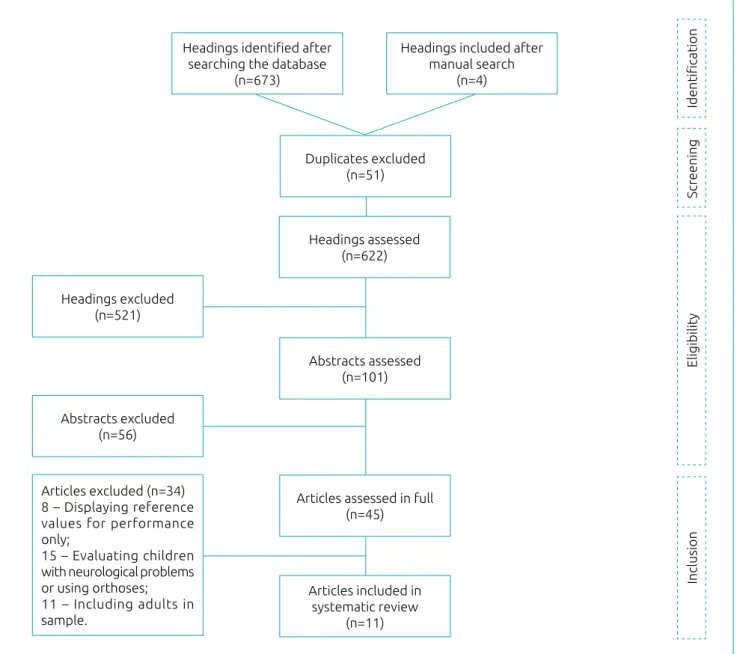
In total, 677 articles were identified in database and manual searches. After exclusion of duplicates, 622 were sent for peer
selection of headings. Of these, 101 were considered eligible for selection of abstracts and 45 for final analysis, that is, full reading of the article. Passed these phases, 11 articles were included in this review. Article selection and exclusion stages are shown in Figure 1.
Most articles selected (seven) evaluated the psychometric properties of the 6MWT; one article evaluated both the 6MWT and the 3-minute step test (3MST), while three evaluated the Incremental Shuttle Walk Test (ISWT), or its adapted version Modified Shuttle Walk Test (MSWT). These studies are listed in Charts 2 and 3.
Chart 4 was elaborated from the results reported in selected studies, listing and classifying each psychometric property of
Figure 1 Flow chart of studies’ selection.
Headings identified after searching the database
(n=673)
Duplicates excluded (n=51)
Headings assessed (n=622)
Abstracts assessed (n=101)
Abstracts excluded (n=56)
Inclusion
Eligibility
Screening
Identification
Articles excluded (n=34) 8 – Displaying reference values for performance only;
15 – Evaluating children with neurological problems or using orthoses; 11 – Including adults in sample.
Headings excluded (n=521)
Articles assessed in full (n=45)
Articles included in systematic review
(n=11)
Headings included after manual search
the tests. It is noted that reliability and reproducibility are con-sidered good for both 6MWT and ISWT. Also, minimal clin-ically important difference (MCID) and responsiveness were sorted as “unknown” for all tests.
DISCUSSION
The analysis of cardiorespiratory response during exercise tests is an important tool to assess the impact of diseases and to monitor the effectiveness of interventions for indi-viduals of all ages.1,14 However, the fact that, in addition
to anthropometric differences, there are numerous physi-cal variations between adults and children must not be lost sight of. Physiological aspects of children and adolescents are constantly changing; their systems are under develop-ment and maturation and may be influenced by genetic and ethnic factors, gender, physical activity, body compo-sition, nutritional status, socioeconomic status, culture, climate, and geographic location.15 Thus, this population
has a pattern (especially during growth spurt and puberty) that seems to interfere with their performance in tests and their responses during physical exercises.16 This justifies the
need for more studies that evaluate and discuss the psycho-metric properties of functional capacity tests, specifically in pediatric populations.
Validity and reproducibility are related to the psychometric properties of the most investigated functional tests applied to the pediatric population. The validity of an instrument refers to its ability to analyze the phenomenon it intends to measure and indicates the extent to which its scores are an adequate reflection of the gold standard one. The reproducibility indi-cates the level of similarity between repeated measurements, reliability, and concordance parameters.17,18
The present review shows that, among functional capac-ity assessment tests, the 6MWT is the test of choice for most pediatric validation studies (healthy children and adolescents of different ethnicities, classified as obese, diagnosed with cys-tic fibrosis, pulmonary hypertension, and others), but import-ant measures such as MCID have not been studied yet in pediatrics. This measure refers to the lowest relevant change in patients’ performance,19 which is representative of clinical
improvement induced by pulmonary rehabilitation protocols or other interventions.20
Another matter that still raises doubts in validation studies is the possible relation of the distance covered in the 6MWT (DC6MWT) with measures representing the maximum capacity of exercise in different pediatric populations. Some studies have shown high or moderately high correlations between the 6MWT and the CPET,22 while others show weak
correlations.8,23 It’s been confirmed that the 6MWT seems
to reflect the maximum exercise capacity of children with moderate to severe cardiorespiratory diseases such as cystic fibrosis21 and hypertension22, but in obese23 and healthy
chil-dren8, it reflects very little exercise capacity. Data presented by Lammers et al.22 reinforce these findings. Researchers point
out a significant linear relationship between peak oxygen consumption (VO2peak) and DC6MWT only in children with pulmonary hypertension who walked less than 300 meters in the 6MWT. DC6MWT represented 71% of the variation in VO2peak, but there was no association when the DC6MWT was greater than 300 meters. As suggested by Bartels et al.,24 the
response in the 6MWT seems to depend on both the pop-ulation and the severity of the disease investigated. Thus, labeling the 6MWT as a maximal or submaximal measure is not justifiable before an adequate assessment of its valid-ity in the target population, including mildly and severely affected patients.
The widespread use of 6MWT in both scientific and clin-ical practice is related to its simple, low-cost, easy-to-admin-ister character,6,7,25 besides high levels of reproducibility and
reliability8,21,23,26-28 and prediction equations and normality
values already described for different ethnic groups.26,29,30
This is a continuous, self-paced walking test in which a constant speed is normally maintained,31 which may
gen-erate certain monotony for children upon its performance. This lack of motivation can interfere in performance and hin-der accurate interpretation. Like the other tests accounted for in this review, the 6MWT was developed for the adult population eventually had its use diffused to the pediatric age group without changes in the administration protocol. This raises the debate about the need to develop (or adapt) tests with playful and motivational components in order to generate more interest and commitment by the children when performing them.
Externally paced tests such as 3MST and ISWT have the advantage of not depending solely on the patient’s motiva-tion.32,33 In 3MST, children climb and descend a platform
with a single step in a fixed time and frequency. Thus, its advantages are being fast, simple, portable and requiring lit-tle space for execution.33 Comparing 3MST and 6MWT in
children with cystic fibrosis, 3MST seems to require more physiological adaptations to its execution. Balfour Lynn et al.32
Author/ year
Checklist STROBE
Population and
sample Method Psychometric property assessed
Gulmans
et al., 1996 15.1
Children and adolescents with CF aged 8 to 18 years (mean 11.1±2.2 years) (n=15 validity)
(mean 14.5±2.0 years) (n=23 reproducibility)
V: 1 6MWT and a test in cycle (10W increment if height was <160 cm, or FEV1 <60%, or 15 W per minute) performed for at least two days before or two days after 6MWT.
R: 2 6MWT (8‑m lane, encouraging every 16 m) in the same day and repeated after a week.
Validity
Reproducibility
• Correlation between CD and VO2máx (r=0.76).
• r=0.90.
Li et al.,
2005 16.1
Healthy Chinese children aged 12 to 16 years (mean 14.2±1.2 years) (n=74 validity) (n=52 reliability)
V concurrent: maximum CPET on treadmill and 6MWT with interval of up to 2 weeks between them. Re: 6MWT was repeated at intervals of 2 to 4 weeks.
Validity
Reliability
• Correlation between DC. 6MWT and VO2max (r=0.44).
• ICC=0.94.
Lammers
et al., 2011 14.1
Children with pulmonary hypertension aged 6 to 18 years (mean 13.0±3.0 years)
V: All of them performed maximum CPET on cycle ergometer and the 6MWT.
Validity
• Correlation between DC. 6MWT and VO2peak with VO2VT (r=0.49 e r=0.40. respectively)
Cunha et al.,
2006 12.1
Children with CF aged 8 to 14 years (mean 11.0±1.9 years) (n=16)
Two 6MWT (28‑m lane) were performed on the same day, with a minimum interval of 30 min between them.
Reproducibility
• No difference between DCs (p=0.31). which shows good reproducibility
Priesnitz
et al., 2009 15.1
Healthy children and adolescents aged 6 to 12 years (mean 11.7 years)
R: Two 6MWT (30‑m lane), with interval of 30 min
Reliability • ICC: 0.74.
Morinder
et al., 2009 14.1
Obese children and adolescents aged 8 to 16 years (mean 13.2 years) (n=49 reproducibility) (n=250 validity)
V: 6MWT and a submaximal exercise test on a stationary bicycle for same-day comparison.
R: Two 6MWT (70‑m lane), with mean interval of 4 days
Validity
Reproducibility
• Correlation between DC in 6MWT with VO2max (r=0.34).
• ICC=0.84.
Mandrusiak
et al., 2009* 13.9
Children and adolescents with CF aged 7 to 17 years (mean 13.1±2.7 years) hospitalized for respiratory exacerbation (n=18)
Re: After one or two days of hospital admission, a 6MWT was performed per day on two consecutive days.
Reliability • ICC=0.93
Chart 2 Description of studies evaluating the psychometric properties of the field test (6MWT).
Chart 3 Description of studies evaluating the psychometric properties of the field tests (6MWT, ISWT/MSWT, 3MST). Author/ year Checklist STROBE Population and
sample Method Psychometric property assessed
Balfour-Lynn
et al., 1998 13.1
Children with symptomatic CF 6‑18 years (mean 12.5 years) (n=54, validity) (n=12 reproducibility – 3MST)
(n=9 reproducibility – 6MWT)
V: two 3MST performed and compared to two 6MWT (17‑m lane), with interval of 30 min between them on the same day. Re: 3MST and 6MWT performed on two consecutive days. For all analyzes, we used the change of the
SpO2 parameters, HR,
degree of dyspnea.
Validity
• 3MST produced significantly higher HRs and Borg compared to the 6MWT. The
decrease in SpO2 was
similar between tests.
Relation between SpO2
decrease and baseline FEV1 also similar in both tests (3MST r = 40.52 and 6MWT r = 40.51)
Reproducibility
• 3MST: (SpO2: ‑2.1 to 2.5; HR: ‑38.0 a 34.0; Borg: ‑1.5 a 1.5) • 6MWT: (SpO2: ‑1.7 to 1.0; HR:‑34.0 a 39.0; Borg: ‑1.1 a 1.9).
Selvadurai
et al., 2003* 15.3
CF children aged 5‑17 years (mean 6.8 years) n=35 (children aged 7 years or less, or too weak to perform a 20-m shuttle test run).
All children performed a CPET on a treadmill, two ISWT tests with simultaneous gas analysis and one ISWT test without oxygen mask in a maximum interval of one week.
Reproducibility
• No significant difference between the two ISWT tests with the mask on or in comparison with and without mask for heart
rate peak, DC, SpO2,
Borg and VO2peak
Validity
• Strong correlation between DC and VO2peak (r = 0.91); there were no significant differences in variables between ISWT and CPET.
Coelho
et al., 2007* 12.1
Children and adolescents with CF: CFG (n=14) and healthy: CG (n = 14) 7‑15 years CFG (11.57 ± 2.50) CG (11.28 ± 1.85)
Each child performed at least two tests with a minimum 30-minute interval between them.
Reproducibility
• CG: DC greater in the second test (p = 0.036). • CFG: significant difference between first and second test only as to resting dyspnea scale, which increased in the second test, just like in healthy children (p = 0.042).
Lanza et al.,
2015 16.0
Brazilian Children and adolescents with normal pulmonary function and no chronic diseases (n=8) 6‑18 years (mean age
12±2 years)
Two ISWT tests performed with interval of 30 min between them.
Reliability
• ICC = 0.98 excellent reliability of distance covered between ISWT 1 and 2.
Chart 4 Psychometric properties of functional capacity tests used in pediatrics.
Test Validity Reproducibility /
Reliability Feasibility MCID Other populations
6MWT
ISWT
3MST
MCID: minimal clinically important difference; 6MWT: 6‑minute walk test; 3MST: 3‑minute step test; ISWT: shuttle walk test; : good; : moderate : bad; : unknown.
When evaluating the feasibility of 3MST applied to children who developed bronchiolitis obliterans after bone marrow transplantation, 3MST was shown to be an easy, well-tolerated and successfully performed test; in addition, it did not trigger hypoxemia and only one child took the maximum effort.35
There are several protocols for the step test with differences in run time (3, 4 and 6 minutes), in the cadence of climbs per minute (96/min, 30/min, 13/min, 15/min, 17/min), number of platform steps (1 or 2 steps), and size of steps.32,35 38 The
lit-erature has not yet presented prediction equations regarding its performance nor values of normality for children and ado-lescents, which can hamper the comparison between studies and the identification of functional limitations upon clinical evaluation of pediatric patients.
In the walk test with incremental load, known as ISWT, the individual walks on and on a 10-meter track with pro-gressive speed dictated by sound signals (increments of 0.17 m/s every minute) until no longer able to maintain the speed required.31 This protocol has been modified39 and an increase
was applied to limit, from 12 to 15 speed levels (MSWT), in order to avoid the ceiling effect that the 12 speed levels could create in healthy or slightly-limited individuals, allow-ing patients to reach exhaustion.40,41 In pediatrics, the ISWT
shows whether it is valid to evaluate functional and exer-cise capacity in children and adolescents with CF,42 which
is highly related to the maximum oxygen volume (VO2max). Its reproducibility has been confirmed for this disease42,43
and in healthy children.44 When applied in asthmatics37
and in ex-premature infants, ISWT45,46 was shown
sensi-tive to identify functional limitations compared to healthy controls. Recently, performance prediction equations (dis-tance covered) for ISWT performed by Brazilian children and adolescents have been established,44 which facilitates
applicability once the comparison with normal values helps to identify functional limitations.
All three tests were found to involved only walking activity, which may restrict the evaluation of the influence of activities performed with the upper limbs on the limitation in ADL.47
Currently, researchers have discussed more comprehensive ways of assessing functional status of patients with lung dis-eases. In this regard, global tests, that is, including more than one task, seem to be the best choice.48 Hence, the
Glittre-ADL multi-task test was developed. In addition to walking, it includes activities such as sitting on and standing up from a chair, walking up and down stairs, and moving objects with the upper limbs, being therefore considered more complete to evaluate the functional status of patients with pneumop-athies.47 Its adaptation with playful components for
appli-cation in the pediatric population (TGlitre P) is recent and has proved reproducible and acceptable for healthy children and adolescents.49
of “validity”, the absence of specific hypotheses about the expected correlations between variables makes it difficult to interpret the results and does not make it clear if they reflect the expected measure;17 nevertheless, we emphasize that all
articles reviewed here considered at least 60% of recommen-dations for the best methodological quality.
When analyzing articles for this review, we found that the psychometric properties of 6MWT, 3MST and ISWT were also studied in groups of children and adolescents with cerebral palsy, cognitive disorders and Down’s syndrome.36,50-53 However,
as these populations present other characteristics that impact the performance of tests, including level of motor function, cognitive level and use of orthoses, we decided not to discuss such studies and suggest that specific reviews on the applica-bility of these tests in children with motor disorders be created. Bartels et al.24 published a recent analysis of the measurement
properties of the 6MWT in children with different chronic conditions (pulmonary, cardiac, neuromuscular, osteoarticular and other), which differs from all other by analyzing the psy-chometric properties of different functional capacity tests used to assess children and adolescents with cardiorespiratory dis-eases, aiming to assist professionals (clinician and/or researcher) in choosing the one that best suits their possibilities (physical space, materials) and which presents adequate psychometric measures to evaluate their target population. In addition, they indicate gaps in the literature that should be investigated, such as the absence of MCID for pediatric performance.
In summary, the 6MWT has been the most studied test applied to the pediatric population, but there are still divergences
in results of validation studies and lack of studies investigating properties such as MCID. The ISWT has satisfactory psycho-metric properties and has been mostly studied in the pediat-ric area. However, research on 3MST with children and ado-lescents is still rare, which makes it difficult to use it in this group. The need for research on the psychometric properties of functional tests is evident to promote safety and credibil-ity of these outcomes when assessing the functional status and clinical evolution of pediatric patients.
CONCLUSION
Evidence on reproducibility and reliability for 6MWT and ISWT are good, but moderate for 3MST. ISWT was proven to have high validity measures for healthy children and chil-dren with chronic respiratory diseases. Measures of validity for 6MWT vary widely across populations studied and should consider each disease’s condition. The validity of 3MST has yet to be clarified, and further studies in the pediatric popu-lation are needed. Future research should explore the ability of such tests to measure significant and clinically important changes in different groups of children with cardiorespira-tory diseases.
funding
This study did not receive funding.
conflict of interests
The authors declare no conflict of interests.
REFERENCES
1. Cooper DM, Radom‑Aizik S, Shin H, Nemet D. Exercise and lung function in child health and disease. In: Wilmott R, Bush A, Boat A, Deterding R, Ratjen F, editors. Kendig and Chernick’s disorders of the respiratory tract in children. Philadelphia: Saunders; 2012.p. 234‑50.
2. Basaran S, Guler-Uysal F, Ergen N, Seydaoglu G, Bingol- Karakoc G, Ufuk Altintas D. Effects of physical exercise on quality of life, exercise capacity and pulmonary function in children with asthma. J Rehabil Med. 2006;38:130‑5. 3. Morris PJ. Physical activity recommendations for children
and adolescents with chronic disease. Curr Sports Med Rep. 2008;7:353‑8.
4. Pereira FM, Ribeiro MA, Ribeiro AF, Toro AA, Hessel G, Ribeiro JD. Functional performance on the six‑minute walk test in patients with cystic fibrosis. J Bras Pneumol. 2011;37:735‑44. 5. American Thoracic Society; American College of Chest Physicians. Statement on cardiopulmonary exercise testing. Am J Respir Crit Care Med. 2003;167:211‑77.
6. Solway S, Brooks D, Lacasse Y, Thomas S. A qualitative systemic overview of the measurement properties of functional walk tests used in the cardiorespiratory domain. Chest. 2001;119:256‑70.
7. Pitta F, Troosters T, Spruit MA, Probst VS, Decramer M, Gosselink R. Characteristics of physical activities in daily life in chronic obstructive pulmonary disease. Am J Respir Crit Care Med. 2005;171:972‑7.
8. Li AM, Yin J, Yu CC, Tsang T, So HK, Wong E, et al. The six-minute walk test in healthy children: reliability and validity. Eur Respir J. 2005;25:1057‑60.
9. Pilatti LA, Pedroso B, Gutierrez GL. Psychometric properties of measurement instruments: a necessary debate. RBECT. 2010;3:81‑91.
11. World Health Organization. Physical status: use and interpretation of anthropometry. Geneva: WHO; 1995. 12. Malta M, Cardoso LO, Bastos FI, Magnanini MM, Silva CM.
STROBE initiative: guidelines on reporting observational. Rev Saúde Pública. 2010;44:559‑65.
13. Conover WJ. Practical nonparametric statistics. New York: Wiley; 1999.
14. Teoh OH, Trachsel D, Mei‑Zahav M, Selvadurai H. Exercise testing in children with lung diseases. Paediatr Respir Rev. 2009;10:99‑104.
15. Oliveira AC. Equação de referência do teste de caminhada de 6 minutos em crianças e adolescentes saudáveis [master’s thesis]. Belo Horizonte (MG): UFMG; 2007.
16. Okuro RT, Schivinski CI. Six‑minute walk test in pediatrics: the relationship between performance and anthropometric parameters. Fisioter mov. 2013;26:219‑28.
17. Mokkink LB, Terwee CB, Patrick DL, Alonso J, Stratford PW, Knol DL, et al. The COSMIN study reached international consensus on taxonomy, terminology, and definitions of measurement properties for health-related patient-reported outcomes. J Clin Epidemiol. 2010;63:737‑45.
18. Vet HC, Terwee CB, Knol DL, Bouter LM. When to use agreement versus reliability measures. J Clin Epidemiol.2006;59:1033‑9. 19. Crosby RD, Kolotkin RL, Williams GR. Defining clinically
meaningful change in health‑related quality of life. J Clin Epidemiol. 2003;56:395‑407.
20. Puhan MA, Mador MJ, Held U, Goldstein R, Guyatt GH, Schunemann HJ. Interpretation of treatment changes in 6‑minute walk distance in patients with COPD. Eur Respir J. 2008;32:637‑43.
21. Gulmans VA, Veldhoven NH, Meer K, Helders PJ. The six‑minute walking test in children with cystic fibrosis: Reliability and validity. Pediatr Pulmonol. 1996;22:85‑9.
22. Lammers AE, Diller GP, Odendaal D, Tailor S, Derrick G, Haworth SG. Comparison of 6‑min walk test distance and cardiopulmonary exercise test performance in children with pulmonary hypertension. Arch Dis Child. 2011;96:141‑7. 23. Morinder G, Mattsson E, Sollander C, Marcus C, Larsson
UE. Six‑minute walk test in obese children and adolescents: reprodutibility and validity. Physiother Res Int. 2009;14:91‑104. 24. Bartels B, Groot JF, Terwee CB. The six‑minute walk test
in chronic pediatric condition: A systematic review of measurement properties. Phys Ther. 2013;93:529‑41. 25. Noonan V, Dean E. Submaximal exercise testing: clinical
application and interpretation. Phys Ther. 2000;80:782‑807. 26. Priesnitz CV, Rodrigues GH, Stumpf CS, Viapiana G, Cabral
CP, Stein RT, et al. Reference values for the 6-min walk test in healthy children aged 6‑12 years. Pediatr Pulmonol. 2009;44:1174‑9.
27. Cunha MT, Rozov T, Oliveira RC, Jardim JR. Six‑minute walk test in children and adolescents with cystic fibrosis. Pediatr Pulmonol. 2006;41:618‑22.
28. Mandrusiak A, Maurer C, MacDonald J, Wilson C, Watter P. Functional capacity tests in young people with cystic fibrosis. NZ J Physiother. 2009;37:13‑6.
29. Saad HB, Prefaut C, Missaoui R, Mohamed IH, Tabka Z, Hayot M. Reference equation for 6‑min walk distance in healthy
North African children 6–16 years old. Pediatr Pulmonol. 2009;44:316‑24.
30. D’silva C, Vaishali K, Venkatesan P. Six‑minute walk test‑normal values of school children aged 7–12 y in India: a cross‑sectional study. Indian J Pediatr. 2012;79:597‑601.
31. Holland AE, Spruit MA, Troosters T, Puhan MA, Pepin V, Saey D, et al. An official European Respiratory Society/ American Thoracic Society technical standard: field walking tests in chronic respiratory disease.Eur Respir J. 2014;44:1428‑46. 32. Balfour‑Lynn IM, Prasad SA, Laverty A, Whitehead BF,
Dinwiddie R. A step in the right direction: assessing exercise tolerance in cystic fibrosis. Pediatr Pulmonol.1998;25:278‑84. 33. Radtke T, Stevens D, Benden C, Williams CA. Clinical exercise
testing in children and adolescents with cystic fibrosis. Pediatr Phys Ther. 2009;21:275‑81.
34. Narang I, Pike S, Rosenthal M, Balfour‑Lynn IM, Bush A. Three-minute step test to assess exercise capacity in children with cystic fibrosis with mild lung disease. Pediatr Pulmonol. 2003;35:108‑13.
35. Arlaud K, Stremler‑Le Bel N, Michel G, Dubus JC. 3‑min step test: feasibility study for children with bone marrow transplantation. Rev Mal Respir. 2008;25:27‑32.
36. Pitetti KH, Fernhall B, Stubbs N, Stadler LV. A step test for evaluating the aerobic fitness of children and adolescents with mental retardation. Pediatr Exerc Sci. 1997;9:127‑35. 37. Gomes EL, Sampaio LM, Costa IP, Dias FD, Ferneda VS,
Silva GA, et al. Analysis of autonomic modulation during maximal and submaximal work rate and functional capacity in asthmatic children. J Asthma. 2013;50:613‑8.
38. Chen CW, Su WJ, Wang JK, Yang HL, Chiang YT, Moons P. Physical self-concept and its link to cardiopulmonary exercise tolerance among adolescents with mild congenital heart disease. Eur J Cardiovasc Nurs. 2015;14:206‑13.
39. Bradley J, Howard J, Wallace E, Elborn S. Validity of the modified shuttle test in adult cystic fibrosis. Thorax. 1999;54:437‑9.
40. Gonçalves CG, Mesquita R, Hayashi D, Merli MF, Vidotto LS, Fernandes KB, et al. Does the incremental shuttle walking test require maximal effort in healthy subjects of different ages? Physiotherapy. 2015;101:141‑6.
41. Dourado VZ, Guerra RLF, Tanni SE, Antunes LC, Godoy I. Reference values for the incremental shuttle walk test in healthy subjects: from the walk distance to physiological responses. J Bras Pneumol. 2013;39:190‑7.
42. Selvadurai HC, Cooper JP, Meyers N, Blimkie JC, Smith L, Mellis CM, et al. Validation of shuttle tests in children with cystic fibrosis. Pediatr Pulmonol. 2003;35:133‑8.
43. Coelho CC, Aquino ES, Almeida DC, Oliveira GC, Pinto RC, Rezende IM, et al.Comparative analysis and reproducibility of the modified shuttle walk test in normal children and in children with cystic fibrosis. J Bras Pneumol. 2007;33:168‑74. 44. Lanza FC, Zagotto EP, Silva JC, Selman JP, Imperatoni TB,
Zanatta DJ, et al. Reference Equation for the Incremental Shuttle Walk Test in Children and Adolescents. J Pediatr. 2015;167:1057‑61.
46. Tsopanoglou SP, Davidson J, Goulart AL, Barros MC, Santos AM. Functional capacity during exercise in very-low-birth-weight premature children. Pediatr Pulmonol. 2014;49:91‑8. 47. Skumlien S, Hagelund T, Bjørtuft Ø, Ryg MS. A field test of
functional status as performance of activities of daily living in COPD patients. Respir Med. 2006;100:316‑23.
48. Janaudis‑Ferreira T, Beauchamp MK, Robles PG, Goldstein RS, Brooks D. Measurement of activities of daily living in patients with COPD: a systematic review. Chest. 2014;145:253‑7. 49. Martins R. Validade, confiabilidade e determinação de
equações de referência para o teste de AVD‑Glittre em crianças [master’s thesis]. Florianópolis (SC): UFSC; 2014. 50. Verschuren O, Takken T, Ketelaar M, Gorter JW, Helders PJ.
Reliability and validity of data for 2 newly developed shuttle run tests in children with cerebral palsy. Phys Ther. 2006;86,1107‑17.
© 2018 Sociedade de Pediatria de São Paulo. Published by Zeppelini Publishers. This is an open access article under the CC BY license (http://creativecommons.org/licenses/by/4.0/).
51. Thompson P, Beath T, Bell J, Jacobson G, Phair T, Salbach NM, Wright F. Test–retest reliability of the 10‑metre fast walk test and 6-minute walk test in ambulatory school-aged children with cerebral palsy. Dev Med Child Neurol. 2008;50:370‑6.
52. Groot JF, Takken T, Gooskens RH, Schoenmakers MA, Wubbels M, Vanhees L, et al. Reproducibility of maximal and submaximal exercise testing in “normal ambulatory” and “community ambulatory” children and adolescents with spina bifida: which is best for the evaluation and application of exercise training? Phys Ther. 2011;91:267‑76.