Autor Responsável: Rivaildo Miranda de Andrade Data de envio: 23/08/2017 Data de aceite: 03/10/2017
10.1590/S1517-707620180004.0589
PCL/ZnO Bio-friendly Films as Food
Packaging Material.Thermal and
morphological analysis
Rivaildo Miranda de Andrade1, Sandro Manoel da Silva Júnior1,
Suellen Veloso Corte Real Coutinho1, Nichollas Guimarães Jaques1,
Hermano de Vasconcelos Pina2, Bruna Gabriella Rodrigues2,
Marcus Vinicius Lia Fook2, Pollyana Caetano Ribeiro Fernandes3,
Andreas Ries4, Renate Maria Ramos Wellen1
1Materials Engineering Department, Federal University of Paraiba, 58051-900, João Pessoa, Paraíba, Brazil.
2 Materials Engineering Department, Federal University of Campina Grande, 58429-900, Campina Grande, Paraíba,
Bra-zil.
3 Renewable Energy Department, Federal University of Paraiba, 58051-900, João Pessoa, Paraíba, Brazil. 4 Electrical Engineering Department, Federal University of Paraiba, 58051-900, João Pessoa, Paraíba, Brazil.
e-mail: [email protected], [email protected], [email protected], [email protected], [email protected], [email protected], [email protected], [email protected], [email protected]
ABSTRACT
Films of Poly(-caprolactone) (PCL) and PCL/Zinc Oxide (ZnO) were obtained by solution processing. Thermal behaviour and morphological structure were analysed by means of Thermogravimetry (TGA), Dif-ferential Scanning Calorimetry (DSC), Optical Microscopy (OM) and Scanning Electron Microscopy (SEM). The addition of ZnO to PCL decreased the degradation temperature about 50-70°C; the films are thermally stable up to 200°C, making them suitable for packaging hot grilled chicken. ZnO did not promote significant alterations of the PCL fusion and melt crystallization, however the crystallinity increased; probably ZnO acts as nucleating agent during PCL crystallization as OM images showed greater amount of small spherulites on PCL/ZnO films. According to SEM, the methodology utilized is adequate for producing films in concentra-tions up to 5% ZnO.
Keywords: PCL, ZnO, Thermal behaviour, Morphological structure.
_______________________________________________________________________________________ 1. INTRODUCTION
Nowadays polymers have been used for sundry purposes; many industrial sectors use them to manufacture products with specific properties. Automobile, textile, packaging, hospital and health care, are examples of industries that have successfully employed polymers. However, most of the traditional polymers have a slow degradation rate, a fact that has generated garbage accumulation and serious environmental problems, be-coming its management and reduction a target for the polymer engineers [1-4]. This scenario favores the pro-duction of biodegradable polymers, natural ones and those obtained from renewable sources. These polymers degrade easily in presence of microorganisms generating nontoxic products to man and environment [5-7]. A quite important and biodegradable polymers is Poly(-caprolactone) (PCL). PCL is a synthetic ali-phatic polyester fabricated from petroleum sources. Its excellent biodegradability and biocompatibility as well as bioreabsorbability have promoted its applications in many fields, such as packing, tissue engineering materials, drug delivery, controlled release carrier, surgery, and so on.
The market demand for biodegradable polymers has been increasing rapidly, which is highly encour-aged by environmental management policies. After disposal, PCL is rapidly biodegraded (~ 6 months in suit-able medium), producing nontoxic low molecular weight compounds [3-9].
an-tibacterial, antisepticizing, UV-shielding, and deodorizing properties [10-12].
The objective of this work was the preparation of PCL and PCL/ZnO films and demonstrating their suitability for hot food packing (e.g. hot grilled chicken); the thermal and morphological properties of the films were analyzed. The thermal stability of PCL and PCL/ZnO films was investigated by Thermogravime-try Analysis (TGA), their thermal properties as well as the crystallinity were measured by Differential Scan-ning Calorimetry (DSC) and the morphological structure was examined by means of Optical Microscopy (OM) and Scanning Electron Microscopy (SEM).
2. MATERIALS AND METHODS
2.1 Materials
PCL (trade name CAPA 6500) was purchased from Perstorp Winning Formulas (Sweden) and was used without any further treatment. Zinc oxide (ZnO) was purchased from Acros Organics (99.5% purity, specific surface area of 28 m2/g). In this work, ZnO was incorporated into the PCL matrix without using any disper-sion agent. Acetone was purchased from Química Moderna (99.5% purity).
2.2 Processing of PCL and PCL/ZnO films
PCL films were produced dissolving PCL pellets in 50 ml acetone, in concentration of 5% (mass/volume). The mixture was stirred at 40°C for 30 minutes; afterwards PCL was completely dissolved. The solution was placed into petri dishes of 15 cm diameter, followed by oven drying at 40ºC for 18 hours. PCL/ZnO films followed the same methodology as neat PCL. The ZnO addition was performed in PCL solution. PCL/ZnO films were produced with 5%, 10% and 15% ZnO (weight).
2.3 Thermogravimetry (TG)
Thermogravimetry analysis was performed on a Shimadzu TGA 60H unit. Samples of approximately 5 mg were heated in an alumina pan from ambient temperature (~ 23°C) to 800°C using a heating rate of 10°C/min, under argon flow of 50 ml/min.
2.4 Differential scanning calorimetry (DSC)
Thermal analysis was performed using a TA Instruments DSC Q20 differential scanning calorimeter, under a nitrogen flow of 50 ml/min and approximately 5 mg sample weight. A thermal cycle of four stages was used: (1) heating from 25°C to 100°C (first heating stage); (2) isothermal stage: the samples were held at 100°C for 3 min to eliminate any residual crystallinity and erase the previous thermal history; (3) the melt was cooled to 0°C (cooling stage) and then (4) reheated to 100°C (second heating or reheating stage). All tests were con-ducted at constant heating and cooling rate of 10°C/min.
The mass crystallinity change Xc during the event was estimated, taking into account the heat
of fusion of 100% crystalline PCL, Hm0: Xc = H / Hm0.
Where: H = E0/ ( wpms) , Eo is the DSC melting/crystallization heat change, wP the polymer
fraction and mS the sample mass.
The literature lists two slightly different reference values for the latent heat of fusion of PCL. Man-delkern [13-14] reports the value 142,4 J/g in two of his textbooks; another textbook by Van Krevelen and Nijenhuis [15] quotes the value 148.1 J/g. In the present work we decided to use the value 145 J/g, an ap-proximated mean value, as the melting enthalpy of 100% crystalline PCL.
2.5 Optical microscopy (OM)
Optical microscopy images were captured using a Zeiss Axiotech 100; the film surfaces of PCL and PCL/ZnO compounds were analyzed without any treatment.
2.6 Scanning electron microscopy (SEM)
3. RESULTS AND DISCUSSION
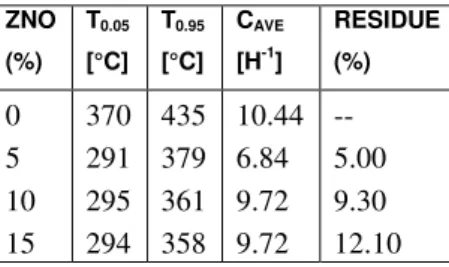
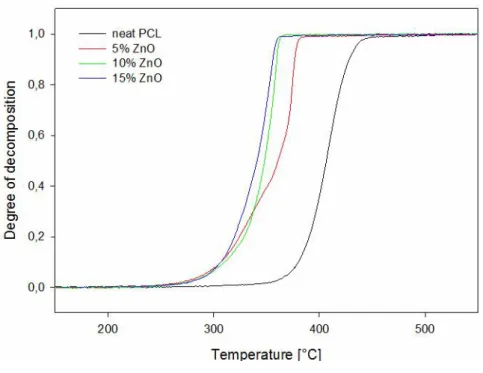
The thermal stability of PCL films and its compounds with 5%, 10% and 15% of ZnO was investigated by thermogravimetry (TG). Figure 1 presents the degree of decomposition versus temperature plots for the com-positions analysed in this work. All comcom-positions presented weight loss in a single stage. ZnO greatly de-creases the thermal stability of PCL, as the sigmoides of PCL/ZnO compounds are shifted around 50-70°C to lower temperatures, depending on the composition. For films produced with neat PCL, T0.05 (temperature for
5% weight loss) was observed at 435°C; the addition of ZnO to PCL decreased the thermal stability, and the compounds exhibited T0.05 of 379°C, 361°C and 358°C, for compositions with 5%, 10% and 15% ZnO,
re-spectively. At the end of the experiment residues of 5%, 9.30% and 12.00% were observed, which corre-spond approximately to the ZnO content added to PCL. The average degradation rate Cave did not
significant-ly change upon addition of ZnO, as can be verified in Table 1. Therefore it is suggested ZnO decreases the thermal stability of PCL, changing only slightly its degradation rate.
Table 1: Thermal parameters computed from TGA analysis for PCL and PCL/ZnO compounds. T0.05 temperature for 5%
of weight loss. T0.95 temperature for 95% of weight loss. Cave evaluated for weight loss ranging from 0.1 to 0.9. Residue
(%): ZnO content at the end of the experiment.
ZNO (%) T0.05 [°C] T0.95 [°C] CAVE [H-1 ] RESIDUE (%) 0 5 10 15 370 291 295 294 435 379 361 358 10.44 6.84 9.72 9.72 -- 5.00 9.30 12.10
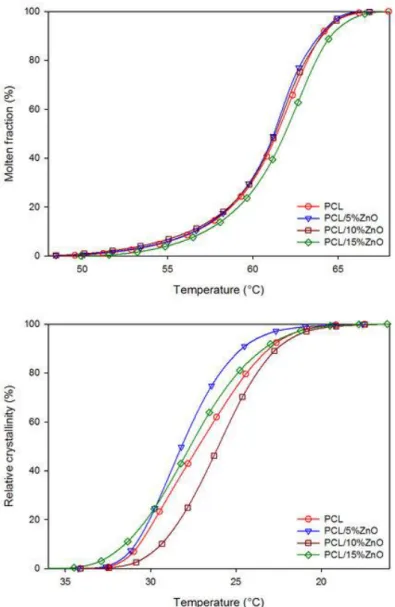
Figure 2: DSC scans for PCL and PCL/ZnO compounds. (a) First heating – melting endotherms, (b) cooling –
Figure 3 shows the molten fraction and relative crystallinity as a function of temperature for PCL and its compounds with ZnO. As can be observed, the fusion curves overlap suggesting PCL fusion mechanisms did not change upon addition of ZnO. A very similar behaviour is observed for the melt crystallization where the overlapping is also verified, in this situation with slight differences. It is a very interesting result, once the PCL thermal stability as well the degradation temperatures are modified upon addition of ZnO (according TG results) but not the mechanisms involved with fusion and crystallization. It is well known that PCL is a ther-mally stable polymer. According to the results presented in this work, the PCL stability is kept until around 300°C (PCL/ZnO); at higher temperatures, degradation starts and develops in a single event as commented in the TG section.
Another consequence extracted from DSC results is related to the processing parameters. As neither fusion nor crystallization changed, the processing of PCL and PCL/ZnO compounds may occur under equal conditions.
Figure 4 shows the fusion rate versus molten fraction and crystallization rate versus crystallized frac-tion for PCL and PCL/ZnO compounds; all composifrac-tions presented quite similar fusion rates, which have a bell-shaped behaviour with the beginning and the ending of the fusion occurring at lower rates and the inter-mediary (gross) mass melting at very fast rate; the same arguments are valid for melt crystallization, but for PCL/ZnO compounds the curves are somehow subtly higher than that for neat PCL. Higher crystallization rates are observed for PCL/ZnO compounds (Table 2), nevertheless the bell-shaped behavior is clearly identi-fied.
Figure 4: Fusion rate versus molten fraction and crystallization rate versus crystallized fraction for PCL and PCL/ZnO compounds.
The crystallinity (Xc) developed during heating/cooling/reheating scans increased upon ZnO
Table 2: DSC thermal parameters of PCL and PCL/ZnO compounds. Tm: melting peak temperature. Tc: crystallization
temperature. cmax:maximum crystallization rate. τ ½: time to reach 50% of developed crystallinity (crystallisable mass).
Xc: degree of crystallinity
Compo- sition
EVENT
FIRST FUSION MELT CRYSTALLIZATION SECOND FUSION
cmax
(min-1) Tm
(°C) τ ½
(min) Xc
(%) cmax
(min-1) Tc
(°C) τ ½
(min) Xc
(%) cmax
(min-1) Tm
(°C) τ ½
(min) Xc
(%)
PCL 1.722 62.8 1.29 19.1 1.189 28.9 0.64 15.8 1.774 55.8 2.38 16.4 PCL/
5%ZnO
1.793 62.6 1.35 23.3 1.609 28.1 0.59 19.0 1.960 55.0 2.43 19.9
PCL/ 10%ZnO
1.726 62.7 1.39 25.6 1.462 25.5 0.74 24.5 1.818 55.2 2.34 21.0
PCL/ 15%ZnO
1.653 63.2 1.16 24.2 1.276 27.5 0.78 19.8 1.642 55.7 2.30 20.7
Figure 5: Optical microscopy images of neat PCL (a) and PCL/5%ZnO (b).
Figure 5 displays optical microscopy images for PCL and PCL/5%ZnO compounds; spherulites are observed in both images. However, in neat PCL these shperulites are bigger. Possibly ZnO acts as a nucle-ating agent during PCL crystallization. In compounds with 10% and 15% ZnO (images not shown), PCL spherulites are lower than they are in compounds with 5% ZnO. This behavior agrees with the higher crystal-lization rates for PCL compounds as presented in Table 2. Probably ZnO particles act as heterogeneities de-creasing the nucleation energy and inde-creasing PCL crystallization rates. The literature presents works where the addition of additives, polymers and fibers modify the crystallization mechanisms and the morphological structure of PCL, see for examples bamboo cellulose/PCL composites [5], PCL/SiO2 [7], PBT/PCL blends
Scanning electron microscopy images for PCL compounds are presented in Figure 6, these images were captured from gold coated PCL films, no other thermal or chemical treatment was done. In Figure 6(a) a smooth surface is observable, similar to that of neat PCL (image not shown); ZnO seems to be well dispersed in the PCL matrix, which is indicative for high quality films; this also agrees with the residue content evalu-ated from TG analysis.
However for higher concentrations of ZnO, i.e., films with 10% and 15% ZnO, a spherulitic surface with pinholes (red circles) is verifiable, as presented in Figure 6(b). The preparation methodology used for these compounds (10% and 15% ZnO) must be improved, pinholes should not exist in films intended for food packaging as their presence prevents the proper food packing. Also, Figure 6(c) shows ZnO aggregates on the film surface, which is indicative of a poor dispersion that can be linked to the lower residue content measured by TG. These films possess zones with higher and lower ZnO concentrations. Figure 6(d) is an amplification of ZnO aggregates displayed in Fig. 6(c). At high ZnO concentrations, the particles appear to be untied to the film surface.
According to the literature, the ZnO bactericidal effect reaches 98% efficacy at 1% concentration; at concentrations higher than 1%, only few improvements are observed. With the methodology applied in this work, films with well dispersed ZnO particles are prepared for ZnO contents up to 5%, thus with a satisfying bactericidal effect for proper food packing [10-12].
4. CONCLUSIONS
PCL and PCL/ZnO films were produced by solution processing; adding ZnO to PCL decreased its thermal stability and increased PCL crystallinity. From MO images ZnO may be considered as a nucleating agent during the PCL crystallization; a higher amount of smaller spherulites was observed for PCL/ZnO com-pounds. According to SEM images, homogeneous PCL/ZnO films were successfully prepared for ZnO con-tents up to 5%.
Figure 6: SEM images for PCL/5%ZnO (a), PCL/15%ZnO (b), PCL/15%ZnO (c), amplification of red circles showed in
5. ACKNOWLEDGEMENTS
NGJ would like to thank CNPq (Conselho Nacional de Desenvolvimento Científico e Tecnológico) for his fellowship, and AR to CAPES (Coordenação de Aperfeiçoamento de Pessoal de Nível Superior) for his post-doctoral fellowship.
6. BIBLIOGRAPHY
[1] WU, W., WANG, W., LI, J., “Star polymers: Advances in biomedical applications”, Progress in Polymer
Science, v. 46, pp. 55-85, 2015.
[2] PERTICI, G., Bioresorbable Polymers for Biomedical Applications. Introduction to bioresorbable poly-mers for biomedical applications. Elsevier Press, Cambridge, pp. 3-29, 2017.
[3] SAFRANSKI, D.L., GRIFFIS, J.C., “Mechanical properties of shape-memory polymers for biomedical applications”, In: Shape Memory Polymers for Biomedical Applications, 1st ed., Elsevier, pp. 9-33, 2015.
[4] FORTUNATI, E., PULIGA, D., ARMENTANO, I., et al., “Multifunctional antimicrobial nanocompo-sites for food packaging applications”, In: Food Preservation, pp. 265-303, 2017.
[5] LIU, H., HUANG, Y., YUAN, L., et al., “Isothermal crystallization kinetics of modified bamboo cellu-lose/PCL composites”, Carbolydrate Polymers, v. 79, pp. 513-519, 2010.
[6] ZHURAYLEV, E., SCHMELZER, J.W.P., WUNDERLICH, B., et al., “Kinetics of nucleation and crys-tallization in poly(-caprolactone) (PCL)”, Polymer, v. 52, pp. 1983-1997, 2011.
[7] JIANG, S., JI, X., AN, L., JIANG, B., “Crystallization behaviour of PCL in hybrid confined environ-ment”, Polymer, v. 42, pp. 3901-3907, 2001.
[8] RIGHETTI, M.C., DI LORENZO, M.L., ANGIULI, M., et al., “Poly(butylene terephthalate)/poly( -caprolactone) blends: Influence of PCL molecular mass on PBT melting and crystallization behavior”, Euro-pean Polymer Journal, v. 43, pp. 4726-4738, 2007.
[9] LV, Q., WU, D., QIU, Y., et al., “Crystallization of Poly(-caprolactone) composites with graphite nano-platelets: Relations between nucleation and platelet thickness”, Thermochimica Acta, v. 612, pp. 25-33, 2015. [10] DIEZ-PASCUAL, M., DEZ-VICENTE, A.L., “Poly(3-hydroxybutyrate) / ZnO bionanocomposites with improved mechanical, barrier and antibacterial properties”, International Journal of Molecular Science, v. 17, pp. 10950-10973, 2014.
[11] YU, W., LAN, C., WANG, S., et al., “Influence of zinc oxide nanoparticles on the crystallization b e-havior of electrospun poly(3-hydroxybutyrate-co-3-hydroxyvalerate)nanofibers”, Polymer, v. 51, pp. 2403-2409, 2010.
[12] PADMAYATHY, N., VIJAYARAGHAVAN, R., “Enhanced bioactivity of ZnO nanoparticles - an an-timicrobial study”, Science and Technology of Advanced Materials, v. 9, n. 3, art.-no. 035004, 2008. [13] MANDELKERN, L., Crystallization of Polymers, v. 1: Equilibrium Concepts. 2nd Edition. Cambridge University Press, Cambridge (UK), p. 249, 2002.