*e-mail: [email protected]
Introduction
Synthetic plastics have been used for various purposes, especially in the packaging industrial sector; however, the majority of these materials constitute at present a serious problem of waste management.
Biodegradable polymers have attracted special attention as a potential solution of this problem, since they can be biologically degraded and therefore can be considered as environmental friendly materials. Among these, a special attention has been given to poly(ε-caprolactone) (PCL),a linear aliphatic semicrystalline polyester, synthesized by ring-opening polymerization of the cyclic lactone in presence of a catalyst. PCL is a polymer with good ductility because of its low glass transition temperature of -60oC. 1-4
PCL has been used in many applications; its biodegradability, biocompatibility and environmental friendliness have contributed to this purpose. It is a prime candidate for use in a variety of disposable materials that are used in food and medical packaging and other consumer items, since plastics disposal is becoming dificult as a result of diminishing landill space. Its physical properties and commercial availability make it very attractive, not only for speciic tools in agriculture for which biodegradation may be required, but also as a substitute of non biodegradable polymers for commodity applications. However, PCL has a low melting temperature (∼65°C) and poor thermal and gas barrier properties, which are the main
limitations to expand PCL applications to other industrial sectors, such as packaging, in which biodegradability is often sought. These drawbacks could be overcome by dispersion of nanoparticles in PCL to prepare nanocomposites that has proven to be suitable for several applications. 5-10
In this work PCL/bentonite (PCL/MMT) and PCL/organo-modiied bentonite (PCL/OMMT) nanocomposites were processed by melt extrusion followed by injection. Bentonite is natural clay whose main component is the mineral montmorillonite; bentonites are a valuable mineral class for industrial applications because of their high cation exchange capacity and high surface area. However, pristine bentonites contain many impurities, including clay and non-clay minerals as well as organic matter that may interfere with their cation exchange capacity as well as with nano dispersion of the load into the polymer matrices. In their natural form, bentonites are hydrophilic, which may make them dificult to disperse in hydrophobic polymer matrices. In previous work, our research group obtained better clay dispersion results using clay organophilization, a procedure where interlayer inorganic cations are replaced by organic quaternary ammonium cations, to increase the clay interlayer distance and diminish its hydrophilic character, leading to intercalated or exfoliated clay/polymer systems. 11-13
The main objective of this work is to investigate the degradation behavior of PCL, PCL/MMT and PCL/OMMT compounds in vacuum at 40oC for up to 45 days and in
Hydrolytic and Thermal Degradation of PCL and PCL/Bentonite Compounds
Danyelle Campos Françaa, Elieber Barros Bezerraa, Dayanne Diniz de Souza Moraisa,
Edcleide Maria Araújoa, Renate Maria Ramos Wellenb*
aMaterials Engineering Department, Federal University of Campina Grande, Campina Grande, PB, 58429-140, Brazil
BMaterials Engineering Department, Federal University of Paraíba, João Pessoa, PB, 58051-900, Brazil
Received: December 30, 2015; Revised: February 15, 2016; Accepted: March 11, 2016
Poly(Ɛ-caprolactone)/montmorillonite (PCL/MMT) and Poly(Ɛ-caprolactone)/organo-modiied montmorillonite (PCL/OMMT) compounds at 3% w/w clay content were prepared by melting mixing. The effect of MMT and OMMT on the degradability of PCL injected specimens was investigated in vacuum at 40oC for up to 45 days and in aqueous medium at 40oC for up to 45 days. Selected specimens were collected after 15, 30 and 45 days of exposure. Microstructural changes were monitored during the degradation experiment by means of melt low rate (MFR), weight loss, X ray diffraction (XRD), mechanical properties, and scanning electron microscopy (SEM). PCL and its compounds revealed not to be prone to hydrolytic degradation with similar results for MFR of samples exposed in vacuum and water. Gain and loss of weight were observed during experiments, probably due to swelling mechanism taking place in two stages, with the amorphous phase being the irst to be swelled followed by the crystalline one. By XRD a new peak corresponding to (002) plane was evident for PCL/OMMT. PCL proved to be resistant to degradation since experiments carried out in vacuum or in aqueous medium for up to 45 days were not enough to affect the mechanical integrity of PCL samples.
aqueous medium at 40oC for up to 45 days. The effect of degradation conditions into PCL systems was analyzed by means of X ray diffraction (XRD), melt low rate (MFR), weight loss, mechanical properties, and scanning electron microscopy (SEM).
Experimental
Materials
Poly (Ɛ-caprolactone) – PCL trade name CAPA 6500, with number – average molecular weight
( )
Mn = 47500 g/mol(GPC, THF, 25oC) and Intrinsic Viscosity (η) = 2890 Pa.s (70oC, 10 l/s) was purchased from Perstork.
Bentonite Clay trade name Brasgel PA, with cation exchange capacity (CTC) 90 meq/100g was kindly supplied by Bentonit União Nordeste (BUN), Brazil Company. In this work this clay is called MMT.
Methods
CompoundingMasterbatches of 1/1 PCL/clay were made by melt intercalation in a thermokinetic mixer model MH-50H; and ground in a knife mill. The concentrates were diluted to inal clay concentration (3% w/w) with neat PCL in a corotating twin screw extruder Coperion-Werner&Pleiderer ZSK 18 operating at 80-90oC and 180 rpm, followed by grinding in a knife mill. Compounds were oven dried for 24hours at 40oC. Same procedure was applied to neat PCL.
Specimens of PCL, PCL/MMT and PCL/OMMT 3% w/w of clay content for tensile and impact testing according to ASTM D638 and ASTM D256 standards were injection molded in a Fluidmec H 30/40 at 60-70°C.
Bentonite clay organophilization
Bentonite clay, as received was screened and organophilized with quaternary ammonium salt, Praepagen HY - (alkyl dimethyl hydroxyethyl ammonium chloride) following the procedure reported elsewhere. 11-13
Hydrolytic and thermal degradation
Molded specimens were used in degradation experiments under controlled conditions, i.e. in vacuum at 40oC for up to 45 days and in aqueous medium at 40oC for up to 45 days. Selected specimens were collected after 15, 30 and 45 days of exposure, and their properties evaluated.
Characterization
Torque rheometry
Neat PCL, and PCL /MMT and PCL /OMMT compounds with 3%, 10% and 20% clay content, were processed in a HaakeRheomix 600 laboratory internal mixer at 60 rpm for 20 minutes, with the chamber wall kept at 80°C. Torque and temperature as functions of time were plotted for PCL and its compounds.
Heat delection temperature (HDT)
Heat delection temperature tests carried out in a HDT 6 VICAT P/N 6921.000 instrument (Polymer Laboratory of Federal University of São Carlos – Brazil) according to ASTM D648. Experiments were conducted at load 455kPa, heating
rate 120oC/h, specimens were submersed in a silicone bath oil. HDT was determined at 0.25mm of specimen delection. Presented results are the average of three tests.
Weight loss experiments
Selected specimens were weighted before and after exposure to degradation experiments; changes of weight were computed according to equation:
* o f L o W W W 100 W − =
Where: Wo and Wf are specimens weight before and after degradation experiments, respectively.
Mechanical tests
Mechanical properties in tension were measured according to ASTM D638; tests were conducted in an EMIC DL 10000 testing machine operating at 50 mm/min elongation rate and 200kgf cell load. Impact tests were carried out in a CEAST Resil-5.5 impact machine operating with a 2.5J pendulum on notched specimens in Izod coniguration, according to ASTM D256. Presented results are an average of seven tests.
Melt low rate
Melt low rate experiments were performed according to ASTM 1238 in a DSM Plastometer MI-3 at 160oC under a load 2.16 kg; samples were collected after lowing for 10 seconds. Presented results are the average of ive tests.
X-ray diffraction (XRD)
X-ray diffraction (XRD) experiments were executed in a Shimadzu XRD-6000 instrument in the region of 2-30° (2θ), with KαCu radiation, tension 40 kV, current 30 mA and
scan rate 2°/min.
Scanning electron microscopy (SEM)
Scanning electron microscopy images were acquired in a SSX 550 Superscan–Shimadzu with 15 KV. Fractured surface from mechanical test was covered with gold to avoid accumulation of charges.
Results and Discussion
Organophilization procedure
X-ray diffratograms of bentonite clays, MMT and OMMT, used in this work are shown in Figure 1. The organophilization procedure was successful as the basal distance increased from around 1.31nm to 1.91nm, indicating that the organic cation was incorporated within the clay galleries, possibly increasing the afinity between PCL and OMMT. 11-13
Thermal stability during processing
means decreasing in molecular weight, suggesting polymer degradation took place during processing. A constant torque plateau, is an indicative of absence of degradation during polymer processing. 14-16
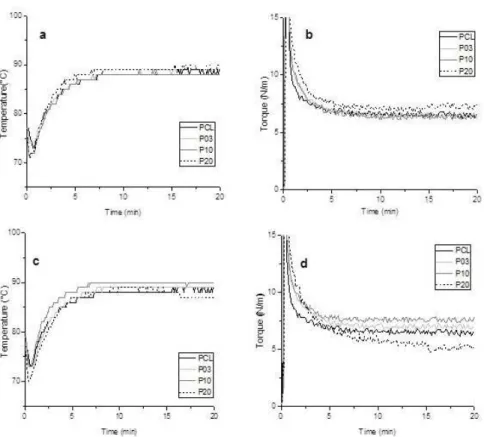
Figure 2 shows temperature and torque versus time plots for PCL/bentonite compounds up to 20% w/w clay content. PCL/MMT compounds show constant temperature and torque plateaus for 20 minutes processing time, evidencing absence of molecular weight decaying. PCL/MMT with 20% w/w clay content presented slightly higher torque values, probable due a higher clay content. PCL/OMMT with 20% w/w clay
content presented a mild decrease in the torque at constant temperature after 8 minutes of processing, suggesting that degradation reactions took place that may relect in a drop of PCL molecular weight. It is believed that ammonium salt clay interlayer favored a decreasing in the thermal stability of PCL/OMMT and promoted the degradation. 11
Among the compositions PCL/MMT and PCL/OMMT analyzed, compounds with 3% w/w clay content were selected for the degradation studies.
Heat delection temperature (HDT) measurements
Figure 3 shows HDT results for PCL, PCL/MMT and PCL/OMMT compounds with 3% w/w clay content. HDT of 42.50oC, 53.80oC and 51.45oC, were obtained for these compositions. Upon clay addition PCL keeps its mechanical performance at higher temperatures. This result may be understood as an evidence of afinity and good dispersion of bentonite into PCL matrix (see SEM images in Figure 9), where clay particles interact with PCL macromolecules; these new interactions may support higher stress levels as those applied during HDT experiments. 17,18Melt low rate
Figure 4 shows melt low rate measurements for PCL, PCL/MMT and PCL/OMMT compounds evaluated during degradation experiments up to 45 days. Figure 4(a) presents the results for tests carried out under vacuum and Figure 4(b) under water, respectively. Mild changes were observed depending on the environment, practically within the experimental error.
Figure 1. X-Ray diffratograms of MMT and OMMT.
Figure 2. Temperature (left) and torque (right) versus time for PCL/MMT (a) and (b), and for PCL/OMMT (c) and (d), respectively, at
Although PCL is a polyester, it is known from literature not be prone to hydrolytic degradation, this statement may be checked in Figure 4, which shows that tests executed under vacuum and aqueous medium presented very similar results. According to these results, unlike others polyesters as PET and PBT which degrade very fast by hydrolyses reactions,
PCL has showed to keep its performance in aqueous medium suggesting that PCL products may be projected for using in humid conditions. 19-23
Weight loss measurements during degradation
experiments
Selected specimens were weighted before and after degradation experiment, and their weight changes computed according to the following equation:
* o f L
o
W W
W 100
W
− =
Where: Wo and Wf are specimens weight before and after degradation experiments, respectively.
Figure 5 (a) presents results of experiments performed under vacuum and Figure 5 (b) under water.
Specimens subjected to vacuum for 15 days presented WL values of 0.22%, 0.14% and 0.19% for PCL, PCL/MMT
and PCL/OMMT compounds, respectively. After 30 days of exposure WL values were 0.64%, 0.76% and 0.82%; and for
45 days 0.23%, 0.21% and 0.13%. Results are graphically presented in Figure 5 (a). The highest WL value took place after 30 days.
Figure 4. Melt low rate measurements of PCL, PCL/MMT and PCL/OMMT compounds; under vacuum and temperature (a), under water
and temperature (b). (Exposure time indicated).
Figure 3. HDT measurements of PCL, PCL/MMT and PCL/
OMMT compounds.
Figure 5. Weight loss during degradation experiments for PCL, PCL/MMT and PCL/OMMT compounds, experiments performed in (a)
Regarding the degradation experiments carried out in aqueous medium at 40oC, after 15 days was observed an increase in the specimen weight, leading to negative values of WL; the same trend was observed after 45 day of exposure.
The values -0.25%, -0.65% and -0.63%; 0.76%, 0.35% and 0.48%; -0.54%, -0.64% and -0.50% were computed after 15, 30 and 45 days of exposure, for PCL, PCL/MMT and PCL/OMMT, respectively.
The swelling of semi-crystalline polyesters in aqueous media has been reported to occur in two steps: the irst step starts with water diffusion into the amorphous regions, which are less organized and allow easier water penetration into the polymer matrix. The second step starts after most of the amorphous regions to be swelled, then the mechanisms proceeds from the edge toward the center of the polymer crystalline domains. 26,27
In the present work it is possible that, initially, water diffused into the amorphous zones, resulting in negative values for WL and sample weight increased. Stabilization of
the amorphous zone increased WL, as observed at 30 days
of exposure. Advancing with the experiment time, water diffuse into the remaining amorphous and crystalline zones promoting a decrease in WL, observed after 45 days
of exposure. Possibly, for longer times, swelling of the crystalline phase would take place and higher values of WL
would be obtained.
Mechanical Properties
Figure 6 and Tables 1 and 2 display mechanical properties results of neat PCL, PCL/MMT and PCL/OMMT compounds subjected to degradation experiments. In principle, mechanical properties changed little during degradation and
Figure 6. Mechanical properties of PCL, PCL/MMT and PCL/OMMT compounds upon addition of 3% w/w clay content. (a), (c), (e)
almost all compositions presented approximately the same values for elastic modulus, yield stress, tensile strength, and elongation at break; neither water nor vacuum experiments showed meaningful changes in mechanical response of the compositions studied in this work.
Regarding to elastic modulus, results are a little higher for vacuum tests compared with those done in aqueous medium. In relation to degradation time, results for 30 days of exposure are higher than those for 15 and 45 days. It is most likely that for 30 days, degradation of the amorphous zones has taken place and the specimens became stiffer; these results agree with Figure 5.
Results for yield strength, Figures 6 c and d (and Tables 1 and 2), for neat PCL are higher under aqueous medium, whereas for PCL/MMT and PCL/OMMT compounds, higher values were obtained in vacuum. Bentonite clay may be abrasive iller, and may interact with PCL macromolecules, probably increasing the hydrolytic degradation.
As PCL melt crystallization ranges from 19oC to 40oC, it is possible during degradation experiments at 40oC, under both conditions, i.e., aqueous medium and vacuum, isothermal crystallization took place promoting an increase on the crystallinity degree and so on the density of the specimens what could have conducted to a higher Elastic Modulus and Yield Strength values. 6,26,28
Concerning the results of elongation at break, the lowest values were observed for PCL/OMMT compounds. Two effects should be considered in this case, the addition of bentonite to PCL and the organophilization of the clay that could result in a stiffer and brittle compound.
Degradation times investigated in this work weren’t long enough to promote considerable changes in the tensile specimens’ integrity, as may be visualized in Figure 6. Mechanical properties were almost unchanged after 45 days of exposure.
Impact strength measurements
An interesting behavior occurred during impact experiments. It was impossible to conduct the impact test with the specimens subjected to degradation under vacuum at 40oC for 30 and 45 days, since they melted during degradation experiment. Probably it was caused due to the lightweight of the impact specimens that is approximately 2.5 g whereas the tensile specimen´s weight is approximately 10 g. This result should be taken as a warning: PCL may melt at temperature as low as 40oC. On the other hand, all specimens immersed in water at 40oC, did not melt and impact test were executed for 15, 30 and 45 day of exposure. Figure 7 and Tables 3 and 4 show the collected data from impact tests.
Table 1: Mechanical properties of PCL and PCL/MMT and PCL/OMMT compounds subjected into aqueous medium at 40oC
Specimens subjected into aqueous medium
Elastic modulus (MPa)
Yield stress (MPa) Tensile strength
(MPa)
Elongation at break (%)
PCL 238.8±12.5 13.7±0.3 19.5±1.5 >413.35
PCL 15 days 215.7±11.5 12.5±0.4 20.5±2.3 463.0±91.5
PCL 30 days 247.0±13.4 14.2±0.4 20.7±2.0 414.4±60.6
PCL 45 days 206.2±5.6 12.3±0.9 18.7±1.7 >414.02
PCL/MMT 227.5±16.1 13.4±0.6 22.8±0.9 >563.19
PCL/MMT 15 days 219.4±13.8 12.6±0.4 18.5±1.2 >303.17
PCL/MMT (30 days 237.0±10.0 13.7±0.6 19.3±1.7 387.9±48.0
PCL/MMT 45 days 212.5±16.1 13.0±0.8 18.8±0.8 354.1±5.5
PCL/OMMT 217.4±23.9 13.7±1.2 22.7±1.1 >359.50
PCL/OMMT 15 days 240.8±16.7 13.5±0.7 20.0±1.6 449.1±71.1
PCL/OMMT 30 days 245.5±11.9 14.0±0.6 18.9±1.5 374.0±87.5
PCL/OMMT 45 days 223.2±5.0 13.8±0.4 21.3±0.5 494.4±60.3
Table 2: Mechanical properties of PCL and PCL/MMT and PCL/OMMT compounds subjected into vacuum at 40oC
Specimens subjected in vacuum
Elastic modulus (MPa)
Yield stress (MPa) Tensile strength
(MPa)
Elongation at break (%)
PCL 238.8±12.5 13.7±0.3 19.5±1.5 >413.35
PCL 15 days 185.3±16.3 10.7±0.6 22.5±1.1 464.0±91.0
PCL 30 days 228.6±9.2 13.4±0.4 17.8±0.7 364.3±22.2
PCL 45 days 211.0±4.8 12.5±0.4 22.7±1.5 507.8±86.2
PCL/MMT 227.5±16.1 13.4±0.6 22.8±0.9 >563.19
PCL/MMT 15 days 218.1±3.3 13.7±1.0 19.5±1.1 321.9±53.4
PCL/MMT 30 days 243.4±21.5 14.8±0.9 19.8±1.2 328.4±97.4
PCL/MMT 45 days 233.6±14.8 14.3±0.6 19.7±0.7 256.9±56.9
PCL/OMMT 217.4±23.9 13.7±1.2 22.7±1.1 >359.5
PCL/OMMT 15 days 252.9±19.8 14.5±0.5 19.9±0.9 234.8±106.7
PCL/OMMT 30 days 297.2±19.0 17.0±0.8 21.3±1.1 191.4±76.2
Figure 7. Impact strength of PCL, PCL/MMT and PCL/OMMT compounds upon addition of 3% w/w clay. (a) Specimens exposed to
vacuum at 40oC; (b) specimens immersed in water at 40oC. Degradation time indicated.
Table 3: Impact strength of PCL and PCL/MMT and PCL/OMMT compounds subjected into aqueous medium at 40oC
Specimens subjected
in water Impact strength (J/m)
0 days 15 days 30 days 45 days
PCL 243.6±7.6 237.0±14.0 243.0±20.3 215.1±13.9
PCL/MMT 148.6±7.7 148.9±11.9 143.8±9.3 133.3±10.9
PCL/OMMT 155.3±4.6 167.1±10.1 159.2±11.3 146.6±9.2
Table 4: Impact strength of PCL and PCL/MMT and PCL/OMMT
compounds subjected into vacuum at 40oC
Specimens in vacuum Impact strength (J/m)
0 days 15 days
PCL 243.6±7.6 377.8±13.9
PCL/MMT 148.6±7.7 107.3±3.9
PCL/OMMT 155.3±4.6 71.3±3.9
A different behavior was veriied for neat PCL after 15 exposure days: under vacuum, it presented very high value of impact strength while compounds with MMT and OMMT presented lower results; we have not found a plausible explication for it.
In general impact strength of PCL/MMT and PCL/OMMT compounds was lower than neat PCL; bentonite clay particles may be acted as stress concentrator inside the PCL matrix and decreased the impact response.
X ray diffraction (XRD) measurements
The study of the effect of degradation on the crystalline phase of PCL and its compounds with bentonite clay was performed by means of XRD. Figure 8 presents X ray diffratograms of PCL, PCL/MMT and PCL/OMMT compounds subjected to degradation experiments.
XRD tests performed with degraded specimens under vacuum or in water did not present signiicant changes in the XRD peaks. This result may be interpreted as the absence of PLC intercalation in the interlayer spacing of the clay. Degradation did not cause major changes in the crystalline character of PCL, whereas all diffratograms peaks were observed around 21,1° and 23,5° corresponding to basal distance 0.42 nm and 0.38 nm due to 110 and 200 planes.
For PCL/OMMT compounds degraded in water, the increase of basal distance (d001) was more pronounced for 45 days (d001=2.84 – 3.11nm); and a new peak corresponding to a (002) plane with d002=1.56 – 1.64nm was observed after 15 exposure days. 24-27
Scanning Electron Microscopy (SEM) Images
SEM images of fractured surface of PCL and PCL/MMT compounds, non-degraded and immersed in water for 45 days, acquired during impact test, are presented in Figure 9. These surfaces were covered with gold to avoid accumulation of charges.these experiments were done in ambient temperature (∼ 23oC), this temperature is high enough to allow macromolecular movements and to promote the development of PCL rubbery phase that probably conducted to the plastic deformation observed in Figure 9 (a) and (b).
In Figure 9 (c) MMT particles are clearly seen, some of them seem to be detached from PCL matrix, a ductile
fracture is also observed, however, less plastic deformation is observed in relation to neat PCL, this aspect agrees with the lowest values of impact strength obtained for the compounds with bentonite (Figure 7). In Figure 9 (d) thin ibrils are observed what may be evidences that degradation mechanisms have taken place. Similar SEM images were captured for PCL/OMMT compounds, images not showed here.
Figure 8. X ray diffratograms of MMT, OMMT, PCL, PCL/MMT and PCL/OMMT compounds. (a) and (b) tests executed with specimens
Conclusions
Adding bentonite to PCL increased its thermal stability by 26% and 21% as observed for HDT experiments of PCL/MMT and PCL/OMMT, respectively. PCL and its compounds were veriied not to be prone to hydrolytic degradation, MFR tests showed similar results in vacuum and water after 45 days of exposure. PCL immersed in water for 45 days presented a swelling process in two stages, probably; irst amorphous zones are swelled at 15 days of exposure followed by the crystallines ones at 45 days. According to XRD diffratograms, neither addition of bentonite nor degradation experiments changed the crystalline character of PCL. Bentonite was observed to be well dispersed in PCL matrix by SEM images, a ductile fracture with plastic deformation was also observed for neat PCL and its compounds. Impact specimens subjected
Figure 9. SEM images of PCL non-degraded (a), PCL immersed in water for 45 days of exposure (b), PCL/MMT non-degraded (c), PCL/
MMT immersed in water for 45 days of exposure (d).
to degradation experiments in vacuum at 40°C melted, what may be linked to their lightweight (2.5 g). Degradation experiments performed with thick tensile specimens (10 g) for 45 days in vacuum or in aqueous medium at 40°C were not enough to affect the mechanical integrity of PCL specimens what is a good result since PCL products may be used in these drastic conditions with no damage.
Acknowledgments
The authors are indebted to CNPq and Capes (Brasilia/DF, Brazil) for the inancial support; to Bentonit União Nordeste for supplying the clay and to Federal University of São Carlos, Polymer Laboratory for HDT experiments.
References
1. Rosa DS, Chui QS, Pantano Filho R, Agnelli JA. Avaliação da biodegradação de poli-β-(Hidroxibutirato), poli-β-(hidroxibutirato-co-valeraro) e poli-β-(caprolactona) em solo compostado.
Polímeros: Ciências e Tecnologia. 2002;12(4):311-317. doi: 10.1590/S0104-14282002000400015
2. Bucci DZ, Tavares LB, Sell I. PHB packaging for the storage
of food products. Polymer Testing. 2005;24:564-571.
3. Falcone DM, Agnelli JÁ, Faria LI. Panorama setorial e
perspectivas na área de polímeros biodegradáveis. Polímeros:
Ciências e Tecnologia. 2007;17(1):5-9. doi: 10.1590/S0104-14282007000100005
4. Harding KG, Dennis JS, von Blottnitz H, Harrison ST.
Environmental analysis of plastic production processes:
Comparing petroleum-based polypropylene and polyethylene
with biologically-based poly-ß-hydroxybutyric acid using life cycle analysis. Journal of Biotechnology. 2007;130(1):57-66. doi:10.1016/j.jbiotec.2007.02.012
5. Fukushima K, Abbate C, Tabuani D, Gennari M, Rizzarelli P, Camino G. Biodegradation trend of poly(ε-caprolactone)
and nanocomposites. Materials Science and Engineering C. 2010;30(4):566-574. doi:10.1016/j.msec.2010.02.012
6. Renstad R, Karlsson S, Albertsson AC, Werner PE, Westdah
of poly(3-hydroxybutyrate- co-3-hydroxyvalerate). Polymer International. 1997;43(3):201-209.
7. Lam C, Teoh SH, Hutmacher DW. Comparison of the degradation of polycaprolactone and polycaprolactone–(β-tricalcium
phosphate) scaffolds in alkaline medium. Polymer International.
2007;56(6):718–728. doi: 10.1002/pi.2195
8. Lepoittevin B, Devalckenaere M, Pantoustier N, Alexandre M, Kubies D, Calberg C, et al. Poly (Ɛ-caprolactone)/ clay
nanocomposites prepared by melt intercalation: mechanical, thermal and rheological properties. Polymer. 2002;43(14):4017-4023.
9. Sinha R, Okamoto M. Polymer/Layered silicate nanocompósitos:
a review from preparation to processing. Progress in Polymer
Science. 2005;28:1539-1641.
10. Lotto NT, Calil MR, Guedes CG, Rosa DS. The effect of
temperature on the biodegradation test. Materials Science and
Engineering C. 2004;24(5):659-662.
11. Barbosa R. Estudo da modiicação de argilas bentoníticas para
aplicação em nanocompósitos de polietileno [tese]. Campina Grande, Paraíba: Universidade Federal de Campina Grande;
2009.
12. Araújo EM, Barbosa R, Morais CR, Melo TJ, Souza AG. The effects of organoclays on the thermal processing of PE/Clay
nanocomposites. Journal of Thermal Analysis and Calorimetric. 2007;90(3):841-848.
13. Morais DD, Barbosa R, Medeiros KM, Araújo EM, Melo TJ. Preparation of poly(lactic acid)/bentonite clay bio-nanocomposite.
Materials Science Forum. 2014;775-776:233-237. doi: 10.4028/ www.scientific.net/MSF.775-776.233
14. Lyons JG, Holehonnur H, Devine DM, Kennedy JE, Geever LM, Blackie P, Higginbotham C. The incorporation of an
organically modified layered silicate in monolithic polymeric matrices produced using hot melt extrusion. Materials Chemistry and Physics. 2007;103(2):419-426.
15. Mould S, Barbas J, Machado AV, Nóbrega JM, Covas JA.
Measuring the rheological properties of polymer melts with on-line rotational rheometry. Polymer Testing. 2011;30(6):602-610. doi:10.1016/j.polymertesting.2011.05.002
16. Aho J, Boetker JP, Baldursdottir S, Rantanen J. Rheology as a
tool for evaluation of melt processability of innovative dosage forms. International Journal of Pharmaceutics. 2015;494(2):623-642. doi:10.1016/j.ijpharm.2015.02.009
17. Wong AC. Heat deflection characteristics of polypropylene
and polypropylene/polyethylene binary systems. Composites Part B: Engineering; 2003;34(2):199-208.
doi:10.1016/S1359-8368(02)00080-X
18. Bledzki A, Mamun AA, Feldmann M. Polyoxymethylene
composites with natural and cellulose fibres: Toughness and heat deflection temperature. Composites Science and Technology. 2012;72(15):1870-1874. doi:10.1016/j.compscitech.2012.08.004
19. Rodenas-Rochina J, Vidaurre A, Cortázar IC, Lebourg M. Effects
of hydroxyapatite filler on long-term hydrolytic degradation of
PLLA/PCL porous scaffolds. Polymer Degradation Stability. 2015;119:121-131. doi:10.1016/j.polymdegradstab.2015.04.015
20. Castilla-Cortázar I, Más-Estellés J, Meseguer-Dueñas JM, Escobar Ivirico JL, Vidaurre A. Hydrolytic and enzymatic degradation of a poly(ε-caprolactone) network. Polymer
Degradation Stability. 2012;97(8):1241-1248. doi:10.1016/j. polymdegradstab.2012.05.038
21. Larrañaga A, Aldazabal P, Martin FJ, Sarasua JR. Hydrolytic
degradation and bioactivity of lactide and caprolactone based sponge-like scaffolds loaded with bioactive glass particles.
Polymer Degradation Stability. 2014;110:121-128. doi:10.1016/j. polymdegradstab.2014.08.021
22. Zhang L. Kinetics of hydrolysis of poly(ethylene terephthalate)
wastes catalyzed by dual functional phase transfer catalyst: A mechanism of chain-end scission. European Polymer Journal. 2014;60:1-5. doi:10.1016/j.eurpolymj.2014.08.007
23. Lavilla C, Muñoz-Guerra S. Biodegradation and hydrolytic
degradation of poly(butylene terephthalate) copolyesters containing cyclic sugar units. Polymer Degradation and Stability. 2012;97(9):1762-1771. doi:10.1016/j.polymdegradstab.2012.06.008
24. Khoee S, Kardani M. Preparation of PCL/PEG superporous
hydrogel containing drug-loaded nanoparticles: The effect of hydrophobic-hydrophilic interface on the physical properties.
European Polymer Journal. 2014;58:180-190. doi:10.1016/j. eurpolymj.2014.06.024
25. Kaunisto E, Marucci M, Borgquist P, Axelsson A. Mechanistic
modelling of drug release from polymer-coated and swelling and dissolving polymer matrix systems. International Journal
of Pharmaceutics. 2011;418(1):54-71. doi:10.1016/j. ijpharm.2011.01.021
26. Jiang S, Ji X, An L, Jiang B. Crystallization behavior of PCL
in hybrid confined environment. Polymer. 2001;42:3901-3907.
27. Vertuccio L, Gorrasi G, Sorrentino A, Vittoria V. Nano clay reinforced PCL/starch blends obtained by high energy ball milling.
Carbohydrate Polymers. 2009;75(1):172-179. doi:10.1016/j. carbpol.2008.07.020
28. Wellen RM, Rabello MS. The kinetics of isothermal cold
crystallization and tensile properties of poly(ethylene terephthalate).