Major Article
Corresponding author: Msc Beatriz Böger. e-mail: [email protected]
Received 1 August 2017 Accepted 4 January 2018
Comparative analysis of Mouse Inoculation Test
and Virus Isolation in Cell Culture for rabies
diagnosis in animals of Parana, Brazil
Thaila Francini Corona
[1],[2], Beatriz Böger
[2], Tatiana Carneiro da Rocha
[2],
Walfrido Külh Svoboda
[3]and Eliane Carneiro Gomes
[2][1]. Divisão de Zoonoses, Divisão de Epidemiologia e Laboratórios de Controle de Doenças, Laboratório Central do Estado do Paraná, Curitiba, PR, Brasil. [2]. Programa de Pós-Graduação em Ciências Farmacêuticas, Universidade Federal do Paraná, Curitiba, PR, Brasil.
[3]. Instituto Latino-Americano de Ciências da Vida e da Natureza, Universidade Federal da Integração Latino-Americana, Foz do Iguaçu, PR, Brasil.
Abstract
Introduction: Rabies is an acute zoonotic disease, caused by a rhabdovirus that can affect all mammals, and is commonly
transmitted by the bite of a rabid animal. The definitive diagnosis is laboratorial, by the Fluorescent Antibody Test (FAT) as a quick test and Mouse Inoculation Test (MIT) as a confirmatory test (gold standard). Studies conducted over the past three decades indicate that MIT and Virus Isolation in Cell Culture (VICC) can provide the same effectiveness, the latter being considered
superior in bioethics and animal welfare. The aim of this study was to compare VICC with MIT, in terms of accuracy, biosafety and occupational health, supply and equipment costs, bioethics and animal welfare, in a Brazilian public health lab. Methods:
We utilized 400 samples of animal neurological tissue to compare the performance of VICC against MIT. The variables analyzed were accuracy, biosafety and occupational health, time spent in performing the tests, supply and equipment costs, bioethics and animal welfare evaluation. Results: Both VICC and MIT had almost the same accuracy (99.8%), although VICC presented fewer
risks regarding biosafety and mental health of the technicians, and reduced time between inoculation and obtaining the results
(approximately 22 days less). In addition, VICC presented lower supply costs (86.5% less), equipment costs (32.6% less), and
the advantage of not using animals. Conclusions: These results confirm that VICC can replace MIT, offering the same accuracy and better features regarding cost, results, biosafety and occupational health, and bioethics and animal welfare.
Keywords: Rabies. Diagnosis. Cell culture. Biosafety. Animal welfare.
INTRODUCTION
Rabies is an acute zoonotic disease caused by a rhabdovirus, commonly transmitted by the bite of a rabid animal, and can affect all mammals. It is acute encephalitis, one of the oldest known diseases in the world, which leads victims to death in
virtually 100 % of cases, after the onset of signs and symptoms.
Till date, rabies has been a serious public health problem and produces great economic loss to livestock1,2.
Typical human exposure to the rabies virus occurs in two general forms: the urban form commonly results from exposure
to a dog, cat, or other sick domestic animals; the wild form
results from exposure to wild animals such as raccoons, skunks, and bats. In general, both types of exposure occur concurrently, that is, exposure of domestic animals and subsequent human
cases. Therefore, it is essential to know the species of animals involved in the disease transmission cycle in a region, as well as to know the changes that occur in the population of affected wild animals3,4.
One of the epidemiological rabies surveillance tools is the
laboratory diagnostics, using specific immunobiologicals, which
is of fundamental importance to human prophylactic treatment
(post-exposure), as well as for the adoption of measures towards
disease-control in domestic animals, avoiding the occurrence
of animal disease, and the identification of areas with virus
circulation5.
Different techniques can be used for postmortem diagnosis
in animals. The fluorescence antibody technique (FAT) is considered a rapid diagnosis, performed by the examination of brain tissue, using fluorescence antibodies against the rabies virus. As a confirmatory test, the Ministry of Health of Brazil
recommends viral isolation by the mouse inoculation test
(MIT)1,6.
The World Health Organization (WHO) has compiled and
analyzed studies that indicate same effectiveness between MIT
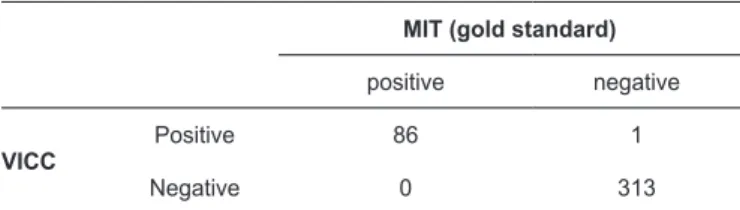
MIT (gold standard)
positive negative
VICC
Positive 86 1
Negative 0 313
TABLE 1: Results of VICC and MIT (gold standard) performed in 400 brain tissue samples of animals in Parana, Brazil.
VICC: Virus Isolation in Cell Culture; MIT: Mouse Inoculation Test.
samples at the Central Laboratory of Paraná State (Lacen-PR)
usually undergo the two tests, FAT and MIT, for rabies diagnosis. In this study, we conducted a comparative analysis of MIT and VICC for accuracy, biosafety and occupational health, supply and equipment costs, bioethics and animal welfare, in a Brazilian public health lab, aiming to establish VICC as a replacement for MIT.
METHODS
Study design
In this study, we performed accuracy tests assessing
sensitivity, specificity, positive and negative predictive values,
and Kappa statistic comparing MIT and VICC. In addition, we conducted comparative analyses regarding the technique
complexities, time elapsed in each method, supply and
equipment costs, biosafety and occupational health, bioethics and animal welfare.
We selected 400 samples, obtained from the rabies diagnosis
routine of the Central Laboratory of Paraná State/Lacen-PR, South Brazil, which is the reference laboratory for rabies diagnosis in the State of Paraná. The samples consisted of brain
fragments of different species, collected from urban areas of
Parana and sent to Lacen-PR over the period of 2009-2015. For MIT, each sample was processed and inoculated in six mice that remained under observation for a maximum period of
30 days. During the observation period, the mice that presented clinical signs of rabies were euthanized and had a brain fragment
collected and analyzed by FAT to confirm the sample’s positivity.
For VICC, the samples were inoculated in murine neuroblastoma cell cultures, registered at the American Type
Culture Collection as Neuro-2a (ATCC® CCL-131TM), according
to the WHO-recommended protocol for VICC.
The comparative analysis was based on:
• Equipment costs for implementation of the techniques; • Supply costs per year;
• Elapsed time during the tests;
• Occupational risks observed during the proceedings; • Animal welfare analysis;
• Bioethics evaluation;
• Results obtained in both methodologies.
Supply and equipment costs were obtained either from
Lacen-PR records or through market research, using information from
Brazilian companies specialized in these trades. Supply costs
were calculated based on the cost to process the 400 selected
samples, and extrapolated for 3,200 samples – the annual number
of samples analyzed in Lacen-PR for rabies diagnosis.
The elapsed time for each test was calculated in days and hours.
The same person processed all the samples.
Occupational risks, inherent to each technique, were listed
and classified according to the guidelines of World Health Organization (WHO) and the Ministry of Health, Brazil8,9,10.
Animal welfare analysis was based on the principle of five
freedoms11, namely: freedom from hunger and thirst; freedom from discomfort; freedom from pain, injury, or disease; freedom
to express normal behavior; freedom from fear and distress.
Bioethics evaluation was carried out considering the current legislation, and Brazilian and international guidelines on the use of animals in research.
Statistical analysis
We performed accuracy tests by calculating sensitivity,
specificity, positive and negative predictive values, and Kappa statistic of VICC against MIT (gold standard).
Ethical considerations
This study followed the ethical principles of research involving laboratory animals and was approved by the Animal Ethics Committee of the Federal University of Parana
(CEUA-BIO/ UFPR), certification number 862/2015.
RESULTS
A total of 400 samples were investigated by both MIT and VICC techniques. In VICC, 87 samples were positive for rabies
and 313 were negative. In MIT, 86 samples were positive and 314 were negative (Table 1).
The sensitivity of VICC was 100% (95% CI, 95.8%-100%), specificity was 99.7% (95% CI, 98.2%-99.9%), positive predictive value was 98.9%, negative predictive value was 100%, and accuracy was 99.8%. The Kappa coefficient was 0.99, which indicates an almost perfect agreement between VICC and MIT (95% CI, 97 %-100%)12.
Regarding the elapsed time for each test in VICC, all the 400
samples took 96h (four days) to produce definitive results. In
MIT, all the 314 samples, which were negative for rabies, took
30 days to confirm the results; the 86 positive samples presented
different durations starting from the inoculation until the onset
of clinical signs of rabies, with maximum period of 20 days,
minimum of 7 days, and average of 13 days. The average elapsed
time in MIT was 26 days. Therefore, the average elapsed time
in VICC was 22 days less than in MIT. The occupational risk factors observed in VICC and in MIT are shown in Table 2.
For animal welfare assessment in MIT, each freedom
Risk factors in VICC Risk factors in MIT Occupational hazards
Potentially contaminated aerosols formed during sample preparation
Potentially contaminated aerosols formed during
sample preparation Biological (rabies virus)
- Inoculation in mice with potentially contaminated
samples using needle
Biological (rabies virus) Biological (bite) Mechanical (bite) Mechanical (puncture)
-Manipulation of the animals during cage cleaning and replacement of wood shaving, producing
dust and ammonia aerosols
Biological (rabies virus) Biological (bite) Mechanical (bite) Physical (dust aerosol)
Chemical (ammonia aerosol)
- Mice inoculation and euthanasia Psychological (distress, depression,
trivialization of death)
- Use of compressed CO2 for euthanasia Physical (explosion)
TABLE 2: Possible occupational risk factors associated with VICC and MIT in a Brazilian public health lab.
VICC: Virus Isolation in Cell Culture; MIT: Mouse Inoculation Test.
Freedoms Observations Diagnosis
Freedom from hunger and thirst
Water and Food ad libitum Special food for mice (lab block)
Replenishment of water and food twice a week
Respected
Freedom from pain, injury or disease
Animals SPF (specific pathogen free
Yet, all animals are inoculated with potentially infected brain tissue samples
Presence of a veterinarian daily, but no treatment is provided to sick animals other than euthanasia
Restricted
Freedom from discomfort
30x20x13cm cages with 6 animals each, throughout their lives
Artificial lighting does not respect the period of 12 hours on 12 hours off
Large variations in temperature and humidity
Continuius noise of the exhaust fans, every day, throughout the mice’s whole lives
Restricted
Freedom to express normal behavior
Artificial and highly restricted environment throughout the mice’s whole lives
Poor social interactions
Lack of physical structures to provide cover and protection against external threats in the cage
Lack of sufficient room inside the cages for separating resting areas from excreta and
source of food supply
Absence of complex areas to permit exploration and search for food
Restricted
Freedom from fear and distress
Animals disturbed by human presence, with no possibility of escape or hiding
Psychological distress signs, such as walking in circles, cannibalism, fights Restricted
TABLE 3: Animal welfare assessment in mice utilized for MIT (according to the five freedoms) in a Brazilian public health lab.
MIT: Mouse Inoculation Test; SPF: specific pathogen free.
Costs VICC (USD) MIT (USD)
Supply costs (USD/year) 9,542 70,549
Equipment costs (USD/implementing the technique) 73,368 108,880
Total (USD) 82,910 179,429
TABLE 4: Supply costs per year and equipment acquisition costs for implementing VICC or MIT in a Brazilian public health lab.
Regarding the supply costs in each technique, it has been
proven that VICC is about 86.5 % less expensive than MIT. In
addition, the costs of acquiring equipment for implementing
VICC are 32.6% less than for implementing MIT (Table 4).
DISCUSSION
The results in this study indicate that VICC, when compared to MIT, has statistically the same performance and accuracy
(99.8%), but fewer risks regarding biosafety and mental
health of the technicians. It involves shorter durations between
inoculation and obtaining the results (on an average 22 days lesser), much lower cost of both supplies (86.5% lesser) and equipment acquisition for implementation (32.6% lesser). In
addition, it is a superior technique, as it does not use animals, according to the premises of bioethics and animal welfare.
Regarding the accuracy of VICC, the World Health
Organization had developed studies that are consistent with the results presented in this article, and predicted the replacement of MIT by VICC in public health laboratories about two decades ago7. More recently, the reference laboratory for rabies diagnosis
in Brazil– the Institute Pasteur of São Paulo – published a study
also corroborating that VICC can be as effective as MIT13. The period between inoculation and obtaining the results
for VICC justifies the huge advantage of this technique over MIT, which can be determinant on both the patient’s health and
the measures undertaken by the epidemiological surveillance,
since the administration of specific immunobiologicals is 100%
effective in preventing the disease before the onset of symptoms. We were able to obtain the real costs for acquiring equipment to implement VICC very precisely because Lacen-PR initiated the purchase process after analyzing the results of this research. As the MIT technique is most widely used in Brazil 14, we
expected VICC implementation to be more expensive compared
to MIT. The cost estimated was surprising and indicated a clear
advantage of VICC over MIT (Table 4).
The supply costs were also calculated through actual acquisition of products, used to perform the VICC technique in Lacen-PR. The results indicated that, for the same cost, seven samples could be processed by VICC in contrast to only one sample by MIT. With an annual routine of 3,200 samples, the savings could account for the acquisition of all equipments required, every 14 months, for the implementation of VICC.
If VICC has the same accuracy as MIT and is cheaper,
faster, and better for both technicians’ mental health and animal
welfare, it was surprising that it had not been accepted in Brazil. At the beginning of this study, we perceived some barriers
regarding the adoption of ‘a new technique’ in Lacen-PR, which
could possibly answer the above dilemma.
The first one was the inertia barrier, which refers to
the difficulty in engaging both, body and mind, to work for
something new, when one is habituated with the same protocol for a long time. MIT has been the gold standard technique for more than 30 years in Lacen-PR and has been effective since then. In order to overcome the barrier, we volunteered to receive training on the new technique and apply it in the lab.
The other was financial barrier that includes the cost consideration to implement and maintain VICC for rabies diagnosis. We referred to some previous literature that indicated that VICC could be cheaper than MIT, but we had no quantitative evidence.
The only way to by-pass this barrier was to convince the
lab’s directors by comparatively demonstrating the costs, item by item, and finally delivering an actual budget on both the
techniques. With this information, the lab could decide whether to continue with MIT or to invest in VICC.
As the results were obtained, the lab directors and other technicians realized that VICC was cheaper, faster, ethically more appropriate, and provided better biosafety and mental
health conditions to the technicians. The later benefits outweigh
the costs, encompassing occupational health, bioethics, and animal welfare.
Currently, VICC is being implemented in Lacen-PR, and the goal is to completely replace MIT by VICC for the diagnosis
of rabies by the end of 2016.
Acknowledgments
We gratefully acknowledge Federal University of Paraná (UFPR), the Central Laboratory of Paraná State and the Institute Pasteur of São Paulo for technical
assistance.
Conflict of interest
The authors declare that there is no conflict of interest.
Financial support
We gratefully acknowledge the financial support from Federal University of Paraná (UFPR).
REFERENCES
1. Ministério da Saúde (MS). Secretaria de Vigilância em Saúde
(SVS). [Internet]. Manual de Diagnóstico Laboratorial da Raiva.
Brasília: SVS/MS; 2008. 108p. Atualizado em mar 2016; Citado
em 24 abr 2016. Disponível em: http://bvsms.saude.gov.br/bvs/ publicacoes/manual_diagnostico_laboratorial_raiva.pdf
2. World Health Organization (WHO). Media Centre – Rabies
[Internet]. Geneva: WHO; 2016. [Updated 2016 March; cited 2016 April 24]. Available from: http://www.who.int/mediacentre/ factsheets/fs099/en/.
3. Centers for Disease Control and Prevention (CDC). Rabies
Homepage [Internet]. Atlanta: CDC; 2016. [Updated 2016
April 18; cited 2016 April 24]. Available from: http://www.cdc. gov/rabies/index.html/
4. Slaven EM, Stone SC Lopez FA. Doenças Infecciosas: Diagnóstico
e Tratamento no Setor de Emergência. Rio de Janeiro: McGraw-Hill Interamericana; 2007. p. 434-6.
5. Ministério da Saúde (MS). Secretaria de Vigilância em Saúde (SVS). Guia de Vigilância Epidemiológica. 7th. edição. Brasília:
6. Levinson W. Microbiologia médica e imunologia.
13th edição. Porto Alegre: AMGH, 2016. p. 317-8.
7. World Health Organization (WHO). Laboratory techniques in rabies. 4th edition. Geneva: WHO; 1996. p. 80-103.
8. Ministério da Saúde (MS). Secretaria de Vigilância em Saúde (SVS). Biossegurança em laboratórios biomédicos e de microbiologia. 3th
edição. Brasília: MS; 2006. p. 65-100.
9. Pan American Health Organization (PAHO). Biosafety in health:
priorities and strategies of action. PAHO; 2010. p. 48-50.
Available from: http://bvsms.saude.gov.br/bvs/publicacoes/ biosseguranca_saude_prioridades_estrategicas_acao.pdf
10. World Health Organization (WHO). In: Laboratory biosecurity
guidance [Internet]. Geneva: WHO; 2006 Sept [Cited 2016 April
24]. Available from: http://www.who.int/csr/resources/publications/ biosafety/WHO_CDS_EPR_2006_6.pdf
11. Broom DM, Fraser AF. Comportamento e bem-estar de animais domésticos. 4thedição. Barueri: Manole, 2010. p.438.
12. Landis JR, Koch GG. The measurement of observer agreement for
categorical data. Biometrics. 1977;33(1):159-74.
13. Castilho JG, Iamamoto K, Lima JYO, Carnieli Jr P, Oliveira RN, Macedo CI,et al. Padronização e aplicação da técnica de isolamento
do vírus da raiva em células de neuroblastoma de camundongo (N2A). BEPA. 2007;4(47):12-18.
14. Bones VC, Molento CFM. Alternativa ao uso de animais de