Engenharia Agrícola e Ambiental v.14, n.2, p.210–217, 2010
Campina Grande, PB, UAEA/UFCG – http://www.agriambi.com.br Protocolo 185.08 – 26/09/2008 • Aprovado em 24/07/2009
Development of biofilm in anaerobic reactors treating wastewater
from coffee grain processing
Fátima R. L. Fia1, Alisson C. Borges1, Antonio T. de Matos1, Iolanda C. S. Duarte2, Ronaldo Fia1 & Lidiane C. de Campos1
ABSTRACT
In recent decades the use of anaerobic fixed bed reactors has been established in Brazil for the treatment of different effluents. As the capability of retaining microorganisms by support media (fixed bed) is a factor influencing the perfor-mance of these reactors, the present study aims at evaluating the influence of three fixed bed on the effectiveness of treating an effluent with high pollution potential: wastewater from coffee grain processing (WCP), with organic matter concentrations varying from 812 to 5320 mg L-1 in the form of chemical oxygen demand (COD). Support media used for the immobilization of biomass were: blast furnace slag, polyurethane foam and #2 crushed stone with porosities of 53, 95 and 48%, respectively. The mean efficiency of COD removal in the reactor filled with polyurethane foam was 80%, attributed to its higher porosity index, which also provided greater retention and fixation of biomass which, when quan-tified as total volatile solids, was found to be 1301 mg g-1 of foam. The biofilm was made up of various microorganisms, including rod, curved rods, cocci, filaments and morphologies similar to Methanosaeta sp. and Methanosarcina sp.
Key words: anaerobic treatment, microbial biomass, support media, coffee
Desenvolvimento de biofilme em reatores anaeróbios tratando
água residuária do processamento dos frutos do cafeeiro
RESUMO
Nas últimas décadas tem-se registrado, no Brasil, o uso de reatores anaeróbios de leito fixo para o tratamento de diversos tipos de efluentes. Uma vez que a capacidade de retenção de micro-organismos pelo meio suporte (leito fixo) é fator de influência no desempenho desses reatores, buscou-se, com a realização do presente estudo, avaliar a influência do leito fixo na eficiência de três unidades tratando um efluente com elevado potencial poluidor: água residuária do processamento dos frutos do cafeeiro (ARC), com concentração de matéria orgânica variando entre 812 e 5.320 mg L-1 na forma de DQO. Os tipos de suporte utilizados na imobilização da biomassa foram: escória de alto-forno, espuma de poliuretano e brita nº 2, com índice de vazios de 53, 95 e 48%, respectivamente. A eficiência média de remoção de DQO no reator preenchido com espuma de poliuretano foi de 80%, atribuída ao seu maior índice de vazios o qual proporcionou também maior retenção e fixação da biomassa que, quantificada na forma de SVT, foi equivalente a 1.301 mg g-1 de espuma. O biofilme apresentou variedade de microrganismos tendo-se registrado bacilos, bacilos curvos, cocos, filamentos, e morfologias semelhantes a Methanosaeta sp. e Methanosarcina sp..
Palavras-chave:tratamento anaeróbio, biomassa microbiana, meio suporte, café
1DEA/UFV. Av. PH Rolfs s/n. – Campus da UFV. CEP 36570-000, Viçosa, MG. Telephone: (31) 3899-2729. E-mail: [email protected]; [email protected]; [email protected];
I
NTRODUCTIONFixed bed anaerobic reactors have been successfully em-ployed for the treatment of different types of wastewater owing to their excellent capacity of retaining microorgan-isms in a support media. Improvements made in the config-uration of these reactors resulted in systems far more stable, controllable and with high degradation efficiency, even when operated with reduced hydraulic retention time (HRT); some-thing attributed to elevated biomass concentrations and to greater cellular retention time (Lima et al., 2005).
These reactors do have something in common: a support cover material whose purpose is to retain biomass in the system interior; be them glued to the material surface, in the form of a biofilm, or, otherwise, adhered to the cover’s in-terstitial spaces in the form of bio-particles like flakes or granules. The immobilization of microorganisms results from their adherence to a solid or else suspended, being as it is influenced by cell-to-cell interaction or by environmental composition (von Sperling, 1996), not to mention the main characteristics of the supporting material, such as form, size, porosity, specific surface, solid quality and its electrostatic charges (Ortega et al., 2001).
Crushed stone #4 is by far the most used material as the ideal filler for the support media of fixed bed reactors; mainly when the treated effluent is the domestic sewage. However, other materials may be used experimentally since crushed stone is highly dense and rather costly in certain regions rendering the installation of reactors very expensive.
Out of a number of support materials commonly used for the adherence and growing of anaerobic biomass there are the following: coconut shells (Torres et al., 2003), porous ceramics (Zellner et al., 1987; Kawasc et al., 1989; Gourari & Achkari-Begdouri, 1997), nylon fibers (Chaiprasert et al., 2003), PVC rings (Ruiz et al., 1997 and Show & Tay, 1999). According to Ortega et al. (2001), the utilization of sup-ports capable of immobilizing the active biomass allows one to increase the mean time of its permanence inside the reac-tors, which favors the methanogenic population, increasing the capacity of the reactor to resist load shocks, the changes in the substrate features and the presence of inhibiting com-pounds.
Because biomass immobilization is an import factor in the functioning of these anaerobic systems, the present study proposes an evaluation of the influence of various support materials (blast furnace slag, polyurethane foam and #2 crushed stone) on the development of biomass retention in fixed bed anaerobic reactors when treating wastewater from the coffee grain processing (WCP).
M
ATERIALANDMETHODSReactors were constructed in PVC in a cylindrical form – 0.35 m diameter and l.5 m high, with total capacity of 0.1395 m3 (Figure 1). These units consisted of support
me-dia, reaching 1.0 m high, and placed on a false bottom plat-form which was placed 0.2 m away from the reactor base.
The false bottom contained 35 holes of 0.018 m diameter evenly distributed. Sample collectors for the supporting ma-terial were placed on top of and along the reactors in order to quantify and qualify the biofilm obtained.
To obtain support material for the immobilization of bio-logical solids, blast furnace slag, polyurethane foam and granite-gnaisse crushed stone, with porosity of 53, 95 and 48%, respectively, were employed. Crushed stone and blast furnace slag presented varying diameters: from 0.024 to 0.032 m, and the polyurethane foam was cut to an edge of 0.025 m. An analysis of the chemical composition of slag is shown in Table 1.
Wastewater
Wastewater from the coffee grain processing used for the experiment was collected at the Unit of Coffee Processing of the UFV.
In view of the lower pH levels and because of the high concentration of volatile acids presented by the WCP, a com-plementation of effluent alkalinity to the reactors was
con-Biogas
5 cm
20 cm
20 cm
35 cm 100 cm
30 cm
Section AA’ ø 1,8 cm
ø 35 cm Effluent
Support media
Taps for sampling of wastewater
Perforated support plate A’
A
Influent Windows for
sampling of support media
Figure 1. Schematic drawing of a fixed bed anaerobic reactor and the false bottom
Table 1. Chemical characterization of the blast furnace slag utilized
O i
S 2 CaO MgO Al2O3 FeO MnO K2O Ti S Cr2O3 Basicity x e d n i g
k g a d ( -1) 7
3 . 1
4 27.66 10.12 11.53 2.04 1.29 1.00 0.56 0.076 0.014 0.66*
sidered necessary, and for such, solid carbonate was utilized. According to Omil et al. (2003), the added alkalinity is cru-cial for securing a buffer medium so as to preserve pH sta-bility. The wastewater characterization employed during the three-phase monitoring system can be seen in Table 2.
Experimental Procedure
In order to secure the immobilization of biomass on the matrices of the support material, sewage sludge with high concentration of TVS and VSS of 41346 and 36860 mg L-1
was used. By means of a technique described by Zaiat et al. (1994), the support material together with the macerate sludge was stored in 200 L barrels, and homogenized ac-cordingly for the period of a week so as to secure steadier immobilization of bio-particles in the supporting material. Afterwards, the blast furnace slag, the polyurethane foam and the crushed stone were kept in their own reactors, tak-ing care that compression would not occur durtak-ing this pro-cess, proceeding then with the reactors start up phase, a period during which smaller organic loads were efficiently administered – a phase when the reactor operation is shown to be most delicate – so as to guarantee the proper accli-matization of biomass to the new environment at the cost of minimum organic or hydraulic load shocks.
The reactors were fed with wastewater at increasing con-centration of biological oxygen demand at 978 mg L-1 (start
up), 2401 mg L-1 and 4545 mg L-1 preserving, however, the
hydraulic retention time (HRT) of approximately 1.3 days. At each volumetric organic loading rate (OLR), the reactors were checked until a state of dynamic equilibrium was achieved, expressed by a balance between alkalinity sumption and the volatile acids production. Balanced con-ditions were maintained so as to make possible the collec-tion of supporting material in order to define the biomass obtained. After completing this stage, organic loading was
increased for all reactors, which went on to operate under new conditions till a new balance was achieved. From this point onwards, the fixed bed anaerobic reactors with ascend-ing outflow were operated and monitored for a period of 119 days. These units worked under room temperature, with mean values of 16, 17 and 19 °C for every phase of the operation, respectively.
Qualitative and quantitative assessment of the biofilm The biomass characterization conducted on each support material was obtained through electronic scanning micros-copy. The main cell morphologies present in the film were also duly assessed. The samples were fixed with phosphate buffer (pH 6.8) containing 5% glutaraldehyde for the period of 1 h and then rinsed 6 times at 10 min intervals with a buffer solution of phosphate (0.1 mol L-1) and distilled
wa-ter, after which the dehydration was done with ethanol so-lutions in increasing concentrations of (30, 50, 70, 80, 95 and 100% v/v). The samples, however, were rinsed three times with an ethanol solution 100% v/v. Each dehydration phase took 10 min to complete. The samples were dried up at 30 °C inside a 20 nm thick Critical Point Dryer Bal Tec CPD 030, whereas the particles were covered with a gold layer by means of a Sputter Coater Balzers SCU 010 and fixed upon aluminum supports (stubs) by means of an elec-tron conductive pen. The material was examined with a LEO VP 1430 electronic scanning microscope, and the analyses were conducted at the Electronic Scanning Microscopy Nu-cleus of the Federal University of Viçosa.
To complete the experiment, two samples placed at three different spots in the reactors (the bottom, middle and top) were assessed in order to establish the quantification of the biofilm produced. The material was rinsed in distilled water so that the biomass stuck on to the surface of the support material could be removed (Show & Tay, 1999). At the same time, the released solids were transferred to a 100 mL por-celain capsule for further examination to determine total solids (TS) and total volatile solids (TVS) through the gravimeter method (APHA, 2005).
R
ESULTSANDDISCUSSIONThe concentration and quantity of adhered biomass for each support material used in the present study are shown in Table 3. Based on visual observations, it may be conclud-ed that the biofilm formconclud-ed on the surface of the support ma-terials was blackish, viscous and of dense texture; the ap-parent thickness, however, varied in relation to the height of the reactor. Meanwhile, the greater thickness of the film was noticed to have occurred at the bottom of the reactor, whereas the biofilm of smallest thickness was noticed to occur on the upper layers of the reactor. As a rule, the bio-film glued to the polyurethane foam was seen to be far thicker and far more viscous than that found on other materials.
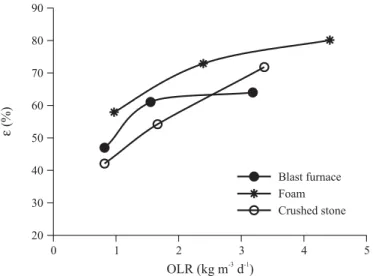
The presence of a larger quantity of microorganisms in the foam reactor was responsible for the higher efficiency values at the COD removal system, as verified with the use Table 2. WCP characterization used during the three-phase monitoring
system (mean values and standard deviation)
s e l b a i r a
V Phase
I II III
H
p 6.44±0.59(31) 6.55±0.46(22) 7.06±0.14(21) C
E 0.66±0.13(29) 1.78±0.40(21) 3.78±0.55(21) D
O
C 978±113(16) 2401±597(13) 4545±511(16) D
O
B 5 457± 87 (5) 1248±300(4) 2342±376(5) A
B 7 ± 34 6 (18) 199±165(12) 575± 89 (16) A
V
T 300± 88 (18) 969±177(12) 2021±360(16) S
T 664±162(10) 2317±605(10) 4755±1052(13) S
V
T 419±115(10) 1298±473(10) 2525±627(13) S
S
T 5 ± 34 (3) 124± 65 (5) 215± 05 (8) S
S
V 5 ± 01 4 (3) 116± 15 (5) 202± 94 (8) l
o n e h
P 13.0± 83. (10) 19.7± 24. (12) 42.7± 35. (16) NT 13.7± 44. (6) 29.0±13.8(4) 71.2±17.6(5) PT 3.7± 72. (6) 3.2± 70. (4) 8.0± 32. (5) (*) The number of samples taken into account for the calculation of the mean is found in parenthesis EC – electrical conductivity (dS m-1); COD – chemical oxygen demand (mg L-1); BOD – biochemical oxygen demand (mg L-1); BA – bicarbonate alkalinity (mg L-1 of CaCO
3); TVA – total volatile acids (mg L-1 de acetic acid) TS – total solids (mg L-1); TVS – total volatile solids (mg L-1); TSS – total suspended solids (mg L-1); VSS – volatile suspended solids (mg L-1); N
of this reactor during the three phases of the operation. Re-moval efficiencies of COD in relation to OLR as applied to each reactor are described in Figure 2. The biomass concen-tration maintained in the reactor in the form of TVS varied from 882 to 1627 mg g-1 of foam with an average value of
1301 mg g-1: values similar to those obtained by Ribeiro et
al. (2005), which varied from 1520 to 1690 mg g-1 of foam.
The quantity of bio-particles attached to the foam depends on the porosity index and the unevenness of the support material, therefore, the greater the area available for micro-bial colonization, the larger the capacity of biomass reten-tion, and, consequently, the better will be the reactors’ per-formance. According to Zaiat et al. (1997), this kind of support is capable of promoting ideal environmental condi-tions for syntrophic relacondi-tions that involve a vast variety of species resulting in optimum utilization of primary and in-termediary substrate.
The biofilm attached to the slag presented features com-parable to those of crashed stone of smooth surface. Never-theless, in spite of its roughness and grooves as detected in the slag, this was seen to be relatively fragile and easily re-movable. This aspect influenced enormously the quantity of biofilm attached to the blast furnace slag.
In spite of the greater removal of organic matter observed in the foam reactor, the other reactors have also presented satisfactory efficiencies, though they have presented smaller mass of microorganisms, quantified as TVS. Considering Table 3, the total mass of TVS in the reactor that contained
crashed stone was similar to that obtained in the reactor that contained blast furnace slag, being approximately 2.8 times smaller than that of the reactor that contained foam. How-ever, the biggest advantage of using foam as a support ma-terial is certainly attributed to the reactor’s constructive as-pect, because smaller foam specific mass results in less costly treatment units.
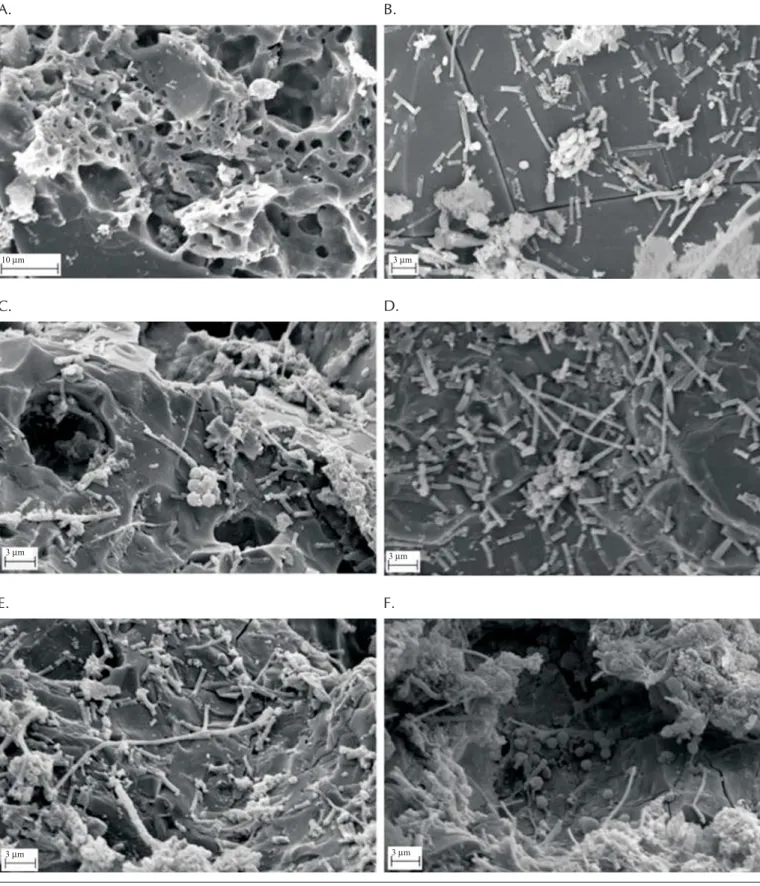
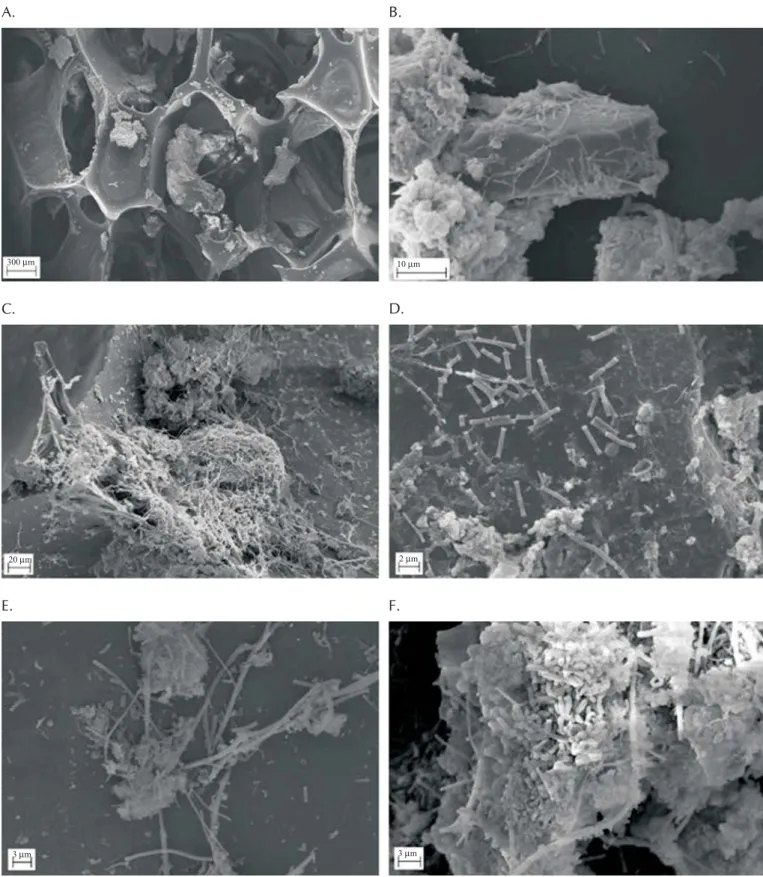
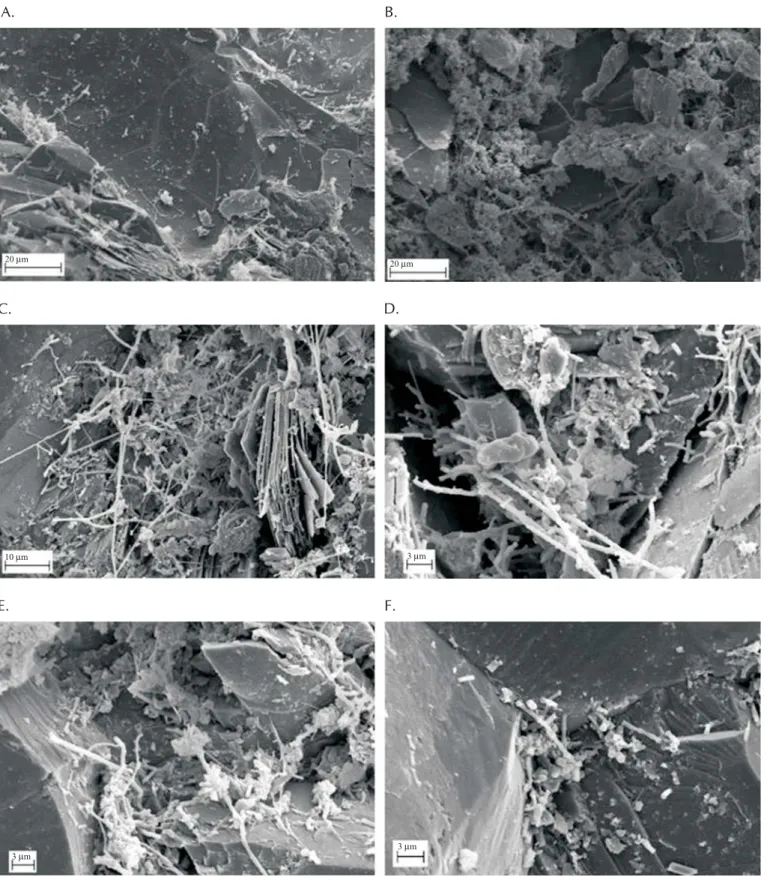
Figures 3, 4 and 5 show the morphologic diversity of microorganisms present in immobilized biomass in the var-ious support materials.
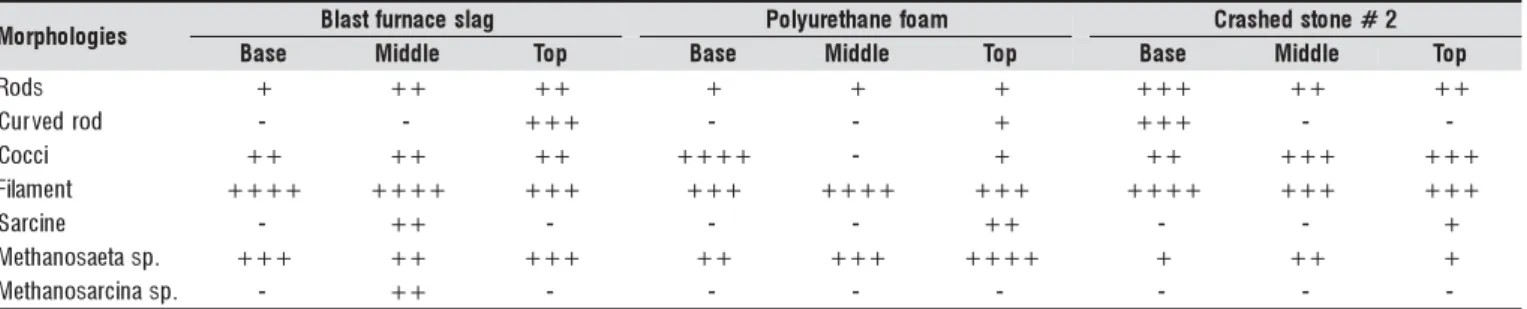
In all conditions, morphologies such as bacilli, cocci and filaments were found in the support materials of three re-actors. However, the predominant morphology in all con-ditions studied was that including non-fluorescent bacilli with round contours, similar to those of the genus
Metha-nosaeta sp. It was also verified that, besides these
morphol-ogies, the presence of cells similar to those of the genus
Methanosarcina sp. in the reactor in which the slag was
used as support material in the third phase of the system operation revealed a cubic disposition; a feature most com-monly found in the characteristic cubic disposition of the cocci forming sarcina and also because of the typical fluo-rescence that results from the presence of coenzyme F420. The methanogenic archaea and the chemical properties of the blast furnace slag are factors that may be connected to the presence of Methanosaeta sp. in the support material.
The presence of metallic ions, such as iron, in the blast furnace slag composition favors enormously the microbial metabolism, triggering the methanogenesis (Gourari & Achkari-Begdouri, 1997). According to Buzzini et al. (2006), the bio-availability of trace metals may interfere with kinetic of growth, for in the absence of appropriate concentrations of these metals, Methanosaeta sp. emerges
accounting for the ever growing frequency of this genus in the reactors. It must also be taken into account that envi-ronmental conditions of the reactors’ operation do favor the developmental and persistence of Methanosaeta sp. in
re-lation to the genus Methanosarcina sp.
Table 4 shows the frequency and the various microbial morphologies found in the biofilm attached to the support materials used in each reactor during the third phase of the system operation. The presence of curve bacilli was also observed, similar to sulphate reducing bacteria (SRB), indi-cating, therefore, the presence of sulphate in the medium.
Examining Figures 3, 4 and 5, it is verified that blast furnace slag, in spite of having presented poor perfor-mance in comparison to that of foam, gave rise to a larg-er variety of morphologies. One plausible justification for poor performance of this reactor has to do with the smaller amount of biomass attached to it in terms of TVS, as dis-cussed previously. It may be concluded that, on account of the smaller amount of biomass in the slag, this config-uration did not present favorable conditions to develop a stable highly concentrated microbial consortium; in oth-er words, by utilizing the slag as support matoth-erial one manages to obtain a large variety of microbial morpholo-gies intended for anaerobic treatment of wastewater, but in smaller concentrations.
Table 3. Mean concentration and quantity of biofilm adhered to different materials used as support media at the final phase of the experiment
t r o p p u S s l a i r e t a M s d il o S l a t o
T TotalVolatlieSoilds )
a
( (b) (c) (a) (b) (c)
g a l
S 18.1 45.7 4322 3.9 9.9 937 m
a o
F 2255 37.0 4989 1301 21.4 2880 e n o t s d e h s a r
C 10.7 32.2 2895 3.7 11.1 1002
(a) solid mass per mass support material (mg g-1); (b) solid mass per utilizable volume of the reactor (g L-1); (c) total mass of solids in the reactor (g)
20 30 40 50 60 70 80 90
0 1 2 3 4 5
OLR (kg m d )-3 -1
ε
(%)
Blast furnace Foam Crushed stone
A. B.
C. D.
E. F.
10 mµ 3 mµ
3 mµ 3 mµ
3 mµ 3 mµ
Figure 3. Morphological scanning observations of support material with blast furnace slag with an electron microscope for the treatment of wastewater from coffee grain processing. A: slag structure with the presence of rod; B: Methanosaeta; C: probably Methanosarcina and Methanosaeta; D: filaments
A. B.
C. D.
E. F.
300 mµ 10 mµ
20 mµ 2 mµ
3 mµ 3 mµ
A. B.
C. D.
E. F.
20 mµ 20 m
µ
10 mµ 3 mµ
3 mµ
3 mµ
Figure 5. Morphological scanning observations by means of electron microscope of support material of the crashed stone reactor for the treatment of wastewater from coffee grains processing. A: rod, cocci and filaments; B: Methanosaeta; C and D: filaments and Methanosaeta; E: Curvad rods, rod and
C
ONCLUSIONS1. Blast furnace slag did not offer satisfactory conditions for the development of a stable microbial consortium with higher concentrations; however, it showed an enormous va-riety of microbial morphologies most appropriate for the anaerobic treatment, though at lower concentrations.
2. The microbial biofilm attached to the various support materials presented a variety of species with similar mor-phologies to those of rod, curved rod, cocci, filaments,
Methanosaeta sp. and Methanosarcina sp.
3. The reactor filled with foam exhibited an average effi-ciency of 80% in removing COD, which can be attributed to its higher porosity index that favors better retention and fixation of biomass that, quantified in the form of chemical oxygen demand, was found to hold 1301 mg g-1 of material.
4. The polyurethane foam may be seen as an efficient al-ternative to support anaerobic fixed bed reactors.
L
ITERATURECITEDAPHA – American Public Health Association; AWWA – Ameri-can Water Works Association; WEF – Water Environment Fed-eration. Standard methods for examination of water and waste-water. 21.ed. Washington: APHA/AWWA/WEF, 2005. 1268p. Buzzini, A. P.; Sakamoto, I. K.; Varesche, M. B.; Pires, E. C.
Eval-uation of the microbial diversity in an UASB reactor treating wastewater from an unbleached pulp plant. Process Biochem-istry, v.41, p.168-176, 2006.
Chaiprasert, P.; Suvajittanont, W.; Suraraksac, B.; Tanticharoend, M.; Bhumiratana, S. Nylon fibers as supporting media in anaerobic hybrid reactors: it’s effects on system’s perfor-mance and microbial distribution. Water Research, v.37, p.4605-4612, 2003.
Colin, X.; Farinet, J. L.; Rojas, O.; Alazard, D. Anaerobic treat-ment of cassava starch extraction wastewater using a horizon-tal flow filter with bamboo as support. Bioresource Technolo-gy, v.98, p.1602-1607, 2007.
Gourari, S.; Achkari-Begdouri, A. Use of baked clay media as bio-mass supports for anaerobic filters. Applied Clay Science, v.12, p.365-375, 1997.
Kawasc, M.; Nomura, T.; Najima, T. Anaerobic fixed bed reactor with a porous ceramic carrier. Water Science. and Technology, v.21, n.4-5, p.77-86, 1989.
Table 4. Morphological characterization of biomass present in anaerobic reactors treating wastewater during the third phase of the system operation
s e i g o l o h p r o
M Blastfurnaceslag Polyurethanefoam Crashedstone#2 e
s a
B Middle Top Base Middle Top Base Middle Top
s d o
R + ++ ++ + + + +++ ++ ++
d o r d e v r u
C - - +++ - - + +++ -
-i c c o
C ++ ++ ++ ++++ - + ++ +++ +++
t n e m a li
F ++++ ++++ +++ +++ ++++ +++ ++++ +++ +++
e n i c r a
S - ++ - - - ++ - - +
. p s a t e a s o n a h t e
M +++ ++ +++ ++ +++ ++++ + ++ +
. p s a n i c r a s o n a h t e
M - ++ - - -
-(++++) predominant; (+++) frequent; (++) less frequent; (+) rare; (-) not observed
Lima, C. A. A.; Ribeiro, R.; Foresti, E.; Zaiat, M. Morphological study of biomass during the start-up period of a fixed-bed anaerobic reactor treating domestic sewage. Brazilian Archives of Biology and Technology, v.48, n.5, p.841-849, 2005. Omil, F.; Garrido, J. M.; Arrojo, B.; Méndez, R. Anaerobic filter
reactor performance for the treatment of complex dairy wastewa-ter at industrial scale. Wawastewa-ter Research, v.37, p.4099-4108, 2003. Ortega, F. S.; Rocha, K. M.; Zaiat, M.; Pandolfelli, V. C. Apli-cação de espumas cerâmicas produzidas via “gelcasting” em biorreator para tratamento anaeróbio de águas residuárias. Cerâmica, v.47, n.304, p.199-203, 2001.
Picanço, A. P.; Vallero, M. V. G.; Gianotti, E. P.; Zaiat, M.; Blundi, C. E. Influence of porosity and composition of supports on the methanogenic biofilm characteristics developed in a fixed bed anaerobic reactor. Water Science and Technology, v.44, n.4, p.197-204, 2001.
Ribeiro, R.; Varesche, M. B. A.; Foresti, E.; Zaiat, M. Influence of the carbon source on the anaerobic biomass adhesion on polyurethane foam matrices. Journal of Environmental Man-agement, v.74, p.187-194, 2005.
Ruiz, I.; Veiga, M. C.; Santiago, P.; Blázquez, R. Treatment of slaughterhouse wastewater in a UASB reactor and an anaero-bic filter. Bioresource Technology, v.60, p.251-258, 1997. Show, K. Y.; Tay, J. H. Influence of support media on biomass
growth and retention in anaerobic filters. Water Research, v.33, n.6, p.1471-1481, 1999.
Torres, P.; Rodríguez, J. A.; Uribe, I. E. Tratamiento de aguas re-siduales del proceso de extracción de almidón de yuca en fil-tro anaerobio: Influencia del medio soporte. Scientia et Tech-nica, v.23, p.75-80, 2003.
von Sperling, M. Princípios básicos do tratamento de esgotos: Princípios do tratamento biológico de águas residuárias. Belo Horizonte: DESA/UFMG, 1996. 211p.
Zaiat, M.; Cabral, A. K. A.; Foresti, E. Horizontal-flow anaero-bic immobilized sludge reactor for wastewater treatment: Con-ception and performance evaluation. Revista Brasileira de En-genharia, v.11, p.33-42, 1994.
Zaiat, M.; Vieira, L. G. T.; Foresti, E. Spatial and temporal varia-tions of monitoring performance parameters in horizontal-flow anaerobic immobilized sludge (HAIS) reactor treating synthetic substrate. Water Research, v.31, n.7, p.1760-1766, 1997. Zellner, G.; Vogel, P.; Kneifel, H.; Winter, J. Anaerobic digestion