ISSN 0104-6632 Printed in Brazil
www.abeq.org.br/bjche
Vol. 30, No. 03, pp. 521 - 529, July - September, 2013
*To whom correspondence should be addressed
Brazilian Journal
of Chemical
Engineering
LAS DEGRADATION IN A FLUIDIZED BED
REACTOR AND PHYLOGENETIC
CHARACTERIZATION OF THE BIOFILM
L. L. Oliveira
1*, R. B. Costa
1, I. K. Sakamoto
1, I. C. S. Duarte
2,
E. L. Silva
3and M. B. A. Varesche
1*1
Department of Hydraulics and Sanitation, School of Engineering of São Carlos, University of São Paulo, Phone: + (55) (16) 3373-8356, Fax: + (55) (16) 3373-9550,
Av. Trabalhador Sãocarlense 400, CEP: 13566-590, São Carlos - SP, Brazil. E-mail: [email protected]; [email protected]
2
Federal University of São Carlos, Rod. João Leme dos Santos, Km 110, SP 264, CEP: 18052-780, Sorocaba - SP, Brazil.
3
Department of Chemical Engineering, Federal University of São Carlos, Rod. Washington Luiz, Km 235, SP 310, CEP: 13565-905, São Carlos - SP, Brazil.
(Submitted: June 26, 2012 ; Revised: August 31, 2012 ; Accepted: October 26, 2012)
Abstract - A fluidized bed reactor was used to study the degradation of the surfactant linear alkylbenzene sulfonate (LAS). The reactor was inoculated with anaerobic sludge and was fed with a synthetic substrate supplemented with LAS in increasing concentrations (8.2 to 45.8 mg l-1). The removal efficiency of 93% was obtained after 270 days of operation. Subsequently, 16S rRNA gene sequencing and phylogenetic analysis of the sample at the last stage of the reactor operation recovered 105 clones belonging to the domain Bacteria. These clones represented a variety of phyla with significant homology to Bacteroidetes (40%), Proteobacteria (42%), Verrucomicrobia (4%), Acidobacteria (3%), Firmicutes (2%), and Gemmatimonadetes (1%). A small fraction of the clones (8%) was not related to any phylum. Such phyla variety indicated the role of microbial consortia in degrading the surfactant LAS.
Keywords: Immobilized biomass; Sand; 16S rRNA, Aeromonas; Novosphingobium.
INTRODUCTION
Linear alkylbenzene sulfonate (LAS) is an anionic surfactant introduced in 1964 as the readily biodegradable replacement for highly branched AlkylBenzene Sulfonates (ABS). Since then, its con-sumption has increased considerably. The estimated world consumption in 2000 was of 2.5 million tons (Sanz et al., 2003).
LAS is one of the xenobiotic compounds frequently found in sewage and industrial wastewa-ter. Its degradation has been widely studied in aerobic systems, and removal efficiencies of more than 97% achieved (Brunner et al., 1988). However,
for anaerobic systems, information is scarce and has been reported only recently, mainly due to recalci-trance of LAS in those systems. Removal efficiency of about 35% was achieved in horizontal anaerobic fixed bed (Duarte et al., 2008), and 85% in Upflow Anaerobic Sludge Blanket (UASB) reactors (Sanz et al., 2003).
Firmicutes, Verrucomicrobia, Actinobacteria, Acido-bacteria, Chloroflexi and Bacteroidetes were also detected. One of the identified clones showed 97% sequence similarity to Desulfosarcina. Furthermore, Pseudomonas was present.
In recent research, Oliveira et al. (2010a, 2010b) studied the anaerobic degradation of LAS in a bench scale fluidized bed reactor filled with different support materials. The authors concluded that the anaerobic fluidized bed reactor containing immobilized biomass can be considered to be a feasible reactor configuration for treating LAS. The reactor’s performance filled with sand reached an LAS removal efficiency of over 98 ± 2% over the operating period, with LAS concentrations in the influent of 18.8 ± 4.2 mg l-1. Regarding the molecu-lar studies, the reactor presented wide microbial diversity, with microorganisms mainly belonging to the phyla Bacteroidetes, Firmicutes, Actinobacteria and Proteobacteria.
Thus, this work was focused on LAS degradation under anaerobic conditions in a fluidized bed reactor. Recent studies in this area have focused on the use of UASB and fixed bed reactors (Almendariz et al., 2001; Sanz et al., 2003; Duarte et al. 2008, Oliveira et al. 2009). The microbial communities from bio-mass present in the reactor were described by 16S rRNA gene analysis. The microbial consortium present in the biofilm was probably involved in LAS degradation.
MATERIAL AND METHODS
Reactor Operation
Assays were performed in a fluidized bed reactor (FBR). The reactor was made of acrylic with a diameter of 4 cm and a height of 100 cm. It was kept in a controlled temperature chamber (30 ± 1 °C) and operated with a hydraulic retention time (HRT) of 18 h. The inoculum used in the experiment came from an UASB reactor used to treat swine wastewater at the UNESP University (Jaboticabal- SP, Brazil). The seed sludge contained 36 g L-1 of volatile solids (VS). The reactor was kept in a closed circuit for biomass immobilization and adaptation to synthetic substrate. In this stage, 3 L of feed medium was prepared. This feed consisted of synthetic substrate, prepared as reported by Oliveira et al. (2010a) (approximately 560 mg L-1 of COD), and anaerobic sludge (10% v/v). The six experimental stages were defined by modifications to the composition of the synthetic substrate: Phase I,
synthetic substrate without LAS; Phase II, synthetic substrate with 8.2 mg L-1 of LAS; Phase III, synthetic substrate with 24.4 mg L-1 of LAS; Phase IV, synthetic substrate with 30.8 mg L-1 of LAS; Phase V, synthetic substrate with 38.4 mg L-1 of LAS and Phase VI, synthetic substrate with 45.8 mg L-1 of LAS.
Physicochemical Analysis
To assess the behavior of the FBR, the following parameters were measured: chemical oxygen demand (COD) and pH (APHA, 2005). Bicarbonate alkalinity (BA) in the form of CaCO3 was measured as described in Dillalo and Albertson (1961) with the modifications of Ripley et al. (1986). The LAS concentration was periodically measured in the liquid phase (influent and effluent) using high-performance liquid chromatography (HPLC) as previously described (Duarte et al., 2006). The final mass balance of LAS in the system was calculated to quantify LAS degradation. The amounts of LAS supplied, measured at the outlet and adsorbed by the support plus biomass in the reactor at the end of the experiment were used in the calculations.
Molecular Biology
The extraction of total DNA was performed using the phenol:chloroform-based protocol described by Griffiths et al. (2000). To construct a 16S rRNA gene library, amplification was performed using the bacterial primers 27f and 1100f (Lane, 1991). A 16S rRNA gene library was constructed from the sludge sample taken in the final stage of reactor operation. The purified PCR product was ligated into the pGEM-T Easy Vector (Promega, Madison, WI, USA) according to the manufacturer's instructions, and then transformed inside Escherichia coli JM109 cells. The 16S rRNA gene inserts were amplified from the plasmid DNA of selected clones using universal M13 forward and reverse primers (Invitrogen).
Phylogenetic assignment of the microorganisms in the reactor samples was achieved by comparing the 500-bp contiguous 16S rRNA gene sequences obtained with 16S rRNA sequence data from reference and type strains and environmental clones deposited in the GenBank (http://www.ncbi.nlm.nih.gov) and RDP (Ribosomal Database Project, WI, USA, http://www.cme.msu.edu/RDP/html/index.html) public databases. Sequence matching was carried out using the BLAST and RDP routines.
Brazilian Journal of Chemical Engineering Vol. 30, No. 03, pp. 521 - 529, July - September, 2013
was done using ALIGNER with the default parameter settings. An evolutionary distance matrix was then calculated using the program COMPLETE LINKAGE CLUSTERING (http://pyro.cme.msu.edu/). The numbers and sequences of each OTU were determined based on an evolutionary distance of 0.05.
The sequences from the different OTUs were aligned with RDP database sequences in MEGA 5.05. The phylogenetic relationships obtained were analyzed by the Neighbor-Joining method using the MEGA 5.05 software package. Bootstrap analysis was based on 100 re-samplings.
The nucleotide sequences determined in this study and included in the phylogenetic trees have been deposited in the Genbank under the accession numbers JX561117-JX561132.
RESULTS AND DISCUSSION
Table 1 presents the results in each of the six phases of reactor’s operation, such as the initial and final concentrations of organic matter, pH, bicarbon-ate alkalinity, total volatile acids and effluent LAS concentration, and its percentage of removal.
The percentage of organic matter removal in the first stage was similar to that found in fixed-bed
reactors for LAS treatment (Oliveira et al. 2009). The reactors used in the previous study were fed with the same synthetic substrate and the mean value of COD removal was 87±3% for the biomass adaptation stage (Stage I).
The filtered COD values obtained in the second stage (86±7%) indicated that LAS did not affect the organic matter degradation as occurred in the study of Oliveira et al. (2009). The other parameters remained constant and stable over the previous steps without LAS in the influent (Table 1).
The high values of COD removal in all stages indicated that LAS did not affect the organic matter degradation. This is possibly justified because the reactor is high-rate. The reactor’s configuration allowed operation with a wide range of organic matter concentration. Furthermore, the development of a mature biofilm in the adaptation stage with co-substrate (sucrose and yeast extract) favored the growth of active biomass capable of degrading LAS. In association with these possibilities, the recircula-tion rate must be highlighted because it favored surfactant dilution, and consequently the microbial degradation.
During the reactor’s operation, the pH, Bicarbonate Alkalinity and Total Volatile Acid of the effluent remained constant with mean values of 8.0, 152 (mgCaCO3 L
-1
) and 15 (mgHAc L-1), respectively.
Table 1: Values of physicochemical parameters in the fluidized bed reactor
CODf a BAb TVAc LAS
Stage Sample
(mg l-1) pH (mgCaCO
3 l-1) (mgHAc l-1) (mg l-1)
Influent 698±58 7.7±0.2 -
Effluent 93±23 8.1±0.2 289±125 17±2 -
I 28 days
Removal (%) 87±3 -
Influent 644±39 7.6±0.2 8.2±1.3
Effluent 90±41 8.1±0.2 151±17 18±6 0.9±0.9
II 28 days
Removal (%) 86±7 88±11
Influent 665±50 7.7±0.1 24.4±3.7
Effluent 58±21 8.0±0.2 143±12 15±3 1.1±1.2
III 49 days
Removal (%) 91±3 96±5
Influent 608±45 7.7±0.2 30.8±4.5
Effluent 42±12 8.0±0.2 152±43 12±3 2.1±2.0
IV 49 days
Removal (%) 93±2 93±6
Influent 639±30 7.6±0.3 38.4±5.7
Effluent 43±13 8.1±0.2 146±6 15±5 2.5±1.2
V 70 days
Removal (%) 93±2 93±3
Influent 632±42 7.6±0.2 45.8±5.4
Effluent 60±17 7.9±0.2 153±47 14±6 3.2±1.2
VI 47 days
Removal (%) 91±2 93±3
a
CODf: Chemical Oxygen Demand filtered b
BA: Bicarbonate Alkalinity
c
At the end of the reactor’s operation, samples of support material were removed to perform the extraction of the adsorbed LAS. The result of LAS extraction from the sand was under the detection limit of the calibration curve (0.49 mg L-1). This indicates no adsorption of surfactant on the support or in the biofilm. Thus, the reactor received about 7760 mg of LAS, and 510 mg were collected in the effluent. The remaining LAS (93%) was removed from the system by the biological degradation process.
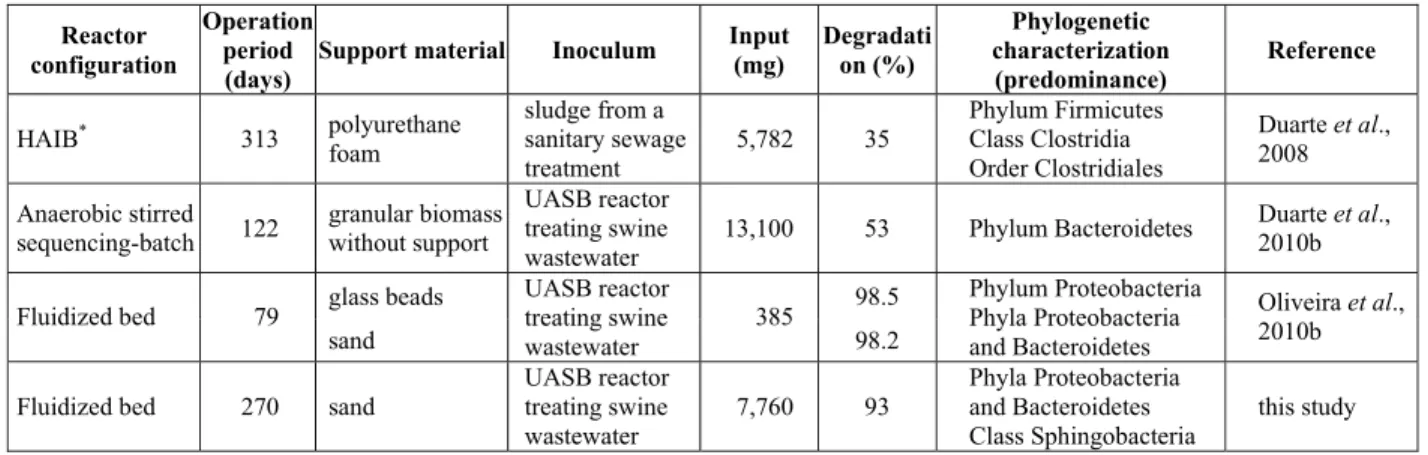
In previous research with FBRs filled with different support materials, including sand, Oliveira et al. (2010a) obtained results similar to this work. The feed and operating conditions of the reactors were similar, but with a fixed concentration of about 15 mg L-1.of LAS. The degradation percentages were 86, 83, 98.5 and 98.2% for the reactor filled with activated charcoal, expanded clay, glass beads and sand, respectively.
The reactor proved to be a suitable alternative for the treatment of LAS, especially when compared with the experiments carried out in horizontal anaerobic immobilized biomass (HAIB) reactors (Duarte et al., 2008; Oliveira et al., 2009). In those studies, the HAIB reactor was operated with a hydraulic retention time (HRT) of 12 h and fed with an LAS concentration of 14 mg l-1 during 313 and 343 days, respectively; 35% and 28% of the input LAS were degraded. In the reactor used in the present study, the percentage of degradation was constantly higher. The difference in degradation must reflect the different configurations of the systems and the microorganisms that developed inside them, because all reactors were fed with the same synthetic substrate and inoculum. Therefore, it is likely that the hydrodynamic characteristics of the system, which is a mixing reactor, combined with
other parameters such as pH and alkalinity, promoted the growth of different microorganisms.
Table 2 shows the comparison of this work with others, cited above.
Identification of Microorganisms Possibly Responsible for LAS Degradation
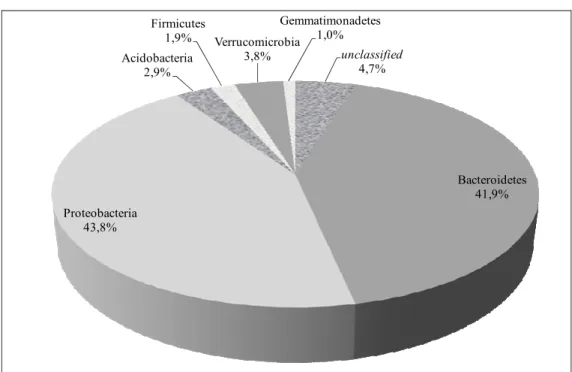
A 16S rRNA gene library was constructed to evaluate the bacterial community composition of the biomass at the end of the reactor operation period (270 days). A total of 110 clones were obtained from the biofilm in the sand reactor bed. The clone library obtained showed a high phyloge-netic diversity, with members from six phyla: 41.8% of the clones were assigned to the phylum Proteobacteria, 40% to Bacteroidetes, 3.6% to Verrucomicrobia, 2.7% to Acidobacteria, 1.8% to Firmicutes, 0.9% to Gemmatimonadetes and 0.9% to Fusobacteria. A small proportion of clones (8.2%) were not assigned to any phylum.
Figure 1 represents the clone percentages in the reactor sample related to different phylum. Although this comparison is represented as a percentage, it is not a quantitative representation of the microorganisms present in the reactor, but a qualitative one.
In a fluidized bed reactor operated on a smaller scale with the same support material and operating conditions for 70 days, Oliveira et al. (2010b) obtained the following classification as regards the Phyla: Bacteroidetes (25%), Proteobacteria (25%), Actinobacteria (12%), Deinococcus-Thermus (12%), Firmicutes (5%), Acidobacteria (3%), Anaerolineae (2%), Gemmatimonadetes (2%), Nitrospira (2%). In the present research lower microbial diversity was observed, which can be related to a potential selection of microorganisms by the higher concentra-tion of surfactant.
Table 2: Comparative study of the efficiency of LAS removal in anaerobic reactors.
Reactor configuration
Operation period (days)
Support material Inoculum Input (mg) Degradati on (%) Phylogenetic characterization (predominance) Reference
HAIB* 313 polyurethane
foam
sludge from a sanitary sewage treatment 5,782 35 Phylum Firmicutes Class Clostridia Order Clostridiales
Duarte et al., 2008
Anaerobic stirred sequencing-batch 122
granular biomass without support
UASB reactor treating swine wastewater
13,100 53 Phylum Bacteroidetes Duarte et al., 2010b
glass beads 98.5
Fluidized bed 79
sand UASB reactor treating swine wastewater 385 98.2 Phylum Proteobacteria Phyla Proteobacteria and Bacteroidetes
Oliveira et al., 2010b
Fluidized bed 270 sand
UASB reactor treating swine wastewater 7,760 93 Phyla Proteobacteria and Bacteroidetes Class Sphingobacteria this study *
Brazilian Journal of Chemical Engineering Vol. 30, No. 03, pp. 521 - 529, July - September, 2013
unclassified 4,7%
Bacteroidetes 41,9%
Proteobacteria 43,8%
Acidobacteria 2,9%
Firmicutes
1,9% Verrucomicrobia 3,8%
Gemmatimonadetes 1,0%
Figure 1: Phylogenetic representation of the microorganisms sampled during FBR operation
A total of 44 clones were related to the phylum Bacteroidetes, with 42 belonging to Class Sphingo-bacteria. The cells of species in this Class are gram-negative, non-spore-forming, straight rods that have no flagella but may exhibit sliding motility. Acid is produced from carbohydrates oxidatively but not fermentatively (Yabuuchi et al., 1983). Niastela sp. (related to 3 clones with 92% similarity) and Terrimonas sp. (related to 12 clones with 83% simi-larity), belonging to this Class, were also found in another reactor filled with sand (Oliveira et al., 2010b). The former is Gram-negative, aerobic, non-flagellated, gliding and filamentous. It was isolated from soil cultivated with Korean ginseng (Weon, H., et al., 2006). The latter is a nitrogen fixator, aerobic, gram-negative and filamentous. It was isolated from garden soil (Xie and Yokota, 2006). Sediminibacterium sp. and Ferruginibacter sp. were also similar to some OTUs. Sediminibacterium sp. is aerobic, Gram-negative rods, phylogenetically related to the genera Terrimonas and Niastella in the phylum Bacteroide-tes (Qu and Yuan, 2008). In this research, they were similar to microorganisms present in activated sludge. Ferruginibacter sp. is gram-negative, aerobic, non-gliding, nonfilamentous single rods (Lim et al., 2009). The OTUs were similar to organisms present in water supply systems, in estrogen-degrading bioreactors, in soil and sea sediments receiving agricultural discharges.
Similarly to Oliveira et al. (2010b), the Phylum Proteobacteria represented a significant proportion of clones obtained (46), but in the present study, the
Class Betaproteobacteria (presenting bacteria highly versatile in their degradation abilities) was more effective with 27 clones. Clones classified as Alphaproteobacteria (14), Gammaproteobacteria (4) and Deltaproteobacteria (1) were also obtained, differently from Oliveira et al. (2010b).
Three clones were related to Aeromonas sp. (100% sequence homology). It has been suggested that this genus degrades surfactants. Jimenez et al. (1991) studied a mixed microbial community consisting of three species of Pseudomonas and one Aeromonas sp. LAS was added at a concentration of 1 mg ml-1 as the only source of carbon, and all species studied were able to degrade over 25% of the input LAS and convert it to CO2. Duarte et al. (2010) also found clones related to Pseudomonas in anaerobic batch reactor treating detergent.
Another clone was identified as Novosphingobium, with 99% sequence similarity. This genus may also have contributed to LAS degradation in the present study, as it has been shown to use the aromatic ring of LAS as a carbon source (Sohn et al., 2004). Moreover, this genus was also found in the sequencing of a batch anaerobic reactor treating detergent (Duarte et al., 2010).
Some clones were related to denitrifying bacteria (Alicycliphilus, 99%) (Heylen et al., 2006) and a nitrogen-fixing bacterium isolated from rice paddy soil (Zoogloea, 91-99%) (Xie and Yokota, 2006). These bacteria belong to the Class Betaproteobacteria. A clone was related to Azospira sp. with 99% similarity. This organism uses aromatic compounds. It was isolated from contaminated soils and water and catabolized benzoate and other aromatic com-pounds anaerobically (Bergey and Holt, 1994). The presence of Azospira sp. in a fluidized bed reactor fed with LAS can be justified by the aromatic ring linked to the sulfonate group in the surfactant molecule.
Several members of the phylum Firmicutes (family Clostridiales) can use xenobiotic compounds as electron acceptors. Therefore, these should be
considered as possibly being responsible for the anaerobic degradation of LAS. In fact, several species of the order Clostridia can desulfonate alkyl- and arylsulfonates (Duarte et al., 2010). Some clones sequenced in this study were related to Clostridium sp. The reactor’s nutritional composition favored the growth of these cells, since both carbohydrates and amino acids (yeast extract) were available.
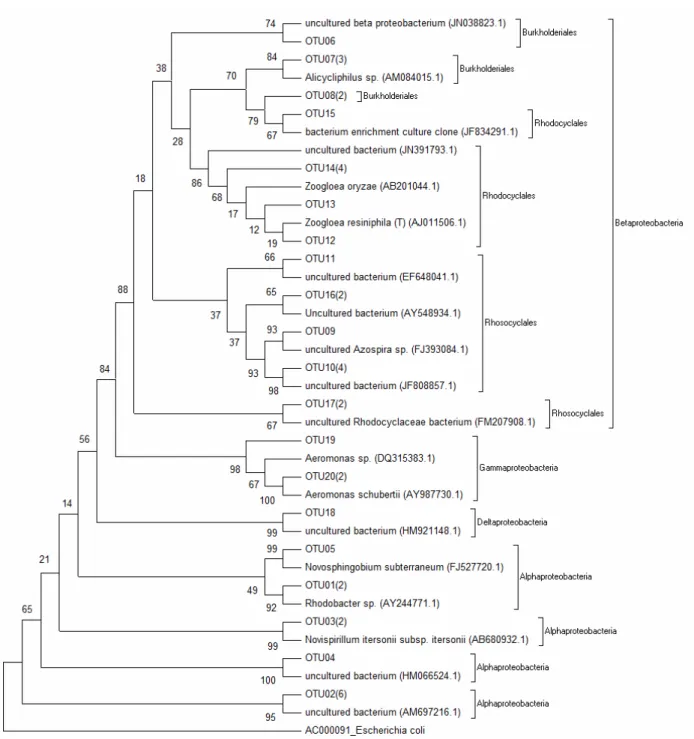
To illustrate the microbial diversity, the phyloge-netic tree related to Phylum Proteobacteria was constructed (Figure 2). Thus, the sequences (exceeding 600 bp) were grouped into operational taxonomic units (OTUs) with more than 95% similarity. Table 3 shows the clones present in Figure 2 classified in OTUs, as well their similarity to sequences with access number in NCBI and the reference.
Table 3: Sequences obtained from Genbank related to clones in the reactor, Phylum Proteobacteria
OTU Number of Clones
Similarity
(%) Access NCBI Description Reference
01 2 98 AY244771 Rhodobacter sp. 2002-65602 16S ribosomal RNA
gene, partial sequence
Drancourt, et al., unpublished
02 6 99 AM697216 Uncultured bacterium partial 16S rRNA gene, isolate
BF0001C057
Rintala et al., 2008
03 2 99 AB680932 Novispirillumitersonii subsp. itersonii gene for 16S
rRNA, partial sequence, strain: NBRC 15648
Nakagawa et al., unpublished
04 1 99 HM066524 Uncultured bacterium clone EDW07B003_75 16S
ribosomal RNA gene, partial sequence
Gray and Engel, unpublished
05 1 99 FJ527720 Novosphingobium subterraneum strain F-4 16S
ribosomal RNA gene, partial sequence
Liang and Li, unpublished
06 1 99 JN038823 Uncultured beta proteobacterium clone P-R36 16S
ribosomal RNA gene, partial sequence
Zhang et al., unpublished
07 3 99 AM084015 Alicycliphilus sp. R-24604 16S rRNA gene, strain
R-24604
Heylen et al., 2006
08 2 97 JF834291 Bacterium enrichment culture clone phytdeg33 16S
ribosomal RNA gene, partial sequence
Dawson et al., unpublished
09 1 99 FJ393084 Uncultured Azospira sp. clone MFC-B162-C02 16S
ribosomal RNA gene, partial sequence
Borole et al., 2009
10 4 100 JF808857 Uncultured bacterium clone R15-38 16S ribosomal
RNA gene, partial sequence
Xia et al., unpublished
11 1 98 EF648041 Uncultured bacterium clone HB31 16S ribosomal
RNA gene, partial sequence
Wang et al., unpublished
12 1 94 AB201044 Zoogloeaoryzae gene for 16S rRNA, partial sequence,
strain: A-4
Xie and Yokota, 2006
13 1 91 AB201044 Zoogloea sp. gene for 16S rRNA, partial sequence,
strain: A-4
Xie and Yokota, 2006
14 4 99 AB201044 Zoogloeaoryzae gene for 16S rRNA, partial sequence,
strain: A-4
Xie and Yokota, 2006
15 1 93 JF834291 Bacterium enrichment culture clone phytdeg33 16S
ribosomal RNA gene, partial sequence
Dawson et al., unpublished
16 2 99 AY548934 Uncultured bacterium clone 1-7 16S ribosomal RNA
gene, partial sequence
Luo and Hu, unpublished
17 2 99 FM207908 Uncultured Rhodocyclaceae bacterium partial 16S
rRNA gene, clone 408
Rotaru et al., 2010
18 1 99 HM921148 Uncultured bacterium clone cpw3d216 16S ribosomal
RNA gene, partial sequence
White et al., unpublished
19 1 94 DQ315383 Aeromonas sp. ZL1-r 16S ribosomal RNA gene,
partial sequence
Zhang et al., unpublished
20 2 100 AY987730 Aeromonas schubertii strain AE-48 16S ribosomal
RNA gene, complete sequence
Brazilian Journal of Chemical Engineering Vol. 30, No. 03, pp. 521 - 529, July - September, 2013
Figure 2: Phylogenetic analysis of partial 16S rRNA gene sequences of clones derived from the bioreactor
sample and related microorganisms (Phylum Proteobacteria). The source of these clones and their Genbank accession numbers are listed after species names. Escherichacoli (AC000091) was used as an outgroup.
CONCLUSIONS
An anaerobic fluidized bed reactor with biofilm in sand was efficient for LAS removal, which was not affected by variations in the influent concentra-tion. The COD removal remained high (above 90%)
and stable under all studied conditions, even with the increase of LAS concentration.
possible bacteria present in the microbial consortium established in biofilms involved in LAS degradation. For example, Aeromonas spp., Novosphingobium spp. and Azospira spp. seemed to have a potential role in LAS degradation. Aeromonas spp. may use the molecule as a source of carbon or energy, Novosphingobium spp. and Azospira spp. may use the aromatic ring of the LAS molecule as a source of carbon and energy.
ACKNOWLEDGEMENTS
The authors gratefully acknowledge the grants received from FAPESP, Process No. 05/58968-4, Brazil.
REFERENCES
Almendariz, F. J., Meráz, M., Soberón, G., Monroy, O., Degradation of linear alkylbenzene sulphonates (LAS) in an acidogenic reactor bioaugmented with a Pseudomonas aeruginosa (M113) strain. Water Science Technology 44, 183-188 (2001). APHA/AWWA/Water Environment Federation.
Standard Methods for the Examination of Water and Wastewater. 20th Ed. Washington, DC, USA (2005).
Bergey, D. H., Holt, J. G., Bergey´s Manual of Determinative Bacteriology. Ed. Williams & Wilkins, 9ª Edition. (books.google.com.br) (1994). Borole, A. P., Hamilton, C. Y., Vishnivetskaya, T. A.,
Leak, D., Andras, C., Morrell-Falvey, J., Keller, M. and Davison, B., Integrating engineering design improvements with exoelectrogen enrichment process to increase power output from microbial fuel cells. J. Power Sources, 191(2), 520-527 (2009).
Brunner, P. H., Capri, S., Marcomini, A., Giger, W., Occurrence and behaviour of linear alkylben-zenesulphonates, nonylphenol, nonylphenol mono- and nonylphenol diethoxylates in sewage and sewage sludge treatment. Water Research, 22, 1465-1472 (1988).
Dillalo, R., Albertson, O. E., Volatile acids by direct tritation. Journal WPCF, 33, 356-365 (1961). Duarte, I. C. S., Oliveira, L. L., Buzzini, A. P., Adorno,
M. A. T., Varesche, M. B. A., Development of a method by HPLC to determine LAS and its application in anaerobic reactors. Journal Brazilian Chemical Society, 17, 1360-1367 (2006).
Duarte, I. C. S., Oliveira, L. L., Mayor, M. S., Okada, D. Y., Varesche, M. B. A., Degradation of
detergent (linear alkylbenzene sulfonate) in an anaerobic stirred sequencing batch reactor con-taining granular biomass. International Biodete-rioration and Biodegradation, 64, 120-143 (2010). Duarte, I. C. S., Oliveira, L. L., Saavedra, N. K. D., Fantinatti-Garboggini, F., Oliveira, V. M., Varesche, M. B. A., Evaluation of the microbial diversity in a horizontal-flow anaerobic immobilized biomass reactor treating linear alkylbenzene sulfonate. Biodegradation, 19, 375-385 (2008).
Griffiths, R. I., Whiteley, A. S., O’Donnell, A. G., Rapid method for coextration of DNA from natu-ral environments for analysis of ribossomal DNA and rRNA-based microbial community composi-tion. Applied and Environmental Microbiology, 66, 5488-5491 (2000).
Heylen, K., Vanparys, B., Wittebolle, L., Verstraete, W., Boon, N., De Vos, P., Cultivation of denitrifying bacteria: Optimization of isolation conditions and diversity study. Applied and Environmental Microbiology, 72(4), 2637-2643 (2006).
Jimenez, L., Breen, A., Thomas, N., Federle, T. W., Sayler, G., Mineralization of linear alkylbenzene sulfonate by a four-member aerobic bacterial consortium. Applied and Environmental Micro-biology, 57, 1566-1569 (1991).
Lane, D. J., 16S/23S rRNA Sequencing in Nucleic Acid Techniques. In Bacterial Systematics, Eds. Stackenbrandt, E. and Goodfellow, M. pp. 115-148, New York: John Wiley and Sons, Inc (1991). Lara-Martín, P. A., Gómez-Parra, A., Köchling, T.,
Sanz, J. L., Amils, R., González- Mazo, E., Anaerobic degradation of linear alkylbenzene sulfonates in coastal marine sediments. Environ-mental Science and Technology, 41, 3573-3579 (2007).
Lim, J. H., Baek, S. H., Lee, S. T., Ferruginibacter alkalilentus gen. nov., sp. nov. and Ferruginibacter lapsinanis sp. nov., novel members of the family 'Chitinophagaceae' in the phylum Bacteroidetes, isolated from freshwater sediment. Int. J. Syst. Evol. Microbiol., 59, 2394-2399 (2009).
Oliveira, L. L., Costa, R. B., Duarte, I. C. S., Silva, E. L., Varesche, M. B. A., Anaerobic degradation of linear alkylbenzene sulfonate in fluidized bed reactor. Braz. J. Chem. Eng., 27(4), 539-543 (2010a).
Brazilian Journal of Chemical Engineering Vol. 30, No. 03, pp. 521 - 529, July - September, 2013
Oliveira, L. L., Duarte, I. C. S., Sakamoto, I. K., Varesche, M. B. A., Influence of support material on the immobilization of biomass for the degradation of linear alkylbenzene sulfonate in anaerobic reactors. Journal of Environmental Management, 90, 1261-1268 (2009).
Rintala, H., Pitkaranta, M., Toivola, M., Paulin, L. and Nevalainen, A., Diversity and seasonal dynamics of bacterial community in indoor environment. BMC Microbiol., 8, 56 (2008). Ripley, L. E., Boyle, W. C., Converse, L. C.,
Improved alkalinetric monitoraing for anaerobic digestion of high-strength wastes. Journal WPCF, 58, 106-411 (1986).
Rotaru, A. E., Probian, C., Wilkes, H. and Harder, J., Highly enriched Betaproteobacteria growing anaerobically with p-xylene and nitrate FEMS Microbiol. Ecol., 71(3), 460-468 (2010).
Sanz, J. L., Culubret, E., de Ferrer, J., Moreno, A., Berna, J. L., Anaerobic biodegradation of linear alkylbenzene sulfonate (LAS) in upflow anaerobic sludge blanket (UASB) reactor. Biodegradation, 14, 57-64 (2003).
Sohn, J. H., Kwon, K. K., Kang, J. H., Jung, H. B., Kim, S. J., Novosphingobium pentaromativorans sp. nov., a high-molecular-mass polycyclic aromatic hydrocarbon-degrading bacterium isolated from
estuarine sediment. Int. J. Syst. Evol. Microbiol., 54, 1483-1487 (2004).
Weon, H., Kim, B., Yoo, S., Lee, S., Kwon, S., Go, S., Stackebrandt, E., Niastella koreensis gen. nov., sp. nov. and Niastellayeongjuensis sp. nov., novel members of the phylum Bacteroidetes, isolated from soil cultivated with Korean ginseng. Int. J. Syst. Evol. Microbiol., 56, 1777-1782 (2006). Xie, C., Yokota, A., Reclassification of [ Flavobacte-rium] ferrugineum as Terrimonasferruginea gen. nov., comb. nov., and description of Terrimonas lutea sp. nov., isolated from soil. Int. J. Syst. Evol. Microbiol.,56, 1117-1121 (2006).
Xie, C. H. and Yokota, A. Zoogloea oryzae sp. nov., a nitrogen-fixing bacterium isolated from rice paddy soil, and reclassification of the strain ATCC 19623 as Crabtreella saccharophila gen. nov., sp. nov. Int. J. Syst. Evol. Microbiol., 56 (PT 3), 619-624 (2006).