U
NIVERSIDADE DE
L
ISBOA
Faculdade de Ciˆencias
Departamento de Inform´atica
COOPERATIVE TESTING
OF MULTITHREADED JAVA APPLICATIONS
Miguel ˆ
Angelo Marques Sim˜oes
DISSERTAC
¸ ˜
AO
MESTRADO EM ENGENHARIA INFORM ´
ATICA
Especializac¸˜ao em Engenharia de Software
2014
U
NIVERSIDADE DE
L
ISBOA
Faculdade de Ciˆencias
Departamento de Inform´atica
COOPERATIVE TESTING
OF MULTITHREADED JAVA APPLICATIONS
Miguel ˆ
Angelo Marques Sim˜oes
DISSERTAC
¸ ˜
AO
MESTRADO EM ENGENHARIA INFORM ´
ATICA
Especializac¸˜ao em Engenharia de Software
Dissertac¸˜ao orientada pelo Prof. Doutor Francisco Cipriano da Cunha Martins e co-orientada pelo Prof. Doutor Eduardo Resende Brand˜ao Marques
Agradecimentos
Agradec¸o aos meus orientadores, professores Eduardo Marques e Francisco Martins, pela constante disponibilidade, apoio e suporte para o desenvolvimento deste trabalho de modo a torn´a-lo o melhor poss´ıvel. Aprendi imenso no desenrolar deste trabalho e grande parte devo-o a eles.
Agradec¸o imenso `a minha fam´ılia, pois sem ela n˜ao teria sido poss´ıvel chegar onde cheguei. Aos meus pais, Fernando Sim˜oes Ferreira e Maria de F´atima Figueiredo, agrade-c¸o todo o apoio, motivac¸˜ao e tamb´em pelos sacrif´ıcios que fizeram para me permitir chegar at´e aqui. Agradec¸o tamb´em `a minha e irm˜a e sobrinho, Tˆania e Rodrigo, pelo apoio constante e que nunca me deixaram de animar. A todos eles, muito obrigado.
Por fim, mas n˜ao menos importante, quero agradecer a todas as pessoas, que ao longo do meu percurso acad´emico me ajudaram e apoiaram. Em especial a quatro pessoas que j´a me acompanham `a algum tempo e tornaram tudo mais f´acil. Ao Jo˜ao Caetano e Filipe Lemos pela companhia e ajuda em muitos trabalhos tanto da licenciatura, como de Mestrado, e por uma amizade pela qual tenho muito valor. E tamb´em `a Lara Caiola e C´esar Santos por toda a amizade e apoio que deram durante o mestrado e principalmente no desenvolvimento da tese. Todos eles foram importantes para chegar aqui.
Resumo
Para desenvolver programas concorrentes, o modelo de programac¸˜ao prevalente ´e o uso de threads. Uma thread define uma linha de execuc¸˜ao sequencial num programa, em que partilha o espac¸o de mem´oria com todas as outras threads que est˜ao a executar o programa ao mesmo tempo. Al´em de mem´oria partilhada, as threads de um programa tamb´em interagem mediante primitivas de concorrˆencia como locks ou barreiras. O uso de threads ´e suportado por alguma das linguagens de programac¸˜ao mais conhecidas e utilizadas, como por exemplo, o Java ou C.
Em programas multithreaded, erros de programac¸˜ao s˜ao f´aceis de cometer, com o uso de mem´oria partilhada e primitivas de interacc¸˜ao. Por exemplo, a partilha de mem´oria entre as threads pode levar a condic¸˜oes de corrida sobre os dados (data races), e inerente inconsistˆencia de valores para os mesmos. Outro problema t´ıpico ´e a ocorrˆencia de im-passes (deadlocks) no uso de primitivas de concorrˆencia, como locks, que n˜ao permitem que uma ou mais threads progridem na sua execuc¸˜ao. Quando um bug se manifesta, um programador normalmente tenta determinar manualmente a sua origem, atrav´es de t´ecnicas de debugging, e/ou executa o conjunto de testes associados ao programa, ob-servando em quais testes s˜ao reportados erros. Frequentemente, estas duas abordagens falham para programas multithreaded.
A raz˜ao para estas dificuldades ´e que numa execuc¸˜ao com m´ultiplas threads as mudanc¸as de contexto acontecem de forma n˜ao-determinista, o que torna imposs´ıvel observar e con-trolar de forma precisa o fluxo de execuc¸˜ao e escalonamento de threads associado. Ao mesmo tempo, os bugs tipicamente apenas se manifestam num sub-conjunto de todos os escalonamentos poss´ıveis, e com frequˆencia apenas em escalonamentos bastante es-pec´ıficos e dif´ıceis de reproduzir. Um teste de software pode ser repetido imensas vezes, sem expor um bug. Se e quando este ´e detectado, pode ser extremamente dif´ıcil identificar e replicar o fluxo de execuc¸˜ao ocorrido. At´e padr˜oes de bugs relativamente simples s˜ao dif´ıceis de detectar e replicar com precis˜ao (por exemplo, ver [9]).
Esta tese trata do problema geral de testar programas concorrentes escritos em Java [16], de modo a que bugs possam ser descobertos e replicados de forma determinista. A nossa abordagem passa pela execuc¸˜ao de testes de software com semˆantica cooperativa [23, 24]. A observac¸˜ao fundamental subjacente ao uso de semˆantica cooperativa ´e que as mudanc¸as
de contexto relevantes entre threads acontecem apenas nos pontos de potencial inter-ferˆencia entre estas, tais como o acesso a dados partilhados ou o uso das primitivas para concorrˆencia, chamados yield points cooperativos. Uma execuc¸˜ao ´e considerada cooper-ativa se o c´odigo entre dois yield points consecutivos da mesma thread executa de forma sequencial como uma transac¸˜ao, sem qualquer interferˆencia de outras threads.
A semˆantica cooperativa pode ser explorada para testes de software deterministas, em que a reproducibilidade de execuc¸˜ao ´e garantida, e a cobertura sistem´atica do espac¸o de estados de escalonamento possa ser efectuada. A ideia base ´e executar as threads com semˆantica cooperativa, por forma a que a execuc¸˜ao repetida de um teste possa explorar o espac¸o de estados de forma controlada e customizada, e at´e eventualmente exaustiva. Esta t´ecnica ´e usada em algumas ferramentas [3, 7, 17] para programas concorrentes escritos em C/C++.
Nesta tese n´os apresentamos o desenho, implementac¸˜ao e avaliac¸˜ao de uma ferramenta de testes cooperativa para programas concorrentes escritos em Java. A ferramenta desen-volvida chama-se Cooperari e est´a dispon´ıvel emhttps://bitbucket.org/edrdo/Cooperari. Tanto quanto pudemos determinar pela avaliac¸˜ao do estado da arte, trata-se da primeira ferramenta de testes cooperativos para programas em Java. As contribuic¸˜oes desta tese s˜ao as seguintes:
• A ferramenta instrumenta o bytecode Java da aplicac¸˜ao, por forma a interceptar yield points na execuc¸˜ao, e a tornar a execuc¸˜ao cooperativa. Os yield points su-portados concernem operac¸˜oes sobre monitores Java (operac¸˜oes de locking e prim-itivas de notificac¸˜ao), operac¸˜oes do ciclo de vida de uma thread definidos na API
java.lang.Thread, e ainda acessos (de leitura e escrita) a campos de objectos ou posic¸˜oes de vectores. A instrumentac¸˜ao dos yield points ´e definida recorrendo `a linguagem AspectJ [14].
• Para a execuc¸˜ao cooperativa definimos um ambiente de execuc¸˜ao, que compreende um escalonador (scheduler) cooperativo e uma implementac¸˜ao cooperativa de mon-itores Java e operac¸˜oes do ciclo de vida de uma thread. O escalonador cooper-ativo condiciona o escalonador ncooper-ativo da m´aquina virtual Java (que se mant´em activo), por forma a se obter uma semˆantica cooperativa na execuc¸˜ao. Aquando da intercepc¸˜ao de um yield point, o escalonador cooperativo toma controlo da execuc¸˜ao, e deterministicamente seleciona a pr´oxima thread que ir´a executar. • Desenvolvimento de duas pol´ıticas de cobertura. A escolha feita num passo de
escalonamento ´e determinado pela pol´ıtica de cobertura do espac¸o de estados de escalonamentos. A primeira delas simplesmente escolhe a pr´oxima thread a exe-cutar de forma pseudo-aleat´oria, sem manter estado entre v´arias execuc¸˜oes de um programa/teste; para execuc¸˜ao determinista, o gerador de n´umeros aleat´orios ´e ini-cializado com uma semente fixa. A outra pol´ıtica mant´em um hist´orico de decis˜oes
de escalonamento anteriores, por forma a evitar decis˜oes repetidas de escalona-mento para o mesmo estado do programa.
• Implementac¸˜ao de mecanismos de monitorizac¸˜ao em tempo de execuc¸˜ao para a detec¸˜ao de data races e alguns tipos de deadlock. ´E assinalado um erro quando na monitorizac¸˜ao do acesso aos dados ´e verificado que para a mesma vari´avel ou posic¸˜ao do vector est´a a ser acedido por duas threads, em que uma delas est´a a escrever e a outra est´a a escrever ou ler. N´os detectamos deadlocks verificando se existe ciclos nas dependˆencias dos locks ou se alguma thread est´a bloqueada eternamente pois est´a `a espera de uma notificac¸˜ao.
• A ferramenta est´a integrada com o JUnit [20], o popular ambiente de testes para programas Java. Os programadores de testes podem usar a ferramenta JUnit da forma usual, recorrendo apenas a anotac¸˜oes adicionais `as classes de teste. Na nossa ferramenta adicionamos novas anotac¸˜oes no JUnit, como por exemplo a definic¸˜ao da pasta que se deve instrumentar, o crit´erio de avaliac¸˜ao para os testes e ainda uma que define que a execuc¸˜ao ir´a ser cooperativa (execuc¸˜ao por n´os desenvolvida). Ap´os a execuc¸˜ao de um teste, a nossa ferramenta detecta se ocorreu um erro, se sim termina a execuc¸˜ao, se n˜ao ir´a executar mais testes at´e cobrir a pol´ıtica ou ent˜ao ter atingido o n´umero m´aximo de execuc¸˜oes.
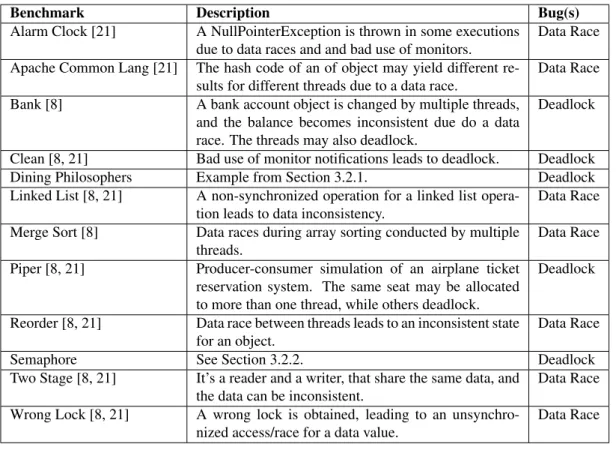
• A ferramenta foi avaliada com exemplos de programas multithreaded retirados dos reposit´orios ConTest e SIR, referenciados na literatura. No caso geral, a ferramenta consegue detectar e replicar deterministicamente os bugs dos programas em causa, em contraste a testes com execuc¸˜ao preemptiva que na vasta maioria dos casos n˜ao o consegue fazer.
O trabalho levou `a publicac¸˜ao do seguinte artigo em conferˆencia internacional com revis˜ao de pares:
Cooperari: A Tool for Cooperative Testing of Multithreaded Java programs, Eduardo R. B. Marques, Francisco Martins, and Miguel Sim˜oes. In: Proceedings of the 2014 Inter-national Conference on Principles and Practices of Programming on the Java platform: Virtual machines, Languages (PPPJ’14), Krakow, Poland, Sept. 23–26, 2014, pp. 200-206, 2014, ISBN 978-1-4503-2926-2, ACM New York, NY.
Palavras-chave: testes de software, semˆantica cooperativa, threads, Java
Abstract
Software bugs are easy to introduce in multithreaded programs, resulting in well-known errors, such as data races in the use of shared memory among threads, or deadlocks when using multithread primitives like locks. These bugs are hard to detect, replicate, and trace precisely, and are typically manifested only for a subset of all possible thread interleavings, many times even for a very particular thread interleaving. At the same time, given the non-determinism and irreproducibility of scheduling decisions at runtime, it is generally hard to control and observe thread interleaving and explore the associated state-space appropriately, when programming/executing software tests for a multithreaded program.
This thesis presents Cooperari, a tool for deterministic testing of multithreaded Java programs, based on the use of cooperative semantics. In a cooperative execution, threads voluntarily suspend at interference points (e.g., lock acquisition, shared data access), called yield points, and the code between two consecutive yield points of the same thread always executes serially as a transaction. A cooperative scheduler takes over control at yield points and deterministically selects the next thread to run. A program test runs multiple times, until it either fails or the state-space of thread interleavings is deemed as covered by a configurable policy that is responsible for the scheduling decisions. Beyond failed assertions in software tests, some types of deadlock and data races are also detected by Cooperari at runtime.
The tool integrates with the popular JUnit framework for Java software tests, and was evaluated using standard benchmark programs. Cooperari can find, characterize, and deterministically reproduce bugs that are not detected under unconstrained preemptive semantics.
Keywords: Software testing, Cooperative semantics, Threads, Java
Contents
List of Figures xvii
List of Tables xix
1 Introduction 1
1.1 Motivation . . . 1
1.2 Problem statement and approach . . . 2
1.3 Contributions . . . 2
1.4 Thesis structure . . . 3
2 Background and related work 5 2.1 Multithreaded Java programs . . . 5
2.2 Bug patterns . . . 7
2.3 Cooperative semantics . . . 8
2.4 Cooperative testing tools . . . 8
2.5 Randomized scheduling . . . 9
2.6 Other approaches . . . 9
3 The Cooperari testing tool 11 3.1 The Cooperari framework . . . 11
3.1.1 Yield point instrumentation . . . 12
3.1.2 Cooperative execution environment . . . 12
3.1.3 Testing environment . . . 13
3.2 Using Cooperari . . . 13
3.2.1 Dining Philosophers . . . 13
3.2.2 Semaphore bug example . . . 15
4 Design and implementation 19 4.1 Yield point instrumentation . . . 19
4.1.1 Instrumentation pattern . . . 19
4.1.2 Lock/monitor yield points . . . 20
4.1.3 Thread-lifecycle yield points . . . 21 xiii
4.1.4 Data access yield points . . . 21
4.2 Cooperative execution environment . . . 22
4.2.1 Overview . . . 22
4.2.2 The cooperative scheduler . . . 22
4.2.3 Cooperative implementation of multi-threading primitives . . . . 23
4.3 Test execution and state-space exploration . . . 24
4.3.1 Overview . . . 24
4.3.2 The random coverage policy . . . 25
4.3.3 The history-dependent policy . . . 26
4.4 Runtime monitoring mechanisms . . . 27
4.4.1 Deadlock detection . . . 27 4.4.2 Race detection . . . 28 5 Evaluation 31 5.1 Benchmark programs . . . 31 5.2 Results . . . 32 5.2.1 Test setup . . . 32
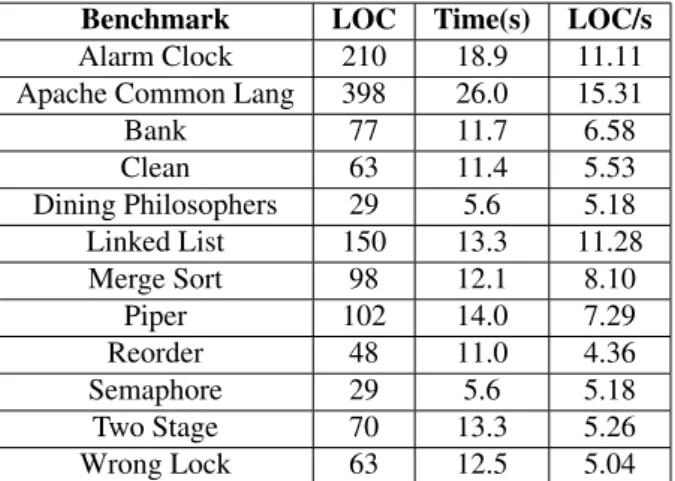
5.2.2 Bytecode Instrumentation time . . . 32
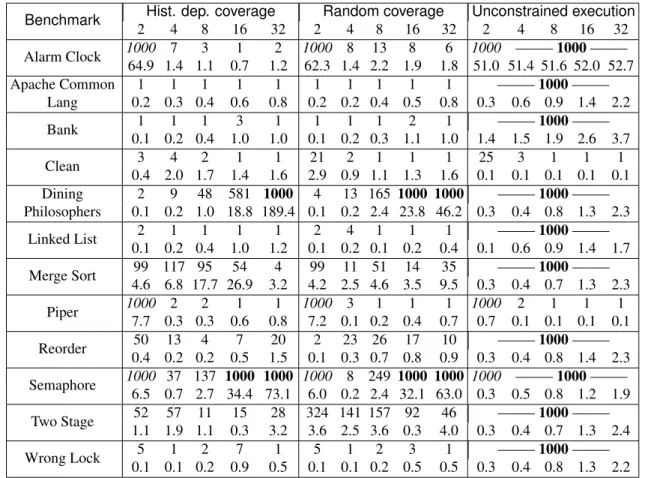
5.2.3 Test execution . . . 33
6 Conclusion 35
Bibliography 39
List of Figures
2.1 Semaphore example . . . 6
2.2 Multithreaded bug examples . . . 7
3.1 The Cooperari framework . . . 11
3.2 Dining philosophers example . . . 14
3.3 Cooperative execution for the dining philosophers . . . 15
3.4 Buggy semaphore example and test . . . 16
3.5 Cooperative execution for the semaphore test . . . 17
4.1 Sample AspectJ instrumentation code . . . 20
4.2 Implementation of cooperative scheduling . . . 23
4.3 Implementation of monitor operations . . . 24
4.4 Code for the random coverage policy . . . 25
4.5 Runtime monitoring of deadlocks and data races . . . 27
List of Tables
4.1 Lock/monitor yield points . . . 21
4.2 Thread-lifecycle yield points . . . 21
4.3 Data access yield points . . . 22
5.1 Program descriptions . . . 32
5.2 Bytecode instrumentation time . . . 33
5.3 Benchmark results . . . 34
Chapter 1
Introduction
1.1
Motivation
The still-prevalent programming model for enabling concurrency in software pro-grams at large is the use of threads. A thread defines a sequential line of execution in a program, that shares a common memory address space with all other threads in the same program that execute concurrently. Beyond shared memory, threads in a multithreaded program communicate using a number of well-established primitives such as locks, bar-riers, or atomic memory updates. The thread model is supported by some of the most well-known and used programming languages, like Java or C.
Programming mistakes are easy to make in multithreaded programs. The use of shared memory and other multithreading primitives requires careful attention and craft by a soft-ware developer. For instance, data races or deadlocks in the use of multithreading primi-tives are well-known problems. When a bug is manifested, a software developer typically tries to manually debug the program at stake and/or execute test suites associated to the program and observe which tests happen to fail. Frequently, both of these approaches cannot uncover bugs.
The reason for these difficulties is that a multithreaded system’s scheduler typically performs context switches in a non-deterministic and irreproducible manner. As a result, it becomes impossible to control and observe thread interleaving appropriately. At the same time, multithreaded bugs are typically manifested only for a subset of all possible schedules, frequently relying on a very particular thread interleaving. Software tests may be repeated many times without exposing the bug (i.e., reproducing the schedules of inter-est). If and when the bug is exposed, it is in any case hard to trace the associated program behaviour and replicate it again. Also, the use of a debugger typically interferes with the program schedule itself, making some bugs, so-called “heisenbugs”, also hard to observe and reproduce manually. Even simple bug patterns may be elusive to detect and replicate precisely (e.g., see [9]).
Chapter 1. Introduction 2
1.2
Problem statement and approach
This thesis deals with the general problem of testing multithreaded programs writ-ten in the Java programming language [16], such that program bugs are uncovered in deterministic/reproducible manner, and can also be traced in program execution without ambiguity.
Our approach is to conduct software tests that execute with cooperative semantics [23, 24]. The key observation underlying cooperative semantics is that a context switch can be made at any point during program execution, but the relevant context switches are only those that cause thread interference, e.g., access to shared data or the use of multithreading primitives, so-called cooperative yield points. A program’s execution is cooperative if the code between two yield points of the same thread executes serially as a transaction without any interference from other threads.
Cooperative semantics may be exploited for software testing to attain a reproducible and systematic coverage of the state-space of thread schedules, e.g., as in a number of tools [17, 3, 7] that work for multithreaded C/C++ programs. The idea is to schedule threads cooperatively, such that (deterministic) context switches are only done at yield points. Repeated executions of a program (test) may then potentially explore the state-space of thread schedules in a customized manner.
1.3
Contributions
The general contribution of this thesis is the design, implementation and evaluation of a tool for cooperative testing of multithreaded Java applications. The tool is called Cooperari and is available for download athttps://bitbucket.org/edrdo/Cooperari. To the best of our knowledge, it is the first cooperative testing tool for the Java programming language. In detail, the contributions are summarized as follows:
• Cooperari instruments Java application byte code such that yield points defining thread interference are intercepted and executed cooperatively. The instrumentation of yield points is specified using AspectJ [14].
• For cooperative execution, a runtime system is defined comprising a cooperative scheduler, and a cooperative implementation of multithreading primitives of Java monitors and thread lifecycle operations.
• Runtime monitoring mechanisms have been implemented for the detection of data races and some forms of deadlock.
• The tool integrates with JUnit [20], the popular testing framework for Java. Test programmers can use the traditional JUnit framework with little extra effort.
Chapter 1. Introduction 3 • Two coverage policies for the exploration of the state-space of thread schedules have been implemented: a memoryless pseudo-random choice of threads, and a history-dependent policy that maintains a record scheduling decisions that persists across test trials,
• The tool has been evaluated using standard benchmark examples from literature. In significance of these contributions, the following peer-reviewed publication de-scribing Cooperari was presented at an international conference during the thesis period: Cooperari: A Tool for Cooperative Testing of Multithreaded Java programs, Eduardo R. B. Marques, Francisco Martins, and Miguel Sim˜oes. In: Proceedings of the 2014 Inter-national Conference on Principles and Practices of Programming on the Java platform: Virtual machines, Languages (PPPJ’14), Krakow, Poland, Sept. 23–26, 2014, pp. 200-206, 2014, ISBN 978-1-4503-2926-2,ACM New York, NY.
1.4
Thesis structure
The remainder of this thesis is structured as follows:
• Chapter 2 (“Background and related work”) provides background on Java multi-threading and multithreaded program bug patterns, and surveys related work. • Chapter 3 (“The Cooperari testing tool”) describes the main features of Cooperari
from a user’s perspective.
• Chapter 4 (“Design and implementation”) describes the design and implementation of Cooperari.
• Chapter 5 (“Evaluation”) provides an evaluation of Cooperari using benchmark pro-gram examples.
• Chapter 6 (“Conclusion”) makes a final discussion and highlights directions for future work.
Chapter 2
Background and related work
2.1
Multithreaded Java programs
In this section we provide an overview of the core multithreading primitives in the Java language and API [16], as defined by the java.lang.Thread and java.lang.Object
classes, plus the built-in support for locks using synchronized blocks.
Multithreaded programming introduces new kind of errors, such as race conditions, deadlocks, and memory consistency. To avoid them we need to properly synchronize our Java objects or methods to allow mutual exclusive access of the critical section to two threads.
The Java scheduler is typically preemptive. Preemptive schedulers are driven by the notion of prioritized computation, i.e the thread with the highest priority should always be the one currently using the processor. If the scheduler has a timer interrupt it will decide which thread is next to run non-deterministically and resume that thread for some constant period of time. When the thread has executed for that time period it will be suspended, i.e. originates a context switch, and the next thread scheduled will be resumed.
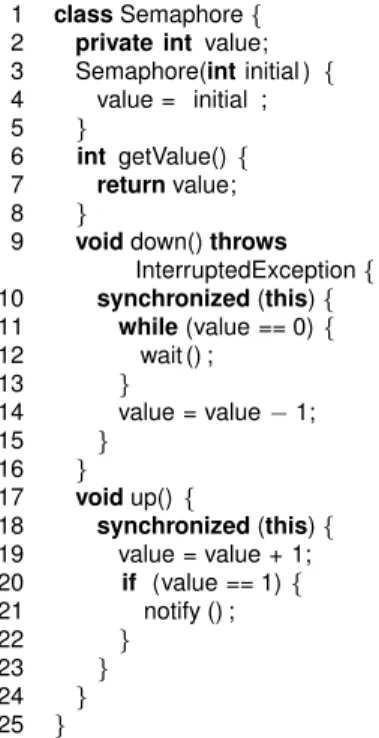
In Fig. 2.1a we have a implementation of a semaphore. A semaphore represents a non-negative integer that can only be atomically incremented or decremented, usingup()
anddown()respectively. Lines 6–9, 12, 14 are synchronized blocks to the object. Before entering their critical section, the thread needs to acquire the lock on the object. The critical section will be only executed by one thread at a time for the object that is locked, ensuring that we have mutual exclusion. Synchronization is also used to prevent simulta-neous access by multiple threads to the same data, for example the access to the variable value (lines 7, 8 and 12).
Line 9 is the termination of a synchronized block, when the thread reaches this point, the lock on the object at stake is released. The lock can also be released if any error or exception occurs. After the lock release, if there are other threads waiting to acquire that lock, one of them is subsequently chosen non-deterministically by the JVM and acquires the lock.
Chapter 2. Background and related work 6
1 class Semaphore {
2 private int value;
3 Semaphore(int initial ) {
4 value = initial ;
5 }
6 int getValue() {
7 return value;
8 }
9 void down() throws
InterruptedException { 10 synchronized (this) { 11 while (value == 0) { 12 wait () ; 13 } 14 value = value − 1; 15 } 16 } 17 void up() { 18 synchronized (this) { 19 value = value + 1; 20 if (value == 1) { 21 notify () ; 22 } 23 } 24 } 25 }
(a) Semaphore implementation
1 static class Client extends Thread {
2 private Semaphore sem;
3 Client (Semaphore sem) {this.sem = sem; }
4 public void run() {
5 try { 6 sem.down(); 7 // do some work ... 8 sem.up(); 9 } 10 catch(InterruptedException e) { } 11 } 12 }
13 static final int N = ...;
14 @Testpublic final void test () {
15 Semaphore sem =new Semaphore(N−1);
16 Client [] c =new Client[N];
17 for ( int i =0; i < N; i++) {
18 c[ i ] =new Client(sem);
19 c[ i ]. start () ; 20 }
21 for ( int i =0; i < N; i++) {
22 c[ i ]. join () ; 23 }
24 assertEquals(N−1, sem.getValue()); 25 }
(b) Semaphore test
Figure 2.1: Semaphore example
The purpose of condition based methods, wait () (line 7) and notify () (line 14) is to coordinate access to synchronized code blocks between two threads that require each other to perform some functionality. In the example, this means that if the value of the semaphore is 0 then the thread needs to wait until the value is bigger then 0 (line 7). The notification is only made (line 14), if the semaphore value is equal to 1 (line 13).
When the wait () (line 7) is executed it releases the lock on the object, and suspends the thread until a notification is delivered by other threads for the object through notify (),
notifyAll (), or spurious wakeup [16] event takes place. When the notify () (line 14) is made, one of the threads that are suspended in the wait call will be resumed, this choice is made non-deterministically by the JVM.
The test shown in Fig. 2.1b creates a semaphore with an initial value ofN−1(line 15), that is shared byN Client threads (line 18). When a thread starts its execution (line 19), it will execute therun() method (line 4). All critical section (line 7), is surrounded by a semaphore (line 6 and 8), the semaphore is used to guarantee mutual exclusion.
At the end of the test, a join () (line 23) is made, to make the test to wait until all threads terminate their execution, and then an assertion is made to verify if the semapho-re’s value is equal to the initial oneN−1(line 20), if so the test passes. Otherwise, the test fails giving a assertion error.
Chapter 2. Background and related work 7
2.2
Bug patterns
void up() { value = value + 1; if (value == 1) notify () ; }(a) Unsynchronized data access
void up() { value = value + 1; synchronized (this) { if (value == 1) notify () ; } }
(b) Partially unsynchronized data access
void up() { synchronized (this) { value = value + 1; } synchronized (this) { if (value == 1) notify () ; } }
(c) Two-stage access pattern
void up() { synchronized (this) { value = value + 1; } if (value == 1) synchronized(this) { notify () ; } }
(d) Two-stage access and unsynchronized access
Figure 2.2: Multithreaded bug examples
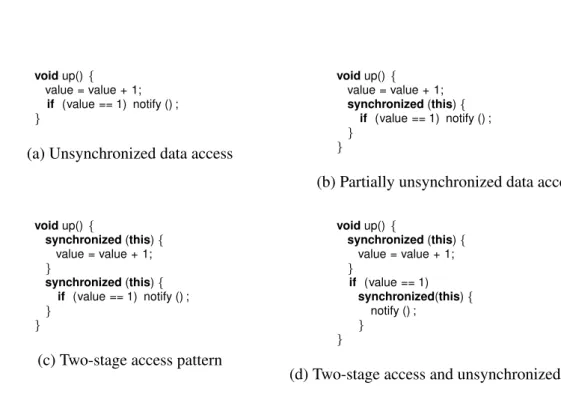
In Figure 2.2, we illustrate some multithread bugs with some variations of the up()
method of the semaphore example back from the previous section.
In (a), theup() method does not acquire any lock. This may result in data races that will render the semaphore’s value inconsistent. Furthermore, if the notify () method is called, it will necessarily throw an exception, since calling this method requires a lock on the target object. Fragment (b) fixes the later issue, but still lets the semaphore value be accessed without any synchronisation.
In (c), we have a more subtle bug, known as a two-stage access bug pattern [9]. The operations are synchronized, but in two steps. Imagine the case where the semaphore value is 0, and one thread in hanging ondown(), Now, two other threads may execute the first synchronised step and take the semaphore value from 0 to 2, if they yield just before entering the second synchronized step. The fragment in (d) a variation of (c), with an additional unsynchronised access to to the semaphore value.
Simple bug patterns like this have been characterised in literature, e.g., see [9] for a taxonomy of concurrent bugs patterns that occur in practice. Some buggy code may execute for quite some time without notice but are eventually manifest—this is actually the case of (a) and (b)— while others are very hard to occur and detect—the case of (c) and (d). In Chapter 3, we present the use of Cooperari over example (d) in detail.
Chapter 2. Background and related work 8
2.3
Cooperative semantics
The use of cooperative scheduling rests on the premise of semantics preservation. An execution is cooperative if it ensures that the code between two yield points of the same thread executes serially as a transaction without any interference from other threads. The execution of a program under cooperative semantics should be equivalent to that obtained using a traditional preemptive scheduler. This happens if the considered yield points characterize all possible thread interference, a property Yi et al. call cooperability [24, 23]. The authors define a formal framework to reason on cooperative semantics of Java programs, along with tools COPPER and SILVER for formal analysis of programs.
COOPER is a dynamic analysis tool that detects cooperability violations by observing an execution trace of the target program, and uses a graph-based algorithm to verify that this observed trace is serializable. It reports an error if the yield annotations are not sufficient to capture all thread interference. After that, it verifies if the program is correct using cooperative reasoning. To place yield annotations automatically in the program, they developed SILVER, a yield inference tool. One of SILVER main objectives is to insert yield annotations as less as possible, to do so it only adds one when it is strictly necessary, to reduce the number of possible executions paths for analysis. .
2.4
Cooperative testing tools
CHESS [17] is a tool for multithreaded Windows programs. It operates as a state-less model checker, enumerating all possible thread schedules, while a test repeatedly executes. CHESS relies on thin wrappers for multithreading primitives to identify non-deterministic choices at yield points, and various techniques to curb state-explosion such as iterative preemption bounding.
Cloud9 [3] is a parallel symbolic execution engine for multithreaded C POSIX pro-grams. During state-space exploration for symbolic assertion checking, Cloud9 relies on cooperative scheduling and a cooperative/symbolic implementation of a portion of the POSIX system calls, in particular for thepthreadsAPI.
CONCURRIT [7] is a tool for C++ multithread programs, employing a DSL for im-posing thread schedule constraints. Tests execute repeatedly, with the guidance of a model checker that covers all schedules defined by the DSL constraints. The execution is coop-erative, relying on yield calls at execution points in user-level code specified by the DSL (specific details are given in [5]).
Compared with these tools, Cooperari works for Java programs, and allows a partial exploration of possible thread schedules through a deterministic pseudo-random search and a structural program coverage criterion. Like CHESS and Cloud9, Cooperari enables cooperative execution of multithreading primitives, while CONCURRIT just works for user-placed yield points.
Chapter 2. Background and related work 9
2.5
Randomized scheduling
Randomized scheduling works by causing interference to the native multithreaded scheduler, trying to “shake” it to produce meaningful context switches in hotspots where bugs may occur. The base technique can be effective to expose bugs, but works non-deterministically.
Rstest [22], transforms a Java program, by inserting calls (“noise”) with a scheduling function at selected points. The scheduling function either does nothing or causes a non-deterministic context switch. They use static analysis to reduce the number of inserted calls to the scheduling, and it does not reduce the probability of detecting deadlocks and assertion violations. Rstest analyses bytecode and monitors for violations of the classifi-cation of objects as unshared, i.e., if the object is accessed by at most one thread. Rstest does not have heuristics.
ConTest [6, 15, 18], inserts calls to the scheduling function at all concurrent events, in particular, the events whose order determines the result of the program. ConTest executes sleep instructions before and after concurrent events. ConTest contains two tools: Erase+ is able to detect data races; AtomRace is able to detect not only data races, but also more general bugs cause by violation of atomicity preemptions. ConTest developed a plug-in that is able to heal bugs (that remain in an application even when it is deployed), automatically at runtime. The plug-in does not remove bugs from the code but it prevents their manifestation.
PCT [4] is a randomized scheduler for finding concurrency bugs, it uses a randomized algorithm for concurrency testing. PCT repeatedly runs a given test program with sup-plied inputs. In each test run, it randomly schedules the threads of the program. All the runs are independent, and so it can increase the probability of finding bugs.
CALLFUZZER [13] employs biased random scheduling to verify if warnings reported by a predictive program analysis are real bugs, a technique known as active testing. It works in two phases: first uses static or dynamic analysis to identify potential concurrency bugs, in the second phase active testing uses a randomized thread scheduler to verify if warnings reported by a predictive program analysis are real bugs, to take care of them they implemented a Hybrid data race, Atomizer algorithm to detect atomic violations and iGoodlock to detect deadlocks. CALFUZZER pauses a thread when it reaches a statement involved in a potential concurrency bug and determines if this statement is benign or harmful (e.g., causes an exception). The tool is available for Java language.
2.6
Other approaches
MultithreadedTC [19] is a framework that allows a test designer to exercise a specific interleaving of threads in an application. It features a personal clock (not the computer clock) that allows test designers to coordinate threads even in the presence of blocking and
Chapter 2. Background and related work 10 timing issues. The clock advances only when all threads are blocked; test designers can delay operations within a thread until the clock has reached a desired tick. IMUnit [12] achieves the same effect as MultithreadedTC, but through annotations that define a kind of temporal logic, and works for Java. The tool also incorporates a translation tool to convert Java sleep-based tests into event-based tests.
Chapter 3
The Cooperari testing tool
In this chapter we provide an overview of the testing framework provided by the Co-operari tool. We start with a description of the CoCo-operari framework and its main features (Section 3.1). We then discuss the use of Cooperari resorting to two examples (Sec-tion 3.2).
3.1
The Cooperari framework
instrumented bytecode cooperative scheduler cooperative threads cooperative execution layer yield resume AspectJ yield point specs. AspectBench Compiler (abc) OFFLINE INSTRUMENTATION COOPERATIVE EXECUTION ENVIRONMENT
JUnit test runner
test failure OR full coverage ?
NO: repeat YES: proceed to next test execution
completed JUnit test code test execution
yield point handling
TEST ENVIRONMENT coverage policy application bytecode
Figure 3.1: The Cooperari framework
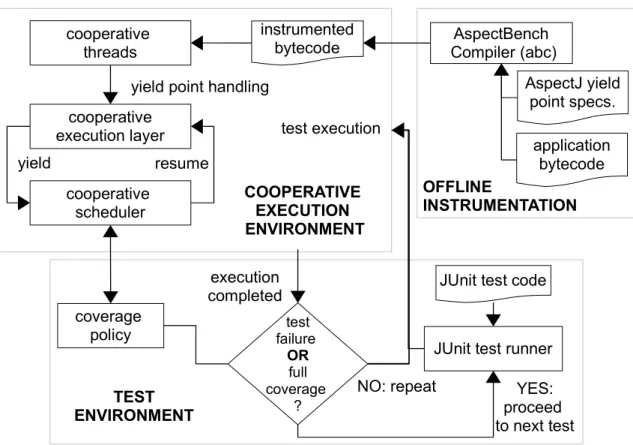
The overall architecture of Cooperari is depicted in Figure 3.1. It comprises the fol-11
Chapter 3. The Cooperari testing tool 12 lowing three main parts :
1. the offline instrumentation of JVM bytecode in support of cooperative execution; 2. a runtime execution environment that is responsible for handling the actual
execu-tion of an applicaexecu-tion with cooperative semantics;
3. and a testing environment that triggers the execution of application tests. Next, we provide an overview of how these parts work and relate to each other.
3.1.1
Yield point instrumentation
To attain cooperative execution, Cooperari instruments the JVM bytecode of Java classes that are of interest. The instrumentation takes care of transforming potential thread interference points into thread yield points for cooperative execution.
To accomplish instrumentation, Cooperari makes use of AspectJ [14], in particular of the AspectJ AspectBench Compiler (abc) [1], as illustrated in Figure 3.1, top-right. The basic idea is to define (aspect-oriented style) code that is triggered when a thread interference point is reached. The instrumented code will then seek to render the pro-gram execution cooperatively. In what concerns the Cooperari user, the instrumentation is automatic, transparent, and no AspectJ knowledge is required.
The yield points defined through bytecode instrumentation overall comprise:
• Java lock/monitor operations: lock acquisition, lock release, plus calls to wait (),
notify (), and notifyAll () in classjava.lang.Object;
• Thread lifecycle methods: methods that affect the behavior or govern the interac-tion of threads in class java.lang.Thread, including start (), stop, join, interrupt, andsleep.
• Read or write accesses to object fields or arrays;
3.1.2
Cooperative execution environment
Cooperari enables a special execution environment for application code to run coop-eratively, shown in Figure 3.1 (top-left). The main components of this environment are a set of cooperative threads, a cooperative execution layer, and a cooperative scheduler.
The cooperative threads runs the application code that has been instrumented. When a thread reaches a yield point, instrumented bytecode gets executed such that control is delegated to the cooperative execution layer in place of normal execution. The two core actions performed at this point by the cooperative execution layer are causing the cur-rent thread to voluntarily stop execution (yield) and invoking the cooperative scheduler.
Chapter 3. The Cooperari testing tool 13 The cooperative scheduler will then select the thread to be resumed next, according to a specified policy, discussed further on. This type of operation guarantees a cooperative ex-ecution: only one thread is active at any time, and that the code between two yield points executes serially as a transaction.
In complement to the core tasks for cooperative execution, the cooperative execution layer also embeds monitoring modules for detecting deadlocks and race conditions. Their use is discussed in the discussion of the examples in Section 3.2.
3.1.3
Testing environment
The Cooperari framework is completed by a testing environment (Figure 3.1, bottom), whose role is to execute application tests, written using the JUnit testing library for Java. Each individual test trial triggers the launch of a cooperative execution environment, corresponding to one execution of application code. Trials of each test are repeated until either a trial fails (e.g., due to a failed test assertion, or to a detection of a deadlock) or the configurable coverage policy determines that no further trials should be executed. The coverage policy configured for a test suite also defines the scheduling function to be used by the cooperative scheduler. At this point we implemented two policies: a pseudo-random (deterministic) choice of thread to run coupled with a bound on the maximum number of test executions, and a history-dependent policy that tries to avoid repeated scheduling decisions.
3.2
Using Cooperari
3.2.1
Dining Philosophers
We first discuss the use of Cooperari with the classic dining philosophers problem. The formulation is well-known, and illustrates deadlocks due to resource sharing in a concurrent setting. A group of N philosophers sits at a round table where N forks are placed in between each plate. To eat, a philosopher has to have both forks, first he grabs his left fork and then his right one. After eating, a philosopher puts both forks down. The philosophers get stuck if they all simultaneously grab the left fork, leaving no right fork available to be picked by anyone. No philosopher may thus progress, defining a deadlock. In line with the dining philosophers’ formulation, the code in Figure 3.2 defines a
PhilosopherJava class, and aTestPhilosopherstest suite.
In Figure 3.2a, we can see that aPhilosopherobject is created using supplied left and right fork objects, and that therun() method defines the behavior of the philosopher. To grab a fork, a philosopher acquires a lock to the corresponding object, making use of a
synchronizedblock within therun()method. The fork acquisition is defined at lines 12– 16 for the left fork and 13–15 for the right fork. The twosynchronizedblocks are nested,
Chapter 3. The Cooperari testing tool 14
1 package philosophers;
2 class Philosopher implements Runnable {
3 private Object left , right ; // forks
4 private boolean thoughts = false;
5 private boolean food = false;
6 Philosopher(Object left , Object right ) { 7 this . left = left ;
8 this . right = right ;
9 }
10 public void run() { // 1. think
11 thoughts =true;
12 synchronized(left) {// 2. get left fork
13 synchronized(right) {// 3. get right
14 food =true; // fork and eat
15 } // 4. release right fork 16 } // 5. release left fork 17 }
18 boolean hadThoughts() { return thoughts;}
19 boolean hadFood() { return food; }
20 }
(a) Philosopher code
1 @RunWith(CTestRunner.class)
2 @CTestOptions(coverage=RANDOM, instrument=‘‘philosophers’’) 3 public class TestPhilosophers {
4 static final int N = ...;
5 @Testpublic void testDinner() {
6 Object f [] =new Object[N];
7 for ( int i = 0; i < N; i++)
8 f [ i ] =new Object();
9 Philosopher[] p =new Philosopher[N];
10 for ( int i =0; i < N; i++)
11 p[ i ] =new Philosopher(f[i ], f [( i +1)%N]);
12 runThreads(p);
13 for ( int i =0; i < N; i++) {
14 assertTrue(p[ i ]. hadThoughts()); 15 assertTrue(p[ i ]. hadFood()); 16 }
17 } 18 }
(b) Dining philosophers test
Figure 3.2: Dining philosophers example
implying that the right fork is only acquired after the left one, and, in the end, that the right fork is released before the left one. If the code inrun() runs to completion, thethoughts
andfoodsfields, initially set tofalse, will have been set totrue.
The code of Figure 3.2b is that of a JUnit test class, TestPhilosophers, with a test method calledtestDinner. The test method first defines the round table setup comprising
Nforks and Nphilosophers (lines 7–11), represented by variables f and p, respectively. After this setup, a call torunThreads(p) is made to execute the N philosopher threads;
runThreadsis an utility method in the Cooperari API that performs the launch of a set of threads, followed by a wait for the termination of all of them. When all the threads complete, a sequence of JUnit-style assertions (14–16) verifies that each philosopher had a round of thought and food.
A normal execution does not uncover the dining philosophers deadlock in a vast ma-jority of executions. For example, we observed that a deadlock is reached only once every 20000 executions oftestDinnerforN=2, and failed to observe deadlock at all forN=3.
To execute the dining philosophers test cooperatively, theTestPhilosopherclass must be appropriately annotated. The@RunWith(CTestRunner.class)annotation (line 1) sets JUnit to use Cooperari’s custom test runner (CTestRunner). In complement, the@CTestOptions
annotation (line 2) defines options for cooperative execution: the coverage =RANDOM
option specifies that pseudo-random, deterministic scheduling decisions should be made at yield points, and the instrument=‘‘philosophers’ ’ option indicates the Java package whose classes should be instrumented for cooperative execution. The Cooperari test run-ner will repeatedly execute each test in the suite, testDinrun-ner alone in this case, until it either fails or reaches a maximum number of trials (by default 1000). The output of an
Chapter 3. The Cooperari testing tool 15 execution is as follows, consideringN=3in the test code.
Instrumented code must be generated, please wait. Changes have been detected.
Instrumentation completed in 5486 ms. testDinner: executed 3 times in 68 ms [ failed ] Failure trace for testDinner written to ’ log /TestPhilosophers testDinner.trace. txt ’ There was 1 failure :
1) testDinner(TestPhilosophers)
DeadlockError: L0/T0/Philosopher.java:13 >L1/T2/Philosopher.java:12
>L2/T0/Philosopher.java:12 >L0/T1/Philosopher.java:12
The execution above starts by performing bytecode instrumentation. This takes more than 5 seconds, but the instrumentation will be triggered just once, so long as the source bytecode does not change. The actual test execution is done afterwards, reporting a failure after 3 trials of testDinnerin 68 milliseconds. A DeadlockError exception is reported, referring to a lock acquisition cycle involving the three threads, identified asT0/1/2, and three fork objects, identified asL0/1/2.
The test execution output also informs the location of a cooperative trace file, where the detailed thread schedule can be inspected. The contents are shown in Figure 3.3. In the listing, the lock acquisition yield points are identified bymonitorenter, the name of the JVM bytecode instruction that is executed for that purpose. In the beginning, all threads are initially suspended (steps 1–3). After startup, thread 1 is allowed to run for two steps (4–5): the first step takes the thread to the point of left fork acquisition, and the second one (with the left fork lock now effectively acquired) to the point of right fork acquisition. Thread 1 then yields, and the same pair of steps is allowed in succession for threads 2 (6–7) and 0 (8–9). A deadlocked state is thus reached, as every philosopher holds the left fork, but neither is able to acquire the right one.
<step> <thread> <yield point> 1 0 [begin] 2 1 [begin] 3 2 [begin] 4 1 monitorenter(L0) Philosopher.java:12 5 1 monitorenter(L2) Philosopher.java:13 6 2 monitorenter(L1) Philosopher.java:12 7 2 monitorenter(L0) Philosopher.java:13 8 0 monitorenter(L2) Philosopher.java:12 9 0 monitorenter(L1) Philosopher.java:13 L0 L1 L2 T0 T1 T2 (4) (5) (6) (7) (8) (9)
Figure 3.3: Cooperative execution for the dining philosophers
3.2.2
Semaphore bug example
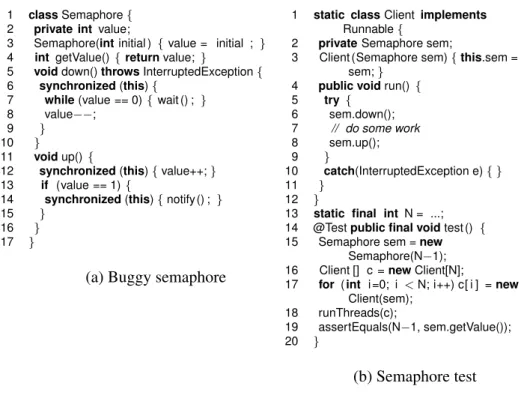
We now go back to the semaphore example, introduced in Chapter 2. The example concerns a bug in the semaphore implementation in method up(), actually variant (d) method in the Figure 2.2 in Section 2.2. We show the full (but this time buggy) semaphore
Chapter 3. The Cooperari testing tool 16 class again and an associated test in Fig. 3.4. The example will illustrate different types of yield points and deadlocks, as well as data race detection by Cooperari. The test shown creates a semaphore with an initial value ofN−1, shared byN Clientthreads. Each thread proceeds (in the run() method) by decrementing the semaphore, doing some work, and incrementing the semaphore back before terminating. At the end, the test passes if the semaphore’s value is equal to the initial one,N−1.
1 class Semaphore {
2 private int value;
3 Semaphore(int initial ) { value = initial ; }
4 int getValue() { return value; }
5 void down() throws InterruptedException {
6 synchronized (this) {
7 while (value == 0) { wait () ; }
8 value−−; 9 } 10 }
11 void up() {
12 synchronized (this) { value++; }
13 if (value == 1) {
14 synchronized (this) { notify () ; }
15 } 16 } 17 }
(a) Buggy semaphore
1 static class Client implements
Runnable { 2 private Semaphore sem;
3 Client (Semaphore sem) {this.sem =
sem; } 4 public void run() {
5 try { 6 sem.down(); 7 // do some work 8 sem.up(); 9 } 10 catch(InterruptedException e) { } 11 } 12 }
13 static final int N = ...;
14 @Testpublic final void test () {
15 Semaphore sem =new
Semaphore(N−1); 16 Client [] c =new Client[N];
17 for ( int i =0; i < N; i++) c[ i ] = new
Client(sem); 18 runThreads(c);
19 assertEquals(N−1, sem.getValue()); 20 }
(b) Semaphore test
Figure 3.4: Buggy semaphore example and test
As explained earlier in Section 2.1 the semaphore class employs the condition-based
wait () and notify () methods associated to Java monitors, the core synchronization primi-tives used by Java applications and thread-safe Java API classes (along with notifyAll ()). In the semaphore code of Fig 3.4 (a), the up() operation only calls notify () when the semaphore increments to 1 (lines 13–14). The code would be correct if a single
synchronized block covered all instructions in up(). Instead, two blocks of the kind are used, a “two-stage access” pattern [9]. Moreover, the notification event relies on an unsynchronized read access tovalue(line 13), which may race with simultaneous write accesses. It is then possible that two or more increments inup()take the semaphore value from 0 to a value greater than 1. A required notification, in case some thread is blocked indown(), may be skipped and, as a result, a waiting thread may block forever. Skipped notifications would also be possible if the read access to value was part of the second
synchronizedblock, but the purpose of the example is also to illustrate data races. Cooperari detects the race condition and the wait deadlock, considering the yield points defined by lock acquisition and release, wait (), notify (), and the read/write
ac-Chapter 3. The Cooperari testing tool 17 cesses to the semaphore value. The output of an execution forN=3is as follows:
Race: T0 at Semaphore.java:12 over Semaphore.value Race: T1 at Semaphore.java:13 over Semaphore.value Failure trace for test written to
’ log /examples.semaphore.TestSemaphore test.trace.txt’ test : executed 36 times in 578 ms [failed ]
1) test (examples.semaphore.TestSemaphore) WaitDeadlockError: { T2/Semaphore.java:7 }
The output reports a race over the semaphore field and a test failure due to aWaitDeadlockError
for a thread identified asT2. A fragment of the cooperative trace is shown in Figure 3.5, where each step is annotated with pending reads and writes (r/w) for the semaphore value. In the execution at stake, thread 0 and 1 (T0,T1) completeddown(), thusvaluewill be 0, and began executingup(), whilst thread 2 (T2) is executingdown(). At step 23,T0
andT1are suspended at the first lock acquisition point in up(), and T2is blocked at the call to wait () indown(). In steps 23–27 and 28–31, T0and T1are in succession able to acquire the lock, increment the semaphore value, relinquish the lock, and suspend again before readingvalue. When they do, just before terminating (steps 32 and 33),valueis 2, hence they fail to deliver the notification toT2. Thus,T2will block forever onwait (). The deadlock is detected at this point. As for the race, it is signaled at step 29, for a pending write byT0and a pending read byT1.
<step> <thread> <yield point> # r /w 15 0 monitorenter(L0) Semaphore.java:12 # {}/{}
...
22 1 monitorenter(L0) Semaphore.java:12 # [value=0] 23 2 wait(L0) Semaphore.java:7 #
24 1 get(Semaphore.value) Semaphore.java:12 # 1/{} 25 1 set(Semaphore.value) Semaphore.java:12 # {}/1 26 1 monitorexit (L0) Semaphore.java:12 # [value=1] 27 1 get(Semaphore.value) Semaphore.java:12 # 1/{} 28 0 get(Semaphore.value) Semaphore.java:12 # 0,1/{} 29 0 set(Semaphore.value) Semaphore.java:12 # 1/0 [race] 30 0 monitorexit (L0) Semaphore.java:12 # [value=2] 31 0 get(Semaphore.value) Semaphore.java:13 # 0,1/{} 32 0 <end> # {}/{};read 2; no call to notify ()
33 1 <end> # read 2; no call to nofity ()
Chapter 4
Design and implementation
4.1
Yield point instrumentation
This chapter describes the main aspects in the design and implementation of Cooper-ari. We first describe the instrumentation of yield points for cooperative execution (Sec-tion 3.1.2). We then turn to the main components of the runtime system for cooperative execution: the cooperative scheduler (Section 4.2), the cooperative implementation of multithreading primitives (Section 4.2.3), and state-space exploration during test execu-tion (Secexecu-tion 4.3). The chapter ends with a descripexecu-tion of the runtime detecexecu-tion mecha-nisms for deadlocks (Section 4.4.1) and races (Section 4.4.2).
As overviewed in Chapter 3, Cooperari employs AspectJ specifications for specifying yield points and instrumenting corresponding application bytecode. We do so in con-junction with the AspectBench Compiler (abc) [1]. The motivation for using abc is the built-in support by the tool for AspectJ extensions related to lock acquisition and release instructions, described in [2]. We next describe the general pattern of instrumentation and the instrumentation of several types of yield points.
4.1.1
Instrumentation pattern
Let us first introduce some aspect-oriented programming terminology to explain the use of AspectJ. AspectJ code is organized in aspects, each of which may contain a col-lection of advices. An advice intercepts the execution of program at special points, called join points, and induces the execution of some code in association to the advice. For this, the specification of an advice comprises a set of pointcut conditions to intercept join points, and a block of code that is executed whenever a join point is intercepted.
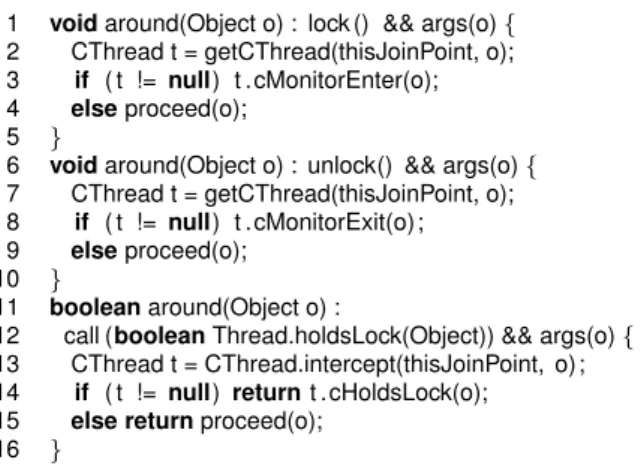
The pattern of instrumentation employed by Cooperari is illustrated by the AspectJ code listed in Figure 4.1. Three advices are shown for: lock acquisition, specified by pointcut lock () (lines 1–5); the second for lock release, specified by pointcut unlock()
(lines 6–10); and calls to theThread.holdsLock() (11–16). In the first two advices, the
lock () andunlock() pointcuts employed are AspectJ extensions for intercepting lock ac-19
Chapter 4. Design and implementation 20
1 void around(Object o) : lock () && args(o) {
2 CThread t = getCThread(thisJoinPoint, o); 3 if ( t != null) t .cMonitorEnter(o);
4 else proceed(o);
5 }
6 void around(Object o) : unlock() && args(o) {
7 CThread t = getCThread(thisJoinPoint, o); 8 if ( t != null) t .cMonitorExit(o);
9 else proceed(o);
10 }
11 boolean around(Object o) :
12 call (boolean Thread.holdsLock(Object)) && args(o) {
13 CThread t = CThread.intercept(thisJoinPoint, o); 14 if ( t != null) return t .cHoldsLock(o);
15 else return proceed(o);
16 }
Figure 4.1: Sample AspectJ instrumentation code
quisition/release instructions [2]. In all three cases, the pointcut specifications are com-plemented by the use of thearoundkeyword, specifying that advice code should run in place of the join point, i.e., program execution will be diverted to the advices’ code in place of the original one that associates to the join points1.
Looking at the advices’ code in Figure 4.1, we see that they follow the same pattern. Each of them first determines if the current thread is subject to cooperative semantics, through a call to getCThread(). The arguments given to this function are used only to initialize profile information of the yield point, if one is at stake. If the current thread is subject to cooperative semantics (t != null), then execution will be diverted to a call in the Cooperari runtime, e.g., cMonitorEnter() (line 3), the first advice will execute in place of themonitorenterJVM instruction for lock acquisition. Otherwise (if t ==null), theproceed AspectJ keyword (lines 4, 9, 15) specifies that the join point should execute normally. The latter case is due to the possibility that instrumented code may run non-cooperatively at some stages of execution, particularly within a JUnit runner thread before or after the invocation of method runThreads(), responsible for creating a cooperative thread environment.
4.1.2
Lock/monitor yield points
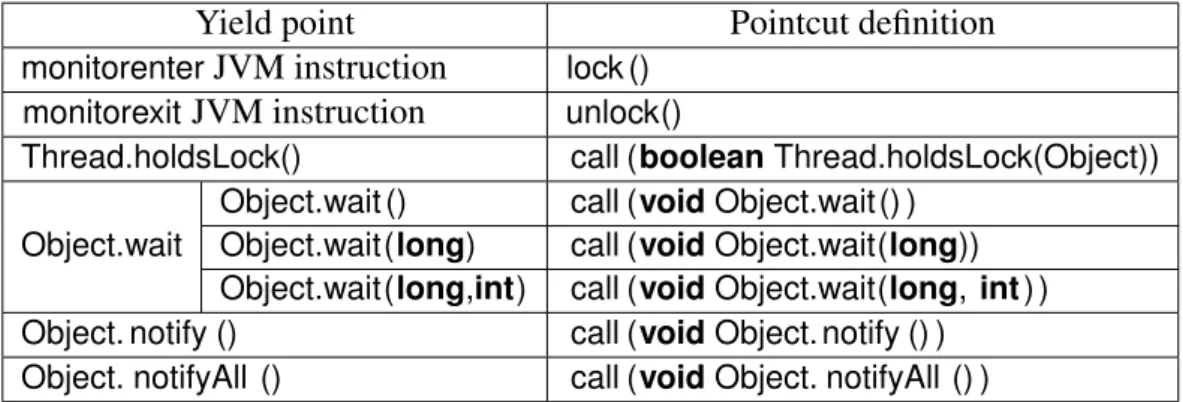
Table 4.1 shows the defined aspects for monitor acquisition, release, and condition-based synchronization.
TheObject.wait(long)andObject.wait(long,int) call is executed within the coopera-tive framework, but not deterministically, because its completion depends on the elapsed time measured by the JVM. In complement, the tool intercepts thread state methods, like
Thread.holdsLock(), to maintain the cooperative semantics coherent, even if this call is not a yield point.
1Among several other AspectJ variations, it is also possible to trigger advice code before or after a join
Chapter 4. Design and implementation 21 Yield point Pointcut definition
monitorenterJVM instruction lock () monitorexitJVM instruction unlock()
Thread.holdsLock() call (boolean Thread.holdsLock(Object))
Object.wait
Object.wait () call (void Object.wait () )
Object.wait(long) call (void Object.wait(long))
Object.wait(long,int) call (void Object.wait(long, int ) )
Object. notify () call (void Object. notify () )
Object. notifyAll () call (void Object. notifyAll () )
Table 4.1: Lock/monitor yield points
4.1.3
Thread-lifecycle yield points
Thread lifecycle methods, are methods that affect the behavior of the threads.
Thread.start (),Thread.stop(),Thread.join() andThread.interrupt () are the core methods for thread creation and thread interruption. Table 4.2 shows the aspects defined to cover this methods and how the pointcuts were defined.
As theObject.wait () call;Thread.sleepandThread.join(long),Thread.join(long, int )
also belong to time-based functions, so they do not execute deterministically, because they depend on the elapsed time of the JVM.
Such asThread.holdsLock(),Thread.getState()call is intercepted to maintain the co-operative semantics coherent.
Yield point Pointcut definition
Thread.sleep Thread.sleep(long) call (void Thread.sleep(long)) Thread.sleep(long,int) call (void Thread.sleep(long,int))
Thread.interrupt () call (void Thread.interrupt () )
Thread.interrupted() call (boolean Thread.interrupted())
Thread.isInterrupted () call (boolean Thread.isInterrupted())
Thread.stop() call (void Thread.stop())
Thread.join
Thread.join() call (void Thread.join() )
Thread.join(long) call (void Thread.join(long))
Thread.join(long,int) call (void Thread.join(long,int) )
Thread.getState() call (Thread.State Thread.getState())
Table 4.2: Thread-lifecycle yield points
4.1.4
Data access yield points
There is a main difference between this yield points and the ones described in sec-tions 4.1.2 and 4.1.3. The difference is that all the other aspects use the keywordaround, but in the data access yield points we use the keywordsbeforeand after. This keywords refer that before and after a write or read access we have a yield point, to check if in
Chapter 4. Design and implementation 22 some point of the program, we have a simultaneous write/read or write/write on the same variable by different threads. In table 4.3, we demonstrate the yields that were defined to cover all the data accesses.
Yield point Pointcut definition
field read get () field write set () array read arrayget () array write arrayset ()
Table 4.3: Data access yield points
4.2
Cooperative execution environment
4.2.1
Overview
The creation of a cooperative execution environment is triggered by a call to the
runThreads()Cooperari API function, typically invoked from a test suite. The call takes an argument, which can either be an array of objects of type java.lang.Runnable. Ob-jects of this kind define method run() with no arguments, which is supposed to define the execution flow of a thread. If the array supplied torunThreads()has length n, then n cooperative threads will be started and executed to completion.
A cooperative execution environment comprises the interaction of cooperative threads launched troughrunThreads()with a cooperative scheduler and a cooperative implemen-tation of multithreading primitives. This happens thanks to the bytecode instrumenimplemen-tation, described earlier in Section 4.1, which intercepts thread execution appropriately at yield points.
4.2.2
The cooperative scheduler
The cooperative scheduler is a special thread, whose role is to decide which appli-cation thread should be active at any given time. To ensure cooperative semantics, only one cooperative thread can be active at any time, and thread context switches are only performed at instrumented yield points. Hence, a cooperative thread voluntarily suspends its execution when it reaches a yield point. The cooperative scheduler assumes control at this point, deciding the next thread to run, and resuming the execution of the chosen thread. The built-in JVM scheduler is conditioned in this process by the actions of the cooperative scheduler and cooperative threads.
The main implementation of the cooperative scheduling scheme is shown in Fig-ure 4.2. It comprises the implementation of primitivescYield () andcResume()in a class
Chapter 4. Design and implementation 23
1 private boolean yield;
2 public void cYield() {
3 ... // yielding 4 yield =true; 5 syncYield() ; 6 while ( yield ) { 7 LockSupport.park(); 8 } 9 syncResume(); 10 ... // resumed 11 }
12 public void cResume() {
13 ...
14 yield =false;
15 LockSupport.unpark(this);
16 }
(a) Thread yield and resumption
1 CoveragePolicy policy; 2 List <CThread> ready; 3 ...
4 public void cStep() {
5 ... 6 syncYield() ; 7 CThread t = 8 policy .decision(ready); 9 t .cResume(); 10 syncResume(); 11 ... 12 } (b) Scheduler step
Figure 4.2: Implementation of cooperative scheduling
calledCThread 4.2a, representing the operation of cooperative threads, and a primitive
cStepin a classCScheduler 4.2b, for the cooperative scheduler operation.
A thread yield is accomplished through a voluntary call tocYield () (Figure 4.2a) by a cooperative thread. The thread starts by enabling a yield condition variable (line 4) and synchronizes with the scheduler with a call tosyncYield() (line 5), a barrier handshake. Essentially, this makes the scheduler aware of the thread yield. The thread then calls the LockSupport.park()Java API method, preventing its execution by the built-in JVM scheduler; the JVM scheduler could otherwise break the cooperative scheduling intent.
In synchrony with the thread yield procedure, the cooperative scheduler works as follows withincStep()(Figure 4.2b). It begins by acknowledging a thread yield through a call to syncYield() (line 6). It then employs the coverage policy in place, policy, to select the next threadt to run amongst the ready thread setready(lines 7–8). Finally, the scheduler executes t .cResume()to resume the chosen thread.
The resumption process incResume(), executed by the scheduler thread, disables a thread’s yield condition (line 14) and allows the thread to be picked up again by the JVM scheduler through a call to theLockSupport.unpark() Java API method (line 15). These two steps are exactly the reverse the thread yield procedure. When the thread resumes again, it will complete the execution ofcYield () in which it blocked. The resumption pro-cess ends with a synchronization handshake between thread and scheduler,syncResume()
in 4.2a and 4.2b.
4.2.3
Cooperative implementation of multi-threading primitives
The multithreaded primitives where implemented inCThreadclass, helped by aCMonitor
class for representing monitors, and aCOperationbase class that implements the behavior of primitives. Each primitive executes an action before its suspension and another after
Chapter 4. Design and implementation 24 resumption.
For instance, theCThread.cMonitorEnter()method (Fig. 4.1) is used by Cooperari for lock acquisition. It is implemented by first initializing aCOperationobject for the new monitor acquisition, after the initialization a cYield () is invoked to suspend the thread execution and when it is resumed (through cResume()) the thread completes the lock acquisition on the object.
1 class CMonitor { 2 // Reference count. 3 int refCount; 4 // Owner thread 5 CThread owner; 6 // Wait count 7 int waitCount; 8 // Notification epoch 9 long nEpoch; 10 // Notification queue 11 Queue<Integer> nQueue; 12 }
(a) Monitor data
1 void init (Object o) {
2 m = getMonitor(o); 3 m.refCount++; 4 } 5 CState getState() { 6 return 7 m.owner ==null ? 8 CREADY : CBLOCKED; 9 } 10 void complete(CThread t) { 11 m.owner = t; 12 } (b) Lock acquisition
Figure 4.3: Implementation of monitor operations
Fig. 4.3 demonstrates part of the support for monitor operations. TheCMonitorclass (Fig. 4.3a) is used for distinct types of COperation corresponding to monitor acquisition, release, notification, and wait wakeup. In Fig. 4.3b is showed the support for lock ac-quisition. As illustrated, each operation comprises initialization (lines 1–4), state report (lines 5–9) and completion methods (lines 10–12). A thread can only resume its exe-cution, if the operation is on a ready state (CREADY, line 8). In the lock acquisition operation, a monitor forois created in thegetMonitor(o)(line 2) call, if there are no pend-ing locks ono. If there already exists a monitor on the object o, the reference counter for the monitor object is incremented (line 3). The same counter is decremented in the completion of lock release, and the monitor is deleted when the reference counter gets the value 0. ACREADYstate is signaled when the monitor has no owner, letting the thread be considered for execution. The thread may go back to aCBLOCKEDstate, if another thread is chosen instead by the scheduler and acquires the lock, this happens if there exists more than one thread blocked in the lock acquisition on the same object. In the comple-tion stage of the operacomple-tion (lines 10–12), the owner of the monitor is the thread that was chosen by the scheduler to run (line 11).
4.3
Test execution and state-space exploration
4.3.1
Overview
When Cooperari is used for a JUnit test suite, the suite must be configured with a coverage policy using a pre-defined value for thecoveragesetting of the@CTestOptions.
Chapter 4. Design and implementation 25 The role of the coverage policy is to guide thread scheduling in each test trial, in interface with the cooperative scheduler, and maintain state across multiple trials of each test to determine for how long test trials should be repeated, according to some criterium of state-space exploration. Two coverage policies are implemented so far in Cooperari: a pseudo-random choice of threads combined with a fixed bound on the number of test trials, and a history-dependent policy that tries to avoid repeated scheduling decisions for the same program state.
Test execution proceeds as follows. After executing a test trial, the Cooperari test runner evaluates if the test failed. If so, no more trials are executed for that test. Otherwise, the coverage policy is queried to determine if the associated coverage criteria has been satisfied. If not, the trial is repeated, otherwise no more trials are executed and the test is considered as passed (no failures will have been detected in this case). This functionality is embedded in Cooperari’s extension of the default JUnit test runner.
Meanwhile, during each trial, more precisely during the execution of a cooperative ex-ecution environment throughrunThreads(), the cooperative scheduler will interface with the coverage policy for the test suite at each scheduling step to determine the thread to run at each yield point, thepolicy .decision() call back in Figure 4.2 (Section 4.2.2).
4.3.2
The random coverage policy
1 public class RandomCoveragePolicy implements CoveragePolicy {
2 private final int maxRuns; // Maximum number of test executions.
3 private int runs; // Executions so far .
4 private Random pRNG; // Pseudo−random number generator.
5 public RandomCoveragePolicy(Class<?> testClass, Method m,
CTestOptions options) { 6 runs = 0;
7 maxRuns = options.maxRuns();
8 pRNG =new Random(0); // uses a fixed seed for repeatable tests
9 }
10 public void onTestFinished() { runs++; }
11 public boolean done() { return runs >= maxRuns; }
12 public CThread decision(List<CThread> readyThreads) {
13 return readyThreads.get( pRNG.nextInt(readyThreads.size()) );
14 } 15 ... 16 }
Figure 4.4: Code for the random coverage policy
The simplest coverage policy implemented within Cooperari is the random coverage policy, activated using the coverage=RANDOMsetting for@CTestOptions. The policy employs a pseudo-random generator for thread scheduling decisions, and a runtime pa-rameter that bounds the maximum number of test trials, configured by themaxRunsPerTest
setting in@CTestOptions(1000 by default if omitted). During a scheduling step, a thread is chosen randomly, without any recall of past decisions. The decision is deterministic across test sessions however, since the random number generator is always initialized