Deposited in Repositório ISCTE-IUL: 2019-03-26
Deposited version: Post-print
Peer-review status of attached file: Peer-reviewed
Citation for published item:
Rodrigues, D. & Lopes, D. (2015). Validating the measurement of components of commitment in a portuguese sample. Social Indicators Research. 121 (1), 273-289
Further information on publisher's website: 10.1007/s11205-014-0627-5
Publisher's copyright statement:
This is the peer reviewed version of the following article: Rodrigues, D. & Lopes, D. (2015). Validating the measurement of components of commitment in a portuguese sample. Social Indicators Research. 121 (1), 273-289, which has been published in final form at https://dx.doi.org/10.1007/s11205-014-0627-5. This article may be used for non-commercial purposes in accordance with the Publisher's Terms and Conditions for self-archiving.
Use policy
Creative Commons CC BY 4.0
The full-text may be used and/or reproduced, and given to third parties in any format or medium, without prior permission or charge, for personal research or study, educational, or not-for-profit purposes provided that:
• a full bibliographic reference is made to the original source • a link is made to the metadata record in the Repository • the full-text is not changed in any way
The full-text must not be sold in any format or medium without the formal permission of the copyright holders. Serviços de Informação e Documentação, Instituto Universitário de Lisboa (ISCTE-IUL)
Av. das Forças Armadas, Edifício II, 1649-026 Lisboa Portugal Phone: +(351) 217 903 024 | e-mail: [email protected]
NOTICE: this is the author’s version of a work that was accepted for publication in Social Indicators Research. Changes resulting from the publishing process, such as peer review, editing, corrections, structural formatting, and other quality control mechanisms may not be reflected in this document. Changes may have been made to this work since it was submitted for publication. A definitive version was subsequently published as:
Rodrigues, D. & Lopes, D. (2015). Validating the Measurement of Components of Commitment in a Portuguese sample. Social Indicators Research, 121, 273-289. doi:10.1007/s11205-014-0627-5
Abstract
This study aimed at adapting and validating the Measurement of Components of Commitment scale (MCC; Johnson et al. in 1999) in a sample of 335 Portuguese
individuals, varying in sexual orientation and type of romantic relationship (single, civil union, married). Results suggest adequate construct validity and reliability. Principal axis factoring and confirmatory factorial analysis supported Johnson et al. (1999)
proposed tripartite structure: personal commitment referring to positive feelings towards the partner (3 factors): moral commitment referring to a sense of moral obligation to maintain the relationship (3 factors); structural commitment referring to the perception of external barriers preventing relationship termination (4 factors). Convergent validity results further suggest the MCC’s distinctiveness regarding other measures of
commitment, by showing personal, but not moral or structural, commitment, to correlate with the Investment Model Scale (Rusbult et al. 1998), defining commitment as a
unitary construct pertaining a general long-term orientation and intent to persist in the relationship, and psychological attachment towards the partner. Finally, the MCC proved sensible across different types of romantic relationship, cohabitation status and relationship duration, further extending the scale’s original results and evidences on construct validity. We discuss MCC’s relevance to academics and professionals studying romantic relationships.
Keywords: Measurement of Components of Commitment Scale; Romantic relationships; Validation; Psychometric properties
1 Introduction
Adjusted and stable romantic relationships allow individuals to experience positive affect, sexual desire and social support (e.g., Dwyer 2000; Moser 1994), but also promote health benefits (Wilson and Oswald 2005) and life satisfaction (Be et al. 2013). One factor influencing relationship stability is certainly commitment, referring to one’s willingness and desire to maintain an ongoing relationship (Johnson 1991;
Rusbult 1980). Commitment is a multidimensional construct (for review, see Stanley et al. 2010) and predicts not only relationship duration (Rusbult et al. 1998), but also the activation of relationship-protection mechanisms (e.g., derogation of attractive
alternative others; Rusbult et al. 2006) that reflect one’s intent to persist in the
relationship. Hence, commitment has not only personal, but also relational benefits, and is associated with important quality of life indicators such as couple happiness and relationship quality (e.g., Drigotas et al. 1999; Hassebrauck and Fehr 2002), and subjective well-being (e.g., Drigotas 2002).
Indeed, greater commitment is associated with greater couple adjustment levels, such as greater couple consensus, successful affective expression, greater satisfaction and cohesion (Rusbult et al. 1998). Higher levels of commitment are also associated with greater couple well-being and healthier functioning within the relationship, namely greater intimacy, more effective problem solving, greater trust and independence, and healthier couple sexuality (Drigotas et al. 1999; Hassebrauck and Fehr 2002).
Moreover, greater commitment is associated with greater subjective well-being in terms of expression of positive affect, happiness and life satisfaction (Myers and Diener
1995), as well as personal growth and approach to one’s ideal self (Aron and Aron 1996; Drigotas 2002).
Being commitment a crucial element for the positive functioning of individuals and their romantic relationships, this article aims at presenting the adaptation and validation process of the Measurement of Components of Commitment (MCC; Johnson et al. 1999) in a sample of Portuguese individuals. This aim is both theoretically and empirically important to promote generalization in the application of this specific scale, as well as boost cross-cultural research in Portuguese speaking countries. In comparison to Johnson et al.’s (1999) original validation study, the sample used in this article is extended to include individuals of different sexual orientations and in different relationships statuses (dating/civil union/married; cohabiting or not). Also, further evidences on construct validity are gathered by resorting to confirmatory factor models, by analyzing correlations with an alternative measure of commitment (i.e., the
Investment Model Scale; Rusbult et al. 1998), and by analyzing differences according to sample characteristics (i.e., relationship status, cohabitation, and relationship duration).
1.1 Components of Commitment Framework
Broadly stated, commitment refers to the desire to maintain a stable romantic relationship (Johnson 1991; Levinger 1999; Rusbult 1980). As individuals experience greater commitment, they will also experience greater well-being and happiness (Drigotas 2002) and greater willingness to remain in the relationship (Le and Agnew 2003; Le et al. 2010; Rusbult et al. 1998). Commitment is transversal to different theoretical perspectives, relating to factors such as attraction (Levinger 1999),
1993), motivation to avoid unpleasant outcomes (Kurdek 2007) and perception of constraints to abandon the relationship (Levinger 1999; Stanley and Markman 1992).
Based on a multidimensional view, Johnson (1991) proposed three components of commitment: (a) personal commitment, i.e., attraction towards the partner and the relationship, (b) moral commitment, i.e., predisposition or sense of obligations to maintain the relationship, and (c) structural commitment, i.e., perception of barriers in leaving the relationship.
Personal commitment derives from the dyadic interactions and feelings towards the partner, namely attraction and love, as well as willingness to maintain the
relationship, a sense of identity as a couple that becomes part of one’s self-concept, and subjective well-being. Moral commitment derives from a personal predisposition or a sense of moral obligation to maintain the relationship, influenced by attitudes, beliefs and values, namely negative attitudes towards the dissolution of the relationship, sense of obligation and responsibility for supporting, taking care and not abandoning the partner, and personal values to maintain consistency in one’s life and one’s choices. Structural commitment refers to the perception of external barrier that can prevent or difficult relationship termination, namely the perception of few alternative scenarios, difficulties in being alone, pressure from family or friends, difficulty of termination procedures necessary to end the relationship, and higher investments applied in the relationship, such as time, shared personal information, and invested resources. While personal and moral commitment arise from internal and personal predispositions defined by one’s attitudes and beliefs, structural commitment depends exclusively on external factors and barriers preventing relationship ending. Importantly, these
components are assumed to have a distinct, and sometimes independent, influence in relationship outcomes (Johnson et al. 1999).
Johnson’s (1991) assumptions are not completely convergent with the
assumptions of the widely used Investment Model (Rusbult 1980). Within this model, commitment refers to a long-term orientation towards relationship maintenance, intent to persist in the relationship and the experience of psychological attachment to the partner. In turn, commitment is positively influenced by satisfaction and investments, while negatively influenced by the perceived quality of the alternatives (i.e., antecedents of commitment). Satisfaction refers to the experience of positive feelings and attraction towards the partner. Investments refer to any resource applied to the relationship, either intrinsic (e.g., time spent together) or extrinsic (e.g., shared material assets), which would be lost or diminished if the relationship was to end. Alternatives refer to any external situation other than being with the partner (e.g., being alone, with friends, or with another person). Research based on this model typically resorts to the Investment Model Scale (IMS), a valid and reliable measure to assess each component of the Investment Model (Rusbult et al. 1998; for a meta-analysis, see Le and Agnew 2003).
The Investment Model assumes commitment as a multidimensional construct mainly associated with the experience of interdependence and positive affect. Johnson’s (1991) framework, however, assumes commitment as a multidimensional construct with affective (personal commitment), intra-individual (moral commitment) and contextual (structural commitment) components. Also, the Investment Model assumes that commitment flows directly from one or more of its antecedents (Rusbult and Martz 1995), not fully explaining, for instance, why individuals engage in encounters with alternative others and still decide to remain in a relationship void of satisfaction and
investments. Again, Johnson’s (1991) framework allows a better understanding of such decision making process, taking into account, for instance, the notion of moral
commitment as a personal predisposition and obligation to remain in the relationship. Indeed, in certain situations commitment and relationship maintenance may arise from personal attachment towards the partner and the relationship, promoting greater
subjective well-being (Drigotas et al. 1999). In other situations, however, it can stem from other internal or external constraints (e.g., children, shared assets) acting as barriers and preventing relationship termination, even in the absence of personal attachment (e.g., emotional divorce; Coleman et al. 2006). This goes in line with the notion of commitment has having independent components that can exert a distinct impact in relationship outcomes, couple functioning and subjective well-being.
1.2 Measurement of Components of Commitment
Based on these theoretical considerations, Johnson et al. (1999) developed and validated the Measurement of Components of Commitment (MCC) in a sample of heterosexual individuals, with at least 13 years of marriage. Results showed the expected three-component structure (Johnson 1991), with: (1) personal commitment comprising three factors: love felt in the relationship, martial satisfaction, and couple identity; (2) moral commitment comprising three factors: attitudes towards divorce, perception of an established contract with one’s partner, and consistency values; and (3) structural commitment comprising four factors: perception of alternative scenarios if breaking up the relationship, perception of social pressure to maintain the relationship, necessary procedures to end the relationship, and investments in the relationship.
In line with the postulated differentiation between the components, the authors found personal commitment to positively correlate with marital interactions and life satisfaction, moral commitment to positively correlate with religiosity, and structural commitment to positively correlate with stability of living arrangements. Also, while moral and structural commitment were found to positively correlate, no association emerged between personal commitment and the remaining components. This empirically supports the notion of the components as independent, possibly with a distinct influence in relationship outcomes (e.g., relationship maintenance based in structural commitment, in the absence of personal commitment).
Bearing these empirical evidences in mind, the present article presents the adaptation and validation the Portuguese version of the MCC, and its main psychometric properties are analyzed. Compared to the original validation study (Johnson et al. 1999), this study adds empirical evidence in four important aspects: (1) the sample of participants is extended to include individuals of different sexual
orientations (i.e., homosexual, heterosexual, bisexual and queer) in different types of romantic relationships (i.e., dating, civil union, married), (2) apart from exploring the factor structure underlying the MCC, confirmatory factor analyses test the scale’s proposed structure, (3) the associations between the MCC and the IMS (Rusbult et al. 1998) are analyzed, and (4) differences in the components of commitment across relationship statuses are studied. These innovations allow to gather important
information regarding scale’s construct validity and sensitivity to tap components of commitment in different types of romantic relationships, thus generalizing its applicability and promoting its use in academic and professional settings.
2 Method
2.1 Participants
A total of 335 Portuguese individuals (75.5% female) with ages varying from 17 to 57 years (M = 29.16, SD = 8.70) voluntarily took part in this study. These were all Portuguese-speaking individuals, mainly from Portugal metropolitan areas (68.7%), with Bachelor/Major (49.3%) or Master/PhD (34%) degrees. From the total participants, 83.9% identified themselves as heterosexuals (67.2% heterosexual women; 16.7% heterosexual men), 7.2% as homosexuals (0.6% lesbian women; 6.6% gay men), and 6.9% with other sexual orientations (4.5% bisexual women; 0.6% bisexual men; 1.8% queer; 2.1% did not reveal their sexual orientation).
All participants were involved in a romantic relationship (3.3% did not specify), from which 48.1% were dating non-cohabiting (41.8% heterosexuals, MLenght = 35.74 months; 3.3% homosexuals, MLenght = 28.60 months; 3% other sexual orientations, MLenght = 29.90 months; no differences in relationship length were found, F < 1), 7.2% were dating cohabiting (4.5% heterosexuals, MLenght = 50.29 months; 1.8%
homosexuals, MLenght = 32.40 months; 0.9% other sexual orientations, MLenght = 17 months; no differences in relationship length were found, F (2, 19) = 1.83, MSE = 1647.36, p = .187), 17.9% were cohabiting in a civil union (14% heterosexuals, MLenght = 72.63 months; 1.8% homosexuals, MLenght = 76.67 months; 2.1% other sexual
orientations, MLenght = 103.14 months; no differences in relationship length were found, F < 1), and 23.6% were married cohabiting (22.7% heterosexuals, MLenght = 188.69 months; 0.9% other sexual orientations, MLenght = 188 months; no differences in relationship length were found, F < 1).
2.2 Instruments
2.2.1 Measurement of Components of Commitment (MCC). The original MCC (Johnson et al. 1999) has 49 items distributed along three components of commitment. Personal commitment (14 items) comprises three factors: (a) love (2 items; α = .75; e.g., “To what extent do you love [partner’s name] at this stage?”), (b) marital satisfaction (9 items; α = .84; e.g., “How satisfied or dissatisfied have you been with your marriage over the past two months, all things considered?”), and (c) couple identity (3 items; α = .73; e.g., “You would miss the sense of being a couple”). Moral commitment (13 items) comprises three factors: (a) divorce attitudes (5 items; α = .74; e.g., “When you agree to get married, you are morally bound to stay married”), (b) partner contract (4 items; α = .76; e.g., “You could never leave [partner’s name] because you would feel guilty about letting [him/her] down”), and (c) consistency values (4 items; α = .71; e.g., “Whenever you promise to do something, you should see it through”). Structural commitment (22 items) comprises four factors: (a) alternatives (6 items; e.g., “You would miss just having somebody around”), (b) social pressure (4 items; e.g., “You would be upset because your family would be uncomfortable with your breaking up”), (c) termination procedures (6 items; e.g., “It would be hard for you to find a new place to live”), and (d) investments (4 items; e.g., “You would feel like you’d wasted the best years of your life”)1. Averaging factors scores within each component results in a mean score for that component of commitment.
The original MCC items were submitted to a translation – back-translation process. All the items were translated to Portuguese by a team of social psychologists
1 The original study does not provide Cronbach alphas for the structural commitment factors (cf. Johnson
and disagreements were resolved through group discussion (reaching 95% level of agreement). A Portuguese native speaker with residence in the US made the back-translation of the items to their original language, compared the final and the original items, and adjusted any discrepancy in order to converge with the original items. For the Portuguese version, response scales were transformed to 7-point scales in all
dimensions (please note that anchoring labels may differ depending on the item, e.g., Completely disagree/Completely agree; Dissatisfied/Satisfied; see Johnson et al. 1999) and phrase construction was adapted to modern Portuguese everyday speaking. Also, to allow for a broader application not restricted to married couples, as it was the case in the original study, references to marriage and divorce were adapted to unmarried
participants. Hence, “marriage” was changed to “significant romantic relationship”, “husband/wife” was changed to “significant other” and “divorce” was changed to “separation”.
2.2.2 Investment Model Scale (IMS). The Portuguese version of the IMS (22 items; Rodrigues and Lopes 2013; Rusbult et al. 1998) assesses commitment (7 items; α = .89; e.g., “I want our relationship to last for a very long time”), satisfaction (5 items; α = .90; e.g., “I feel satisfied with our relationship”), quality of alternatives (5 items; α = .83; e.g., “The people other than my partner with whom I might become involved are very appealing”) and investment size (5 items; α = .81; e.g., “I have invested a great deal of time in our relationship”). Responses to each item were given on a scale ranging from 1 (Do not agree at all) to 7 (Agree completely). The average of responses within each subscale results in a mean score for that subscale.
2.2.3 Sociodemographic measures. Participants were additionally asked to indicate: (a) their age (in years), (b) their relationship status (dating/civil
union/married), (c) cohabitation (yes/no), (d) relationship length (in months), and (e) sexual orientation (homosexual/heterosexual/if other, please specify).
2.3 Procedure
An online questionnaire was developed in the Qualtrics® web platform. The resulting hyperlink was published in social network sites (e.g., Facebook®) and sent by email to mailing lists. When accessing the questionnaire, participants were informed they would be taking part in a study about personal relationships, and it was explicitly stated they could abandon the investigation at any point by simply closing the web browser. The questionnaire started with sociodemographic questions, followed by the MCC and IMS scales. At the end, participants were thanked and provided with an email to contact the researchers. There was no time limit (MTime completion = 16 minutes) and only completed questionnaires were retained for analyzes (90% of the collected
questionnaires). Following recommendations for best practices in online data collection (Gosling et al. 2004), checks of single Internet protocol (IP) addresses association with more than one questionnaire were conducted, so as to tap repeated responding. No suggestions of these sorts of repetitions were found in our sample.
3 Results
3.1 Principal Axis Factor Analysis and Reliability
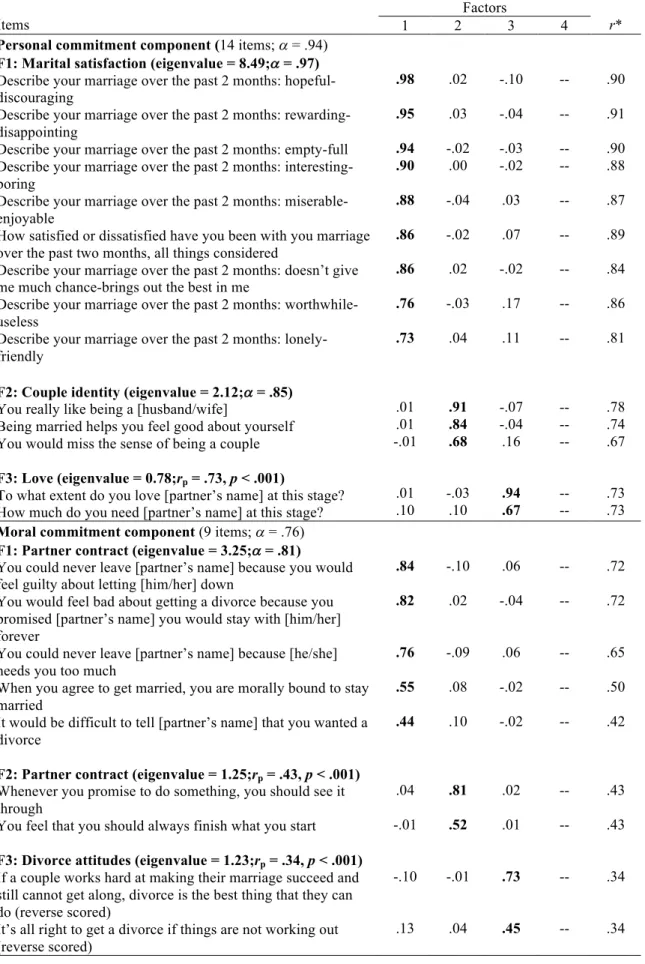
Similarly to Johnson et al. (1999), a principal axis factor analyses (PAF) with oblimin rotation was deployed. The number of retained factors was determined by scree plot analysis, and item loadings were taken from pattern matrices. Table 1 presents a
summary of results for the final 44 items, along with internal consistency values for each factor and component (Cronbach’s alphas and Pearson’s r).
Table 1
For personal commitment (14 items; a = .94) three factors were retained (F1 = Marital satisfaction; F2 = Couple identity; F3 = Love) with high adequacy (KMO = .94) and 76.02% of the total variance accounted for. Loadings of each item on the respective factor were moderate to high, and factors had high reliability levels, with each item contributing to the reliability of its factor as shown by the item-total corrected correlations.
For moral commitment (9 items; a = .75), the three factors solution (F1 = Partner contract; F2 = Consistency values; F3 = Divorce attitudes) presented high adequacy (KMO = .78) and accounted for 46.62% of the total variance. Items presented moderate to high loadings on their respective factor. Again, factors presented moderate to high reliability levels, with each item contributing to the reliability of its factor (shown by item-total corrected correlations). In this solution, three items were dropped due to their low to non-acceptable loadings (“Even when things get hard, you should do the things you have promised to do”, “It’s important to stand by what you believe in”, and “Getting a divorce violates your religious beliefs”), and one item originally from the divorce attitudes factor loaded on the partner contract factor (“When you agree to get married, you are morally bound to stay married”).
Structural commitment (21 items; a = .89) presented four factors (F1 =
high adequacy (KMO = .87) and 52.07% of explained variance. Items presented moderate to high loadings within their respective factor with high item-total corrected correlations, and factors presented high internal consistency. One item (“You would miss just having somebody around”) originally from the alternatives factor was dropped due to low loading scores in each of the extracted factors (< .15), and one item (“You would lose some of your [child’s/children’s] love”) originally from the social pressure factor loaded on the termination procedures factor.
3.2 Associations Between Components and its Factors
Based on the obtained factor structure, the pattern of correlations between the components of commitment and its respective factors was analyzed. For personal commitment, love positively correlated with marital satisfaction, r = .69, p < .001, and with couple identity, r = .35, p < .001. Marital satisfaction positively correlated with couple identity, r = .27, p < .001.
For moral commitment, divorce attitudes positively correlated with partner
contract, r = .24, p < .001, and with consistency values, r = .12, p = .02. Partner contract positively correlated with consistency values, r = .29, p < .001.
For structural commitment, alternatives positively correlated with social pressure, r = .27, p < .001, with termination procedures, r = .61, p < .001, and with investments, r = .14, p = .001. Social pressure positively correlated with termination procedures, r = .48, p < .001, and with investments, r = .32, p < .001. Termination procedures positively correlated with investments, r = .34, p < .001.
3.3 Confirmatory Factor Models
To make stronger assumptions regarding MCC’s construct validity, confirmatory factor analyses (CFA) were conducted using AMOS software (Arbuckle 2006), testing the obtained factor structure. Based on the original assumptions and results (Johnson et al. 1999) three models were tested: (1) a partially correlated second-order model in which moral commitment and structural commitment were allowed to correlate (Model 1, the hypothesized model), (2) an alternative uncorrelated second-order model in which the components of commitment were not allowed to correlate (Model 2), and (3) an alternative correlated second-order model in which the three components of
commitment correlated with each other (Model 3).
For the sake of model identification and to meet generally required specifications (Byrne 2010), on each first-order latent factors one indicator path loading was set to 1, and measurement errors paths to the indicator were all set to 1. By the same token, the variance of all second-order components was set to 1. Both relative and absolute goodness of fit indexes of the models were obtained: the chi-square fit index (χ2); the relative chi-square fit index (χ2/df); the comparative fit index (CFI; Bentler 1990); the Tucker-Lewis fit index (TLI; Tucker and Lewis 1973); the root mean square error of approximation (RMSEA; Browne and Cudeck 1989); and the standardized root mean square residual (SRMR; Bentler 1990). Table 2 presents a summary of these analyses.
Table 2
All models present acceptable fits, with moderate to high standardized regression paths between the items and their latent first-order factors, .36 < l < .93, all p < .001,
and moderate to high standardized regression paths between the first-order factors and their respective second-order component of commitment, .36 < g < .81, all p < .001. As expected, Model 1 presented a highly significant correlation between moral and
structural commitment, f = .56, p < .001. Although in Model 3 this same correlation also emerged as significant, f = .57, p < .001, contrarily to its postulates no correlation emerged between personal and moral commitment, f = -.02, p = .844, or between personal and structural commitment, f = -.12, p = .119.
Given the similarity between the fit indexes of the three tested models, it is reasonable to assume that the MCC is better represented by our hypothesized partially correlated second-order structure, with a high and significant correlation between moral and structural commitment components (Figure 1), converging with the original
assumptions (Johnson et al. 1999). Importantly, results from Model 3 further show that personal commitment is not correlated with neither of the remaining components of commitment, thus being dropped as an adequate structure to fit our data.
Figure 1 Fig. 1 MCC partially correlated second-order model
3.4 Convergence Between MCC and IMS Scales
Personal commitment was positively correlated with IMS’ commitment, r = .76, p < .001, and with satisfaction, r = .72, p < .001, while negatively correlated with quality of alternatives, r = -.38, p < .001. Moral commitment, on the other hand, was positively correlated with IMS’ investments, r = .39, p < .001, but not with commitment, r = .05, p = .401. Similarly, structural commitment was positively correlated with IMS’
investments, r = .37, p < .001, but not with commitment, r = -.03, p = .601. Table 3 presents the full pattern of correlations.
Table 3
3.5 Differences According to Sample Characteristics
As the MCC was originally developed and validated exclusively with a sample of married couples (cf. Johnson et al. 1999), the present validation studies were extended to analyze differences in personal, moral and structural commitment according to the type of romantic relationship, cohabitation status, and relationship duration.
As personal commitment refers to one’s willingness to remain in the relationship, no differences between dating, civil union and married relationships were expected. On the other hand, referring moral commitment to a predisposition or sense of moral obligation to maintain the relationship, and structural commitment to the perception of constraints and barriers preventing relationship termination, married individuals were expected to report higher moral and structural commitment, when compared to the remaining participants. In agreement with these hypotheses, participants scores in personal commitment were unaffected by type of relationship, F (2,332) = 2.00, MSE = .90, p < .137. However, scores in moral commitment, F (2,332) = 4.72, MSE = .86, p < .009, η2p = .02, and in structural commitment, F (2,332) = 22.95, MSE = .95, p < .001, η2p = .12, were affected by type of relationship. In this sense, married participants reported higher levels of moral commitment (M = 3.81) and structural commitment (M = 3.34) over and above participants in a civil union or dating (respectively, moral commitment: M = 3.43, M = 3.45; structural commitment: M = 2.69, M = 2.46).
Furthermore, cohabitation was expected to influence scores in structural
commitment, given its association with perceived constraints and barriers, contrarily to scores in personal or moral commitment. In agreement with this hypothesis, only scores in structural commitment varied accordingly to co-habitation status, F (1,331) = 32.58, MSE = .98, p < .001, η2p = .09, with cohabiting participants showing higher structural commitment than non-cohabiting ones, (respectively, M = 3.59, M= 2.41).
Finally, differences in commitment scores taking into consideration relationship duration were analyzed. In line with previous hypotheses, participants in longer relationships were expected to report higher scores in commitment, especially in structural commitment. Results show higher structural commitment in participants with longer relationships (M = 2.97) than shorter relationships (M = 2.48), F (1,324) = 20.36, MSE = .98, p < .001, η2p = .06 (relationship duration was median split for this analysis; Median relationship duration = 48 months). The remaining commitment components were unaffected by relationship duration: personal commitment, F (1,324) = 1.48, MSE = .92, p < .225; moral commitment, F (1,324) = 2.25, MSE = .86, p < .135.
4 General Discussion and Conclusions
This research aimed at obtaining the main psychometric properties of the MCC scale in a sample of Portuguese individuals. Compared to Johnson et al.’ (1999) original study, the innovation of the present study was fourfold: (1) a broader sample was used, by adding individuals in different types of romantic relationships (dating, in a civil union, and married) varying in length, either cohabiting or not, and with diverse sexual orientations (heterosexual, bisexual, homosexual, and queer), (2), apart from running
PAF analysis, the MCC’s structure was further tested with a CFA, (3) the analyses were extended to the associations between MCC and IMS scales, and (4) differences
according to sample characteristics were analyzed, in regards to the components of commitment. These innovations allowed for a cross-cultural validation of the MCC, to gather more evidence regarding its construct validity, and to validate its applicability to different relationship contexts. Importantly, this research provides a relevant basis to analyze the different components of commitment, fundamental to romantic relationship quality, well-being and happiness (e.g., Drigotas et al. 1999; Rusbult et al. 1998).
Results suggest the Portuguese version of the MCC as having an adequate construct validity and reliability. The PAF analyses converge with the original MCC structure, although three important aspects must be noted. First, four items from both moral and structural commitment had non-acceptable loading scores, and were
consequently dropped from the analyses. Second, one item originally from the divorce attitudes factor loaded in the partner contract factor (“When you agree to get married, you are morally bound to stay married”). This modification can be understood when attending more closely to the item’s content, i.e., the sense of being morally bound to stay married after publically agreeing to it seems to be more in line with the experience of a personal moral contract not to leave the partner, and not so much as a personal attitude regarding marriage dissolution. Third, an item from the structural commitment component, originally from the social pressure factor, loaded in termination procedures factor (“You would lose some of your [child’s/children’s] love”). Again, this can be understood taking into account that dealing with the loss of child’s/children’s love after the dissolution of a relationship can be perceived more as a difficulty adding to the
termination process of a relationship, and not so much as a social pressure to maintain the current relationship.
Despite these changes, results show the expected pattern of correlations between the factors within each component, and between personal, moral and structural
commitment. Equally important, the original analysis was extended by resorting to CFA, which tested the structure found in the PAF analysis. Even though the three tested models presented good fit indexes, the hypothesized partially correlated second-order model represented more accurately the MCC structure originally proposed by Johnson et al. (1999). Indeed, even in a model where the components of commitment were allowed to correlate with each other, no correlation emerged between personal and either moral or structural commitment. This goes in line with the assumed
distinctiveness in the subjective experience of the components of commitment (see Johnson 1991; Johnson et al. 1999), adding up to MCC construct validity.
The strong and significant positive correlation between moral and structural commitment, suggest both components as possible perceived barriers (internal and external, respectively). Backing up these evidences, results further show that personal commitment was only positively correlated with IMS’ commitment and satisfaction, while negatively correlated with quality of alternatives. Moral and structural
commitment were positively correlated only with IMS’ investments. Hence, it is not surprising that when feeling more generally committed (personal commitment), an individual is more satisfied and does not consider other alternative scenarios as viable or attractive. On the other hand, greater investments in the relationship lead to the
perception of more barriers, either internal or external, and moral and/or structural commitment, respectively. In line with other theoretical perspectives (e.g., Levinger
1999; Stanley and Markman 1992), personal commitment reflects attraction and dedication, while moral and structural commitment reflect constraints preventing
relationship termination. The theoretical and practical relevance of the MCC scale relies in the fact that it goes beyond a general notion of commitment and assesses additional and relevant components that may lead to a broader understanding of commitment and relationship maintenance (e.g., moral obligation in the absence of love).
Another important finding refers to the comparison of commitment scores
between type of relationship, cohabitation status and relationship duration. As expected, no differences were found in personal commitment, i.e., attraction, satisfaction and sense of couple identity are similar across different types of relationships. Given the positive correlation between personal commitment and IMS’ commitment, this converges with empirical evidences showing that dating and married couples do not differentiate in their level of commitment (e.g., Le and Agnew 2003). Different results emerged for the remaining components of commitment. Married individuals reported higher moral and structural commitment, compared to single individuals and those in a civil union. On the one hand, expressing one’s marriage vows may provide individuals with a sense of moral obligation to maintain the relationship and support the partner (moral commitment). On the other hand, publicly celebrating the union and building a shared life may activate the perception of barriers (either intrinsic or extrinsic) to abandon the relationship (e.g., costs associated with the dissolution, child/children, division of assets; structural commitment). In fact, it is important to note that
individuals in a civil union, with legal benefits in maintaining and costs in terminating the relationship, reported higher structural commitment than dating individuals. Taken together, these results considering a vaster sample of participants attests the MCC
robustness in assessing the different components of commitment experienced in distinct types of relationships.
Also, for cohabitation status and relationship duration differences were found in structural, but not personal or moral, commitment. This converges with the theoretical conceptualization (Johnson 1991) and validation (Johnson et al. 1999) of the
components of commitment. To the extent that individuals decide to cohabit and have a longer romantic relationship, they will also share a greater amount of assets and
investments, thus perceiving more external barriers and constraints preventing relationship termination.
Future research should analyze in greater detail the role of each component of commitment in the maintenance of romantic relationships, for instance, understanding the impact of moral obligation (moral commitment) and the perception of external barriers (structural commitment) in the decision to maintain the relationship, even in the absence love, marital satisfaction and/or couple identity (personal commitment). Also, a more thorough analysis should be carried out inquiring the relationship between
commitment components and couples’ well-being and perceived quality of life. Importantly, this should be complemented with other indicators of commitment (e.g., using the IMS), thus providing further evidences in construct validity, and more broadly lending helpful insights and a more thorough understanding of the motivations
underlying the maintenance of romantic relationships.
Despite the important findings reported previously, the present research is not without limitations. Indeed, the sample of participants used encompassed a vast
majority of female respondents. Although gender differences may emerge in regards to the influence of each component of commitment to the activation of
relationship-protection mechanisms (e.g., Lydon et al. 2008), commitment is normally thought of as a basic cognitive process drawn from personal and relational experiences, and as such these validation results should hold robust over and above such potential gender differences. Nonetheless, future research using the MCC should take this into account.
Also, and although the sample encompassed individuals in same-sex relationships and of different sexual orientations, its size did not allow to draw sound conclusions, and future research should study commitment in same-sex relationships. This aspect is particularly important since research should pay particular attention studying how specific characteristics of same-sex relationships, namely greater sexual openness (Peplau and Fingerhut 2007), lesser investments (Lehmiller and Agnew 2006) or polygamy (Wosick-Correa 2010), influence the experience of commitment and each of its components. Moreover, research should try to understand how socially marginalized individuals (e.g., same-sex relationships, Lehmiller and Agnew 2006) experience commitment and subjective well-being, as well as engagement in health-risk behaviors (Lehmiller 2012) within their relationships. Finally, and also extremely important, research should understand how recent social and juridical context changes in several countries (e.g., legally recognition of same-sex civil unions and same-sex marriages; Vale de Almeida 2010) impacts social acceptance and influences commitment, personal well-being and relationship maintenance. This would allow for a comprehensive
understanding and generalization of currently available evidences (e.g., Kurdek 2005). In short, the present study shows that the Portuguese version of MCC scale has good psychometric properties, validity and reliability, supporting its use in future research focused on different types of romantic relationships. This scale represents a valuable tool in understanding more broadly commitment and its components, allowing
not only academics to analyze how different couple dynamics interplay with commitment and diverse relationship outcomes, but also professionals to identify potential sources of conflict within couples and strategize intervention programs to enhance relationship quality and well-being, happiness and quality of life.
Acknowledgments
This research was funded by the grant SFRH/BPD/73528/2010, awarded by Fundação para a Ciência e Tecnologia to the first author.
References
Arbuckle, J. (2006). Amos (Version 7.0) [Computer Program]. Chicago, Il: SPSS. Aron, E., & Aron, A. (1996). Love and expansion of the self: The state of the model.
Personal Relationships, 3, 45-58, doi:10.1111/j.1475-6811.1996.tb00103.x. Be, D., Whisman, M., & Uebelacker, L. (2013). Prospective associations between
marital adjustment and life satisfaction. Personal Relationships, 20, 728-739, doi:10.1111/pere.12011.
Bentler, P. (1990). Comparative fit indexes in structural models. Psychological Bulletin, 107, 238-246, doi:10.1037/0033-2909.107.2.238.
Browne, M., & Cudeck, R. (1989). Single sample cross-validation indices for covariance structures. Multivariate Behavioral Research, 24, 445-455, doi:10.1207/s15327906mbr2404_4.
Byrne, B. (2010). Structural equation modeling with Amos: Basic concepts, applications, and programming (2nd ed.). New York, NY: Routledge.
Coleman, M., Lawrence, G., & Leon, K. (2006). Divorce and postdivorce relationships. In A. Vangelisti, & D. Perlman (Eds.), The Cambridge handbook of personal relationships (pp. 157-173). New York, NY: Cambridge.
Drigotas, S. (2002). The Michelangelo phenomenon and personal well-being. Journal of Personality, 70, 59-77, doi:10.1111/1467-6494.00178.
Drigotas, S., Rusbult, C., & Verette, J. (1999). Level of commitment, mutuality of commitment, and couple well-being. Personal Relationships, 6, 389-409, doi:10.1111/j.1475-6811.1999.tb00199.x.
Gosling, S., Vazire, S., Srivastava, S., & John, O. (2004). Should we trust web-based studies? A comparative analysis of six preconceptions about internet
questionnaires. American Psychologist, 59, 93-104, doi:10.1037/0003-066X.59.2.93.
Hassebrauck, M., & Fehr, B. (2002). Dimensions of relationship quality. Personal Relationships, 9, 253-270, doi:10.1111/1475-6811.00017.
Johnson, M. (1991). Commitment to personal relationships. In W. Jones, & D. Perlman (Eds.), Advances in personal relationships (Vol. 3, pp. 117-143). London, UK: Kingsley.
Johnson, M., Caughlin, J., & Huston, T. (1999). The tripartite nature of marital
commitment: Personal, moral, and structural reasons to stay married. Journal of Marriage and Family, 61, 160-177, doi:10.2307/353891.
Kurdek, L. (2005). What do we know about gay and lesbian couples? Current directions in psychological science, 14, 251-254, doi:10.1111/j.0963-7214.2005.00375.x.
Kurdek, L. (2007). Avoidance motivation and relationship commitment in heterosexual, gay male, and lesbian partners. Personal Relationships, 14, 291–306,
doi:10.1111/j.1475-6811.2007.00155.x.
Le, B., & Agnew, C. (2003). Commitment and its theorized determinants: A meta– analysis of the Investment Model. Personal Relationships, 10, 37–57, doi:10.1111/1475-6811.00035.
Le, B., Dove, N., Agnew, C., Korn, M., & Mutso, A. (2010). Predicting nonmarital romantic relationship dissolution: A meta-analytic synthesis. Personal Relationships, 17, 377–390, doi:10.1111/j.1475-6811.2010.01285.x.
Lehmiller, J. (2012). Perceived marginalization and its association with physical and psychological health. Journal of Social and Personal Relationships, 29, 451-469, doi:10.1177/0265407511431187.
Lehmiller, J., & Agnew, C. (2006). Marginalized relationships: The impact of social disapproval on romantic relationship commitment. Personality and Social Psychology Bulletin, 32, 40-51, doi:10.1177/0146167205278710.
Levinger, G. (1999). Duty toward whom? In J. Adams, & W. Jones (Eds.), Handbook of interpersonal commitment and relationship stability (pp. 37-52). New York, NY: Springer.
Lydon, J., Menzies-Toman, D., Burton, K., & Bell, C. (2008). If-then contingencies and the differential effects of the availability of an attractive alternative on
relationship maintenance for men and women. Journal of Personality and Social Psychology, 95, 50-65, doi:10.1037/0022-3514.95.1.50.
Moser, G. (1994). Les relations interpersonnelles. Paris, France: Presses Universitaires de France.
Myers, D., & Diener, E. (1995). Who is happy? Psychological Science, 6, 10-17, doi:10.1111/j.1467-9280.1995.tb00298.x.
Peplau, L., & Fingerhut, A. (2007). The close relationships of lesbians and gay men. Annual Review of Psychology, 58, 405-424,
doi:10.1146/annurev.psych.58.110405.085701.
Rodrigues, D., & Lopes, D. (2013). The Investment Model Scale (IMS): Further Studies on Construct Validation and Development of a Shorter Version (IMS-S).
Journal of General Psychology, 140, 16-28, doi:10.1080/00221309.2012.710276.
Rusbult, C. (1980). Commitment and satisfaction in romantic associations: A test of the investment model. Journal of Experimental Social Psychology, 16, 172-186, doi:10.1016/0022-1031(80)90007-4.
Rusbult, C., & Buunk, B. (1993). Commitment processes in close relationships: An interdependence analysis. Journal of Social and Personal Relationships, 10, 175-204, doi:10.1177/026540759301000202.
Rusbult, C., Coolsen, M., Kirchner, J., & Clarke, J. (2006). Commitment. In A. Vangelisti, & D. Perlman (Eds.), The Cambridge handbook of personal relationships (pp. 615-635). New York, NY: Cambridge.
Rusbult, C., & Martz, J. (1995). Remaining in an abusive relationship: An Investment Model analysis of nonvoluntary dependence. Personality and Social Psychology Bulletin, 21, 558-571, doi:10.1177/0146167295216002.
Rusbult, C., Martz, J., & Agnew, C. (1998). The Investment Model Scale: Measuring commitment level, satisfaction level, quality of alternatives, and investment size. Personal Relationships, 5, 357–387, doi:10.1111/j.1475-6811.1998.tb00177.x. Stanley, S., & Markman, H. (1992). Assessing commitment in personal relationships.
Journal of Marriage and Family, 54, 595-608, doi:10.2307/353245.
Stanley, S., Rhoades, G., & Whitton, S. (2010). Commitment: Functions, formation, and the securing of romantic attachment. Journal of Family Theory & Review, 2, 243–257, doi:10.1111/j.1756-2589.2010.00060.x.
Tucker, L., & Lewis, C. (1973). A reliability coefficient for maximum likelihood factor analysis. Psychometrika, 38, 1-10, doi:10.1007/BF02291170.
Vale de Almeida, M. (2010). O contexto LGBT em Portugal [Portuguese LGBT context]. In C. Nogueira, & J. M. d. Oliveira (Eds.), Estudo sobre a
discriminação em função da orientação sexual e da identidade de género [Study on discrimination according to sexual orientation and gender identity] (pp. 45-92). Lisboa, Portugal: Comissão para a Cidadania e a Igualdade de Género. Wilson, C., & Oswald, A. (2005). How does marriage affect physical and psychological
health? A survey of the longitudinal evidence. IZA Discussion Paper No. 1619. http://ssrn.com/abstract=735205. Accessed 6 January 2014.
Wosick-Correa, K. (2010). Agreements, rules and agentic fidelity in polyamorous relationships. Psychology & Sexuality, 1, 44-61,
Table 1: Summary of Principal Axis Factor (PAF) Analysis for the MCC Scale Items
Items
Factors
r*
1 2 3 4
Personal commitment component (14 items; a = .94) F1: Marital satisfaction (eigenvalue = 8.49;a = .97)
Describe your marriage over the past 2 months: hopeful-discouraging
Describe your marriage over the past 2 months: rewarding-disappointing
Describe your marriage over the past 2 months: empty-full Describe your marriage over the past 2 months: interesting-boring
Describe your marriage over the past 2 months: miserable-enjoyable
How satisfied or dissatisfied have you been with you marriage over the past two months, all things considered
Describe your marriage over the past 2 months: doesn’t give me much chance-brings out the best in me
Describe your marriage over the past 2 months: worthwhile-useless
Describe your marriage over the past 2 months: lonely-friendly
F2: Couple identity (eigenvalue = 2.12;a = .85)
You really like being a [husband/wife]
Being married helps you feel good about yourself You would miss the sense of being a couple
F3: Love (eigenvalue = 0.78;rp = .73, p < .001)
To what extent do you love [partner’s name] at this stage? How much do you need [partner’s name] at this stage?
.98 .95 .94 .90 .88 .86 .86 .76 .73 .01 .01 -.01 .01 .10 .02 .03 -.02 .00 -.04 -.02 .02 -.03 .04 .91 .84 .68 -.03 .10 -.10 -.04 -.03 -.02 .03 .07 -.02 .17 .11 -.07 -.04 .16 .94 .67 -- -- -- -- -- -- -- -- -- -- -- -- -- -- .90 .91 .90 .88 .87 .89 .84 .86 .81 .78 .74 .67 .73 .73
Moral commitment component (9 items; a = .76) F1: Partner contract (eigenvalue = 3.25;a = .81)
You could never leave [partner’s name] because you would feel guilty about letting [him/her] down
You would feel bad about getting a divorce because you promised [partner’s name] you would stay with [him/her] forever
You could never leave [partner’s name] because [he/she] needs you too much
When you agree to get married, you are morally bound to stay married
It would be difficult to tell [partner’s name] that you wanted a divorce
F2: Partner contract (eigenvalue = 1.25;rp = .43, p < .001)
Whenever you promise to do something, you should see it through
You feel that you should always finish what you start
F3: Divorce attitudes (eigenvalue = 1.23;rp = .34, p < .001)
If a couple works hard at making their marriage succeed and still cannot get along, divorce is the best thing that they can do (reverse scored)
It’s all right to get a divorce if things are not working out (reverse scored) .84 .82 .76 .55 .44 .04 -.01 -.10 .13 -.10 .02 -.09 .08 .10 .81 .52 -.01 .04 .06 -.04 .06 -.02 -.02 .02 .01 .73 .45 -- -- -- -- -- -- -- -- -- .72 .72 .65 .50 .42 .43 .43 .34 .34
Structural commitment component (21 items; a = .89)
F1: Termination procedures (eigenvalue = 7.03;a = .88)
Dealing with the legal system would be difficult It would be hard to work out who would get the kid(s) It would be awfully difficult to do the things necessary to get a divorce
Having to move your things would be a burden
It would be hard to work out who would get what property You would lose some of your [child’s/children] love It would be hard for you to find a new place to live
F2: Investment (eigenvalue = 2.64;a = .83)
You would feel like you’d wasted the best years of your life You would lose all the time you had put into the marriage You would feel like all the effort you had put into keeping the two of you together had been wasted
You would lose money you’d put into the marriage
F3: Social pressure (eigenvalue = 1.88;a = .82)
You would be upset because your family would be uncomfortable with your breaking up
It would be difficult to face your friends and family after you broke up
You would be upset because your in-laws would be uncomfortable with your breaking up
You would be upset because you would lose some respect from friends
You would be upset because you would lose your place or standing in the community
F4: Alternatives (eigenvalue = 1.23;a = .79)
You would miss living in your house
You would miss the help you get around the house from having a partner
You would miss being able to see your [child/children] regularly
If you and [partner’s name] were to break up, you would miss important income, insurance, or other property
You would not have to work around the house so much
.79 .74 .71 .51 .48 .45 .45 -.06 .02 -.02 .23 -.06 .02 .06 -.02 .10 .09 .21 .22 -.11 -.02 .05 -.05 .01 .13 .09 .00 .19 .83 .79 .78 .51 -.02 .04 -.04 .01 .01 -.06 -.09 -.06 .09 .03 -.07 .04 -.02 .03 -.14 -.24 -.08 -.05 .02 .08 -.11 -.82 -.72 -.72 -.71 -.47 .06 .01 .09 -.06 -.12 -.14 .12 .07 .32 .15 .03 .25 -.07 .06 < .01 -.02 .14 -.04 -.03 -.04 .05 .77 .63 .62 .57 .50 .67 .70 .71 .70 .65 .53 .68 .72 .72 .67 .53 .75 .67 .66 .61 .44 .68 .64 .65 .45 .45 Note: Factor loadings ³ .35 are boldfaced. *corrected item-total correlations. Reliability indexes, i.e., Cronbach’s alphas and Person r’s (rp) are presented between parentheses. For unmarried participants,
“marriage” was changed to “significant romantic relationship”, “husband/wife” was changed to “significant other”, and “divorce” was changed to “separation”. This allowed for a broader application, not restricted to married couples.
Table 2
Summary of Fit Indexes for the MCC Scale Confirmatory Models
Models N df χ2 χ2/df CFI TLI SRMR RMSEA (CI)
Model 1: Partially correlated Model 2: Totally uncorrelated Model 3: Totally correlated 330 330 330 890 896 894 1816.79 1998.40 1969.07 2.04 2.23 2.20 .90 .88 .88 .89 .87 .87 .10 .11 .09 .06 (.05; .06) .06 (.06; .07) .06 (.06; .06) Note: Model 1 only assumes the correlation between moral and structural commitment, following Johnson and colleagues’ (1999) assumptions (our hypothesized model). Model 2 assumes the absence of correlation between the three components of commitment. Model 3 assumes the correlation between personal, moral and structural commitment.
Table 3
Correlations between MCC and IMS
IMS MCC Satisfaction Quality of alternatives Investments Commitment Personal commitment .72** -.38** .29** .76** F1. Marital satisfaction .85** -.33** .08 .71** F2. Couple identity .24** -.19** .36** .34** F3. Love .66** -.40** .23** .79** Moral commitment -.05 .03 .39** .05 F1. Partner contract -.03 .08 .44** .03 F2. Consistency values .06 .03 .18** .08 F3. Divorce attitudes -.13* -.05 .19** -.02 Structural commitment -.12* .05 .37** -.03 F1. Termination procedures -.06 .05 .23** .01 F2. Investments -.28** .05 .22** -.13* F3. Social pressure -.07 .05 .41** -.03 F4. Alternatives .02 < .01 .23** .05 * p < .05 ** p < .001