Recording Reefs with Darwinian Questions: Historical
Studies on the Brazilian Northeast Coast
Almir Leal de Oliveira1
1Department of History, Federal University of Ceara, Brazil
Corresponding author: [email protected]
Abstract. The objective of this research is to gather empirical information to emphasize the insertion of the Northeast Coast of Brazil into the North-American Darwinian discussion, especially the zoology of its coral reefs. References on subject are found in descriptions produced by the Stanford Expedition to Brazil, 1911. The Expedition was directed by John Branner, geologist who worked for a long time with David Jordan, zoologist at Stanford. They worked with models of speciation of species and their scientific practices included a variety of methods of natural sciences: biogeographic records, systematic taxonomy (distribution laws), ecological perspectives and collaborative research (biology and geology). This expedition recorded the biogeography of the marine life to understand the role of the isolation on the divergence of species characteristics separated by a natural barrier. The taxonomy developed by these studies involves a knowledge that has acted as a bridge between the old-fashioned natural history and a modern field system. This kind of fieldwork integrated the descriptive activity with qualitative models. Today, the results of the Expedition are reflected in many scientific institutions in North America including biological collections and bibliographies. These indications are important biological records about the Brazilian reefs and they are indicative of the relevant scientific Darwinian work made by this Expedition in a period of the “eclipse” of the Darwinian Theory. Thus, we attempt to analyze all these references as a whole, placing emphasis on both the practical science and the history documented in the records of Brazilian coral reefs.
Key words: Brazil, Darwinism, Biogeography, Isolation, Natural barriers.
Introduction
“There is no more striking geological phenomena along the eastern shores of South America than the stone reefs of Brazil.” (John Casper Branner, 1904)
John Casper Branner published in 1904 a long monograph about the geology of Brazilian reefs. This study was a result of years of experience on fieldwork along the Brazilian coast. The paper contents of his work covered among 3 hundred pages of writings and almost a hundred plates with indicative maps of reefs and coral reefs of Brazil. This monograph was an important definition of the differentiation between the redstone reef, the arenito reef and the coral reefs.
The first contact Branner had with the Brazilian reefs was in 1876 when he worked as an assistant geologist for the Imperial Geological Commission coordinated by his professor Charles Friederick Hartt. At this time he was a student at Cornel University and this experience was a mix of training in fieldwork and scientific theory. The biggest question to Hartt and his workers at that time was about the Ice Age in the
tropics, a question that mobilized Louis Agassiz since the repercussion of the transmutation theory of Charles Darwin. Hartt was concerned about explaining the Ice Age but did not found proof that supported this formation in the Brazilian tropics. This was the beginning of a transition between the Creationism theory to evolutionary explanation for the Brazilian geological formation (Marcus Vinicius de Freitas, 2001).
Hartt was worried about the rigor and excellence of the empirical observations to sustain an interpretation about the geology of the country, especially the granite formation of the shore. He was trained by Louis Agassiz under a rigorous methodology of field work and trained his students with the same strategy: all the theories needed strong support from empirical evidence (Jon Roberts, 2009).
of the geological origins to the evolutionary theory. From the geological point of view Branner, just like Hartt, was impacted with the dynamic causes on the geological formations of the tropics. All the dynamic agents of the atmosphere and animal life (including humans) were a problem to explore the changes of the beds of the earth. With a vision of dynamic geology with causes and origins and the transmutation theory Branner began to see the reefs of Brazil as a special subject for further exploration. He searched the old naturalist descriptions of the reefs and, in 1876 he was impressed with the Darwinian records about the reefs made during his trip in the Beagle, when he described the geological formation of the volcanic island of Fernando de Noronha and the reefs at Recife.
After many years in the United States, where Branner worked in the National Geological Survey (Arkansas) he began to teach at Stanford University, invited by Zoologist and fish specialist, and orthodox Darwinian professor David Starr Jordan. He returned to his questions on reefs during field work in Brazil in 1899, when he traveled to explore the coast between Bahia and Rio Grande do Norte states, recording the occurrences of the marine life and researching the geological origins of these formations.
The explanation emerged from Branner’s
interpretations regarding the flourishing of the reefs and coral reefs by this time were centered on dynamic events that made this particular formation possible. This was a question from his mentors who attempted to find evidence of glaciation in the tropics. Harrt and Agassiz intended to find drifts in rocks to prove the Ice Age, but the erosion in tropical areas with hot water and the strong solar incidence caused a quick decomposition of the rocks. It was impossible to distinguish if the rocks were sculpted from the action of the ice or the climatic tropical events. Branner began an interpretation of the reefs from observation of the erosion and other geological dynamic agents, especially the chemical agents. His explanation of the reef formation and the difficulty in distinguishing the redstone reefs from the coral reefs of Brazil was based on these dynamic geological components.
According to Branner, many naturalists throughout history described the reefs of Brazil as coral reefs. The reason for this misunderstanding was the resemblance between both types of reefs. To the naturalists there weren’t distinguishable qualities between the coral reefs and the simple reef formations. The coral grew under the sandstone reefs covering them with calcareous. The extensive reef barriers along the coastline are associated with this type of coral reef. Branner detected that the geological formations of the reefs originated from the Cretaceous (the base of the reefs), the sedimentary rocks from the deposit of sediments during the Eocene Tertiary, more
deposition of sediments compacted by the depression of the Pliocene Era and the results of the erosion and depression of the coast during the late Pliocene to recent period. The geological formation of the reefs is associated with the action of the chemical processes and the physical conditions of the climate. At the shore the geography causes disturbances with the mangrove sediments, the streams of maritime currents, the freshwater from the rivers and the consolidation of the sand from the beaches. These aspects affect the geological beds of the reefs and create a continuous process of growth of the coral reefs. Furthermore, the combination between many kinds of stone reefs is associated with the formation of the coral reefs.
During the late Nineteenth Century Branner was convinced that the coral reefs of Brazil were the combinations of the old reefs and special dynamic processes of the tropical nature. For him there was no evidence that the coral reefs were associated with volcanic formations or eruptive phenomena. The magnesium limestone and dolomite stones found in the most important part of the shore attested the age of the coral reefs from the Tertiary (perhaps Cretaceous) Era, and the discovery that its fauna were similar to the fauna observed in the Caribbean zoology. These conclusions demonstrated Branner’s position within the coral reef discussion in 1899.
Material and Methods
In 1911 John Casper Branner organized another expedition to explore the coral reefs of Brazil. His intention was to demonstrate a special and particular problem of the transmutation theory and the causes of the evolution. He was concerned primarily with the problem of the speciation and the place of the natural barriers on evolution.
namely those of David Starr Jordan and Vernon Kellog, the most important zoologists of the university, who dedicated many texts to the defense of Darwinism as a scientific paradigm. Secondly I worked with the articles produced by the expedition. From 1911 to 1913 twenty-three articles were published with the results of the expedition. These scientific studies are indicative of the questions on morphology, physiology, adaptation, taxonomy and mutualism. They also identified new species, genera and sub-genera. The members of the expedition worked with fish, mollusks, insects, bees, ants and shells. These studies were published in many scientific reviews and represented the extension of the scientific problems that the expedition supported. Thirdly, I worked biological collections from the expedition. I tried to identify the destinations of the collections after they arrived in the United States. After the end of the expedition, the members sent the collections to many specialists around North America and Europe. They tried to show the importance that
these collections were made with criterious
methodology. They searched for the most important naturalists in each area to demonstrate the role of these species on the adaptation under isolation and for the results of the expedition to gain recognition in the scientific community. The strategy to share the collections outside of Stanford is a limitation to the research. Prior to this article I identified parts of the collections in the following scientific institutions: Stanford University, California Academy of Sciences, US National Museum of Natural History, Museum of
Comparative Zoology at Harvard University,
Academy of Natural Sciences of Philadelphia, San Diego Natural History Museum and others.
Results
Branner and his group departed from New York City in April 18, 1911 en route to the Amazon River, first stopping in the city of Belém, where they collected fish and insect specimen. In Belém they visited the Paraense Museum where they gathered species from the naturalist Emilia Snethlage, Director of the museum. From there they traveled to Ceará, where they spent a few days exploring the reefs and visiting Quixadá to study the geologic granite formations. During their time in Natal the party spent most of their time collecting maritime life at the coral reefs. They continued to travel along the shore to many small fishing villages to organize the collections.
Figure 1: The members of The Stanford Expedition to Brazil, 1911. Edwin Starks, John Casper Branner, Fred Baker, Harold Heath, Olaf Jekin, George Casper Branner, Willian Mann, Earl Lieb.
John Branner invited two other
zoologists/professors from Stanford (Edwin Starks, ichthyologist and Harold Health, physiologist) and a mollusk specialist from San Diego, Fred Baker. Four students were invited to assist the professors (Figure 1). This collaborative research allowed data exchange of data between the professors and benefited the entire group. One of the articles published after the expedition was co-authored by Jordan.
In the decade of 1900 the defense of Darwinism at Stanford University had occupied the naturalist’s attention and they published books and articles against the claims of the mutation theory. They
published the book Darwinism To-day (Kellogg,
1907) to criticize the alternatives theory of natural
selection. Jordan published the article The Origin of
Species Through Isolation (Jordan, 1905) to emphasize that isolation is a factor of the speciation.
According to Magnus (1993): “This law of
distribution, plus the fact of increased in barrier laden regions, where the two chief facts which Jordan thought required recognizing the role of isolation in speciation. The alternative mutation theory, which had a new species arise alongside its parent, simply did not reflect the evidence of the distribution of species to be found in nature. If the mutation theory were true, one would expect the most closely related species to arise in the same region as its parent, rather than in a neighboring region, and one would expect that since barriers or isolation were irrelevant to speciation, there would be less speciation in regions broken up by barriers, just as there were fewer genera or families.”
Jordan also contributed with his research on
biogeography to define the concept of species: “The
impasse [definition of species] by favoring a populational conception of species over a taxonomic one. Biogeography would be a good guide to their status as discrete species.” (David J. Depew, 1996).
The trip to explore the zoology of the reefs in Brazil was completely aligned with the theory and methodology developed by Jordan and his research group about isolation as a factor to natural selection. His biogeography supported the Darwinian argument against the Mendelian theory of the heredity and the mutation theory of Hugo de Vries. Theoretically, the biogeography of the West-East coast of Brazil was homogeny, with the same physical and climatic conditions that made this region a potential subject for field work. The region to be prospected could be recorded in the same zoological area and a big natural barrier could be found – the mouth of Amazon River. The problem to be explored was if the fresh water from the river could be understood as a natural biological barrier or if the geological origin of this barrier was sufficient to create an isolation of the species. So, if the isolation of the coastal fish was detected the expedition could work with the variations of the marine fauna: adaptations, interbreedings, speciations and the evolution of the species by natural selection.
Fresh water from the Amazon River outflow creates a geographic isolation, which divides the same zoological area and interrupted the rhythms of population changes, transforming this region into an available environment to the evolutionary research.
This was the intention of Branner: “I want to know
just what fresh water barrier does to marine life. I know that it is profoundly affected, but no one has ever made such a study, and I know of no place where it can be made so advantageously.” (John Casper Branner, 1910)
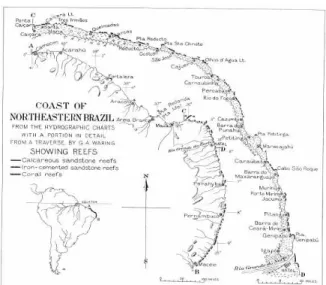
Branner and his group focused special attention to the geological formation of the reefs. The natural features with an artificial appearance that had impressed Darwin in his trip around the world and the extension of the formation over thousand miles was a subject of their interpretations. In 1914 they published a map (Figure 2) identifying the calcareous, iron-cemented and coral reefs of Rio Grande do Norte State (Warring, 1914).
Figure 1: Gerald A. Warring – Reef Formations of the Northeast Coast of Brazil, The American Journal of Sciences, Fourth Series, Vol. XXXVII, no. 221, May 1914.
They studied the chemical form of the reefs distinguished the sand reef in front of the rivers mouths compacted with shells from the redstone reef, both with coral formations. They identified the cement action of the calcium carbonate to explain the particular formation. The freshwater from the rivers in contact with the salt water was an explanation to this hard rock almost identified as quartz.
The dynamics process of the semi-arid tropical whether was a central element in his interpretation. During the rain seasons the minerals (iron, lime) accumulated was carried by the rivers to the sea and added with organic acids from sediments which in contact with the calcium carbonate from the salt water dissolved lime from the shells and cemented the reef. The actions of the sand of the shore, the marine currents and the changes of the sea level in geologic eras (especially from the Pliocene) were important to differentiate old redstone reef from the arenito and coral reefs.
They also detect that those dead reefs found along the coast were evidence of its slightly elevation.
the same geographic area where coral reefs and freshwater from Amazon River catchment occur. Nowadays the collections are in the California Academy of Sciences, donated from the Hopkins Marine Station at Monterey, CA. A reference bibliography of the new species classified by Edwin Starks can be considered one of the most important results of the Expedition (Baker, 1913; Health, 1913 and Starks, 1913).
Discussion
In 1911 the Stanford University made a scientific travel to the Brazilian coast. It was a tide expedition with Darwinian question. They made systematic studies between Rio Grande do Norte State and the mouth of Amazon River recording the natural animal variations to natural barriers. This region was prospected like an evolutionary subject. They studied the geological formation of the shore and the animal distribution in zoological areas. The studies results of the Expedition were rich and diverse. They proposed a new geological interpretation about coral reefs and granites formation. They classified new species of fishes and mollusks from the coral reefs. Through field work, they established new collections of the neo tropical biodiversity in addition to natural history (morphology) and modern biology studies on systematics (physiology).
The results of the Stanford Expedition to Brazil are indicators of how the Brazilian shore was prospected with evolutionary questions and the collections are a heritage of the marine life biodiversity. Branner developed extensive research along the Brazilian coast with rigorous methods and modern analysis derived from Chemistry and Physics. He also utilized the power of evidence through meticulous observation, a heritage from his training in the methodology of Agassiz/Harrt. The data collected from these methods proved the age of the coral reefs, supporting the Darwinian explanation and the transmutation theory. The combination between field work and evolutionary theory was essential in understanding the most important record of the coral reefs made in the late XIX century and the beginning of XX century and this work can be considered one of the first Darwinian studies of the reefs of Brazil.
Acknowledgement
I am especially grateful to Rodolfo Dirzo, Bing Professor in the Department of Biology and Director of the Center for Latin American Studies at Stanford University for receiving me during the 2011 academic year as a Joaquim Nabuco Professor in Brazilian Studies. I would also like to thank the CAPES for a fellow ship that permitted me to develop this research. Finally, I would like to thank Christopher Foster for his very useful comments on the manuscript.
References
David Starr Jordan (1905) The Origin of Species Through Isolation. Science, Vol.XXII, n. 566, pp. 546-562.
David J. Depew and Bruce H. Weber (1995) Darwinism evolving: systems dynamics and the genealogy of natural selection. A Bradford book, London, pp. 305.
David Magnus (1993) In Defense of Natural History: David Starr Jordan and the role of isolation in evolution. Stanford University, Ph.D. Thesis Department of Philosophy, Palo Alto, pp. 75-76.
Edwin Chapin Starks (1913) The Fishes of the Stanford Expedition to Brazil. The University, Stanford University, Palo Alto.
Fred Baker (1913) The Land and Fresh Water Mollusks of the Stanford Expedition to Brazil. Proceedings of the Academy of Natural Sciences of Philadelphia, Vol. 65, No. 3, Sep-Dec., 1913, pp. 618-672.
Harold Heath (1913) The Anatomy of Two Brazilian Land Shells
Anastoma depressum and Tomigerus clausus. Proceedings of the
Academy of Natural Sciences of Philadelphia, Vol. 65, No. 3, Sep-Dec., 1913, pp. 688-692.
John Casper Branner (1904) The stone reefs of Brazil, their geological and geographical relations, with a chapter on the coral reefs. Bulletin of The Museum of Comparative Zoology, Harvard College, Cambridge, p. 4.
John Casper Branner (1910) Letter to Henry Willians, July, 11, 1910, Celil Green Library, Department of Special Collections and University Archives at Stanford University.
Jon Roberts (2009) Louis Agassiz: poligienismo, transmutação e a metodologia científica. Uma reavaliação. Heloisa Bertol Domingues et alli Orgs. Darwinismo, meio ambiente e sociedade, Via Lettera/Museu de Astronomia e Ciências Afins, São Paulo, Rio de Janeiro, pp.73-99.
Marcus Vinicius de Freitas (2001) Expeditions in Imperial Brazil (1865-1878), Metalivros, São Paulo.
Roy Macleod and Philiph F. Rehbock (1994) (Eds.) Darwin’s laboratory: evolutionary theory and natural history in the Pacific. University of Hawaii, Honululu.