TEMAS LIVRES FREE THEMES
1 Faculdade de Ciências da Saúde, Universidade do Estado do Rio Grande do Norte. R. Atirador Miguel Antônio da Silva Neto s/n, Aeroporto. 59607-360 Mossoró RN Brasil. [email protected] 2 Universidade Federal Rural do Semi-Árido.
Characterization of Enzymatic profiles of
Aedes aegypti
strains from the State of Rio Grande do Norte, Brazil
Caracterização de perfis enzimáticos de cepas do
Aedes aegypti
do Estado do Rio Grande do Norte, Brasil
Resumo Este estudo foi realizado em quatro
cepas de mosquitos Aedes aegypti da cidade de Mossoró, Rio Grande do Norte, com o intuito de avaliar os perfis de atividade enzimática e corlacioná-los com os mecanismos bioquímicos de re-sistência a inseticidas. Mosquitos foram utilizados para quantificar as seguintes enzimas de detoxifi-cação: oxidase de Função Mista (MFO), PNPA-es-terase (PNPA-EST) e acetilcolinesPNPA-es-terase (AChE). Os perfis das populações foram comparados esta-tisticamente com os da cepa Rockefeller por meio do teste de Kruskal-Wallis e do de comparações múltiplas de Dunn (p < 0,05). O percentil 99 dos valores de atividade enzimática da cepa referência foi calculado para cada enzima, e o percentual de indivíduos acima desse valor foi quantificado. As atividades enzimáticas foram classificadas como “Inalterada” ( < 15%), “Alteração Identificada” ( > 15% e < 50%), e “Substancialmente Altera-da” ( > 50%). A análise estatística revelou dife-renças significativas nos perfis de MFO e AChE, que são fundamentais na determinação de perfis de resistência a inseticidas. Três populações foram classificadas como “Substancialmente Alteradas” para MFO. Os níveis alterados de atividade en-zimática demonstram que essa mudança pode de-sempenhar um importante papel na resistência a inseticidas.
Palavras-chave Aedes aegypti, Dengue,
Meca-nismos de resistência, Inseticidas
Abstract This study was conducted in four
strains of Aedes aegypti mosquitoes to evaluate the enzymatic activity profiles in the city of Mos-soró, Rio Grande do Norte, and correlate them with biochemical mechanisms of resistance to insecticides. Mosquitos were used to quantify the following detoxification enzymes: Mixed-Func-tion Oxidase (MFO), PNPA-esterase (PNPA-EST), and Acetylcholinesterase (AChE). The pro-files were compared statistically with propro-files from the Rockefeller strain, through the Kruskal-Wallis test and Dunn’s multiple comparisons (p < 0.05). The 99 percentile of the values of enzyme activity from the reference strain was calculated for each enzyme, and the percentage of individuals above the 99 percentile was quantified. The enzyme ac-tivities were classified as “Unchanged” (< 15%), “Identified change” (> 15% and < 50%), and “Substantially changed” (> 50%). The statisti-cal analysis revealed significant differences in the MFO and AChE profiles, which are fundamen-tal in the determination of profiles of resistance to insecticides. Three populations were classified as “Substantially changed” for MFO. The altered enzymatic activity showed that the changes could have an important role in exposing resistance to insecticides.
Key words Aedes aegypti, Dengue fever, Resis-tance mechanisms, Insecticides
Renan Flávio de França Nunes 1
Marcos Antonio de Souza 1
Jéssica Costa de Oliveira 2
Richardeson Fagner de Oliveira Grangeiro 1
Maria Jocileide de Medeiros Marinho 1
N
unes RFF
Introduction
The mosquito Aedes aegypti is the most impor-tant vector of diseases in urban areas due to its great ability to adapt to that environment’s conditions. It is the vector for the transmission of four distinct serotypes of the dengue virus (DENV-1, 2, 3, 4), which is the etiologic agent of the dengue fever1,2. This disease is currently
a major public-health problem, having become the most significant vector-borne viral disease worldwide; about 2.5 billion people are at risk of infection with the dengue virus, mainly in tro-pical countries where the environmental con-ditions favor the proliferation of Aedes aegypti3.
In Brazil, the vector control began between 1902 and 1907. Currently, the only method of control or prevention of dengue fever is combating the vector mosquitoes, which is mainly achieved through the massive use of chemicals to control the development of adults and larvae, a practice of questionable efficiency. Traditional approa-ches to dengue prevention and control have been inherited from the vertical programs that targe-ted vector elimination in domestic habitats, with the use of larvicides and insecticides in addition to breeding site elimination as the core of Aedes control strategies. However, the main problem with the use of chemical pesticides is the develo-pment of resistance resulting in reduced efficien-cy of the products. Thus, resistance to insectici-des poses a threat to the effectiveness of strategies to control mosquito populations and, moreover, infections with the dengue virus4-6. In many
cou-ntries, chemical control has proved inadequate to prevent infestation by the mosquito vector. Many measures, including sanitation and trash remo-val, epidemiological, entomological, and virolo-gical vigilance, health education, and community participation has proven essential to decisively prevent outbreaks7.
Aedes aegypti is present in all States and most cities in Brazil; it is present in approximately 98% of the municipalities in the State of Rio Grande do Norte. The municipality of Mossoro, in this context, presents high levels of infestation, and thus, is endemic for dengue fever. So far, control strategies has shown not very effective due to in-tense disease urbanization and limitation of the disease surveillance process itself8. According to
data from the 2011 Epidemiological Surveillan-ce bulletin from the Brazilian Ministry of Heal-th, this municipality presented 1,652 confirmed dengue fever cases, which represents a 10 fold increase to the number of cases from 2010 (160
confirmed cases). Moreover, Mossoró was lis-ted among the 72 municipalities in Brasil where insecticide resistance profiles were detected in mosquito populations according to the Technical Note No. 023 from the Brazilian Ministry of He-alth issued in 2009.
Chemical insecticides still have an important role in the control of vectors for disease trans-mission. The most widely used act on the central nervous system (CNS) of insects and are classi-fied into four large groups according to their che-mical nature: organochlorines, organophospha-tes, carbamates and pyrethroids. Insect resistance to these compounds stems mainly from a change in their metabolic sites of action or greater effi-ciency for detoxification2,9-12.
The use of insecticides in Brazil since 1967 has been exposing the vector of dengue fever to intense selective pressure9. This study evaluated
enzymatic profiles in different populations of the A. aegypti mosquito from the municipality of Mossoro, and correlated profiles alterations with insecticide resistance and the use of chemical in-secticides in this municipality.
Materials and methods
Mosquitoes
Larvae and pupae of Aedes aegypti mosqui-toes were collected from four previously chosen sites in the city of Mossoró located at 06°12’43” S, 37°20’39” W and 285 km from Natal, the capital of Rio Grande do Norte State in Brazil. (Figure 1). The collection sites corresponded to the nei-ghborhoods named Santo Antonio (SA), Pare-dões (PA), Abolições (AB), and Bom Jardim (BJ), which are located in the northern area of the mu-nicipality, the region with the highest population density and greater epidemiological significance related to dengue fever. This region has the most new and recurrent cases, besides presenting the highest rates of infestation by the vector mosqui-to, according to the Epidemiological Surveillan-ce. These neighborhoods are mainly urban areas and with low socio-economic conditions in this city. Data collected was directed by the density map of disease cases by neighborhoods, using a simple random probability sampling, reaching a minimum of 20 households per district. All sam-ples were collected in June month, as suggested by Bessa Júnior et al.8. Specimens were collected
e C
ole
tiv
a,
21(1):285-292,
2016
humidity. The samples used were derived from field population, being tested the F0 generation. Adult females, at up to one day old (0 to 24 h after emergence), not blood fed or exposed to chemical insecticides during the adult and the larval stage were used in the study. The choice of females was based on their feeding habits, which consequently leads to the transmission of the dengue virus. The separation of adult mosquitoes by sex was made considering the sexual dimorphism represented by the antennae. Additionally, the Rockefeller strain was used as internal control in all experi-ments because it is the reference internationally known to be susceptible to insecticides9,10.
Biochemical Assays
Enzymatic dosing for Acetylcholinesterase (AChE and AChI), the first in the absence of the propoxur inhibitor, and the second in the presen-ce of the inhibitor, PNPA-esterase (PNPA-EST), and Mixed-Function Oxidase (MFO), and total protein quantification were performed in ten fe-male mosquitoes, in the adult stage, from each studied site, and from the Rockefeller strain. Each mosquito was homogenized in 300 µl of Milli-Q water and the homogenates distributed, in
dupli-cates, in 96-well plates; each enzyme was analysed in a separate plate. The homogenates were centri-fuged at 12,000 g for 60 seconds in a refrigera-ted centrifuge before aliquots were taken to dose PNPA-EST enzyme and total protein (Eppen-dorf Centrifuge 5430 R®). Absorbance was
me-asured spectrophotometrically for each enzyme using the appropriate wavelengths (405 and 620 nm) in a microplate reader (Asys Expert Plus®).
Standard curves were obtained for BSA (Bovine Serum Albumin) and Cytochrome C to correct the amounts of total protein and (MFO), respec-tively. Samples for which the standard deviation were equal or greater than 30% of the average measurement were discarded. The experiments and processing of absorbance values were based on the manual “Methodology for the Quantifica-tion of Enzyme Activity Related to Resistance to Insecticides in Aedes aegypti”9.
Mixed-Function Oxidases (MFO)
The assay used measures the amount of heme groups in the mosquito, thus, allowing an indi-rect estimate of the cytochrome P450 enzyme activity, with which the heme group is mainly associated10.In this assay, performed in duplicate,
the following was added to every 20 µl of homo-genate: 60 µl of 90 mM potassium phosphate bu-ffer (final pH adjusted to 7.2), 200 µl of Na ace-tate/TMBZ working solution (0.012g of 3,3,5,5 tetramethyl benzidine dihydrochloride in 6 ml of methanol and 18 ml of 250 mM sodium aceta-te buffer at pH 5.0), and 25 µl of 3% hydrogen peroxide (H2O2). The plates were incubated for 90 minutes at room temperature, protected from light, and subsequently read at 620 nm.
Acetylcholinesterase (AChE)
The dosing of acetylcholinesterase was per-formed in two separate 96-well plates, assigned to AChE and AChI, to estimate the total activi-ty of aceactivi-tylcholinesterase in the presence or ab-sence of the propoxur inhibitor, respectively. The following was added on 25 µl of homogenates, to all plates and in duplicate: 145 µl of Triton/Na phosphate (5 ml of 100% Triton X-100 in 50 ml of 1M sodium phosphate buffer at pH 7.8 and 455 ml of distilled water), and 10 µl of DTNB/Na phosphate (10 mM DTNB in 100 mM sodium phosphate buffer at pH 7.0). In the AChE plates, 10 mM acetylcholine iodide in water was added to each well in the absence of propoxur. In the AChI plates, 10 mM acetylcholine iodide in
N
unes RFF
ter was added in the presence of propoxur (6 µl of 0.1 M in acetone). All plates were incubated for an hour at room temperature, protected from light, and read at 405 nm.
PNPA Esterase (PNPA-EST)
The homogenates were centrifuged at 12,000 g for 60 seconds and 10 µl were taken in dupli-cate and placed in 96-well plates. The following was added to each well: 200 µl of PNPA/Na phos-phate working solution prepared by adding 100 mM PNPA in acetonitrile (0.01815 g of PNPA in 1 ml of acetonitrile) to 24.75 ml 50 mM sodium phosphate buffer at pH 7.4 (50 ml of 1 M sodium phosphate buffer at pH 7.4 in 950 ml of distilled water). This assay aims to estimate the reaction kinetics, therefore, the absorbance variation re-presented by the amount of substrate consumed9
was measured through nine readings at 405 nm, every 15 seconds.
Total protein
Dosing of total protein in each mosquito is necessary to correct the values of enzymatic acti-vity related to metabolic resistance and the wei-ght of each individual insect. Duplicates of 10 µl homogenates were taken after centrifugation and plated in 96-well plates; 300 µl of the Bradford reagent 1:5 diluted was added to each well. The plates were read at 620 nm 3 to 5 minutes after the addition of the reagent.
Controls
The controls were performed in all experi-ments and divided into “blank” and “positive” controls. They did not receive homogenates but received the specific reagent for each enzyme and were used to adjust the absorbance values of the wells containing homogenates. There were only wells corresponding to blank samples in the AChE and PNPA-EST tests, whereas in the MFO test there were blanks and controls. In the (MFO) assay, the three blank control wells received 80 µl of potassium phosphate buffer, and the three po-sitive control wells received 60 µl of potassium phosphate buffer and 20 µl of cytochrome C so-lution (0.01 mg/ml in 250 mM sodium acetate pH 5.0). In the (AChE and AChI) assay, the six blank control wells received 25 µl of water and the other common reagents. In the PNPA-EST assay, the six blank control wells received the PNPA/Na phosphate reagent and 10 µl of water.
In the total protein assay, the three blank wells received the Bradford reagent and 10 µl of water; the three positive control wells received 10 µl of 1 µg/µl BSA solution in addition to the Bradford reagent.
Data Analysis
The absorbance values obtained in the du-plicate samples were corrected in relation to the volume of homogenates, and the values for the enzymatic activities related to metabolic resis-tance were corrected by the total protein dosing measurements. The level of significance was set to p-value < 0.05. The medians of the enzyma-tic activity values from each population of A. aegypti were compared with the values from the Rockefeller reference strain using the Kruskal -Wallis and Tukey’s nonparametric tests (p-value < 0.05). The comparison between the obtained values for the pool of populations and reference strain was performed using the Mann-Whitney test (nonparametric T-test) at p-value < 0.05.
The calculation of the 99 percentile of the Ro-ckefeller strain values in each enzyme was used to qualify the changes detected in the enzymatic activity in the studied populations. The activities were classified as “Unchanged”, “Identified chan-ge” and “Substantially changed” if the percenta-ges of individuals in each population over the 99 percentile were < 15%, between 15% and 50%, and > 50%, respectively. The multiple compari-sons test of Dunn’s was used to analyze the varia-tions in the medians from the populavaria-tions, thus, determining which populations varied signifi-cantly among themselves. The GraphPadPrism software, version 5.00 for Windows, San Diego California, USA was used for the analyses and ge-neration of graphs10,11.
Results
e C
ole
tiv
a,
21(1):285-292,
2016
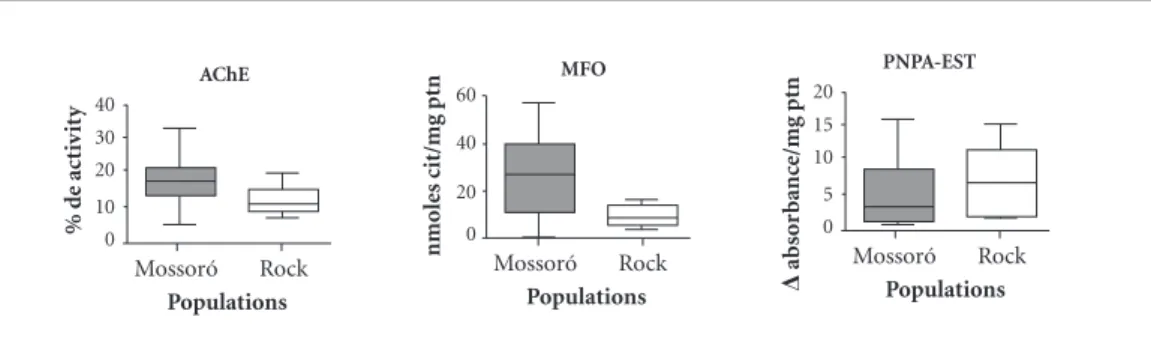
Moreover, a comparison between the en-zymatic profiles of pooled samples from the stu-died sites, and thus, mimicking a single popula-tion named “Mossoró”, and the reference strain Rockefeller, named “Rock” was performed. All tests, with the exception of PNPA-EST, showed statistical significance in this analysis; some at p-value < 0.05, as shown in Figure 2.
Mixed-Function Oxidase (MFO)
The median level of enzymatic activity ob-served in the BJ population differed significantly from the “Rock” reference strain (p-value < 0.05). No statistical significance was observed in PA and AB populations (p-value > 0.05). The difference
was significant (p-value < 0.05) in the compari-son between the pooled populations and referen-ce strain (Figure 2). The SA population presented an “Unchanged” enzymatic profile. All other po-pulations presented the “Substantially changed” profile and a number greater than 50% of indivi-duals were placed above the 99 percentile of the reference strain; among these, 80% of individuals from the PA population showed important en-zymatic activity changes (Table 1).
Acetylcholinesterase (AChE)
The population from PA was the only that showed differences in medians with statistical significance compared to the Rockfeller strain
(p-Strains
Rockefeller
Santo Antônio Paredões Abolições Bom Jardim
Table 1. Quantification of enzyme activity for Acetylcholinesterase (AChE), Esterase PNPA (PNPA-ESP), and
Mixed-Function Oxidase (MFO) in populations of Aedes aegypti from Mossoró in Rio Grande do Norte State,
Brazil.
Na
48
N
39 40 40 40
Medianb
11.10
Median
10.95 19.05 18 18.75
p99c
19.71
% >p99d
13.00 40.00 30.00 40.00
a Number of tested mosquitoes. b Median for each enzymatic activity. c 99 percentile for the Rockefeller reference strain.
d Percentage of mosquitoes with enzymatic activity over the 99 percentile for the Rockefeller strain. * > 50% of mosquitões over the 99 percentile (Enzimatic activity “Substantially change”).
The Kruskal-Wallis test and multiple comparisons test of Dunn’s were used to establish comparisons between the medians of the populations studied and the reference strain and to analyze the variations between the median of the population, respectively.
N
40
N
40 39 40 40
Median
3.15
Median
3.3 1.5 2.75 4.15
p99
15.41
% >p99
10.00 0.00 10.00
0.00 N
38
N
40 40 40 40
Median
7.99
Median
13.61 28.36 35.69 39.05
p99
16.28
% >p99
10.00
80.00*
70.00*
75.00*
AChE(% activity) PNPA-EST(Δabs/mg ptn/min) MFO (nmolescit/mg ptn)
Figure 2. Graphic representation, box-plot type, of enzymatic activity in populations of Aedes aegypti from Mossoró (four study site pooled samples) and Rockefeller (Rock). Acetylcholinesterase, Mixed-Function Oxidase, and Esterase PNAPA are represented, respectively.
Populations
nmoles cit/mg p
tn
0 20 40 60
MFO
Mossoró Rock
Populations
% d
e act
iv
it
y
0 10 20 30 40
AChE
Mossoró Rock
Populations
Δ
abso
rbanc
e/mg p
tn
0 5 10 15 20
PNPA-EST
N
unes RFF
value < 0.05). AB and BJ was not differed statisti-cally (p-value > 0.05). Three populations (PA, AB, and BJ) were categorized with “Identified change” profile because they placed between the 15% and 50% of individuals above the 99 percentile of the reference strain. The SA population presented an unchanged enzymatic profile (Table 1).
PNPA Esterase (PNPA-EST)
No statistical significant difference was obser-ved in the medians of PNPA-EST enzymatic acti-vities between the tested and reference strains (p-value > 0.05). None of the samples (among the studied populations and sites) showed changes in enzyme activity (“Unchanged” profile) when compared with the 99 percentile of the reference strain (all presented less than 15% of individuals with activity above the p99) (Table 1).
Discussion
According to the Epidemiological Surveillance bulletin from the Municipality and Department of Public Health of the Rio Grande do Norte State, the organophosphate Temephos was used in large scale during the last decade. During the past six years, only in the years of 2008 (in which Cipemetrine adulticid pyrethroids were admi-nistered and Deltamethrin) and 2010 (in which Malathion GT 96% adulticid organophosphate was used) emergency treatment with chemical adulticids were used.
The MFO are commonly involved in resistan-ce to pyrethroids, and organophosphates insec-ticides to a lesser degree13-16. Studies by Paeporn
et al.17 found increased levels of MFO in
popula-tions of Aedes aegypti from from Thailand that had been selected through resistance to deltame-thrin and permedeltame-thrin, which are pyrethroid in-secticides; the former is routinely used in vector control in Mossoró. Rodríguez et al.18 described
that MFOs were important enzymes in the detec-tion of resistance to organophosphates in speci-mens from Latin America. In our study, changes in the enzymatic activity of MFO were observed; in fact, this enzyme showed the greatest profile changes in three of the studied populations rated as “Substantially changed” according to the 99 percentile of the reference strain ( > 50%). The fact that both pyrethroids and organophospha-tes have been used during routine activities for vector control in the municipality under study could probably be the cause for the selection of
resistant populations. In addition, Polson et al.10
still considers the participation of Temephos in the changing the MFO profiles.
Together with detoxification enzymes, AChE belongs to another enzyme class with fundamen-tal importance in the determination of insecti-cide resistance profiles in mosquitoes. AChE is responsible for the degradation of acetylcholine (ACh) where the primary site of action of orga-nophosphorus insecticides is located2; structural
changes in this site resulted in the development of resistance in many insect vectors19. In the
pre-sent study, this enzyme prepre-sented the “Identified change” profile ( > 15% and < 50%) for three of the studied populations. Moreover, this enzyme showed the greatest significance in the statistical analysis (p-value < 0.05) in the comparison be-tween the pooled populations (Mossoró) and the Rock strain. The Mossoró population presented proven resistance to Temephos, which is an or-ganophosphorus insecticide and acts directly on the acetylcholinesterase sites, according to the Te-chnical Note no. 023 from the Brazilian Ministry of Health in 2009.
The PNPA-EST were related to resistance to organophosphates and pyretroids in other stu-dies in populations of Aedes aegypti in Brazil. This resistance is conferred by target site insen-sitivity and/or increased metabolic detoxifica-tion20. However, the PNPA-EST in Mossoró was
not showed resistance, which corroborates the results reported by Polson et al.10 with
popula-tions from Trinidad and Tobago.
insectici-e C
ole
tiv
a,
21(1):285-292,
2016
des in mosquito populations, they do not provide definite information about these profiles in these populations because many variables are involved. The distribution of enzymes is heterogenous in most field strains and through biochemical as-says, individuals which may show altered activity are quickly detected. It is important to be able to identify populations which are incipiently altered because this makes it possible for intervention ef-forts to be taken before resistance spreads throu-ghout the entire population10. However, the
avai-lable data point to a probable correlation betwe-en betwe-enzymatic profiles and mechanisms related to the development of resistance to insecticides.
Conclusion
The detection of populations of Aedes aegypti mosquitoes in the city of Mossoró-RN with al-tered enzymatic activity, and the frequent use of chemical insecticides for vector control suggest enzymatic resistance in dengue’s vector. This stu-dy may provide information that may assist the authorities responsible for controlling vectors to create a workable strategy to optimize vector control in different neighbourhoods in the city bringing economic and health care benefits to the population by avoiding the unregulated use of chemical insecticides. However, the organiza-tion and support from public authorities are re-quired in order to make this strategy a standard procedure.
Hence, biochemical assays should be com-bined with vector control programs to monitor and prevent the generation of resistance to insec-ticides in mosquito populations. The implemen-tation of this strategy in the city of Mossoró-RN alone can not be a viable alternative to control the successive dengue epidemics that have affec-ted this population, but is an important indicator
of the development of resistance in vectors, whi-ch, if tackled, could help to improve the quality of public health.
Collaborations
RFF Nunes: Processing of samples, conducting resistance tests, data interpretation, writing and submission the manuscript. MA Souza: Process-ing of samples, conductProcess-ing resistance tests. JC Oliveira: Processing of samples, conducting diag-nostic tests, data interpretation. RFO Grangeiro: Access to research subjects and release and super-vision to obtain the samples listed. MJM Marin-ho: Technical support specialist, reading articles related to the theme and preparation of the man-uscript. WO Pereira: Guidance and supervision during the research and writing and submission the manuscript.
Acknowledgements
N
unes RFF
Martins AJ, Lins RMMA, Linss JGB, Peixoto AA, Valle D. Voltage-gated sodium channel polymorphism and metabolic resistance in pyrethroid-resistant Aedes ae-gypti from Brazil. Am J Trop Med Hyg 2009; 1(81):108-115.
Strode C, Melo-Santos M, Magalhaes T, Araujo A, Ayres C. Expression profile of genes during resistance reversal in a temephos selected strain of the dengue vector, Ae-des aegypti.PLoS One 2012; 7(8):e39439.
Polson KA, Rawlins SC, Brogdon WG, Chadee DD. Characterization of DDT and pyrethroid resistan-ce in Trinidad and Tobago populations of Aedes aegyp-ti. Bull Entomol Res 2011; 101(4):435-441.
Brogdon WG, McAllister JC. Insecticide resistance and vector control. Emerg Infect Dis 1998; 4(4):605-613. Scott JG, Liu N, Wen Z. Insect cytochromes P450: di-versity, insecticide resistance and tolerance to plant toxins. Comp Biochem Physiol 1998; 1-3(121):147-155. Paeporn P, Supaphathom K, Srisawat R, Komalamisra N, Deesin V, Ya-umphan P, Leeming Sawat S. Bioche-mical detection of pyrethroid resistance mechanism in Aedes aegypti in Ratchaburi province, Thailand. Trop Biomed 2004; 2(21):145-151.
Rodriguez MM, Bisset JA, Fernandez D. Levels of in-secticide resistance and resistance mechanisms in Ae-des aegypti from some Latin American countries. J Am Mosq Control Assoc 2007; 4(23):420-429.
Coleman M, Hemingway J. Insecticide resistance mo-nitoring and evaluation in disease transmitting mos-quitoes. J Pestic Sci 2007; 2(32):69-76.
Saavedra-Rodriguez K, Suarez AF, Salas IF, Strode C, Ranson H, Hemingway J, Black IV WC 2011. Trans-cription of detoxification genes after permethrin se-lection in the mosquito Aedes aegypti. Insect Mol Biol online 2012; 21(1):61-77.
Artigo apresentado em 28/09/2014 Aprovado em 15/04/2015
Versão final apresentada em 17/04/2015 12.
13.
14.
15. 16.
17.
18.
19.
20. References
Regis L, Monteiro AM, Melo-Santos MA, SilveiraJr JC, Furtado AF, Acioli RV, Santos GM, Nakazawa M, Car-valho MS, Ribeiro Júnior PJ, Souza WV. Developing new approaches for detecting and preventing Aedes aegypti population outbreaks: basis for surveillance, alert and control system. Mem Inst Oswaldo Cruz 2008; 103(1):50-59.
Braga IA, Valle D. Aedes aegypti: inseticidas, mecanis-mos de ação e resistência. Epidemiol. Serv. Saúde 2007; 16(4):279-293.
Rocco IM, Silveira VR, Maeda AY, Silva SJS, Spenassatto C, Bisordi I, Suzuki A. Primeiro isolamento de Dengue 4 no Estado de São Paulo, Brasil, 2011. Rev. Inst. Med. trop. 2012; 54(1):49-51.
Reis CB, Andrade SMO; Cunha RV. Aliados do A. Ae-gypti: fatores contribuintes para a ocorrência do den-gue segundo as representações sociais dos profissionais das equipes de saúde da família. Cien Saude Colet 2013; 18(2):517-526.
Polanczyk RA, Garcia MO, Alves SB. Potencial de Ba-cillus thuringiensis israelensis Berliner no controle de Aedes aegypti. Rev Saude Publica 2003; 37(6):813-816. Gómez-Dantés H, Willoquet JR. Dengue in the Ameri-cas: challenges for prevention and control. Cad Saude Publica 2009; 25(Supl. 1):S19-S31.
Bezerra JM, Silva JS, Ibiapina SS, Tadei WP, Pinheiro VC. Evaluation of students’ knowledge as a contribu-tion to dengue control programs. Cien Saude Colet 2011; 16(11):4367-4373.
Bessa Júnior FN, Nunes RFF, Souza MA, Medeiros AC, Marinho MJM, Pereira WO. Distribuição espacial da dengue no município de Mossoró, Rio Grande do Nor-te, utilizando o Sistema de Informação Geográfica. Rev. Bras. Epidemiol. 2013; 16(3):603-610.
Valle D, Montella IR, Ribeiro RA, Viana-Medeiros PF, Martins-Júnior AJ, Lima JBP. Metodologia para quan-tificação de atividade de enzimas relacionadas com a resistência a inseticidas em Aedes aegypti /Quantifica-tion methodology for enzyme activity related to insecti-cide resistance in Aedes aegypti. Rio de Janeiro, Brasília: Fundação Oswaldo Cruz, Secretaria de Vigilância em Saúde/Ministério da Saúde; 2006.
Polson KA, Brogdon WG, Rawlins SC, Chadee DD. Characterization of insecticide resistance in Trinida-dian strains of Aedes aegypti mosquitoes. Acta Trop 2010; 1(117):31-38.
Montella IR, Martins AJ, Viana-Medeiros PF, Lima JBP, Braga IA, Valle D. Insecticide resistance mechanisms of Brazilian Aedes aegypti populations from 2001 to 2004. Am J Trop Med Hyg 2007; 3(77):467-477.
1.
2.
3.
4.
5.
6.
7.
8.
9.
10.