Verbal and non-verbal semantic impairment
From fl uent primary progressive
aphasia to semantic dementia
Mirna Lie Hosogi Senaha
1, Paulo Caramelli
2, Claudia Sellitto Porto
3, Ricardo Nitrini
4Abstract – Selective disturbances of semantic memory have attracted the interest of many investigators and the question of the existence of single or multiple semantic systems remains a very controversial theme in the litera-ture. Objectives: To discuss the question of multiple semantic systems based on a longitudinal study of a patient who presented semantic dementia from fl uent primary progressive aphasia. Methods: A 66 year-old woman with selective impairment of semantic memory was examined on two occasions, undergoing neuropsychological and language evaluations, the results of which were compared to those of three paired control individuals. Results: In the fi rst evaluation, physical examination was normal and the score on the Mini-Mental State Examination was 26. Language evaluation revealed fl uent speech, anomia, disturbance in word comprehension, preservation of the syntactic and phonological aspects of the language, besides surface dyslexia and dysgraphia. Autobiographical and episodic memories were relatively preserved. In semantic memory tests, the following dissociation was found: disturbance of verbal semantic memory with preservation of non-verbal semantic memory. Magnetic resonance of the brain revealed marked atrophy of the left anterior temporal lobe. After 14 months, the diffi culties in verbal semantic memory had become more severe and the semantic disturbance, limited initially to the linguistic sphere, had worsened to involve non-verbal domains. Conclusions: Given the dissociation found in the fi rst examination, we believe there is suffi cient clinical evidence to refute the existence of a unitary semantic system.
Key words: semantic dementia, semantic memory, temporal lobe, progressive primary aphasia, semantic system.
Comprometimento semântico verbal e não-verbal: da afasia progressiva primária para demência semântica Resumo – Distúrbios seletivos da memória semântica têm atraído o interesse de muitos pesquisadores e a questão da existência de sistema semântico único ou múltiplo permanece como um tema muito controvertido na literatura. Objetivos: Discutir a questão de sistemas semânticos múltiplos por meio de um estudo longitudinal de uma paciente com afasia progressiva primária fl uente que evoluiu para um quadro de demência semântica. Métodos: Uma mulher de 66 anos com comprometimento seletivo da memória semântica foi avaliada em dois momentos por meio de testes neuropsicológicos e fonoaudiológicos e os resultados foram comparados aos de três indivíduos controles pareados. Resultados: Na primeira avaliação, o exame físico estava normal e a paciente obteve 26 pontos no Mini-exame do estado mental. Na avaliação da linguagem foram constatadas: produção oral fl uente, anomia, comprometimento da compreensão de palavras, preservação dos aspectos sintáticos e fonológicos da linguagem e dislexia e disgrafi a de superfície. As memórias autobiográfi ca e episódica encontravam-se relativa-mente preservadas. Em testes de memória semântica, a seguinte dissociação foi constatada: distúrbio da memória semântica verbal com preservação da memória semântica não-verbal. Os exames de ressonância magnética cerebral revelaram atrofi a acentuada do lobo temporal anterior do hemisfério cerebral esquerdo. Após 14 meses, as difi culdades da memória semântica verbal tornaram-se mais intensas e o distúrbio semântico, inicialmente restrito, à esfera verbal passou a domínios não-verbais. Conclusões: Dada a dissociação encontrada na primeira avaliação, acreditamos que temos evidências clínicas contra a existência de um único sistema semântico.
Palavras-chave: demência semântica, memória semântica, lobo temporal, afasia progressiva primária, sistema semântico.
1PhD. Member of Behavioral and Cognitive Neurology Unit of the Department of Neurology, University of São Paulo School of Medicine, São Paulo, Brazil. 2MD, PhD. Associate Professor, Department of Internal Medicine, Faculty of Medicine, Federal University of Minas Gerais, Belo Horizonte, Minas Gerais, Brazil. 3PhD. Member of Behavioral and Cognitive Neurology Unit of the Department of Neurology, University of São Paulo School of Medicine, São Paulo, Brazil. 4MD, PhD. Associate Professor, Department of Neurology, University of São Paulo School of Medicine, São Paulo, Brazil.
In 1992, fi ve cases of semantic dementia (SD) were de-scribed by Hodges et al.1 who distinguished this type of fl
u-ent progressive aphasia from the non-fl uu-ent primary pro-gressive aphasia described initially by Mesulam.2 Hodges et
al.1 proposed the following criteria for the diagnosis of this
syndrome: (1) selective impairment of semantic memory causing severe anomia, impaired spoken and written single-word comprehension, reduced generation of exemplars on category fl uency tests and an impoverished general knowl-edge; (2) relative sparing of other components of language, notably syntax and phonology; (3) normal perceptual skills and non-verbal problem-solving abilities; (4) relatively pre-served autobiographical and episodic memory; (5) surface dyslexia.
In SD, the intense vocabulary loss associated with the diffi culty in recognizing pictures, objects or famous peo-ple’s faces, in the absence of perceptive alterations, could be taken as evidence of the existence of a single semantic system. The existence of single or multiple semantic sys-tems remains a very controversial theme in the literature.3-11
Caramazza et al.5 and Hillis et al.6 supported the hypothesis
of a single semantic system and proposed a model of se-mantic processing called OUCH (Organized Unitary Con-tent Hypothesis). On the other hand, Shallice12-14 advocates
modularity of the semantic system, making a separation
between the visual semantic system and verbal semantic system. He refers to modality-specific aphasias, distur-bances of modality-specifi c semantic memory and effects of modality-specifi c priming.
The objectives of the current investigation were to ex-plore and discuss the question of multiple semantic sys-tems based on a case-study of a patient with a semantic memory disturbance.
Methods
Subjects
EHO, a 66 year-old retired Biology teacher, presented in 1998 with a two-year history of progressive word-fi nding diffi culties and impaired single word comprehension. Her autobiographical memory and her daily life activities were unaffected and she continued running the household and engaging in voluntary work, which entailed the accounting of a charity home for children. Her behavior and personal-ity were reported as unchanged.
Physical exam, performed in 1998, was normal and the score in the Mini-Mental State Examination15-16 was 26.
Routine laboratory tests and electroencephalogram were also normal. Resonance imaging revealed left temporal lobe atrophy, and brain SPECT showed left anterior temporal lobe hypoperfusion (Fig 1).
EHO’s performances in several tasks in neuropsycho-logical and language assessments were impaired due to her language diffi culties (Table 1). In spontaneous speech, EHO’s oral production was fl uent, but marked by anomia. Phonological and syntactic aspects of oral language were preserved. Sentence comprehension was appropriate. How-ever, oral and written word comprehension was impaired. Her greatest diffi culty was in naming tasks.
Three control individuals, right-handed women aged 60 to 65, all graduated in education as EHO, were also evaluated.
Materials and procedures
Matching, sorting, lexical decision, naming and other tasks were carried out. Some of these were adapted from the semantic memory protocol,1,17 while others were
spe-cifi cally devised to characterize EHO’s disturbance. A re-evaluation was performed 14 months after the fi rst exami-nation.
For comparative purposes, the tasks were also applied to the three control individuals.
Statistical analysis was conducted, through Fisher´s ex-act test. The value of signifi cance accepted was 0.05.
To facilitate the comprehension of the investigations the data were divided into three test series.
TEST SERIES 1: SEMANTIC MEMORY EVALUATION 1. Naming and verbal fl uency
1.1. Oral naming – The oral naming of the 90 pictures adapted from the semantic memory protocol1,17 was
re-quested. The pictures represented thirteen semantic cat-egories.
1.2. Written naming – The written naming of the same pictures was requested.
1.3. Verbal fl uency1,17 – Category and letter-based fl
u-ency (FAS) tests were performed.
2. Matching
2.1. Oral word-picture matching – In this task, the ex-aminer said a word and the individuals had to indicate the picture corresponding to this word, picking from eight pic-tures in the same semantic category. This task comprised 90 target stimuli.
2.2. Written word-picture matching – The task above was adapted, whereby all the presented oral words were converted to written words.
2.3. Sound-picture matching – Twenty-two sounds re-lating to non-verbal sounds such as musical instruments and nature sounds were presented separately and the indi-viduals had to select, from four pictures, the drawing cor-responding to the sound.
Table 1. EHO´s performances in neuropsychological and language evaluation.
Tests
Results / Correct responses MMSE
Dementia rating scale
Attention Initiation/perseveration Construction Conceptualization Memory Total 26/30 35/37 29/37 6/6 26/39 20/25 116/144 (0.16 SD*) (–1.12 SD*) (0.30 SD*) (–1.89 SD*) (0.98 SD*) (–1.74 SD*) WAIS Verbal Information Comprehension Arithmetic Similarities Digit span Vocabulary Digit symbol Performance Picture completion Block design Object assembly Picture arrangement Verbal IQ Performance IQ Total IQ 3 7 10 9 9 7 13 10 13 10 14 91 133 110 (–2.01 SD) (–0.83 SD) (0.21 SD) (0.08 SD) (0.30 SD) (–0.89 SD) (3.15 SD) (0.60 SD) (2.08 SD) (1.09 SD) (2.80 SD) (–0.9 SD) (3.3 SD) (1.0 SD) Trail making test
Part A Part B 33s 131s P 50 P 25 Rey-Osterrieth complex fi gure
Copy Memory 29/36 9/36 (–0.42 SD) (–0.69 SD) Logical memory (WMS)
Immediate recall Delayed recall (30’)
1.5/23 1.5/23
(–2.25 SD) (–1.58 SD)
Visual reproduction (WMS) Immediate recall
Delayed recall (30’)
10/14 10/14
(1.09 SD) (1.40 SD)
Paired associates learning test (WMS) Immediate recall
Delayed recall (30’)
7/21 4/7
(–2.89 SD) (–2.66 SD)
Language comprehension tasks Oral word comprehension (Beta) Written word comprehension (Beta) Oral sentence comprehension (Beta) Written sentence comprehension (Beta) Token Test - 1st part
Token Test - 2nd part Token Test - 3rd part Token Test- 4th part Token Test - 5th part
Token Test - 5th part (adapted version)**
13/17 10/13 38/38 8/8 10/10 6/6 9/10 9/10 14/21 19/21 Language production tasks
Boston naming test
Reading aloud of words and words (Beta)
Word and non-word dictation (Beta) Repetition of words and non-words (Beta)
Repetition of sentences (Boston)
10/60 26/30
9/10 30/30
13/16
2.4. Visual semantic matching (Protocole d’évaluation des gnosies visuelles - Agniel)18 – The individuals had to
as-sociate a target picture to another which was semantically related, choosing from three alternatives (example: padlock - key/rose/bowl).
2.5. Verbal semantic matching – The task above was adapted, whereby all the presented visual stimuli were converted to their verbal forms.
3. Sorting
3.1. Visual sorting1,17 – The picture sorting was requested
at three different levels:
– Level I: classifying 48 pictures into living or inani-mate items.
– Level II: (a) classifying the living pictures into land, aquatic animals or birds. (b) classifying the inanimate items into household items, musical instruments or vehicles.
– Level III: (a) classifying the land animal pictures ac-cording to habitat, size and ferocity was requested. (b) clas-sifying the household items according to size, kitchen and electrical or non-electrical objects.
3.2. Verbal sorting – The task above was adapted, so that all the presented pictures were converted into their verbal form.
4. Gesture production
In this task the individuals were asked to make gestures from pictures.
5. Reading and dictation
The reading and dictation from the HFSP protocol19
were applied.
TEST SERIES 2: INPUT LEXICON AND VISUAL REPRESENTATION EVALUATION
1. Object decision
In this task, 24 pictures were employed, twelve cor-responding to concrete/real images, and twelve pictures with no correspondence to any real item. Each picture was presented in a random order and the individuals had to state whether the picture corresponded to something real or not.
2. Face recognition
Thirty faces, fi fteen famous people and fi fteen unknown faces, were used. Each picture was presented, in a random order whereby the individuals had to say if the person was famous or not.
Table 2. EHO´s performance in verbal fl uency and naming tasks in the fi rst evaluation.
Tasks EHO
Control individuals
mean p
Verbal fl uency
Semantic category (living things) Land animals
Aquatic animals Birds
Breeds of dog Total–living things
4 2 1 0 7
19.3 13.3 11.0 6.0 49.6
– – – – – Semantic category (artifacts)
Household items Vehicles
Musical instruments Types of boats Total - artifacts
7 4 1 1 13
19.0 12.7 13.7 5.0 50.3
– – – – – FAS
F A S
Total – F, A, S
11 7 7 25
18.7 13.7 15.0 47.3
– – – –
Oral naming 41/90 84/90 <0.001*
Written naming 35/90 84/90 <0.001*
3. Oral lexical decision
Thirty two oral stimuli were utilized, where sixteen stimuli referred to real words while the other half corre-sponded to non-words based on the real words while keep-ing the same structure and syllabic length as the originals. Each stimulus was presented orally in random order. The individuals were asked to indicate whether the stimulus corresponded to a real word or not.
4. Orthographic lexical decision
This task comprised 28 written stimuli, with half corre-sponding to real words and half to non-words. Each stimu-lus was presented, in random order, and the individuals had to state whether the written stimulus corresponded to a real word or not.
5. Homophonic heterographic written words defi nition This task was composed of twelve pairs of written words. Each pair comprised two homophonic heterograph-ic words (words with different spelling but presenting the same pronunciation) such as, “cesta” (basket) and “sexta” (Friday) in Portuguese, or “mail” and “male” in English. The written words were presented in random order and individuals were then requested to provide the meaning of the words. The goal of this task was to investigate access
from the input logographic lexicon to the semantic system. The integrity of this access is verifi ed in the absence of con-fusing meanings between homophonous words.
TEST SERIES 3: RE-EVALUATION
In re-evaluation, the matching, sorting and naming tasks described in test series 1 were reapplied and the fol-lowing new tasks were performed:
1. Tactile semantic matching
This task was composed of 20 target stimuli each, hav-ing five alternatives. The target stimulus was an object concealed inside a bag which the individuals had to touch, without seeing it. After touching, the individuals were re-quested to match the object touched, with one of fi ve ob-jects placed on the table which presented some semantic relationship to the target, for example, key/lock.
2. Orthographic semantic matching
The task above was adapted, so that all the presented objects were converted into their written words.
3. Object and tactile naming
The oral naming of the 20 objects was requested in two different ways. Firstly, the individuals had to name objects
Table 3. EHO´s performance in matching and sorting tasks in the fi rst evaluation.
Tasks n
% success
p EHO
Control individuals mean
Matching (linguistic stimuli) Oral word-picture Written word -picture Verbal semantic
90 90 20
82.2 82.2 80.0
99.6 100.0
98.3
<0.001* <0.001* 0.013*
Matching (non-linguistic stimuli) Sound-picture
Visual semantic
22 20
90.9 100.0
90.9 100.0
1 1
Verbal sorting (linguistic stimuli) Level 1 (living; inanimate)
Level 2 a (land; aquatic animal; bird) Level 2 b (household; vehicles; music.) Level 3 a (ferocity; size; habitat) Level 3 b (kitchen; size; electrical)
48 24 24 36 36
89.6 75.0 83.3 61.1 88.9
100.0 100.0 95.8 93.5 99.1
0.001* <0.001*
0.063 <0.001*
0.014
Visual sorting (non-linguistic stimuli) Level 1 (living; inanimate)
Level 2 a (land; aquatic animal; bird) Level 2 b (household; vehicles; music.) Level 3 a (ferocity; size; habitat) Level 3 b (kitchen; size; electrical)
48 24 24 36 36
100.0 100.0 100.0 97.2 100.0
100.0 98.6 95.8 90.7 99.1
1 1 0.571 0.292 1
by touch without seeing them. Secondly, oral naming upon seeing the same objects was requested.
Results
The low number of items produced by EHO in verbal fl uency coupled with her performance in naming tasks, demonstrate her semantic-lexical difficulty (Table 2). Moreover, it was verifi ed that EHO produced a larger num-ber of items in FAS fl uency than in category fl uency.
In both matching and sorting tasks, EHO’s poorest performance occurred when the input of information was through linguistic stimuli (Table 3). For non-linguistic stimuli, non-verbal sounds and pictures, EHO´s perfor-mances were similar to those of the controls.
In the gesture production from pictures task, the pa-tient and controls managed to produce appropriate ges-tures for all items.
When comparing EHO´s performance in the oral word-picture, written word-picture matching and naming tasks, we observed a close relationship between errors commit-ted across the different tests. All the items that resulcommit-ted in failures on the oral comprehension task were left unnamed by EHO in the subsequent naming task. Similarly, all the inadequate responses in the written comprehension task were on items that were also not named.
In reading, EHO’s performance ranged from 90% to 100%, on lists of non-words, regular and close class words. Her performance was not influenced by linguistic vari-ables such as frequency, length and imageability. On the other hand, EHO read only 67.5% of the irregular words correctly, while a similar pattern was observed in writing upon dictation. EHO displayed good performance in writ-ing non-words, regular and closed class words; 80%, 100% and 95%, respectively. For irregular words however, EHO wrote only 56.7% of the items correctly. These data and qualitative analyses showing a large number of regulariza-tions, suggested that EHO presented surface dyslexia and dysgraphia.
In most of the tests in series 2, lexical, object decision and face recognition tasks, EHO achieved satisfactory per-formances as displayed in Table 4. EHO´s perper-formances in these tasks reveal the integrity of the input lexicons (logo-graphic and logophonic) and also of the input representa-tions involving visual-fi gurative stimuli and faces.
These data suggestive of input lexicon preservation are reinforced by EHO´s performance in word defi nition. In some words for which the patient did not provide the ap-propriate defi nition, she stated that the words were not totally unknown to her, but that she was unable to access their meaning.
Table 4. EHO´s performance in decision tasks in the fi rst evaluation.
Decision tasks n
% success
p EHO
Control individuals mean
Object decision 24 95.8 93.1 1
Face recognition 30 90.0 91.1 1
Oral lexical decision 32 100.0 93.7 0.336
Orthographic lexical decision 28 92.8 95.2 0.639
Table 5. EHO´s performance in homophonic heterographic written words defi nition task in the fi rs evaluation.
Homophonic heterographic written
defi nition task EHO
Control individuals
mean p
Correct responses 14/24 20.7/24 0.007*
Absence of response in pointing out graphic form of word
4 0.7 0.033*
Absence of response 1 1.0 1
Indefi nite mistakes (without apparent relationship with the target)
3 0 0.234
Supply of the meaning of the homophonic and heterographic word
2 1.7 0.416
In 12 word pairs of homophonic heterographic writ-ten words defi nition, EHO provided the correct meaning for 14 (62,5%), whereas the average of controls was 86.1% (Table 5).
Comparing EHO´s responses to the controls showed that EHO presented a larger number of mistakes, probably as a consequence of semantic memory disturbance, given half of the mistakes were due to the absence of response. On the other hand, considering solely the confusing meanings between heterographic homophonic written words, EHO made two mistakes. Control 1 made two mistakes, control 2 made none while control 3 made three mistakes. These data suggest that EHO did not have impairment in access from the input logographic lexicon to the semantic memory.
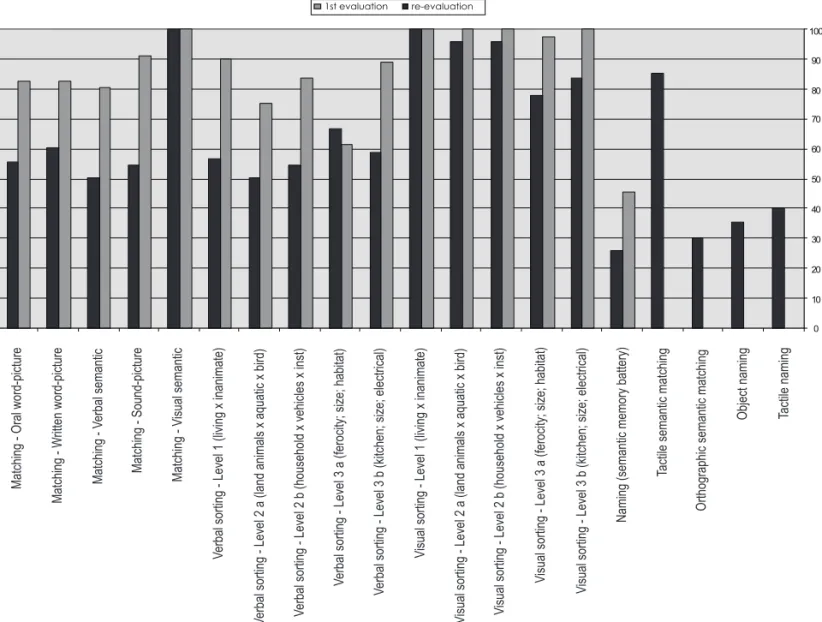
In re-evaluation, EHO’s performances in matching tasks fell, except in the visual semantic matching task (Fig 2). These falls occurred in all tasks involving linguistic items – oral word-picture, written word-picture, verbal semantic
match-ing – and in the sound-picture matchmatch-ing task. In the fi rst evaluation on the sorting tasks, an excellent performance by EHO was observed in those tasks involving picture stimuli, in contrast to the impaired performance in the classifi ca-tion of verbal stimuli. Upon re-evaluaca-tion, the dissociaca-tion between visual and verbal sorting was still evident; however, EHO made some errors in the visual sorting tests, suggesting an initial disturbance in visual semantic memory.
Responses indicative of disturbance in the visual se-mantic memory were also seen in oral naming tasks. During the fi rst evaluation, EHO did not commit errors related to diffi culties in visual semantic knowledge of pic-tures. However, this mistake type was encountered in the re-evaluation, albeit in small number. For example, in the
lock picture during the fi rst examination, EHO said: “to put a key in, isn’t it? But it has a name...” and in re-evaluation she said: “what is this? I have no idea”. In the asparagus
picture in the fi rst evaluation, EHO said: “it looks like that
0 10 20 30 40 50 60 70 80 90 100 1st evaluation re-evaluation
Matching - Oral word-picture
Matching - W
ritten word-picture
Matching - V
erbal semantic
Matching - Sound-picture
Matching - V
isual semantic
V
erbal sorting - Level 1 (living x inanimate)
V
erbal sorting - Level 2 a (land animals x aquatic x bird) Verbal sorting - Level 2 b (household x vehicles x inst)
V
erbal sorting - Level 3 a (ferocity; size; habitat)
V
erbal sorting - Level 3 b (kitchen; size; electrical)
V
isual sorting - Level 1 (living x inanimate)
V
isual sorting - Level 2 a (land animals x aquatic x bird) Visual sorting - Level 2 b (household x vehicles x inst)
V
isual sorting - Level 3 a (ferocity; size; habitat)
V
isual sorting - Level 3 b (kitchen; size; electrical)
Naming (semantic memory battery)
Tactile semantic matching
Orthographic semantic matching
Object naming Tactile naming
thing to make salad. Oregano?” and in the re-evaluation, her response was: “what is this? An animal? Here is the mouth, but I don’t know what it is”.
During re-evaluation, in the two new semantic match-ing tasks - one from graphic and another from tactile stim-uli - the dissociation between the performances based on linguistic and non-linguistic stimuli were clear. In the new naming tasks the performances were independent of the input modality of the stimulus being named.
Discussion
EHO´s diffi culties in oral and written word comprehen-sion, oral and written naming, reading and writing of ir-regular words can be interpreted as indicative of a selective impairment in semantic memory. To support the hypothe-sis of the isolated impairment of the semantic system, tasks were designed to examine the integrity of the input lexicon – logographic and logophonic – and the input visual rep-resentations. The results suggest these lexicons integrity. It was possible to test access from the input logographic lexicon to the semantic system by the homophonic hetero-graphic written words defi nition. In this task EHO made a few mistakes – as did the controls – related to confused meaning between homophonic heterographic words, thus suggesting the integrity of this access. The other accesses, from the input logophonic lexicon to the semantic system, and from the visual representation to the semantic system, are diffi cult to test separately. Therefore, the available data points to the notion that EHO’s disturbance is character-ized by semantic degradation with preservation of input lexicons. Moreover, in the visual and verbal stimuli sorting tasks, we observed that the mistakes occurred only in verbal sorting tasks, while her performance in the visual sorting task was excellent, even for the more specifi c items.
According to the models of lexical processing allow-ing for the existence of a sallow-ingle semantic system, as in the model by Hillis,20 a functional disturbance of the semantic
memory would also impair the semantic comprehension of pictures, objects and non-verbal sounds. However, no al-terations were observed in any tasks involving the compre-hension of non-verbal stimuli during EHO’s fi rst evaluation (visual semantic matching, sound-picture matching, pro-duction of gestures based on pictures and visual sorting). In the production of gestures task, EHO presented a good performance, as well as in the sound-picture matching task. Also, in the oral naming task, no mistakes resulting from the visual semantic knowledge of pictures were seen.
How can this be explained? According to the single semantic system models, the pathological process should have affected the stimuli comprehension, regardless of the input modality. The single semantic system models do not
explain the dissociation found in EHO’s fi rst evaluation, namely: excellent performance in tasks related to non-ver-bal semantic memory in conjunction with diffi culties in tasks related to verbal semantic memory. In the gesture production task, EHO was able to perform the gestures accurately. However, according to Caramazza et al.,5 the
accurate production of gestures based on pictures does not imply the existence of multiple semantic systems, be-cause sometimes it is not possible to know if the gesture was properly performed. How can one distinguish between the gestures representative of a truck or a car, and between tea or coffee?
By the same token, how can EHO´s performances in the sorting tasks be explained? EHO experienced diffi culties in the verbal sorting, but had satisfactory performance in vi-sual classifi cation tasks. Some authors, such as Caramazza et al.,5 support the idea that fi gurative representation already
carries implicit information on meaning. Something that has feet or eyes is probably a living thing. We believe that only further information of a generic nature can be extract-ed from fi gurative stimuli, such as classifying a picture into living or inanimate, as required in the sorting tasks (level 1). Analyzing the visual sorting tasks that we adapted from the semantic memory protocol,1,17 sorting level 2 requests
the classifi cation of living things into: land, aquatic animals, and birds, whilst the objects into: domestic utensils, musical instruments and transport. At this level, some information in the drawing can indeed facilitate the classifi cation; for instance, the existence of wheels suggests that it is a vehicle, the existence of wings indicates that the animal fl ies, and so on. In the last part of the task - sorting level 3 - the request-ed response no longer depends on the visual information taken from the fi gurative stimulus. For example, on visual sorting (level 3) the individuals have to decide if the picture of a bear is larger or smaller than a man, whether the animal is native to Brazil or not, and whether it is ferocious or not. In other words, the information required on classifi cation by size, habitat and ferocity is not given away by any visual picture characteristics. The household items have to be clas-sifi ed into: size, whether they are used in the kitchen or not and if they are electrical or otherwise. In the same way, the visual characteristics of the pictures do not give away any information to help accomplish this sorting.
verbal stimulus is used, while it is considered by Bozeat et al.3 to be sensitive in detecting mild semantic problems.
In conclusion, given the dissociation found in the fi rst examination on the sorting tasks, the good performance in sound-picture matching, the integrity of the input lexical memories and the preservation of the access from the in-put logographic lexicon to the semantic system, we believe that suffi cient clinical evidence can be drawn from this case study to refute the existence of a unitary semantic system.
One of the characteristics mentioned by Hodges et al.1
to diagnose SD - impoverishment of general knowledge - was not found in our patient upon fi rst evaluation. Af-ter 14 months, however, the diffi culties in verbal seman-tic memory had increased. In addition to this impaired function, other diffi culties in visual sorting of fi gurative stimuli, mistakes in naming for non-semantic recognition of pictures, and diffi culties in the sound-picture matching, hitherto not seen in the fi rst evaluation, were later present. These data suggest that the semantic disturbance of EHO, limited initially to the linguistic domain, had spread to other, non-verbal domains. Moreover, in the course of the disease, symptoms related to frontal lobe dysfunction, such as disinhibition and childish behavior emerged. In other words, the patient’s picture, characterized initially by selec-tive disturbance of verbal semantics expanded to become widespread semantic impairment and behavioral changes. Such characteristics can be associated with the diagnosis of SD. The selective disturbance of verbal semantic memory could be the initial symptom of SD in the case of EHO.
References
1. Hodges JR, Patterson K, Oxbury S, Funnell E. Semantic De-mentia. Progressive fl uent aphasia with temporal lobe atro-phy. Brain 1992;115:1783-1806.
2. Mesulam MM. Slowly progressive aphasia without general-ized dementia. Ann Neurol 1982;11:592-598.
3. Bozeat S, Lambon Ralph MA, Patterson K, Garrard P, Hodges JR. Non-verbal semantic impairment in semantic dementia. Neuropsychologia 2000;38:1207-1215.
4. Buxbaum LJ, Schartz MF, Carew TG. The role of semantic memory in object use. Cogn Neuropsychol 1997;14:219-254. 5. Caramazza A, Hillis AE, Rapp BC, Romani C. The multiple
semantics hypothesis: multiple confusions? Cogn Neuropsy-chol 1990;7:161-189.
6. Hillis AE, Rapp BC, Romani C, Caramazza A. Selective
im-pairment of semantics in lexical processing. Cogn Neurop-shychol 1990;7:191-243.
7. Hodges JR, Miller B. The neuropsychology of frontal variant frontotemporal dementia and semantic dementia. Introduction to the special topic papers: Part II. Neurocase 2001;7:113-121. 8. Hodges JR, Spatt J, Patterson K. “What” and “how”: evidence for the dissociation of object knowledge and mechanical problem-solving skills in the human brain. Proc Natl Acad Sci USA 1999;96:9444-9498.
9. Kertesz A, Davidson W, McCabe P. Primary progressive se-mantic aphasia: A case study. J Int Neuropsychol Soc 1998; 4:388-398.
10. Lambon Ralph MA, Howard D. Gogi aphasia or semantic de-mentia? Simulating and assessing poor verbal comprehension in a case of progressive fl uent aphasia. Cogn Neuropsychol 2000;17:437-465.
11. Lauro-Grotto R, Piccini C, Shallice T. Modality-specifi c op-erations in semantic dementia. Cortex 1997;33:593-622. 12. Shallice T. Specialization within the semantic system. Cogn
Neuropsychol 1988;5:133-142.
13. Shallice T. From Neuropsychology to mental structure. Cam-bridge: Cambridge University Press; 1988:269-306. 14. Shallice T. Multiple semantics: Whose confusions? Cogn
Neu-ropsychol 1993;10:251-261.
15. Folstein MF, Folstein SE, Mchugh PR. Mini-mental state. A practical method for grading the cognitive state of the pa-tients for the clinician. J Psychiatr Res 1975;12:189-198. 16. Brucki SM, Nitrini R, Caramelli P, Bertolucci PH, Okamoto
IH. Suggestions for utilization of the mini-mental state ex-amination in Brazil. Arq Neuropsiquiatr 2003;61:777-781. 17. Hodges JR, Salmon DP, Butters N. Semantic memory
im-pairment in Alzheimer’s disease: failure of access or degrades knowledge? Neuropsychologia 1992;30,301-314.
18. Agniel A, Joanette Y, Dojon B, Duchein C. Protocole d’éva-luation des gnosies visuelles. Montréal-Toulouse. Isbergues: Ortho-édition; 1992.
19. Parente MAMP, Hosogi ML, Delgado AP, Lecours AR. (Por-tuguese) Protocolo de Leitura para o projeto H.F.S.P; 1992. 20. Hillis AE. Contributions from cognitive analyses. In: R.
Chap-ey, Editor. Language Intervention strategies in adult aphasia. Baltimore: Williams & Wilkins; 1994:207-219.