shown in helping Peru with large donations and the provision of human resources.
The cost of lost exports has not been determined, but different sources place it between $US10 million and $US400 million. This has led to con-flicts between various sectors and the Ministry of Health, with unfavorable consequences for the con-trol efforts.
Another negative development has been the decrease in sales of fish along the entire coastline. The fish are caught by village fishermen who depend on this income to support their families. Although the Ministry of Health s recommendation was not to eat raw fish or shellfish, there has been a decrease in the consumption of seafood in general, with the consequences already mentioned.
Conclusions
- The cholera epidemic affecting Peru is of great magnitude, and is the largest of the known epidemics, at least in the last hundred years. - The mode of introduction of the V. cholerae that
triggered the epidemic is still undetermined. - The country offers highly propitious conditions
(poverty, lack of water and sanitation, extensive pollution) for the spread of cholera.
- The rapid reaction of the Ministry of Health-which alerted the population quickly, organized medical services and carried out an appropriate health education campaign, with active com-munity participation-has resulted in a very low death rate and the early recovery of thousands of patients.
- The costs of responding to the epidemic are extremely high, and there have also been nega-tive economic consequences for the production and marketing of marine products.
All of the above probably could have been avoided with timely investments in the water and sanitation infrastructure.
- The epidemic can spread to neighboring
countries, making it necessary to coordinate ac-tions, exchange information and form ap-propriate technical teams in order to minimize the impact of the disease.
(Source: Horacio Lores and Julio Burbano, PAHO/Peru; Eduardo Salazar, José Luis Seminario and Augusto E.
López, Ministry of Health, Peru.)
Cholera Situation in Ecuador
* When the cholera epidemic in Peru was first reported, the authorities in Ecuador immediately embarked on active epidemiological surveillance in all the populations on the Ecuador-Peruvian border and issued a decree declaring a public health emer-gency in the Provinces of El Oro and Loja on the Peruvian border.
At the same time, steps were taken to prioritize the activities being undertaken by the National Committee on Cholera Prevention with support from the following subcommittees: Epidemiologi-cal Surveillance; Patient Care; Education; Com-munication and Logistics; Finances; Public Relations; Laboratories; Environmental Health, and Sanitary Control.
In the areas that were most at risk, an emergency plan was implemented for action to be taken in the event of a cholera epidemic in Ecuador, and an epidemiological surveillance system was put into effect in all the provincial health services throughout the country.
Audiovisual materials were prepared and widely disseminated through the voice and print media. At the same time, environmental sanitation activities were stepped up, as was the chlorination of water
in urban water supply systems.
In addition, adequate quantities of oral rehydra-tion salts, intravenous solurehydra-tions (Hartman), and antibiotics (tetracycline and erythromycin in
pediatric suspension) were distributed to hospitals and health centers serving the most vulnerable populations; beds were readied with special mat-tresses to accommodate cholera patients; and the medical and paramedical personnel in the public health universities were trained.
As a result, the health teams in the areas at greatest risk were prepared to face the imminent threat of cholera.
Presence of the First Cases of Cholera
Despite the preventive measures taken by the Ministry of Public Health, on Friday, 1 March 1991, the health authorities in El Oro Province reported to the central level that 9 patients with a clinical picture of profuse aqueous diarrhea, vomiting, and rapid dehydration had sought medi-cal care at the hospital in Machala (capital of El Oro Province).
The next day, 2 March, a team of national epidemiologists, with the active participation of PAHO/WIHO, initiated an epidemiological inves-tigation of the outbreak, with the following results:
Clinical Diagnosis
The signs and symptoms observed in the patients ranged from mild diarrhea with moderate dehydra-tion to profuse diarrhea with serious dehydradehydra-tion
and shock. Most of the patients had notable ob-nubilation, dyspnea, hyperventilation, abdominal discomfort, severe muscle cramps, and coffee-colored evacuations at first that later took on a whitish coconut milk appearance. Most of them (85%) recovered with liquids given orally, while the rest (15 %) needed intravenous rehydration. The signs and symptoms of these first patients were
compatible with cholera.
Laboratory Diagnosis
Headquarters were set up for training, super-vision, and advisory services in laboratory diag-nosis at the Leopoldo Izquieta Pérez National Institute of Hygiene in Guayaquil, and peripheral laboratories were set up in Machala, Santa Rosa, Arenillas, Huaquilas, and Macará (in the border area) for the collection and bacteriological ex-amination of fecal samples.
Diagnosis was performed using dark-field microscopy, the cholera red test, and culture on agar TCBS medium.
The 48 samples examined as of 15 March all yielded Vibrio cholerae 01, biotype El Tor, serotype Inaba.
Chronological Pattern
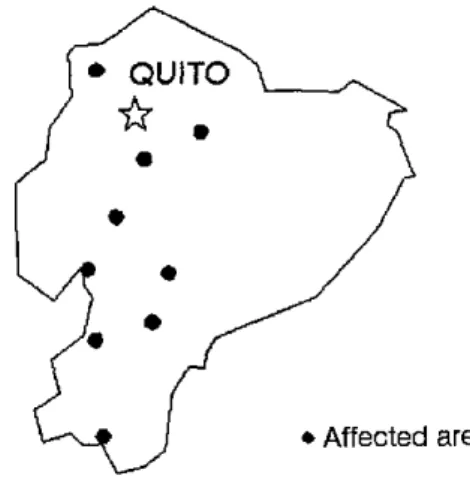
The epidemiological studies carried out so far indicate that the outbreak began in Ecuador on 28 February 1991. The average incubation period has been three days. As of 10 April 1991, a total of 2,489 cases had been reported, of which 682 have been confirmed, and 59 have died. The distribution by province is shown in Table 3 and the cholera affected areas are shown in Figure 5.
Table 3. Cumulative number of probable and confirmed cases and deaths from cholera, by province.
Ecuador, 28 February to 10 April 1991.
Province Probable Confirmed Deaths
Azuay 1 5
Chimborazo 42 12 16
El Oro 1,352 215 11
Esmeraldas 36 2
-Guayas 691 391 16
Imbabura 59 1 2
Loja 72 32 5
Los Ríos 235 21 8
Pichincha 1 3 1
Total 2,489 682 59
Figure 5. Cholera affected areas in Ecuador.
.
* Affected areas
Geographical Distribution
The outbreak began in Campamento La Puntilla, Bajo Alto Commune, El Guabo Canton, in El Oro Province on the Pacific Coast, which is located a few kilometers from the Peruvian town of Túmbez. The commune has a population of approximately 1,800, who live in poor socioeconomic conditions. Basic sanitation is precarious due to the lack of drinking water, latrines, and excreta disposal, plus widespread hawking of food and beverages without any hygienic control.
Secondary cases occurred in neighboring Machala, Santa Rosa, Arenillas, El Guabo, and Guayaquil. Carriers with mild symptomatology
had fled to these places during the first hours when they began to suspect cholera. They had been aware
of its symptoms because of the intense dissemina-tion of preventive measures by the health authorities.
The secondary cases were rapidly located by the surveillance system that had been set up in the country. Chemoprophylaxis with tetracycline was given to household contacts. In the city of Machala, capital of El Oro Province, the cases reached the population on the urban outskirts.
Characteristics of the Cases
The majority of cases (83.6%) have been in the over-15 age group, primarily affecting men
(74.8%). In terms of occupation, the attack is con-centrated in a group who gather shrimp larvae along the Pacific coast.
Thanks to the prompt attention given to the patients, the case fatality rate has been low; 59 deaths have been reported up to 10 April 1991.
8
Hypothesis
The characteristics and spread of the outbreak suggest a common source of contamination of hydric origin, located in Campamento La Puntilla, where the presence of fecal matter and Vibrio cholerae was confirmed in a septic tank built very near a well that overflowed at high tide and con-taminated the drinking water supply. In the first group of patients, all had drunk from this well.
The disease was then spread via contaminated seafood which, despite an intensive public health campaign, the patients had continued to eat raw,
claiming that it was difficult to get fuel to cook their food and boil their water.
It is believed that the Vibrio cholerae contamina-tion in Bajo Alto originated with larvae gatherers coming from Túmbez (Peru), a region that had reported cholera two weeks earlier. According to the people living in Bajo Alto Commune, since it was the laying season, a large number of Peruvian fishermen and vendors had come to the La Puntilla beaches to collect shrimp larvae. The hygienic con-ditions had been deplorable: defecation in the open, lack of drinking water, and very poor makeshift shelter consisting of cardboard, tin, or plastic sheets propped up with sugarcane stalks-the only hous-ing available for the larvae-gatherers and their
families.
Health Sector Response
Ever since the outbreak was identified, the health authorities have insisted on the following measures:
- Outfitting of rooms in hospitals and health centers to accommodate patients.
- Distribution of oral rehydration salts and drugs to use for control (parenteral solutions, an-tibiotics) in the event of an epidemic.
- Immediate treatment of patients with oral rehydration salts, intravenous hydration (in pre-shock), and administration of tetracycline 500 mg every 6 hours for 4 consecutive days. - Coordination with municipal councils and water
boards to guarantee adequate chlorination of drinking water sources.
- Provision of chlorine to the populations at greatest risk.
- Formation of health brigades for environmental sanitation and vector control.
- Sanitary surveillance of food and beverages. - Design of special forms to be used by the
attend-ing physicians.
- Meetings, round tables, and talks to health per-sonnel on the clinical and epidemiological aspects of cholera.
- Broad dissemination of messages in the com-munity (leaflets, instructions, bulletins) on cholera prevention and hygienic measures that the population should take.
- Educational household interviews in the affected sectors.
- Public information and education through press, radio, television, and direct personal contact in the community.
- Dispatch of epidemiological teams to investigate the problem on site.
- Creation and implementation of epidemiological control in the Provinces of El Oro, Loja, and Zamora Chinchipe.
- Reporting to the Ministry of National Defense on control in ports and airports.
Cholera Cases in Colombia
The Colombian Health Ministry's National Institute of Health confirmed the country's first case of cholera on March 10 with the isolation of Vibrio cholerae 01, El Tor, Inaba. The patient was an adult man from a community on the banks of the Mira River, 20 km south of Tumaco in Nariño Department, near the border with Ecuador.
The epidemiological investigation of the case revealed that the patient had not traveled outside his home area, nor had he received visitors from outside the country.
The water that the patient drank came from a source pipe upstream from the treatment plant.
Thirty specimens taken from the patient's personal contacts, and from water and food he consumed, have all been negative for cholera.
On February 7 Colombia's Minister of Health established the National Committee for Epidemiological Surveillance of Cholera. Coor-dinated by the Director of the National Institute of Health, the Committee includes: the Office of Disaster Preparedness and Relief, Presidency of the Republic; and, within the Ministry of Health, the Directors of Medical Care, Epidemiology, En-vironmental Sanitation, Direct Campaigns, and Community Participation, and the Chief of the Office of Disaster Preparedness. The Committee has formulated a strategy for public education, prevention, control and treatment of cholera cases. In response to the first reported case, surveillance was stepped up in the area, and a plan for public education was put into effect. In addition, the