Since publication of the previous update, cholera cases have been identified in three more countries of the Region-Guatemala, El Salvador, and Bolivia
(EpidemiologicalBulletin, Vol. 12, No. 2, 1991). From the beginning of the epidemic in Peru at the end of January, cholera has attacked a country a month: Ecuador in February, Colombia in March, Chile in April, Brazil in May, Mexico in June, Guatemala in July, El Salvador in August, and, most recently, Bolivia.
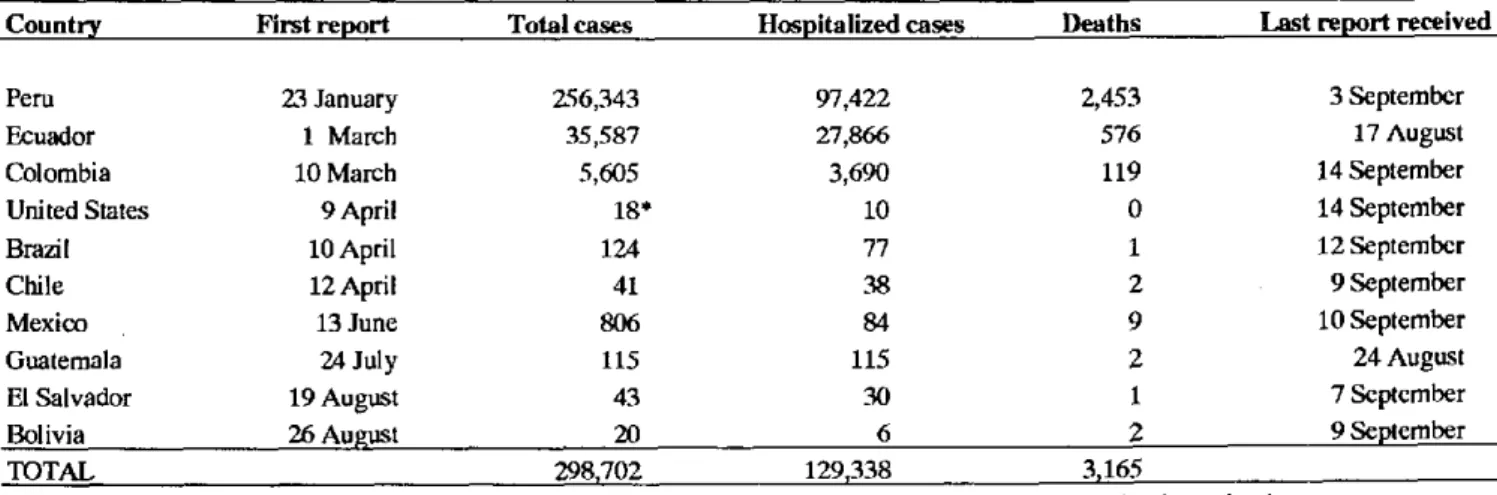
Table 1 shows the total number of cases reported to PAHO as of 14 September 1991 was 298,702, with 3,165 deaths. This number is more than four times the total number of cholera cases reported worldwide in 1990.
Guatemala. Vibrio cholerae 01, El Tor, Inaba, was isolated during the third week of July 1991 from the stools of a Guatemalan male from San Marcos Department, on the Mexican Border.
During the first three weeks of the epidemic the rural population was the most affected, as 98% of suspected and confirmed cases are from small villages in the west of the country. The first cases in the capital were reported during the second week of August.
From the start of the epidemic all ages were affected. At the Tecun Uman Health Center, San Marcos Department, during the first two weeks of the epidemic a total of 48 cases were registered, of which only 28 were over 5 years of age (58%). Twenty-one of the 48 cases (44%) were among females. The age and sex distributions were similar in the other three departments
affected. Clinical manifestations predominant among the first confirmed cases in the Coatepeque Hospital were liquid stools (93%), dehydration (80%), vomiting (73%), exhaustion (67%) and cramps (47%).
Preliminary investigations in relation to forms of transmission found Vibrio cholerae in the Suchiate River, on the sourthern Mexico-Guatemala border, and in food sold by street vendors, specifically beverages in Tecun Uman. Several case-control studies indicate that well waterand foods for home consumption, cooked but eaten while no longer hot, might also have been sources of infection. Coliform contamination of the piped water supply available to affected populations has been shown, as well as insufficient concentration of chlorine in relation to recommended levels.
During the first two weeks of the epidemic, case management was primarily hospital-based, generally with use of intravenous fluids; 85% of the cases in San Marcos Department were hospitalized in Coatepeque Hospital. Tetracycline and trimethoprim/ sulphamethoxazole have been the antibiotics most
frequently used for treatment of patients.
Care was gradually decentralized by providing in-service training at other levels, and community centers are being organized. In addition, norms have been updated and technical documents and educational materials for the community have been prepared and distributed. Actions to guarantee a safe water supply and to promote healthy habits to prevent disease are being emphasized.
Table 1. Cholera cases and deaths reported in the Americas.
Country First report Total cases Hospitalized cases Deaths Last report received
Peru 2.3 January 256,343 97,422 2,453 3 September
Ecuador 1 March 35,587 27,866 576 17 August
Colombia 10 March 5,605 3,690 119 14 September
United States 9 April 18* 10 0 14 September
Brazil 10 April 124 77 1 12 September
Chile 12 April 41 38 2 9 September
Mexico 13 June 806 84 9 10 September
Guatemala 24 July 115 115 2 24 August
El Salvador 19 August 43 30 1 7 September
Bolivia 26 August 20 6 2 9 September
TOTAL 298,702 129,338 3,165
*15 related to travel to Latin America, 2 to travel in other regions, and one of undetermined origin, pending investigation.
11
-Adoption of a clear definition of what constitutes a cholera case has been a concern of national authorities. This definition should be the basis of the system for case reporting, to collect data on the cholera situation in the different levels of the health services. In addition, efforts are being made to include data on cases attended outside the institutional health services system. This component is deemed to have sizable magnitude, given the characteristics of the clinical presentation of cholera and the low health services coverage in Guatemala.
A total of 115 confirmed cholera cases have been reported through the third week of August 1991. The affected departments are San Marcos, Suchitepéquez, Retalhuleu, Guatemala, Quetzaltenango, Sololá and Escuintla.
In El Salvador the first two cases of cholera were reported on 16 and 21 August. Both patients were indigent men living in Colonia Esmeralda, Barrio San Jacinto, in the capital city, San Salvador. Neither had a history of having traveled outside the area. The laboratory isolated Vibrio cholerae 01, El Tor, Inaba from the feces of both patients. Since the first reported cases, there have been a total of 43 cases and one death, all occurring in the metropolitan region (14 neighborhoods) and surrounding area (Zacatecoluca).
Bolivia reported the occurrence of four cholera cases confirmed by laboratory on 27 August. All the patients were adult residents of two communities located along the Choqueyapu River in the Río Abajo region, 20 km south of La Paz. As of 9 September, 20 additional cases had been reported, from the Rio Abajo and El Alto regions, and one death in the El Alto region, near La Paz. Peru. Until the end of August, the cholera epidemic had affected at least 1.5% of the country's population. During that month the incidence fell to 1,200 cases per week, as compared to 15,000 to 20,000 weekly cases reported in February 1991. Intense transmission of the disease is reported to continue in remote Departments, such as Loreto. Case fatality in this Department is 2.8%, compared to 0.5% in the areas of the Coast.
In Ecuador the provinces most affected during the month of August were Esmeraldas, El Oro and Guayas. The average number of reported cases per week in the country during July and August was 800 compared to 300 reported in the first 30 days of the epidemic.
In Colombia cholera has spread to the departments of Santa Fe de Bogota, Antioquia, Bolivar and Risaralda,
with 3,006 additional cases reported since the last update.
Mexico. The last report on the cholera situation O
covers the period up to 10 September. From 28 June to that date, 779 additional cases were reported by the states of Mexico, Hidalgo, Veracruz, Puebla, Chiapas, Campeche, Tabasco, and the Federal District.
Cholera in Brazil continues to be confined basically to the State of Amazonas. As of the last report received, cases had occurred in the municipalities of Jutai, Atalaia do Norte, and Sáo Paulo de Olivenga (in Medio Solimóes), in addition to Tabatingá and Benjamin Constant. An isolated case was reported in the State of Mato Grosso and an imported case was registered in the city of Sáo Paulo. No associated cases were registered. Brazil reported 106 cases during the period 30 June-12 September compared to 18 reported cases in the two previous months. In this country cholera cases are considered to be only those confirmed through laboratory identification of V. cholerae 01, El Tor, Inaba.
In the United States of America, four cases of cholera have been identified in addition to the fourteen previously reported in 1991. All were imported, two of them from other regions of the world (Cambodia and India) and two from Latin America (Ecuador). No secondary cases of transmission have been registered
*
within the country.In Chile the epidemic has ceased, the last case having been reported on 22 May of this year.
In assessing the situation in the Region on the basis of data reported by the aforementioned countries, it should be borne in mind that clinical manifestations of
V. cholerae 01 infection have ranged from asymptomatic infections (75%) and mild diarrhea up to the severest clinically identifiable forms (5%).
Given the evolution of the cholera epidemic in Latin America over the past seven months, both in terms ofits magnitude and the way in which it has spread, it is feared that the disease may extend to other countries in coming months and become endemic in some areas of the Region. It is therefore essential that all the countries take steps to prepare for a possible attack of cholera and formulate or review their national plans for contending with this disease.
(Source: Information from country reports consolidated by the Health Situation and Trend
Assessment Program, PAHO.)
o
12