11
1a
ISSN 0256-1859
Printed on acid-free paper Vol. 12 No. 1, 1991
Cholera Situation in the Americas
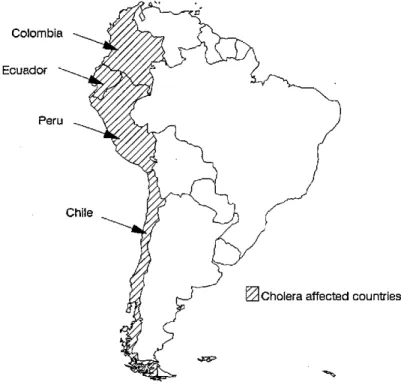
Between February and 20 April 1991 there have been confirmed cases of cholera in Peru, Ecuador, Colombia and Chile (Figure 1), thus adding the American Hemisphere to the list of regions to which the seventh pandemic has spread since 1961. The prognosis for the course in the epidemic in the affected countries and in other countries of the Region is guarded, since it is impossible to prevent the transmission of cholera from one country to another. The living conditions of the population are a crucial factor in determining the intensity and manner in which cholera epidemics spread, and at this time in the Region the majority of the people are living in marginal conditions. Preparedness for dealing with the situation necessarily involves the medical, environmental, educational, and
economic aspects of the problem.
The present issue of the Epidemiological Bul-letin, devoted exclusively to cholera, is part of the Pan American Health Organization (PAHO) effort to disseminate technical information on this sub-ject. Through the Bulletin and other mechanisms, information is being distributed on the occurrence of the disease in the affected countries. At the same time, the updating of personnel is being promoted
INDEXED
Figure 1. Countries affected by cholera outbreak.
South America, through 20 April 1991.
Colombia
Ecuador
Peru-[ Cholera affected countries
IN THIS ISSUE...
· Cholera Situation in the Americas
* Historical Background of Cholera in the Americas * Epidemiological Surveillance of Cholera
* Clinical Diagnosis and Treatment of Cholera Cases
* Laboratory Diagnosis of Cholera * Environmental Health, Prevention
and Control of Cholera
* Risk of Transmission of Cholera by Foods
1
through the provision of current guidelines for the prevention, control, and treatment of cholera.
In addition, PAHO is providing direct technical assistance to the countries; promoting the in-ser-vice training of personnel, especially laboratory
personnel; participating in the coordination of as-sistance from international agencies; and facilitat-ing the countries' procurement of supplies and equipment for laboratories and other health services.
r
-t Cholera Epidemic in Peru
- lhTD.,
XED
Since January 23, 1991, Peru has suffered a seventh pandemic of cholera which began in 1961. severe cholera epidemic marked by high morbidity The genetic studies that make it possible to estab-and wide geographical extension. The first cases lish this relationship were carried out by the United were reported in Chancay, a town on the Pacific States Centers for Disease Control.
coast in the environs of Lima, and almost simul- Since it is impossible to perform bacteriological taneously, in Chimbote, another coastal town lo- tests on all patients, the epidemiological monitor-cated 400 kms north of Chancay. In both places ing requirements established by the Ministry of there was an increase in the number of adults Health for the health services call for reporting seeking medical care for acute diarrhea. Since cases of acute diarrhea. These are considered prob-cholera was suspected, the National Institute of able cases of cholera.
Health was authorized to do the appropriate Figures 3 and 4 show the tally of reported cases, laboratory studies, resulting in the rapid isolation hospitalized cases and deaths due to acute diarrheal of the causal agent. disease in the country from the start of the epidemic
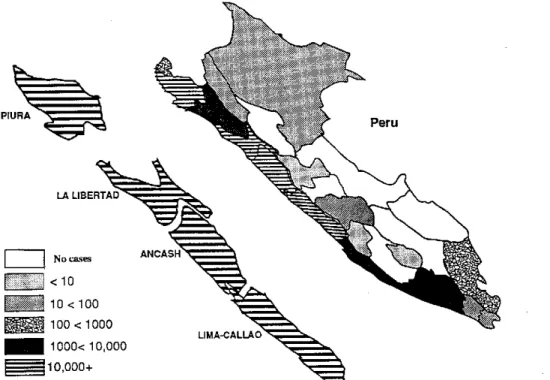
Over the next few days cases were reported in the until March 20, 1991.
cities of Piura and Lima, and then in other localities The laboratory at the Health Ministry's National on the coast or near it (Figure 2). It was noteworthy Institute of Health isolated the cholera agent in the that the disease appeared almost simultaneously in feces of patients from each of the affected communities located along a 1,200 km length of localities. Once this confirmation was obtained, coastline. The mountain and tropical forest regions epidemiological monitoring was carried out to as-also have been affected, approximately 16 and 29 sess the extent of the disease in the affected area. days respectively after the start of the epidemic. The distribution of cases by age group cor-The agent isolated from the feces of patients in the roborates the diagnosis of cholera. The data on age affected areas is the Vibrio cholerae, serovariant come from a survey carried out in Chancay during 01, biotype El Tor, serotype Inaba. It is considered the first weeks of the epidemic, in which it was quite probable that this epidemic forms part of the noted that 81% of the patients were five years old
Figure 2. Areas affected by cholera outbreak, by Department, Peru, through 20 March 1991.
PIURA
Peru
LA
| No cases
M L::i< 10
L 10<100
. 100 < 1000 1000< 10,000 1I 10,000+
.
2