Cardiogenic shock associated with subarachnoid
hemorrhage
Choque cardiogênico associado à hemorragia subaracnóidea
INTRODUCTION
Subarachnoid hemorrhage (SAH) is a challenging clinical condition, its incidence ranging according to the country (2 cases/100,000 inhabitants in China to 22.5 cases/100,000 inhabitants in Finland). he most afected age range is between 40 and 60 years-old, but this condition may afect from children to elderly adults. he hospital mortality rates range between 33% and 45%.(1-3)
SAH is frequently associated with systemic complications such as pul-monary edema, sodium disorders and deep venous thrombosis.(2,4) Among
the cardiovascular changes, may be found electrocardiographic signs (50-90% of the cases), increased heart enzymes, and global or partial contractile
Glauco Adrieno Westphal1, Gerson
Costa2, Sérgio Gouvêa3, Keitiane
Michele Kaefer4, Rodrigo Soares da
Silva4, Milton Caldeira Filho1
1. PhD, Physician of the Hospital Municipal São José - Joinville (SC), Brazil.
2. Physician of the Hospital Municipal São José - Joinville (SC), Brazil. 3. Physician of the Hospital Municipal São José - Joinville (SC), Brazil. 4. Resident Physician of the Intensive Care Unit of the Hospital Municipal São José - Joinville (SC), Brazil.
ABSTRACT
Systemic complications are frequent in subarachnoid hemorrhage patients. Among these complications, electro-cardiographic abnormalities simulating ischemic cardiomyopathy may occur, possibly associated with myocardial dys-function. his manuscript aims to report a case of subarachnoid hemorrhage asso-ciated with myocardial dysfunction and cardiogenic shock. A 45 years old woman was admitted with subarachnoid hemor-rhage and coma, showing Glasgow scale = 7, Hunt-Hess = 5 and Fischer computed tomography classiication = 3. On the sec-ond day, the patient underwent anterior cerebral communicant artery aneurysm embolization. he clinical evaluation revealed difuse pulmonary iniltration, dyspnea and hypotension. Additional tests showed electrocardiographic lateral wall repolarization changes and elevated creatine kinase-MB fraction (36U/L). he cardiac index was 2.03 L/minute/
m², Vascular systemic resistance was 3728 dynes.sec/cm². he non-responsiveness to volume demonstrated a cardiogenic shock pattern. he ventricular ejection fraction was 39%. he coronariography was normal, showing no obstructive le-sions. Six days later the patient was re-moved from respiratory support and af-ter eight days the dobutamine infusion was discontinued. he ejection fraction recovered up to 65%. Serial transcranial Doppler evaluations did not show vascu-lar spasm. After ten days the patient was discharged form the intensive care unit. Patients with subarachnoid hemorrhage may be complicated with ventricular dys-function and cardiogenic shock, increas-ing the cerebral ischemia risk. Diagnosis optimization and hemodynamic stabili-zation are essential to minimize the risk of cerebral vasospasm and ischemia.
Keywords: Subarachnoid hemorrhage/
etiology; Shock, cardiogenic; Heart failure; Cardiomyopathies; Case reports
Received from the Intensive Care Unit of the Hospital Municipal São José - Joinville (SC), Brazil.
Submitted on February 24, 2010 Accepted on July 8, 2010
Author for correspondence:
Glauco Adrieno Westphal
Rua: Oscar Schneider, 237 – Bairro Atiradores
Zip Code: 89203-040 - Joinville (SC), Brazil.
Phone: (47) 9964-2295
dysfunction mimicking ischemic heart disease which may result in cardiogenic shock. Herein we report on a SAH case with severe ventricular dysfunction and car-diogenic shock.(3,5-7)
CASE REPORT
A previously healthy 45 years-old woman lost con-sciousness suddenly while riding a bicycle. She was ini-tially seen by paramedics and had Glasgow = 7, non-measurable blood pressure (BP), cold skin, heart rate (HR) = 126 beats per minute (bpm) and respiratory frequency (RF) = 10 movement per minute (mpm).
Upon arrival to the emergency room she had Glasgow grade 5, BP 98/66, HR 70 bpm, arterial oxygen satura-tion (SaO2) 85%. After orotracheal intubasatura-tion, the ar-terial oxygen saturation (SaO2) was improved, however a large amount of pink and foamy secretion came out from the orotracheal tube, suggesting acute pulmonary edema. he chest radiography showed difused pulmo-nary iniltrate (Figure 1) and the electrocardiogram had sinusal rhythm, prolonged QT and lateral wall re-polarization changes (Figure 2). CK-MB was 36 U/L (normal range up to 16 U/L). Metabolic acidosis was identiied, with lactate 2.1 mmol/L (normal range up to 1.6 mmol/L).
Head computed tomography showed difusely corti-cal sulci stretching, hyperdense basal cisterns, Silvian sulcus and inter-hemispheric clouding (Fisher’s tomog-raphy classiication = 3) (Figure 3). he Hunt-Hess clinical classiication was grade 5. In the second
hos-pital day the patient underwent cerebral arteriography showing a bilobar saccular aneurysm in the anterior communicant artery measuring about 5x4 mm (Figure 4). During the test she had mechanic vasospasm, which improved following intra-arterial nimodipine. he an-eurysm was embolized with 4, 3 and 2 mm platinum microcoils. Following the endovascular procedure and
Figure 1 – Chest X-ray evidencing difuse pulmonary inil-tration.
Figure 2 – Admission electrocardiogram. Sinusal rhythm, inverted T wave on DI and aVL leads, and enlarged QT interval.
day. She had then Glasgow 15 and transcranial Dop-pler showed no vasospasm. On the eighth hospital day, a new echocardiogram showed EF 65%, and mild to moderate difused hypokinesia. Dobutamine was then weaned of.
On the eleventh day, the consciousness level was re-duced (Glasgow 13). he head computed tomography (CT) showed mild hydrocephaly, no bleeding, and no medium line deviation. No vasospasm on transcranial Doppler was found, and conservative measures were adopted.
With complete neurological recovery, the patient was discharged from the ICU on the fourteenth day.
DISCUSSION
Heart changes overall afect 39% to 63% of SAH patients. Many of them have most severe presentations, remaining the heart lesion pathophysiology unclear.
Autopsies in SAH subjects have shown no corre-lation between SAH-associated electrocardiographic changes and relevant either coronary or myocardium disease. Additionally, other studies have concluded that these ventricular function changes are generally re-vertible, thus suggesting a non-ischemic “hibernating myocardium”.(7) Some hypothesis were proposed to
jus-tify the SAH-associated heart dysfunction, as coronary
Figure 4 – Digital angiography evidencing saccular aneu-rysm in the anterior communicant artery.
consciousness improvement, the patient was extubated and referred to the intensive care unit (ICU). Dyspneic, she required non-invasive ventilatory support (NIV). he electrocardiographic (ECG) changes were main-tained, and the transthoracic echocardiogram showed lateral-dorsal wall akinesia and hypokinesia.
In the third day she had Glasgow 15, with no fo-cal deicits. he ventilatory pattern worsened, and orotracheal plus controlled mechanic ventilation was required. She involved with volume-refractory hypo-tension (80/40). Intravenous norepinephrine infusion was started. Daily transcranial Doppler showed no vasospasm or signiicant efects on cerebral low, even during hypotension.
he respiratory arterial pulse changes (ΔPp = 7%) showed the patient to be volume unresponsive. he low cardiac index (2.03 L/min/m2) and increased systemic
vascular resistance (3728 dynes.sec/cm5/m2) evidenced
a hemodynamic pattern of cardiogenic shock. A new transthoracic echocardiogram showed lateral-dorsal akinesia, severe left ventricular function impairment, ejection fraction (EF) 39% and venous congestion signs. Evident improvement of hemodynamic param-eters was seen after dobutamine start and gradual nor-epinephrine weaning.
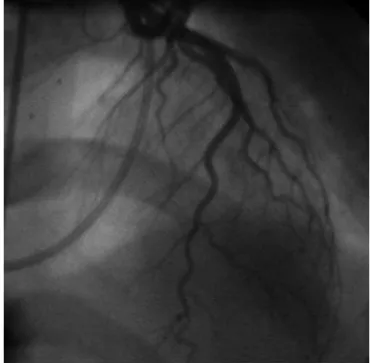
Heart catheterization on the ifth hospital day showed no coronary arteries obstructive lesions, left ventricle with moderate to severe hypokinesia, and un-changed thoracic aorta (Figure 5).
he patient was extubated on the sixth hospital
thrombosis, coronary spasm, secondary to hypertension myocardial oxygen ofer and consumption unbalance, and tachycardia. Also it is believed that a post-SAH myocardial injury comes from a combination of neu-ral and hormonal mechanisms. he cathecolamines re-lease intensity is strongly correlated with SAH patients’ heart complications. Also, cardiac lesions histopathol-ogy doesn’t have a ischemic pattern, and is associated to sympathetic nerve terminations in the heart. Excessive norepinephrine release from these nerve terminations result in vascular constriction followed by subendocar-dial necrosis.(6)
SAH-associated cardiovascular dysfunction diagno-sis is based on hemodynamic changes, electrocardiogra-phy, echocardiography and cardiac biomarkers testing. SAH-associated electrocardiographic changes in-clude heart arrhythmias, ST segment elevation or de-pression, T wave inversion, pathologic Q waves, and QT interval changes. These changes have no defined prognostic value, and are found in most of the pa-tients.(6,7)
Cardiac biomarkers such as CK-MB and troponin I elevation have been seen in about 40% of SAH pa-tients. hese changes are often related to echocardio-graphic changes, increased cardiovascular risk, late ce-rebral ischemia and poorer prognosis.
Abnormal myocardial function is frequently (10% to 31%) seen in SAH patients echocardiography. hese contraction changes may be either global or segmental, without conirmed concomitant coronary disease either by necropsy or coronariography.
Our patient had severe ventricular dysfunction and cardiogenic shock associated with the previously described electrocardiographic, enzymatic, echocar-diographic and angiographic features. he SAH sever-ity, characterized by the clinical (Hunt-Hess = 5) and tomographic (Fisher = 3) signs was itself a high risk condition for cerebral vasospasm and ischemia.(1) he
association of low cardiac output has severely wors-ened the cerebral hypolow and ischemia risk.(1,8) he
hemodynamic support therapy associated with cerebral blood low monitoring with transcranial Doppler likely
contributed to cerebral ischemia prevention.
Finally, in SAH patients a ventricular dysfunction may be present, plus severe overall blood low and ce-rebral blood low impairment, and increased cece-rebral ischemia risk. hus, early attention should be given to this diagnosis possibility, and to the hemodynamic optimization requirements, aiming to minimize vaso-spasm and ischemia risks.
RESUMO
Complicações sistêmicas são vistas frequentemente em indi-víduos acometidos por hemorragia subaracnóidea. Dentre estas alterações podem ocorrer anormalidades eletrocardiográicas que simulam miocardiopatia isquêmica que podem ou não estar associadas com disfunção miocárdica. O objetivo deste é relatar um caso de associação de hemorragia subaracnóidea com dis-função miocárdica e choque cardiogênico. Mulher de 45 anos foi internada com quadro de coma secundário a hemorragia su-baracnóidea. À admissão apresentava Glasgow = 7, Hunt-Hess = 5 e classiicação tomográica de Fisher = 3. O aneurisma ce-rebral de artéria comunicante anterior evidenciado pela arterio-graia cerebral foi embolizado com sucesso no segundo dia de internação. Evoluiu com dispnéia e iniltrado pulmonar difuso. Havia alteração da repolarização ventricular em parede lateral, aumento da CK-MB (36 U/L) e hipotensão. O índice cardíaco de 2,03 L/min/m2, a resistência vascular sistêmica 3728 dynes.
seg/cm5/m2, e a irresponsividade a volume evidenciavam o
pa-drão hemodinâmico de choque cardiogênico. A fração de ejeção do ventrículo esquerdo era de 39%. A cineangiocoronariograia não apresentava lesões coronarianas obstrutivas. Após 6 dias a paciente foi extubada e ao oitavo dia foi possível a retirada com-pleta da dobutamina. A fração de ejeção passou a 65%. Sucessi-vos exames de Doppler transcraniano não apresentaram vasoes-pasmo. A paciente recebeu alta da unidade de terapia intensiva no décimo quarto dia. Pacientes com hemorragia subaracnóidea podem apresentar disfunção ventricular e choque cardiogênico, aumentando o risco de isquemia cerebral. O diagnóstico e a oti-mização hemodinâmica são essenciais para minimizar os riscos de vasoespasmo e isquemia cerebral.
Descritores: Hemorragia subaracnóidea/etiologia; Choque
cardiogênico; Insuiciência cardíaca; Miocardiopatias; Relatos de casos
REFERENCES
1. Bederson JB, Connolly ES Jr, Batjer HH, Dacey RG, Dion JE, Diringer MN, Duldner JE Jr, Harbaugh RE, Patel AB, Rosenwasser RH; American Heart Association. Guidelines for the management of aneurysmal subarachnoid
hemorrhage: a statement for healthcare professionals from a special writing group of the Stroke Council, American Heart Association. Stroke. 2009;40(3):994-1025. Erratum in: Stroke. 2009;40(7):e518.
1997;336(17):1267.
3. Kothavale A, Banki NM, Kopelnik A, Yarlagadda S, Lawton MY, Ko N, et al. Predictors of left ventricular regional wall motion abnormalities after subarachnoid hemorrhage. Neurocrit Care. 2006;4(3):199-205.
4. Suarez JI, Tarr RW, Selman WR. Aneurysmal subarachnoid hemorrhage. N Engl J Med. 2006;354(4):387-96. 5. Lee HC, Yen HW, Lu YH, Lee KT, Voon WC, Lai WT,
Sheu SHS. A case of subarachnoid hemorrhage with persistent shock and transient ST elevation simulating acute myocardial infarction. Kaohsiung J Med Sci.
2004;20(9):452-6.
6. Letsas KP, Gavrielatos G, Sideris A. Neurocardiogenic injury in subarachnoid hemorrhage. J Emerg Med. 2008;35(3):315-6.
7. Stevens RD, Nyquist PA. he systemic implications of aneurismal subarachnoid hemorrhage. J Neurol Sci. 2007;261(1-2):143-56.