ABSTRACT
BACKGROUND AND OBJECTIVES: Adequate postopera-tive pain evaluation and management are priorities for quality assistance, especially after neurological surgeries. his study ai-med at evaluating postoperative pain of neurosurgical patients submitted to unruptured brain aneurysm clamping.
METHODS: Prospective and descriptive study carried out in a charity hospital of the city of Aracaju, Sergipe, Brazil. Sample was made up of 28 patients submitted to elective craniotomy for unruptured brain aneurysm clamping. Mann-Whitney, Kruskal--Wallis and Dunn-Bonferroni tests were used for inferential analysis. Signiicance level was 5% throughout the study. RESULTS: Most patients (78.6%) were females, 64.0% had postoperative pain. here has been signiicant diference in the number of days with postoperative pain among patients with as-sociated comorbidities (p=0.04) and previous surgery (p=0.01). Most patients had moderate and throbbing headache. here were no adequate pain records and most frequent analgesics were simple analgesics. Opioids prescription was incipient.
CONCLUSION: Systematic pain evaluation should be part of multiprofessional assistance, in compliance with international and national pain institutions recommendations.
Keywords: Analgesia, Aneurysm, Nursing, Pain, Pain measurement.
Postoperative pain and analgesia in patients submitted to unruptured
brain aneurysm clamping
Dor pós-operatória e analgesia em pacientes submetidos à pinçamento de aneurisma cerebral
não roto
Míriam Geisa Virgens Menezes1, Caíque Jordan Nunes Ribeiro2, Flávio dos Santos Nascimento1, José Antonio Barreto Alves1, Alanna
Gleice Carvalho Fontes Lima2, Maria do Carmo de Oliveira Ribeiro1
1. Universidade Federal de Sergipe, Departamento de Enfermagem, Aracaju, SE, Brasil. 2. Universidade Federal de Sergipe, Programa de Pós-Graduação em Ciências da Saúde, Aracaju, SE, Brasil.
Submitted in April 26, 2016.
Accepted for publication in January 18, 2017. Conlict of interests: none – Sponsoring sources: none.
Correspondence to:
Av. Cláudio Batista, S/N - Bairro Sanatório 49060-108 Aracaju, SE, Brasil. E-mail: [email protected]
© Sociedade Brasileira para o Estudo da Dor
RESUMO
JUSTIFICATIVA E OBJETIVOS: Avaliação e manuseio adequa-dos da dor pós-operatória são prioridades para uma assistência de qualidade, sobretudo em cirurgias neurológicas. O objetivo deste estudo foi avaliar a dor pós-operatória de pacientes neurocirúrgi-cos submetidos a pinçamento de aneurisma não roto.
MÉTODOS: Estudo prospectivo e descritivo realizado em um hospital beneicente do município de Aracaju, Sergipe, Brasil. A casuística foi constituída por 28 pacientes submetidos a cra-niotomia eletiva para tratamento de aneurisma cerebral não roto por meio de pinçamento. Na análise inferencial foram utilizados os testes de Mann-Whitney, Kruskal-Wallis e Dunn-Bonferroni. Foi adotado nível de signiicância de 5% em todo o estudo. RESULTADOS: A maioria dos pacientes (78,6%) era do sexo feminino, 64,0% apresentaram dor no pós-operatório. Houve diferença signiicativa quanto ao número de dias com dor pós--operatória entre os pacientes que tinham comorbidades asso-ciadas (p=0,04) e cirurgia anterior (p=0,01). A maior parte dos pacientes apresentou cefaleia de intensidade moderada e pulsátil. Não houve registro adequado da dor nos prontuários, os analgé-sicos mais utilizados foram analgéanalgé-sicos simples e a prescrição de opioides foi incipiente.
CONCLUSÃO: A avaliação do fenômeno doloroso de forma sis-temática deve fazer parte da assistência multiproissional, conforme as recomendações de instituições nacionais e internacionais da dor. Descritores: Analgesia, Aneurisma, Dor, Enfermagem, Mensu-ração da dor.
INTRODUCTION
Pain is a subjective and multidimensional experience afecting most patients submitted to surgical procedures, especially in the postoperative period of aneurysm clamping1. It is a health
area challenge because it causes physical and emotional dis-tress resulting in physiologic impact adverse to several syste-ms, with repercussion on patients’ recovery and general well-being. Although being considered the ifth vital sign, it is still a poorly explored parameter in some health institutions2-4.
Efective pain control is patient’s right which should be as-sured to prevent postoperative complications and prolonged hospital stay3,5. In this sense, efective pain management exists
when measurement and evaluation are continuously and sys-tematically performed.
Nurses, as leaders, should play their role in controlling pain by means of evaluation and orientation to their teams about important aspects of adequate management, in addition to discussing with the multidisciplinary team when the analgesic treatment is not based on patient’s evaluation and on national and international guidelines1,6.
Although there are diferent scientiic evidences related to the efective management of postoperative pain, surgical patients still sufer with inadequate analgesic regimens7. Multimodal
analgesic therapy has its eicacy recognized for decreasing doses and adverse efects of certain drugs, especially opioids8.
On the other hand, the practice of oligoanalgesia is still fre-quent after craniotomy9.
he study is justiied by the need for looking for pain con-trol strategies for patients submitted to aneurysm clamping, respecting the premises of the International Association for the Study of Pain (IASP) and Single Health System (SUS) recommendations.
Our study aimed at evaluating postoperative pain of neuro-surgical patients submitted to aneurysm clamping analyzing the variables: location, intensity, duration, aggravating and mitigating factors, as well as at verifying pain records made by the health team on patients’ medical charts in the posto-perative period and the prevalence of pain during the irst post-craniotomy week.
METHODS
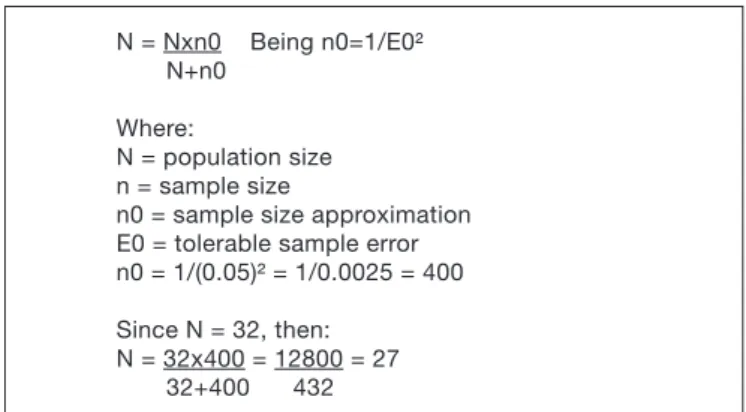
his is a prospective, descriptive and exploratory study with quantitative approach, carried out from September 2014 to May 2015, in the intensive care unit and neurosurgery sector of a charity hospital of the city of Aracaju, Sergipe, Brazil. Sample was made of 28 patients submitted to unrupted aneurysm clamping. After checking the number of patients submitted to craniotomy for aneurysm clamping between September 2013 and March 2014, it was observed that 32 craniotomies were performed for brain aneurysm. After this stage, sample size was calculated10 and has determined the
minimum number of 27 patients as shown in the following model (Figure 1).
Participated in the study patients above 18 years of age, sub-mitted to elective craniotomy due to unrupted brain
aneu-rysm, with Glasgow comma scale score (GCS) equal 15. Evolution to death at any follow-up moment was considered exclusion criteria. Included patients were evaluated in the irst seven postoperative days and/or until hospital discharge. Data collection form had data on patients’ socio-demographic and clinical proile. Additionally, there was information about pain presence, location and intensity after surgery, speciic questions on postoperative headache characteristics, adminis-tered analgesia, pain recording by professionals, in addition to pain numeric visual scale (NVS).
Data were collected by means of patients’ medical charts se-lection. After this stage, documental analysis was performed followed by interviews. Patients were evaluated from the irst to the seventh postoperative day and/or until hospital dis-charge, in cases when patients were discharged before the se-venth day.
Pain NVS was used to evaluate pain intensity. Patients were asked to inform pain site, to identify its intensity on the scale and to mention pain aggravating and mitigating factors, as well as headache characteristics.
Pain intensity was evaluated once a day, before and one hour after analgesic administration (routinely prescribed by institution’s assistant physician). Patients not receiving anal-gesia and/or not referring pain were also evaluated one hour after the irst evaluation and questioned about the presence of pain.
he study complied with recommendations of Resolution 466/2012, National Health Council, and all patients have signed the Free and Informed Consent Term (FICT).
his study was approved by the Ethics Committee, Univer-sidade Federal de Sergipe (CAAE: 32813114.8.0000.5546).
Statistical analysis
For descriptive analysis, variables were expressed by means of simple frequency and percentage (when categorical) or mean and standard deviation (when continuous or ordinal). Mann--Whitney test (for two independent measures), Kruskal-Wallis test (three or more independent variables) and Dunn-Bon-ferroni test (multiple comparisons) were used for inferential analysis. Signiicance level of 5% was adopted to the whole study and software was R Core Team 2015.
RESULTS
Participated in the study 28 patients submitted to aneu-rysm clamping, who were interviewed until the third pos-toperative day (POD). Along follow-up, 10 patients were discharged, remaining 18 patients evaluated until the se-venth POD.
Most patients were females (78.6%), aged ≥ 45 yeas (67.9%), married (53.6%) and without pathologic background (67.9%). Headache has prevailed in all patients. he num-ber of days with postoperative pain was signiicantly diferent among patients with associated comorbidities and those being submitted to surgery. Mean hospitalization time in the inten-sive care unit was 2.8 days (Table 1).
N = Nxn0 Being n0=1/E0² N+n0
Where:
N = population size n = sample size
n0 = sample size approximation E0 = tolerable sample error n0 = 1/(0.05)² = 1/0.0025 = 400
Since N = 32, then: N = 32x400 = 12800 = 27 32+400 432
Table 1. Socio-demographic data and number of days related to the presence of pain in the postoperative period of aneurysm clamping. Aracaju, SE, Brazil, 2015
Variables n % Pain
Number days Mean (SD)
p value % days
Mean (SD)
p value
Gender
Male 6 21.4 2.5 (1.8) 0.81* 36 (26) 0.57*
Female 22 78.6 2.7 (1.6) 44 (23)
Age
<45 9 32.1 2.8 (2.0) 0.81* 42 (28) 0.85*
>=45 19 67.9 2.6 (1.5) 43 (22)
Pathologic background
Diabetes and hypertension 3 10.7 4.7 (0.6)¶ 0.04** 71 (13)¶ 0.04**
Hypertension 6 21.4 1.8 (1.2)¶¶ 30 (16)¶¶
No background 19 67.9 2.6 (1.7)¶.¶¶ 42 (24)¶.¶¶
Previous surgery
Yes 13 46.4 1.9 (1.8) 0.02* 31 (25) 0.01*
No 15 53.6 3.3 (1.2) 52 (17)
*Mann-Whitney test, ** Kruskal-Wallis Test and ¶,¶¶Subgroups different from 5% for Dunn-Bonferroni test.
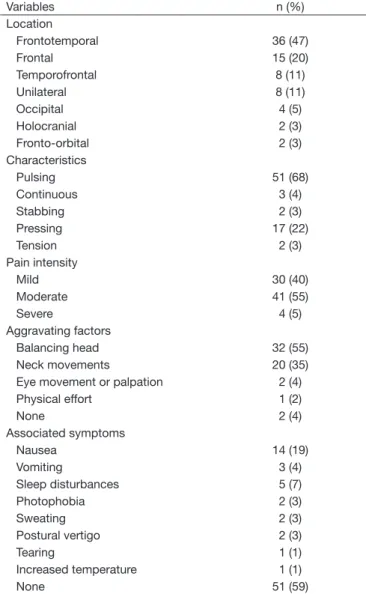
Table 2. Presence of postoperative headache according to location, characteristics, intensity, aggravating factors and associated symp-toms. Aracaju, SE, Brazil, 2015
Variables n (%)
Location
Frontotemporal 36 (47)
Frontal 15 (20)
Temporofrontal 8 (11)
Unilateral 8 (11)
Occipital 4 (5)
Holocranial 2 (3)
Fronto-orbital 2 (3)
Characteristics
Pulsing 51 (68)
Continuous 3 (4)
Stabbing 2 (3)
Pressing 17 (22)
Tension 2 (3)
Pain intensity
Mild 30 (40)
Moderate 41 (55)
Severe 4 (5)
Aggravating factors
Balancing head 32 (55)
Neck movements 20 (35)
Eye movement or palpation 2 (4)
Physical effort 1 (2)
None 2 (4)
Associated symptoms
Nausea 14 (19)
Vomiting 3 (4)
Sleep disturbances 5 (7)
Photophobia 2 (3)
Sweating 2 (3)
Postural vertigo 2 (3)
Tearing 1 (1)
Increased temperature 1 (1)
None 51 (59)
Among respondents, 64.0% had postoperative pain. Preva-lence of headache was higher in the irst POD and lower in the seventh (Figure 2).
Most patients had moderate, pulsing headache located in the frontotemporal (48.0%) and temporal (20.0%) regions. Ma-jor symptoms associated to this pain were nausea, vomiting and sleep disturbances (Table 2).
here has been postoperative pain in most follow-up days, however there has been no adequate pain recording on me-dical charts. Physicians were professionals more adequately recording pain, as compared to nurses. Simple analgesics were most widely used, with incipient prescription of opioids. Prescriptions “as needed” sufered a variation from 3.5% in the irst POD to 64.0% in the seventh POD (Tables 3 and 4).
Figure 2. Prevalence of postoperative pain after aneurysm clamping. Aracaju, SE, Brazil, 2015
POD = postoperative days.
Patients Pain prevalence (%).
DISCUSSION
Adequate analgesia and pain relief are patients’ unalienable rights, since after aneurysm clamping pain is one of the most prevalent symptoms. So, adequate pain management is cri-tical for postoperative recovery and early return to daily life activities.
Nursing professionals play a critical role in relieving pain of such patients because they are directly related to care throu-ghout the daily assistance cycle, being responsible for helping the choice of analgesics to be administered, when they accu-rately evaluate pain intensity referred by patients.
Results of our study have shown predominance of females. Such data conirm studies aiming at investigating pain pre-valence, intensity and recording in the irst week after
sur-gery11,12. Possible explanation for such results might be
as-sociated to gender diferences in terms of risk factors for cardiovascular diseases. Changes going on during females’ life cycle, related to hormonal modiications, might have contri-buted for the development of vascular changes, peaking with the formation of aneurysms.
Mean patients’ age was 47.6 years. Studies with patients sub-mitted to craniotomy had similar results9-11,13. Chronic,
non--communicable diseases are more frequent in the fourth de-cade of life. It is believed that the preventive access to health attention network, with early diagnosis and timely deinite treatment has prevented neurological complications, sequelae and health conditions impairment, thus favoring less hospita-lization days for such patients.
Most prevalent pain was moderate headache, being compati-ble with that described by other authors14-16. Another study
has shown that after surgical aneurysm treatment, there is hi-gher risk for developing headache17. Postoperative headache
is a common symptom in post-craniotomy patients, which requires a multidisciplinary approach aiming at decreasing neurological sequelae, hospitalization time and costs. In addi-tion, it may provide better quality of care and satisfaction for patients and their relatives.
Pulsing headache was the most prevalent presentation, with predominance of frontal and frontotemporal regions. A stu-dy investigating pos-craniotomy headache has observed that among most frequent characteristics there are those starting in the irst postoperative day, located at the same side and place of the surgical incision, and improving along the week18. Another
study analyzing the incidence of acute post-craniotomy pain has described pulsing headache as prevalent and has shown that pain intensity and location depend on surgical approach19. In
our study, supratentorial surgeries have prevailed. It is believed that pain location in the frontotemporal region is related to this type of approach and surgical incision location.
Moderate pain was the most prevalent, which requires the use of weak opioids associated to irst class opioids, as recommen-ded by the World Health Organization (WHO) analgesic lad-der. However, there has been inconsistency in the use of these drugs, which is in disagreement with IASP and WHO
premi-ses20,21. Similar data were obtained in other studies, where the
use of analgesics not providing adequate pain management has prevailed8,9,15,16.
Pain persistence may induce diferent neurovegetative and neu-rologic changes and decrease oxygen supply to tissues. So, it is necessary to adequately manage it to decrease such noxious efects. Inadequately treated acute pain may evolve to chronicity becoming a disease impairing daily life activities and needing a multidisciplinary approach to improve patients’ quality of life. Major pain-associated symptoms were nausea and vomiting. Similar results were found in recent studies aiming at eva-Table 3. Pain presence and recording in the postoperative period of aneurysm clamping. Aracaju, SE, Brazil, 2015
Variables Pain presence and recording n (%)
1stPOD 2ndPOD 3rdPOD 4thPOD 5thPOD 6thPOD 7thPOD
Pain
Yes 18 (64) 14 (50) 15 (54) 9 (36) 10 (42) 7 (32) 2 (11)
Professional recording
Nursing team 4 (50) 5 (71) 5 (71) 4 (100) 7 (100) 1 (50) 1 (100)
Physician 4 (50) 3 (43) 3 (43) 0 (0) 0 (0) 1 (50) 1 (100)
Table 4. Pain intensity and administered analgesics in the postoperative period of aneurysm clamping. Aracaju, SE, Brazil, 2015
Administered drug Pain intensity Mean (SD)
1stPOD 2ndPOD 3rdPOD 4thPOD 5thPOD 6thPOD 7thPOD
Simple analgesics 3.7 (2.5) 2.5 (1.9) 2.2 (2.6) 1 (1.6) 2.3 (3.9) 3 (2.2) 0 (0)
NSAIDs 4.1 (2.0) 2.3 (4.0) 0.8 (1.5) 0 (0) 1.3 (2.3) 9 (0) 2 (0)
Weak opioid 1.8 (2.0) 2.5 (3.3) 1.5 (3) 0.8 (1.3) 1.3 (2.3) 0 (0) 0 (0)
Strong opioid 0 (0.0) 0 (0) 0 (0) 3 (0) 0 (0) 0 (0) 0 (0)
Simple analgesics + NSAIDs 0 (0.0) 1 (1.7) 2.4 (2.2) 2.6 (2.8) 2.9 (3.1) 1.1 (1.8) 0.3 (0.9)
luating the incidence of nausea and vomiting in the posto-perative period of craniotomy22. Vomiting impairs patients’
neurosurgical recovery because there is intracranial pressure increase, with risks of brain hemorrhages as well as hydroelec-trolytic imbalance. So, health professionals should use syste-matic strategies to prevent such symptoms.
Another pain-associated symptom was sleep pattern chan-ges23. his disorder is related to fatigue, depression and
men-tal health disorders and may negatively relect on patients’ prognosis. So, adequate sleep may improve clinical recovery, decrease anxiety and excessive daily sleepiness.
Although there has been pain throughout the postoperative period, medical chart records were incipient. Recent studies have also observed this fact3,11,24. Physicians were professionals
who adequately recorded pain. As opposed, just one nurse has recorded pain. Documentation of health activities should be part of professional routine, taking into account ethical--medical support assurance. his data is worrisome because lack of records suggests precarious pain evaluation, thus unsa-tisfactory management.
Nurses should adequately evaluate and record pain, because when they have accurate measurements, they are able to iden-tify divergences with regard to established analgesic therapy, and to question the implementation of adequate analgesia25.
Prescription “as needed” (A/N) was present in many medical records. his prescription delegates to nurses the responsibili-ty of managing patients’ pain, because when there are several analgesics prescribed under this condition, the choice of the analgesic to be administered, in many situations, is performed by the nursing team25.
Systematic pain evaluation was not present in the study, sin-ce nursing team records just reported presensin-ce or absensin-ce of pain and simple analgesics were the prevailing option even in cases of moderate to severe pain25.
Due to the magnitude of the painful phenomenon, it is ne-cessary that health professionals be continuously updated to provide their team an efective ongoing education aiming at quality assistance15,26.
CONCLUSION
Most participants were females, with associated comorbi-dities such as hypertension and diabetes. Most prevalent pain was moderate and pulsing headache. Simple analge-sics were more commonly used and there has been under-reporting of pain.
REFERENCES
1. Ribeiro Mdo C, Pereira CU, Sallum AM, Alves JA, Albuquerque MF, Fujishima PA. Knowledge of doctors and nurses on pain in patients undergoing craniotomy. Rev Lat Am Enfermagem. 2012;20(6):1057-63. English, Portuguese, Spanish.
2. Zorowitz RD, Smout RJ, Gassaway JA, Horn SD. Usage of pain medications during stroke rehabilitation: the Post-Stroke Rehabilitation Outcomes Projects (PSROP). Top Stroke Rehabil. 2005;12(4):37-49.
3. Ribeiro MC, Pereira CU, Sallum AM, Martins-Filho PR, Nunes MS, Carvalho MB. Dor pós-operatória em pacientes submetidos à craniotomia. Rev Dor. 2012;13(3):229-34. 4. Saha P, Chattopadhyay S, Rudra A, Roy S. Pain after craniotomy: a time for
reapprai-sal? Indian J Pain. 2013;2(1):4-6.
5. Molnár L, Simon E, Nemes R, Fulesdi B, Molnár CJ. Postcraniotomy headache. J Anesth. 2014;28(1):102-11.
6. Barbosa TP, Beccaria LM, Beccaria RM, Pereira AM. Evaluation of postoperative pain experience in intensive care unit patients. Rev Bras Ter Intensiva. 2011;23(4):470-7. 7. Fanelli G, Berti M, Baciarello M. Updating postoperative pain management: from
multimodal to context-sensitive treatment. Minerva Anestesiol. 2008;74(9):489-500. 8. Gottschalk A, Yaster M. he perioperative management of pain from intracranial
sur-gery. Neurocrit Care. 2009;10(1):387-402.
9. Rahimi SY, Alleyne CH, Vernier E, Witcher MR, Vender JR. Postoperative pain ma-nagement with tramadol after craniotomy: evaluation and cost analysis. J Neurosurg. 2010;112(2):268-72.
10. Barbetta PA. Estatística aplicada às ciências sociais. 6a ed. Florianópolis: Editora da
UFSC; 2006.
11. de Oliveira Ribeiro Mdo C, Pereira CU, Sallum AM, Martins-Filho PR, Santana JM, da Silva Nunes M, et al. Immediate post-craniotomy headache. Cephalalgia. 2013;33(11):897-905.
12. Smitherman TA, Burch R, Sheikh H, Loder E. he prevalence, impact and treatment of migraine and severe headaches in the United States: a review of statistics from national surveillance studies. Headache. 2013;53(3):427-36.
13. Kim YD, Park JH, Yang S, Kim S, Hong JTK, Sung JH, et al. Pain assessment in brain tumor patients after elective. Brain Tumor Res Treat. 2013;1(1):24-7.
14. Ribeiro MC, Pereira CU, Sallum AM, Lopes JR, Alves JA, Carvalho MB. Las conse-cuencias del dolor en pacientes sometidos a craneotomía elective. Rev Chil Neurocir. 2012;38(2):105-9.
15. Fernández-Galinski DL, Gordo F, López GS, Pulido C, Real J. Conocimientos y ac-titudes de pacientes y personal sanitario frente al dolor postoperatorio. Rev Soc Esp Dolor. 2007;14(1):3-8.
16. Durieux M, Himmelseher S. Pain control after craniotomy: of balance on the tightro-pe? J Neurosurg. 2007;106(2):207-9.
17. Magalhães JE, Azevedo-Filho HR, Rocha-Filho PA. he risk of headache attri-buted to surgical treatment of intracranial aneurysms: a cohort study. Headache. 2013;53(10):1613-23.
18. Rocha-Filho PA. Post craniotomy headache: a clinical view with a focus on the persis-tent form. Headache. 2015;55(5):733-8.
19. Gray LC, Matta BF. Acute and chronic following craniotomy: a review. Anaesthesia. 2005;60(7):693-704.
20. International Association for Study of Pain (IASP). Consensus development conferen-ce statement: the integrated approach to the management of pain. Accid Emerg Med. 1994;6(3):491-2.
21. World Health Organization (WHO). Cancer pain relief: with a guide to opioid avai-lability. 2nd ed. WHO Library: Geneva; 1996.
22. Ryu JH, Lee JE, Lim YJ, Hong DM, Park HP, Han JI, et al. A prospective, rando-mized, double-blind, and multicenter trial of prophylactic efects of ramosetronon postoperative nausea and vomiting (PONV) after craniotomy: comparison with on-dansetron. BMC Anesthesiology. 2014;63(1):1-8.
23. Finan PH, Goodin BR, Smith MT. he association of sleep and pain: an update and a path forward. J Pain. 2013;14(12):1539-52.
24. Kiekkas P, Gardeli P, Bakalis N, Stefanopoulos N, Adamopoulou K, Avdulla C, et al. Predictors of nurses’ knowledge and attitudes toward postoperative pain in Greece. Pain Manag Nurs. 2015;16(1):2-10.
25. Peón AU, Diccini S. [Postoperative pain in craniotomy]. Rev Lat Am Enfermagem. 2005;13(4):489-95. Portuguese.