ABSTRACT
BACKGROUND AND OBJECTIVES:Headache is a major
symptom referred by patients with brain aneurysm. As other types of pain, it is often ignored by the multiprofessional team. Although important, headache evaluation in the preoperative period of brain aneurysm clamping is a challenge for the health team. his study aimed at evaluating preoperative headache of patients submitted to unrupted aneurysm clamping.
METHODS:his is a descriptive, exploratory and quantitative study carried out between September 2014 and May 2015 in the neurosurgery sector and the intensive care unit of a medium-sized hospital. Sample was made up of 28 patients in the pre-operative period of elective craniotomy to treat unrupted brain aneurysm. Mann-Whitney, Kruskal-Wallis and Fisher Exact tests were used with signiicance level of 5%.
RESULTS: It was observed that 78.6% of patients were females with mean age of 46.7 years. Moderate pulsing and frontal head-ache was the most prevalent pain. Nausea and vomiting were also present, as well as pain in the eye. Pain has worsened with physical efort and shaking the head. here has been statistically signiicant diference for the variables pain recurrence and pain in the eye.
CONCLUSION: his article clariies major items to be inves-tigated to evaluate headache of brain aneurysm patients and its characteristics to help early diagnosis and better neurologic re-covery.
Keywords: Analgesia, Aneurysm, Headache, Pain, Pain mea-surement.
Preoperative headache in patients submitted to unrupted brain
aneurysm clamping
Cefaleia pré-operatória em pacientes submetidos a pinçamento de aneurisma cerebral não roto
Míriam Geisa Virgens Menezes1, Caíque Jordan Nunes Ribeiro1, Lidiane Souza Lima1, Amanda Santos de Oliveira1, Mariangela da Silva
Nunes1, Maria do Carmo de Oliveira Ribeiro1
1. Universidade Federal de Sergipe. Aracajú, SE, Brasil.
Sumbitted in August 27, 2015.
Accepted for publication in January 22, 2016. Conlict of interests: none – Sponsoring sources: none.
Correspondence to:
Maria do Carmo de Oliveira Ribeiro Av. Cláudio Batista, S/N - Bairro Sanatório 49060-108 Aracaju, SE, Brasil. E-mail: [email protected]
© Sociedade Brasileira para o Estudo da Dor
RESUMO
JUSTIFICATIVA E OBJETIVOS: A cefaleia é um dos princi-pais sintomas referidos por pacientes com aneurisma cerebral. Como outras dores são, frequentemente, ignoradas pela equipe multiproissional. Apesar de importante, a avaliação da cefaleia no pré-operatório de pinçamento de aneurisma cerebral é um desaio para a equipe de saúde. O objetivo deste estudo foi avaliar a cefaleia pré-operatória em pacientes submetidos a pinçamento de aneurisma não roto.
MÉTODOS: Estudo descritivo, exploratório, de abordagem quantitativa, realizado entre setembro de 2014 e maio de 2015 no setor de neurocirurgia e na unidade de terapia intensiva de um hospital de médio porte. A casuística foi constituída por 28 pacientes no pré-operatório de craniotomia eletiva para o trata-mento de aneurisma cerebral não roto. Utilizaram-se os testes de Mann-Whitney, Kruskal-Wallis e Exato de Fisher e adotou-se nível de signiicância de 5%.
RESULTADOS: Demonstrou-se que 78,6% dos pacientes eram do gênero feminino com média de idade de 46,7 anos. A cefaleia pulsátil de localização frontal e intensidade moderada foi a dor mais prevalente. Náuseas e vômitos também estiveram presentes, assim como a dor no globo ocular. A dor piorou com o esforço físico e balanceio da cabeça. Houve diferença estatisticamente signiicativa para as variáveis: recorrência da dor e dor em globo ocular.
CONCLUSÃO: Este estudo esclarece os principais itens a serem investigados na avaliação da cefaleia do paciente com aneurisma cerebral e suas características a im de facilitar o diagnóstico pre-coce e a melhora antecipada na recuperação neurológica.
Descritores: Analgesia, Aneurisma, Cefaleia, Dor, Mensuração da Dor.
INTRODUCTION
Brain aneurysms (BA) are common and affect from 3 to 6% of world population above 30 years of age1. Severe
headache is a major symptom referred by BA patients2,3,
especially with unrupted BA4. As other types of pain, this is
a sensory, individual and untransferable experience often ignored by the health team. The reason for headaches has not yet been consistently explained, but it is believed that a possible mechanism is related to vascular distention caused by malformation in the walls of vessels involved with BAs5.
Factors such as anxiety and depression may interfere with the frequency and intensity of acute headache in the preoperative period of unrupted BA clamping. There are evidences that this pain significantly improves after surgical treatment. However, the mechanism for such improvement is not yet clear4.
Due to major negative repercussions of headache on the life of a person, adequate evaluation and management of this pain are critical for early clinical recovery6.
Notwithstanding its importance, headache evaluation in the preoperative period of unrupted BA is still a challenge for the health team and has to be better studied to establish adequate therapy, enhance neurological recovery and decrease patients’ distress.
In light of the above, this study aimed at evaluating preoperative headache in patients submitted to unrupted aneurysm clamping.
METHODS
This is a cross-sectional, descriptive, exploratory study with quantitative approach, carried out from September 2014 to May 2015, in the department of neurosurgery and the intensive care unit (ICU) of a middle-sized hospital in Aracaju, SE, Brazil.
Sampling technique was not probabilistic, by convenience and consecutive. Sample was made up of 28 BA patients. Inclusion criteria were age equal to or above 18 years, in the preoperative period of elective craniotomy to treat unrupted BA and Glasgow coma scale score equal to 15. Data were collected by selecting medical records of patients to be submitted to elective craniotomy to treat BA. Then, documents were analyzed and data collection form was filled. Included patients were interviewed the day before surgery.
Data collection form had two parts. The first had questions about socio-demographic profile. The second part had patients’ clinical data and information about pain: intensity, location and characteristics of preoperative headache, improving and worsening factors. There were also questions about analgesia. Numeric visual scale, or faces scale when patient had difficulty with the former, was used to measure pain.
Data were stored and processed by the R Core Team 2015 software. For descriptive analysis, variables were expressed in simple and percentage frequency (when categorical) or mean and standard deviation (when continuous or ordinal). Mann-Whitney test (for two independent means), Kruskal-Wallis test (three or more independent means) and Fisher Exact test (association) were used for inferential analysis. Significance level for the whole study was 5%.
This study has followed recommendations of Resolution 466/2010, of the National Health Council, and was approved by the Ethics Committee, Universidade Federal de Sergipe (CAAE: 32813114.8.0000.5546).
RESULTS
Participated in the study 28 BA patients. here has been pre-dominance of females (78.6%) and mean age was 47.6±11.2 years. Patients’ age has varied from 18 to 69 years, with higher frequency for ages above 45 years (67.9%).
With regard to clinical variables, it was observed that 21.4% of patients had previous diagnosis of arterial hypertension (AH) and 10.7% had AH associated to diabetes mellitus
(DM). When asked about the reason for looking for health services, all patients have referred sudden and severe head-ache. In 28.0% of cases, headache was associated to syncope and in 22.0% to impaired level of consciousness (Table 1). It has been identiied that 64.3% of patients used simple anal-gesics at home to relieve pain. hese drugs are not systemati-cally self-administered.
Previous surgeries were reported by 46.4% of patients, of whom 30.7% had already been submitted to previous aneu-rysm clamping. It has to be stressed that one patient has re-ferred being submitted to craniotomy due to brain trauma. In addition, 21.4% have reported family history of neurological surgeries (Table 1).
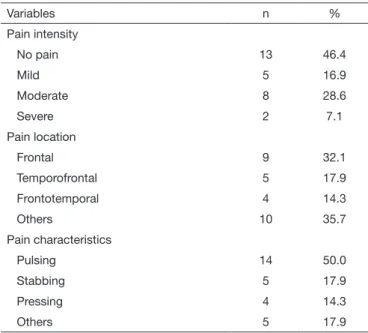
With regard to preoperative pain, 53.6% of patients had headache and pain intensity was moderate in 28.6% of cas-es. There has been prevalence of pulsing frontal headache (Table 2).
It was observed that 85.7% had pain for more than one week, lasting more than one hour in 60.4% of respondents. It should be highlighted that mean pain intensity for patients reporting having it for less than seven days was exacerbated as compared to those feeling it for a longer time. However, this diference was not statistically proven. On the other hand, in
Table 1. Clinical proile of patients in the preoperative period of aneu-rysm clamping. Aracaju, SE, Brazil, 2015
Variables n %
Comorbidities
Arterial hypertension 6 21.4
Diabetes mellitus and arterial hypertension 3 10.7
Does not have 19 67.9
Reason for looking for health service
Sudden and severe headache 14 50.0
Sudden and severe headache associated to syncope 8 28.0
Sudden and severe headache associated to impaired level of consciousness
6 22.0
Previous surgery
Yes 13 46.7
Aneurysm clamping 4 30.7
Others surgeries 9 69.3
No 15 53.6
Relatives with similar clinical presentation
Yes 6 21.4
case of pain recurrence, there has been signiicant diference in mean pain intensity between patients referring it and deny-ing it (Table 3).
As to headache-associated symptoms, only nausea was sig-nificant for mean pain intensity. Major factors worsening headache according to patients were physical effort and shaking of head in 46.4% and 28.6% of cases, respectively (Table 4).
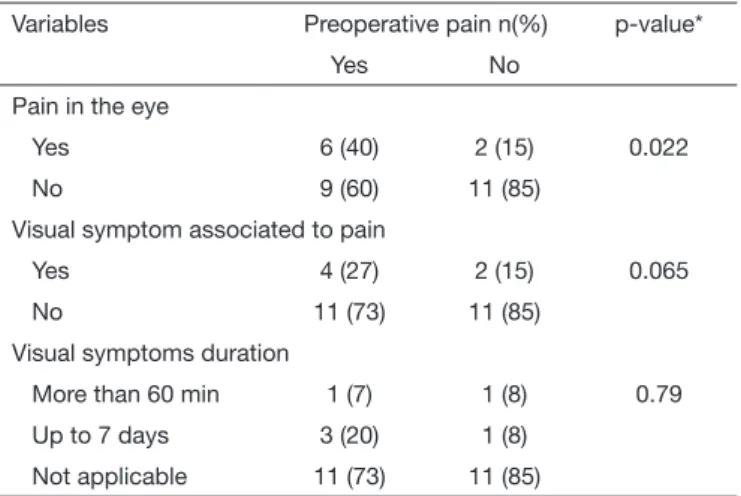
Among studied neurosensory changes, pain in the eye was associated to headache (Table 5).
Data have shown that pain was managed with simple analge-sics, weak opioids and non-steroid anti-inflammatory drugs (NSAIDs), being more prevalent the association among the three drugs (75%). In 35.7% of cases, drugs were prescribed “as needed”. Although pain was severe in 7.1% of patients there were no prescriptions of strong opioids.
Table 2. Characterization of preoperative headache of patients sub-mitted to aneurysm clamping. Aracaju, SE, Brazil, 2015
Variables n %
Pain intensity
No pain 13 46.4
Mild 5 16.9
Moderate 8 28.6
Severe 2 7.1
Pain location
Frontal 9 32.1
Temporofrontal 5 17.9
Frontotemporal 4 14.3
Others 10 35.7
Pain characteristics
Pulsing 14 50.0
Stabbing 5 17.9
Pressing 4 14.3
Others 5 17.9
Table 3. Association between mean headache intensity and temporal characterization of pain in patients in the preoperative period of aneu-rysm clamping. Aracaju, SE, Brazil, 2015
Variables n (%) Pain intensity
Mean (SD)
p-value
Presence of pain (days)
≤7 4 (14.3) 5.25 (3.86) 0.276**
>7 14 (85.7) 0 (0)
Frequency of pain (min)
<60 11 (39.3) 2.91 (3.62) 0.246**
≥60 17 (60.7) 2.75 (3.16)
Recurrence of pain
Yes 14 (50) 3.86 (3.28) 0.014*
No 14 (50) 1.86 (2.82)
*Mann-Whitney test; ** Kruskal-Wallis test.
Table 4. Headache intensity and presence of other symptoms in
pa-tients in the preoperative period of aneurysm clamping. Aracaju, SE,
Brazil, 2015
Variables n (%) Pain intensity
Mean (SD)
p-value
Pallor
Yes 1 (3.6) 5 (0) 0.571
No 27 (96.4) 2.78 (3.2)
Sweating
Yes 6 (21.4) 2.67 (2.66) 0.978
No 22 (78.6) 2.91 (3.35)
Nausea
Yes 9 (32.1) 4.67 (3.35) 0.044
No 19 (67.9) 2 (2.77)
Vomiting
Yes 9 (32.1) 3.11 (3.69) 0.847
No 19 (67.9) 2.74 (3)
Photophobia
Yes 1 (3.6) 9 (0) 0.062
No 27 (96.4) 2.63 (2.99)
Phonophobia
Yes 1 (3.6) 3 (0) 0.071
No 27 (96.4) 2.85 (3.23)
Sleep disorders
Yes 10 (35.7) 3.6 (3.17) 0.356
No 18 (64.3) 2.44 (3.18)
Tearing
Yes 4 (14.3) 3.5 (3.87) 0.681
No 24 (85.7) 2.75 (3.12)
Nasal obstruction
Yes 2 (7.1) 4.5 (6.36) 0.64
No 26 (92.6) 2.73 (3)
Postural vertigo
Yes 6 (21.4) 2 (2.76) 0.566
No 22 (78.6) 3.09 (3.29)
Pain worsens with
Neck movement 1 (3.6) 5 (0) 0.492**
Physical effort 13 (46.4) 3.62 (3.52)
Shaking of head 8 (28.6) 2.25 (2.87)
None 6 (21.4) 1.67 (2.88)
DISCUSSION
BA-induced headache leads to patient distress with negative repercussions in health recovery and rehabilitation process. For this reason, this pain deserves being systematically and broadly evaluated aiming at assuring better health team per-formance for the adequate management of this pain.
Historically, females are more concerned with health than males, so they look more often for health services and are submitted to a larger number of diagnostic and therapeutic procedures7. his might be the explanation for the
predomi-nance of females in our study.
Mean age was 47.6 years, with emphasis to age group above 45 years, which conirms other studies carried out with pa-tients submitted to craniotomy8,9.
AH and DM were common among studied patients. his might have inluenced headache frequency and intensity10.
In addition, cardiovascular and metabolic diseases might contribute to poorer clinical diagnosis11. So, the health team
should detect them early aiming at minimizing their noxious efects on patients’ clinical recovery, such as postoperative in-tracranial hypertension and metabolic imbalances.
Although females look more often for health services7 and
AH and DM require regular medical follow up, the demand for health services was caused by sudden factors, that is, per-sistent headache previous to hospitalization in many patients was not a reason for the early search for health professionals. Most part of the sample has chosen self-medication in mo-ments of pain exacerbation. his is worrisome because when aneurysms are not early treated, there is risk of rupture, which negatively inluences patients’ health status.
he history of previous surgeries may trigger anxiety and, consequently, relect in increased preoperative pain intensi-ty12. Pain worsening brings several damages to patients, such
as increased heart work, decreased blood ofering to tissues and increased distress13, which may also be noxious for
pa-tients’ clinical recovery.
Most patients had preoperative moderate, pulsing and fron-tal headache. Studies evaluating the prevalence of pain in patients submitted to craniotomy had high frequency of preoperative pain with similar characteristics8-14. The
pres-ence of aneurysm might have influpres-enced pain pulsing char-acter and frontal location.
Nausea and vomiting were symptoms referred by patients with pain. Prophylactic administration of antiemetics may decrease and/or prevent nausea and vomiting in patients submitted to craniotomy15. Adequate prevention and
treat-ment of nausea and vomiting minimizes possible postopera-tive troubles such as bronchial aspiration, hydroelectrolyte imbalance and increased intracranial pressure. In addition, they decrease physical efforts and consequently pain. Pain intensity may increase when patients perform simple activities such as standing up or walking9, with risk of early
aneurysm rupture. In our study, physical effort and shaking of head were associated to pain worsening. So, the health team should orient patients to avoid sudden changes in po-sition, as well as help them walking and performing daily activities.
Other factors associated to headache are neurosensory changes, such as pain in the eye. Similar study with patients submitted to aneurysm clamping has found relationship be-tween headache, pain in the eye and visual symptoms10. In
our study, visual changes had no significant association. It is possible that neurosensory changes are related to intracra-nial aneurysm location.
Simple analgesics, associated to NSAIDs and weak opioids, were more often prescribed. However such prescriptions had no fixed administration times. The use of analgesics in fixed time prevents major fluctuations of drug plasma level and peaks of pain. Multimodal analgesic therapy is emphasized not only for its effectiveness but for decreasing doses and, as a consequence, preventing adverse effects4. Prophylactic
ad-ministration of analgesics in a systematic manner is critical to maintain patients’ hemodynamic balance and to assure effective neurosurgical recovery.
It should be highlighted that pain control is patients’ right which should be assured aiming at preventing noxious ef-fects of pain, thus assuring adequate assistance13.
CONCLUSION
Headache in patients in the preoperative period of BA clamping is in general moderate, frontal and pulsing. Nau-sea and vomiting are often associated to pain, which worsens with physical effort and shaking of head. Pain in the eye may also be present in these patients. Analgesics were not system-atically prescribed, being insufficient for total pain relief. Headache is common in patients in the preoperative period of aneurysm clamping, but its evaluation is still a challenge for the multiprofessional team. So, this study explains major items to be investigated and general headache characteristics of these patients. This helps improving the level of suspicion of health professionals with regard to the presence of brain Table 5. Association of neurosensory changes and headache in
pa-tients in the preoperative period of aneurysm clamping. Aracaju, SE, Brazil, 2015
Variables Preoperative pain n(%) p-value*
Yes No
Pain in the eye
Yes 6 (40) 2 (15) 0.022
No 9 (60) 11 (85)
Visual symptom associated to pain
Yes 4 (27) 2 (15) 0.065
No 11 (73) 11 (85)
Visual symptoms duration
More than 60 min 1 (7) 1 (8) 0.79
Up to 7 days 3 (20) 1 (8)
Not applicable 11 (73) 11 (85)
aneurysms, which helps early diagnosis and faster improve-ment of neurological recovery.
REFERENCES
1. Wardlaw JM, White PM. he detection and management of unruptured intracranial aneurysms. Brain. 2000;123(Pt 2):205-21.
2. Zorowitz RD, Smout RJ, Gassaway JA, Horn SD. Usage of pain medications during stroke rehabilitation: the Post-Stroke Rehabilitation Outcomes Projects (PSROP). Top Stroke Rehabil. 2005;12(4):37-49.
3. Molnár L, Simon É, Nemes R, Fülesdi B, Molnár C. Postcraniotomy headache. J Anesth. 2014;28(1):102-11.
4. Schwedt TJ, Gereau RW, Frey K, Kharasch ED. Headache outcomes following tre-atment of unruptured intracranial aneurysms: a prospective analysis. Cephalalgia. 2011;31(10):1082-9.
5. Morris LMD. he International Classiication of Headache Disorders, 3rd ed. (ICHD
III) – Changes and Challenges. Headache Currents--Clinical Review. 2013:1383-95. 6. Goren A, Gross HJ, Fujii RK, Pandey A, Mould-Quevedo J. Prevalence of pain aware-ness, treatment, and associated health outcomes across diferent conditions in Brazil. Rev Dor. 2012;13(4):308-19.
7. Ribeiro MC, Pereira CU, Sallum AM, Silva CB, Santos DS, Nunes MS, et al. Prevalência de dor no pós-operatório de craniotomia eletiva. Arq Bras Neurocir.
2012;31(3):124-7.
8. de Oliveira Ribeiro Mdo C, Pereira CU, Sallum AM, Martins-Filho PR, Santa-na JM, Silva Nunes M, et al. Immediate post-craniotomy headache. Cephalalgia. 2013;33(11):897-905.
9. Kim YD, Park JH, Yang SH, Kim S, Hong JT, Sung JH, et al. Pain assessment in brain tumor patients after elective craniotomy. Brain Tumor Res Treat. 2013;1(1):24-7. 10. Chang SI, Tsai MD, Wei CP. Posterior communicating aneurysm with
oculo-motor nerve palsy: clinical outcome after aneurysm clipping. Turk Neurosurg. 2014;24(2):170-3.
11. Hanak BW, Walcott BP, Nahed BV, Muzikansky A, Mian MK, Kimberly WT, et al. Postoperative intensive care unit requirements after elective craniotomy. World Neu-rosurg. 2014;81(1):165-72.
12. Magalhães JE, Azevedo-ilho HR, Rocha-Filho PA. he risk of headache attri-buted to surgical treatment of intracranial aneurysms: a cohort study. Headache. 2013;53(10):1613-23.
13. Ribeiro MC, Pereira CU, Sallum AM, Martins-Filho PR, Nunes MS, Carva-lho MB. Dor pós-operatória em pacientes submetidos à craniotomia. Rev Dor. 2012;13(3):229-34.
14. de Gray LC, Matta BF. Acute and chronic following craniotomy: a review. Anaesthe-sia. 2005;60(7):693-704.