21
ABSTRACT
BACKGROUND AND OBJECTIVES:Low back pain is a public health problem and among physiotherapeutic treatment modalities there are joint mobilizations, such as central posteroanterior joints. However, there is a gap with regard to mobilization of all lumbar vertebrae. So, this study aimed at evaluating the efects of difer-ent Maitland mobilizations levels, in all lumbar spine vertebrae, in healthy volunteers, to assess pain intensity to cold and pressure. METHODS: his was a crossover clinical trial, with 15 female volunteers who received posteroanterior mobilizations, varying the level between I-IV. In one of the weeks, volunteers received no mobilization. Studied variables were pain intensity to cold and pain threshold to pressure, previous to mobilization (AV1), 5 (AV2) and 35 minutes after mobilization (AV3).
RESULTS: It was observed that 35 minutes after mobilization for levels II and III there has been signiicant pain intensity de-crease to cold as compared to AV1, what was also true for levels III and IV as compared to AV2. here have been no signiicant diferences in pressure threshold evaluation.
CONCLUSION: Mobilizations have produced as from LII sig-niicant decrease in pain intensity to cold, but there has been no efect with regard to pain to pressure.
Keywords:Physiotherapy modalities, herapy with exercises, Spine.
RESUMO
JUSTIFICATIVA E OBJETIVOS: A dor lombar é um prob-lema de saúde pública e dentre as formas de tratamento i-sioterapêutico são utilizadas as mobilizações articulares, como as póstero-anteriores centrais. Contudo, há uma lacuna com
Posteroanterior lumbar spine mobilizations in healthy female volunteers.
Evaluation of pain to cold and pressure: crossover clinical trial*
Mobilizações póstero-anteriores na coluna lombar em voluntárias saudáveis. Avaliação da dor
ao frio e à pressão: ensaio clínico cruzado
Jhenifer Karvat1, Juliana Sobral Antunes1, Gladson Ricardo Flor Bertolini1
*Received from the Laboratory for the Study of Injuries and Physiotherapeutic Resources, State University of Western Paraná (UNIOESTE), Cascavel, PR, Brazil.
1. State University of Western Paraná, Cascavel, PR, Brazil.
Submitted in September 10, 2012. Accepted for publication in January 14, 2014. Conlict of interests: none.
Correspondence to:
Gladson Ricardo Flor Bertolini
Rua Universitária, 2069 – Jardim Universitário 85819-110 Cascavel PR, Brasil.
E-mail: [email protected]
© Sociedade Brasileira para o Estudo da Dor
relação à mobilização de todas as vértebras lombares. Assim, o objetivo deste estudo foi analisar os efeitos de diferentes graus das mobilizações de Maitland, em todas as vértebras da coluna lombar, em voluntários saudáveis, avaliando a intensidade de dor ao frio e à pressão.
MÉTODOS: O estudo caracterizou-se como clínico e cruzado e composto por 15 voluntárias que receberam mobilizações póstero-anteriores, variando-se o grau entre I-IV e também em uma das semanas não receberam mobilização. As variáveis analisadas foram a intensidade de dor ao frio e o limiar de dor à pressão, prévio à mobilização (AV1), cinco (AV2) e 35 minutos após a mobilização (AV3).
RESULTADOS: Foi possível observar que após 35 minutos da mobilização para os graus II e III houve diminuição signii-cativa da intensidade de dor ao frio ao comparar com AV1, o que também ocorreu para os graus III e IV ao comparar com AV2. Na avaliação do limiar de pressão não houve diferenças signiicativas.
CONCLUSÃO: As mobilizações produziram a partir do grau II, redução signiicativa na intensidade de dor ao frio, mas não houve efeito com relação à dor à pressão.
Descritores: Coluna vertebral, Modalidades de isioterapia, Te-rapia por exercício.
INTRODUCTION
Low back pain (LBP) is considered a global public health prob-lem, generating signiicant social and health costs. here is a variety of physiotherapeutic approaches being most common the use of manual therapy with mobilizations and manipula-tions, electric stimulation and guidance1.
here are manual therapy techniques which are applied for di-agnosis and management of joint mobility. So, physiotherapists using manual techniques correlate the indings of the exam to the nature and distribution of symptoms to reach a diagnosis and be able to select the most adequate treatment2. hese man-ual techniques may be efective to control pain because skin touch may be a powerful means to modulate pain, and velocity of proprioceptive stimuli may help the inhibition of painful stimuli in the central nervous system (CNS)3.
Many manual therapy techniques, for being associated to the application of loads through physiotherapists’ hands, depend
Rev Dor. São Paulo, 2014 jan-mar;15(1):21-4 ORIGINAL ARTICLE
22
Karvat J, Antunes JS and Bertolini GR
Rev Dor. São Paulo, 2014 jan-mar;15(1):21-4
on training and manual perception of each professional. A well-known manual therapy method is Maitland joint mo-bilization. his method involves a series of maneuvers used to evaluate and treat musculoskeletal system disorders. It consists in applying oscillatory loads to produce accessory intra-joint movement. his method divides loads application in levels of movement. However, such levels are deined in qualitative terms, which may lead to major variability in the application of loads for each level4.
Maitland mobilization levels I and II correspond to the ap-plication of oscillatory movements, with slow rhythm in the beginning of accessory joint movement amplitude, free from the resistance ofered by tissues, and are indicated in cases of painful joint processes. Levels III and IV are maneuvers characterized by oscillatory movements at the end of acces-sory movement amplitude or as from periarticular tissues re-sistance5. Load imposed during maneuvers levels III and IV promotes viscoelastic adaptation of connective tissues, thus being indicated to recover accessory movements when there is restriction for such movement6.
One joint mobilization technique used to evaluate and treat spinal disorders is the central posteroanterior (PA) pressure technique. Here, the evaluator through the pisiform bone ap-plies oscillatory load on the spinal process of one vertebra of a patient in the prone position. Although there are studies us-ing PA mobilization on the lumbar spine, there is a gap with regard to mobilization of all vertebrae of this segment. his study aimed at evaluating the efect of diferent levels of Maitland mobilizations in all lumbar spine vertebrae, in healthy volunteers, by evaluating pain intensity to cold and pressure.
METHODS
his is a crossover and transversal clinical trial. Sample was composed of 15 young, adult, female volunteers, students of the State University of Western Paraná (UNIOESTE), Cas-cavel campus, age 21.27±0.88 years, height 1.67±0.06 meters and weight 57.93±4.83 kg. Sample size was calculated based on previous studies with the use of pressure dolorimeter for a standard deviation of 4.5 and diference to be detected of 5Kgf, with signiicance level of 5% and power of 85%. In the irst contact, volunteers were explained about inten-tions and procedures, as well as were asked about their inter-est in participating in the research. After acceptance of vol-unteers and their signing of the Free and Informed Consent Term, evaluations and mobilization techniques were started. Volunteers should not present LBP (chronic and/or acute), spinal surgeries, local sensory disorders and/or in lower limbs, infections, gestation and recent trauma. hey should have their sensitivity preserved and should attend to relevant mo-ments and dates.
Evaluation moments
Volunteers participated in the project once a week for ive weeks. During four weeks they randomly received a diferent
mobilization level (LI, LII, LIII, LIV) plus evaluations, and in one week they were just evaluated without mobilization (L0). Evaluations were carried out three times every day: pre-mobilization moment (AV1), 5 (AV2) and 35 minutes after mobilization (AV3).
Evaluation of pain intensity to cold
Volunteer immersed the dominant foot up to the most distal region of the medial malleolus, in a container with water and ice at 5o C ± 1 for 30 minutes and temperature was controlled with Incoterm® mercury thermometer. After 30 seconds the volunteer was asked about pain intensity by the visual analog scale (VAS). Such scale was a wood apparatus with a movable metal cursor on one side, where the volunteer would mark position between “0” (no pain) and “10” (maximum imagin-able pain), and on the other side there was a ruler in the op-posite direction allowing for the quantiication in centimeters of pain indicated by participant.
Evaluation of pain threshold to pressure
To evaluate pain to pressure a pressure dolorimeter (Kratos®) was used, with capacity to produce up to 50Kgf, with 1cm2 circular tip, which was applied on the spinous process of the 3rd lumbar vertebra soon after evaluation by VAS.
Mobilization protocol
Patients received central PA technique for mobilization in all lumbar spine spinous processes, for one minute each. Two therapists have performed mobilizations, however to prevent biases, there was no rotation between therapists, that is, they would mobilize always the same individual.
Volunteers remained in the prone position with arms along the body. herapist remained at the left side and positioned left hand ulnar border, region of pisiform and hamate bones, in contact with the spinous process of the vertebra to be mo-bilized. Left hand was then reinforced by shell-shaped right hand with the approximation of thenar and hypothenar emi-nences over the radial surface of the other hand. So, leaving right middle, ring and little ingers between left index inger and thumb, and placing left index inger and thumb over left hand dorsum, stability was obtained by holding the palm of left hand between thenar eminence and right middle, ring and little ingers. herapist’s shoulders were in balance over the patient, with slightly lexed elbows.
he study was carried out during ive weeks, being that in four weeks volunteers received interleaved levels of mobiliza-tion and in one week they were only randomly evaluated. For every week there were three randomly chosen volunteers for each subgroup. Mobilization levels were:
Level I – low amplitude movement close to initial route posi-tion;
Level II – high amplitude movement within the route. It may occupy any part of the route which is free from any muscle stifness or spasm;
23
Posteroanterior lumbar spine mobilizations in healthy female volunteers.Evaluation of pain to cold and pressure: crossover clinical trial
Rev Dor. São Paulo, 2014 jan-mar;15(1):21-4
Level IV – low amplitude forced movement within muscle stifness or spasm at the end of amplitude.
Volunteers received mobilizations soon after the irst evalua-tion moment (AV1) and then they were evaluated as already described.
ANOVA test for repetitive measures with Bonferroni post-test were used for data analysis, considering signiicant α=5%. his study was approved by the Research Ethics Commit-tee, State University of Western Paraná (UNIOESTE) under opinion 242/2011.
RESULTS
Pain intensity to cold, evaluated by VAS, has shown pain in-tensity decrease only in the last evaluation, when mobiliza-tion was carried out as from LII. here were no statistically signiicant diferences among groups (Table 1).
Table 1. Pain intensity to cold, according to visual analog scale, in all levels of the three evaluations
Levels AV1 AV2 AV3
Visual analog scale
L0 3.94 ± 2.09 4.19 ± 2.17 3.33 ± 2.64
LI 4.95 ± 3.08 4.79 ± 3.08 3.70 ± 2.86
LII 4.70 ± 2.98 4.50 ± 2.64 3.36 ± 2.58 *
LIII 4.75 ± 2.37 4.65 ± 2.72 2.84 ± 2.13 *°
LIV 3.90 ± 2.35 4.36 ± 2.69 2.86 ± 2.42 °
*Signiicant difference within group, when comparing with AV1; ° Signiicant difference, within group, when comparing with AV2.
Pain threshold to pressure
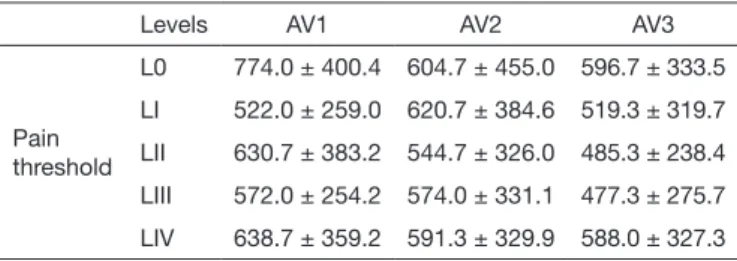
During evaluation of pain threshold to pressure, no group has shown signiicant diferences (Table 2). here were also no signiicant diferences among groups.
Table 2. Results of pain threshold to pressure on L3 according to levels used during three evaluations
Levels AV1 AV2 AV3
Pain threshold
L0 774.0 ± 400.4 604.7 ± 455.0 596.7 ± 333.5
LI 522.0 ± 259.0 620.7 ± 384.6 519.3 ± 319.7
LII 630.7 ± 383.2 544.7 ± 326.0 485.3 ± 238.4
LIII 572.0 ± 254.2 574.0 ± 331.1 477.3 ± 275.7
LIV 638.7 ± 359.2 591.3 ± 329.9 588.0 ± 327.3
DISCUSSION
Manual therapy is efective to treat LBP7. During evaluation, therapists look for signs of spinal stifness of people with low back pain aiming at treating it8. However, there are contro-versies with regard to stifness as predictor of clinical results such as pain and incapacity9. However, notwithstanding con-troversies, spinal mobilizations have as major results the
in-hibition of pain induced by mechanical stimuli, which may occur by creating long term depression of CNS synaptic func-tion, in addition to improving lumbar spine movement am-plitude10,11. Our study has used the PA technique in the whole lumbar segment, which has decreased pain intensity to cold. A previous study, also using PA mobilization, but in patients with LBP, has shown that mobilization may decrease pain in-tensity when patients actively move, and the protocol used was three one-minute repetitions and mobilization force mag-nitude was selected by the therapist according to the patient12. Similarly, it was observed in our study that pain intensity to cold was decreased with mobilizations as from level II, fact which was not observed both for control group (G0) and level II. Precise pain relief mechanisms are still not established, but possible explanations are theories such as gates and descend-ing suppression mediated by periaqueductal gray matter. A study using PA mobilization on L3, with pressure variations between 50 and 200N, which were alternated from large to semi-static oscillations, has observed decreased pain threshold to pressure in all variations13.
his result was not observed in the evaluation of pain thresh-old to pressure in our study, however it is worth highlight-ing that all lumbar vertebrae were mobilized, which might have generated discomfort caused by pressure in more than one segment. Also, one have to take into consideration that, in our study, mobilizations were performed by two students who, in spite of having been trained, had little experience with the technique, which even for experienced therapists, according to studies, has poor reliability of mobilization levels performance5,14. Another limitation of our study was that it was a crossover study, which might have generated the load-ing efect, although in attempt to decrease such efect, there was a 7-day interval between mobilizations.
So, it is suggested that new studies could be carried out with more experienced therapists and evaluating mobilizations in more than one segment. We also stress that the lack of changes in cold-induced pain for level I does not mean that this could not produce hypoalgesic efects15, but for individu-als without previous pain such stimulus was insuicient to generate minimizing efects. So, studies with mobilizations in more than one segment in acute and chronic low back pain patients are relevant.
CONCLUSION
Oscillatory mobilizations on lumbar vertebrae of healthy in-dividuals have produced, as from LII, signiicant decrease in pain intensity to cold, but there has been no efect with regard to pain to pressure.
ACKNOWLEDGMENTS
24
Karvat J, Antunes JS and Bertolini GR
Rev Dor. São Paulo, 2014 jan-mar;15(1):21-4
REFERENCES
1. Gracey JH, McDonough SM, Baxter GD. Physiotherapy management of low back pain: a survey of current practice in Northern Ireland. Spine. 2002;27(4):406-11. 2. van de Veen EA, de Vet HC, Pool JJ, Schuller W, de Zoete A, Bouter LM.
Va-riance in manual treatment of nonspeciic low back pain between orthomanual physicians, manual therapists, and chiropractors. J Manipulative Physiol her. 2005;28(2):108-16.
3. Gosling AP. Mecanismos de ação e efeitos da isioterapia no tratamento da dor. Rev Dor. 2013;13(1):65-70.
4. Chiradejnant A, Latimer J, Maher CG. Forces applied during manual therapy to pa-tients with low back pain. J Manipulative Physiol her. 2002;25(6):362-9. 5. Snodgrass SJ, Rivett DA, Robertson VJ. Manual forces applied during cervical
mobi-lization. J Manipulative Physiol her. 2007;30(1):17-25.
6. Hsu A, Ho L, Chang J, Chang GL, Hedman T. Characterization of tissue resistance during a dorsally directed translation mobilization of the glenohumeral joint. Arch Phys Med Rehabil. 2002;83(3):360-6.
7. Slater SL, Ford JJ, Richards MC, Taylor NF, Surkitt LD, Hahne AJ. he efectiveness of sub-group speciic manual therapy for low back pain: a systematic review. Man her. 2012;17(3):201-12.
8. Kumar S. Posteroanterior spinal stifness at T5, T10, and L3 levels in normal subjects. PMR. 2012;4(5):342-8.
9. Ferreira ML, Ferreira PH, Latimer J, Herbert RD, Maher C, Refshauge K. Rela-tionship between spinal stifness and outcome in patients with chronic low back pain. Man her. 2009;14(1):61-7.
10. Zusman M. Mechanism of mobilization. Phys her Rev. 2011;15(4):233-6. 11. Sato T, Koumori T, Uchiyama Y. Preliminary study of the immediate efect of spinal
segmental side bending mobilization on improves lumbar range of motion. J Phys her Sci. 2012;24(5):431-4.
12. Goodsell M, Lee M, Latimer J. Short-term efects of lumbar posteroanterior mobilization in individuals with low-back pain. J Manipulative Physiol her. 2000;23(5):332-42. 13. Krouwel O, Hebron C, Willett E. An investigation into the potential hypoalgesic
efects of diferent amplitudes of PA mobilisations on the lumbar spine as measured by pressure pain thresholds (PPT). Man her. 2010;15(1):7-12.
14. Snodgrass SJ, Rivett DA, Robertson VJ. Manual forces applied during posterior-to-anterior spinal mobilization: a review of the evidence. J Manipulative Physiol her. 2006;29(4):316-29.