Case Report
Major Article
http://dx.doi.org/10.1590/0037-8682-0069-2014INTRODUCTION
Address to: Dra Roberta Juliano Ramos. Lab. de Microbiologia de Alimentos/ Depto de Ciência e Tecnologia de Alimentos/UFSC. Rod. Admar Gonzaga 1346, 88034-001 Florianópolis, SC, Brasil.
Phone: 55 48 3721-5379; Fax: 55 48 3721-9943 e-mail: [email protected] Received 24 March 2014
Accepted 23 June 2014
Occurrence of potentially pathogenic
Vibrio
in oysters
(
Crassostrea gigas
) and waters from bivalve mollusk
cultivations in the South Bay of Santa Catarina
Roberta Juliano Ramos
[1], Letícia Adélia Miotto
[1], Marília Miotto
[1], Nelson Silveira Junior
[2],
Andréia Cirolini
[1], Helen Silvestre da Silva
[1], Dália dos Prazeres Rodrigues
[3]and Cleide Rosana Werneck Vieira
[1][1]. Laboratório de Microbiologia de Alimentos, Departamento de Ciência e Tecnologia de Alimentos, Universidade Federal de Santa Catarina, Florianópolis, SC. [2]. Associação de Maricultores do Sul da Ilha, Florianópolis, SC. [3]. Laboratório de Enterobactérias, Instituto Oswaldo Cruz, Rio de Janeiro, RJ.
ABSTRACT
Introduction: This research aimed to identify and quantify potentially pathogenic Vibrio from different cultivations of bivalve
shellfi sh in the State of Santa Catarina, Brazil, and water regions in the South Bay, as well as correlate the incidence of these
microorganisms with the physicochemical parameters of marine waters. Methods: Between October 2008 and March 2009, 60 oyster and seawater samples were collected from six regions of bivalve mollusk cultivation, and these samples were submitted for Vibrio counts. Results: Twenty-nine (48.3%) oyster samples were revealed to be contaminated with one or more Vibrio
species. The Vibrio parahaemolyticus and Vibrio vulnifi cus counts in the samples ranged from < 0.5 log10 Most Probable Number (MPN) g-1 to 2.3 log
10 MPN g
-1 oyster and from < 0.5 log
10 MPN g
-1 to 2.1 log
10 MPN g
-1 oyster, respectively. Of the 60 seawater
samples analyzed, 44 (73.3%) showed signs of contamination with one or more vibrio species. The counts of V. parahaemolyticus
and V. vulnifi cus in the samples ranged from < 0.3 log10 MPN·100mL-1 to 1.7 log
10MPN·100mL
-1 seawater and from < 0.3 log 10
MPN·100mL-1 to 2.0 log
10MPN·100mL
-1 seawater, respectively. A positive correlation between V. vulnifi cus counts and the
seawater temperature as well as a negative correlation between the V. parahaemolyticus counts and salinity were observed.
Conclusions: The results suggest the need to implement strategies to prevent vibrio diseases from being transmitted by the
consumption of contaminated bivalve shellfi sh.
Keywords: Oyster. Crassostrea gigas. Vibrio parahaemolyticus. Vibrio vulnifi cus. Shellfi sh. Polymerase chain reaction.
In Brazil, the production of bivalve shellfi sh occurs primarily
in the Southern region of the State of Santa Catarina because of the excellent geographical conditions of this area for the cultivation of marine organisms, such as the presence of a large number of bays, which facilitates the establishment of marine farms1,2. In 2011, approximately 18.3 tons of shellfi sh were
sold in the State of Santa Catarina, and the largest production of oysters (Crassostrea gigas) occurred at marine farms located in the South Bay near the Island ofSanta Catarina.
In addition to indicators of fecal contamination, which are widely used to assess the microbiological quality of bivalve mollusks, different species of the Vibrio genus occur naturally
in marine, coastal and estuary environments. However, some species, such as Vibrio parahaemolyticus, Vibrio vulnifi cus and Vibrio cholerae, are potentially pathogenic to humans and
may be present in fi sh and raw or partially cooked shellfi sh3.
The possibility of seafood consumers becoming infected with pathogenic Vibrio from oyster consumption depends on the microbiological quality of the marine habitat as well as
the handling and processing practices of these shellfi sh4. The
occurrence of these bacteria is not related to the counts of either
Escherichia coli or thermotolerant coliforms, which are primarily responsible for gastroenteritis related to seafood consumption5.
Infections caused by Vibrio parahaemolyticus have been reported in Asia6-9, Europe (Spain10 and Italy11) and American
countries (United States12-16, Chile17,18, Peru19 and Brazil20).
Pathogenic V. parahaemolyticus strains can be differentiated from non-pathogenic strains by their ability to produce thermostable hemolysin (TDH), which is known as the Kanagawa phenomenon. The pathogenicity of V. parahaemolyticus is associated with the presence of the tdh and trh genes21.
Infections caused by V. vulnificus show different clinical presentations, of which the primary septicemia, wound infections, and gastroenteritis are the most prevalent16. Vibrio vulnifi cus infections
METHODS
The concentration of both V. parahaemolyticus and
V. vulnifi cus in oysters is directly related to water temperature, with a higher concentration of this Vibrio present when the oysters are in warm water. Because of this, these microorganisms are rarely isolated when the water temperature is below 15°C22.
In Brazil, the temperature of the seawater is greater than 20°C for the majority of the year, favoring the occurrence of these microorganisms in different stations.
This study aimed to identify and quantify the potentially pathogenic marine Vibrio in fresh oysters (Crassostrea gigas) and seawaters from different regions of bivalve shellfish cultivations in the South Bay of the Island of Santa Catarina, Brazil, as well as correlate the incidence of these microorganisms with the physicochemical parameters of the marine waters in these regions.
Rio Grande do Sul
Km
0 50 100
Paraná
-54o o o o
-52 -50 -48
Argentina Santa Catarina Santa Catarina Island
Santa Catarina
Island North
Bay Brazil
South Atlantic
South Bay
Atlantic Ocean F*
E*
D*
C*
B*
A* Km
0 50 10 Km
0 50 1000
-26o
-20o
0o
-60o -40o
-60o -40o
-27 30'o
-27 45'o
-48 30'o
-48 45'o
-27o
-28o
-29o
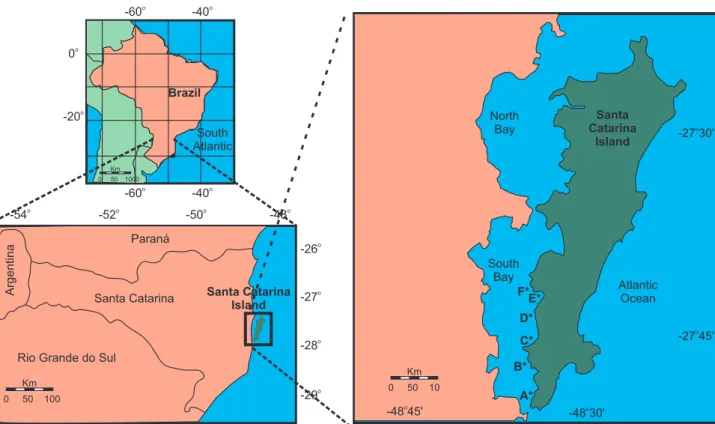
FIGURE 1 - Detailed map of the South Bay, with letters A through F indicating the sampling sites. Collection and preparation of the samples
Between October 2008 and March 2009, 60 oyster samples (Crassostrea gigas) and 60 seawater samples were collected from six regions of bivalve mollusk farms in the South Bay near the Island Santa Catarina (27° S, 48° W), Brazil. These regions are identifi ed as A, B, C, D, E and F in Figure 1. A total of 10 samplings were collected from each region.
Each oyster sample comprised 12 oysters, totaling 720 specimens. Water samples were collected following the
methods published by the American Public Health Association23,
which consisted of using sterile 1-liter polypropylene screw-cap containers 50cm below the surface. The seawater temperature and dissolved oxygen levels were measured in situ using a YSI-550A dissolved oxygen meter (YSI Incorporated, Ohio, USA), salinity was measured using a refractometer (Alfakit, 211, Florianópolis, Brazil), and the Secchi depth was measured using a Secchi disc; all of these measurements were obtained in
the fi eld. However, the water pH was measured in a laboratory
with a digital pH meter (Quimis® Q-400, São Paulo, Brazil). All measurements were obtained in triplicate. The oysters and water samples were transported to the laboratory in an isothermal box with packaged potable ice and analyzed within 3h of sampling.
The oysters were scrubbed under tap water to remove debris, allowed to dry, disinfected with 70% ethanol, and opened aseptically using a sterilized knife. The flesh and intervalve liquid were aseptically transferred to sterile bags and homogenized for 1 min, forming a pool of 12 oysters. The oysters’ pH was evaluated from the pool of 12 oysters from each sample with a Quimis ® Q-400 digital pH meter. This process was conducted in triplicate.
Isolation and enumeration of Vibrio spp
To detect the Vibrio spp. in oysters, 50g of each sample was weighed, 450mL of phosphate buffered saline (PBS, Oxoid, Ltd, England) was added to each sample and the mixtures were
liquefi ed in a Bagmixer blender. Serial dilutions up to 10-4 were
RESULTS
inoculated into a tube containing alkaline peptone water (APW) and 3% NaCl to enumerate themost probable number (MPN) of
Vibrio parahaemolyticus and Vibrio vulnifi cus in the sample using a method described in the US Food and Drug Administration Bacterial Analytical Manual24. Each dilution was measured in
triplicate. Further biochemical differentiation for the identifi cation and confi rmation of isolated particles were performed using the Analytical Profi le Index (API) 20E system (bioMérieux, France).
For the water analysis, 5 tubes were prepared with alkaline peptone water (APW, Oxoid), concentrated twice with 3% of NaCl, and two sets of 5 tubes were prepared with APW in normal concentration with 3% NaCl. Approximately 10mL of collected
water was added to the fi rst set of 5 tubes, whereas 1 and 0.1mL
of cultivated water was added to the other two sets. The tubes were incubated at 35°C overnight, and those showing turbidity were sowed onto plates of Thiosulfate Citrate bile Sucrose agar (TCBS, Oxoid). These plates were incubated at 35°C (± 1°C) for 24 hours. The colonies that were suspected to be Vibrio spp. were inoculated into triple sugar iron agar (TSI, Oxoid) containing 3%
NaCl and subjected to indole motility sulfi de agar (SIM, Oxoid)
to determine motility, as well as an oxidase test (Newprov oxidase strips), gram coloration and inspection of bacterial morphology. Strains suspected in these tests were further subjected to taxonomic
identifi cation of the species using the API 20E kit from bioMérieux
with a bacterial suspension containing 0.85% NaCl. The count
result was obtained using the MPN table for the series of fi ve tubes
for each dilution (10mL, 1mL and 0.1mL) according to section 9221C (APHA, 2005). All of the strains of V. parahaemolyticus
were genotypically confirmed by detecting the tlh gene using multiplex polymerase chain reaction (multiplex-PCR).
Determining pathogenicity
Strains identifi ed as V. parahaemolyticus were shipped in Luria Bertani agar containing 3% NaCl to the Microbiology laboratory at the Institute Oswaldo Cruz (IOC) to determine pathogenicity. These strains were also subjected to the following phenotypical virulence tests: urease detection using Urea Agar Base (UAB, Oxoid) and hemolysis of human erythrocytes in Wagatsuma agar to detect the Kanagawa phenomenon24.
Genotypic confi rmation of pathogenicity was performed
using multiplex PCR detection of the tdh (thermostable direct hemolysin) and trh (thermostable direct hemolysin-related hemolysin) genes using the following primers: VPTDH-L: 5’-gta aag gtc tct gac ttt tgg ac-3’ and VPTDH-R: 5’-tgg aat aga acc ttc atc ttc acc-3’; VPTRH-L: 5’-ttg gct tcg ata ttt tca gta tct-3’ and VPTRH-R: 5’-cat aac aaa cat atg ccc att tcc g-3’, respectively. The tlh (thermolabile hemolysin) gene, which is a species-specifi c
marker for V. parahaemolyticus, was amplifi ed using the primers
L-TL: 5’-aaa gcg gat tat gca gaa gca ctg-3’ and R-TL: 5’-gct act ttc tag cat cat ttt ctc tgc-3’, as described by Bacteriological Analytical Manual/Food and Drug Administration (BAM/FDA)24.
Statistical analysis
Results of the microbiological tests were transformed into log values and assumed to be normally distributed; statistical analyses were performed using Statistica 7.0® software
(Stat-Soft, Inc., USA). To facilitate the statistical analyses of
quantitative data obtained by the most probable number, counts for V. parahaemolyticus and V. vulnifi cus when the levels were below the limit of detection were substituted for 2 MPN g-1
oyster and 1.7 MPN·100mL-1 seawater. A test of signifi cance of
the observed differences in V. parahaemolyticus and V. vulnifi cus levels regarding the environmental parameters in oysters and seawater across the six sites sampled was conducted using one-way analysis of variance (ANOVA). An alpha level of 0.05 was
considered to be the minimum level for statistical signifi cance. The infl uence of the physicochemical microbiological counts
in seawater was evaluated by analyzing the nonparametric Spearman rank correlation, whereas the correlation between the physical and chemical parameters and incidence of
Vibrio spp. was assessed by the Pearson correlation.
Collections were performed from October 2008 to March 2009, which included the spring and summer seasons, and the temperature of the seawater ranged from 20ºC and 29°C. The average temperature of the six geographically studied regions was 24.3°C ± 2.2.
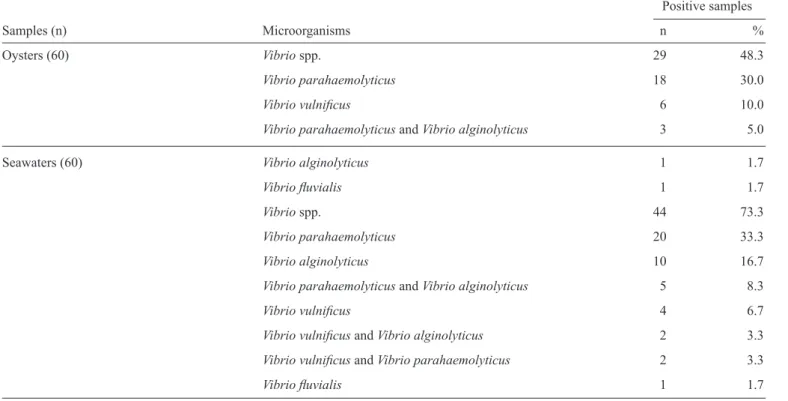
Of the 60 examined oyster samples, 29 (48.3%) were found to contain potentially pathogenic Vibrio spp. (Table 1). The most frequently isolated species from the oysters were
V. parahaemolyticus (21 isolates, 35%), V. vulnifi cus (6 isolates, 10%) and V. alginolyticus (4 isolates, 6.7%). V. cholerae was not isolated from any of the 60 analyzed samples, and V. fl uvialis was isolated from only one sample. The V. parahaemolyticus counts ranged from < 0.5 log10 MPN g-1 oyster (non-detectable) to 2.3
log10MPN g-1 oyster, with the mean level of V. parahaemolyticus
in the oyster samples at 1.2 log10 MPN·g-1 oyster. The
V. vulnifi cus counts ranged from < 0.5 log10 MPN·g-1 oyster
(non-detectable) to 2.1 log10 MPN·g-1 oyster, and the mean level
of V. vulnifi cus was 0.8 log10 MPN g-1 oyster. In December and
January, which is summertime in Brazil, the highest counts of V. vulnifi cus and V. parahaemolyticus were observed in the oyster samples.Interestingly, two Vibrio species coexisted in three oyster samples (Table 1).
During the entire monitoring period, 32 Vibrio strains were isolated from the oyster samples. In the C region, the incidence of Vibrio was higher compared to the other regions.
Based on ANOVA (Table 2), there were no signifi cant
differences in the mean log10 density of total counts of Vibrio parahaemolyticus and V. vulnifi cus in the oyster samples from the six sites tested (p > 0.05).
TABLE 2 - Results of microbiological analysis and seawater parameters of samples collected from the South Bay of Santa Catarina, Brazil.
VP in oysters log VP in seawater log VV in oyster log VP in seawater log
MPN·g-1 MPN·100mL-1 MPN·g-1 MPN·100mL-1
Site T (°C) S (ppm) mean ± SD* mean ± SD* mean ± SD* mean ± SD*
A 22.9 ± 2.0a 33.9 ± 3.6a 0.4 ± 0.2a 0.5 ± 0.4a 0.6 ± 0.6a 0.3 ± 0.2a
B 23.3 ± 1.9ab 33.3 ± 3.3a 0.8 ± 0.7a 0.4 ± 0.3a 0.4 ± 0.2a 0.3 ± 0.2a
C 24.6 ± 2.0ab 32.8 ± 3.5a 0.9 ± 0.6a 0.6 ± 0.5a 0.3 ± 0.0a 0.3 ± 0.2a
D 24.9 ± 1.9ab 32.5 ± 3.5a 0.4 ± 0.3a 0.5 ± 0.4a 0.4 ± 0.4a 0.40 ± 0.6a
E 24.9 ± 2.0ab 30.7 ± 6.5a 0.7 ± 0.7a 0.8 ± 0.4a 0.3 ± 0.0a 0.2 ± 0.0a
F 25.2 ± 2.3b 31.2 ± 4.0a 0.8 ± 0.0a 0.5 ± 0.5a 0.7 ± 0.6a 0.4 ± 0.4a
T: temperature; S (ppm): salinity parts-per-million;VP: Vibrio parahaemolyticus; VV: Vibrio vulnifi cus; MPN: most probable number; SD: standard deviation. * means (n = 3) in the column with different superscripts (a, b) are signifi cantly different (p < 0.05).
Seawater parameters
TABLE 1 - Prevalence of Vibrio in oysters and seawater.
Positive samples
Samples (n) Microorganisms n %
Oysters (60) Vibrio spp. 29 48.3
Vibrio parahaemolyticus 18 30.0
Vibrio vulnifi cus 6 10.0
Vibrio parahaemolyticus and Vibrio alginolyticus 3 5.0
Seawaters (60) Vibrio alginolyticus 1 1.7
Vibrio fl uvialis 1 1.7
Vibrio spp. 44 73.3
Vibrio parahaemolyticus 20 33.3
Vibrio alginolyticus 10 16.7
Vibrio parahaemolyticus and Vibrio alginolyticus 5 8.3
Vibrio vulnifi cus 4 6.7
Vibrio vulnifi cus and Vibrio alginolyticus 2 3.3
Vibrio vulnifi cus and Vibrio parahaemolyticus 2 3.3
Vibrio fl uvialis 1 1.7
The Vibrio parahaemolyticus counts ranged from < 0.3 log10 MPN·100mL-1 seawater (non-detectable) to 1.7 log
10
MPN·100mL-1 seawater, and the mean level of V. parahaemolyticus
in the seawater samples was 0.8 log10 MPN·100mL-1, whereas
the V. vulnifi cus counts ranged from < 0.3 log10 MPN 100mL-1
seawater (non-detectable) to 2.0 log10MPN·100mL-1 seawater,
and the mean level of V. vulnifi cus was 0.6 log10 MPN 100mL-1
seawater. Two Vibrio species coexisted in nine seawater samples (Table 1).
Spearman correlation analysis indicated a significant positive correlation between the log10 total of V. vulnifi cus
counts in the seawater and oysters at the same site of the South Bay (p < 0.05); however, the same was not observed for
V. parahaemolyticus (p > 0.05).
The infl uence of temperature on the concentration of Vibrio
in the marine waters was only observed with V. vulnifi cus (p < 0.05). For V. parahaemolyticus (p> 0.05), no Spearman correlation was established, presumably due to samplings that were conducted during the spring and summer months when water temperatures remained at approximately 24°C on average, resulting in the continuous detection of different species of
A negative Spearman correlation was observed between the counts of V. parahaemolyticus and salinity (p < 0.05); however, this was not observed with V. vulnifi cus (p > 0.05). The seawater clarity, dissolved oxygen and pH measurements were not correlated with the level of contamination with either
V. parahaemolyticus (p > 0.05) or V. vulnifi cus (p > 0.05). The incidence of different species of marine vibrio in the water did not correlate with any of the physicochemical parameters measured (p > 0.05). The pH values of the oysters from the different regions of the South Bay ranged between 5.8 and 6.8, and the average pH observed was 6.2 ± 0.2. Although Brazilian
laws have set pH limits for fi sh, there are none for mollusks.
Only one of the 48 strains isolated from oyster and seawater
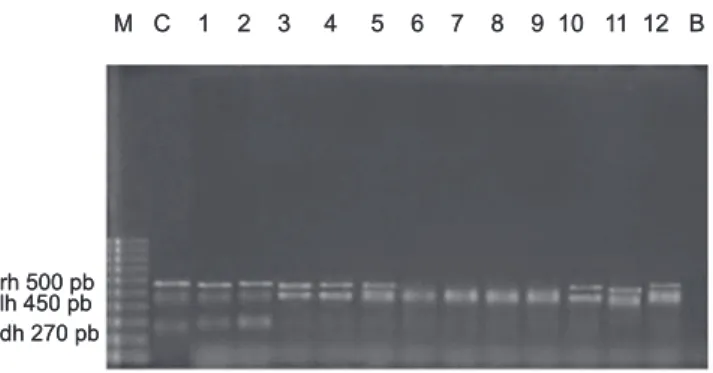
samples (confi rmed to be V. parahaemolyticus by tlh detection) was urease-positive, but the strain did not produce b-hemolysis halos in Wagatsuma agar. The tdh gene was detected in four strains, and trh was detected in 23 strains (Figure 2).
M C 1 2 3 4 5 6 7 8 9 10 11 12 B
FIGURE 2 - Agarose gel electrophoresis of the multiplex PCR products obtained from the collected Vibrio parahaemolyticus strains. Lanes: M: 100bp molecular weight marker; C: positive control (tlh-, trh- and tdh-positive V. parahaemolyticus); B: negative control; 1 and 2, positive for trh and tdh; 3, 4, 5, 10, 11 and 12, positive for trh; 1 - 12, positive for tlh.
trh 500 pb tlh 450 pb tdh 270 pb
M C 1 2 3 4 5 6 7 8 9 10 11 12 B
trh 500 pb tlh 450 pb tdh 270 pb
DISCUSSION
Similar mean water temperatures were observed at the six sites investigated except the temperatures of regions A and F, where a
signifi cant difference was observed (p < 0.05). This most likely
occurred because the collections took place early in the morning in the A region and approximately 12h later in the F region, over which time the water temperature experiences a natural increase. The average temperature of 24.3°C in the water of the six sampling stations in South Bay of Santa Catarina Island was favorable for the development of Vibrio because pathogenic
Vibrio are more frequently isolated in an aquatic environment with temperatures varying between 10 and 30°C25. According
to Strom and Paranjpye26, V. vulnifi cus proliferates in areas
when the water temperature exceeds 18°C. The lowest recorded temperature of all of the samples was 20°C.
Several studies have suggested a strong influence of temperature on the concentration of vibrio in marine waters27-30.
However, this study only established a correlation with
V. vulnifi cus (p < 0.05). For V. parahaemolyticus (p > 0.05), it was not possible to establish any correlation, presumably due to the average water temperature of 24°C, which enabled the continuous detection of different species of Vibrio.
In this study, the prevalence and concentration of
V. parahaemolyticus were lower compared to studies performed in southeastern regions of Brazil31-33. Although no isolated
Kanagawa-positive strains have been isolated, 6.7% of the strains isolated in this study contained tdh and 38.3% of the strains contained trh, both of which are related to the pathogenicity of V. parahaemolyticus.
Kanagawa-negative strains carrying the tdh gene produce TDH and are therefore potentially toxigenic. The only urease-positive strain, which also contained the trh gene, has been previously described by other authors4,34. According to these
studies, urease positivity is an indication of virulence.
In this study, more than half of the isolates were
V. parahaemolyticus; this percentage of isolates is different from that previously observed in another study conducted in the same region35. The variability in the incidence of different species of
Vibrio may be related to the fact that this study was conducted in the warmer spring and summer seasons, whereas the other study covered all four seasons. Vieira et al.4 also observed a higher
prevalence of V. parahaemolyticus (30.3% of those isolated) in the oyster samples.
In Brazil, the bacteriological quality of the aquaculture water areas is evaluated by either fecal coliforms or the Escherichia coli test36. Through Resolution 12/2001, the Department of
Sanitary Vigilance37 determined the maximum acceptable level
of V. parahaemolyticus in raw seafood-based dishes to be 103
per gram. Though oysters are not mentioned explicitly in this
defi nition, they should be considered as raw seafood because
they are traditionally consumed in nature. Considering this legislation as a parameter put the results observed in our study into context, the V. parahaemolyticus counts reported here vary below the maximum-allowed limit.
The United States, through the Guide for the Control of
Molluscan Shellfi sh, which was published by the National Shellfi sh Sanitation Program38, has established action levels
and levels of concern for V. parahaemolyticus levels that are equal to or greater than an MPN count of 10,000 per gram, as well as Kanagawa positive or negative strains. However, the recommended attention to V. vulnifi cus does not establish limits for this microorganism, which must be analyzed on a case-by-case basis.
Many factors are involved in the distribution and survival of microorganisms in estuarine ecosystems, such as biotic and abiotic parameters of the surrounding seawater (i.e., temperature, salinity, pH and turbidity)30,32,39. The
concentration of V. parahaemolyticus in seawater increases with rising water temperatures and corresponds to a seasonal increase, with sporadic cases reported in the warmer months40. According
V. parahaemolyticus infections in the Pacifi c Northwest and
Texas occur primarily during the summer months. However, this study showed no correlation between the V. parahaemolyticus
counts and the water temperature, most likely due to the minimal
temperature variation over the study period, whereas a signifi cant
correlation was observed between the V. vulnifi cus counts and
water temperature, confi rming the previously reported results41,42.
Audemard et al.43 suggested that unexplored postharvest
processing (PHP) methods to eliminate V. vulnifi cus from oysters, which use relaying to high salinity waters, could be an alternative strategy, considering that high salinities appear to negatively affect the survival of V. vulnifi cus. However, this study observed a negative correlation between salinity and V. parahaemolyticus, whereas no correlation was observed between salinity and
V. vulnifi cus; this result is consistent with results obtained in other
studies conducted in shellfi sh cultivation areas off the Brazilian
coast32,35 and in other parts of the world41,44.
Although the V. parahaemolyticus and V. vulnifi cus counts observed in the waters can be considered as low, it is important
to note that in fi ltering shellfi sh such as oysters and mussels, these
microorganisms are concentrated in their guts and in other tissues, with levels reaching up to 106 bacteria per gram of shellfi sh30.
Although only eight (13.3%) samples in this study were positive for V. vulnifi cus (even at low concentrations), these data should serve as an indication for the need for constant
monitoring of this species in areas of bivalve shellfi sh cultivation
due to the ability of this organism to cause serious infections that are often fatal30.
The results of this study suggest the need to improve strategies to prevent the occurrence of diseases transmitted by
consumption of bivalve shellfi sh contaminated with pathogenic
vibrio. This translates to monitoring not only indicators of fecal contamination, such as Escherichia coli, but also the potentially pathogenic Vibrio. Additionally, establishing time and temperature parameters for the handling, transporting, marketing,
distribution and consumption of these shellfi sh is imperative to
prevent illnesses due to these foodborne pathogens.
The authors declare that there is no confl ict of interest. CONFLICT OF INTEREST
FINANCIAL SUPPORT
This study was supported by the Conselho Nacional de
Desenvolvimento Científi co e Tecnológico (CNPq) and Fundação de Amparo à Pesquisa do Estado de Santa Catarina (FAPESC).
REFERENCES
1. Coelho C, Heinert AP, Simões CM, Barardi CR. A virus detection in oysters (Crassostrea gigas) in Santa Catarina State, Brazil, by reverse transcription-polymerase chain reaction. J Food Protc 2003; 66:507-511. 2. Corrêa AA, Albarnaz JD, Moresco V, Poli CR, Teixeira AL, Simões CM. Depuration dynamics of oysters (Crassostrea gigas) artifi cially
contaminated by Salmonella enterica serovar Typhimurium. Mar Environ Res 2007; 63:479-489.
3. Thompson FL, Iida T, Swings J. Biodiversity of Vibrio. Microbiol Mol Biol Rev 2004; 68:403-431.
4. Vieira RHSF, Costa RA, Menezes FGR, Silva GC. Kanagawa-Negative, tdh- and trh-Positive Vibrio parahaemolyticus Isolated from Fresh Oysters Marketed in Fortaleza, Brazil Curr Microbiol 2011; 63:126-130. 5. Martinez-Manzares E, Mornigo MA, Castro D, Babelona MC, Munoz MA,
Borrego JJ. Relationship between indicators of faecal pollution in shellfi sh-growing water and occurrence of human pathogenic microorganisms in shellfi sh. J Food Protc 1992;55:609-614.
6. Pan TM, Wang TK, Lee CL, Chien SW, Horng CB. Food-borne disease outbreaks due to bacteria in Taiwan, 1986 to 1995. J Clin Microbiol 1997; 35:1260-1262.
7. Lee WC, Lee MJ, Kim JS, Park SY. Foodborne illness outbreaks in Korea and Japan studied retrospectively. J Food Prot 2001; 64:899-902. 8. Su HP, Chiu SI, Tsai JL, Lee CL, Pan TM. Bacterial food-borne illness
outbreaks in northern Taiwan, 1995 e 2001. J Infect Chemother 2005; 11:146-151.
9. Kubota K, Iwasaki E, Inagaki S, Nokubo T, Sakurai Y, Komatsu M, et al. The Human Health Burden of Foodborne Infections Caused by Campylobacter, Salmonella, and Vibrio parahaemolyticus in Miyagi Prefecture, Japan. Foodborne Pathog Dis 2008; 5: 641-648.
10. Lozano-Leon A, Torres J, Osorio CR, Martinez-Urtaza J. Identifi cation of tdh-positive Vibrio parahaemolyticus from an outbreak associated with raw oyster consumption in Spain. FEMS Microbiol Lett 2003; 226:281-284.
11. Ottaviani D, Leoni F, Rocchegiani E, Santarelli S, Canonico C, Masini L, et al. First clinical report of pandemic Vibrio parahaemolyticus O3:K6 infection in Italy. J Clin Microbiol 2008; 46:2144-2145.
12. Centers for Disease Control (CDC) Outbreak of Vibrio parahaemolyticus infections associated with eating raw oysters - Pacifi c Northwest, 1997. Morb Mortal Wkly Rep 1998; 47:457-462.
13. Centers for Disease Control (CDC). Outbreak of Vibrio parahaemolyticus infection associated with eating raw oysters and clams harvested from Long Island Sound-Connecticut, New Jersey, and New York. Morb Mortal Wkly Rep 1999; 48:48-51.
14. McLaughlin JB, DePaola A, Bopp CA, Martinek KA, Napolilli NP, Allison CG, et al. Outbreak of Vibrio parahaemolyticus gastroenteritis associated with Alaskan oysters. New Engl J Med 2005;351:1463-1470. 15. Centers for Disease Control (CDC). Vibrio parahaemolyticus infections
associated with consumption of raw shellfi sh - three states, 2006. Morb Mortal Wkly Rep 2006; 55:854-856.
16. Drake SL, DePaola A, Jaykus LA. An overview of Vibrio vulnifi cus and Vibrio parahaemolyticus. Compr Rev Food Sci Food Saf 2007; 6:120-144. 17. Harth E, Matsuda L, Hernández C, Rioseco ML, Romero J, Gonzalez-Escalona N, et al. Epidemiology of Vibrio parahaemolyticus outbreaks, southern Chile. Emerg Infect Dis 2009; 15:163-168.
18. Gil AI, Miranda H, Lanata CF, Prada A, Hall ER, Barreno CM, et al. O3:K6 Serotype of Vibrio parahaemolyticus identical to the global pandemic clone associated with diarrhea in Peru. Int J Infect Dis 2007; 11:324-328.
19. Martinez-Urtaza J, Simental L, Velasco D, DePaola A, Ishibashi M, Nakaguchi Y, et al. Pandemic Vibrio parahaemolyticus O3:K6, Europe. Emerg Infect Dis 2005; 11:1319-1320.
20. Leal NC, da Silva SC, CavalcantiVO, Figueiroa ÂCT, NunesVV, Miralles IS, et al. Vibrio parahaemolyticus serovar O3:K6 gastroenteritis in northeast Brazil. J Appl Microbiol 2008; 105:691-697.
21. Nishibuchi M, Kaper JB. Thermostable direct hemolysin gene of Vibrio parahaemolyticus: a virulence gene acquired by a marine bacterium. Infect Immun 1995; 63:2093-2099.
22. Su Y, Liu C. Vibrio parahaemolyticus: A concern of seafood safety. Food Microbial 2007; 24:549-558.
Methods for the Examination of Water and Wastewater. 21st edition.
Washington DC, USA; 2005. p 1336.
24. Kaysner CA, DePaola Jr A. Vibrio cholerae, V. parahaemolyticus,
V. vulnifi cus, and other Vibrio spp. In US Food and Drug Adminstration/ Center for Food Safety & Applied Nutrition (US FDA/CFSAN). Bacteriological Analytical Manual Online 2001, Chapter 9, revisad May 2004. http:// www.cfsan.fda.gov Accessed 10 July 2008.
25. Matté GR, Matte MH, Sato MIZ, Sanchez PS, Rivera IG, Martins MT. Potentially pathogenic vibrios associated with mussels from a tropical region on the Atlantic Coast of Brazil. J Appl Bact 1994; 77:201-207. 26. Strom MS, Paranjpye RN. Epidemiology and pathogenesis of Vibrio
vulnifi cus. Microb Infect 2000; 2:177-188.
27. Chae MJ, Cheney D, Su YC. Temperature Effects on the Depuration of Vibrio parahaemolyticus and Vibrio vulnifi cus from the American Oyster (Crassostrea virginica). J Food Sci 2009; 74:62-66.
28. Deepanjali A, Kumar H, Karunasagar I. Seasonal variation in abundance of total and pathogenic Vibrio parahaemolyticus bacteria in oysters along the southwest coast of India. Appl Environ Microbiol 2005; 71: 3575-3580.
29. Depaola A, Nordstrom JL, Bowers JC, Wells JG, Cook DW. Seasonal abundance of total and pathogenic Vibrio parahaemolyticus in Alabama oysters. Appl Environ Microbiol 2003; 56:2299-2302.
30. Wang D, Zhang D, Chen W, Yu S, Shi X. Retention of Vibrio parahaemolyticus in oyster tissues after chlorine dioxide treatment. Int J Food Microbiol 2010; 137:76-80.
31. Costa Sobrinho OS, Destro MT, Franco BDGM, Landgraf M. Correlation between environmental factors and prevalence of Vibrio parahaemolyticus in oysters harvested in the southern coastal area of São Paulo state, Brazil. Appl Envir Microbiol 2010; 76:1290-1293.
32. Ristori CA, Iaria ST, Gelli DS, Rivera ING. Pathogenic bacteria associated with oysters (Crassostrea brasiliana) and estuarine water along the south coast of Brazil. Int J Environ Health Res 2007; 17:259-269.
33. Costa Sobrinho OS, Destro MT, Franco BDGM, Landgraf M. Occurrence and distribution of Vibrio parahaemolyticus in retail oysters in Sao Paulo State, Brazil. Food Microbiol 2011; 28:137-140.
34. Suthienkul O, Ishibashi M, Iida T, Nettip N, Supavej S, Eampokalap B. Urease production correlates with possession of the trh gene in Vibrio parahaemolyticus strains isolated in Thailand. J Infect Dis 1995; 172:1405-1408.
35. Ramos RJ, Pereira MA, Miotto LA, Faria RD, Silveira Jr N, Vieira CRW. Ocurrence of Vibrio spp., positive coagulase staphylococci and enteric bacteria in oysters (Crassostrea gigas) harvested in the south bay of Santa Catarina Island, Brazil. Ciênc Tecnol Aliment 2012; 32:478-484. 36. Conselho Nacional do Meio Ambiente. Brasil. Resolução 357 de 17 de
março de 2005. Diário Ofi cial. Brasília 18 março de 2005.
37. Resolução RDC nº12 de 02 de janeiro de 2001. Brasil. Aprova o regulamento técnico princípios gerais para estabelecimento de critérios e padrões microbiológicos para alimentos e seus anexos I, II e III. Diário Ofi cial. Brasília, 1 de janeiro de 2001.
38. United States, Food and Drug Administration (USFDA) National Shellfi sh Sanitation Program model ordinance 2009. http://www.fda.gov/Food/ FoodSafety/ProductSpecifi cInformation/Seafood/FederalStatePrograms/ NationalShellfi shSanitationProgram. Accessed 05 June2010.
39. Rippey SR. Infectious diseases associated with molluscan shellfi sh consumption. Clin Microbiol Rev 1994; 7:419-425.
40. Hlady WG, Klontz KC. The epidemiology of Vibrio infections in Florida, 1981-1993. J Infect Dis 1996; 173:1176-1183.
41. Høi L, Larsen JL, Dalsgaard I, Dalsgaard A. Occurrence of Vibrio
vulnifi cus Biotypes in Danish Marine Environments. Appl Environ Microbiol 1998; 64:7-13.
42. Lhafi SK, Kühne M. Occurence of Vibrio spp. in blue mussels (Mytilus edulis) from the German Wadden Sea. Int J Food Microbiol 2007; 116:297-300.
43. Audemard C, Kator HI, Rhodes MW, Gallivan T, Erskine AJ, Leggett AT, et al. High salinity relay as a postharvest processing strategy to reduce Vibrio vulnifi cus levels in Chesapeake Bay oysters (Crassostrea virginica). J Food Prot 2011; 74:1902-1907.