Exposure to alcohol among
adolescent students and
associated factors
I Departamento de Vigilância de Doenças e
Agravos Não Transmissíveis e Promoção da Saúde. Secretaria de Vigilância em Saúde. Ministério da Saúde. Brasília, DF, Brasil
II Departamento Materno Infantil e
Saúde Pública. Escola de Enfermagem. Universidade Federal de Minas Gerais. Belo Horizonte, MG, Brasil
III Universidade Federal do Piauí. Teresina,
PI, Brasil
IV Departamento de Medicina Preventiva e
Social. Instituto de Patologia Tropical e Saúde Pública. Universidade Federal de Minas Gerais. Belo Horizonte, MG, Brasil
V Departamento de Saúde Coletiva.
Faculdade de Medicina. Universidade Federal de Goiás. Goiânia, GO, Brasil Correspondence:
Deborah Carvalho Malta
Departamento de Vigilância de Doenças e Agravos Não Transmissíveis e promoção da Saúde Secretaria de Vigilância em Saúde
Ministério da Saúde
SAF Sul, Trecho 02, Lotes 05 e 06, Bloco F, Torre I, Edifício Premium, Térreo, Sala 14 70070-600 Brasília, DF, Brasil E-mail: [email protected] Received: 9/18/2012
Approved: 10/17/2013
Article available from: www.scielo.br/rsp
ABSTRACT
OBJECTIVE: To describe the prevalence of alcohol consumption among
adolescent school students and identify its individual and contextual associated factors.
METHODS: The present research used data from the 2009 National School
Health Survey (PeNSE), which included a sample of 59,699 9th grade students in Brazilian capitals and the Federal District. The association between regular alcohol consumption and independent explanatory variables was measured by means of the Pearson’s Chi-square test, with a 0.05 signiicance level. The explanatory variables were divided into four groups based on afinity (sociodemographic; school and family context; risk factors; and protection factors). A multivariate analysis was carried out for each group, always adjusting for age and sex. Variables with p < 0.10 were used in the inal multivariate analysis model.
RESULTS: The highest alcohol consumption in the preceding 30 days was
independently associated with pupils aged 15 years (OR = 1.46) and over, female (OR = 1.72), white, children of mothers with higher education, studying in private school, students who had tried smoking (OR = 1.72) and drug use (OR = 1.81), with regular tobacco consumption (OR = 2.16) and those who have had sexual intercourse (OR = 2.37). The factors related to family were skipping school without parental knowledge (OR = 1.49), parents not knowing what children do in their free time (OR = 1.34), having fewer meals with their parents (OR = 1.22), reporting that parents do not care (OR = 3.05), or care little (OR = 3.39) if they go home drunk, and having suffered domestic violence (OR = 1.36).
CONCLUSIONS: The results reinforce the importance of viewing alcohol
consumption among adolescents as a complex, multifactorial and socially determined phenomenon.
DESCRIPTORS: Alcohol Drinking. Alcoholic Intoxication. Adolescent.
Adolescent Behavior. Dangerous Behavior. School Health.
Deborah Carvalho MaltaI,II
Márcio Dênis Medeiros MascarenhasI,III
Denise Lopes PortoI
Sandhi Maria BarretoIV
Adolescence is a period of great change, fostering contact with new habits and exposure to behavioral risk factors, such as smoking, inadequate diet and seden-tarism. In this transition from childhood to adulthood, experimenting with alcohol and drugs can also occur, placing health at risk.19
Sporadic alcohol consumption is more common among adolescents and may turn into alcohol abuse, leading to potential health risks, such as alcohol poisoning. Moreover, alcohol use in adolescence may lead to road trafic accidents, homicide and suicide, which represent the main causes of death among young people,20,a,b and can lead to excessive alcohol consumption in adulthood.27
Alcohol consumption is one of the main public health problems in this age groupb and is generally related to other high risk lifestyles such as: smoking and use of illegal drugs;15 mental disorders, such as depression and anxiety;23 eating disorders and increased body mass index;4 and, also, ights at school, bullying, vandalism, and other types of violence.19
Alcohol use at this stage of life is associated with genetic predisposition, and may also affect cerebral maturation and reduce the size of the hippocampus and, consequently, affect learning and memory.7
Evidence suggests that alcohol use is associated with becoming sexually active earlier and to risk taking attitudes, such as not using condoms, having multiple partners and pregnancy.8,28 However, positive family attitudes may act as a protection factor in reducing alcohol use in adolescents.14,18,24 A longitudinal study of 10,500 young people in the United States, e.g., indi-cated that familial cohesion and supervision reduced alcohol consumption in adolescents.24
A World Health Organization (WHO) study comparing 40 countries showed that 25.0% of male and 17.0% of female adolescents aged 15 had consumed alcohol within the last week.b
In Brazil, patterns of alcohol consumption are worrying, above all in adolescents and young people. A study conducted with adolescents aged 14 to 17 in 143 Brazilian municipalities indicated that 75.0% reported having consumed alcohol at least once.c
This study aims to analyze the prevalence of alcohol consumption in adolescent students and to identify indi-vidual and contextual associated factors.
INTRODUCTION
METHODS
The study analyzes data from the 2009 National School Health Survey (PeNSE),d conducted with 9th grade students in private and public schools in the 26 Brazilian state capitals and the Federal District. Elementary education in Brazil lasts nine years. The 9th (inal) grade was chosen for the age group and to facilitate international comparisons. Around 90.0% of the students were aged between 13 and 15. The majority of systems for monitoring adolescents’ health coordi-nated by the World Health Organization use this age group and a similar methodology.11,b
A probabilistic, two-stage complex sample was used. The schools were selected, followed by the year groups in the 27 geographic strata (Brazilian state capitals). The schools in each stratum were grouped according to administration (public or private). The sample size was allocated proportionally for each of these groups.19,d
In total, 1,453 schools and 2,175 year groups were sampled, containing 68,735 students who attended school, of the 72,872 registered. On the day on which the data were collected, 63,411 (92.3%) were present, giving losses of 7.7% at this stage. A further 501 were excluded from the sample as they refused to participate in the research and 1,937 as they did not complete the section on gender. Data on 60,973 (88.7%) students were analyzed, giving an overall non-response rate of 11.3%.d Of the 60,973 students who did participate on PeNSE, 1,274 were excluded from this study as they did not respond to the question concerning alcohol consumption in the preceding 30 days, resulting in 56,699 students.
The research used a structured questionnaire to be completed by the students themselves, and contained the following variables: sociodemographic character-istics, diet, body image, physical activity, smoking, alcohol and drug consumption, oral health, sexual behavior, exposure to violence, perception of family and overall assessment of the questionnaire. The students completed the questionnaire in their class-rooms using a Personal Digital Assistant (PDA). All information given by the students and the school was conidential. Further details of the survey method can be found elsewhere.19,d
a World Health Organization. International guide for monitoring alcohol consumption and related harm. Geneva; 2002.
b Currie C, Zanotti C, Morgan A, Currie D, Looze M, Roberts C, et al. Social determinants of health and well-being among young people.
Health Behaviour in School-aged Children (HBSC) study: international report from the 2009/2010 survey. Copenhagen; 2012 [cited 2013 Mar 25]. (Health Policy for Children and Adolescents, 6). Available from: http://www.euro.who.int/__data/assets/pdf_file/0003/163857/Social-determinants-of-health-and-well-being-among-young-people.pdf
c Centro Brasileiro de Informações sobre Drogas Psicotrópicas (BR). II Levantamento domiciliar sobre o uso de drogas psicotrópicas no Brasil:
estudo envolvendo as 108 maiores cidades do país. São Paulo: UNIFESP; 2006.
To study association between individual and contex-tual factors and alcohol consumption in the preceding month, the response variable used was regular consumption of alcohol, obtained using the question: “Of the last 30 days, on how many did you have at least one glass or shot of alcohol?” Characterized as none, and one or more days.
The explanatory variables were grouped into four cate-gories of co-variables, namely:
1. Students’ sociodemographic characteristics: a) male or female); b) age in years; c) race/color (white, black, mixed race, Asiatic, Indigenous); d) maternal schooling (completed university, did not complete university, did not inish high school, did not inish elementary schooling, no schooling, do not know);
2. Features of the home context: a) family structure (lives with mother and father, only with mother, only with father, does not live with parents); b) eats meals with mother or guardian (every day, at least one day, rarely, never); c) parents or guardians know what student has done in the preceding 30 days (always, mostly, sometimes/rarely, never); d) perception of parents’ or guardians’ reactions if student drinks (care very much, do not care much, do not care, do not know); intra-familial violence (in the preceding 30 days have you been physically assaulted by any adult family member (no/yes);
3. Contextual characteristics of the school: a) adminis-tration (public or private); b) reported missing school without parents’ permission in the preceding 30 days (never, one or two days, three or more days); repor-ted having been victim of bullying (never, rarely/ sometimes, often/always, no response);
4. Risk/protection behaviors: a) experimented with smoking at least once (no, yes); b) regular con-sumption of cigarettes in the preceding 30 days; c) reported having had sexual relations at least once (no, yes); d) taken drugs at least once – cannabis, cocaine, crack, glue, loló or lança perfume (drug produced using ethyl alcohol and benzene, chloro-form, ether and fruit essence, which can be inhaled from a rag or from the can), ecstasy or other (no, yes); e) is or would be physically active most days: (does physical activity most days, would do phy-sical activity most days, would not do); f) healthy diet, eats fruit (no, yes).
First, the variables which characterize regular exposure to alcohol were described according to sex and age in order to calculate the prevalence of regular alcohol consumption for each category or explanatory variables and their respective 95% conidence intervals. Next, logistic regression of regular alcohol consumption was performed for each explanatory variable. For each
regression a p-value for the F test and the odds ratio associated with the explanatory variable categories was reported, together with their 95% conidence intervals. Variables associated with regular alcohol consumption in this analysis (p < 0.10) were selected for inclusion in the multivariate analysis in each of the four catego-ries and the adjusted OR and 95% conidence intervals were calculated. In each category, the sex and age vari-ables were included in the calculation of the adjusted OR, even when not shown in the Tables. Finally, asso-ciated variables in each category were included in the multiple analysis of the inal model.
To correct the different probabilities of selection of each school, weighting was used in estimating propor-tions. Analysis made use of SPSS software, version 18, using the Complex Samples Module, appropriate for analyzing data obtained from complex sampling plans.
This study was registered with the Ministry of Health National Research Ethics Committee, amendment 005/2009, concerning Record 11,537, on 6/10/2009.
RESULTS
Of the 56,699 adolescents, 47.4% were male; 52.6% female; 23.8% were aged 13; 47.2% aged 14; 18.2% aged 15 and 10.1% aged 16 and over.
Table 1 shows the distribution of the students according to their reporting regular consumption of alcohol, sociodemographic characteristics and risk and protec-tion behavior. More than 1/4 of the students reported consuming alcohol regularly. Prevalence was directly proportional to age. Female adolescents consumed more alcohol that their male counterparts. Being mixed race was shown to be a protection factor, even after adjusting for other sociodemographic factors. Students whose mothers had lower levels of schooling were less likely to consume alcohol.
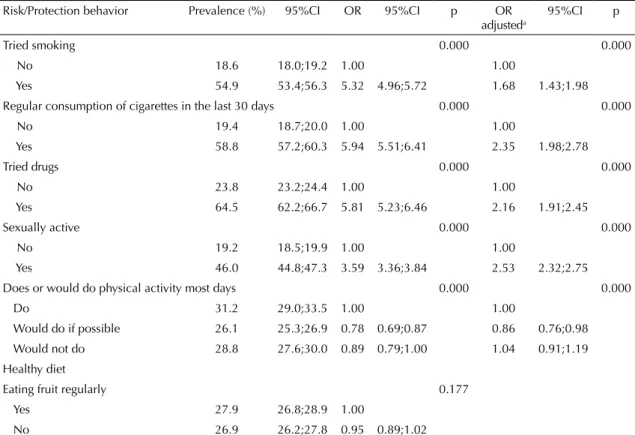
Regarding protection and risk behavior in adolescents, regular consumption of alcohol in the 30 days preceding the survey was higher among those who had tried smoking, those who had taken drugs at least once and those who had become sexually active. Those adoles-cents who did physical activity when they had the oppor-tunity consumed alcohol less frequently. There was no link with healthy eating (eating fruit regularly) (Table 2).
With regards to the school context, all of the variables were independently associated with alcohol. Regular consumption in the preceding 30 days was higher in private schools, in students who played truant and among those who suffered bullying at school (Table 3).
mother and/or father; less frequently eating meals with mother or guardian during the week; parents or guard-ians not being aware of what the student did most of the time; parents who did not care is the students drank; violence at the hands of adult family members (Table 4).
Table 5 shows the inal model. After adjusting for all vari -ables the following ceased to be signiicant: “doing phys -ical activity”, “being bullied” and “living with father and/ or mother”. Higher alcohol consumption in the preceding 30 days was independently associated with students aged 15 and over, being female, white, mothers having higher levels of schooling, attending private school, having tried smoking and drugs and having become sexually active. Factors related to family were: playing truant, parents unaware of what the student did in their free time, eating fewer meals with parents, reporting that parents did not care, or cared little, if they came home drunk and having suffered domestic violence.
DISCUSSION
Around a quarter of students who participated in the PeNSE had consumed alcohol regularly in the preceding 30 days. The prevalence of regular alcohol
consumption, deined as having drunk alcohol on at least one day of the last 30, after controlling for all vari-ables in the model, was shown to be associated with female adolescents, older students, and adolescents whose mothers have higher levels of schooling. With regards the school context, playing truant and attending a private school were independently associated with a greater likelihood of consuming alcohol. Regarding the domestic context, the parents or guardians not being aware of what the student did in their free time, of not caring whether the student drank, not eating together often or students reporting having suffered domestic violence were associated with a greater chance of the adolescents consuming alcohol. Of the other risk and protection factors, regular alcohol consumption was higher among those who smoked regularly, who had tried drugs and who were sexually active.
Other national and international studies have shown high regular alcohol consumption among adolescents. In Pelotas, RS, Southern Brazil, a cross-sectional study in 2005/2006 showed that 23.0% of adolescents aged between 11 and 15 had consumed alcohol in the month preceding the study.27 In the United States, a national study, Youth Risk Behavior Survey, revealed
Table 1. Prevalence of regular alcohol consumption in school students according to sociodemographic characteristics and risk and protection behaviors. Brazil, 2009.
Sociodemographic
characteristics Prevalence (%) 95%CI OR 95%CI p adjustedOR a
95%CI p
Total 27.3 26.7;28.8
Sex 0.013 0.000
Male 26.5 25.6;27.4 1.00 1.00
Female 28.1 27.2;29.0 1.08 1.02;1.16 1.23 1.14;1.32
Age (years) 0.000 0.000
< 13 13.9 10.0;19.1 0.63 0.43;0.93 0.66 0.43;1.01
13 20.4 19.2;21.6 1.00 1.00
14 24.6 23.7;25.5 1.27 1.16;1.39 1.30 1.18;1.44
15 35.9 34.3;37.4 2.19 1.97;2.42 2.40 2.14;2.69
16 and over 42.3 40.3;44.3 2.86 2.56;3.20 3.41 3.0;3.87
Race/Color 0.000 0.000
White 27.9 26.8;29.0 1.00 1.00
Black 30.1 28.3;31.9 1.11 1.01;1.23 0.98 0.87;1.10
Mixed race 25.7 24.7;26.6 0.89 0.83;0.96 0.83 0.76;0.90
Asiatic 28.6 25.4;32.0 1.03 0.87;.23 0.96 0.80;1.17
Indigenous 29.9 27.1;32.9 1.10 0.95;1.28 1.02 0.87;1.20
Maternal schooling 0.019 0.000
Finished university 29.5 28.0;31.1 1.00 1.00
Did not finish university 28.0 26.7;29.3 0.93 0.84;1.02 0.88 0.79;0.97
Did not finish high school 25.6 24.0;27.3 0.82 0.73;0.92 0.73 0.64;0.82
Did not finish elementary 28.2 26.9;29.6 0.94 0.85;1.04 0.76 0.68;0.85
No schooling 27.3 23.8;31.1 0.90 0.74;1.09 0.63 0.51;0.77
that 37.9% of adolescents aged between 14 and 17 had drunk alcohol in the preceding month, with a preva-lence of 30.3% in 9th grade students,11 higher than the level found in Brazil. These data show the scale of the problem of alcohol consumption among adolescents in Brazil and in other countries, something that should be monitored in order to acquire better understanding of the situations related to its use.13,c
The PeNSE study showed that age is independently associated with regular alcohol consumption in students, corroborating international literature,11,b and tending to be more accentuated in students inishing high school and in higher education, decreasing after graduation.4,11,13,16
The higher prevalence in female adolescents (OR = 1.72) stands out, differing from studies in other countries. The Health Behavior in School Aged Children published
Table 2. Prevalence of regular alcohol consumption in school students according to risk and protection behaviors. Brazil, 2009.
Risk/Protection behavior Prevalence (%) 95%CI OR 95%CI p OR
adjusteda
95%CI p
Tried smoking 0.000 0.000
No 18.6 18.0;19.2 1.00 1.00
Yes 54.9 53.4;56.3 5.32 4.96;5.72 1.68 1.43;1.98
Regular consumption of cigarettes in the last 30 days 0.000 0.000
No 19.4 18.7;20.0 1.00 1.00
Yes 58.8 57.2;60.3 5.94 5.51;6.41 2.35 1.98;2.78
Tried drugs 0.000 0.000
No 23.8 23.2;24.4 1.00 1.00
Yes 64.5 62.2;66.7 5.81 5.23;6.46 2.16 1.91;2.45
Sexually active 0.000 0.000
No 19.2 18.5;19.9 1.00 1.00
Yes 46.0 44.8;47.3 3.59 3.36;3.84 2.53 2.32;2.75
Does or would do physical activity most days 0.000 0.000
Do 31.2 29.0;33.5 1.00 1.00
Would do if possible 26.1 25.3;26.9 0.78 0.69;0.87 0.86 0.76;0.98
Would not do 28.8 27.6;30.0 0.89 0.79;1.00 1.04 0.91;1.19
Healthy diet
Eating fruit regularly 0.177
Yes 27.9 26.8;28.9 1.00
No 26.9 26.2;27.8 0.95 0.89;1.02
a OR adjusted for all factors included in the table and for age and gender (except healthy diet – eating fruit regularly).
Table 3. Prevalence of regular alcohol consumption in school students according to school context variables. Brazil, 2009.
School context variables Prevalence (%) 95%CI OR 95%CI p OR
adjusteda
95%CI p
Administration 0.000 0.000
Private 29.5 28.2;30.8 1.00 1.00
Public 26.8 26.1;27.5 0.87 0.81;0.94 0.65 0.60;0.71
Played truant in the last 30 days 0.000 0.000
No 23.5 22.9;24.2 1.00 1.00
One or two days 41.1 39.1;43.1 2.27 2.07;2.48 2.13 1.93;2.34
Three or more days 52.3 49.1;55.5 3.57 3.12;4.08 3.12 2.72;3.59
Victim of bullying 0.000 0.000
Never 26.4 25.7;27.2 1.00 1.00
Rarely/Sometimes 28.8 27.5;30.1 1.12 1.04;1.21 1.16 1.08;1.26
Most of the time/Always 31.8 28.9;34.8 1.30 1.13;1.49 1.30 1.12;1.52
the results of a comparative study conducted in around 40 countries and differences in prevalence of regular alcohol use in the preceding week. In school students aged 15, the prevalence was 17.0% in females and 25.0% in males. There were only two countries in which the prevalence in females was slightly higher than in males, these being, respectively, 8.0% and 7.0% in Finland and 8.0% and 6.0% in Greenland.b Some authors argue that the fact that female adoles-cents begin to drink at a younger age may be related to puberty beginning earlier than in male adolescents. As age increases, this situation reverses itself. As young people aged 14 predominated in the PeNSE sample, this inding should be considered a stage of adolescence, and not a fact that lasts during the entire adolescence.26
A review22 indicated that white students in the United States generally had better socioeconomic conditions and reported heavy consumption of alcohol more frequently.
After controlling for other variables, the study showed that white students consumed alcohol more frequently, whereas being of mixed race was a protective effect. In general, white students had higher socioeconomic levels. There was an association between alcohol consumption in students and higher levels of schooling, a proxy of better socioeconomic levels.
Along the same lines, attending a private school represented a risk factor for alcohol consump-tion. However, PeNSE data which were not shown and were not adjusted for age and other variables showed the contrary: higher prevalence of regular alcohol consumption in public schools.d This can be explained by the fact that private schools have more students aged between 13 and 14 (86.8%), this being only 66.0% in public schools. After adjusting for age, this effect disappears and private schools are shown to be a greater risk for alcohol and other risk factors, such as smoking.2
Proxy variables for socioeconomic condition (higher levels of maternal schooling, white skin, studying in a private college) remained in the study’s inal model. Other authors have also shown an associa-tion between alcohol use and higher socioeconomic levels, which may be explained by greater acquisitive power and more access to such products, leading to more risk behaviors.1,29
In the school context, the study also showed that students who regularly consume alcohol miss more classes. The link between elevated alcohol consump-tion and performance at school, also measured through attendance, conirms the result of studies of adolescents in various countries. Consuming alcohol is associated
Table 4. Prevalence of regular alcohol consumption in school students according to domestic context variables. Brazil, 2009.
Domestic context variable Prevalence
(%)
95%CI OR 95%CI p OR
adjusteda
95%CI p
Family structure 0.000 0.025
Lives with mother and father 25.3 24.4;26.1 1.00 1.00
Lives with mother 29.8 28.7;31.0 1.25 1.17;1.34 1.11 1.03;1.20
Lives with father 31.0 28.1;34.0 1.32 1.14;1.53 1.18 0.99;1.4
Does not live with either parent 32.4 29.8;35.0 1.41 1.24;1.60 1.04 0.90;1.21
Eats meals with mother or guardian 0.000 0.000
Every day 24.7 23.9;25.6 1.00 1.00
At least one day 30.0 28.6;31.5 1.25 1.14;1.38 1.26 1.15;1.38
Rarely/Never 31.2 29.9;32.5 1.34 1.24;1.44 1.05 0.96;1.14
Parents or guardians know what student was doing in the last 30 days
0.000 0.000
Always/Mostly 23.2 22.4;24.0 1.00 1.00
Sometimes/Rarely/Never 32.6 31.6;33.6 1.43 1.33;1.54 1.39 1.29;1.49
Perception of parents’/guardians’ reactions to them drinking
0.000 0.000
Very bothered 24.6 24.0;25.3 1.00 1.00
Little bothered 63.6 60.4;66.8 5.36 4.65;6.18 4.65 4.00;5.41
Not bothered 64.6 58.3;70.5 5.60 4.27;7.34 4.22 3.11;5.73
Domestic violence 0.000 0.000
No 25.7 25.1;26.4 1.00 1.00
Yes 42.6 40.4;44.9 2.14 1.94;2.36 1.87 1.68;2.09
Table 5. Prevalence of regular alcohol consumption in school students according to sociodemographic variables, risk/protection behaviors and school and familiar contexts. Brazil, 2009.
Sociodemographic variables, risk/protection behaviors,
school and family contexts Reference category adjustedOR a
95%CI p
Sex Male 1.00 0.000
Female 1.72 1.56;1.89
Age (years) 13 1.00 0.000
< 13 0.74 0.42;1.29
14 1.10 0.98;1.23
15 1.46 1.27;1.68
16 and over 1.64 1.40;1.92
Race/Color White 1.00 0.001
Black 0.92 0.80;1.06
Mixed race 0.80 0.72;0.88
Asiatic 0.93 0.74;1.18
Indigenous 0.85 0.69;1.04
Maternal schooling Finished university 1.00 0.000
Did not finish university 0.90 0.79;1.03
Did not finish high school 0.73 0.62;0.85
Did not finish elementary education 0.76 0.66;0.88
No schooling 0.59 0.46;0.76
Tried smoking No 1.00 0.000
Yes 1.72 1.42;2.09
Regular consumption of cigarettes in the last 30 days No 1.00 0.000
Yes 2.16 1.76;2.64
Tried drugs No 1.00 0.000
Yes 1.81 1.56;2.11
Sexually active No 1.00 0.000
Yes 2.37 2.14;2.63
Does or would do physical activity most days Does 1.00 0.027
Would do 0.96 0.82 ;1.12
Would not do 1.10 0.93;1.30
Administration Private 1.00 0.000
Public 0.71 0.63;0.80
Played truant in the last 30 days No 1.00 0.000
One or two days 1.49 1.31;1.69
Three or more days 1.49 1.24;1.79
Victim of bullying Never 1.00 0.082
Rarely/Sometimes 1.12 1.01;1.23
Often/Always 1.10 0.90;1.35
Family structure Lives with father and
mother 1.00 0.424
Lives with mother 0.95 0.86;1.04
Lives with father 1.03 0.82;1.30
Does not live with either parent 0.88 0.73;1.06
Eats meals with mother or guardian Every day 1.00 0.001
One day 1.22 1.09;1.36
Rarely/Never 0.99 0.88;1.10
Parents or guardians know what student did in the last 30 days Always/Often 1.00 0.000
Sometimes/Rarely/Never 1.34 1.23;1.46
Perception of parents’ or guardians’ reactions to them drinking Very bothered 1.00 0.000
Little bothered 3.39 2.81;4.09
Not bothered 3.05 2.18;4.26
Domestic violence No 1.00 0.000
Yes 1.36 1.18;1.57
with worse performance at school, with lower grades, missing classes, dropping out of school and reduced expectations of educational progression, such as to higher education.25
Although there are international studies5 describing an association between bullying and alcohol, this was not conirmed in this study.
The coexistence of behaviors placing health at risk also occurs in adolescence. Alcohol use is consistently associated with various risk behaviors, such as drug use and smoking.2,12,17 The coexistence of unhealthy habits is also found in young adults.3 Consumption, intensity of consumption and being underage when starting to consume alcohol and other drugs were independently associated with sexual experimenta-tion and teenage pregnancy in a study using data from the Youth Risk Behavior Surveillance System, in the United States.6
A national study highlights the beneits of doing phys -ical activity in preventing risk factors, such as smoking,2 however, our indings did not conirm this associa -tion after adjusting for all variables in the model. The family is the fundamental environment for adolescents’ development, being the most important context for the emergence of health related concepts. Studies show that children of parents who are more attentive to the activi-ties their child does are less likely to become involved with alcohol, drugs and tobacco.10,18,21
The fact that the adolescents considered that 93.0% of parents would be bothered if they were to come home drunk shows that parents who concern themselves with their children’s attitudes discourage attitudes deemed to be risky. In the multivariate analysis, variables related to parental supervision remained strongly associated with alcohol use in students.
Studies have indicated that family supervision exercises a protective effect against drug and alcohol use.9,18,21 The data analyzed conirm these indings and show that parents’ interest in their children’s free time activities and friends is a practice which decreases risk behavior in adolescence, such as alcohol consumption.
Family interaction and cohesion, as with activities carried out together, prevent alcohol and drug use in adolescents,18,21 juvenile delinquency, depression and psychosomatic symptoms.9,b Thus, the indicator of family interaction (eating meals with parents) repre-sents a protection factor for alcohol consumption.
The variable living with father and/or mother was not shown to be associated, possibly because of co-linearity between the other variables measuring family supervision.
PeNSE is the largest survey of school students in Brazil, both in terms of the sample size and the topics researched. However, as it was only conducted in the state capitals and the Federal District, it is possible that the characteristics analyzed here may not relect the school student population in smaller cities. But, as the majority of Brazilians live in medium sized and large municipalities, it is possible that the reality exam-ined here does relect that of the majority of 9th grade students in this country. Another limitation consists in the use of regular alcohol consumption as a contin-uous variable (number of servings in the preceding 30 days) and as a categorical variable (drink alcohol or not drink alcohol), there possibly being different patterns of alcohol consumption which were not considered.
The results of this study broaden relection on the complex relationship between country, family, school and risk taking behavior in adolescents. Causal linearity cannot be established, as there are a variety of situa-tions and variables which were not included in this study, such as, for example, relationships with class-mates and friends.
The results show the seriousness of alcohol consumption in adolescents, showing the earliness of exposure, the scale and associated factors. The consumption of alcohol by young people is a complex phenomenon, linked to various contexts, and it is important to promote studies which may verify associations and indicate trends.
In many countries, alcohol consumption is socially acceptable and encouraged, which makes preventative actions using regulatory measures dificult.a Studies have indicated the importance of regulatory policies concerning the advertising of alcoholic beverages, including beer, as well as measures affecting point of sale, establishments which sell alcoholic drinks having to close by a certain time, training staff and managers, warnings on labels and taxing alcohol, aiming to reduce young people’s exposure to and, consequently, their consumption of these products.e
Alcohol in adolescence is a complex, multi-faceted and socially determined phenomenon. There are a variety of factors which contribute to explaining alcohol use, including the contexts of the school environment, the family and sociodemographic factors, as well as others which are not examined here, such as relationships with friends and other adolescents. Health promoting public policies preventing alcohol use should be coor-dinated with the involvement of various social actors, the authorities, educators, the family and society in general. It is urgent that society become involved in the debate concerning alcohol consumption by adoles-cents, aiming to improve existing public policies, from regulation of provision to sales.
1. Alwan H, Viswanathan B, Rousson V, Paccaud F, Bovet P. Association between substance use and psychosocial characteristics among adolescents of the Seychelles.
BMC Pediatr. 2011;11:85.
2. Barreto SM, Giatti L, Casado L, Moura L, Crespo C, Malta DC. Contextual factors associated
with smoking among Brazilian adolescents. J
Epidemiol Community Health. 2011;66(8):723-9. DOI:10.1136/jech.2010.122549
3. Barreto SM, Passos VM, Giatti L. Healthy behavior among Brazilian young adults.
Rev Saude Publica. 2009;43(Suppl 2):9-17. DOI:10.1590/S0034-89102009000900003
4. Breslow R & Smothers A. Drinking patterns and Body Mass Índex in never smokers. National Health Survey,
1977-2001. Am J Epidemiol. 2005;161(4):368-76.
DOI:10.1093/aje/kwi061
5. Carlyle KE, Steinman KJ. Demographic differences in the prevalence, co-occurrence, and correlates of adolescent bullying at school. J School Health. 2007;77(9):623-9. DOI:10.1111/j.1746-1561.2007.00242.x 6. Cavazos-Rehg PA, Krauss MJ, Spitznagel EL,
Schootman M, Cottler LB, Bierut LJ. Substance use and the risk for sexual intercourse with and without a history of teenage pregnancy among adolescent females. J Stud Alcohol Drugs. 2011;72(2):194-8. 7. Commitee on Substance Abuse. Alcohol use by youth
and adolescents: a pediatric concern. Pediatric. 2010;125(5):1078-87. DOI:10.1542/peds.2010-0438 8. Cooper ML. Alcohol use and risky sexual behavior
among college students and youth: evaluating the evidence. J Stud Alcohol Suppl. 2002;(14):101-17. 9. De Micheli D, Formigoni ML. Drug use by
Brazilian students: associations with family, psychosocial, health, demographic and behavioral characteristics. Addiction. 2004;99(5):570-8. DOI:10.1111/j.1360-0443.2003.00671.x
10. DiClement RJ, Wingood GM, Crosby R, Sionean C, Cobb BK, Harrington K, et al. Parental monitoring: association with adolescents’ risk. Pediatrics. 2001;107(6):1363-8.
11. Eaton DK, Kann L, Kinchen S, Shanklin S, Flint KH, Hawkins J, et al. Youth risk behavior surveillance
– United States, 2011. MMWR Surveill Summ.
2012;61(4):1-162.
12. Faeh D, Viswanathan B, Chiolero A, Warren W, Bovet P. Clustering of smoking, alcohol drinking and cannabis use in adolescents in a rapidly developing
country. BMC Public Health. 2006;27(6):169.
DOI:10.1186/1471-2458-6-169
13. Giancola PR. Alcohol related aggression during the college years: Theories, risk factors and policy implications. J Stud Alcohol Suppl. 2002;(14):129-39. 14. Horta RL, Horta BL, Pinheiro RT. Drogas: famílias
que protegem e que expõem adolescentes ao risco. J Bras Psiquiatr. 2006;55(4):268-72. DOI:10.1590/S0047-20852006000400002
15. Johnston LD, O’Malley PM, Bachman JG. Monitoring the future: national survey results on drug use, 1975–2001. Volume 1: secondary school students. Bethesda: National Institute on Drug Abuse, National Institutes of Health; 2002.
16. Karam E, Kypri K, Salamoun M. Alcohol use among college students: an international perspective. Curr Opin Psychiatry. 2007;20(3):213-21.
17. Leatherdale ST, Hammond D, Ahmed R. Alcohol, marijuana, and tobacco use patterns among youth in
Canada. Cancer Causes Control. 2008;19(4):361-9.
DOI:10.1007/s10552-007-9095-4
18. Malta DC, Porto DL, Melo FCM, Monteiro RA, Sardinha LMV, Lessa BH. Família e proteção ao uso de tabaco, álcool e drogas em adolescentes, Pesquisa Nacional de Saúde dos Escolares.
Rev Bras Epidemiol. 2011;14(Supl 1):166-77. DOI:10.1590/S1415-790X2011000500017
19. Malta DC, Sardinha LMV, Mendes I, Barreto SM, Giatti L, Castro IRR, et al. Prevalência de fatores de risco e proteção de doenças crônicas não
transmissíveis em adolescentes: resultados da Pesquisa Nacional de Saúde do Escolar (PeNSE), Brasil, 2009.
Cienc Saude Coletiva. 2010;15(Supl 2):3009-19. DOI:10.1590/S1413-81232010000800002
20. Modelli MES, Pratesi R, Tauil PL. Blood alcohol concentration in fatal traffic accidents in the Federal District, Brazil. Rev Saude Publica. 2008;42(2):350-2. DOI:10.1590/S0034-89102008005000012
21. Paiva FS, Ronzani TM. Estilos parentais e consume de drogas entre adolescentes: revisão sistemática. Psicol Estud. 2009;14(1):177-83. DOI:10.1590/S1413-73722009000100021 22. Perkins HW. Surveying the damage: a review of
research on consequences of alcohol misuse in college populations. J Stud Alcohol. 2002;(14):91-100. 23. Rohde P, Lewinsohn PM, Seeley JR. Psychiatric
comorbidity with problematic alcohol use in high school students. J Am Acad Child Adolesc Psychiatry. 1996;35(1):101-9. DOI:10.1097/00004583-199601000-00018 24. Sale E, Sambrano S, Springer JF, Peña C, Pan W,
Kasim R. Family protection and prevention of alcohol use among Hispanic youth at high risk.
Am J Community Psychol. 2005;36(3-4):195-205. DOI:10.1007/s10464-005-8614-2
25. Schmid H, Bogt TT, Godeau E, Hublet A, Dias SF, Fotiou A. Drunkenness among young people: a cross-national comparison. J Stud Alcohol.
2003;64(5):650-61.
26. Schulte MT, Ramo D, Brown SA. Gender differences in factors influencing alcohol use and drinking
progression among adolescents. Clin Psychol Rev.
2009;29(6):535-47. DOI:10.1016/j.cpr.2009.06.003 27. Strauch ES, Pinheiro RT, Silva RA, Horta BL.
Uso de álcool por adolescentes: estudo de base
populacional. Rev Saude Publica. 2009;43(4):647-55.
28. Stueve A, O’Donnell LN. Early alcohol initiation and subsequent sexual and alcohol risk behaviors among
urban youths. Am J Public Health. 2005;95(5):887-93.
DOI:10.2105/AJPH.2003.026567