Danielle Souto de MedeirosI Cristiano Soares de MouraII Mark Drew Crosland GuimarãesIII Francisco de Assis AcurcioIV
I Núcleo de Epidemiologia e Saúde Coletiva.
Instituto Multidisciplinar em Saúde. Universidade Federal da Bahia. Vitória da Conquista, BA, Brasil
II Division of Clinical Epidemiology. McGill
University Health Center. McGill University. Montrèal, Canada
III Departamento de Medicina Preventiva e
Social. Faculdade de Medicina. Universidade Federal de Minas Gerais. Belo Horizonte, MG, Brasil
IV Departamento de Farmácia Social.
Faculdade de Farmácia. Universidade Federal de Minas Gerais. Belo Horizonte, MG, Brasil
Correspondence:
Danielle Souto de Medeiros Instituto Multidisciplinar em Saúde Universidade Federal da Bahia Campus Anísio Teixeira
Rua Rio de Contas, 58 Quadra 17 Lote 58 Candeias
45055-090 Vitória da Conquista, BA, Brasil E-mail: [email protected] Received: 3/6/2013
Approved: 6/1/2013
Article available from: www.scielo.br/rsp
Medication use by the
“quilombola” population: a
survey in Southwestern Bahia,
Brazil
ABSTRACT
OBJECTIVE: To characterize the medication use by the quilombola population.
METHODS: A population-based cross-sectional study was conducted with
797 adult quilombola in Vitória da Conquista, BA, Northeastern Brazil, in
2011. Analysis of variance was used to compare means of drugs by subject, according to demographic, socioeconomic and health-related behavior
variables. Prevalence, prevalence ratios and their 95% conidence intervals
were estimated. Multivariate analysis was carried out using Poisson regression with robust variance.
RESULTS: The most widely consumed drugs by the population were those for the cardiovascular and nervous systems. Prevalence of medication use was
41.9%, signiicantly higher among women (50.3%) than men (31.9%). After
adjusted analysis, medication use was associated with being female gender, being aged 60 or older, higher economic level, worse self-rated health, greater number of self-reported diseases and number of medical appointments.
CONCLUSIONS: Strategies to improve rational drug use should preferentially focus on women and older adults. Thus, special attention should be given to promote rational prescription in everyday health services.
Medications are important therapeutic instruments used in the disease/health process. They are among the most commonly used interventions and of great value in treating diseases, increasing survival and improving quality of life.6 Their use is inluenced by demographic
structure and socio-economic and cultural factors.
2-6,10-12 The use of prescription and non-prescription
medications is greater among women and older people, making them more susceptible to drug interactions and inappropriate use.3,10-12 Most Brazilian studies on this topic have been carried out in the South and Southeast of the country,5-8,10-12 in urban areas1,2,4,5,7,8 and limited
to a speciic age group.4,6,8,10-12
In the literature available there is a lack of epidemiological studies that characterize the situation and use of
medica-tions in speciic populamedica-tions in rural areas and in other
regions of Brazil, especially in the Northeast. There are different patterns of medication use, which change over
time and according to changes in the proile of diseases
and in health policies. Regular local investigations are needed, which enable data on medication use to be
iden-tiied, monitored and produced for speciic populations.
Obtaining information on medication use in the
quilombola population is important in identifying the problems that exist in this area and factors associated with their use. This population lives in a context char-acterized by exclusion, by denial of their natural right to belong and, as they are mainly located in rural areas,
by geographical dificulty.9,15 This context determines
speciic conditions of vulnerability and inequalities
in health care and subsidized the development and
implementation of speciic afirmative policies for the
black and quilombola communities.a,b,c
This study aimed to describe the use of medications by
the population of quilombola communities.
METHODS
This was a cross-sectional population based study
using data from the COMQUISTA project (Quilombola
Communities from Vitória da Conquista: Evaluation of
Living conditions – Comunidades Quilombolas de Vitória
INTRODUCTION
da Conquista: Avaliação de Condicionantes de Saúde), in
Vitória da Conquista, BA, Northeastern Brazil, in 2011.d
The 797 participants were selected using probabilistic
two-stage sampling: i) proportional division between the ive districts that contain quilombola communi-ties, according to the population and selection of each community, chosen through simple random selection;
ii) random selection of residences according to the
proportional distribution per district. Residents aged 18 and over in the selected residences were invited to take part in the research.
When calculating the sample size, the following were considered: an estimated prevalence of 50.0% given the heterogeneity of the events measured, accuracy of 5%,
95% conidence interval (95%CI) and a design effect of 2. An extra 30.0% was added to the number obtained, to
cover losses, producing a sample size of 884 individuals. Details of the survey’s sampling process can be found in another publication.d The losses encountered (15.5%) were smaller than forecast in the beginning of the study,
but signiicantly higher among males and younger indi
-viduals (18 to 34 years old). The main reasons for losses
were not being in the residence and refusals.
The data were obtained using a semi-structured
ques-tionnaire adapted from the National Health Survey.e
A pilot study was carried out to verify the recruitment dynamic, test the data collection instruments and
conirm the viability of the investigation. Individual
interviews were carried out at the homes and applied
using laptop computers (HP Pocket Rx5710) between
September and October 2011.
The dependent variable was medication use, obtained based on the following question: “In the last 15 days have you used any medications?”, checked by the presentation of packaging or prescription. For those who responded yes, the name, pharmaceutical form and dosage of each were recorded, and whether or not they had been
prescribed by a health care professional (doctor, dentist or nurse). The medications were classiied according to the Anatomical Therapeutic Chemical (ATC) Classiication
System,f levels 1 (anatomical) and 2 (therapeutic). The a Ministério da Saúde. Portaria no 992/GM, de 13 de maio de 2009. Institui a Política Nacional de Saúde Integral da População Negra. Diario Oficial Uniao. 14 mai 2009 [cited 2012 Feb 25]. Available from: http://bvsms.saude.gov.br/bvs/saudelegis/gm/2009/prt0992_13_05_2009.html
b Brasil. Lei ordinária nº 12.288, de 20 de julho de 2010. Institui o Estatuto da Igualdade Racial; altera as Leis nº 7.716, de 5 de janeiro de
1989, 9.029, de 13 de abril de 1995, 7.347, de 24 de julho de 1985, e 10.778, de 24 de novembro de 2003. Diario Oficial Uniao. 21 jul 2010 [cited 2012 Feb 25]:1. Available from: http://www.planalto.gov.br/ccivil_03/_Ato2007-2010/2010/Lei/L12288.htm
c Secretaria Especial de Políticas de Promoção da Igualdade Racial. Programa Brasil Quilombola. Brasília (DF): Abaré; 2004 [cited 2010 May
12]. Available from: http://bvsms.saude.gov.br/bvs/publicacoes/brasilquilombola_2004.pdf
d Bezerra VM, Medeiros DS, Gomes KO, Souzas R, Giatti L, Guimarães MDC et al. Inquérito de Saúde em Comunidades Quilombolas de
Vitória da Conquista/BA (Projeto COMQUISTA): aspectos metodológicos e análise descritiva. Cienc Saude Coletiva [internet]. 2013 ago [cited 2013 Ago 2]. Available from: http://www.cienciaesaudecoletiva.com.br/artigos/artigo_int.php?id_artigo=12327
e Ministério da Saúde. Pesquisa Nacional de Saúde (PNS). Inquérito Região Integrada do Distrito Federal (RIDE/DF). Brasília (DF); 2011 [cited
2011 Apr 02]. Available from: http://www.pns.icict.fiocruz.br/index.php?pag=proposicao
f World Health Organization. Anatomical therapeutic chemical (ATC) classification index with defined daily doses (DDD’s) 2000. Oslo; 2000
medications were classiied by their presence, or not,
in the Relação Municipal de Medicamentos Essenciais
(REMUMEg – Municipal List of Essential Medicines) in force at the time. The units of analysis were the individual and the medications. The mean number of medications per interviewee was used as an indicator of intensity of use. Each medication was broken down by principle active ingredients with the help of the Pharmaceutical
Specialties Dictionaryh in order to calculate the mean
number of active ingredients per interviewee.
Independent variables were age, marital status,
schooling, work status, economic level (economic classiication deined by the Associação Brasileira de Empresas de Pesquisa (Brazilian Institute of Research
Companies),i self-perceived state of health, number of self-reported morbidities, frequency of home visits form a community health worker or health care profes-sional and number of medical appointments in the preceding 12 months. The number of morbidities was
deined based on adding the interviewee’s self-reported morbidities and included in the questionnaire (hyper -tension, diabetes, hypercholesterolemia, heart disease, stroke, asthma or asthmatic bronchitis, arthritis, chronic spinal problems, tuberculosis, depression, other mental
disease, lung disease and osteoporosis). Gestational
hypertension or diabetes were not considered.
Differences between the means of active ingredients per interviewee were compared using variance analysis. The prevalence of medication use was calculated based on the number of participants who responded having used at least one medication in the 15 days preceding the interview divided by the total number of interviewees. The Prevalence Ratio was used as an estimate of association between medication use and the explanatory variables in question. This measure and its 95%CI were estimated using Poisson regres-sion with robust variance. Poisson multiple regresregres-sion with robust variance was used to obtain estimates of the prevalence ratios for medication use, adjusted for potential confounding factors. Those variables which had an association with medication use with a level
of signiicance < 20% in the univariate analysis were included in the initial model. A level of signiicance
of 5% was used for the tests and to judge whether the
variables would remain in the inal model. Models were compared using Akaike’s Information Criterion (AIC) and Bayesian Information Criterion (BIC). The it of
the model was evaluated using Chi-square test. The R program, version 2.11.1 was used to analyze the data.
The research was approved by the Research Ethics
Committee of the Faculdade São Francisco de
g Secretaria Municipal de Saúde de Vitória da Conquista. Comissão de Farmácia e Terapêutica. Relação Municipal de Medicamentos
Essenciais: REMUME 2010. Vitória da Conquista; 2010.
h Dicionário de Especialidades Farmacêuticas: DEF 2011/12. 40 ed. Rio de Janeiro: EPUC; 2011.
i Associação Brasileira de Empresas de Pesquisa. Critérios de classificação econômica no Brasil. São Paulo; 2012 [cited 2012 Mar 21].
Available from: http://www.abep.org/novo/Content.aspx?ContentID=301
Barreiras (CAAE 0118.0.066.000-10, on 29/10/2010)
and of the Universidade Federal de Minas Gerais
(CAAE 0118.0.066.203-10, on 13/7/2011), and
followed the standards set by the Declaration of
Helsinki and by Resolution 196/96 of Conselho
Nacional de Saúde. Participants were informed of the research objectives and procedures beforehand and
assured of the conidentiality of all data by reading the
informed consent form, expressing their agreement to take part in the study.
RESULTS
Among the 797 adult individuals who responded to the
survey, 54.3% were female; the majority were aged between 35 and 59 years old (41.5%). More than half (61.4%) cohabited and 72.4% had up to four complete years of schooling (Table 1). The majority were unem -ployed and 85.6% belonged to economic class D or E. The predominant self-perception of health was good or very good and 41.2% of the interviewees reported having none of the morbidities in question. With regards to health care service use, half of the participants had
not seen a doctor and 50.3% of them had received a
monthly visit from a community health worker or health care professional. The frequency of medication use was
41.9% (95%CI 38.5;45.4).
Participants used 714 different types of medicine,
corresponding to 853 active ingredients (mean = 1.1
active ingredients/individual; standard deviation – 1.7;
range = 0 to 15). The majority of medications had been prescribed by a doctor, dentist or nurse (83.3%) and
70.0% of them appeared in REMUME.
The most commonly used medications belonged to Cardiovascular, Nervous and Musculo-skeletal system,
and Alimentary tract and metabolism (Table 2), with
means of consumption higher for these groups. The most commonly used therapeutic subgroup were
diuretics (mean of 0.15/individual), followed by agents acting on the renin-angiotensin system (0.13), analge
-sics (0.08) and anti-inlammatory and antirheumatic products (0.07). Drugs used in diabetes predominated
in Alimentary tract and metabolism.
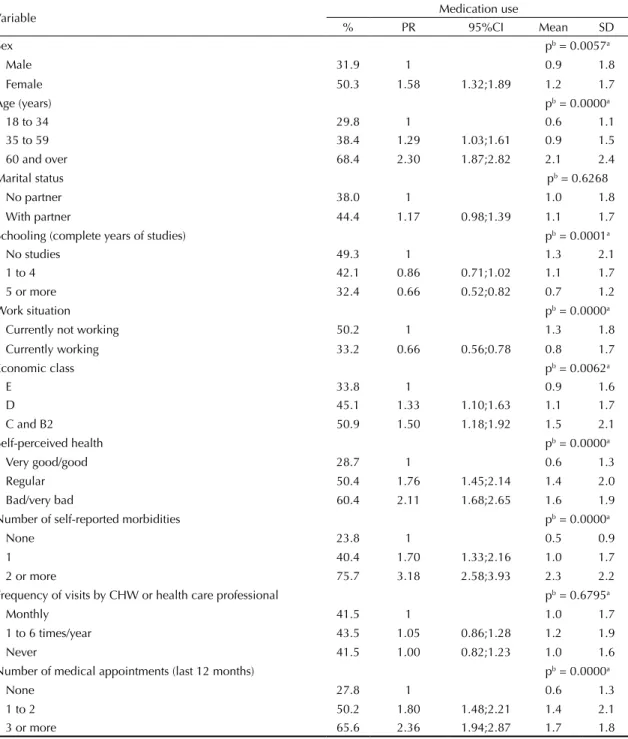
The prevalence of medication use was signiicantly higher in women than in men (50.3% and 31.9%, respectively) (Table 3). Medication use was positively and signiicantly associated with being female, older age groups, better economic level (classes D, C and B2), worse self-reported health, a higher number of
Table 1. Characteristics of the studied quilombola population. COMQUISTA Project, Vitória da Conquista, BA, Northeastern Brazil, 2011.
Variable Total
n %
Sex
Male 364 45.7
Female 433 54.3
Age (years)
18 to 34 289 36.3
35 to 59 331 41.5
60 and over 177 22.2
Marital status
No partner 308 38.6
With partner 489 61.4
Schooling (completed years of study)
0 274 34.6
1 to 4 299 37.8
5 and over 219 27.7
Work situation
Currently not working 408 51.2
Currently working 389 48.8
Economic class
E 275 34.8
D 401 50.8
C and B2 114 14.4
Self-perceived health state
Very good/good 356 44.8
Regular 337 42.4
Bad/very bad 101 12.7
Number of self-reported morbidities
None 328 41.2
1 280 35.1
2 or more 189 23.7
Frequency of visits by CHW or health care professional
Monthly 393 50.3
1 to 6 times/year 193 24.7
Never 195 25.0
Number of medical appointments (last 12 months)
None 399 50.1
1 to 2 247 31.0
3 or more 151 18.9
Use of medications (preceding 15 days)
No 463 58.1
Yes 334 41.9
CHW: community health worker
Table 2. Distribution of medications by group and subgroup according to anatomical and therapeutic classification (1st and
2nd levels of the ATC),a and ratio of number of medications
per individual. COMQUISTA Project, Vitória da Conquista, BA, Northeastern Brazil, 2011.
Anatomical and therapeutic
group n %
Number of medications per individual Alimentary tract and
metabolism
81 11.3 0.10
Drugs for acid-related disorders
18 2.5 0.02
Antiemetics and antinauseants
6 0.8 0.01
Drugs used in diabetes 33 4.6 0.04 Vitamins 13 1.8 0.02 Blood and blood forming organs 27 3.8 0.03 Antithrombotic agents 18 2.5 0.02
Antianemic preparations 8 1.1 0.01 Cardiovascular system 314 44.0 0.39 Cardiac therapy 10 1.4 0.01 Diuretics 118 16.5 0.15
Beta blocking agents 36 5.0 0.05 Calcium channel blockers 22 3.1 0.03 Agents acting on the
renin-angiotensin system
102 14.3 0.13
Lipid modifying agents 22 3.1 0.03 Genitourinary system and sex
hormones
26 3.6 0.03
Sex hormones and modulators of the genital system
23 3.2 0.03
Anti-infectives for systemic use 19 2.7 0.02 Antibacterials for systemic use 18 2.5 0.02 Musculo-skeletal system 80 11.2 0.10
Anti-inflammatory and antirheumatic products
56 7.8 0.07
Muscle relaxants 23 3.2 0.03 Nervous system 108 15.1 0.14 Analgesics 64 9.0 0.08
Antiepileptics 17 2.4 0.02 Psycholeptics 13 1.8 0.02 Respiratory system 27 3.8 0.03
Drug for obstructive airway diseases
7 1.0 0.01
Cough and cold preparations 7 1.0 0.01 Anti-histamines for systemic
use
13 1.8 0.02
Sensory organs 11 1.5 0.01 Ophthalmologicals 11 1.5 0.01 Total 714 100.0 0.90
a It includes anatomical therapeutic groups (1st ATC
level) with frequency above 2% and the most frequent therapeutic subgroups (2nd ATC level), totaling less than
appointments in the preceding 12 months (Table 3). A negative signiicant association was observed with having ive or more complete years of schooling and
being in work at the time of the interview.
The mean number of active ingredients taken by the
interviewees was signiicantly higher among females,
older ages groups, those with lower levels of schooling,
those who were out of work, those with a better economic level, with worse self-evaluated health, a higher number of reported diseases and medical
appointments (Table 3).
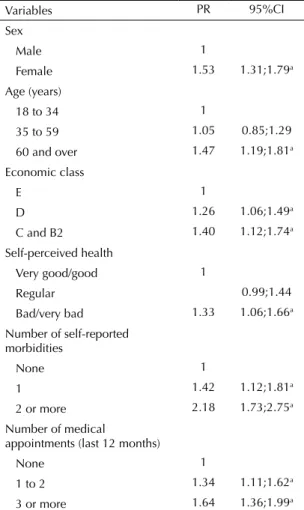
The following proved to independently associated with
more frequent medication use in the quilombola
popu-lation: a) being female; b) being aged 60 and over; c)
Table 3. Prevalence and prevalence ratio (PR) for medication use, mean and standard deviation (SD) for the number of active ingredients according to the variables analyzed. COMQUISTA Project, Vitória da Conquista, BA, Northeastern Brazil, 2011. (N = 797)
Variable Medication use
% PR 95%CI Mean SD
Sex pb = 0.0057a
Male 31.9 1 0.9 1.8
Female 50.3 1.58 1.32;1.89 1.2 1.7
Age (years) pb = 0.0000a
18 to 34 29.8 1 0.6 1.1
35 to 59 38.4 1.29 1.03;1.61 0.9 1.5
60 and over 68.4 2.30 1.87;2.82 2.1 2.4
Marital status pb = 0.6268
No partner 38.0 1 1.0 1.8
With partner 44.4 1.17 0.98;1.39 1.1 1.7 Schooling (complete years of studies) pb = 0.0001a
No studies 49.3 1 1.3 2.1
1 to 4 42.1 0.86 0.71;1.02 1.1 1.7
5 or more 32.4 0.66 0.52;0.82 0.7 1.2
Work situation pb = 0.0000a
Currently not working 50.2 1 1.3 1.8
Currently working 33.2 0.66 0.56;0.78 0.8 1.7
Economic class pb = 0.0062a
E 33.8 1 0.9 1.6
D 45.1 1.33 1.10;1.63 1.1 1.7
C and B2 50.9 1.50 1.18;1.92 1.5 2.1
Self-perceived health pb = 0.0000a
Very good/good 28.7 1 0.6 1.3
Regular 50.4 1.76 1.45;2.14 1.4 2.0
Bad/very bad 60.4 2.11 1.68;2.65 1.6 1.9 Number of self-reported morbidities pb = 0.0000a
None 23.8 1 0.5 0.9
1 40.4 1.70 1.33;2.16 1.0 1.7
2 or more 75.7 3.18 2.58;3.93 2.3 2.2
Frequency of visits by CHW or health care professional pb = 0.6795a
Monthly 41.5 1 1.0 1.7
1 to 6 times/year 43.5 1.05 0.86;1.28 1.2 1.9
Never 41.5 1.00 0.82;1.23 1.0 1.6
Number of medical appointments (last 12 months) pb = 0.0000a
None 27.8 1 0.6 1.3
1 to 2 50.2 1.80 1.48;2.21 1.4 2.1
3 or more 65.6 2.36 1.94;2.87 1.7 1.8
CHW: community health worker
higher socio-economic level, with dose-response gradient;
d) self-evaluating health as bad or very bad; e) higher
number of self-reported morbidities, with dose-response
gradient (Table 4). The values predicted by the models
were shown to be adequate to the observed values.
DISCUSSION
The frequency of medication use in this population
(41.9%) was lower than that observed in studies of adults in Fortaleza, CE, Northeastern Brazil (49.7%),1
Lorena, SP, Southeastern Brazil (51.3%),7 Pelotas,
RS, Southern (65.9%),2 and in Brazil (49.0%).3 This
may be partially explained by quilombola’s minor
access to medications, once they live in rural areas, where public health care services are generally limited. For those resident in more distant locations, with no regular provision of public transport, travelling from their place of residence to acquire medications can be
dificult.6 The percentage of medications present in REMUME was high as, in low income populations,
more prescription of medications available in municipal health care network pharmacies is common. In studies of the older adults in Brazil, lower levels of medication
use were found in small cities in the countryside (such as 69.1% in Bambuí, MG, Southeastern Brazil),10 in
areas of low socio-economic levels (the periphery of
Fortaleza, 60.7%)4 and in rural areas (Carlos Barbosa,
RS, Southern Brazil, 63.5%).6 Medication use in
quilombola communities do not seem to differ from that observed in rural or low income communities.
Medication use was more prevalent among women, which agrees with the literature.1,2-6,11 Sans et al13 explain that medication use is higher among women because of the higher frequency of medical appointments and the subsequent greater probability of health problems being detected and diagnosed. Moreover, various health
care programs (prenatal, breast cancer and cancer of the uterus prevention) are aimed at women, making
them more prone to medicalization.2 In this study, the
number of medical appointments was signiicantly
higher among women.
The most commonly used group of medications were those that acted on the cardiovascular, nervous and musculo-skeletal system, and alimentary tract and metabolism, in agreement with other population-based national studies5 and studies on older adult population.4,6,10-12 Other national studies on the adult population2,3 showed similar data, although the ATC system was not used to classify the medications, which limits comparisons.
Research in Catalonia,13 Spain, showed the same
thera-peutic groups, albeit in a different order of classiication,
with drugs used for the nervous system predominating. There is no set prescription standard, which depends on the characteristics of the health care system and of the population assessed. However, Ribeiro et al11 stated that it was possible that the prescriber takes on patterns of prescribing according to the age of the patients and according to ideological and market pressures, which would explain the similarities observed.
There were high levels of consumption of analgesics
and anti-inlammatory and antirheumatic products.
This may be explained by the greater tendency to self-medicate, common among users of these therapeutic
classes,14 partly due to their being over-the-counter
drugs and their sale being, often, irregular. In fact,
65.6% of analgesics and 46.4% of anti-inlammatory
and anti-rheumatic products had not been prescribed by a health care professional.
Medication use increased with age, a trend that is consistent with the literature2,3,5,7 and that may relect the higher prevalence of morbidities that occur with advancing age. This effect was confirmed in the adjusted analysis, in which this variable was indepen-dently associated with medication use.
Table 4. Prevalence ratios, adjusted for medication use, of the variables included in the final regression model. COMQUISTA Project, Vitória da Conquista, BA, Northeastern Brazil, 2011.
Variables PR 95%CI
Sex
Male 1
Female 1.53 1.31;1.79a
Age (years)
18 to 34 1
35 to 59 1.05 0.85;1.29 60 and over 1.47 1.19;1.81a
Economic class
E 1
D 1.26 1.06;1.49a
C and B2 1.40 1.12;1.74a
Self-perceived health
Very good/good 1
Regular 0.99;1.44
Bad/very bad 1.33 1.06;1.66a
Number of self-reported morbidities
None 1
1 1.42 1.12;1.81a
2 or more 2.18 1.73;2.75a
Number of medical
appointments (last 12 months)
None 1
1 to 2 1.34 1.11;1.62a
3 or more 1.64 1.36;1.99a
Schooling negatively inluenced the amount of medi
-cations used. This inding differed from those found among the elderly in Belo Horizonte, MG,11 and Rio de Janeiro, RJ,12 in the population of Fortaleza, CE,1 and of Brazil,3 but agrees with that found in the population of Pelotas, RS.2 The effect, however, did not persist after adjusting for the other variables. The communities in question were homogenous with regards to the level of
schooling (more than 70.0% had up to four complete years of schooling), which meant that the cutoff point
for this variable was lower than that adopted in other
studies, making comparisons dificult. Other factors
investigated, such as age, may also confound the association. In fact, an association was found between age and schooling, indicating that the proportion of individuals aged 60 and over, without schooling, was
75.7% (against 33.3% and 10.8% in the 35 to 59 and 18 to 34 age groups, respectively), and at the same time,
they used more medications.
Higher medication use among individuals in higher economic levels was consistent with the study by
Bertoldi et al,2 although level A and B1 were not
identiied in the quilombola population. Other studies that used monthly household income as an indicator of economic level1,6,10 found similar results. This
associa-tion was conirmed after adjusted analysis.
Medication use was lower among individuals who were working at the time of the interview, although this effect did not persist after adjusting for the other variables. Rural work has characteristics that may interfere in the use of medications. Dal Pizzol6 highlighted that rural workers, who remain laboring the whole day, may stop using one or more medications more frequently than those in urban environments if the use is made more
dificult by the conditions of rural work itself.
A trend was observed for the frequency and number of medications used to increase with worsening of health. Self-perception of health was shown to be negatively associated with medication use, in agreement with the
indings of other epidemiological studies.1,3,7,10-13 The
effect of this variable was conirmed in the adjusted
analysis. Another variable that indicates the health status of the population was the number of self-reported comorbidities, which shows individuals’ chronic health problems and which was associated with medication use even after adjustment.
The variables related to health care services, frequency of home visits from community health care workers or health care professionals and the number of medical appointments behaved differently. The frequency of home visits proved not to be associated with medication
use, even with the study population coming from a rural zone and considering this visit an opportunity in which medications could have been supplied.
Frequency of medication used increased as the number of medical appointments increased, even after adjust-ment, as had been indicated in other studies.1,11,12 Arrais et al1 suggested that this could be related to increasing medicalization of society, in which the majority of appointments end in a prescription. The Brazilian
Health Care System faces dificulties in overcoming the
practices of the bio-medical model, as the population value and prefer curative practices, individualized care based on prescriptions to activities promoting health and preventing health problems. Hand in hand with this practice often goes irrational use of medications, which can lead to a variety of problems, such as adverse
reactions, iatrogenic disease, resistance (antimicrobial)
and unnecessary costs.2
This study had some limitations. The use of a 15-day recall period to assess medication use was prioritized to enable comparison with other studies, as the majority used this period. However, this strategy may result in memory bias. To avoid this limitation, analysis was restricted to medications for which there was proof of use, through showing packaging or prescription. The differential loss, observed in males and in the 18
to 34 age group, may have caused an overestimate of
the use of medications by the overall population and by males, as lower consumption is expected in under-represented groups.
Assessment of individual determinants of consumption in quilombolas indicates that women, as well as the elderly, are the group with the greatest propensity to use medications; they should, therefore, be the groups
given preference when developing speciic strategies
for ensuring rational use. Higher numbers of medical
appointments also signiicantly increased medication
use, which reinforces the need to intensify promotional strategies in the day-to-day work of the health care
services. Knowing the proile of medication use in the
quilombola population is the irst step in understanding
access and discussing rational use. Aspects such as self-medicating and polypharmacy, as well as the lifestyle, beliefs and values of the quilombolas in seeking health care and using medication need to be investigated in greater detail.
ACKNOWLEDGEMENTS
1. Arrais PSD, Brito LL, Barreto ML, Coelho HLL. Prevalência e fatores determinantes do consumo de medicamentos no Município de Fortaleza, Ceará, Brasil. Cad Saude Publica. 2005;2(6):1737-46. DOI:10.1590/S0102-311X2005000600021
2. Bertoldi AD, Barros AJD, Hallal PC, Lima RC. Utilização de medicamentos em adultos: prevalência e determinantes individuais.
Rev Saude Publica. 2004; 38(2):228-38.
DOI:10.1590/S0034-89102004000200012
3. Carvalho MF, Pascom ARP, Souza-Júnior PRB, Damacena GN, Szwarcwald CL. Utilization of medicines by the Brazilian population, 2003.
Cad Saude Publica. 2005;21 Suppl 1:100-8.
DOI:10.1590/S0102-311X2005000700011
4. Coelho Filho JM, Marcopito LF, Castelo A. Perfil de utilização de medicamentos por idosos em área urbana do Nordeste do Brasil.
Rev Saude Publica. 2004;38(4):557-64.
DOI:10.1590/S0034-89102004000400012
5. Costa KS, Barros MBA, Francisco PMBS, César CLG, Goldbaum M, Carandina L. Utilização de medicamentos e fatores associados: um estudo de base populacional no Município de Campinas, São Paulo, Brasil. Cad Saude Publica. 2011;27(4):649-58. DOI:10.1590/S0102-311X2011000400004
6. Dal Pizzol Tda S, Pons Eda S, Hugo FN, Bozzetti MC, Sousa MLR, Hilgert JB. Uso de medicamentos entre idosos residentes em areas urbanas e rurais de municipio no Sul do Brasil: um estudo de base populacional. Cad Saude Publica. 2012;28(1):104-14. DOI:10.1590/S0102-311X2012000100011
7. Fleith VD, Figueiredo MA, Figueiredo KFLRO, Moura EC. Perfil de utilização de medicamentos em usuários da rede básica de saúde de Lorena,
SP. Cienc Saude Coletiva. 2008;13(Suppl):755-62.
DOI:10.1590/S1413-81232008000700026
8. Flores VB, Benvegnú LA. Perfil de utilização de medicamentos em idosos da zona urbana de Santa Rosa, Rio Grande do Sul, Brasil.
Cad Saude Publica. 2008; 24(6):1439-46.
DOI:10.1590/S0102-311X2008000600024
9. Guerrero AFH, Oliveira SD, Toledo LM, Guerrero JCH, Teixeira P. Mortalidade Infantil em Remanescentes de Quilombos do Munícipio de Santarém - Pará, Brasil. Saude Soc. 2007;16(2):103-10. DOI:10.1590/S0104-12902007000200010
10. Loyola Filho AI, Uchôa E, Firmo JOA, Lima-Costa MFF. Estudo de base populacional sobre o consumo de medicamentos entre idosos: Projeto Bambuí. Cad Saude Publica. 2005;21(2):545-53. DOI:10.1590/S0102-311X2005000200021
11. Ribeiro AQ, Rozenfeld S, Klein CH, César CC, Acurcio FA. Inquérito sobre uso de medicamentos por idosos aposentados, Belo Horizonte,
MG. Rev Saude Publica. 2008;42(4):724-32.
DOI:10.1590/S0034-89102008005000031
12. Rozenfeld S, Fonseca MJM, Acurcio FA. Drug utilization and polypharmacy among the elderly: a survey in Rio de Janeiro City, Brazil.
Rev Panam Salud Publica. 2008;23(1):34-43.
DOI:10.1590/S1020-49892008000100005
13. Sans S, Paluzie G, Puig T, Balañá L, Balaguer-Vintró I. Prevalencia del consumo de medicamentos en la población adulta de Cataluña. Gac Sanit. 2002;16(2):121-30.
14. Schmid B, Bernal R, Silva NN. Automedicação em adultos de baixa renda no município de São Paulo. Rev Saude Publica. 2010;44(6):1039-45. DOI:10.1590/S0034-89102010000600008
15. Silva JAN. Condições Sanitárias e de Saúde em Caiana dos Crioulos, uma Comunidade Quilombola do Estado da Paraíba. Saude Soc. 2007;16(2):111-24. DOI:10.1590/S0104-12902007000200011 REFERENCES
Article based on the doctoral thesis of Medeiros D.S., entitled: “Estudo de Utilização de Medicamentos pela População de Comunidades Quilombolas de Vitória da Conquista/BA”, presented to the Post-Graduate Program in Public Health of the Faculty of Medicine, Universidade Federal de Minas Gerais, in 2013.
This study was presented at the 10th Public Health Congress, Universidade Federal do Rio Grande do Sul, Porto Alegre, RS,
in 2012.
COMQUISTA Project was supported by the Ministério da Saúde/Conselho Nacional de Desenvolvimento Científico e
Tecnológico/Fundação de Amparo à Pesquisa, state of Bahia/Health Department of the state of Bahia, Terms of Award
no. 00017/2010. Projeto de Doutorado Interinstitucional (DINTER) financed by the Coordenação de Aperfeiçoamento de Pessoal de Nível Superior (CAPES), Edital 05/2009, Ação Novas Fronteiras.