Steerable Antegrade Stenting: A New Trick of the Trade
Udo Nagele, Aristotelis G. Anastasiadis, Bastian Amend, David Schilling, Markus Kuczyk,
Arnulf Stenzl, Karl-Dietrich Sievert
Department of Urology, University of Tuebingen, Tuebingen, Germany
ABSTRACT
Introduction: Whereas a retrograde attempt to insert an indwelling stent is performed in lithotomy position, usually renal access is gained in a prone position. To overcome the time loss of patient repositioning, a renal puncture can be performed in a modified lithotomy position with torqued truncus and slightly elevated flank. There is a two-fold advantage of this position: transurethral and transrenal access can be obtained using a combined approach. In the present study, this simple technique is used to position a floppy guide wire through a modified needle directly through the renal pelvis into the ureter. Materials and Methods: The kidney is punctured in the modified lithotomy position under sonographic control using an initial three-part puncture needle. A floppy tip guide-wire is inserted into the collecting system via the needle after retrieving the stylet. The retracted needle is bent at the tip while the guide-wire is secured in the needle and the collecting system. The use of the floppy tip guide-wire helps to insert the curved needle back into the kidney pelvis, which becomes the precise guidance for the now steerable wire. The desired steerable stent is positioned under radiographic control in a retrograde fashion over the endoscopically harbored tip of the guide-wire. Two patient cohorts (newly described method and conven-tional method) were compared.
Results: The presented steering procedure saves 16.5 mean minutes compared to the conventional antegrade stenting and 79.5 Euros compared to the control group.
Conclusion: The described combined antegrade-retrograde stent placement through a bent three-part puncture needle results in both clinical superiority (OR time, success rate) and financial benefits.
Key words: ureter; stent; nephrostomy; kidney Int Braz J Urol. 2007; 33: 389-394
INTRODUCTION
Retrograde ureteral stenting is a daily routine in endourologic procedures. Large prostatic glands, transitional cell carcinoma of the bladder, impacted ureteral stones, kidney transplants and orthotopic as well as incontinent diversions belong to those chal-lenging cases, where a successful retrograde stenting is not always possible; especially if the ureteral
ori-fice is involved in a pathological process, antegrade access is sometimes preferable.
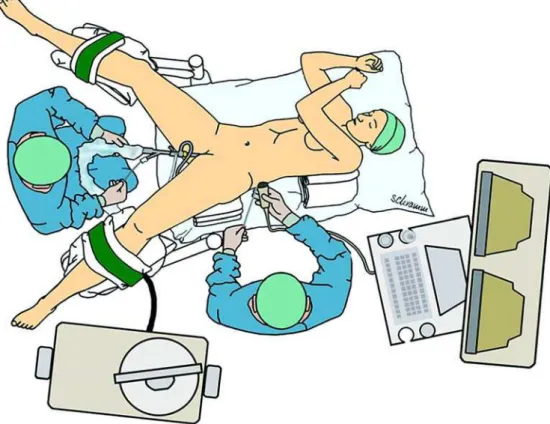
Whereas a retrograde attempt to insert an indwelling stent is normally done in the lithotomy tion, usually renal access is gained in the prone posi-tion. To overcome the time loss of patient reposition-ing, the renal puncture can be performed in a modi-fied lithotomy position with a slightly elevated flank. A major advantage of this position is the combined ap-proach transurethral and transrenal access (1).
This position, in particular, is the easiest way to gain a safe access below the 12th rib, in the lower
or middle calyx, resulting in an unfavorable angle to the pyeloureteral junction. Many different techniques are reported to solve this issue, such as j-shaped ure-teral catheters, “cobra” or “hook”-angiographic cath-eters, bent wires, peel-away sheets, assistance of rigid or flexible nephroscopes and dozens of other more or less useful and expensive tools (2).
This study demonstrates a simple technique by using only the puncture needle and a floppy guide-wire to pass the guide-guide-wire into the pyeloureteral junction.
MATERIALS AND METHODS
Patients Recruitment
A retrospective chart review was performed on 14 consecutive patients receiving an indwelling ureteral stent using the presented technique, which were compared to the following 15 consecutive pa-tients, who received the stent in the conventional tech-nique with the additional nephrostomy tube. Mean age in this group was 65.5 years (control group 67.5 years). Four patients had acute urinary retention (control = 6) and 10 had chronic hydronephrosis (control = 9), caused by malignancy in 6 patients (control = 6) vs. benign disease in 4 cases (control = 3).
OR time (puncture to successful introduction of the guide-wire in the ureter), success rate of the intubation of the proximal ureter, blood transfusions as well as complications in both groups were recorded and analyzed. Costs for each procedure were recorded and comparatively evaluated.
Surgical Technique
The patient is paced in a lithotomy position and the patient is slightly elevated at the site of the potential kidney puncture (Figure-1). A retrograde evaluation of the ureter is done. After deciding to use an antegrade or combined approach to place a ureteral stent, the kid-ney is punctured under sonographic control with a three-part puncture needle (Bard GMBH, Karlsruhe, Ger-many) 1.3 mm in diameter with MS-cut, thus facilitat-ing visibility in the ultrasound. Urine is collected for culture before radiopaque contrast medium is injected into the renal cavity. The renal pelvis, pyeloureteral junc-tion and calyces are identified; a sensor guide-wire (Boston Scientific, Nanterre Cedex, France) with a hydrophilic floppy tip is inserted into the collecting sys-tem via the needle after retrieving the stylet.
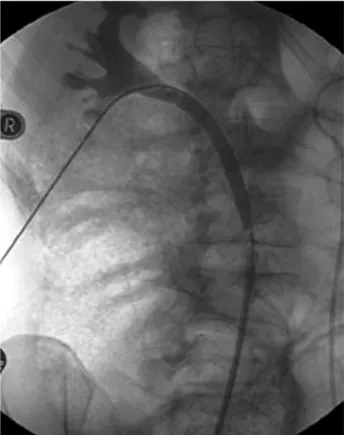
The retracted needle is bent at the tip at about 3-4 cm length in a smooth curvature (Figure-2) while the guide-wire is secured in the needle as well as in the collecting system. The use of the floppy wire re-sults in the possibility of inserting the curved needle once again into the kidney as the needle acts as a precise guidance for the now steerable floppy guide-wire (Figure-3).
The wire is guided through the ureter into the bladder and preferably harbored with an extracting forceps. The end of the guide-wire is secured with a clamp at the skin level and the desired steerable stent is positioned under radiographic control in a retrograde fashion over the harbored tip of the guide-wire. Fi-nally, the wire is extracted through the puncture and the stent is released in its correct position.
In the standard technique, a peel-away sheet is inserted after placing the guide-wire in the calyceal system and either a “billiard-like” procedure with the floppy wire or an attempt with angiographic catheters is used to intubate the ureter. After harboring the guide-wire through the meatus, the stent is placed in the same way as mentioned above and a 9 Fr. Pigtail nephrostomy is placed in the renal pelvis for at least one day.
Figure 3 – Placing the floppy guide-wire into the ureter
with bent needle through the lower calyx in modified litho-tomy position.
Figure 2 – Original (left) and bent (right) puncture needle
A Foley catheter is placed in the bladder and a perioperative prophylaxis is administered with a twice-daily oral application of 250 mg ciprofloxacin.
RESULTS
With the new procedure, a puncture of the lower calyx was achieved in 7 cases and the middle calyx or renal pelvis in 7 patients. Direct access into the ureter was gained in 1 case. In one case, primary access was not possible due to an infundibulo-ure-teral angle of less than 20° (on antegrade pyelogra-phy). After dilatation of the access tract, a metal 15 F nephroscope sheet was inserted and intubation was facilitated by flexible nephroscopy. In 10 of the 14 cases, the placement of the wire into the bladder and therefore combined stenting was possible. After suc-cessful stenting, no nephrostomy tube was required after removal of the guide-wire. OR time (puncture to intubation of the proximal ureter) was 9.5 minutes. In the control group, the lower calyx was punc-tured in 7 cases and the middle calyx or renal pelvis in 8 cases. Accidental direct access was gained one time, whereas dilatation of the nephrostomy tract, insertion of a peel-away sheet and guidance with angiographic catheters was successful in 9 and aided by flexible ureteroscope (Flex-x, Storz, Tuttlingen, Germany) in 3 cases. OR time (puncture to intubation of the proximal ureter) was performed in an average in 26 minutes.
The nephrostomy tube was extracted the first postoperative day in all cases in the control group.
Mean additive costs in the control cohort were 79.5 euros. The higher costs were caused by the use of nephrostomy tube, peel-away sheet, and angiographic catheter.
Mechanical problems of the needles were not observed after bending (e.g. broken needles, cut wires, etc).
Fever did not occur in either the study nor in the control group; no major complications were reported and no blood transfusions were necessary.
COMMENTS
Using the new torqued lithothomy position fa-cilitates fast access in all patients including the control
group. This technique requires an ultrasound guided puncture because of the inability to sufficiently con-trast the collecting system in a retrograde fashion. An-other positioning with prone split leg and flank roll posi-tion is reported by Grasso et al. (3). The advantages of the technique described here, compared to the approach of Grasso, are easier positioning of the patient and fa-cilitated access with semi-rigid instruments, whereas only radiographic controlled puncture is more difficult. The use of floppy tip guide-wires avoided acci-dental puncture of the contra-lateral wall of the renal pelvis, which resulted in extravasation and therefore bad vision after application of radiopaque contrast medium. Surprisingly, about 7% (n = 1) of initial guide-wire placements resulted in direct intubation of the ureter in both patient groups; in all other patients the presented steering procedure resulted in major time saving (16.5 minutes).
In comparison with another published approach by a radiologist with a success rate of 88% using pre selected patients, 57% were excluded and a two stage approach was performed later (4). The presented ap-proach, which has been performed many times, pro-vides the urologist in even more sophisticated cases (e.g. tumor, stricture etc.) the potential to perform a one-stage procedure with the possibility of frequent immediate transurethral intervention.
The use of a combined approach is initially pre-sented by Wirth et al. (5). The dilatation of the access tract using the bent needle as a steering guide was less traumatic. This results in a safe approach to retract the guide-wire without the need of a nephrostomy or sealing of the tract by gelatine matrix haemostatic sealant (6). The average cost saving of the steerable approach is 79.5 Euro.
Additional placement of an indwelling stent in the same session, in case of failed retrograde at-tempt and without time loss caused by patient reposi-tioning, further reduces hospital and especially OR time related costs (2).
CONCLUSION
three-part puncture needle instead of the common equip-ment and technique of antegrade stenting results a better clinical outcome (OR time, success rate) and financial benefit.
AKNOWLEDGEMENT
Hannes Schramm provided graphical assistence.
CONFLICT OF INTEREST
None declared.
REFERENCES
1. Macri A, Magno C, Certo A, Basile A, Scuderi G, Crescenti F, et al.: Combined antegrade and retrograde
ureteral stenting: the rendezvous technique. Clin Radiol. 2005; 60: 257-60.
2. Watson GM, Patel U: Primary antegrade ureteric stenting: prospective experience and cost-effectiveness analysis in 50 ureters. Clin Radiol. 2001; 56: 568-74.
3. Grasso M, Nord R, Bagley DH: Prone split leg and flank roll positioning: simultaneous antegrade and ret-rograde access to the upper urinary tract. J Endourol. 1993; 7: 307-10.
4. Patel U, Abubacker MZ: Ureteral stent placement with-out postprocedural nephrostomy tube: experience in 41 patients. Radiology. 2004; 230: 435-42.
5. Wirth B, Loch T, Papadopoulos I, Schmidt S: Ureteral stenting using a combined antegrade/retrograde pro-cedure. A technique for difficult cases. Scand J Urol Nephrol. 1997; 31: 35-7.
6. Nagele U, Schilling D, Kuczyk M, Anastasiadis A, Stenzl A, Sievert K: The use of Floseal® to close the track of the Mini-PCNL shortens the hospital stay. Eur Urol. (suppl) 2005, Abstract 779.
Accepted after revision: March 30, 2007
Correspondence address: Dr. Udo Nagele
Department of Urology University of Tuebingen Hoppe-Seyler-Str. 3 Tuebingen, 72076, Germany Fax: + 49 7071 295092
E-mail: [email protected]
EDITORIAL COMMENT
This paper introduces a technique of antegrade double-J ureteral stent placement in a single session, for cases in which retrograde access is not possible. The proposed simultaneous cystoscopic and percutaneous renal access method affords greater safety compared to antegrade fluoroscopic guidance alone.
One limitation of this technique is that some urologists do not routinely perform sonographically guided renal puncture. Another point of caution is that in the patient with urosepsis from obstructive
uropathy, initial percutaneous nephrostomy drainage is warranted, rather than trying to place a ureteral stent across the obstructed segment in a single setting.
Dr. Sangtae Park
Assistant Professor, Department of Urology, University of Washington Seattle, Washington, USA Email: [email protected]EDITORIAL COMMENT
The combination of retrograde and antegrade procedures for ureteral stenting, especially in difficult cases, such as patients with ureteral strictures and urologic lesions, where conventional stenting has failed, has been previously described in the literature (1,2). The “rendezvous technique”, as so elegantly described, is a well-established technique in order to increase the success rates, even in antegrade stenting proce-dures (3). The loss of time in repositioning the patient from prone to lithotomy position is sometimes an is-sue, particularly in countries where the concept of re-ducing operative time is of great importance. The present study, which is evaluating the potential of a renal access in a slightly modified lithotomy position, combining transurethral and transrenal approach at the same time, is worthy of noticing.
The authors are presenting a punctured tech-nique in a one-stage procedure that seems feasible and convenient to perform, reducing the time of the process, with the possible accumulation of a financial benefit. Nevertheless, the exclusive requirement of ultrasound guidance and the small number of cases, whereas patient selection criteria were not unequivo-cally clarified, necessitate the further evaluation of this method in the field of ureteral stenting.
Antegrade stent placement is a well-estab-lished procedure, which can manage ureteral stric-tures and obstruction with great success (4,5). This newly described technique, that facilitates the tran-surethral and transrenal approach at the same time,
can only offer another valuable implement to the ar-senal of the endourologists and we believe that in time will prove its merit in selected cases.
REFERENCES
1. Wirth B, Loch T, Papadopoulos I, Schmidt S: Ureteral stenting using a combined antegrade/retrograde pro-cedure. A technique for difficult cases. Scand J Urol Nephrol. 1997; 31: 35-7.
2. Clark JA, Isaacson S, Pugash RA: Combined retrogradeantegrade ureteral stenting for ureteral fistulae -a single st-age procedure without cystoscopy: c-ase report. Can Assoc Radiol J. 1999; 50: 104-6.
3. Macri A, Magno C, Certo A, Basile A, Scuderi G, Crescenti F, et al.: Combined antegrade and retrograde ureteral stenting: the rendezvous technique. Clin Radiol. 2005; 60: 257-60.
4. Chitale SV, Scott-Barrett S, Ho ET, Burgess NA: The management of ureteric obstruction secondary to ma-lignant pelvic disease. Clin Radiol. 2002; 57: 1118-21. 5. Richter F, Irwin RJ, Watson R, Lang E: Endourologic
management of malignant ureteral strictures. J Endourol. 2000; 14: 583-7.