380
Laparoscopy in Traumatic Intraperitoneal Bladder Rupture Case Report
International Braz J Urol Vol. 33 (3): 380-382, May - June, 2007
Laparoscopic Treatment of Traumatic Intraperitoneal Bladder
Rupture
Andre A. Figueiredo, Jose G. T. Tostes, Miguel V. M. Jacob
Santa Casa de Misericordia, Juiz de Fora, Minas Gerais, Brazil
ABSTRACT
Traumatic intraperitoneal bladder rupture requires surgical suture and bladder drainage. In stable patients the laparoscopic approach is the best short recovery and less traumatic treatment allowing visualization of the entire peritoneal cavity to exclude others lesions. We present one case of successful laparoscopic treatment of this entity.
Key words: bladder; wounds and injuries; laparoscopy
Int Braz J Urol. 2007; 33: 380-2
INTRODUCTION
Traumatic intraperitoneal bladder rupture re-quires surgical suture and bladder drainage. In stable patients the laparoscopic approach is the best short recovery and less traumatic treatment allowing visu-alization of the entire peritoneal cavity to exclude oth-ers lesions.
CASE REPORT
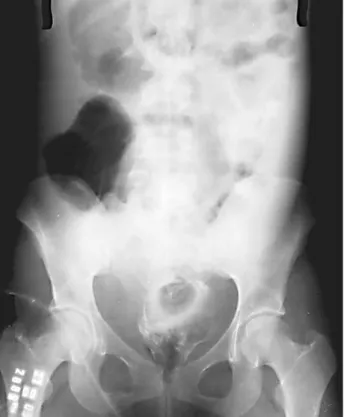
A 20-year-old female presented to hospital with complains of abdominal pain and hematuria after alcohol ingestion and a two floors fall with ventral collision. She was hemodynamically stable and the radiological evaluation showed a right pubic ramus fracture and free peritoneal liquid, discontinuity of blad-der wall and normal kidneys through sonography (Fig-ures-1 and 2). The cystography made evident an in-traperitoneal bladder rupture (Figure-3).
The patient was submitted to laparoscopic ex-ploration with three trocars, a 10 mm umbilical trocar and two 5 mm trocars, one in each iliac fossa. The surgeon’s position was on the patient’s left side to al-low inspection of pelvic structures. The laparoscopic findings were blood and urine in the peritoneal cavity, a 5 cm bladder rupture in the dome and no other lesions. The cavity was cleaned and the bladder sutured with a continuous one layer 3-0 polyglactin suture.
The patient was discharged from hospital in the 5th postoperative day due to the need of bed rest for pelvic fracture consolidation. Fourteen days after surgery the bladder catheter was removed with fa-vorable evolution.
COMMENTS
ret-381
Laparoscopy in Traumatic Intraperitoneal Bladder Rupture
roperitoneal perforations and cystorrhaphy for the in-traperitoneal ones (1).
Laparoscopy is a minimally invasive technique to diagnose and eventually treat abdominal trauma. It can avoid laparotomy in 63% of the cases, decreas-ing its associated morbidity (2). In hemodynamically stable patients without diffuse peritonitis, the diagnos-tic laparoscopy can be used in stab wounds, gunshot wounds with questionable peritoneal penetration and in blunt trauma with free peritoneal fluid or equivocal physical examination. In the presence of simple and accessible injuries the therapeutic laparoscopy is per-formed. Bladder intraperitoneal rupture is of easy Figure 1 – Sonography showing free intraperitoneal fluid.
Figure 2 – Sonography showing discontinuity of peritoneal blad-der wall.
Figure 3 – Cystography showing intraperitoneal bladder rupture.
correction through laparoscopic approach (2) and in the eventually presence of concomitant extraperitoneal rupture, the bladder drainage after surgery can treat it, if the rupture is not complex, avoiding an open sur-gery.
Laparoscopic repair of intraperitoneal blad-der perforation was first described in 1994 and since then, a few cases of such approach have been re-ported to treat traumatic, spontaneous and iatrogenic bladder rupture, avoiding laparotomy (3).
The aim of this report was to stimulate the practice of laparoscopic exploration in stable trauma and remember the urologists the laparoscopic ap-proach to any form of peritoneal bladder rupture.
CONFLICT OF INTEREST
382
Laparoscopy in Traumatic Intraperitoneal Bladder Rupture
REFERENCES
1. Gunnarsson U, Heuman R: Intraperitoneal rupture of the urinary bladder: the value of diagnostic laparoscopy and repair. Surg Laparosc Endosc. 1997; 7: 53-5. 2. Gorecki PJ, Cottam D, Angus LD, Shaftan GW:
Diag-nostic and therapeutic laparoscopy for trauma: a
tech-nique of safe and systematic exploration. Surg Laparosc Endosc Percutan Tech. 2002; 12: 195-8.
3. Matsui Y, Ohara H, Ichioka K, Terada N, Yoshimura K, Terai A: Traumatic bladder rupture managed success-fully by laparoscopic surgery. Int J Urol. 2003; 10: 278-80.
Accepted after revision: October 24, 2006
Correspondence address: