Lower Urinary Tract Dysfunction in Children. What Do
Pre-School Teachers Know About It?
Patricia Lordelo, Fabio Maron, Daniela G. Barros, Danilo V. Barroso, Jose Bessa Jr, Ubirajara
Barroso Jr
Department of Pediatric Urology, School of Medicine, Federal University of Bahia, Salvador, Bahia,
Brazil
ABSTRACT
Objective:To evaluate the basic knowledge of pre-school teachers who deal with children between the ages of 4 and 7 years, who present signs of lower urinary tract dysfunction (LUTD).
Materials and Methods: We performed a survey with 50 teachers from 9 private schools working with pre-school children. The criteria for selection were if teachers were certified or non-certified elementary school teachers - NCEST and the amount of professional experience.
Results:Thirty-three teachers considered that the normal daily urinary frequency should be from 4 to 7 times. Two of the 50 teachers considered it normal to urinate less than 4 times per day and 15 teachers considered more than 7 times per day as normal. There was no difference between the 2 categories of certified or NCEST nor between those with more or less than five years of professional experience. Thirty-three percent believed that to urinate more than 4 times during a class period (4-5 hours) could indicate a urinary problem. There was a statistically significant difference among the certified and NCEST but not in terms of time of professional experience. If during this period the child would not ask to urinate, only 18% considered that as an indication of urinary problem. When asked about the symptoms that would indicate urinary urgency and urge incontinence, only 24% of the teachers connected it with urinary problem. There was no difference in terms of professional background or professional experience in these 2 last analyses.
Conclusion:Our data shows evidences that private pre-schools teachers are not well informed of the clinical manifestation of LUTD.
Key words: children; urinary incontinence; etiology; enuresis; schools
Int Braz J Urol. 2007; 33: 383-8
INTRODUCTION
Currently children spend most of their day at school giving teachers increasing responsibility as edu-cators and health promoters. For that reason, educa-tors should have a comprehensive understanding about the physical, mental and social characteristics of
chil-dren regarding growth and development processes and health problems that might occur in different ages.
where habits and attitudes are being modeled. Health promotion should also occur at pre-school age. The definition of “pre-school age” varies among authors as being from 2 to 6 years old or between the ages of 3 and 7 (2). The teacher is responsible for the educa-tional development at school, which includes actively monitoring health deviations, which are sometimes undetected by the children and their family.
Lower urinary tract dysfunction (LUTD) oc-cupies an important place among the causes of uri-nary losses and uriuri-nary tract infections in children from the age of 4 years old. LUTD is clearly associated to urinary infection, vesicoureteral reflux, renal scar and psychological changes (3-6). Clinically it is charac-terized by symptoms of urinary urgency, urge inconti-nence without neurological evidence or urinary tract infection. The clinical evidences (conditions or manifestations), such as urinary incontinence, urinary urgency, urinary contention habits, and interrupted voiding are frequently misdiagnosed and may impact the psychological, emotional and social well fare of the child. It is relevant for the teachers to know how to identify the clinical symptoms above because the children spend most of their time at school under their teacher’s care. The objective of this study is to evalu-ate the basic knowledge of teachers working with children between the ages of 4 and 7 years in relation to the major manifestations (we believe it to be better than evidences) of LUTD.
MATERIALS AND METHODS
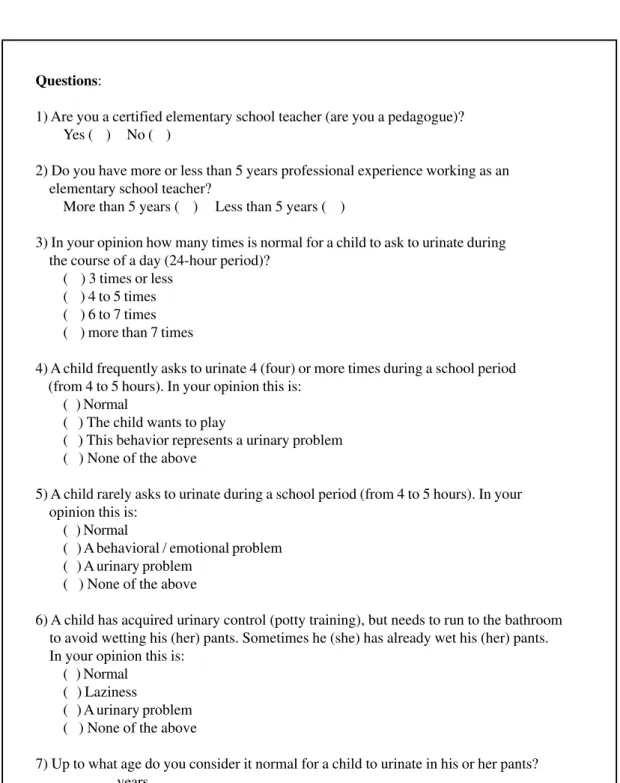
A questionnaire (Figure-1) was prepared by the researchers and taken by 50 pre-elementary level teachers (pre-elementary level includes children from 4 to 7 years of age) from 9 private schools chosen by convenience. The interviewer delivered the question-naire to the teacher’s work place and explained that it was to be self-administered and anonymous. The re-sponses were compared taking into account the type of professional background: if they are pedagogues or non-pedagogues (certified or non-certified elemen-tary school teachers) and if they have more or less than 5 years professional experience working in the area.
The statistic analysis was performed compar-ing the proportions uscompar-ing the Qui-square or Fisher test. For continuous variables purposes the “T” test was applied. For statistic significance, P value less than or equal to 0.05 was considered.
RESULTS
Thirty-three professionals were graduated as certified teachers and 17 of them were not. The av-erage time of teaching was 10 years, varying from 0.1 to 24. Thirty-one of he 50 teachers had 5 years of experience or more while 19 teachers had less than 5 years experience.
Regarding urinary frequency; 33 answered that the urinary daily frequency would be around 4 and 7 times, 2 thought that the normal frequency would be less than 4 times per day and 15 considered it nor-mal to urinate (they chose the questionnaire’s option four) more than 7 times per day. There was no differ-ence between certified and non-certified teachers nor among the professionals with 5 years or less experi-ence (P = 0.37 and 0.17, respectively).
Teachers were asked about the following questions (Table-1) and the results are shown below. Question: A child frequently asks to urinate 4(four) or more times during a school period (from 4 to 5 hours) - From all the teachers interviewed, 30% considered this normal and 33% believed that this behavior could represent a urinary problem. Fifty-five percent of the certified teachers believed that this could represent a urinary problem as opposed to 17.64% of the non-certified teachers (p = 0.03). This rate was 36.8% and 35.4% for the group of profes-sionals with more or less than 5 years of experience, respectively (p = 0.9).
Questions:
1) Are you a certified elementary school teacher (are you a pedagogue)? Yes ( ) No ( )
2) Do you have more or less than 5 years professional experience working as an elementary school teacher?
More than 5 years ( ) Less than 5 years ( )
3) In your opinion how many times is normal for a child to ask to urinate during the course of a day (24-hour period)?
( ) 3 times or less ( ) 4 to 5 times ( ) 6 to 7 times ( ) more than 7 times
4) A child frequently asks to urinate 4 (four) or more times during a school period (from 4 to 5 hours). In your opinion this is:
( ) Normal
( ) The child wants to play
( ) This behavior represents a urinary problem ( ) None of the above
5) A child rarely asks to urinate during a school period (from 4 to 5 hours). In your opinion this is:
( ) Normal
( ) A behavioral / emotional problem ( ) A urinary problem
( ) None of the above
6) A child has acquired urinary control (potty training), but needs to run to the bathroom to avoid wetting his (her) pants. Sometimes he (she) has already wet his (her) pants. In your opinion this is:
( ) Normal ( ) Laziness
( ) A urinary problem ( ) None of the above
7) Up to what age do you consider it normal for a child to urinate in his or her pants? ______ years
8) Up to what age do you consider it normal for a child to urinate in bed (night enuresis)? ______ years
Question: A child has acquired urinary con-trol (potty training), but needs to run to the bathroom to avoid wetting his (her) pants. Sometimes he (she) has already wet his (her) pants - From the group of teachers, 12% considered it normal and 24% consid-ered a urinary problem. It was found that 30.3% and 11.7% (p = 0.18) of the group of pedagogues and non pedagogues and 26.3% and 22.5% (p = 0.38) of the group of professionals with more or less than 5 years of experience, respectively, considered that this would be an alteration in the urinary tract.
The results for the other questions asked are shown below.
Question: Up to what age do you consider it normal for a child to urinate in his or her pants? - The age varied from 2 to 15, with 3.9 years old as an aver-age. Ninety per cent believed that children stop losing urine up to 5 years old. There was no statistical dif-Table 1 – Distribution of teachers’ answers for each question.
Questions
A child frequently asks to urinate 4 (four) or more times during a school period (from 4 to 5 hours). In your opinion this is:
Normal
The child wants to play
This behavior represents a urinary problem None of the above
A child rarely asks to urinate during a school period (from 4 to 5 hours). In your opinion this is:
Normal
A behavioral / emotional problem A urinary problem
None of the above
A child has acquired urinary control (potty training), but needs to run to the bathroom to avoid wetting his (her) pants. Sometimes he (she) has already wet his (her) pants. In your opinion this is:
Normal Laziness
A urinary problem None of the above
N
15
07 19
09
10 15
09 16
06 22 12 10
%
30 14 38 18
20 30 18 32
12 44 24 20
ference between the group of pedagogue and non-pedagogue and also regarding the group of profes-sionals with more or less than 5 years of experience, believed that children stop losing urine up to 5 years old. There was no statistic difference among the peda-gogues and non-pedapeda-gogues nor in terms of amount the time working as a professional (p = 0.17 and 0.43, respectively).
33% of the teachers considered it normal. Prudent urinary health prescribes that children must be stimu-lated to avoid spending such a long period of time with-out urinating. Bladder over distention may cause blad-der over activity, urinary infection and histological al-terations such as collagen deposition (9,10).
In Cooper’s studies it has been observed that only 18% of public elementary school teachers in the USA have received some form of information about abnormalities on the functioning of the urinary blad-der or bowel (11). This demonstrates that even in de-veloped countries, there is too little information about this theme. These authors also suggest a training pro-gram to the teachers about elimination disturbances.
CONCLUSION
Our data shows that teachers working with children at ages between 4-7 years, in the private edu-cational system, have too little information about clini-cal occurrences of the LUTD. An educational pro-cess lead by professional educators needs to be imple-mented in order that children receive proper orienta-tion about LUTD, while at school.
CONFLICT OF INTEREST
None declared.
REFERENCES
1. Ministério da Saúde: A promoção da saúde no contexto escolar. Rev. Saúde Pública. 2002; 36.
2. Vieira MLF, Carvalho MMB: O Conhecimento de Saúde Escolar de Professores de Escolas Públicas: Uma Visão Pediátrica e Pedagógica. Rev Paul Pediatria. 2002; 20: 215-23.
3. Barroso U Jr, Barroso DV, Jacobino M, Vinhaes AJ, Macedo A Jr, Srougi M: Etiology of urinary tract infec-tion in scholar children. Int Braz J Urol. 2003; 29: 450-4. 4. Koff SA, Lapides J, Piazza DH: Association of urinary tract infection and reflux with uninhibited bladder con-tractions and voluntary sphincteric obstruction. J Urol. 1979; 122: 373-6.
COMMENTS
Our data shows that the teachers have a sig-nificant lack of knowledge about the subject of LUTD, despite its relevance and frequency. Hellstrom et al. emphasized that around 6% of the girls and 3.8% of the boys had daily urinary incontinence at 7 years old (7). Simple urinary instruction measures could revert those symptoms and that despite the high rate of spon-taneous remission, some children have urinary infec-tion and high post-urinary residue, vesicoureteral re-flux and even detrusor hypocontractility where it is nec-essary to use clean intermittent catheterization (3-5).
There was no difference between time of professional experience and the quality of the re-sponses. There was a statistically significant differ-ence in two questions regarding the answers of the pedagogues and non-pedagogues, demonstrating that the type of professional background can have some impact in the problem recognition. For example, when asked about the children who urinate four times or more during the class period, there was a statistically significant difference among pedagogues and non-pedagogues. Even so, the rate of pedagogues that considered it as a urinary problem was only 56%. Fre-quency in children deserves some clinical urological evaluation since not only does this represent the pos-sibility of disturbances of an emotional order, but it also could be the clinical manifestation of a urological disease (8). Even so, only 24% of the teachers be-lieved that clinical signs of urge incontinence repre-sent urological abnormalities while 44% pointed out that the child loses urine simply because she or he does not feel like going to the toilet. Urinary inconti-nence and manifestation of bladder over activity makes the child feel extremely embarrassed. The interpreta-tion of these facts as a laziness or untidiness often leads to punishing or singling out the children for their lack of willpower.
5. Snodgrass W: Relationship of voiding dysfunction to urinary tract infection and vesicoureteral reflux in chil-dren. Urology. 1991; 38: 341-4.
6. von Gontard A, Lettgen B, Olbing H, Heiken-Lowenau C, Gaebel E, Schmitz I: Behavioural problems in chil-dren with urge incontinence and voiding postpone-ment: a comparison of a paediatric and child psychiat-ric sample. Br J Urol. 1998; 81 Suppl 3: 100-6.
7. Hellstrom AL, Hanson E, Hansson S, Hjalmas K, Jodal U: Micturition habits and incontinence in 7-year-old Swedish school entrants. Eur J Pediatr. 1990; 149: 434-7. 8. Burgio KL: Influence of behavior modification on
over-active bladder. Urology. 2002; 60: 72-7.
9. Leppilahti M, Hirvonen J, Tammela TL: Influence of transient overdistension on bladder wall morphology and enzyme histochemistry. Scand J Urol Nephrol. 1997; 31: 517-22.
10. de Souza GM, Costa WS, Bruschini H, Sampaio FJ: Morphological analysis of the acute effects of overdistension on the extracellular matrix of the rat uri-nary bladder wall. Ann Anat. 2004; 186: 55-9.
11. Cooper CS, Abousally CT, Austin JC, Boyt MA, Hawtrey CE: Do public schools teach voiding dys-function? Results of an elementary school teacher sur-vey. J Urol. 2003; 170: 956-8.
Accepted after revision: February 10, 2007
Correspondence address: Dr. Ubirajara Barroso Jr.
Rua Alameda dos Antúrios, 212 / 602 Salvador, BA, 40280-620, Brazil E-mail: [email protected]
EDITORIAL COMMENT
The authors are to be congratulated on ex-ploring an important, but frequently ignored area. As noted in their manuscript, children spend a significant amount of their waking hours in school. With an in-crease in the number of children attending pre-school it is important to evaluate the level of knowledge pre-school teachers hold regarding a child’s basic biologi-cal functions. In this study, the authors demonstrate inconsistent answers among a group of 50 pre-school teachers. For the most part this did not seem to relate to the teachers’ previous training, which likely reflects a deficit of training regarding this topic in the curricu-lum for future teachers.
We previously reported similar findings in pub-lic elementary school teachers in the United States. Since many toileting habits are established during pre-school, the findings in the present study are potentially even more relevant. The authors of the present study
also propose a training program regarding pediatric toileting for professional educators. Since a signifi-cant number of children with urinary incontinence or recurrent urinary tract infections benefit from prac-ticing improved bladder habits, teaching these habits during pre-school could have significant public health benefits. Therefore, further studies to evaluate the efficacy of teaching future educators what constitutes normal and abnormal pediatric bowel and bladder hab-its seem warranted.