ORIGINAL
RES
EAR
CH
Correspondence to: Palloma Rodrigues de Andrade – Universidade Federal da Paraíba (UFPB) – Campus I, Cidade Universitária – CEP: 58059-900 – João Pessoa (PB), Brazil – E-mail: [email protected]
Presentation: Nov. 2013 – Accepted for publication: July 2014 – Financing source: none – Conflict of interests: nothing to declare – Approval at the Ethics Committee n. 02/2009.
ABSTRACT | Studies have shown that cryotherapy, trans-cutaneous electrical nerve stimulation (TENS) and the association of them promotes analgesia, but the effective-ness of this association is unclear. The objective was to evaluate the effects of single and combined application of TENS and cryotherapy on pressure-induced pain thresh-old in healthy subjects. The sample consisted of 40 sub-jects, randomly assigned into four groups: (1) cryotherapy group – CG, (2) TENS group – GT; (3) cryotherapy + TENS group – GCT; (4) placebo group – GP. The pain threshold was determined by an algometer before (T1), immediately after (T2) and in the instants 10 (T3), 20 (T4) and 30 (T5) minutes after application of the analgesic techniques. TENS (100 Hz, 40 μs) and cryotherapy (cold compress) were applied for 20 minutes in the GC, GT and GTC, while in the GP was simulated electrical stimulation for the same period of time. Repeated measures ANOVA and Bonferroni post hoc test were employed, considering a significance level of 5%. All experimental groups showed an increase in pain threshold when compared to GP: GC (p<0.001), GT (p<0.009) and GCT (p<0.008). In relation to the time of analgesia, there was an increase in pain threshold in T2 for all experimental groups (p <0.001) up T3 to GCT (p <0.001) and only in the GC analgesia lasted up to T5. We concluded that under the conditions studied, the three experimental groups had an increase in pain threshold compared to the GP, but cryotherapy had more prolonged effect.
Keywords | Analgesia; Combined Modality Therapy; Algometer.
Effects of transcutaneous electrical nerve
stimulation and cryotherapy
on pain threshold by induced pressure
Efeitos da estimulação elétrica nervosa transcutânea e da crioterapia sobre o limiar de
dor induzida por pressão
Efectos de la estimulación eléctrica nerviosa transcutánea y crioterapia en el umbral de
dolor inducida por presión
Lairton Fabricio de Menezes Maciel1, Jose Jamacy de Almeida Ferreira2, Heleodorio Honorato dos Santos1,
Palloma Rodrigues de Andrade1
Study conducted at the Universidade Federal da Paraíba (UFPB) – João Pessoa (PB), Brazil.
1Physical Therapy Department, UFPB – João Pessoa (PB), Brazil.
RESUMO | Estudos têm demonstrado que a crioterapia,
a estimulação elétrica nervosa transcutânea (TENS) e a associação destas promovem analgesia, porém a efetivi-dade dessa associação não está clara. Objetivou-se ava-liar os efeitos da aplicação isolada e associada da TENS e da crioterapia sobre o limiar de dor induzida por pressão em sujeitos saudáveis. A amostra constou de 40 sujeitos, designados aleatoriamente em quatro grupos: (1) grupo crioterapia – GC; (2) grupo TENS – GT; (3) grupo crioterapia + TENS – GCT; e (4) grupo placebo – GP. O limiar doloroso foi determinado por meio de um algômetro antes (T1), imedia-tamente após (T2) e nos instantes 10 (T3), 20 (T4) e 30 (T5) minutos após a aplicação das técnicas de analgesia. A TENS (100 Hz, 40 μs) e a crioterapia (compressa fria) foram apli-cadas durante 20 minutos em GC, GT e GCT, enquanto no GP foi simulada a eletroestimulação pelo mesmo período de tempo. Uma ANOVA para medidas repetidas e o teste
post hoc de Bonferroni foram utilizados nas análises, con-siderando nível de significância de 5%. Todos os grupos experimentais apresentaram aumento no limiar doloroso quando comparados ao GP: GC (p<0,001), GT (p<0,009), e GCT (p<0,008). Em relação ao tempo da analgesia, observou-se aumento do limiar doloroso em T2 para todos os grupos experimentais (p<0,001), até T3 para o GCT (p<0,001) e ape-nas no GC a analgesia se prolongou até o T5. Concluiu-se que nas condições estudadas, os três grupos experimen-tais tiveram um aumento no limiar doloroso comparado ao GP, porém a crioterapia teve o efeito mais prolongado.
INTRODUCTION
Pain is a multifactorial phenomenon that is considered a mechanism of alert and defense of the organism1,2.
Painful symptoms are part of complex sensations that require a deep analysis on the physiological and psychic mechanisms involved in their production and perception, as well as on their types of treatment3,4. his
phenom-enon has not been completely understood yet, probably because it represents an individually subjective feeling of diicult characterization and generalization5.
A6, and the adverse efects from the clinical and/or
surgical analgesic methods can be minimized or prevented when they are associated or replaced with an analgesic therapy based on noninvasive physical means7. Several
procedures and techniques have been used in the anal-gesic physiotherapeutic practice and amongst the most common we can mention cryotherapy and transcutane-ous electrical nerve stimulation (TENS).
TENS is a current that produces electrical pulses with a frequency of up to 200 Hz able to inluence the processes of pain neuro-conduction8,and its analgesia
physiologi-cal mechanism depends on the modulation of the cur-rent applied in the afected area. Low-frequency (4 Hz) and high intensity TENS produces analgesia through the activation of opioid receptors, releasing endogenous analgesic substances through the brain or spinal cord9,10,
while TENS with a frequency higher than 100 Hz and applied with low intensity promotes analgesia through the
mechanism of pain barrier. According to this last theory, the electrical current activates the Aβ nerve ibers afer-ent, which are melanized, of thick caliber and fast con-duction, inhibiting in the medulla the passage of painful stimuli taken by Aδ and C ibers, both of small diameters, non-melanized and of slow conduction11. hus, TENS
in this modulation promotes an analgesia immediately or after ten minutes of use, which can continue for 20 to 30 minutes or until two hours later12.
Cryotherapy includes a wide quantity of speciic tech-niques that use cold sources in the solid, liquid and gaseous forms with the therapeutic aim of removing heat from the body and inducing the tissues to decrease metabo-lism and inlammatory efects, thus reducing the pain13.
In the nerve ibers, the cold action mechanism happens by decreasing the excitability of the free nerve termi-nations and the speed of the conduction of the nerve ibers, through the asynchrony transmission in the pain ibers, the release of endorphins and the inhibition of spine neurons and by an increase in the refractory period14.
After a 20-minute application of such technique, the nerve transmission can be reduced in up to 29.4% with its con-duction remaining deteriorated until a certain point for 30 minutes after the cold modality had been removed15.
Lately, some professionals have been using TENS and cryotherapy simultaneously (CRIOTENS-CT) because they believe that by doing this they will raise the analge-sic efect of these resources, since they will achieve a sum of physiologic actions promoted by both treatments16.
RESUMEN | Estudios tienen demostrado que la crioterapia, la
estimulación eléctrica nerviosa transcutánea (TENS) y la asocia-ción de ellas promueven analgesia, pero la efectividad de esa asociación no está clara. Se objetivó evaluar los efectos de la aplicación aislada y asociada de la TENS y de la crioterapia sobre el umbral doloroso inducido por presión en sujetos saludables. La muestra incluyó 40 sujetos aleatoriamente separados en cuatro grupos.: (1) grupo crioterapia – GC; (2) grupo TENS – GT; (3) grupo crioterapia + TENS – GCT; y (4) grupo placebo – GP. El umbral doloroso fue determinado por medio de un algómetro antes (T1), luego después (T2) y en los instantes 10 (T3), 20 (T4) y 30 (T5) minutos después de la aplicación de las técnicas de analgesia. La TENS (100 Hz, 40 μs) y la crioterapia (compresa fría) fueron aplicadas durante 20 minutos en el GC, GT y GCT,
mientras que en el GP fue simulada la electroestimulación por el mismo período. Un ANOVA para medidas repetidas y el test
post hoc de Bonferroni fueron utilizados en los analices, con-siderando un 5% de nivel de significancia. Todos los grupos experimentales presentaron aumento en el umbral doloroso al compararlos al GP: GC (p<0,001), GT (p<0,009) y GCT (p<0,008). Con relación al tiempo de analgesia, se observó un aumento del umbral doloroso en T2 para todos los grupos experimen-tales (p<0,001) hasta T3 para el GCT (p<0,001) y solamente en el GC la analgesia prosiguió hasta T5. Se concluyó que en las condiciones estudiadas, los tres grupos experimentales tuvie-ron un aumento en el umbral doloroso comparado al GP, pero la crioterapia tuvo un efecto más longo.
However, the analgesic efects and mechanism of action of the association of the abovementioned techniques have not been very well clariied in the literature. It is known that the pain neurotransmitter promoted by cryo-therapy involves the lateral spinal thalamic axis, while TENS uses the anterior spinal thalamic axis and both veins become one only in the bridge’s height, forming the medial lemniscus that is directed to the thalamus17.
herefore, it is assumed that the association of these two therapeutic modalities creates a paradox between the physiological mechanism of pain reduction, because while one of them reduces the speed of the nerve con-duction, the other stimulates the nerve ibers18.
Facing this controversy, this study aimed at assess-ing the inluence of TENS and cryotherapy used alone or together on the pressure-induced pain threshold in healthy subjects. It took into consideration the hypoth-esis that CRIOTENS could not present an improve-ment in the pain threshold of the individuals, because the TENS and cryotherapy neurophysiological mecha-nisms of pain regulation act paradoxically.
METHODOLOGY
Sample
A cross-sectional study with an almost experimental outline was carried out, with approval of the Ethics and Research Committee in Human Beings of the institu-tion (protocol number 002/2009), and all the partici-pants signed the free informed consent according to Resolution number 196/96 from the Brazilian Health National Counsel.
Forty subjects from both genders (19.9±1.4 years old; 63.9±13.4 kg; 1.67±0.07 m), 20 men and 20 women, were chosen through non-probabilistic criteria. In order to take part in the study, subjects had to be healthy, do not have history of injury, pain or deicit of sensitivity in the non-dominant forearm region. Individuals who had ingested painkillers 24 hours before the beginning of the study were excluded and also those with any kind of allergies to ice and hypersensitivity to electrical current, which were checked before each technique was applied.
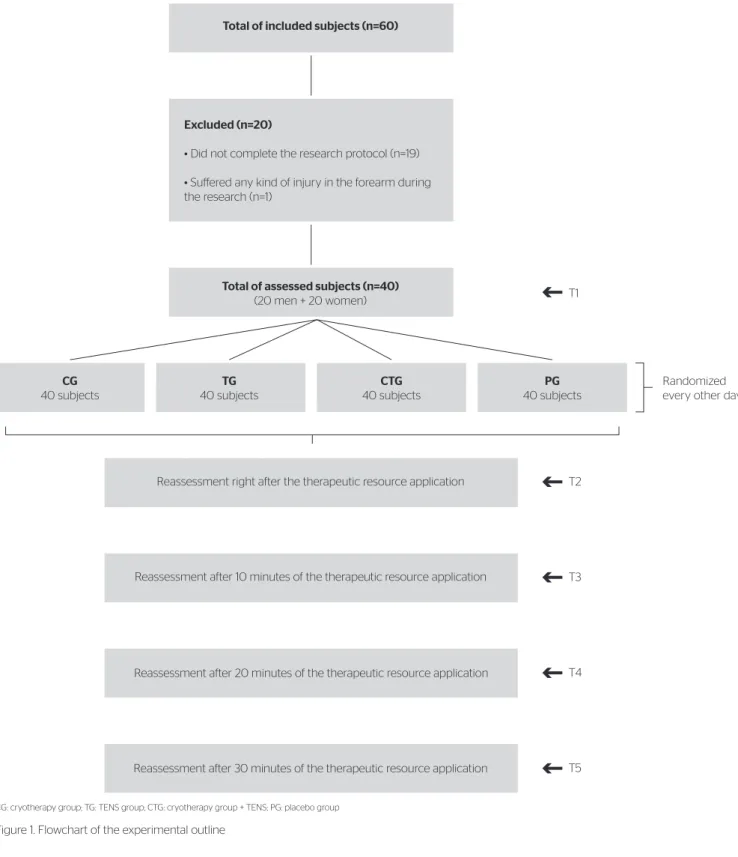
Every other day, all subjects underwent three protocols of analgesia (cryotherapy, TENS, CRIOTENS) and one placebo, which was randomly assigned. he lowchart of the experimental design is described in Figure 1.
Procedures
Protocol to assess painful threshold
In order to assess the painful threshold, the medium point of the anterior part of the non-dominant fore-arm was standardized, signalized with a dermographic marker, obtained by the trace of the medium line between the elbow and the wrist. Individuals were sat with their forearms in anatomical position and elbows extended, and the painful threshold (lower pressure needed for the subject to feel pain) was checked before and after the research protocols through pressure stimuli mea-sured in kfg/cm2 using a digital algometer (Kratos,
Brasil)19-21. he instrument, whose contact probe had
a plane format and measured 1 cm2 of area22, was
posi-tioned in 90º compared to the forearm.
he subject was requested to inform the evaluator when did the pressure start bothering him/her, proportionally to a painful perception of level three in the analogical visual scale (AVS)23,24. At this moment, subjects should
communicate this sensation by using the word “done”, so then the pressure stimulus was removed and the maxi-mum pressure peak marked in the device was registered. With the aim of familiarizing the subject to the stimulus, the measure protocol was previously explained to him/her and a test with three stimuli in the counter-lateral limb (dominant) was carried out with the pur-pose of ensuring more reliability of the measures25,26.
In total, ive evaluations in the non-dominant limb were performed: the irst, before the experimental protocol application (T1); the second, right after (T2); the third, 10 minutes later (T3); the fourth, 20 minutes later (T4); and the ifth, 30 minutes later (T5).
In the TENS group (TG), before the therapy application, skin cleaning was done with 70% alcohol in the non-dominant forearm, and subjects were sat with their forearms in anatomic position and elbow at a 90º lexion. TENS was applied for 20 minutes at 100 Hz frequency, 40 μs pulse duration and intensity in the sensorial limit, using Endomen 582 ID device (Enraff Nonius, Netherlands) with silicone/carbon rect-angular electrodes measuring 8x6 cm, longitudinally positioned on the forearm anterior region.
In the CRIOTENS group (CG), subjects were in the same position as TG and GC. TENS was applied with the same parameters used in TG and, simulta-neously, the cold compress was applied identically as in CG for 20 minutes.
In the placebo group (PG), the same TG protocol was used; however, the device was connected with zero stimulation amplitude during a 20-minute period.
Statistical analysis
he analyzed dependent variable was the pressure mea-sured by the algometer in kgf/cm2. Data were tabulated
by time (T1 to T5) and group, and descriptive statistics was calculated (mean±standard deviation). Initially, data normality (Kolmogorov-Smirnov) and variance homo-geneity (Levene) tests were performed, followed by the
CG: cryotherapy group; TG: TENS group; CTG: cryotherapy group + TENS; PG: placebo group
Figure 1. Flowchart of the experimental outline Excluded (n=20)
• Did not complete the research protocol (n=19)
• Suffered any kind of injury in the forearm during the research (n=1)
Total of assessed subjects (n=40)
(20 men + 20 women)
Reassessment right after the therapeutic resource application
Randomized every other day
T2 T1
T3
T4
T5
Reassessment after 10 minutes of the therapeutic resource application
Reassessment after 20 minutes of the therapeutic resource application
Reassessment after 30 minutes of the therapeutic resource application
CG
40 subjects
TG
40 subjects
CTG
40 subjects
PG
40 subjects
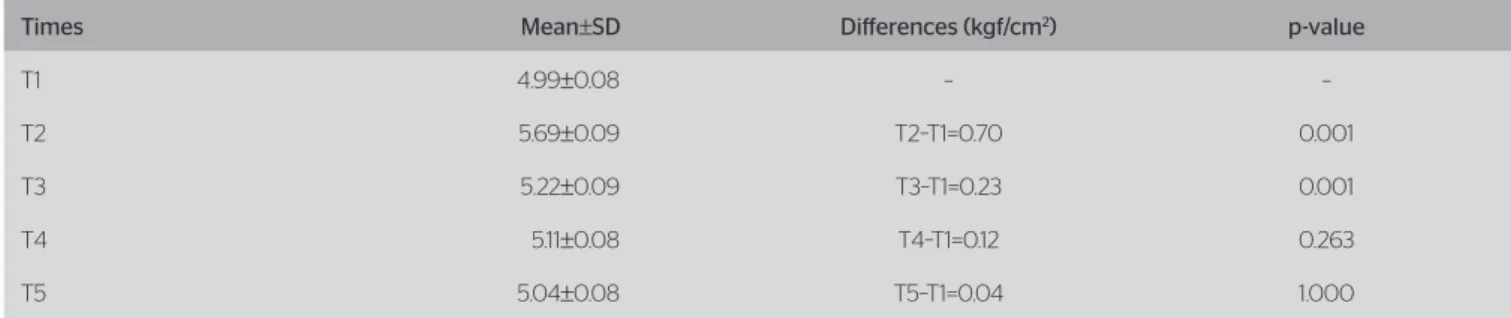
Table 1. Means and standard deviations of pressures in diferent times and diferences of pressures compared to T1 for all the experimental groups
Times Mean±SD Diferences (kgf/cm2) p-value
T1 4.99±0.08 – –
T2 5.69±0.09 T2–T1=0.70 0.001
T3 5.22±0.09 T3–T1=0.23 0.001
T4 5.11±0.08 T4–T1=0.12 0.263
T5 5.04±0.08 T5–T1=0.04 1.000
SD: standard deviation.
variance analysis (ANOVA) for repeated measures with Bonferroni’s post hoc to compare the means of pres-sures in the diferent time intervals and experimental groups, as well as to analyze the interaction between time versus group variables. For the statistical analysis, the Statistical Package for the Social Sciences was used (SPSS version 16), considering a 5% level of signiicance.
RESULTS
he ANOVA with repeated measures provided signif-icant diferences in the mean values of the pressures through time intervals of the experiment regardless the experimental group [F(4.153)=43.476; p<0.001].
It was seen that only in T2 and T3 the pressures were statistically higher than in T1 (p<0.001). Pressures means and standard deviations compared to time, as well as diferences of pressures obtained in every time interval with regard to T1 are presented in Table 1.
The analysis of the pressure values concern-ing the groups also showed significant differences [F(3.156)=6.786; p<0.001]. All the experimental groups had an increase in the painful threshold (a higher pres-sure diference) compared to the PG (p<0.01). Painful threshold mean and standard deviation of each group by time measurement, as well as values of pressure dif-ferences per group, are presented in Table 2.
In the intragroup analysis there was a signiicant increase in the painful threshold in all times after application (T2, T3, T4, T5; p<0.005) for CG, only in T2 (p<0.001) for
Table 2. Means and standard deviations of pressures in the groups in each measurement time and diferences of general means per group
Groups Mean per time±SD Mean±SD Diference (kgf/cm2) p-value
Cryotherapy
T1=4.97±0.17 T2=6.31±0.18 T3=5.63±0.17 T4=5.49±0.17 T5=5.38±0.17
5.56±0.16
CG–TG=0.22 CG–CTG=0.21 CG–PG=0.94
1.000 1.000 0.001
TENS
T1= 4.99±0.17 T2=5.87±0.18 T3=5.36±0.17 T4=5.27±0.17 T5=5.19±0.17
5.34±0.16
TG–CG=-0.22 TG–CTG=-0.01 TG–PG=-0.71
1.000 1.000 0.009
CRIOTENS
T1= 4.97±0.17 T2=5.99±0.18 T3=5.32±0.17 T4=5.29±0.17 T5= 5.15±0.17
5.34±0.16
CTG–CG=-0.21 CTG–TG=-0.01 CTG–PG=-0.72
1.000 1.000 0.008
Placebo
T1=5.06±0.17 T2=4.62±0.18 T3=4.59±0.17 T4=4.41±0.17 T5=4.43±0.17
4.621±0.16
PG–CG=-0.94 PG–TG=-0.72 PG–CTG=-0.72
0.001 0.009 0.008
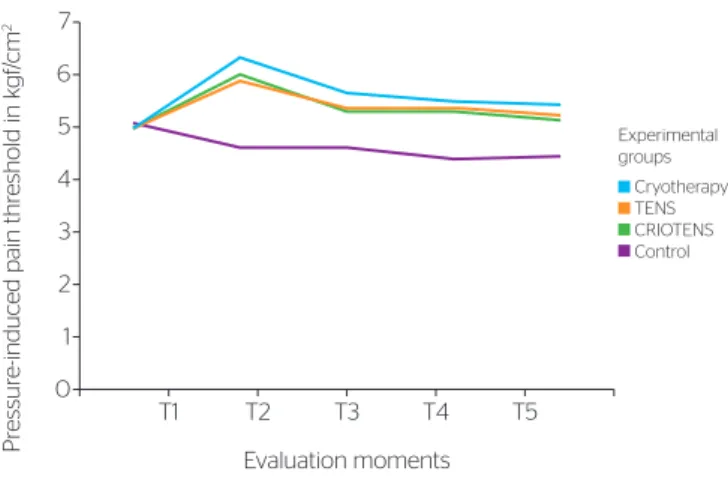
TG, and in T2 (p<0.001), T3 and T4 (p<0.05) for CTG. Figure 2 allows the visualization of modiications done in the means of the pressure-induced pain threshold of groups due to evaluation time.
It was also veriied an interaction between time versus
group variables [F(12.405)=10.722; p<0.001]. hus, it has been observed that means of the four groups did not have a signiicant diference in the T1 instant (p>0.05). However, all the experimental groups were diferent from the PG in all times (p<0.001).
DISCUSSION
In this study, cryotherapy, TENS and CRIOTENS efects analysis in an experimental condition of pressure-induced pain pressure-induced allows emphasizing two important indings: (1) all the techniques were efective in increas-ing the painful threshold, with the exception of placebo; and (2) cryotherapy presented a longer analgesia efect.
Painful threshold decrease in the placebo group was expected due to the non-application of an anal-gesic resource and of painful tactile stimulation sev-eral repeated times, promoting the irritation of the tissue, with release of neurotransmitters, and reducing the threshold of nociceptive excitement27. It was also
expected the analgesic efectiveness of cryotherapy16-18
and TENS16,17,28,29 alone, because they are resources that
have already been proved to increase painful threshold. As to the immediate analgesic efect, results reported herein are in agreement with those presented by Abreu
et al.16, who assessed the analgesic eiciency of cryotherapy,
TENS and its association, through AVS, in people with chronic lower back pain. hese authors found that there was no signiicant diference between the groups, so none of the analgesia techniques overcame the others. In addi-tion, in a study carried out with healthy subjects and pressure-induced pain using a plicometer, Farias et al.30
also did not see a signiicant diference in the efect of analgesic techniques. However, none of these studies point to a higher durability of the analgesic efect of the cryotherapy technique, as it was found here.
On the other hand, Ribeiro et al.17, in a study that
assessed the efects of using cryotherapy and TENS simultaneously to treat low back pain in women, veri-ied some diferent results from what was achieved in this study. heir results showed that the pain men-tioned through AVS presented a signiicant reduction in patients treated with TENS and with CRIOTENS, which was not seen in the group treated with cryother-apy alone. We must emphasize that the sample used by Ribeiro et al.17 was composed by women with chronic
pain, which includes diferent processes from the acute pain created by a characteristic mechanical stimulus in the method used in this investigation.
In another study, Schulz et al.31, assessing the efect
of TENS Burst on the pressure-induce pain threshold, veriied no signiicant diference in the painful thresh-old when the diferent moments of evaluation were compared for the PG and TG. Nevertheless, there is an important methodological diference of this exper-imental protocol with regard to what was done in our study. TENS Burst has a known indication for chronic pain, while the conventional TENS (100 Hz, 40 μs) is more efective for the promotion of analgesia in acute pain like it was induced in both studies32.
Even though CRIOTENS did not overcome the other analgesia modalities, it showed to be more efective in promoting an increase in the perception pain threshold, like in other studies16,17,30; however, it is believed that
cryotherapy was the most responsible for increasing the pressure-induced pain threshold. his questioning is supported in the analgesia duration, since CTG had a similar behavior with increase of the painful thresh-old longer than the TG. Furthermore, CTG presented a painful threshold increase even after 20 minutes of the application (T4), while this duration lasted 30 minutes (T5) for CG, which leads us to believe that the nerve stimulation promoted by TENS may have decreased the cryotherapy action to reduce the nerve conduction speed to acute pains, like the case of this sample.
Figure 2. Modifications in the pressure-induced pain threshold (kgf/cm2) of
the experimental groups with regard to evaluations (T1 to T5)
Pr
essur
e
-induced pain thr
eshold in k
gf
/cm
2
Evaluation moments
T1 T2 T3 T4 T5
7
6
5
4
3
2
1
0
In this aspect, although it is said that in CRIOTENS, cryotherapy inhibits TENS action by reducing the speed of sensitive and motor nerve conduction33-35,
there is a possibility that the inhibitory mechanism may be reciprocal, since TENS performs the nerve stimulation opposed to cryotherapy that promotes a decrease of this excitement activity.
he cryotherapy inhibitory efect on TENS may seem to be more clariied as to the nerve conduction periph-eral pathways. An experimental study performed in rats that assessed the electrical activity of the femoral nerve (EAFN) before, during and after the individual and asso-ciated application of TENS and cryotherapy, evidenced that TENS increased EAFN and cryotherapy did not change this variable. In the associated therapy, there was an attenuation in the EAFN, previously raised by isolated TENS, therefore the association of cryotherapy with TENS opposes the stimulation efect and reduces TENS therapeutic actions when applied isolatedly18.
An important methodological aspect needs to be regis-tered: the area of the contact probe between the device and skin is an important factor in pain perception. Probes with larger area of contact seem more useful to detect pressure-induced muscular pain36, whereas the smaller ones cause
skin pain37. Since the objective of our study was to induce
supericial pain, it was used a probe with an area of 1 cm2,
which was enough to produce a supericial acute pain. Results provided in this paper show that, in experimen-tal conditions of pressure-induced acute pain, cryotherapy presents longer efects than TENS and CRIOTENS, which is probably the most economic and efective resource to treat acute pains. In addition, studies like this one support the physical therapy practice that may help in choosing the needed analgesic modalities both to perform the treat-ment and to reduce the clinical symptoms. Furthermore, based on the results presented here, CRIOTENS does not raise analgesia, because in the present sample neither it showed a totality result increasing the pain threshold nor it increased analgesia time.
However, despite the pressure-induced pain meth-odology be wide used in experimental protocols, it is believed that it does not reliably replicate what hap-pens in the physiopathological process of secondary pain to pathologies or traumas, which is considered a limitation of this study. herefore, in order that these indings may be used in the physiotherapeutic prac-tice, more studies including patients with acute and chronic pains should be carried out.
CONCLUSION
Results from this study show that cryotherapy, TENS and CRIOTENS are efective techniques to increase the pressure-induced painful threshold in healthy subjects; however, cryotherapy presented a longer analgesic efect. hese indings improve knowledge on non-drug analgesic methods and point out for the use of cryotherapy alone as a preferential method to treat supericial acute pains.
REFERENCES
1. Melzack R, Wall PD. Textbook of pain. Edinburg: Churchill Livingstone; 1994.
2. Cervero F. Pain: Friend or Foe? A Neurobiologic Perspective: The 2008 Bonica Award Lecture. Reg Anesth Pain Med. 2009;34(6):569-74.
3. Lianza S. Medicina de Reabilitação. Guanabara: Rio de Janeiro; 2007.
4. Neugebauer V, Galhardo V, Maione S, Mackey SC. Forebrain pain mechanisms. Brain Res Rev. 2009;60(1):226-42.
5. Ferreira CHJ, Beleza ACS. Abordagem fisioterapêutica na dor pós-operatória: a eletroestimulação nervosa transcutânea. Rev Col Bras. 2007;34(2):127-30.
6. Colhado OC, Boeing M, Ortega LB. Toxina botulínica no tratamento da dor. Rev Bras Anestesiol. 2009;59(3):366-81.
7. Vale NB. Analgesia Adjuvante e Alternativa. Rev Bras Anestesiol. 2006;56(5):530-55.
8. Rushton DN. Electrical stimulation in the treatment of pain. Disabil Rehabil. 2002;24(8):407-15.
9. King EW, Sluka KA. The efect of varying frequency and intensity of transcutaneous electrical nerve stimulation on secondary mechanical hyperalgesia in an animal model of inflammation. J Pain. 2001;2(2):128-33.
10. Maeda Y, Lisi TL, Vance CG, Sluka KA. Release of GABA and activation of GABA(A) in the spinal cord mediates the efects of TENS in rats. Brain Res. 2007;1136(1):43-50.
11. Melzack R, Wall PD. Pain mechanisms: a new theory. Science. 1965;150(699):971-9.
12. Katz J, Melzack R. Auricular transcutaneous electrical nerve stimulation (TENS) reduces phantom limb pain. J Pain Symptom Manage. 1991;6(2):73-83.
13. Moreira NB, Artifon EL, Meireles A, Silva LI, Rosa CT, Bertolini GRF. A influência da crioterapia na dor e edema induzidos por sinovite experimental. Fisioter Pesq. 2011;18(1):79-83.
14. Nadler SF, Weingand K, Kruse RJ. The physiological basis and clinical application of cryotherapy and thermotherapy for the pain practitioner. Pain Physician 2004;7(3):395-9.
15. Andrews JR, Harrelson GL, Wilk KE. Reabilitação física das lesões desportivas. Rio de Janeiro: Guanabara Koogan; 2000.
17. Ribeiro RS, Monteiro TV, Abdon APV. Estudo do efeito da utilização simultânea da crioterapia e do TENS nos pacientes portadores de lombalgia. Rev Ter Man 2006;4(16):82-5.
18. Santuzzi CH, Gonçalves WL, Rocha SS, Castro ME, Gouveia AS, Abreu GR. Efeitos da crioterapia, estimulação elétrica transcutânea e da sua associação na atividade elétrica do nervo femoral em ratos. Rev Bras Fisioter 2008;12(6):441-6.
19. Schenk P, Laeubli T, Klipstein A. Validity of pressure pain thresholds in female workers with and without recurrent low back pain. Eur Spine J. 2007;16(2): 267-75.
20. Svensson P, Arendt-Nielsen L, Nielsen H, Larsen JK. Efect of chronic and experimental jaw muscle pain on pain-pressure thresholds and stimulus-response curves. J Orofac Pain 1995;9(4):347-56.
21. Kinser AM, Sands WA, Stone MH. Reliability and validity of a pressure algometer. J Strength Cond Res. 2009;23(1):312-4.
22. Finocchietti S, Mogens N, Morch CD, Arendt-Nielsen L, Graven-Nielsen T. Pressure-induced muscle pain and tissue biomechanics: A computational and experimental study. Eur J Pain 2011;15(1):36-44.
23. Silva MC, Silva PAB, Silva LB, Soares SM. Instrumentos de avaliação da dor crônica em idosos e suas implicações para a enfermagem. Rev Enferm Centro Oeste Min. 2011;1(4):560-70.
24. Martinez JE, Grassi DC, Marques LG. Análise da aplicabilidade de três instrumentos de avaliação de dor em distintas unidades de atendimento: ambulatório, enfermaria e urgência. Rev Bras Reumatol. 2011;51(4):299-308.
25. Persson A, Brogårdh C, Sjölund B. Tender or not tender: test-retest repeatability of pressure pain thresholds in the trapezius and deltoid muscles of healthy women. J Rehabil Med. 2004;36(1):17-27.
26. Pickering G, Jourdan D, Eschalier A, Dubray C. Impact of age, gender and cognitive functioning on pain perception. Gerontology. 2002;48(2):112-8.
27. Vale FM. Dor. Novos aspectos fisiopatológicos e consequentes estratégias farmacológicas. RFML. 2003;3(5):291-304.
28. Liebano RE, Vance CG, Rakel BA, Lee JE, Cooper NA, Marchand S,
et al. Transcutaneous electrical nerve stimulation and conditioned
pain modulation influence the perception of pain in humans. Eur J Pain. 2013;17(10):1539-46.
29. Vassal F, Créac´h C, Convers Ph, Laurent B, Garcia-Larrea L, Peyron R. Modulation of laser-evoked potencials and pain perception bay transcutaneous electrical nerve stimulation (TENS): a placebo-controlled study in healthy volunteers. Clin Neurophys. 2013;124(9):1861-7.
30. Farias RS, Melo RS, Machado YF, Lima FM, Andrade PR. O uso da tens, crioterapia e criotens na resolução da dor. Rev Bras Ciênc Saúde. 2010;14(1):27-36.
31. Schulz AP, Chao BC, Gazola F, Pereira GD, Nakanishi MK, Kunz RI, et al.
Ação da estimulação elétrica nervosa transcutânea sobre o limiar de dor induzido por pressão. Rev Dor. 2011;12(3):231-4.
32. Liebano RE, Rakel B, Vance CGT. An investigation of the development of analgesic tolerance to TENS in humans. Pain. 2010; 152(2):335-42.
33. Herrera E, Sandoval MC, Camargo DM, Salvini TF. Motor and sensory nerve conduction are afected diferently by ice pack, ice massage, and cold water immersion. Phys Ther. 2010;90(4):581-91.
34. Algafly AA, George KP. The efect of cryotherapy on nerve conduction velocity, pain threshold and pain tolerance. Br J Sports Med. 2007;41(6):365-9.
35. Zhang J, Pan T, Eang JHC. Cryotherapy suppresses tendon inflammation in an animal model. J Orthop Transl. 2014:2(2);75-81.
36. Takahashi T, Taguchi T, Itoh K, Okada K, Kawakita K, Mizumura K. Influence of surface anesthesia on the pressure pain threshold measured with diferent sized probes. Somatsens Mot Res. 2005;22(4):299-305.