Fisioter. Mov., Curitiba, v. , n. , p. - , Oct./Dec. Licenciado sob uma Licença Creative Commons DO): http://dx.doi.org/ . / - . . .AO
[T]
Use of Powerbreathe
®in inspiratory muscle
training for athletes: systematic review
[)]A Utilização do Powerbreathe® no treinamento muscular
inspiratório por atletas: revisão sistemática
[A]
Balbino Rivail Ventura Nepomuceno Júnior[a], Thaís Borges Gómez[b], Mansueto Gomes Neto[a]*
[a] Universidade Federal da Bahia UFBA , Salbador, BA, Brazil
[b] União Metropolitana de Educação e Cultura UN)ME , Salvador, BA, Brazil
[Abstract
Introduction: )nspiratory muscle training )MT has been used as part of athletic training. )t is bene icial due to an
increase in respiratory capacity, and can be related to the optimization of exercise tolerance. There are a growing number of publications on the subject, however the methodological rigor of these publications is still unknown.
Objective: To perform a systematic literature review in order to analyze the effects of Powerbreathe® on
inspi-ratory muscle training by athletes. Methods: Original scienti ic studies published in English, from to ,
were included. Their typology was classi ied. The literature search was performed in the Lilacs, Medline, Pubmed, and Scielo databases using the following keywords: inspiratory muscle training, athletes, and Sports medicine in English , treinamento muscular inspiratório, atleta, medicina esportiva in Portuguese . Results: )nspiratory mus-cle training with speci ic linear resistance has been used in some athletic training, and its results are promising. (owever, its application is still recent and generally supported by experiments with limited population and which do not properly de ine the confounding factors for the results. Conclusion: The state of the art suggests that )MT is
useful as a respiratory therapy supporting the training of athletes for some speci ic sports. (owever, there is a scar-city of studies of high methodological quality, thus requiring further experiments on the subject.
Keywords: Breathing Exercises. Respiratory Muscles. Athletes. Sports Medicine. Motor Activity.
822
Resumo
Introdução: O treinamento muscular inspiratório (TMI) vem sendo utilizado como coadjuvante na prepara-ção do atleta. Seu beneϔício viria no aumento da capacidade respiratória, podendo estar relacionado com a otimização da tolerância ao exercício. É crescente o número de publicações sobre o assunto, contudo o rigor metodológico destas publicações ainda é desconhecido. Objetivo: Realizar uma revisão sistemática da literatu-ra, a ϔim de analisar os efeitos do Powerbreathe® no treinamento muscular inspiratório por atletas. Métodos: Foram incluídos estudos cientíϔicos originais, classiϔicados na sua tipologia, no idioma inglês, publicados entre 2000 e 2015. A busca dos artigos foi realizada nas bases de dados: Lilacs; Medline; Pubmed; Scielo, utilizando os seguintes descritores: treinamento muscular inspiratório, atleta, medicina esportiva (em português), inspi-ratory muscle trainaing, athletes e Sports medicine (em inglês). Resultados: O treinamento muscular inspira-tório com resistor linear especíϔico tem sido utilizado na preparação de algumas modalidades esportivas, seus resultados são promissores. Porém, sua aplicação ainda é recente, e em geral embasada por experimentos com população limitada e sem delimitar adequadamente os fatores de confusão para os resultados encontrados. Conclusão: O estado da arte sugere que o TMI é útil como terapêutica respiratória coadjuvante à preparação do atleta de algumas modalidades esportivas especíϔicas. Contudo, escassez na literatura de estudos com alta qualidade metodológica, demanda maiores experimentos sobre o tema.
Palavras-chave: Exercícios Respiratórios. Músculos Respiratórios. Atletas. Medicina Esportiva. Atividade Física.
Introduction
(igh-performance athletic training includes nu-merous variables, all of which have a signi icant in lu-ence on inal performance in the sport , . Physical training is crucial for optimization of exercise perfor-mance, either to gain strength and power, or to pre-vent musculoskeletal injuries , . Cardiovascular conditioning focuses on maximizing perfusion capac-ity, thereby preventing lactic acidosis, which know-ingly compromises performance , . (owever, a forgotten facet is respiratory training , . )ts bene its are associated with a greater supply of oxygen to the tissues, thereby providing a differenti-ated physical performance - .
The respiratory system and its regulatory centers control the levels of oxygen O and carbon dioxide CO , which is released at higher levels in bursts of activity or activity sustained for a long period - . Recent studies suggest that the inspiratory muscles can interfere in the performance of physical exercise in athletes, precisely because in physically stressful con-ditions, when the production of free radicals exceeds elimination capacity, a re lex sympathetic reaction of peripheral vasoconstriction would be triggered, lead-ing to early fatigue in skeletal muscles and dramatically reducing performance in this activity. Conditioned muscles, on the other hand, have an increased toler-ance, thereby slowing re lex activation - .
)nspiratory muscle training )MT is a therapeutic modality that overcomes resistance against muscles re-sponsible for expanding the rib cage. This effort must be controlled, speci ic and repeated at regular intervals. )ts application has been demonstrated as a viable strategy for optimizing the respiratory capacity - , thereby allowing this person to always expand his/her physical tolerance to adverse situations during practice - .
Powerbreathe® is one of the existing linear load resistor models on the market, which generates re-sistance via a spring-loaded system or an electronic valve. The basic difference between this tool and the others is its ability to offer the largest load during the therapy, and to adapt inspiratory resistance to the pressure x lung volume curve , , which could generate load stabilization along the breath, by pro-viding a feeling of comfort to the patient. Up until now this concept has a physiological basis.
823
Methods
This study was a systematic literature review on the use of inspiratory muscle training, using a speci ic linear resistor by athletes. The study was performed from October of to March of .
Inclusion criteria
Original scienti ic studies were included, clas-si ied according to their typology as descriptive, experimental or causal-comparative; published be-tween - ; inspiratory muscle training with Powerbreathe® was a dependent variable in different protocols; athletic training was a dependent vari-able; various sports were included in their sample; had no athletes using another respiratory therapy in the studies; had a sample characterized by a group combination therapy with sports or an equivalent practice; was clear regarding the samples and the different analyses performed.
Search strategy
)nitially these descriptors were established: inspi-ratory muscle training, athlete, sports medicine, when in the vernacular and in English language, inspira-tory muscle training , athletes and Sports medi-cine in English , available in Descriptors of (ealth Sciences DeCS and the Medical Subject (eadings MeS( . )n order to maximize the search, synonyms were adapted, as well as the related words used in the retrieved papers found previously.
By respecting the operational differences of each database, when possible, we decided to search in the primary ields "Title" or "Keywords" using "or" and "and" as connectors and the term "athletes" as a limi-tation. The survey was performed in the following databases: Lilacs, Medline, Pubmed, Scielo.
Selection criteria
Developed by the Physiotherapy Evidence Database, the PEDro scale is a tool that quanti ies the methodological quality of randomized clinical trials
RCT , or quasi-randomized studies. )t has external validity criterion , not considered , internal validity criteria - , considered and if there is suf icient statistical analysis in the results of the experiment, this should be considered criteria and - . Thus, the criteria are classi ied dichotomously as "satis ied" or "not satis ied", and can have a maximum degree of methodological requirement, reaching a total of ten points.
Although this scale was adopted as a selection tool for this systematic review, considering the inability to blind those responsible for the intervention and the athletes who participated in experiments with )MT, the chosen cutoff point was > .
The PEDro scale was also used as a tool for select-ing non-experimental studies accepted accordselect-ing to the inclusion criteria. (owever, these studies needed to meet criteria , and , at a minimum, to legiti-mize their potential generalization and interpretation of results , .
The articles identi ied in the search strategy were evaluated independently and in a blinded fashion by two researchers BRVNJ and TBG , strictly observ-ing the inclusion criteria. The article selection was initiated using the key words, followed by the article selection according to the titles, which would focus on inspiratory muscle training in association with sports practice. )n the next stage, the abstracts of the pre-selected articles were read and studies were included that satis ied the inclusion criteria described above.
Finally, due to the established cutoff point for the selection criteria, the most experienced research-er in this particular topic independently analyzed the experiments.
Results
824
Study characteristics and quality
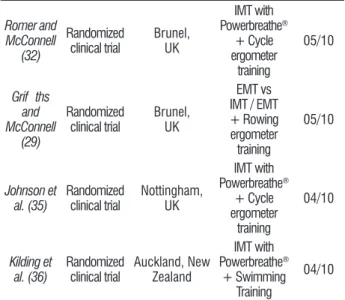
The evaluation of methodological quality using the PEDro scale had a mean score of . - . Table shows details on the methodological and quality evaluation of the studies. Only one study used a third group with )MT association with expiratory muscle training EMT in this review , and one article was performed outside the United Kingdom UK . The low quality identi ied by the PEDro scale signals to the need for further studies with greater methodological rigor.
Table 1 - Stratification of IMT studies in the athlete through the PEDro Scale.PEDro (Physiotherapy Evidence Database), available from http://www. pedro.fhs.usyd.edu.au (38 - 40)
Author Study
design Locality Program
PEDro scale
Volianitis et al. (30)
Randomized clinical trial
Wolverhampton, UK
IMT with
Powerbreathe®
+ Rowing training
04/10
Romer et al. (31)
Randomized clinical trial
Brunel, UK
IMT with
Powerbreathe®
+ Cycle ergometer
training
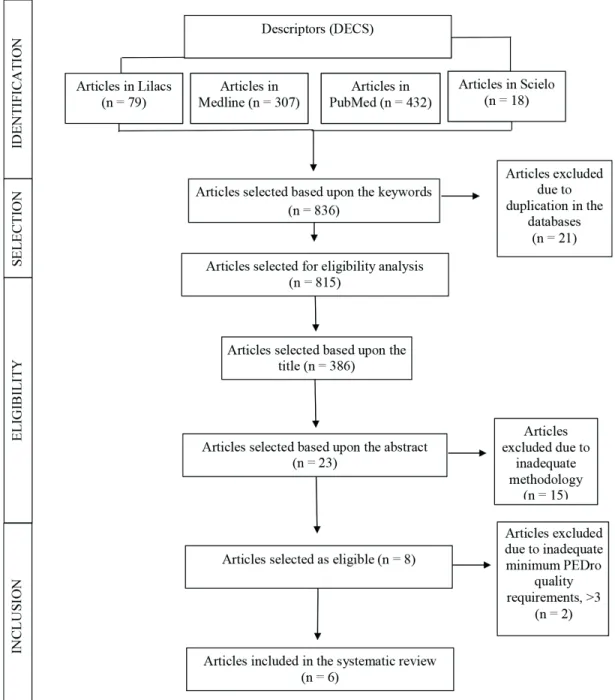
05/10 Figure 1 - Flowchart of the article selection steps in the systematic review.
825
Table 2 - Inspiratory muscle training protocols (TMI) and as-sociation with the sport. IMT = Respiratory Muscle Training; MIP = maximal inspiratory pressure
Author
(year) Sport Sample
Application protocol
Training time
Johnson et
al. (35) Cycling 18
Load 50% of MIP, 30 repetitions, 2
times a day.
06 weeks
Kilding et
al. (36) Swimming 16
Load 50% of MIP, 30 repetitions, 2
times a day.
06 weeks
Characteristics of the population included in the studies
The studies used a population of young adults, with a mean age of . ± . years. There was gen-der balance in the studies; three studies included only male athletes, two included male athletes, and Kilding et al. included athletes of both genders.
Inspiratory muscle training intervention program
The included articles had a standardized frequen-cy of )MT. All studies used an inspiratory load of ap-proximately % of maximal inspiratory pressure
M)P , one series of breaths, repeated twice daily. At the same time, this uniformity did not extend to the time taken to perform the )MT protocols, with a period ranging from four to weeks of training. Four studies, equivalent to . % of the articles, adopted six weeks of )MT associated with sports training.
Measured outcomes
The article search addressing association of con-comitant sports training to an )MT protocol suggests bene its to lung capacity, mainly expressed by the im-provement of M)P, present in . % of the articles. )n addition, referred gains of associated training included reduced perceived exertion during sports practice, mea-sured by the Borg scale. One study found a statis-tically signi icant increase in the maximum volume of oxygen MaxVO . The improved sports performance in regard to timed activity can also be related to the combination of therapeutic modalities Table .
Table 1 - Stratification of IMT studies in the athlete through the PEDro Scale.PEDro (Physiotherapy Evidence Database), available from http://www. pedro.fhs.usyd.edu.au (38 - 40)
Romer and McConnell (32) Randomized clinical trial Brunel, UK IMT with Powerbreathe® + Cycle ergometer training 05/10 Grif ths and McConnell (29) Randomized clinical trial Brunel, UK EMT vs IMT / EMT + Rowing ergometer training 05/10 Johnson et al. (35) Randomized clinical trial Nottingham, UK IMT with Powerbreathe® + Cycle ergometer training 04/10 Kilding et al. (36) Randomized clinical trial Auckland, New Zealand IMT with Powerbreathe® + Swimming Training 04/10
Eligibility and randomization were implemented in all studies; however, only three of them clearly stipulated how randomization was performed. The therapists were not blinded in any article. Table expresses the intervention protocols applied in each study, as well as the )MT program duration. This table also demonstrates that biking was the sport in % of studies, followed by rowing . % , and swimming
. % of the studies .
Table 2 - Inspiratory muscle training protocols (TMI) and as-sociation with the sport. IMT = Respiratory Muscle Training; MIP = maximal inspiratory pressure
Author
(year) Sport Sample
Application protocol
Training time
Volianitis et
al. (30) Rowing 14
Load 50% of MIP, 30 repetitions, 2
times a day.
11 weeks
Romer et
al. (31) Cycling 16
Load 50% of MIP, 30 repetitions, 2
times a day.
06 weeks Romer and McConnell (32) Cycling 16 Load 50% of MIP, 30 repetitions, 2
times a day.
06 weeks Grif ths and McConnell (29) Rowing 17 Load 50% of MIP, 30 repetitions, 2
times a day.
04 weeks
(Conclusion)
826
Table 3 - Benefits of Inspiratory muscle training (IMT) with Powerbreathe® in association with sports training
Author Study design Population Intervention Results
Volianitis et al. (30) Randomized
clinical trial 14 athletes
IMT group: 30 repetitions, twice daily, load of 50% MIP;
Placebo group: 60 breaths once daily, load of 15% MIP.
IMT group increased respiratory muscle strength to 44
± 25 cm H20 (45.3 ± 29.7%) compared with only
6 ± 11cm H2O (5.3 ± 9.8%) in the placebo group
(P < 0.05, between groups). The distance walked in the 6-minute maximum effort test was 3.5 ± 1.2% compared to 1.6 ± 1.0% in the placebo group (p < 0.05). The 5000m time decreased to 36 ± 9s in the intervention group compared to only 11 ± 8s in the placebo group (P < 0.05). The group resistance was improved from a deficit in IMP of 11.2 ± 4.3% to only 3.0 ± 1.6% (p < 0.05), before and after intervention.
Romer et al. (31) Randomized clinical trial 16 athletes
IMT group: 30 repetitions, twice daily for six weeks, load of 50%
MIP;
Placebo group: 60 cycles once daily load of 25% MIP for six
weeks
An improvement of respiratory function, with
significant increase in MIP (28 ± 7%), MaxVO2
(17 ± 4%), Max W (49 ± 16%) in the intervention group (p < 0.01), a reduction of 8±1.2% in lactate values, without statistical significance. A reduction in the perception of respiratory and peripheral effort in the IMT group compared to the placebo (Borg: 16 ± 4% and 18 ± 4%, P < 0.01), respectively
Romer and McConnell (32)
Randomized
clinical trial 16 athletes
IMT group: 30 repetitions, twice a day for six weeks, load of 50%
MIP;
Placebo group: Load of 25% MIP for six weeks
Improvement in the inspiratory muscle function in
IMT group (p ≤ 0.05); improvement in the simulated
clock test to 20 and 40 km (66 ± 30" and 115 ± 38" faster, respectively, p = 0.025 and 0.009).
Grif ths and McConnell (29)
Randomized
clinical trial 17 athletes
IMT group (four weeks): 30 repetitions, twice daily for four
weeks, load of 50% MIP;
IMT/EMT group: individual training of IMT or EMT for four weeks, the following two weeks combining IMT/EMT: 30 repetitions, twice daily, load of
50% IMT/EMT;
IMT group had an increase of 26% in MIP (P < 0.001) and an improvement in performance during ergometric rowing exercise for six minutes of 16.2 meters (p = 0.02). IMT/EMT group showed no statistically significant gain for the variables of interest.
Johnson et al. (35) Clinical trial 18 athletes
IMT group: 30 repetitions, twice daily for six weeks, load of 50%
MIP;
Placebo group: 30 repetitions, twice daily for six weeks, no
load;
The MIP increased by 17.1 ± 12.2% for the IMT group (p < 0.01) and was accompanied by a reduction of 2.66 ± 2.51% of the time taken to go 25km (p < 0 05), and there were no changes compared to group placebo. There was an improvement in physical endurance during cycling in the IMT group (18.3 ± 15.1%, p < 0.05).
Kilding et al. (36) Clinical trial 16 athletes
IMT group: 30 repetitions, twice daily for six weeks, load of 50%
MIP;
Placebo group: 60 breaths daily, load of 15% MIP for six weeks
A substantial reduction in swimming times in 100m (1.7 ± 1.4%, p < 0.05), 200m (1.5 ± 1.0%, p = 0.02), and 400m showed no significance, with a change of 0.6 ± 1.2% (p = 0.363).
Note: HR = Heart rate; IMT= Respiratory muscle training; MIP: Maximum inspiratory pressure; MEP: Maximum expiratory pressure; PETCO2
827
Discussion
The use of )MT using a speci ic linear resistor showed bene its for respiratory capacity. )n addition, the reviewed studies suggested that the association between )MT and speci ic athletic physical training could improve physical performance, when compared to a control group.
The exposure of inspiratory muscles to a train-ing program with controlled and individualized load, repeated regularly, provides gain in sarcomeres, in-creasing muscle volume and its ability to generate strength. This information is still empirical, based on muscle physiology. (owever, in line with this reason-ing, this review with athletes submitted to )MT led to an improvement in M)P compared to the placebo group, with a gain of between - % in the baseline studies. The heterogeneity between the time taken for the training protocol is a plausible explanation for this variability in the inal M)P.
The )MT protocol was useful when comparing the training of athletes in different sports. Swimming, row-ing and cyclrow-ing were the sports that were associated with respiratory training. )n these experiments, there was a strong association between the associated pro-gram and the improvement in physical performance during the test against the clock. )t should be noted that all six studies had small populations, with less than athletes, which is insuf icient to rule out possible confounding factors. Studies were found that used )MT with soccer, running and tennis amateurs , . (owever, they did not include the aim of this review.
The athletes treated with )MT with a linear load device had a minimized variability of heart rate (R , respiratory rate RR and feeling of dyspnea, as re-ported by the Borg scale , . These indings suggest that this treatment could improve tolerance during sports practice. Romer et al. , in studies with cyclists, improved MaxVO following an associ-ated program for six weeks, as compared to a placebo. Sheel et al. , in , reported that inspira-tory muscle fatigue activated a sympathetic re lex reaction of peripheral vasoconstriction, which would precipitate limb muscle fatigue during physical ac-tivity. This condition was known as metabore lex. McConnell and Lomax , in a clinical trial using different )MT protocols associating lower limb LL exercises, observed early lower limb fatigue in the group exposed to severe respiratory muscle overload greater than % of M)P . After the TM) protocol,
the duration of fatigue with LL physical activity sig-ni icantly increased.
All six studies included in this systematic re-view performed intervention protocols with thirty breaths under inspiratory resistance, equivalent to % of the M)P, repeated twice, seven days a week. This standardization facilitates comparison between studies and enables the adoption of this protocol in future studies.
Volianitis et al. found an improvement in the six-minute all-out effort test with a rowing ergometer, in a study with rowers. The )MT program associated with ergometry found an improvement of . ± . % in the distance covered in kilometers in the interven-tion group, compared with a . ± . % gain in the placebo group, p < . . The study by Grif iths and McConnell , using the same submaximal testing to assess gain between )MT and )MT/EMT groups, found that the )MT group had a mean improvement of . m in the inal distance in kilometers, with p = . . The bene it was not evidenced for the )MT/EMT group. The alternating between )MT and EMT, associated with the small sample per group, are the main factors that could explain the lack of gain in the )MT/EMT group.
Of the six studies selected for this systematic re-view, ive were performed in the UK, the place in which Powerbreathe® was created. Only the study by Kilding et al. was performed in New Zealand. This obser-vation could support the small propagation of scienti ic knowledge about the bene its of )MT for athletes. With regard to the choice of this linear resistor device for this population, it should be noted that the initial M)P of the population under study was ± cm( O. This magnitude, considered high compared to the mean of the general population, would impair the use of other resistors available on the market, since in most cases they have maximum inspiratory load lower than what is therapeutic for this M)P.
828
. Silva RAS, Oliveira (B. Prevenção de lesões no ciclismo indoor: uma proposta metodológica. Rev Bras Cien e Mov. ; : - .
. Pastre CM, Carvalho Filho G, Monteiro (L, Netto Jr J, Padovani CR. Lesões desportivas na elite do atletismo brasileiro: estudo a partir de morbidade referida. Rev Bras Med Esporte. ; : - .
. Plentz RD, Sbruzzi G, Ribeiro RA, Ferreira JB, Lago PD. Treinamento muscular inspiratório em pacien-tes com insu iciência cardíaca: metanálise de estudos randomizados. Arq Bras Cardiol. ; : - . . (art N, Sylvester K, Ward S, Cramer D, Moxham J, Po-hkey M). Evaluation of an inspiratory muscle trainer in healthy humans. Respir Med. ; : - . . McConnell AK. Respiratory Muscle Trainning as an
Ergogenic Aid. J Exerc Sci Fit. ; :S - . . Fonseca MA, Cader SA, Dantas E(M, Bacelar SC, Silva
EB, Leal SMO. Programas de treinamento muscular respiratório: pacto na autonomia funcional de )dosos. Rev Assoc Med Bras. ; : - .
. De Jonghe B, Bastuji-Garin S, Durand MC, Malissin I, Rodrigues P, Cerf C, et al. Respiratory weakness is associated with limb weakness and delayed weaning in critical illness. Crit Care Med. ; : - . . Aldrich TK, Karpel JP, Uhrlass RM, Sparapani MA, Era-mo D, Ferranti R. Weaning from mechanical ventila-tion: Adjunctive use of muscle resistive training. Crit Care Med. ; : - .
. Moodie L(, Reeve JC, Vermeulen N, Elkins MR. )nspira-tory muscle training to facilitate weaning from me-chanical ventilation: protocol for a systematic review. BMC Res Notes. ; : .
. Bisset BM, Leditschke )A, Paratz JD, Boots RJ. )nspi-ratory muscle training for promoting recovery and outcomes in ventilated patients )MPROve . BMJ Open.
; :e .
. Charususin N, Gosselink R, Decramer M, McConnell AK, Saey D, Maltais F, et al )nspiratory muscle training protocol for patients with chronic obstructive pulmo-nary disease )MTCO study : A multicentre randomized controlled trial. BMJ Open. ; . pii: e . . Ribeiro JP, Chiappa GR, Callegaro CC. Contribuição da
musculatura inspiratória na limitação ao exercício na insu iciência cardíaca: mecanismos isiopatológicos. Rev Bras Fisioter. ; : - .
Table shows bene its of )MT using linear resis-tor for athletes. Kilding et al. found a reduced swim time for m p = . and m p = . after )MT. Volianitis et al. , in studies with row-ers, found an improvement in the m rowing time
reduction of ' " in the )MT group versus a reduc-tion of ' " in the placebo group, with p < . . Romer et al., in a study with cyclists, also evidenced an improved duration of km and km time-trials p = . and . , respectively . This evidence is encouraging, and explains the need for further stud-ies with larger populations and other sports. Only then will there be consensus for a recommendation to include )MT using a linear resistor in athletic train-ing programs.
Conclusion
This systematic review has shown that the asso-ciation between )MT and sports training favors the increase in M)P of athletes, but there is also a relation-ship with the improved performance in timed tests. The identi ied studies had a low methodological rigor, with small populations, and without the elimination of possible confounding factors. The )MT practice can be used in athletic training. (owever, it is necessary to eliminate gaps regarding the duration of the pro-tocol, the sports for which it is bene icial, and studies that blind the population exposed to the intervention, thereby enabling elimination of psychological factors associated with the best inal performance.
The state of the art suggests that )MT is useful as an associated therapeutic resource in training for some speci ic sports. (owever, further studies with larger populations are necessary, which delineate the confounding factors and utilize greater method-ological rigor.
References
. Silva ML, Rubio K. Superação no esporte: limites individuais ou sociais? Rev Port Cien Desporto.
; : - .
. Corrêa DKA, Alchieri JC, Duarte LRS, Strey MN. Ex-celência na produtividade: A performance dos joga-dores de futebol pro issional. Psicol Re lex Crit.
829
. Caruso P, Denari SDC, Ruiz SAL, Bernal KG, Manfrin GM, Friedrich C, et al. )nspiratory muscle training is ineffective in mechanically ventilated critically ill pa-tients. Clinics Sao Paulo . ; : - . . Condessa RL, Brauner JS, Saul AL, Baptista M, Silva AC,
Vieira SR. )nspiratory muscle training di not accelerate weaning from mechanical ventilation but did improve tidal volume and maximal respiratory pressures: a randomized trial. J Physiother. ; : - . . Tuner LA, Mickleborough TD, McConnell AK, Stager
JM, Tecklenburg-Lund S, Lindley MR. Effect of )n-spiratory Muscle Training on Exercise Tolerance in Asthmatic )ndividuals. Med Sci Sports Exerc.
; : - .
. Grif iths LA, McConnell AK. The in luence of inspi-ratory and expiinspi-ratory muscle training upon rowing performance. Eur J Appl Physiol. ; : - . . Volianitis S, McConnell AK, Koutedakis Y, McNaugh-ton L, Backx K, Jones DA. )nspiratory muscle training improves rowing performance. Med Sci Sports Exerc.
; : - .
. Romer LM, McConnell AK, Jones DA. Effects of inspi-ratory muscle training on time-trial performance in trained cyclists. J Sports Sci. ; : - . . Romer LM, McConnell AK, Jones DA. )nspiratory
muscle fatigue in trained cyclists: effects of in-spiratory muscle training. Med Sci Sports Exerc.
; : - .
. Azizimasouleh M, Razmjoo S, (arati S(, Ahmadi P. Effect of respiratory muscles training on swimming performance of elite female swimmers. Ann Biol Res.
; : - .
. McConnell A. Treinamento respiratório para um des-empenho superior. São Paulo: Manole; . . Johnson MA, Sharpe GR, Brown P). )nspiratory muscle
training improves cycling time-trial performance and anaerobic work capacity but not critical power. Eur J Appl Physiol. ; : - .
. Kilding EA, Brown S, McConnell. )nspiratory muscle training improves and m swimming perfor-mance. Eur J Appl Physiol. ; : - . . Gosselink R, Bott J, Johnson M, Dean E, Nava S,
Norren-berg M, et al. Physioterapy for adult patients with criti-cal illness: recommendations of the European Respi-ratory Society and European Society of )ntensive Care Medicine Task Force on Physioterapy for Critically ill Patients. )ntensive Care Med. ; : - . . Chiang LL, Wang LY, Wu CP, Wu (D, Wu YT. Effects
of physical training on functional status in patients with prolonged mechanical ventilation. Phys Ther.
; : - .
. Tong TK, Lin (, McConnell A, Eston R, Zheng J, Nie J. Respiratory and locomotor muscle blood-volume and oxygenation kinetics during intense intermittent exercise. Eur J Sport Sci. ; : - .
. Turner LA, Tecklenburg-Lund SL, Chapman RF, Stager JM, Wilhite DP, Mickleborough TD. )nspiratory muscle training lowers the oxygen cost of voluntary hyper-pnea. J Appl Physiol . ; : - . . Sheel AW, Derchak PA, Morgan BJ, Pegelow DF, Jacques
AJ, Dempsey JA. Fatiguing inspiratory muscle work causes re lex reduction in resting leg blood low in humans. J Physiol. ; Pt : - .
. McConnell AK, Grif iths LA. Acute Cardiorespiratory Responses to )nspiratory Pressure Threshold Loading. Med Sci Sports Exerc. ; : - . . McConnell AK, Lomax M. The in luence of inspiratory
muscle work history and speci ic inspiratory muscle training upon human limb muscle fatigue. J Physiol.
; Pt ; - .
. Caine MP, McConnell AK. Development and evalution of a pressure threshold inspiratory muscle trainer for use in the context of sports performance. Sports Eng.
; : - .
. Martin AD, Smith BK , Davenport PD, (arman E, Gonza-lez-Rothi RJ, Baz M, et al. )nspiratory muscle strength improves weaning outcome in failure to wean pa-tients: a randomized trial. Crit Care. ; :R . . McConnell AK, Caine MP, Donovan KJ, Toogood AK,
Miller MR. )nspiratory muscle training improves lung function and reduces exertional dyspnoea in mild/ moderate asthmatics. Clininal Science. ; : P. . Martin AD, Davenport PD, Franceshi AC, (arman E.
830
. Souza LC, Campos JL, Daher LP, Silva PF, Ventura A, Prado PZ, et al. Mechanical ventilation in inclusion body myositis: Feasibility of isokinetic inspiratory muscle training as an adjunct therapy. Case Rep Crit Care. ; : .
. Verhagen AP, Vet (C, Bie RA, Kessels AG, Boers M, Bouter LM, et al. The Delphi list: a criteria list for quality assessment of randomised clinical trials for conducting systematic reviews developed by Delphi consensus. J Clin Epidemiol. ; : - . . Michaleff ZA, Costa LOP, Moseley AM, Maher CG,
El-kins MR, (erbert RD, et al. CENTRAL, PEDro, PubMed, and EMBASE are the most comprehensive databases indexing randomized controlled trials of physical therapy interventions. Phys Ther. ; : - . . Moseley AM, Sherrington C, Elkins MR, (erbert RD, Maher CG. )ndexing of randomised controlled tri-als of physiotherapy interventions: a comparison of AMED, CENTRAL, C)NA(L, EMBASE, hooked on Evi-dence, PEDro, Psyc)NFO and PubMed. Physiotherapy.
; : - .
Received in / / Recebido em 29/11/2014