A vol. 49, special issue, 2013
Brittany K. Myers earned her BS in Biochemistry in 2010 from Baylor University in Waco, TX, USA where she worked in the lab of Professor Robert Kane and studied the use of 4-amino-1,8-naphthalimides in tissue bonding and meniscal repair. She is currently pursuing a Ph.D. in Chemistry at Tulane University under the guidance of Professor Scott M. Grayson. Her research is focused on the exploration and synthesis of novel polymer architectures using bis-MPA-based dendritic scaffolding.
Scott M. Grayson completed his PhD in Chemistry from the University of California, Berkeley (2002), studying the role of polymer architecture for drug delivery under Jean M. J. Fréchet. Following post-doctoral studies in the laboratories of C. Grant Willson at the University of Texas, he was appointed a s a p r o f e s s o r a t t h e d e p a r t m e n t of chemistry at Tulane University in New Orleans, Louisiana, USA. As an associate professor at Tulane, his present research explores the synthesis and applications of well-defined, yet complex macromolecular structures. His research group has recently focused on amphiphilic and cyclic polymers.
*Correspondence: S. M. Grayson. 2015 Percival Stern Hall, 6400 Freret Street, Tulane University, 70118 - New Orleans – LA, USA. E-mail: [email protected]
Synthesis and MALDI-ToF characterization
of dendronized poly(ethylene glycol)s
Brittany K. Myers, Joanna E. Lapucha,
Scott M. Grayson
Department of Chemistry, Tulane University, New Orleans, LA, United States of America
Well-deined hybrids of linear poly(ethylene glycol)s (PEGs) and dendritic polyesters were prepared via the dendronization of the alcohol end groups of the mono and difunctional linear PEGs. Though useful for rudimentary product characterization, GPC and NMR could not verify the overall structural purity of these linear-dendritic hybrids. On the other hand, the detailed data provided by MALDI-ToF mass spectrometry enabled conirmation of the high structural purity of the dendronized PEGs at each step of the dendronization procedure. The well-deined number of functionalities on these dendronized PEGs, renders them particularly useful for research in the biomedical sphere where functionality and purity are of the utmost importance. The MALDI-ToF mass spectrometric approach described herein represents a valuable technique for detailed monitoring of these dendronization reactions, as well as a variety of other polymer end group modiications.
Uniterms: Poly(ethylene glycol). Dendrons. Dendrimers. Dendronized polymers.
Híbridos bem deinidos de poli(etilenoglicol) lineares (PEGs) e poliésteres dendriméricos
foram preparados via “dendronização” de álcool e grupos de PEGs lineares mono e bifuncionais. Embora úteis para a caracterização rudimentar de produtos, Cromatograia por Permeação em Gel e RMN podem não demonstrar a pureza estrutural global desses híbridos lineares dendríticos. Por outro lado, informações detalhadas provenientes de espectrometria de massas MALDI-ToF permitiram a conirmação de elevada pureza estrutural de PEGs “dendronizados” em cada passo do processo de “dendronização”. O número de funcionalidades bem deinidas destes PEGs “dendronizados”, torna-os particularmente úteis para pesquisa na área biomédica, na qual funcionalidade e pureza são de grande importância. A abordagem de espectrometria de massas MALDI-ToF descrita aqui representa uma técnica valiosa para o monitoramento detalhado destas reações de “dendronização”, bem como diversas modiicações de outros polímeros e grupos.
Unitermos: Poli(etilenoglicol). Dendrons. Dendrímeros. Polímeros “dendronizados”.
INTRODUCTION
The search for functional, biocompatible polymeric materials has in -tensiied in recent years and one class of macromolecules that has garnered particular interest is linear-dendritic hybrids (Gitsov, Frechet, 1993; Gitsov, 2008; Lundberg et al., 2011). These hybrid materials are of particular
biocompatibility, low-toxicity, non-immunogenicity, and non-antigenic nature (Veronese, Pasut, 2005). As a result of this unique set of properties, PEG has been used for applications as diverse as improving the water solubility of drugs (Pasut, Veronese, 2010) and increasing the mo -lecular weight and therefore blood circulation of proteins (Abuchowski et al., 1977). However, the applications of
PEGs are limited by the simple fact that they bear only one or two modiiable functionalities at the polymer chain ends. In this context, the ability to incorporate an increased multiplicity of addressable functional groups through dendronization is invaluable. However, as purity remains a critical issue for biomedical materials applications, it is necessary to establish the reproducible synthesis of well-deined linear-dendritic hybrids as well as develop rigor -ous characterization methodologies to conirm their purity. Dendrimers are highly branched, monodisperse macromolecules with an exact multiplicity of functional groups that increase exponentially in number as the generation of the dendrimer increases (Frechet, 1994). In this investigation, the dendritic component of linear dendritic hybrids is a divergently grown dendron, a “wedge-like” dendritic segment. Although numerous dendritic syntheses have been reported (Frechet, Tomalia, 2001), the polyester dendrimers and dendrons based on 2,2-bis(hydroxymethyl)propionic acid (bis-MPA (Ihre et al., 1996;Ihre et al., 2001) are the most promising given
their ease of synthesis, exceptional structural purity, and biocompatible nature (Padilla de Jesus et al., 2002;
Lundberg et al., 2011).
The key advantage of coupling dendrons to linear polymers is the multivalent nature of the resulting mac -romolecule which allows for increased functionalization and can impart both increased solubility (Gitsov, Frechet, 1993) and increased strength of intermolecular interactions (Gitsov et al., 2000). These characteristics are particularly
important when considering polymers for biomedical ap -plications. One example of the useful modularity of the linear-dendritic hybrid system is that, while the linear PEG provides increased plasma half-life, low toxicity, and overall stability from enzymatic or hydrolytic degradation, the dendrons provide a multiplicity of functional groups to increase the drug payload or targeting groups (Padilla de Jesus et al., 2002).
However, the use of linear-dendritic hybrids in the biomedical realm necessitates rapid and reliable methods of characterization to conirm their structural purity. Typi -cally, nuclear magnetic resonance spectroscopy (NMR) and gel permeation chromatography (GPC) are employed to conirm the purity of macromolecules. However, these methods can provide vague data regarding the purity of
linear-dendritic hybrids. If laws exist that truncate one or more of the expected branching points, this will yield a polymer with a different number of attachment points and, therefore, different biophysical properties. Additionally, in NMR, the multiplicity of both linear and branched repeat units makes it dificult to conirm the structural purity, while GPC measures the hydrodynamic radius which is not likely to be affected substantially by minor structural impurities. Though important, these traditional character -ization methods must be complemented by a technique like matrix-assisted laser desorption/ionization time-of-light mass spectrometry (MALDI-ToF MS) that offers a more complete picture in terms of composition, structure, number of end groups, and molecular weight distributions (Polce, Wesdemiotis, 2002).
Herein we report the synthesis and characterization of linear-dendritic hybrids, and dendritic-linear-dendritic “dumbbells” composed of a linear PEG block, and den -dritic blocks based on the branched bis-MPA monomer. While the synthesis of such hybrids has already been reported (Ihre, Padilla de Jesus, Frechet, 2001), improve -ments in the resolution of MALDI mass spectrometers enable a more detailed characterization, which will be de -scribed in this investigation. These compounds have been fully characterized using the standard methods employed (NMR and GPC) but were also characterized extensively by MALDI-ToF MS to verify their structural integrity.
MATERIAL AND METHODS
Material
All reagents were purchased from Aldrich and used without further puriication, unless otherwise noted.
Characterization
Mass spectral data was acquired using a Bruker Autolex III matrix-assisted laser desorption/ionization time-of-light mass spectrometer (MALDI-ToF MS) with delayed extraction using both positive ion and relector detection modes. THF stock solutions of α-cyano-4-hydroxycinnamic acid or trans-2-[3-(4-tert
-butylphenyl)-2-methyl-2-propenylidene]malononitrile were used as the matrix (10 mg mL-1) and sodium triluoroacetate was used
to provide a cation for ionization (1 mg mL-1). The den
-dronized PEG stock solutions were prepared at a 2 mg mL-1
ion source 2 voltage of 16.30 kV, a lens voltage of 9.1 kV, a low mass gate at 300 AMU, and a laser power set to 65%. In order to provide highly accurate mass measurements, the mass scale for each spectrum was calibrated against Spheri -Cal dendritic mass standards (Polymer Factory, Sweden).
Gel permeation chromatography (GPC) was car -ried out on a Waters model 1515 series pump (Milford, MA) with three column series from Polymer Labora -tories, Inc. (Amherst, MA) consisting of PLgel 5 µM Mixed D (300 mm x 7.5 mm, molecular weight range 200-400,000), PLgel 5 µm 500 Å (300 mm x 7.5 mm, molecular weight range 500-30,000), and PLgel 5 µm 50 Å (300 mm x 7.5 mm, molecular weight range up to 2000) columns. The system was itted with a Model 2487 dif -ferential refractometer detector and anhydrous tetrahydro -furan was used as the mobile phase (1 mL min-1 low rate).
Data were collected and processed using Precision Acquire software and calibrated against polystyrene standards.
Methods
The benzylidene-protected bis-(hydroxymethyl)
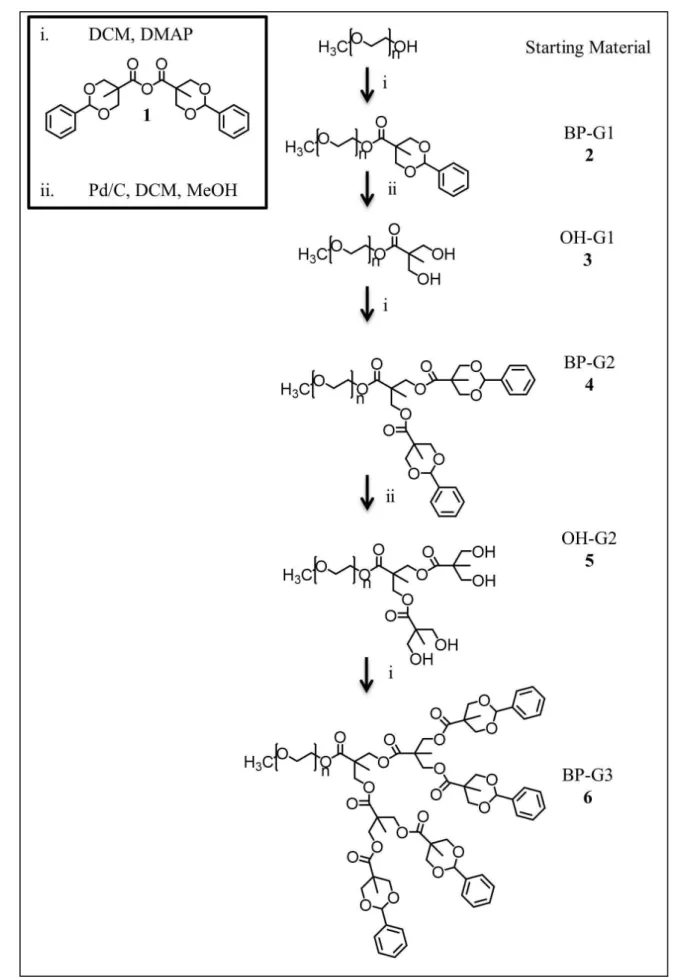
propionic anhydride was synthesized using a previously reported technique (Ihre, Padilla de Jesus, Frechet, 2001). Two different low-polydispersity PEGs were used as start -ing materials to prepare the linear-dendritic PEG hybrids: a linear monomethyl ether PEG alcohol (5000 Da) and a linear PEG diol (4600 Da). The linear-dendritic hybrids were then synthesized (Figures 1 and 2) by repetition of an acid anhydride esteriication “dendron growth” reaction and a palladium-catalyzed hydrogenolysis “deprotection” reaction (Ihre, Padilla de Jesus, Frechet, 2001).
RESULTS AND DISCUSSION
Characterization techniques
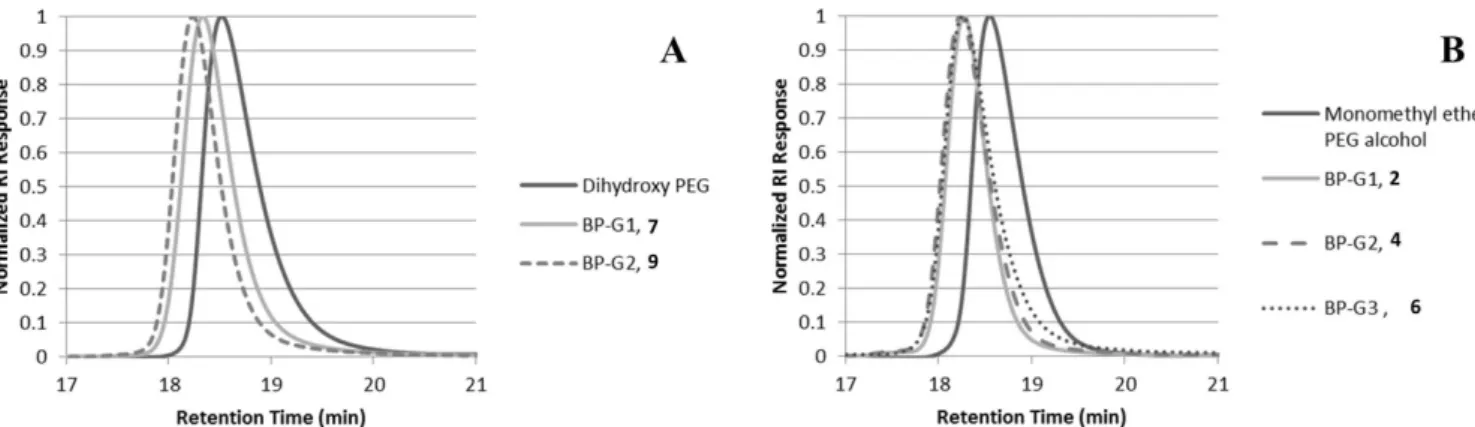
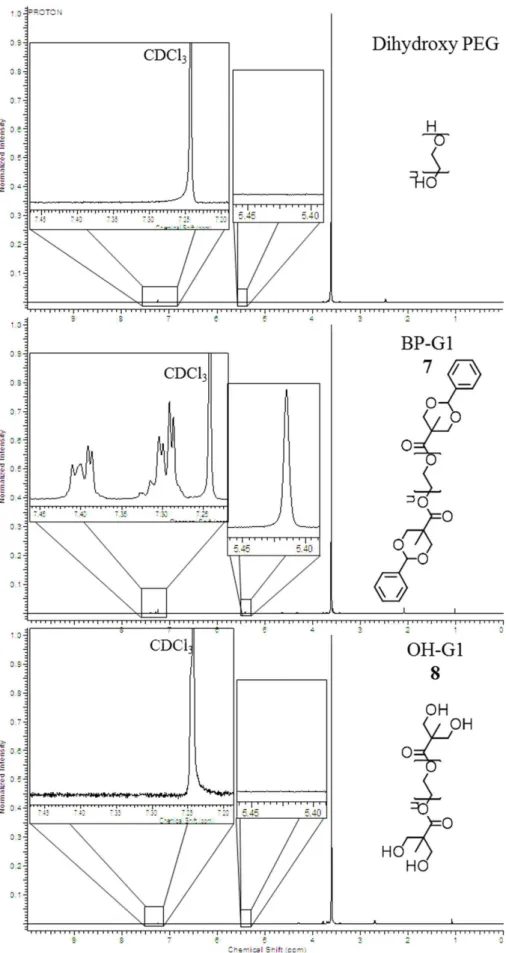
For the end group analysis required to conirm the preparation of these linear-dendritic hybrids, the most reli -able characterization method was MALDI-ToF MS. Nei -ther GPC (Figure 3a and b) nor NMR (Figure 4) provided enough structural information to determine the purity of the compounds due to the methods’ lack of sensitivity to the subtle changes in overall molecular structure, and the possibility of a low percentage of incomplete reactions or byproducts. For example, 1H NMR of the dendronization
of dihydroxy PEG can be used to conirm the addition of the aromatic hydrogens (7.25-7.45 ppm) and the benzyli -dene methyne (5.42 ppm). However, the low proportion of these end group signals relative to the PEG backbone makes the completion of the reaction dificult to determine
via 1H NMR integration alone. Likewise, the subtle shifts
observed in the GPC chromatograms were insuficient to draw meaningful conclusions about the extent of dendroni -zation. However, GPC was valuable in conirming that the narrow molecular weight distribution of the PEG starting materials were maintained throughout the dendronization process, and that low molecular weight impurities which might not be apparent in MALDI-ToF MS were absent from the samples. MALDI-ToF MS provided the neces -sary data for end group analysis and assurance of complete coupling and deprotection. While one can observe the expected shift in the entire mass distribution throughout the synthesis, it is perhaps most intuitive to select an oligo -mer of a speciic number of repeat units (e.g. 109--mer or 110-mer) and follow it through the expected transforma -tions during dendronization (Figures 6 and 7).
Reaction monitoring by MALDI-ToF MS
For the dihydroxy PEG, an excess (up to 3 eq./hy -droxyl) of the anhydride monomer, 1, was used in order to ensure that the esteriication reaction was carried to completion. The workup when using an excess of esterii -cation reagent was technically simple, as the product could be isolated via precipitation. The coupling reaction could be easily monitored by MALDI-ToF MS, to determine when the reaction was complete (Figure 5). While inter -pretation of the MALDI mass spectra was complicated by the polydisperse nature of PEG, rigorous calibration enabled the identification of the reactant and product distributions with a high degree of certainty. Within the irst minute of the reaction, the reaction mixture distribu -tion exhibited a 204.1 mass increase, corresponding to a single esteriication (A to B). By 16 minutes, a second distribution (C), which corresponded to the diester and an additional 204.12 mass increase, became the predominant distribution. By 256 minutes, only the diester product was apparent, and no signal could be observed for the previous distributions, suggesting the esteriication had been carried out to completion.
Product characterization
When comparing the reactant and product, in the case of the esteriication of monomethyl ether PEG alco -hol, reaction with the acid anhydride monomer, 1, yields the corresponding ester, 2. This product is expected to
FIGURE 2 - Synthesis of dendritic-linear-dendritic triblock via divergent dendronization of dihydroxy PEG.
taminants, but exhibited a larger than expected shift, likely because the hydroxyl-functionalized precursor can exhibit non-speciic interactions with the separation media. The 1H
NMR spectrum exhibited the expected addition of aromat -ic (7.25-7.44 ppm) and benzylidene methyne (5.42 ppm) resonances, though these peaks were dificult to quantify due to the low signal relative to the PEG backbone. In the deprotection step, the benzylidene group of 2 could be re -moved to reveal a diol end group functionality in polymer
3. The 1H NMR data conirmed the loss of the benzylidene
group, however the GPC exhibited only a negligible shift in retention time. The MALDI-ToF mass spectrum, how -ever, clearly exhibited the removal of the benzylidene group through an observed 87.83 amu reduction in mass (theoretical 88.03 amu). Likewise, for the next esteriica -tion reac-tion to convert polymer 3 to the second generation
dendronized PEG, 4, the MALDI mass spectrum provided
the most convincing data, with a mass increase that corre -sponded to the addition of two monomer units (theoretical: 408.16 amu, observed 408.12 amu). The next deprotec -tion to yield polymer 5 could again be confirmed by a
uniform loss of 175.95 amu in the mass spectrum (theo -rectical 176.07 amu). And inally, the purity of the third generation dendronized polymer, 6, could be conirmed
by the addition of 816.44 amu (theoretical 816.31 amu) with respect to the mass of the tetra-ol precursor, 5. The overall yield for this series of reactions was 68%.
For the dendronization of the diol, analogous results were obtained. For the dendronization to yield the irst generation dendronized-PEG dumbbell, 7, the product is
expected to exhibit a positive mass shift of 408.16 amu in its MALDI-ToF mass spectrum, and a shift of 408.12 amu was observed. Characterization by GPC showed a small decrease in retention time, while 1H NMR (Figure 2)
could be used to confirm the presence of the benzyli -dene-protected G1 dendron (e.g. methyne: 5.42 ppm, aryl: 7.25-7.45 ppm). After hydrogenolysis with Pd catalysts, the deprotected tetra-ol, 8, can be identified by an ex -pected loss of 176.06 amu (observed 176.17). Again, the GPC retention time exhibits a negligible shift, but NMR studies verify that the benzylidene protecting group has been removed, via loss of the aromatic (7.25-7.45 ppm) and benzylidene methyne resonances (5.42 ppm). The next dendronization reaction yielded the protected second generation dendronized PEG dumbbell, 9 with a mass
shift corresponding to the addition of four benzylidene protected monomers (theoretical: 816.32 amu, observed: 816.38 amu) Finally, the deprotection could be carried out on polymer 9, to yield the dendronized PEG dumbbell, 10, with four hydroxyl end groups on each end. Again, the MALDI mass spectra could be used to conirm the loss of
all four benzylidene groups via a mass reduction of 352.01 amu (theorectical 351.12 u). The overall yield for this set of reactions was 72%.
This relatively rapid and easily scalable synthetic approach provides a reliable method for preparing hyper -functional PEGs. In addition, the rapid and straightfor -ward conirmation of the exceptional structural purity of the dendronized PEGs via MALDI-ToF MS makes these biocompatible materials highly attractive for biomedical research.
CONCLUSIONS
Well-deined hybrid poly(ethylene glycol)-dendron polymers have been prepared via the dendronization of the alcohol end groups of the mono and difunctional linear polymers. While GPC and NMR exhibit the expected data, they cannot alone conirm the high purity of these linear-dendritic hybrids. MALDI-ToF mass spectrometry, on the other hand, provides tremendously detailed data which can enable veriication of the high structural purity of the dendronized PEG analogs. Because biomedical ap -plications require high purity, and a well-deined degree of functionalization, these high-purity, multifunctional PEGs represent important materials for future medical research. The MALDI-ToF mass spectrometric approach described herein demonstrates the value of this charac -terization technique in deining the purity of polymeric materials, particularly when structural purity is critical for the speciic application.
ACKNOWLEDGMENTS
This work was supported by NSF and Louisiana Board of Regents under NSF EPSCoR cooperative agree -ment No EPS-1003897.
REFERENCES
ABUCHOWSKI, A.T.; Van ES, N.C.; PALCZUK, F.F.D. Alteration of immunological properties of bovine serum
albumin by covalent attachment of polyethylene glycol. J.
Biol. Chem., v.252, p. 3578-3581, 1977.
FRECHET, J.M. Functional polymers and dendrimers: reactivity, molecular architecture, and interfacial energy.
Science, v.25, p. 1710-1715, 1994.
FRECHET, J.M.J.; TOMALIA, D.A. Dendrimers and other
dendritic polymers. West Sussex: John Wiley & Sons, Ltd.,
GITSOV, I. Hybrid linear dendritic macromolecules: from
synthesis to applications. J. Polym. Sci. Part A: Polym.
Chem., v.46, p.5295-5314, 2008.
GITSOV, I.; FRECHET, J.M.J. Solution and solid state properties of hybrid linear-dendritic block copolymers.
Macromolecules, v.26, p.6536-6546, 1993.
GITSOV, I.; FRECHET, J.M.J. Solution and solid-state properties of hybrid linear-dendritic block copolymers.
Macromolecules, v.26, p.6536-6546, 1993.
GITSOV, I.; LAMBRYCH, K.R.; REMNANT, V.A.; PRACITTO, R. Micelles with highly branched nanoporous interior: solution properties and binding capabilities of amphiphilic copolymers with linear dendritic architecture.
J. Polym. Sci., v.38, p.2711-2727, 2000.
GITSOV, I.; KEVIN, R.; LAMBRYCH, P.T.I.; LEWIS, S. Linear-dendritic poly(ether)-block-poly(ester) copolymers constructed by divergent and convergent growth methods.
Polym. Mater. Sci. Eng., v.84, p.925-926, 2001.
HENRIK, I.; HULT, A.; SODERLIND, E. Synthesis, characterization, and 1H NMR self-diffusion studies of dendritic aliphatic polyesters based on 2,2-Bis(hydroxymethyl)
propionic acid and 1,1,1-Tris(hydroxyphenyl)ethane. J. Am.
Chem. Soc., v.118, p.6388-6395, 1996.
HENRIK, I.; PADILLA DE JESUS, O.L.; FRECHET, J.M.J. Fast and convenient divergent synthesis of aliphatic ester
dendrimers by anhydride coupling. J. Am. Chem. Soc.,
v.123, p.5908-5917, 2001.
LUNDBERG, P.; WALTER, M.V.; MONTAÑEZ, M.I.; HULT, D.; HULT A.; NYSTRÖM, A.; MALKOCH, M. Linear dendritic polymeric amphiphiles with intrinsic biocompatibility: synthesis and characterization to
fabrication of micelles and honeycomb membranes. Polym.
Chem., v.2, p.394-402, 2011.
PADILLA DE JESUS, O.L.; HENRIK, R.I.; GAGNE, L.; FRECHET, J.M.J.; SZOKA Jr, F.C. Polyester dendritic
systems for drug delivery applications: in vitro and in vivo
evaluation. Bioconjugate Chem., v.13, p.453-461, 2002.
PASUT, G.; VERONESE, F.M. Improvement of drug therapy by covalent PEG conjugation: an overview from a research
laboratory. Isr. J. Chem., v.50, p.151-159, 2010.
POLCE, M.; WESDEMIOTIS, C. Introduction to mass
spectrometry of polymers. In: _____ Mass spectrometry
of polymers. Boca Raton: CRC Press LLC, 2002. p.1-36.
VERONESE, F.M.; PASUT, G. PEGylation, successful
approach to drug delivery. Drug Discovery Today, v.10,