Reinforcement Learning Explains Conditional
Cooperation and Its Moody Cousin
Takahiro Ezaki1,2,3,4, Yutaka Horita3,4, Masanori Takezawa5,6, Naoki Masuda7*
1Research Center for Advanced Science and Technology, The University of Tokyo, Meguro-ku, Tokyo, Japan,2Japan Society for the Promotion of Science, Kojimachi, Chiyoda-ku, Tokyo, Japan,3National Institute of Informatics, Hitotsubashi, Chiyoda-ku, Tokyo, Japan,4JST, ERATO, Kawarabayashi Large Graph Project, c/o Global Research Center for Big Data Mathematics, NII, Chiyoda-ku, Tokyo, Japan,
5Department of Behavioral Science, Hokkaido University, Kita-ku, Sapporo, Japan,6Center for
Experimental Research in Social Sciences, Hokkaido University, Kita-ku, Sapporo, Japan,7Department of Engineering Mathematics, University of Bristol, Clifton, Bristol, United Kingdom
Abstract
Direct reciprocity, or repeated interaction, is a main mechanism to sustain cooperation under social dilemmas involving two individuals. For larger groups and networks, which are probably more relevant to understanding and engineering our society, experiments employ-ing repeated multiplayer social dilemma games have suggested that humans often show conditional cooperation behavior and its moody variant. Mechanisms underlying these behaviors largely remain unclear. Here we provide a proximate account for this behavior by showing that individuals adopting a type of reinforcement learning, called aspiration learn-ing, phenomenologically behave as conditional cooperator. By definition, individuals are satisfied if and only if the obtained payoff is larger than a fixed aspiration level. They rein-force actions that have resulted in satisfactory outcomes and anti-reinrein-force those yielding unsatisfactory outcomes. The results obtained in the present study are general in that they explain extant experimental results obtained for both so-called moody and non-moody con-ditional cooperation, prisoner’s dilemma and public goods games, and well-mixed groups and networks. Different from the previous theory, individuals are assumed to have no access to information about what other individuals are doing such that they cannot explicitly use conditional cooperation rules. In this sense, myopic aspiration learning in which the unconditional propensity of cooperation is modulated in every discrete time step explains conditional behavior of humans. Aspiration learners showing (moody) conditional coopera-tion obeyed a noisy GRIM-like strategy. This is different from the Pavlov, a reinforcement learning strategy promoting mutual cooperation in two-player situations.
Author Summary
Laboratory experiments using human participants have shown that, in groups or contact networks, humans often behave as conditional cooperator or its moody variant. Although conditional cooperation in dyadic interaction is well understood, mechanisms underlying
a11111
OPEN ACCESS
Citation:Ezaki T, Horita Y, Takezawa M, Masuda N (2016) Reinforcement Learning Explains Conditional Cooperation and Its Moody Cousin. PLoS Comput Biol 12(7): e1005034. doi:10.1371/journal. pcbi.1005034
Editor:Natalia L. Komarova, University of California, Irvine, UNITED STATES
Received:March 21, 2016
Accepted:June 27, 2016
Published:July 20, 2016
Copyright:© 2016 Ezaki et al. This is an open access article distributed under the terms of the
Creative Commons Attribution License, which permits unrestricted use, distribution, and reproduction in any medium, provided the original author and source are credited.
Data Availability Statement:All relevant data are within the paper and its Supporting Information files.
these behaviors in group or networks beyond a pair of individuals largely remain unclear. In this study, we show that players adopting a type of reinforcement learning exhibit these conditional cooperation behaviors. The results are general in the sense that the model explains experimental results to date obtained in various situations. It explains moody conditional cooperation, which is a recently discovered behavioral trait of humans, in addition to traditional conditional cooperation. It also explains experimental results obtained with both the prisoner’s dilemma and public goods games and with different population structure. Crucially, our model assumes that individuals do not have access to information about what other individuals are doing such that they cannot explicitly condi-tion their behavior on how many others have previously cooperated. Thus, our results pro-vide a proximate and unified understanding of these experimentally observed patterns.
Introduction
Humans very often cooperate with each other when free-riding on others’efforts is ostensibly lucrative. Among various mechanisms enabling cooperation in social dilemma situations, direct reciprocity, i.e., repeated interaction between a pair of individuals, is widespread. If indi-viduals will repeatedly interact, they are motivated to keep on cooperation because no coopera-tion would invite retaliacoopera-tion by the peer in the succeeding interaccoopera-tions [1,2]. Past theoretical research using the two-player prisoner’s dilemma game (PDG) identified tit-for-tat (TFT) [2], generous TFT [3], a win-stay lose-shift strategy often called Pavlov [4–6] as representative strong competitors in the repeated two-player PDG.
Direct reciprocity in larger groups corresponds to the individual’s action rule collectively called the conditional cooperation (CC), a multiplayer variant of TFT. By definition, an indi-vidual employing CC would cooperate if a large amount of cooperation has been made by other group members. In the present study, we study a reinforcement learning model. Depend-ing on the parameter values, the outcome of the learnDepend-ing process shows CC patterns and their variant that have been observed in behavioral experiments.
In fact, the following evidence suggests that the concept and relevance of CC are much more nuanced than in the case of dyadic interactions, calling for examinations. First, early the-oretical studies have concluded that CC in the multiplayer PDG is unstable as the group size increases [7,8]. In addition, CC assumed in these and follow-up studies is a threshold behavior (i.e., players cooperate when the number of peers that have cooperated the last time exceeds a prescribed threshold). However, CC patterns and their variants observed in the extant experi-ments are gradual rather than a threshold behavior [9–17].
Second, the public goods game (PGG) models social dilemmas occurring in a group beyond a pair of individuals. In the repeated PGG, CC has been observed in laboratory experiments with human participants [9–12,17] and in real society [18]. By definition, an individual adopt-ing CC increases the amount of cooperation when others have made large contributions the last time. CC in the repeated PGG with two or more players is theoretically stable under some conditions [19–24]. However, these conditions are not generous and how they connect to the experimental results is not clear. This situation contrasts to that of the two-player, discrete-action PDG mentioned previously, where conditions under which direct reciprocity occurs and strategies enabling them are well characterized [2,3,5].
Third, recent experiments have discovered that humans show moody conditional coopera-tion (MCC) behavior in the repeated PDG game played on contact networks [13–16]. MCC is defined as follows. MCC is the same as CC if the player has cooperated the last time. If the Competing Interests:The authors have declared
player has defected the last time, a player adopting MCC decides on the action without taking into account what the neighbors in the contact network have done previously. In this sense, the player’s action rule is moody. The genesis of MCC is not well understood. First, evolutionary dynamics do not promote MCC behavior [15,25]. Second, non-evolutionary numerical simu-lations assuming MCC do not intend to explain why MCC emerges or is stable [14,15,26]. Third, a numerical study employing reinforcement learning [25] has MCC behavior built in into the model in the sense that MCC occurs whenever cooperation is sustained (see Discus-sionfor more).
In this article, we provide an account for experimentally observed CC and MCC patterns using a family of reinforcement learning called the aspiration learning [27–36]. In reinforce-ment learning, players satisfice themselves rather than maximize the payoff in the sense that a player increases and decreases the likelihood of the behavior that has yielded a large and small reward, respectively. In aspiration learning, players are satisfied if and only if the obtained pay-off is larger than a threshold. Because the probability to select the behavior, such as coopera-tion, is dynamically updated in every discrete time step, aspiration learning is different from a conditional strategy in general.
Our main conclusion that reinforcement learning explains CC and MCC resembles that of a previous study [25]. However, the present study is radically different from Ref. [25] in the fol-lowing aspects. First, as stated above, MCC behavior is an assumed mode of the model pro-posed in Ref. [25]. In the present model, players myopically adjust the unconditional
probability of cooperation depending on the previous action and reward, as in previous aspira-tion learning models [28,29,31,32,37–39]. Second, the present model is also simpler, even without assuming players to be aware of the amount of cooperation carried out nearby or to explicitly implement conditional strategies.
Model
We place a player obeying the reinforcement learning rule on each node of the square lattice with 10 × 10 nodes with periodic boundary conditions. However, the following results do not require particular network structure (Fig A inS1 Text). Each player is involved in the two-player PDG against each of the four neighbors on the network. The game is also interpreted as a PGG played in the group composed of the player and all neighbors submitting binary deci-sions [40]. The game is repeated overtmaxrounds. We settmax= 25 unless otherwise stated.
Each player selects either to cooperate (C) or defect (D) in each round (Fig 1A). The submit-ted action (i.e., C or D) is used consistently against all the neighbors. In other words, a player is not allowed to cooperate with one neighbor and defect against another neighbor in the same round. If both players in a pair cooperate, both players gain payoffR= 3. If both defect, both gainP= 1. If a player cooperates and the other player defects, the defector exploits the coopera-tor such that the cooperacoopera-tor and defeccoopera-tor gainS= 0 andT= 5, respectively.
Each player is assumed to update the intended probability to cooperate,pt, according to the Bush-Mosteller (BM) model of reinforcement learning [27–29,32,39] as follows:
pt¼
pt 1þ ð1 pt 1Þst 1 ðat 1 ¼C;st 10Þ;
pt 1þpt 1st 1 ðat 1 ¼C;st 1<0Þ;
pt 1 pt 1st 1 ðat 1 ¼D;st 10Þ;
pt 1 ð1 pt 1Þst 1 ðat 1 ¼D;st 1<0Þ;
8
> > > > <
> > > > :
ð1Þ
respectively. For example, thefirst line on the right-hand side ofEq (1)states that the player increases the probability to cooperate if it has cooperated and been satisfied in the previous round. The multiplicative factor (1−pt−1) is imposed to respect the constraintpt<1.
The stimulus is defined by
st 1¼ tanh½bðrt 1 AÞ; ð2Þ
wherert−1is the payoff to the player in roundt−1, averaged over the four neighboring players, Ais the aspiration level, andβ(>0) controls the sensitivity ofst−1tort−1−A[39]. The player is
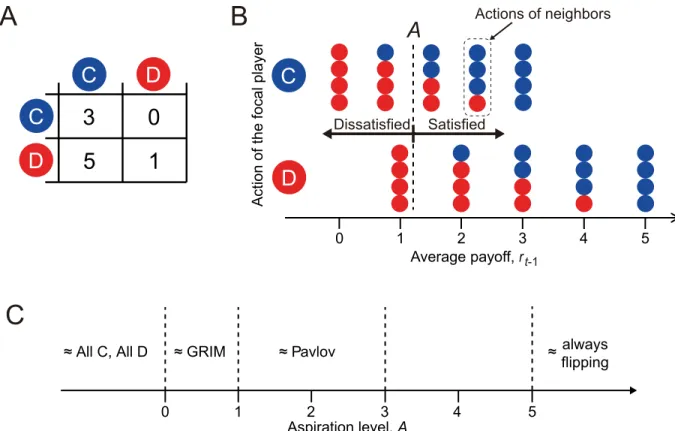
satisfied and dissatisfied ifrt−1−A>0 (i.e.,st−1>0) andrt−1−A<0 (i.e.,st−1<0), respec-tively (Fig 1B). The so-called Pavlov strategy corresponds toβ=1andP<A<R[4,5] (Fig 1C). The so-called GRIM strategy, which starts with cooperation and turns into permanent defection (if without noise) once the player is defected [2,41], corresponds toβ=1andS<A <R[38]. Whenβ<1, which we assume, the behavior realized by the BM model is not an exact conditional strategy such as Pavlov or GRIM, but an approximate one. Unlike some pre-vious studies in whichAadaptively changes over time [32,37–39], we assume thatAisfixed.
In each round, each player is assumed to misimplement the decision with probability[5,6, 39]. Therefore, the actual probability to cooperate in roundtis given by
~
ptptð1 Þ þ ð1 ptÞ. We set= 0.2 and the initial probability of cooperationp1= 0.5 unless otherwise stated.
Fig 1. Behavior of the aspiration learner in the repeated PD game.(A) Payoff matrix. The payoff values for the row player are shown. (B) Concept of satisficing in the aspiration-based reinforcement learning model. The payoff values shown on the horizontal axis are those for the focal player. (C) Relationship between the aspiration level,A, and the approximate (un)conditional strategy, given the payoff matrix shown in (A).
Results
Prisoner
’
s dilemma game
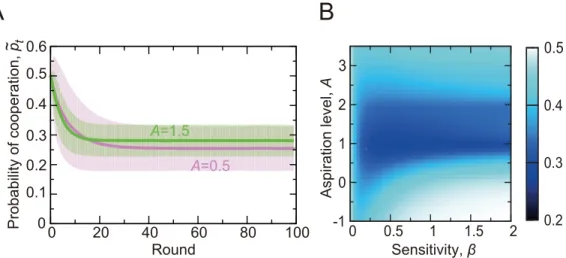
ForA= 0.5 andA= 1.5, the realized probability of cooperation,~p
t, averaged over the players
and simulations is shown inFig 2Aup to 100 rounds. Due to a relatively large initial probability of cooperation,p1= 0.5,p~tdrops within thefirst20 rounds and stays at the same level
after-wards for bothAvalues. This pattern is roughly consistent with behavioral results obtained in laboratory experiments [13–16,42].
For a range of the two main parameters, the sensitivity of the stimulus to the reward (i.e.,β) and the aspiration level setting the satisfaction threshold for players (i.e.,A),~p
taveraged over
thefirst 25 rounds is shown inFig 2B. Thefigure indicates that cooperation is frequent whenβ
is large, which is consistent with the previous results [39], and whenAis less than1. The probability of cooperation is also relatively large whenAis larger than2. In this situation, defection leads to an unsatisfactory outcome unless at least two out of the four neighbors coop-erate (Fig 1B). Because this does not happen often, a player would frequently switch between defection and cooperation, leading to~p
t0:4.
The results shown inFig 2Bwere largely unchanged when we variedtmaxand(Fig B inS1 Text).
The probability of cooperation,~p
t, is plotted against the fraction of cooperating neighbors
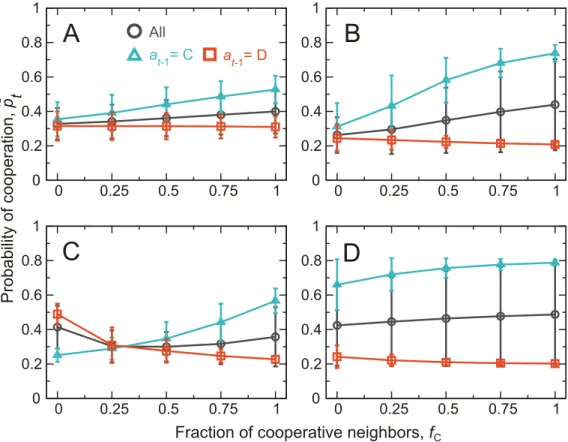
in the previous round, denoted byfC, forA= 0.5 and two values ofβinFig 3A and 3B. The results not conditioned on the action of the player in the previous round are shown by the cir-cles. The player is more likely to cooperate when more neighbors cooperate, consistent with CC patterns reported in experiments with the PDG on the square lattice [42]. CC is particularly pronounced at a large value ofβ(Fig 3Bas compared toFig 3A).
The relationship between~p
tandfCconditioned on the last action of the focal player, denoted byat−1, is shown by the triangles and squares. We observe clear MCC patterns, partic-ularly for a largeβ. In other words, players that have previously cooperated (i.e.,at−1= C) show CC, whereas the probability of cooperation stays constant or mildly decreases asfCincreases
Fig 2. Probability of cooperation in the repeated PDG game on the square lattice having 10 × 10 nodes.
(A) Mean time courses of the actual probability of cooperation,p~
t. The lines represent the actual probability of
cooperation averaged over the 102players and 103simulations. We setβ= 0.2 andA= 0.5. The shaded
regions represent the error bar calculated as one standard deviation. (B) Probability of cooperation for various values of the sensitivity of the stimulus to the reward,β, and the aspiration level,A. The shown values are averages over the 102players, thefirstt
max= 25 rounds, and 103simulations.
when the player has previously defected (i.e.,at−1= D). These MCC patterns are consistent with the extant experimental results [13–16].
In the experiments, MCC has also been observed for different population structure such as the scale-free network [16] and a dynamically changing network [14]. We carried out numeri-cal simulations on the regular random graph (i.e., random graph in which all nodes have the same degree, or the number of neighbors) with degree four and the well-mixed group of five players in which each player had four partners. The results remained qualitatively the same as those for the square lattice, suggesting robustness of the present numerical results with respect to the network structure (Fig A inS1 Text). Spatial or network reciprocity is not needed for the present model to show MCC patterns.
A different aspiration level,A, produces different patterns. CC and MCC patterns are lost when we setA= 2 (Fig 3C), with which the dependence of~p
tonfCis small, and~ptwhen no
neighbor has cooperated in the previous round (i.e.,fC= 0) is larger forat−1= D (squares in Fig 3C) than forat−1= C (triangles). The latter pattern in particular contradicts the previous behavioral results [13–16]. CC and MCC patterns are mostly lost forA=−1 as well (Fig 3D).
WithA=−1, the BM player is satisfied by any outcome such that any action is reinforced
except for the action implementation error. Therefore, the behavior is insensitive to the reward, or tofC.
Fig 3. CC and MCC in the repeated PDG on the square lattice.The actual probability of cooperation,p~
t, is
plotted against the fraction of cooperative neighbors in the previous round,fC. The error bars represent the
mean±standard deviation calculated on the basis of all players,tmax= 25 rounds, and 103simulations. The
circles represent the results not conditioned onat−1. The triangles and the squares represent the results
conditioned onat−1= C andat−1= D, respectively. We set (A)β= 0.1 andA= 0.5, (B)β= 0.4 andA= 0.5, (C)β
= 0.4 andA= 2.0, and (D)β= 0.4 andA=−1.0.
To assess the robustness of the results, we scanned a region in theβ−Aparameter space.
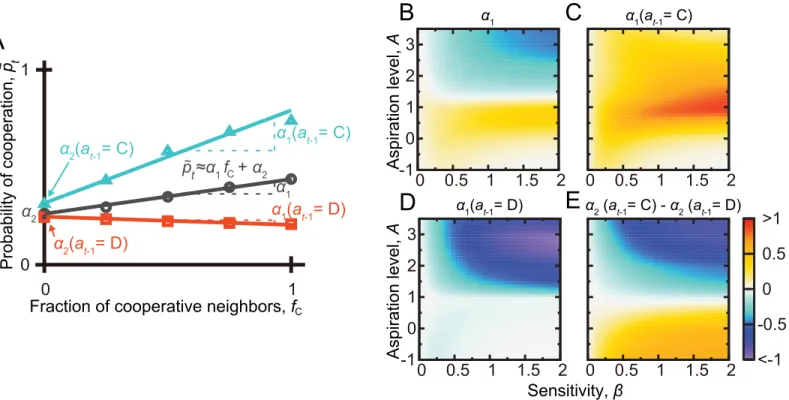
For each combination ofβandAvalues, we performed linear least-square fits to the relation-ship between the mean~p
tandfC, estimating~pta1fCþa2(Fig 4A). CC is supported if the
obtained slopeα1is positive when unconditioned onat−1(circles inFig 3). MCC is supported ifα1is positive whenat−1= C (triangles inFig 3) and negative or close to zero whenat−1= D (squares inFig 3). Interceptα2is equal to the value ofp~twhen no neighbor has cooperated in
the previous round. The behavioral results suggest thatα2is larger when conditioned on
at−1= C than onat−1= D [13–16].
Fig 4Bindicates that the slopeα1unconditioned onat−1is positive, producing CC, when A1 andβis larger than0.25. However,α1is less positive whenAis extremely small, i.e., smaller than0. When conditioned onat−1= C,α1is positive, consistent with the MCC pat-terns, except whenβis larger than0.5 andAis smaller than0 (Fig 4C). When conditioned onat−1= D,α1is close to zero whenA1 and substantially negative whenA1 (Fig 4D). The difference in the value ofα2, the intercept of the linear fit, between the casesat−1= C and at−1= D is shown inFig 4E. The figure indicates that this value is non-negative, consistent with the experimental results, only whenA<1. To conclude, CC and MCC patterns consistent with the behavioral results are produced when 0<A<1 andβis not too small. We also confirmed that a different implementation of the BM model [32] produced CC and MCC patterns when
A<1 (Fig C inS1 Text).
The BM model withP<A<R, i.e., 1<A<3, corresponds to the Pavlov strategy, which is a strong competitor and facilitator of cooperation in the repeated PDG [4,5]. Our results do not indicate that the Pavlov strategy explains CC and MCC patterns. In fact, the BM model Fig 4. Search of CC and MCC patterns in the repeated PDG on the square lattice.(A) Schematic of the linear fit,~p
ta1fCþa2. (B) Slopeα1of the
linearfit when not conditioned on the focal player’s previous action,at−1. (C)α1when conditioned onat−1= C. (D)α1when conditioned onat−1= D. (E)
Difference between the intercept,α2, obtained from the linearfit conditioned onat−1= C and that conditioned onat−1= D. For each combination of theβand
Avalues, a linearfit was obtained by the least-squares method on the basis of the 102players,t
max= 25 rounds, and 103simulations, yielding 2.5 × 10⁶
samples in total.
withS<A<P(i.e., 0<A<1), which is a noisy GRIM-like reinforcement learning, robustly produces CC and MCC patterns. It should be noted that, a noisy GRIM strategy without rein-forcement learning components does not produce CC and MCC patterns (Fig D inS1 Text). This result suggests an active role of reinforcement learning rather than merely conditional strategies such as the noisy GRIM.
Public goods game
CC behavior has been commonly observed for humans engaged in the repeated PGG in which participants make a graded amount of contribution [9–11,43–45]. It should be noted that the player’s action is binary in the PDG. In accordance with the setting of previous experiments [10], we consider the following repeated PGG in this section. We assume that four players form a group and repeatedly play the game. In each round, each player receives one monetary unit and determines the amount of contribution to a common pool, denoted byat2[0, 1]. The sum of the contribution over the four players is multiplied by 1.6 and equally redistributed to them. Therefore, the payoff to a player is equal to1 a
tþ0:4ðatþ
P3
j¼1~aj;tÞ, wherea~j;tis the
contribution by thejth other group member in roundt. The Nash equilibrium is given by no contribution by anybody, i.e.,at¼~aj;t¼0(1j3).
We simulated the repeated PGG in which players implemented a variant of the BM model (seeMaterials and Methods). Crucially, we introduced a threshold contribution valueXabove which the action was regarded to be cooperative. In other words, an amount of contributionat
Xandat<Xare defined to be cooperation and defection, respectively. Binarization of the action is necessary for determining the behavior to be reinforced and that to be anti-reinforced.
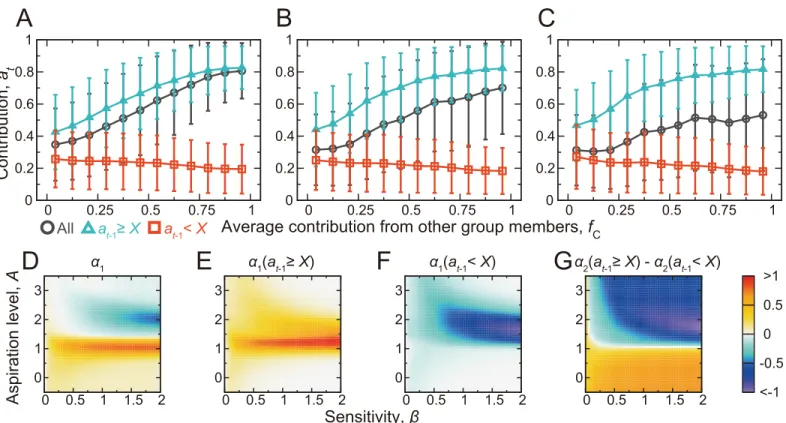
InFig 5, the contribution by a player,at, averaged over the players, rounds, and simulations is plotted against the average contribution by the other group members, which is again denoted byfC(0fC1). We observe CC behavior for this parameter set whenX= 0.3 and 0.4 (circles inFig 5A and 5B, respectively). CC patterns are weak forX= 0.5 (Fig 5C). The average contri-bution by a player as a function offCand the action of the focal player in the previous round is shown by the triangles and squares inFig 5A–5C. We find MCC patterns. CC and MCC shown inFig 5are robustly observed ifβis larger than0.2,A1, and 0.1X0.4 (Fig 5D–5Gand Fig E inS1 Text).
Directional learning is a reinforcement learning rule often applied to behavioral data in the PGG [46,47] and the PDG [48]. By definition, a directional learner keeps increasing (decreas-ing) the contribution if an increase (decrease) in the contribution in the previous round has yielded a large reward. In a broad parameter region, we did not find CC or MCC behavior with players obeying the directional learning rule (Fig F inS1 Text). The present BM model is sim-pler and more accurate in explaining the experimental results in terms of CC and MCC pat-terns than directional learning is.
Presence of free riders
Discussion
We have provided compelling numerical evidence that the BM model, a relatively simple aspi-ration-based reinforcement learning model that has been employed in various decision making tasks [27–29,31–39], explains CC and MCC patterns. On one hand, aspiration learning has offered a proximate mechanism for cooperation [28,29,31,32,37–39]. On the other hand, conditional cooperation in the repeated PGG [9–11,43–45] and its moody variant in the repeated PDG on networks [13–16] have been consistently observed. Here we provided a con-nection between aspiration learning and conditional cooperation. Our choice of the parameter values including the number of rounds, the size of the group or neighborhood, and the payoff values, supports the comparison of the present numerical data with the results of behavioral experiments.
We are not the first to provide this link. Cimini and Sánchez have shown that MCC emerges from a BM model [25]. The current results significantly depart from theirs and are fundamen-tally new as follows.
First, MCC is built in into their model in the sense that every outcome except for a popula-tion of uncondipopula-tional defectors implies MCC patterns. In their model, the linear relapopula-tionship
pt=α1fC+α2after the focal player’s cooperation, whereptis the probability of cooperation andfCis the fraction of cooperation in the neighborhood in the previous round, adaptively changes according to the BM model dynamics. In fact,α1andα2are simultaneously updated Fig 5. CC and MCC patterns in the repeated PGG in a group of four players.(A)–(C) Contribution by a player (i.e.,at) conditioned on the average
contribution by the other group members in the previous round (i.e.,fC). We setβ= 0.4 andA= 0.9. (A)X= 0.3, (B)X= 0.4, and (B)X= 0.5. The circles
represent the results not conditioned onat−1. The triangles and the squares represent the results conditioned onat−1Xandat−1<X, respectively. (D)
Slopeα1of the linear fit,atα1fC+α2, when not conditioned onat−1. (E)α1when conditioned onat−1X. (F)α1when conditioned onat−1<X. (G)
Difference betweenα2obtained from the linear fit conditioned onat−1Xand that conditioned onat−1<X. The mean and standard deviation in (A)–(C)
and the linear fit used in (D)–(G) were calculated on the basis of the four players,tmax= 25 rounds, and 2.5 × 10⁴simulations, yielding 2.5 × 10⁶samples
in total.
under a constraint and take a common value after a transient (S1 Text), consistent with their numerical results (Fig 2 in [25]). This relationship yieldspt=α1(fC+ 1), implying MCC when-everα1>0. Whenα1= 0, we obtainpt= 0, i.e., unconditional defection. In contrast, players in our model directly adapt the unconditional probability of cooperation without knowingfC such that there is no room for players to explicitly learn the MCC rule. Therefore, our approach is inherently bottom-up.
Second, our model is cognitively less taxing than the Cimini-Sánchez model. In their model, a player refers tofCand updates the action rule based on its own actions in the last two rounds. Depending on the action that the player has submitted in the second last round, the parameters in one of the two subrules ((p,r) orqin [25]) are updated. In contrast, as already mentioned, players do not refer tofCin our model. They only refer to their own reward and action in the previous round. A player simply increases or decreases the unconditional probability of coop-eration in the next round depending on the amount of satisfaction, as assumed in the previous experimental [28] and theoretical [29,32,37–39] studies applying aspiration-based reinforce-ment learning models to social dilemma games.
In Ref. [25], the Pavlov rather than GRIM rule produced MCC patterns. Our results were the opposite. With Pavlov, CC behavior is lost in our simulations (Figs4Band5D). In addition, a Pavlov player cooperates more often after it has defected than cooperated in the last round (Figs4Eand5G), qualitatively contradicting the experimental results. This inconsistency with Pavlov persists even if we use the Macy-Flache reinforcement learning model as in [25] (Fig C inS1 Text). MCC is intuitively associated with GRIM, not Pavlov, for the following reason. Consider the two-person PDG for simplicity and a player obeying MCC. The player and has obtained payoffR(by mutual cooperation;fC= 1), the player would cooperate in the next round. If the same MCC player has obtained payoffS(by the player’s unilateral cooperation;
fC= 0), the player would defect in the next round. If the player has obtained payoffPorT(by the player’s defection, i.e.,at−1= D), the player would next submitat(= C or D) independently of the previously obtained payoff (i.e.,PorT). Ifat= C, the player has flipped the action becauseat−1= D. This MCC behavior is not realizable by the aspiration learning because it requiresS,P,T<A<R, which contradicts the payoff of the PDG, i.e.,S<P<R<T. Ifat= D, the player has not flipped the action. This MCC behavior is realizable by a value ofA verify-ingS<A<R,P,T, which is the GRIM.
The GRIM is not exploited by an unconditional defector. In contrast, the Pavlov is exploited by an unconditional defector every other round because Pavlov players flip between coopera-tion and defeccoopera-tion. In experiments, a substantial fraccoopera-tion of participants uncondicoopera-tionally defects [9,43,49,50]. The parameters of the aspiration learning may have evolved such that humans behave like noisy GRIM to protect themselves against exploitation by unconditional defectors. It should be noted that the mere GRIM strategy, corresponding toβ=1andS<A <Pin our model, does not produce MCC patterns (Fig D inS1 Text). Therefore, an involve-ment of reinforceinvolve-ment learning seems to be crucial in explaining the behavioral results, at least within the framework of the present model.
Our numerical results indicated MCC in the PGG. Past laboratory experiments using the PGG focused on CC, not MCC, to the best of our knowledge. As pointed out in previous litera-ture [16], examining the possibility of MCC patterns in the repeated PGG with experimental data warrants future research. Conversely, applying the BM model and examining the rele-vance of noisy GRIM in the existing and new experimental data may be fruitful exercises.
games in laboratory experiments, humans may behave differently from the assumptions of evo-lutionary dynamics. In fact, regular lattices [54] and scale-free networks [16] do not enhance cooperation in behavioral experiments, which is contrary to the prediction of the evolutionary game theory. In addition, human strategy updating can considerably deviate from those corre-sponding to major evolutionary rules [42]. Aspiration learning provides an attractive alterna-tive to evolutionary rules in approximating human behavior in social dilemma situations and beyond.
Materials and Methods
BM model for the PGG
Unlike in the PDG, the action is continuous in the PGG such that the behavior to be reinforced or anti-reinforced is not obvious. Therefore, we modify the BM model for the PDG in the fol-lowing two aspects. First, we defineptas the expected contribution that the player makes in roundt. We draw the actual contributionatfrom the truncated Gaussian distribution whose mean and standard deviation are equal toptand 0.2, respectively. Ifatfalls outside the interval [0, 1], we discard it and redrawatuntil it falls within [0, 1]. Second, we introduce a threshold contribution valueX, distinct fromA, used for regarding the action to be either cooperative or defective.
We updateptas follows:
pt¼
pt 1þ ð1 pt 1Þst 1 ðat 1 X and st 1 0Þ;
pt 1þpt 1st 1 ðat 1 X and st 1 <0Þ;
pt 1 pt 1st 1 ðat 1 <X and st 1 0Þ;
pt 1 ð1 pt 1Þst 1 ðat 1 <X and st 1 <0Þ:
8
> > > > <
> > > > :
ð3Þ
For example, thefirst line on the right-hand side ofEq (3)states that, if the player has made a large contribution (hence regarded to be C) and it has been rewarding, the player will increase the expected contribution in the next round. The stimulus,st−1, is defined byEq (2).
In the numerical simulations, we draw the initial condition,p1, from the uniform density on [0, 1], independently for different players.
Supporting Information
S1 Text. Supporting Information for: Reinforcement Learning Explains Conditional Coop-eration and Its Moody Cousin.
(PDF)
Acknowledgments
We acknowledge Hisashi Ohtsuki and Shinsuke Suzuki for valuable comments on the manuscript.
Author Contributions
Conceived and designed the experiments: NM. Performed the experiments: TE. Analyzed the data: TE. Wrote the paper: TE YH MT NM.
References
2. Axelrod R. The Evolution of Cooperation. New York: Basic Books; 1984.
3. Nowak MA, May RM. Evolutionary games and spatial chaos. Nature. 1992; 359:826–829. doi:10.1038/ 359826a0
4. Kraines D, Kraines V. Learning to cooperate with Pavlov: An adaptive strategy for the iterated prisoner’s dilemma with noise. Theory Decis. 1993; 35:107–150. doi:10.1007/BF01074955
5. Nowak MA, Sigmund K. A strategy of win-stay, lose-shift that outperforms tit-for-tat in the Prisoner’s Dilemma game. Nature. 1993; 364:56–58. doi:10.1038/364056a0PMID:8316296
6. Nowak MA, Sigmund K, El-Sedy E. Automata, repeated games and noise. J Math Biol. 1995; 33:703–
722. doi:10.1007/BF00184645
7. Boyd R, Richerson PJ. The evolution of reciprocity in sizable groups. J Theor Biol. 1988; 132:337–356. doi:10.1016/S0022-5193(88)80219-4PMID:3226132
8. Joshi NV. Evolution of cooperation by reciprocation within structured demes. J Genet. 1987; 66:69–84. doi:10.1007/BF02934456
9. Keser C, van Winden F. Conditional cooperation and voluntary contributions to public goods. Scand J Econ. 2000; 102:23–39. doi:10.1111/1467-9442.00182
10. Fischbacher U, Gächter S, Fehr E. Are people conditionally cooperative? Evidence from a public goods experiment. Econ Lett. 2001; 71:397–404. doi:10.1016/S0165-1765(01)00394-9
11. Fehr E, Fischbacher U. Social norms and human cooperation. Trends Cogn Sci. 2004; 8:185–190. doi: 10.1016/j.tics.2004.02.007PMID:15050515
12. Gächter S. Conditional cooperation: Behavioral regularities from the lab and the field and their policy implications. In: Frey BS, Stutzer A, editors. Economics and Psychology: A Promising New Cross-disci-plinary Field. Cambridge: MIT Press; 2007. pp. 19–50.
13. GrujićJ, Fosco C, Araujo L, Cuesta JA, Sánchez A. Social experiments in the mesoscale: Humans playing a spatial prisoner’s dilemma. PLOS ONE. 2010; 5:e13749. doi:10.1371/journal.pone.0013749 PMID:21103058
14. GrujićJ, Röhl T, Semmann D, Milinski M, Traulsen A. Consistent strategy updating in spatial and non-spatial behavioral experiments does not promote cooperation in social networks. PLOS ONE. 2012; 7: e47718. doi:10.1371/journal.pone.0047718PMID:23185242
15. GrujićJ, et al. A comparative analysis of spatial Prisoner’s Dilemma experiments: Conditional
coopera-tion and payoff irrelevance. Sci Rep. 2014; 4:4615. doi:10.1038/srep04615PMID:24722557
16. Gracia-Lázaro C, et al. Heterogeneous networks do not promote cooperation when humans play a Pris-oner’s Dilemma. Proc Natl Acad Sci USA. 2012; 109:12922–12926. doi:10.1073/pnas.1206681109 PMID:22773811
17. Fowler JH, Christakis NA. Cooperative behavior cascades in human social networks. Proc Natl Acad Sci USA. 2010; 107:5334–5338. doi:10.1073/pnas.0913149107PMID:20212120
18. Rustagi D, Engel S, Kosfeld M. Conditional cooperation and costly monitoring explain success in forest commons management. Science. 2010; 330:961–965. doi:10.1126/science.1193649PMID:
21071668
19. Wahl LM, Nowak MA. The continuous prisoner’s dilemma: I. Linear reactive strategies. J Theor Biol. 1999; 200:307–321. doi:10.1006/jtbi.1999.0996PMID:10527720
20. Doebeli M, Hauert C. Models of cooperation based on the Prisoner’s Dilemma and the Snowdrift game. Ecol Lett. 2005; 8:748–766. doi:10.1111/j.1461-0248.2005.00773.x
21. André JB, Day T. Perfect reciprocity is the only evolutionarily stable strategy in the continuous iterated prisoner’s dilemma. J Theor Biol. 2007; 247:11–22. doi:10.1016/j.jtbi.2007.02.007PMID:17397874
22. Le S, Boyd R. Evolutionary dynamics of the continuous iterated Prisoner’s Dilemma. J Theor Biol. 2007; 245:258–267. doi:10.1016/j.jtbi.2006.09.016PMID:17125798
23. Takezawa M, Price ME. Revisiting“The revolution of reciprocity in sizable groups”: Continuous reci-procity in the repeatedn-person prisoner’s dilemma. J Theor Biol. 2010; 264:188–196. doi:10.1016/j. jtbi.2010.01.028PMID:20144622
24. Guttman JM. On the evolution of conditional cooperation. Eur J Polit Econ. 2013; 30:15–34. doi:10. 1016/j.ejpoleco.2012.11.003
25. Cimini G, Sánchez A. Learning dynamics explains human behaviour in Prisoner’s Dilemma on net-works. J R Soc Interface. 2014; 11:20131186. doi:10.1098/rsif.2013.1186PMID:24554577
26. Gracia-Lázaro C, Cuesta JA, Sánchez A, Moreno Y. Human behavior in Prisoner’s Dilemma experi-ments suppresses network reciprocity. Sci Rep. 2012; 2:325. doi:10.1038/srep00325PMID:22439103
28. Rapoport A, Chammab AM. Prisoner’s Dilemma: A Study in Conflict and Cooperation. Ann Arbor: Uni-versity of Michigan Press; 1965.
29. Macy MW. Learning to cooperate: Stochastic and tacit collusion in social exchange. Am J Sociol. 1991; 97:808–843. doi:10.1086/229821
30. Fudenberg D, Levine DK. The Theory of Learning in Games. Cambridge: MIT Press; 1998.
31. Bendor J, Mookherjee D, Ray D. Aspiration-based reinforcement learning in repeated interaction games: An overview. Int Game Theory Rev. 2001; 3:159–174. doi:10.1142/S0219198901000348
32. Macy MW, Flache A. Learning dynamics in social dilemmas. Proc Natl Acad Sci USA. 2002; 99:7229–
7236. doi:10.1073/pnas.092080099PMID:12011402
33. Bendor J, Diermeier D, Ting M. A behavioral model of turnout. Am Polit Sci Rev. 2003; 97:261–280. doi:10.1017/S0003055403000662
34. Duffy J. Agent-based models and human subject experiments. In: Tesfatsion L, Judd KL, editors. Hand-book of Computational Economics. Amsterdam: North-Holland; 2006. pp. 949–1011.
35. Fowler JH. Habitual voting and behavioral turnout. J Polit. 2006; 68:335–344. doi: 10.1111/j.1468-2508.2006.00410.x
36. Rische JL, Komarova NL. Regularization of languages by adults and children: A mathematical frame-work. Cogn Psychol. 2016; 84:1–30. doi:10.1016/j.cogpsych.2015.10.001PMID:26580218
37. Karandikar R, Mookherjee D, Ray D, Vega-Redondo F. Evolving aspirations and cooperation. J Econ Theory. 1998; 80:292–331. doi:10.1006/jeth.1997.2379
38. Posch M, Pichler A, Sigmund K. The efficiency of adapting aspiration levels. Proc R Soc B. 1999; 266:1427–1435. doi:10.1098/rspb.1999.0797
39. Masuda N, Nakamura M. Numerical analysis of a reinforcement learning model with the dynamic aspi-ration level in the iterated Prisoner’s dilemma. J Theor Biol. 2011; 278:55–62. doi:10.1016/j.jtbi.2011. 03.005PMID:21397610
40. Pacheco JM, Santos FC, Souza MO, Skyrms B. Evolutionary dynamics of collective action inN-person stag hunt dilemmas. Proc R Soc B. 2009; 276:315–321. doi:10.1098/rspb.2008.1126PMID:18812288
41. Friedman JW. Non-cooperative equilibrium for supergames. Rev Econ Stud. 1971; 38:1–12. doi:10. 2307/2296617
42. Traulsen A, Semmann D, Sommerfeld RD, Krambeck HJ, Milinski M. Human strategy updating in evo-lutionary games. Proc Natl Acad Sci USA. 2010; 107:2962–2966. doi:10.1073/pnas.0912515107 PMID:20142470
43. Kurzban R, Houser D. Experiments investigating cooperative types in humans: A complement to evolu-tionary theory and simulations. Proc Natl Acad Sci USA. 2005; 102:1803–1807. doi:10.1073/pnas. 0408759102PMID:15665099
44. Herrmann B, Thöni C. Measuring conditional cooperation: A replication study in Russia. Exp Econ. 2009; 12:87–92. doi:10.1007/s10683-008-9197-1
45. Chaudhuri A. Sustaining cooperation in laboratory public goods experiments: A selective survey of the literature. Exp Econ. 2011; 14:47–83. doi:10.1007/s10683-010-9257-1
46. Burton-Chellew MN, Nax HH, West SA. Payoff-based learning explains the decline in cooperation in pub-lic goods games. Proc R Soc B. 2015; 282:20142678. doi:10.1098/rspb.2014.2678PMID:25589609
47. Nax HH, Perc M. Directional learning and the provisioning of public goods. Sci Rep. 2015; 5:8010. doi: 10.1038/srep08010PMID:25619192
48. Selten R, Stoecker R. End behavior in sequences of finite prisoner’s dilemma supergames: A learning theory approach. J Econ Behav Organ. 1986; 7:47–70. doi:10.1016/0167-2681(86)90021-1
49. Kurzban R, Houser D. Individual differences in cooperation in a circular public goods game. Eur J Pers. 2001; 15:37–52. doi:10.1002/per.420
50. Fischbacher U, Gächter S. Social preference, beliefs and the dynamics of free riding in public goods experiments. Am Econ Rev. 2010; 100:541–556. doi:10.1257/aer.100.1.541
51. Nowak MA. Evolutionary Dynamics. Cambridge: Harvard University Press; 2006.
52. Szabó G, Fáth G. Evolutionary games on graphs. Phys Rep. 2007; 446:97–216. doi:10.1016/j. physrep.2007.04.004
53. Perc M, Gómez-Gardeñes J, Szolnoki A, Floría LM, Moreno Y. Evolutionary dynamics of group interac-tions on structured populainterac-tions: A review. J R Soc Interface. 2013; 10:20120997. doi:10.1098/rsif. 2012.0997PMID:23303223