Artigo Original
Emilse Aparecida Merlin Servilha1
Marina de Almeida Delatti2
Descritores
Saúde do trabalhador Docentes Ruído ocupacional Efeitos do ruído Voz Distúrbios da voz
Keywords
Occupational health Faculty Noise, occupational Noise effects Voice Voice disorders
Correspondence address:
Emilse Aparecida Merlin Servilha Av. John Boyd Dunlop s/nº, Jardim Ipaussurama, Campinas (SP), Brasil, CEP:13060-904.
E-mail:emilsemerlinservilha@ puc-campinas.edu.br
Received: 8/10/2011
Accepted: 7/4/2012
Study conducted at the School of Speech-Language Pathology and Audiology, Pontifícia Universidade Católica de Campinas – PUC-Campinas – Campinas (SP), Brazil.
Grants: Supporting Fund to Scientific Initiation– FAPIC/Reitoria
(1) School of Speech-Language Pathology and Audiology, Pontifícia Universidade Católica de Campinas – PUC-Campinas – Campinas (SP), Brazil.
(2) School of Medicine, Pontifícia Universidade Católica de Campinas – PUC-Campinas – Campinas (SP), Brazil.
Conflict of interests: None
and extra-auditory symptoms referred by university
professors
Percepção de ruído no ambiente de trabalho e sintomas
auditivos e extra-auditivos autorreferidos por professores
universitários
ABSTRACT
Purpose: To investigate the correlation between noise in the work environment and auditory and extra-auditory symptoms referred by university professors. Methods: Eighty five professors answered a questionnaire about identification, functional status, and health. The relationship between occupational noise and auditory and extra-auditory symptoms was investigated. Statistical analysis considered the significance level of 5%. Results:
None of the professors indicated absence of noise. Responses were grouped in Always (A) (n=21) and Not Always (NA) (n=63). Significant sources of noise were both the yard and another class, which were classified as high intensity; poor acoustic and echo. There was no association between referred noise and health com-plaints, such as digestive, hormonal, osteoarticular, dental, circulatory, respiratory and emotional complaints. There was also no association between referred noise and hearing complaints, and the group A showed higher occurrence of responses regarding noise nuisance, hearing difficulty and dizziness/vertigo, tinnitus, and earache. There was association between referred noise and voice alterations, and the group NA presented higher percen-tage of cases with voice alterations than the group A. Conclusion: The university environment was considered noisy; however, there was no association with auditory and extra-auditory symptoms. The hearing complaints were more evident among professors in the group A. Professors’ health is a multi-dimensional product and, therefore, noise cannot be considered the only aggravation factor.
RESUMO
Objetivo: Investigar a correlação entre ruído no ambiente de trabalho e sintomas auditivos e extra-auditivos mencionados por professores universitários. Métodos: Oitenta e quatro professores responderam a um ques-tionário com questões sobre identificação, situação funcional e saúde. A relação entre ruído no trabalho e sintomas extra-auditivos e auditivos foi pesquisada. Foi realizada análise estatística, considerando o nível de significância de 5%. Resultados: Nenhum professor indicou ausência de ruído. As respostas foram agrupadas em Sempre (S) (n=21) e Não Sempre (NS) (n=63). Houve diferença quanto ao pátio e a outra sala de aula como fontes de ruído, classificado como de forte intensidade; acústica insatisfatória e eco. Não houve associação entre referência à presença de ruído e queixas extra-auditivas do tipo digestivo, hormonal, osteoarticular, dentário, circulatório, emocional e respiratório. Não houve associação entre autopercepção de presença de ruído e de queixas auditivas e o grupo S mostrou maior ocorrência de respostas em incômodo ao ruído, dificuldade de ouvir e tontura/vertigem, zumbido e dor de ouvido. Houve associação entre autopercepção de alterações na voz e ruído e o grupo NS apresentou maior porcentagem de casos com alteração na voz que o grupo S. Conclusão:
INTRODUCTION
The presence of noise has been constantly mentioned in the professional context, especially high-intensity noise. In spite of the presence of noise in schools, its characteristics are different from those found in companies, and even if, indirectly, some laws may favor teachers(1,2) as they establish levels of acoustic
comfort in teaching environments as well as in those where concentration-demanding work is performed.
The methods of investigation on noise in schools have used both objective(3,4) and subjective(5,6) assessments of this risk
factor, in order to clarify its intensity and frequency, as well as its consequences on the health of participating subjects. Even though the objective measurement of noise levels results in data that allow for their comparison to acceptable levels for each work environment, it should be noted that the worker is the one under this risk factor and his perception and reactions provide valuable information.
The investigations about noise in schools have been more frequent in elementary and high school levels(5-8), and less
in universities(4,9). This fact is justified, because significantly
lower levels of noise are expected in higher education, since the students are adults, and there are common break periods, in which activities do not include plays and games, as in child education environments.
Studies have also shown that noise has been one of the most common risk factors present in the work environment mentioned by teachers, even as a variable that interferes in class development, and in the learning and communication of students(3,10-12). The sources of this noise in school have been
most frequently associated to the courtyard, students’ voices in the hallway and in the classroom, as well as noise coming from students using sports fields and courts and sounds coming from the music rooms(3,11,13,14).
Constant high-intensity noise may have negative conse-quences on health, such as generalized reaction to stress, high blood pressure, increase in muscle tension, sleep deprivations, neurological disorders, digestive problems, behavioral issues, tiredness, lack of attention and concentration(15,16), as well as
auditory problems such as tinnitus, vertigo, hearing loss and noise nuisance(5,7,17),and vocal issues such as hoarseness, sore
throat and voice loss(14,18,19).
In face of the great number of studies about noise and health of elementary and high school teachers, the same subject needs to be investigated in university settings. In this perspective, the purpose of this paper is to investigate the correlation between the presence of noise in the work envi-ronment and auditory and extra-auditory symptoms reported by university professors.
METHODS
This study is part of a larger project entitled “Work and heal-th in heal-the university: strategies to promote heal-the voice of teachers” that has been approved by the Ethics Committee for Research with Human Beings of the Pontifícia Universidade Católica de Campinas in 11/12/2009, under protocol number 885/09.
Participants were 85 university professors teaching health-related subjects. One questionnaire was excluded as the faculty member left several questions unanswered, invalidating the use of the data. Therefore, the final sample comprised 84 respon-dents, with mean age of 50 years (SD=10.10; median=51), where the minimum age was 32 and maximum 74 years. Sixty three subjects (75%) were female and 21 (25%) were male; 60 (71.4%) were married; 47 (56%) had a Ph.D. degree. The time in the teaching career varied, though a larger number were teaching for 21 years or more. This was the case for 41 (48.8%) professors. Forty eight (57.1%) professors worked only at the university, while 36 (42.9%) also taught elsewhere; 37 (44%) were at the university for 21 or more years.
The questionnaire Voice Production Conditions for Teachers (CPV-P)(20) which includes information on identification,
func-tional status, general health aspects, habits and vocal aspects, was administered in an electronic version. The specific answers considered were those regarding presence of noise in school, noise origin/intensity, classroom acoustics, and presence of echo. These answers were related to those of other questions regarding health issues (disorders related to digestion, hormo-nes, teeth, circulatory system, emotional, respiratory, auditory, back problems and other issues). The study intended to measure noise in classrooms and to compare these measurements with the teachers’ perception of noise. However, objective analysis of noise levels was not conducted.
The following question was added as another health item: “Do you have or have had a voice disorder in the past?”. This question was originally located in the vocal aspects domain. Still in regards to this last question, the teachers’ answers to one of the three offered alternatives – no; yes, I have had; and yes, I do have – were organized into two categories: no, when the teacher denied the presence of voice disorder, and yes, in the presence of either past or present disorder. This decision was made in order to favor group comparison.
The teachers were contacted and invited to take part in the study by e-mail. The message contained a link that, upon access, initially granted access only to the free and informed consent term. The teacher had to agree to the conditions in order to be able to see and respond to the questionnaire. From a total of 320 faculty members in the health area, 84 (26.87%) accepted the invitation and filled out the research instrument. The subjects were overall receptive to the electronic format and the possibility to fill out the instrument in several steps, by saving their previous answers. The questionnaire was available for access during a three-month period.
The option was made to privilege the analysis of the answers given by the teachers because the worker’s perception of the risk factors of his environment may not be overlooked, as he is the most affected and also because he may be made aware and able to establish changes in behavior and attitude that can favor his health in the work environment.
of noise in common, it was decided to verify whether there were differences between them in regards to auditory complaints (difficulty hearing, ear pain, discomfort from noise, tinnitus, dizziness/vertigo) and extra-auditory complaints (heartburn, hormonal, circulatory or emotional disorders, rhinitis, tonsilli-tis, asthma, among others). The indicator was the frequency in which they mentioned the occurrence of this risk factor. Thus, the teachers’ answers were classified in two groups: Always (A), which contained the sum of answers from the professors who reported that noise was always present and Not Always (NA), when noise was associated with frequencies ‘rarely’ and ‘sometimes’, so that there were 21 (25%) subjects in category A and 63 (75%) subject in category NA.
Firstly the subjects were characterized according to social--demographic variables using the t-Student test to find the mean, median and standard deviation of ages. Then, the perception of noise by groups Always and Not Always were compared to age, gender, schooling and relationship status, using the Chi-square test and Fisher’s exact test. In order to compare the origin of noise, its qualities and classroom characteristics which may favor or restrain it, Fischer’s exact test and the Chi-square test were also used. Then, the same statistical tests were used to compare auditory and extra-auditory complaints reported by professor to the presence of noise mentioned in categories Always and Not Always. Finally, the Chi-square test was used in order to compare voice complaints in both groups of teachers. The level of significance adopted in all tests was 5%.
RESULTS
In regards to the presence of noise in the university, teachers reported that it occurred in different frequencies: 21 (25%) said it happened always, 58 (69%) sometimes, five (6%) said rarely and none said never.
When comparing mentions of noise in groups A and NA with data on age, gender, social status and teachers’ level of
schooling, there was no difference in between the groups. However, regarding gender, in both groups (A and NA) women were the subjects who most frequently complained about the presence of noise with 1616 (76.19%) and 46 (73.02%) sub-jects, respectively, when compared to me with five (23.81%) and 17 (26.98%)subjects. As far as relationship status there was an agreement between groups A and NA, where the subjects who most reported presence of noise were married, with 16 (76.19%) and 44 (69.84%) teachers, respectively. There was a greater number of titled professor complaining about noise always (group A), that is, 15 (71.43%) with Ph.D. and four (19.05%) with Masters’ degrees. This fact was also observed in the NA group, in which subjects with Ph.D. were the majo-rity, with 31 (49.21%) faculty members, followed by Masters with 11 (17.46%) subjects and those conducting post-doctoral studies, with seven (11.11%) subjects.
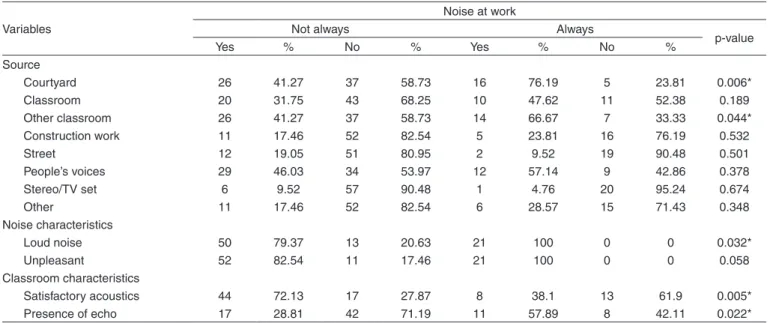
There was a similarity between both groups of professor in relation to the most frequent noise sources in the university. However, they were only distinguished by the courtyard and the classroom. Furthermore, noise was considered strong and unpleasant by the teachers. Most subjects in group A and only about one third of group NA identified the presence of echo in the classroom, which indicates that the teachers in the first group consider classroom conditions less favorable to teaching than their colleagues (Table 1).
In regards to extra-auditory complaints, group NA presented more complaints, even though both groups (A and NA) were exposed o noise. Gastritis occurred in equal frequency in both groups, emotional and circulatory disorders were more frequent in the NA group, and emotional disorders were among the most frequently reported disorders by the studied subjects. There was no difference in between the groups for any of the studied variables (Table 2).
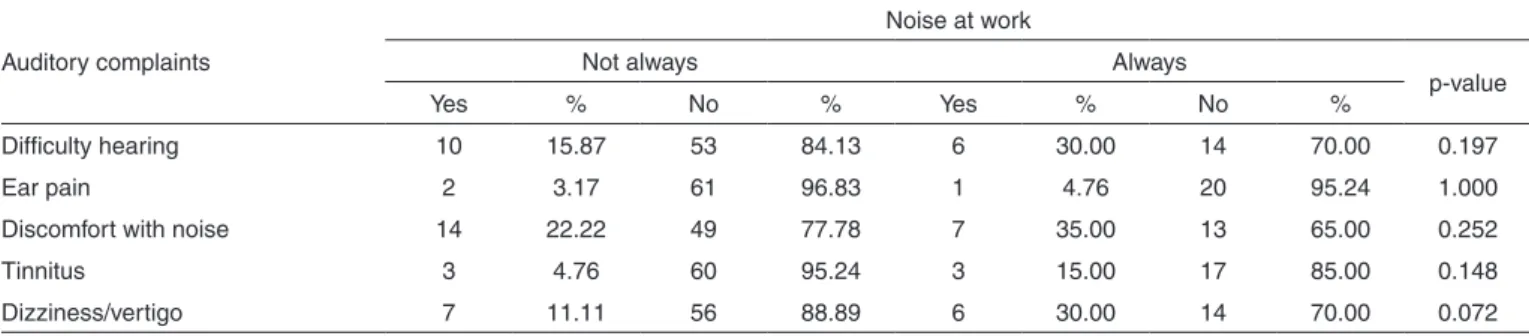
When comparing noise and specific auditory complaints (Table 3), none of the variables distinguished the groups; however, differently from the extra-auditory complaints, the
Table 1. Relationship between noise source and noise and classroom characteristics, according to professors
Variables
Noise at work
Not always Always
p-value
Yes % No % Yes % No %
Source
Courtyard 26 41.27 37 58.73 16 76.19 5 23.81 0.006*
Classroom 20 31.75 43 68.25 10 47.62 11 52.38 0.189
Other classroom 26 41.27 37 58.73 14 66.67 7 33.33 0.044*
Construction work 11 17.46 52 82.54 5 23.81 16 76.19 0.532
Street 12 19.05 51 80.95 2 9.52 19 90.48 0.501
People’s voices 29 46.03 34 53.97 12 57.14 9 42.86 0.378
Stereo/TV set 6 9.52 57 90.48 1 4.76 20 95.24 0.674
Other 11 17.46 52 82.54 6 28.57 15 71.43 0.348
Noise characteristics
Loud noise 50 79.37 13 20.63 21 100 0 0 0.032*
Unpleasant 52 82.54 11 17.46 21 100 0 0 0.058
Classroom characteristics
Satisfactory acoustics 44 72.13 17 27.87 8 38.1 13 61.9 0.005*
Presence of echo 17 28.81 42 71.19 11 57.89 8 42.11 0.022*
Table 2. Relationship between reports of extra-auditory complaints and presence of noise in groups Not Always and Alwaysre
Extra-auditory complaints
Noise at work
Not always Always
p-value
Yes % No % Yes % No %
Heartburn 18 28.57 45 71.43 9 42.86 12 57.14 0.225
Reflux 14 22.22 49 77.78 6 28.57 15 71.43 0.554
Gastritis 15 23.81 48 76.19 5 23.81 16 76.19 1.000
Other digestive 7 11.11 56 88.89 2 10.00 18 90.00 1.000
Hormonal 7 11.48 54 88.52 2 10.00 18 90.00 1.000
Back 25 40.32 37 59.68 7 33.33 14 66.67 0.570
Dental 14 22.22 49 77.78 3 14.29 18 85.71 0.542
Circulatory 11 17.74 51 82.26 1 5.00 19 95.00 0.277
Emotional 19 31.15 42 68.85 4 20.00 16 80.00 0.337
Rhinitis 22 34.92 41 65.08 3 14.29 18 85.71 0.073
Sinus infection 17 27.42 45 72.58 4 19.05 17 80.95 0.446
Tonsillitis 8 12.70 55 37.30 0 0.00 21 100.0 0.192
Pharyngitis 17 26.98 46 73.02 7 35.00 13 65.00 0.491
Laryngitis 12 19.05 51 80.95 3 15.00 17 85.00 1.000
Bronchitis 0 0.00 63 100.0 1 4.76 20 95.24 0.250
Asthma 0 0.00 63 100.0 1 4.76 20 95.24 0.250
Cold 25 39.68 38 60.32 6 28.57 15 71.43 0.361
Other respiratory complaints 5 8.06 57 91.94 2 9.52 19 90.48 1.000
Other health problems 11 18.03 50 81.97 4 19.05 17 80.95 1.000
Fisher’s Exact Test and Chi-Square test (p≤0.05)
Table 3. Relationship between auditory complaints and presence of noise reported by professors in groups Not Always and Always
Auditory complaints
Noise at work
Not always Always
p-value
Yes % No % Yes % No %
Difficulty hearing 10 15.87 53 84.13 6 30.00 14 70.00 0.197
Ear pain 2 3.17 61 96.83 1 4.76 20 95.24 1.000
Discomfort with noise 14 22.22 49 77.78 7 35.00 13 65.00 0.252
Tinnitus 3 4.76 60 95.24 3 15.00 17 85.00 0.148
Dizziness/vertigo 7 11.11 56 88.89 6 30.00 14 70.00 0.072
Fisher’s exact test (p≤0.05)
Table 4. Relationship between self-reported voice disorder and pre-sence of noise in groups Not Always and Always
Voice disorder
Noise at work
p-value Not always Always
n % n %
No 24 42.11 14 73.68 0.011*
Yes 33 57.89 5 26.32
* Significant values (p≤0.05) – Fisher’s exact test constant presence of noise reported by group A resulted in
more complaints, such as discomfort in the presence of noise, difficulty hearing, dizziness, vertigo, tinnitus and ear pain, than those referred by group NA. In this specific case, it may be supposed that the greater number of auditory complaints have as its most probably causes the exposure and susceptibility to noise of teachers of group A.
The association in between perception of noise presence and voice disorder was also found in the present study (Table 4). However, it came from teachers who did not complain of the presence of this risk factor systematically.
DISCUSSION
Firstly, it should be stressed that, in this study, the results were obtained based on the self-perception of college professors on noise. Therefore, it is a subjective data that may be com-plemented by other objective ones, from noise measurements
performed with specific equipment, procedure that has not been conducted in this study for technical reasons.
data obtained both by objective noise measurements and by teachers’ evaluations.
In addition to presenting a few options of noise sources to be signaled by the professors, the questionnaire also pro-vided space so that this item could be complemented with new information which they deemed necessary. There were mentions of fans and students in the hallway, sources also often reported in specific literature of this field(3,13). The division of
noise sources mentioned by the subjects into intra and extra--classroom categories shows that this last one occurred more frequently, indicating the need to revise the spaces in which noise-generating activities occur, such as student mingling, as well as the acoustics of the classrooms, so that more favorable conditions are created for teaching and learning.
These findings confirm those from other studies that indicate high noise levels in educational environments, mainly coming from the school courtyard, a place for student meetings, recre-ation, talking and relaxation(7,13). This fact show the need for
considering ergonomic aspects in the construction of schools, among them, the study of space in a way such that different acti-vities such as teaching, socializing, sports and others may occur at the same time, without the noise they generate interfering in one another. Another relevant issue is the fact that teachers signaled that noise is generated inside the classroom. This may be avoided by using active teaching-learning methods such as, for example, researching a given subject in the classroom or laboratory, with student seminars in which their colleagues contribute, jury simulations or debate of a controversial theme with pro and con argumentations by different student groups, which would involve them in the proposed activities and reduce classroom noise level.
The teachers in group A evaluated the acoustics in the clas-srooms as being dissatisfactory, differently from group NA that signaled the opposite. This variable distinguished the groups and may be justified by the fact that the teachers who complai-ned of noise may have a greater perception that bad acoustics is deleterious to class development. On the other hand, those who reported inconsistent noise seem to not feel the impact of this problem as intensely. One study(21) evaluated the knowledge and
attitudes of 70 teachers regarding the impact that background noise and reverberation in classrooms has in students’ learning and in their perception of the teacher’s speech, and found that those teachers had no adequate knowledge about classroom acoustics or the way this affects speech perception and learning.
Another investigation(4) measured the acoustics of 25
clas-srooms according to teachers of three universities using the scale – good, regular, bad, and very bad – and the results showed that the frequency in categories bad and very bad varied from 63.30% to 33.30%. Thus, literature shows recurrent teacher complaints on classroom acoustics and how it interferes in class, voice and health of teachers(11,14,22,23).
The echo in the classroom was a problem reported by te-achers, especially those in group A, and its importance lies in the fact that the echo interferes in the intelligibility of speech of professor and students, and may cause lack of comprehension and miscommunication between them, as well as restricting the teaching-learning process(12,22).
The percentages of extra-auditory complaints varied in both groups, but were smaller than those found in other stu-dies, in regards to emotional issues, such as stress(10) and other
complaints such as metal exhaustion, sore throat, hoarseness and irritation(3), which also show much higher indexes than the
ones in the present study. The percentages found in this study were similar to one paper(7) in which the main extra-auditory
complaints were digestive disorders (heartburn, gastritis, indi-gestion, menstrual disorders), and were also similar to those in another study where, only a small part of the 58 participating teachers had muscle-skeleton, respiratory, digestive and mental disorders(8).
The most commonly reported extra-auditory disorders origi-nated from noise reported in the literature are general reactions to stress, sleep difficulties, neurological disorders, vestibular, digestive and behavioral issues(15,16). It should be noted that
the noise to which professors are submitted in their work is much different than that derived from other types of profes-sional activities such as industrial iron or cloth manipulation among others, that have exacerbated frequency and intensity as well as constant periodicity, which may justify the findings. Furthermore, the complaints listed by the faculty members may not be predominantly caused by noise, which would require a more in-depth study of the data and is beyond the scope of this study, opening new study perspectives in this field.
In regards to auditory complaints, teachers in group A had more complaints, a finding which is comparable to data from another study that identified 65% of auditory complaints from teachers, where hearing loss was most common (31.25%), which could or not be accompanied by tinnitus and/or verti-go. Of these teachers, 93.75% reported excessive noise in the classroom(5).
The teachers with self-reported voice disorders were those who complained less of the noise, and the unexpected association between these variables indicates that the many factors involved in voice production and its disorders must be considered. Noise, being just one of these, is valued in different ways by the subjects in the study.
The relation between high levels of noise in school envi-ronment and voice disorder has been frequently approached in literature, as when faced with a noisy environment the teacher needs to systematically raise voice volume, generating greater effort to speak and even larynx and voice disorders. Although this relationship is understandable, the association between them has been found in some studies(4,10,14), and denied by
others(24,25), and so it may not be affirmed that there is a direct
relationship between the presence of noise and voice disorders in teachers.
perform his work and feel that his work and health is or is not harmed. The findings derive from information provided by working teachers and confirm the findings of other studies that use environmental noise measurements to show the presence of noise in schools, including those of higher education(4,9).
CONCLUSION
The association between the presence of noise in the work environment and auditory and extra-auditory symptoms in university professors was not obtained in statistical terms. However, auditory symptoms proved to be more prevalent in the group of professors that reported its constant presence.
The association between noise and voice disorder was found in this study in the group of teachers who reported inconsistent presence of noise, indicating that voice disorders has its origins in many different factors, and so noise may not be considered the only health hazard.
The different perceptions of the presence and frequency of noise by the professors seem to point towards the need to continue to combine objective and subjective assessments of this risk factor in the workplace and its association to health and voice problems.
REFERENCES
1. Brasil. Ministério do Trabalho e Emprego. Normas Brasileiras Regulamentadoras, NBR 10152-2000. Níveis de Ruído para Conforto Acústico. Brasília; 2000. [Internet]. [citado 2010 Nov 6]. Disponível em: http://www.scribd.com/doc/4035856/NBR-10152-2000-Nivel-de-Ruido-para-Conforto-Acustico.
2. Brasil. Ministério do Trabalho e Emprego. Normas Brasileiras Regulamentadoras, NBR 10151-2000. Avaliação de ruídos em áreas habitadas visando o conforto da comunidade. Brasília; 2000. [Internet]. [citado 2010 Nov6]. Disponível em: http://www.scribd.com/ doc/14126784/NBR-10151-Procedimento-Avalicao-Ruido-Habit. 3. Ribeiro ME, Oliveira RL, Santos TM, Scharlach RC. A percepção dos
professores de uma escola particular de Viçosa sobre o ruído nas salas de aula. Rev Equilib Corp e Saúde. 2010;2(1):27-45.
4. Cutiva LC, Muñoz AI. Salud vocal de docentes universitarios y condiciones acústicas en una universidad pública en Bogotá. Salud Trab (Maracay). 2009;17(2):97-105.
5. Martins RH, Tavares EL, Lima Neto AC, Fioravanti MP. Surdez ocupacional em professores: um diagnóstico provável. Rev Bras Otorrinolaringol. 2007;73(2):239-44.
6. Jaroszewski GC, Zeigelboim BS, Lacerda A. Ruído escolar e sua implicação na atividade de ditado. Rev CEFAC. 2007;9(1):122-32. 7. Libardi A, Gonçalves CG, Vieira TP, Silvério KC, Rossi D, Penteado RZ.
O ruído em sala de aula e a percepção dos professores de uma escola de ensino fundamental de Piracicaba. Rev Dist Comunic. 2006;18(2):167-78.
8. Vedovato TG, Monteiro MI. Perfil sociodemográfico e condições de saúde e trabalho dos professores de nove escolas estaduais paulistas. Rev Esc Enferm USP. 2008;42(2):290-7.
9. Colito AH, Teles B, Gomes CS. Ruído em ambiente de estudo e sua influência sobre desempenho acadêmico de estudantes de computação da Unicamp. Rev Ciência do Ambiente On-Line. 2008;4(1):1-5. 10. Gonçalves VS, Silva LB, Coutinho AS. Ruído como agente
comprometedor da inteligibilidade de fala dos professores. Produção. 2009;19(3):466-76.
11. Hans RF. Avaliação de ruído em escolas. Rio Grande do Sul: UFRS-PROMEC, 2001. [Internet]. [citado 2010 Dez 16]. Disponível em: http:// www.liberato.com.br/upload/arquivos/ 0131010715441616.pdf. 12. Klatte M, Lachmann T, Meis M. Effects of noise and reverberation on
speech perception and listening comprehension of children and adults in a classroom-like setting. Noise Health. 2010;12(49):270-82.
13. Woolner P, Hall E. Noise in schools: a holistic approach to the Issue. Int J Environ Res Public Health. 2010;7(8):3255-69.
14. Ilomaki I, Leppanen K, Kleemola L, Tyrmi J, Laukkanen AM, Vilkman E. Relationships between self-evaluations of voice and working conditions, background factors, and phoniatric findings in female teachers. Logoped Phoniatr Vocol. 2009;34(1):20-31.
15. Seligman J, Ibañez RN, Costa EA, Nudelmann AA. Perda auditiva induzida pelo ruído. In: Campos CA, Costa HO. Tratado de otorrinolaringologia. Vol. 2, São Paulo: Roca; 2002.p.119-125. 16. Costa EA, Morata TC, Kitamura S. Patologia do ouvido relacionada
com o trabalho. In: Mendes R. Patologias do trabalho. 2a ed. Vol. 2, São Paulo: Atheneu, 2007. p.1253-82.
17. Ferreira LP, Giannini SP, Figueira S, Silva EE, Karmann DF, Souza TM. Condições de produção vocal de professores da prefeitura do município de São Paulo. Dist Comunic. 2003;14(2):275-91.
18. Chen SH, Chiang SC, Chung YM, Hsiao LC, Hsiao TY. Risk factors and effects of voice problems for teachers. J Voice. 2010;24(2):183-90. 19. Bovo R, Galceran M, Petruccelli J, Hatzopoulos S. Vocal problems
among teachers: evaluation of a preventive voice program. J Voice. 2007;21(6):705-22.
20. Ferreira LP, Giannini SP, Latorre MR, Zenari MS. Distúrbio de voz relacionado ao trabalho: proposta de um instrumento para avaliação de professores. Dist Comunic. 2007;19(1):127-36.
21. Ramma L. Knowledge and attitudes of teachers regarding the impact of classroom acoustics on speech perception and learning. S Afr J Commun Disord. 2009;56:35-47.
22. Dreossi RC, Momensohn-Santos TM. O ruído e sua interferência sobre estudantes em uma sala de aula: revisão de literatura. Pró-Fono. 2005;17(2): 251-8.
23. Gonçalves VSB, Sena L, Carvalho M, Silva LB. Ruído ocupacional e a inteligibilidade em salas de aula. 2006. [Internet]. [citado 2010 Dez 16]. Disponível em: http://www.higieneocupacional.com.br/download/ruido-valeria.pdf.
24. Kooijman PG, Jong FI, Thomas G, Huinck W, Donders R, Graamans K, et al. Risk factors for voice problems in teachers. Folia Phoniatr Logop. 2006;58(3):159-74.