VOCAL, LARYNGEAL AND SELF-PERCEPTION
MEASUREMENTS OF DYSPHONIC TEACHERS:
ANALYSIS AFTER VOICE THERAPY
Parâmetros vocais, laríngeos e de autopercepção de professoras
disfônicas: análise após tratamento fonoaudiológico
Mariah Batalha Ribeiro (1), Ana Cristina Côrtes Gama (2), Iara Barreto Bassi (3), Letícia Caldas Teixeira (4)
(1) Speech-language pathologists – Federal University of Minas Gerais – UFMG, Belo Horizonte, Minas Gerais, Brazill.
(2) Speech-language pathologists, Phd, Professor of Curso de Fonoaudiologia da Faculdade de Medicina, Federal Uni-versity of Minas Gerais – UFMG, Belo Horizonte, Minas Gerais, Brazil.
(3) Speech-language pathologists. Master’s in Public Health at Federal University of Minas Gerais – UFMG, Belo Hori-zonte, Minas Gerais, Brazil.
(4) Speech-language pathologists, Professor of Curso de Fonoaudiologia da Faculdade de Medicina, Federal Uni-versity of Minas Gerais – UFMG, Belo Horizonte, Minas Gerais, Brazil; Master’s in Education at Federal University of Minas Gerais.
Source: Fundação de Amparo a Pesquisa de Minas Gerais – FAPEMIG.
Conlict of interest: non-existent
INTRODUCTION
Hyperfunctional voice disorders may be triggered by ignorance about correct voice use, making useful an inappropriate vocal model and by maintenance of harmful vocal habits1, characterized as the most
common vocal disorder in teachers. Teachers depend of their voices to pass on the contents in a satisfactory way, to discuss and communicate with students and the other professionals who work at school. However, many factors contribute for appearance of vocal problems in this category.
For example, the inadequate conditions of job environment such as noise, dust, extended workday
and the lack of training for a correct voice use2.
ABSTRACT
Purpose: to analyze the results of evaluations vocals, laryngeal and self-perception after speech therapy in a group of dysphonic teachers. Method: this is a retrospective study carried out using a handbook review of 42 patients with hyperfunctional dysphonia, yielding data of hearing-perceptual
and acoustic analysis, laryngeal exams and Voice Activity and Participation Proile (VAPP) before
and after speech therapy. Patients were treated by students of speech language therapy, under supervision of a single professional using direct therapy, which consists in vocal techniques, and
indirect, with exposure about vocal health care. Results: in respectto hearing-perceptual assessment, 73,8% of voice samples were described as better in post treatment situation. The parameters grade of dysphonia (G) and roughness (R) most contributed for voice improvement. In acoustic analysis, there
was signiicantly change after therapy for jitter, perturbation of frequency, shimmer and perturbation of
amplitude parameters. Laryngeal analysis demonstrated that 43% have improved in visual-perceptual
assessment after vocal therapy; 38% of the exams had no change with therapy and 19% were worst at discharge moment. Considering VAPP, was possible to verify signiicant improvement in post
treatment situation for all parameters, and the biggest difference between the averages before and after vocal therapy refers to “effects of this alteration at work”. Conclusions: there was an improvement of hearing-perceptual parameters grade of dysphonia (G) and roughness (R), acoustic parameters of
perturbation of frequency and amplitude, in larynx image and a positive impact of voice in evaluated
patient’s quality of life after voice therapy.
The goal of voice therapy for these patients is to minimize or correct the unsuitable voice use with the purpose of restore phonatory function. To reach this goal, two different approaches can be used: the direct one, which consists in changing the harmful aspects for vocal production by doing
speciic exercises; and the indirect, which focus in
the managing of bad habits that contribute or get the dysphonia worse3, for example, smoke, scream,
poor hydration and others.
According to the assessment protocol prepared by Phoniatrics Comittee of European Laryngological Society4, the following components
most be considered in vocal assessment: hearing-perceptual and acoustic analysis, estroboscopy,
airlow measurements and patient’s self-perception
of vocal problem. Standardize outcomes allows they can be passive of comparison with the ones which are already described in literature no matter if they use the same type of approach.
About voice therapy with teachers, literature describes positive outcomes with many different types of approach. Researches analyzing the
effec-tiveness of Vocal Function exercises5,6, Resonance
Method7,8 and global vocal approach9 with dysphonic
teachers, concluded that those techniques are
eficient in voice rehabilitation of this group, with
improvement of vocal characteristics and positive impact in quality of life after treatment.
Sound ampliication is also described in literature as eficient for voice improvement of dysphonic
theachers8,10 besides conducting programs about
vocal behavior with guidance of vocal hygiene6,10.
As shown, researches emphasizes the impor-tance of a global vocal approach with direct therapy
(speciic exercises) and indirect (guidance about
vocal health care)5,6,10, avoiding use of a single
program focusing in vocal hygiene11.
Literature demonstrates that teachers submitted to vocal therapy for dysphonia which have improved their voice quality also showed positive vocal self-perception after 18 months of follow up, keeping professional voice use12.
Whereas dysphonia has become a concern cause of absenteeism, with a negative impact on profes-sional, social and economical levels for teachers, it becomes essential to know the outcomes of vocal rehabilitation in order to ensure the quality of care for these professionals. The purpose of this study is to analyze vocal, laryngeal and self-perception parameters of voice assessment after treatment in a group of dysphonic women teachers, who have been discharged from vocal therapy.
METHOD
This work was reviewed by the Research Ethics Committee of the Federal University of Minas Gerais and approved on the report number ETIC 482/08.
This is a longitudinal retrospective study using a chart review, in which were yielded data from patients
identiied as having hyperfunctional dysphonia who
were discharged from voice therapy. Therapy was administered by speech therapist students of the Federal University of Minas Gerais supervised by a unique professional, from March 2007 to July 2011. Teachers reported the following criteria were included in this study: being female teacher, have a diagnosis of hyperfunctional dysphonia, have done vocal therapy and have been discharged from the
treatment. 167 charts were collected, of which 42 it
on inclusion’s criteria, remaining in the study.
The following data were analyzed in pre and post treatment moment: patient’s voice recording for perceptual analysis, the values of acoustic analysis
and Voice Activity and Participation Proile (VAPP) and the medical’s report from laryngeal examination
and also age, kind of dysphonia and number of treatment sessions.
All teachers were submitted to therapy approach
which included direct therapy with vocal exercises
and indirect with guidance about vocal health care
and professional voice use. Vocal therapy was
performed once a week, in pair, with duration of 30 minutes. Patients were guided about doing
exercises at home three times a day for a period of three to ive minutes, besides doing vocal warming
techniques before initiating professional voice use. In direct approach were included vocal techniques of corporal, orofacial organs, voice and phonation
methods14. Vocal techniques were selected
according to vocal characteristics of each patient, so therapeutic planning was individualized and personalized.
Voice samples referred to the connected
speech, which included emission of weekdays and sustained vowel /a/ in usual way with no variation
of pitch and loudness, excluding the beginning and
the end of the emission because of its irregular features. The recordings were made directly in a Dell® computer, model Optiplex GX260, with Direct
Sound® professional sound board and professional
condenser unidirectional microphone Shure® was
used too. Individuals remained standing during the recording, with the microphone laterally positioned
at a distance of 5 cm from the mouth, with a 90 º
angle. Records were made in a silent room. The
same procedure done in the irst assessment was
Hearing-perceptual analysis
Voice samples pre and post therapy were given to two speech therapists with more than ive years of experience in voice’s assessment, in a way that
they didn’t knew if the record corresponded to pre therapy or post therapy situation. The speech therapists should analyze voices in a consensual
way, listening the irst and the second sample of
each patient and classifying the second sample
as better, worst or equal the irst one. Then, they should choose two of the six parameters Grade,
Roughness, Breathiness, Asteny, Strain, Instability (GRBASI)15 to judge which of them most contributed
for voices improvement or worsening. In cases which the second voice sample corresponded to pre treatment situation, outcome was considered in inverse way.
Grades of vocal deviation for each parameter of GRBASI scale were not analyzed.
Acoustic Analysis
The values of acoustic analysis before and after
therapy were analysed from patient’s chart. Voice
samples of sustained vowel /a/ were recorded and
analyzed by Computerized Speech Lab (CSL)
MDVP, from Kay Pentax®. Following values were
considered: fundamental frequncy (F0), jitter (%), shimmer (%), pertubation of frequency (PPQ %), perturbation of amplitude (APQ %) and
harmonic-to-noise ratio (NHR dB). Values were obtained
from vowel /a/ sustained emission. The choice of
such parameters in this research is justiied by their
prevalence in studies of speech therapy area16 –18.
Laryngeal exams
The reports from laryngeal examination before
and after therapy of each patient were taken from medical records, digitalized and sent to two
otorhino-laryngologists with at least ive years of experience in area, so that they could judge in a consensual way, if the laryngeal examination is better, worst or
have no change after vocal therapy. Reports from pre and post treatment situation were randomized, and otorhinolaringologist have no knowledge about which moment of therapy reports corresponded.
They should analyze if the irst shown laryngeal exam improved or worsened according to the
second. In cases which the second report corre-sponded to pre treatment situation, outcome was considered in inverse way.
For reports analysis, the following data were considered: presence/absence of vocal fold lesion; kind of glottal closure and presence/absence of involvement supraglottis structures. Evaluators
judged report’s written transcript without analyze
directly larynx image of patients due to absence of
image record in most of handbooks.
As the otorhinolaringological reports evaluations
were done in consensus, judge’s analysis occurred
simultaneously and together.
Both of evaluator’s group, speech therapist and otorhinolaringologist have knowledge about the fact that patients were submitted to treatment for dysphonia. To minimize bias in outcomes
interpre-tation of hearing-perceptual and larynx analysis, treatment moment was randomized, so judges
have no knowledge if voice samples or otorhino-laringological reports corresponded to pre or post treatment situation. Is also important ensure that evaluation dates or information about patients were
not offered to judges.
Self-reporting protocol
To assess dysphonia’s impact in quality of life,
the Voice Activity and Participation Proile (VAPP)
validated for Brazilian Portuguese9 was used. The
VAPP is composed of 28 questions divided into ive
parameters: self-perception of the vocal problem severity, effects of this alteration at work, social communication, daily communication and emotional effects. For each question, the participant’s answer according to their perception is represented on an analog scale of 10 cm: not affected (left) and affected (right). The score’s average, in centimeters,
was extracted from each parameter. The protocols
applied pre and post therapy were attached in patient’s records.
The statistical analysis used was the SPSS (Statistical Package for the Social Sciences), version 17.0. Firstly, a descriptive analysis of data was performed with measures of central tendency
and dispersion. Later, the Wilcoxon Signed Rank Test was used. The standard level of signiicance used was 95%.
RESULTS
The research was done with chart reviews of 42 teachers, and the age range was 27 to 57 years old, with a mean of 40,8 years. Among these, 57.1% were diagnosed with functional dysphonia and
42.9% of organofunctional dysphonia. The number of speech therapy sessions ranged from six to 30,
with an average of 16 sessions and mode of nine sessions.
Hearing-perceptual analysis
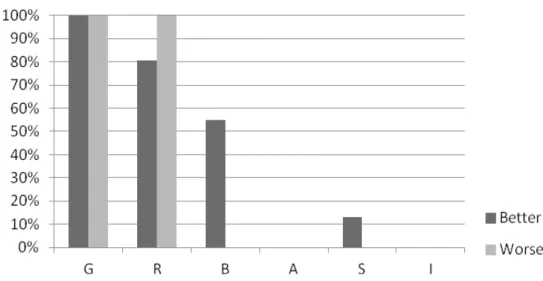
are distributed according each ones inluence in
voice improvement or worsened in post treatment situation. It’s possible to notice that situations in which patients showed improvement in voice quality after treatment, is related to Grade (G-100%),
Roughness (R-80,64%), Breathiness (B-54,84%)
and Strain (S- 12,91%). In cases of worsening in
voice quality after treatment, this was related to worsening in Grade (G-100%) and Roughness (R-100%) of vocal quality.
Figure 1 – Results of the hearing-perceptual analysis
Figure 2 – Distribution of GRBASI parameters according their inluence in voice change.
Acoustic Analysis
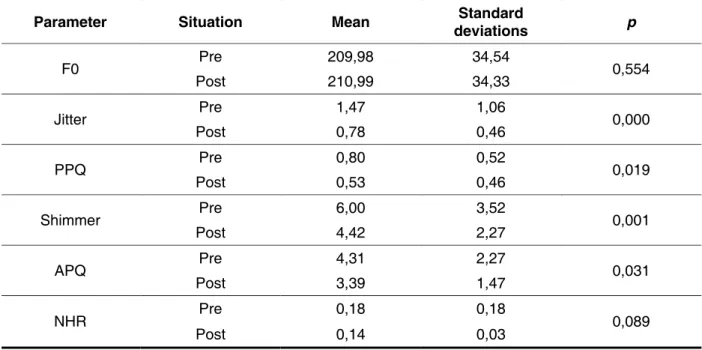
Table 1 reveals the values of acoustic analysis
pre and post treatment. There were signiicant differ
-ences for jitter, PPQ, shimmer and APQ parameters.
Laryngeal examinations
Figure 3 gives a descriptive analysis of
laryngeal examinations data. It shows that 43% of patients have improved in visual-perceptual larynx assessment after vocal therapy; 38% of the exams
didn’t change with therapy and 19% were worst at
discharge moment.
Self-reporting protocol
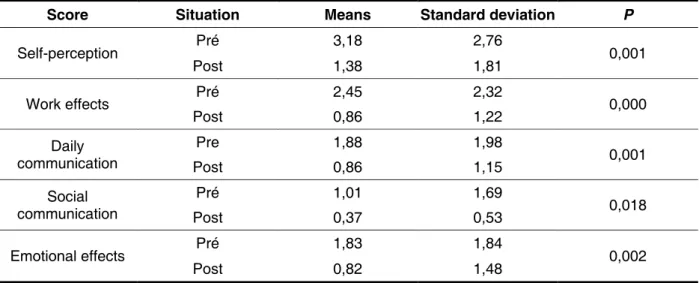
In table 2 are the results of ive VAPP parameters
comparing the scores before and after treatment. All
parameters have signiicant improvement in post
Parameter Situation Mean deviations Standard p
F0 Pre 209,98 34,54 0,554
Post 210,99 34,33
Jitter Pre 1,47 1,06 0,000
Post 0,78 0,46
PPQ Pre 0,80 0,52 0,019
Post 0,53 0,46
Shimmer Pre 6,00 3,52 0,001
Post 4,42 2,27
APQ Pre 4,31 2,27 0,031
Post 3,39 1,47
NHR Pre 0,18 0,18 0,089
Post 0,14 0,03
Table 1 – Comparision of acoustic measurements before and after treatment
Wilcoxon Test; p<0,05* Subtitle:
F0 – Fundamental Frequence (Hz) Jitt – jitter (%)
PPQ – Frequence disturbance quotient (%) Shim – shimmer (%)
APQ – Amplitude disturbance quotient NHR – Harmonic-noise proportion (dB)
Score Situation Means Standard deviation P
Self-perception Pré 3,18 2,76 0,001
Post 1,38 1,81
Work effects Pré 2,45 2,32 0,000
Post 0,86 1,22
Daily communication
Pre 1,88 1,98
0,001
Post 0,86 1,15
Social communication
Pré 1,01 1,69
0,018
Post 0,37 0,53
Emotional effects Pré 1,83 1,84 0,002
Post 0,82 1,48
Table 2 – Means and standard deviations of VAPP scores before and after treatment
Wilcoxon test; p<0,05*.
DISCUSSION
Despite the methodological differences between the studies investigating the outcome of voice
therapy, this study is consistent with the indings of
other studies in which the positive effects of voice therapy in dysphonia are reported3,7,20,21
.
The task of comparing voices in the pre and post treatment was chosen for the perceptual analysis because it is characterized as a procedure that allows a direct comparison between the results, and has been described in literature as the most appro-priate way to study the quality vocal22,23.
Time of professional experience was above ive years in both groups of judges, once literature shows that evaluator’s experience inluences in outcomes
analysis and their reliability 24,25.
The mean age was 40 years, such as described in literature about the age of teacher’s professional
group26. In respect to number of voice therapy
sessions, prevalent value was 9 sessions, matching
with international clinical practice which suggests a
mean value between six to 10 sessions27.
In hearing-perceptual assessment, voices have an improvement in 73,8% of cases, supporting
the hypothesis that a subjective improve must be
considered an important parameter for monitoring
treatment eficacy. It was found that parameters
which most changed with voice improvement was Grade of dysphonia and Roughness. Breathiness
and Strain parameters also appear as inluences,
but in a small scale. In the same way in cases of improvement, when voices got worst after treatment, G and R parameters most contributed for vocal quality change. Grade (G) of dysphonia and
Roughness (R) most relected voice improvement
in post treatment situation, which is consistent
with other researches indings that describe such
hearing-perceptual parameters as the most sensitive to vocal rehabilitation and the most common in cases of behavior dysphonia28,29.
In a study which analyzed vocal assessment outcomes in individuals with hyperfunctional voice
disorders, there was signiicant improvement of (R) and acoustic parameter jitter comparing pre
treatment results with the long-term ones, referring
to 6.1 years after discharge moment20. Another
research conducted in order to correlate the param-eters of GRBASI scale and measures provided by
MDVP, concluded that improvement in (G) and (R)
parameters correlates with improvement in NHR, suggesting that noise is the most noticeable charac-teristic in dysphonic voices29. However, this
corre-lation remains controversial in the literature and could not be evaluated in this study once that the values of NHR were normal, even before treatment.
A study was done with 29 dysphonic patients and they should judge their own voices using the
parameters (G), (R) and (B) of the GRBASI scale in
analog version, six months after discharge. It was
found that the less the individual perceived his voice as (R), the higher the score for improvement in the voice quality, obtained from the parameter (G). This relationship was not observed between the param-eters (G) and (B)30.
Of analyzed voice samples, 7,14% were described as worse in discharge moment, which means that despite vocal quality has no improvement
with treatment, other factors inluenced to discharge
patient himself, such as satisfaction with his own voice, absence of vocal fatigue or vocal quality adapted to social and professional demands or may be based in results of other tools of vocal analysis that are available, assuming that voice analysis is multidimensional. Thereby, self-reporting protocols are important once they can demonstrate patient’s self perception about their own voices and its impact in quality of life19, which could be found by
improvement in VAPP parameters in this study.
Data from acoustic analysis reveals that there
was signiicantly change after therapy for all investigated parameters, except for Fo and NHR. This was an expected result, because Fo and
NHR values are frequently in normal limits in pre treatment situation even in case of moderate vocal deviations, not suffering changes with therapy. This fact was also observed in a study with women with unilateral vocal fold mobility alteration whose voices were acoustically analyzed. It was found that even before therapy, f0 values were considered normal31. The same study veriied reduction of PPQ and
APQ measurements; nonetheless, this reduction
wasn’t signiicantly and values after treatment were higher than normal range proposed by MDVP, Kay
Elemetrics®.
In literature, the improvement of acoustic analysis values is controversial. In a study with 50 patients with vocal deviations recruited for voice assessment before and after treatment, it was noticed that 84% improved acoustic parameters, but change was only
signiicantly for jitter18. A study analyzed the results
of acoustic measurements in dysphonic teachers
before and after treatment, and a signiicantly improvement for jitter, shimmer and NHR was not identiied17. Signiicantly change in jitter, shimmer
and NHR parameters was described in a study with
78 subjects with chronic dysphonia submitted to
vocal therapy5. These results suggest that acoustic
analysis should not be the only instrument for voice assessment and for measure therapy outcomes, serving as a complementary tool since it only provides analysis from sustained vowels, which did not represent vocal quality present during natural and connected speech29.
In respect to laryngeal exams, was possible to identify an improvement in most exams in post
therapy situation. However, it is necessary to
emphasize that the evaluations were made by
different experts and different instruments, which
may prevent an adequate analysis. Moreover,
judges evaluated written transcription of laryngeal examination’s report, not evaluating, in a directly way, the larynx images, due to the lack of exams
in most of patients chart. This methodological
limitation was expected since it is a retrospective
study. Improvement in laryngeal examinations was
described in previous research7,28,29, suggesting that
voice therapy improves functionally and anatomically
the larynx. In cases of laryngeal exams which had no
improvement, the decision of discharge prioritized vocal quality stability and the absence of complaint related to vocal fatigue, which not depends on the improvement in laryngeal assessment. It should be noted that cases of vocal fold cysts and sulcus vocalis do not regress with voice therapy, and so
improvement in larynx image can’t be found. Taking in account results of VAPP, is possible verify signiicantly improvement for all parameters
of the questionnaire, showing that the voice therapy has a positive impact on quality of life and in the self –report of vocal problem severity. Considering that the goal of voice therapy with voice professionals is to adapt vocal standard to individual’s professional lawsuits, the improvement in “effects of the alteration at work” parameter certify that patient’s perception suggest treatment’s success while achieving its goal. The following results were found in a study
which analyzed PPAV results from 95 dysphonic
patients with or without laryngeal alterations, who were recruited for treatment: from patients who had
mild vocal deviations, 47% upgraded VAPP scores; between moderate alterations the rate was 59% and
in cases of severe alterations, 75%. The protocol was done in a second moment, 12 months after
discharge, and it was possible to see that beneits
from therapy persists and progress after the end of treatment, what can be noticed by the improvement
in VAPP scores in this situation32.
Studies using others instruments to evaluate the impact of dysphonia in quality of life3,7,, including the Voice Handicap Index33 also shows that scores are signiicantly better in pos treatment moment.
Instruments that measures self-perception about the vocal problem have high validity, since they
allow a quantiication of the problem by the patient, instead of obtain a unique measure based exclusive
in the day of the consultation 16. However, in vocal
assessment before treatment, essential clinical information for diagnosis and treatment can be not
identiied if we only consider patient’s perspective
about vocal problem34. Considering that patient can
minimize their problem, the other assessment tools are crucial for detecting pathological conditions not evaluated in self-reporting questionnaire.
It is understood that ideal situation for search requires a control group in order to verify if voice therapy is the responsible for voice improvement,
larynx image and quality of life aspects analyzed
analysis of voice therapy itself. However, it was not possible create this group due to methodological restrictions involving study chronology.
Assuming that many patients can show normal values in one or more procedures of voice evalu-ation in pre treatment situevalu-ation3, and so they don’t
show any improvement in those parameters with treatment, it underscores the need of a multidimen-sional analysis in order to obtain a real view about treatments effects, avoiding voice changing under or overestimation.
There are many studies that demonstrate voice therapy effectiveness in treatment of dysphonic teachers using different kinds of vocal rehabilitation5-9. Evaluation procedures adopted on
this research agree with multidimensional voice analysis and are useful to help speech therapists in checking treatment effects and so in clinical decision about discharge moment, attesting voice therapy
as beneicial in managing of behavior dysphonia in
teachers.
CONCLUSION
In post treatment voice therapy situation, it was found improvement in hearing-perceptual
param-eters grade of dysphonia, roughness and larynx image in most of teachers. Acoustic parameters jitter
and shimmer were better in post treatment moment,
with statistical signiicance. Values of VAPP protocol decreased after treatment, with statistical signii -cance, demonstrating a positive impact of voice in teacher’s quality of life after voice therapy. Hearing-perceptual measurements, acoustic analysis,
laryngeal examinations and self-reporting protocol
proved to be useful tools to measure voice therapy outcomes for teachers with behavior dysphonia.
ACKNOWLEDGEMENT
To FAPEMIG for inanced resources that allowed this research execution.
To the secretary of Speech language Pathology Clinic of the Federal University of Minas Gerais, for assistance in gathering the records.
RESUMO
Objetivo: analisar os resultados das avaliações vocais, laríngeas e de autopercepção após tratamento
fonoaudiológico em um grupo de professoras disfônicas. Método: trata-se de estudo retrospectivo com revisão de 42 prontuários de mulheres portadoras de disfonia comportamental, com coleta de dados referente à análise perceptivo-auditiva, acústica, de avaliação laríngea e de protocolo de
auto-percepção vocal (PPAV) nas situações pré e pós-fonoterapia. As professoras foram atendidas por estudantes do curso de Fonoaudiologia supervisionados por um único proissional. Foram utilizadas terapia direta com a realização de técnicas vocais e indireta com orientação sobre cuidados com a
saúde vocal. Resultados: com relação à análise perceptivo-auditiva, 73,8% das vozes foram descritas
como melhores após a fonoterapia. Os parâmetros que mais se modiicaram foram o grau da disfonia (G) e a rugosidade (R). No que concerne à análise acústica, os parâmetros que melhoraram signiican -temente após o tratamento foram o jitter, quociente de perturbação de frequência, shimmer e quociente de perturbação de amplitude. A avaliação laríngea demonstrou que 43% das pacientes apresentaram
melhora no exame após o tratamento fonoaudiológico; 38% dos exames não sofreram alteração com o tratamento e 19% pioraram no momento da alta. A partir do PPAV, constatou-se melhora estatistica
-mente signiicante para todos os domínios no momento pós-fonoterapia, sendo que a maior diferença entre as médias pré e pós-tratamento foi referente ao parâmetro “efeitos no trabalho”. Conclusão:
observou-se melhora dos parâmetros perceptivo-auditivos de grau geral da disfonia e rugosidade, nas medidas acústicas de jitter e shimmer, bem como melhora da imagem laríngea e impacto positivo da voz na qualidade de vida das professoras avaliadas após o tratamento fonoaudiológico.
REFERENCES
1. Brandi E. Voz falada: estudo, avaliação e tratamento. Rio de Janeiro: Atheneu, 1990.
2. Araújo TM, Reis EJFB, Carvalho FM, Porto
LA, Reis IC, Andrade JM. Fatores associados a alterações vocais em professoras. Cad. Saúde
Pública. 2008;24(6):1229-38.
3. Carding PN, Horsley IA, Docherty GJ. A study of the effectiveness of voice therapy in the treatment
of 45 patients with nonorganic dysphonia. J Voice. 1999;13(1):72-104.
4. Dejonckere PH, Bradley P, Clemente P, Cornut
G, Crevier-Buchman L, Friedrich G et al. A basic protocol for functional assessment of voice
pathology, especially for investigating the eficacy
of (phonosurgical) treatments and evaluating new assessment techniques. Eur Arch Otorhinolaryngol. 2001;258(2): 77-82.
5. Roy N, Weinrich B, Gray SD, Tanner K, Toledo. S.W.; Dove,H; Corbin-Lewis,K: Stemple, JC. Voice ampliication versus vocal hygiene instruction for
teachers with voice disorders:A treatment outcomes study. J Speech Lang Hear Res. 2002; 45:625-38. 6. Gillivan-Murphy P, Drinnan MJ, O´Dywer TP, Ridha R, Carding P. The effectiveness of a voice treatment approach for teachers with self-reported
voice problems. J Voice. 2006; 20(3):423-31.
7. Chen H, Hsiao T, Hsiao L, Chung Y, Chiang S. Outcome of resonant voice therapy for female teachers with voice disorders: perceptual, physiological, acoustic, aerodynamic, and functional
measurements. J Voice. 2006;21(4):415-25.
8. Roy N, Merril R.M, Thibeaul T.S, Gray S.D,
Smith EM. Voice disorders in teachers and the
general population: effects on work performance, attendance, and future career choices. J Speech Lang Hear Res. 2004; 47:542-51.
9. Niebudek-Bogusz E, Sznurowska-Przygocka B, Fiszer M, Kotylo P, Sinkiewicz A, Modrzewska M, et
al. The effectiveness of voice therapy for teachers with dysphonia. Folia Phoniatr Logop. 2008; 60:134-41.
10. Roy N, Weinrich B, Gray S.D, Tanner K, Stemple
J.C & Sapienza, S.M. Three treatment for teachers with voice disorders: a randomized clinical trial. J Speech Lang Hear Res. 2003; 46:670-88.
11. Simões-Zenari M, Latorre MRDO. Mudanças em comportamentos relacionados com o uso da
voz após intervenção fonoaudiológica junto a
educadoras de creche. Pró-Fono R. Atual. Cient. 2008; 20(1): 61-6.
12. Gama ACC, Bicalho VS, Valentim AF, Bassi
IB, Assunção AA. Sintomas relacionados à voz e sua produção e autopercepção vocal após alta do
tratamento fonoaudiológico: estudo prospectivo. Distúrb Comun. 2010; 22 (3): 201-11.
13. Tutya AS, Zambom F, Oliveira G, Behlau M.
Comparação dos escores dos protocolos QVV, IDV e PPAV em professores. Rev. soc. bras. fonoaudiol.
2011; 16(3): 273-81.
14. Behlau M, Madazio G, Feijó D, Azevedo R,
Gielow I, Rehder MI. Aperfeiçoamento vocal e tratamento fonoaudiológico das disfonias. In:
Behlau M. Voz: O livro do especialista. Rio de Janeiro: Revinter; 2005. p.409-86.
15. Hirano M. Clinical examination of voice. New York: Springer Verlag; 1981. p. 81-4.
16. Carding PN, Wilson JA, MacKenzie K, Deary
IJ. Measuring voice outcomes: state of the science
review. J Laryngol Otol. 2009;123(8):823-9.
17. Felippe ACN, Grillo MHMM, Grechi TH. Normatização de medidas acústicas para
vozes normais. Ver. Bras. Otorrinolaringol. 2006;72(5):659-64.
18. Zojaji R, Mirzadeh SM, Nourian A, Sadeghi H. Eficacy of voice laboratory in evaluation of treatment in dysphonic patients. IJO. 2007;19(49):3-8.
19. Tutya AS, Zambom F, Oliveira G, Behlau M. Comparação dos escores dos protocolos QVV, IDV e PPAV em professores. Rev. soc. bras. fonoaudiol.
2011; 16(3): 273-81.
20. Van Lierde KM, Claeys S, De Moth M, Van Cauwenberge P. Long term outcome
of hyperfunctional voice disorders based
on a multiparameter approach. J Voice. 2007;21(2):179-88.
21. Morsomme D, Faurichon de la Bardonnie M,
Verduyckt I, Jamart J, Remacle M. Subjective evaluation of the long-term eficacy of speech therapy on dysfunctional dysphonia. J Voice.
2010;24(2):178-82.
22. Patel S, Shrivastav R. Perception of dysphonic vocal quality: some thoughts and research updates – perspectives on voice and voice disorders. ASHA Division 3. 2007;17(2):3-6.
23. Oates J. Auditory-perceptual evaluation of disordered voice quality: pros, cons and future
directions. Folia Phoniatr Logop. 2009; 61(1):49-56. 24. Zraick RI, Kempster GB, Connor NP, Thibeault S, Klaben BK, Bursac Z, Thrush CR, Glaze LE. Establishing Validity of the Consensus Auditory-Perceptual Evaluation of Voice (CAPE-V). Am J
Speech Lang Pathol.2011; 20: 14-22.
25. Carding PN, Wilson JA, MacKenzie K, Deary
IJ. Measuring voice outcomes: state of the science
review. J Laryngol Otol. 2009;123(8):823-9.
26. Medeiros AM, Barreto SM, Assunção AA.
Voice disorder (dysphonia) in public school female
teachers working in Belo Horizonte: prevalence and
27. Behlau M, Murry T. International and intercultural aspects of voice and voice disorders. In: Battle DE. Communication disorders in multicultural and international populations. 4th ed. Missouri: Elsevier; 2011. p. 174-207.
28. Speyer R, Wieneke GH, Dejonckere PH.
Documentation of progress in voice therapy: perceptual, acoustic, and laryngostroboscopic
indings pretherapy and posttherapy. J Voice.
2004;18(3):325-40.
29. Rodriguez-Parra, MJ, Adrian, JA, Casado, JC. Voice therapy used to test a basic protocol for multidimensional assessment of dysphonia. J Voice. 2009;23(3):304-18.
30. Butha T, Patrick L, Garnett JD. Perceptual evaluation of voice quality and its correlation
with acoustic measurements. J Voice. 2004;18(3):299-304.
31. Mangilli LD, Amoroso MRM, Nishimoto IN,
Barros APB, Carrara-de-Angelis E. Voz, deglutição
e qualidade de vida de pacientes com alteração
de mobilidade de prega vocal unilateral pré e
pós-fonoterapia. Rev Soc Bras Fonoaudiol. 2008;13(2):103-12.
32. Kleemola L, Helminen M, Rorarius E, Sihvo
M, Isotalo E. twelve-month clinical follow up study of voice patient’s recovery using the voice
activity and participation proile (VAPP). J Voice.
2010;25(5):245-54.
33. Jacobson BH, Johnson A, Grywalski C, Silbergleit A, Jacobson G, Benninger MS et al. The voice
handicap index (VHI): development and validation. Am J Speech Lang Pathol. 1997;6(3):66-70.
34. Murry T, Medrado R, Hogikyan ND, Aviv JE. The relationship between ratings of voice quality
and quality of life measurements. J Voice. 2004; 18(2):183-92.
Received on: June 02, 2012 Accepted on: March 11, 2013
Mailing Address: Mariah Batalha Ribeiro
Rua Equador, 245/402 – São Pedro Belo Horizonte – Minas Gerais
CEP:30330-390