From the Department of Urology, Endocrinology and Pathology, Hospital das Clínicas, Faculty of Medicine, University of São Paulo.
ORIGINAL ARTICLES
ADRENOCORTICAL TUMORS: RESULTS OF
TREATMENT AND STUDY OF WEISS’S SCORE AS A
PROGNOSTIC FACTOR
Antonio Marmo Lucon, Maria Adelaide Pereira, Berenice B. Mendonça,Maria Claudia Zerbini, Luiz B. Saldanha and Sami Arap
RHCFAP/3102
LUCON AM et al. - Adrenocortical tumors: results of treatment and study of Weiss’s score as a prognostic factor. Rev. Hosp. Clín. Fac. Med. S. Paulo 57(6):251-256, 2002.
PURPOSE: The differential diagnosis between benign and malignant adrenal cortical tumors circumscribed to the gland is controversial. One hundred and seven patients with adrenal cortex tumors (excluding those with primary hyperaldosteronism) were studied to assess the 5-year survival rate of adults, children, patients stratified by pathological stage, and patients stratified according to Weiss’s score of <3 or >3.
METHODS: The patients were evaluated both clinically and biochemically. One hundred and five patients underwent surgery and were classified pathologically as stages I, II, III, or IV. The tumors were weighed, measured, and classified according to Weiss’s criteria and divided into 2 groups: <3 and >3.
RESULTS: After 5 years, the survival rate was 77.5% for the whole group, 74.61% for the adults, 84.3% for the children, 100% for stage I, 83.9% for stage II, 33% for stage III, and 11.7% for stage IV groups. Additionally, after 5 years, 100% of the patients with tumors with Weiss’s score <3 were alive compared to 61.65% of those with Weiss’s score >3. The average weights of the tumors of score <3 and >3 were 23.38 g + 41.36 g and 376.3 + 538.76 g, respectively, which is a statistically significant difference. The average sizes of tumors of Weiss’s score <3 and >3 were 3.67 + 2.2 cm and 9.64 + 5.8 cm, respectively, which is also a statistically significant difference.
CONCLUSIONS: Weiss’s score may be a good prognostic factor for tumors of the adrenal cortex. Additionally, there was a statistically significant difference between the average weight and size of tumors with benign behavior (Weiss’s score <3) and those with malignant behavior (Weiss’s score >3).
DESCRIPTORS: Adrenocortical carcinoma. Weiss’s score. Adrenocortical tumors. Adrenocortical adenomas. Adrenal neoplasia.
Tumors arising in the adrenal cor-tex are potentially malignant. In the past, the majority of adrenal neo-plasms were discovered as a result of the symptoms caused by the growth of the nonfunctioning tumor (pain, ab-dominal mass, or metastases) or the clinical picture of the functioning tumor: primary aldosteronism, Cush-ing’s syndrome, virilization, or feminization either alone or in associa-tion. At the present time, very small nodules—either asymptomatic
(incidentalomas) or oligosymptomatic, for which laparoscopic ablation has shown itself to be a good option espe-cially for benign lesions1—are
discov-ered by ultrasonography, computerized tomography (CT), and magnetic reso-nance imaging (MRI). Tumors not causing symptoms and signs of
but in the absence of these character-istics, the histopathological analysis of the adrenal tumor is controversial and makes use of multiple histopatho-logical criteria suggestive of malig-nancy, though none of them is pathog-nomonic3-5. Furthermore, each of the 3
most important reported systems has its particular aspects, and in some cases any one of them characterizes the tumor as benign or indeterminate while another may suggest malig-nancy6. Although the size of the tumor
has been advocated as a parameter for surgical removal, because the small ones tend to be benign and the larger malignant7, this criterion varies
ac-cording to the author—6 cm8, 4 cm7,
or 3 cm9—demonstrating that there is
no unanimity on this subject.
We reviewed our cases of adrenal cortex tumors (excluding those tumors that produced primary hyperaldos-teronism) in order to analyze after a 5-year follow up the overall survival rates of adults, children, patients with tumors of pathological stages I, II, III, or IV in accordance with Macfarlane’s classification10, and patients with
tumors scoring 0 to 3 and 4 to 8 on Weiss’s scale to verify whether that scale may be used as a prognostic fac-tor. We also studied the correlation be-tween the weight and size of tumors classified between 0 and 3 and 4 and 8 according to Weiss’s score to assess a possible significant difference be-tween the weight and size of the 2 groups of tumors.
METHODS
Study subjects
The records of 107 patients treated between 1979 and 1998 were reviewed retrospectively. In 105 of them, the his-topathological diagnosis of adrenocor-tical neoplasia was made in the surgi-cal specimen. The remaining 2 patients did not undergo surgery, and the
diag-nosis was made on the basis of the clini-cal picture of Cushing’s syndrome with virilization, and Cushing’s syndrome associated with feminization in patients with adrenal tumors seen in imaging studies. Ninety-two patients were fe-males, and 15 were males aged between 7 months and 69 years (median age of 29 years). Of these, 29 were below 10 years of age and were included in the group of children. The race distribution was white 95.5%, black 3.3%, and Asian 1.1%.
Clinical picture
The duration of clinical history varied from 18 days to 8 years. Clini-cally, 40 patients presented Cushing’s syndrome, 29 presented virilization, 27 Cushing’s syndrome with viriliza-tion, 1 Cushing’s syndrome with feminization, and 10 nonfunctioning tumors, 3 of which were discovered af-ter work up for nonspecific abdominal pain, and 7 were discovered inciden-tally.
Hormonal evaluation
The biochemical assessment of the production of glucocorticoids was made by measuring baseline urinary cortisol and serum cortisol before and after the administration of 2 mg of dexamethasone. Androgen production was assessed by measuring serum lev-els of androstenedione, dehydro-epiandrostenedione sulfate, and testo-sterone. The tumors of patients with a high basal urinary cortisol level or those whose serum cortisol was not de-pressed by the administration of dex-amethasone were considered to be pro-ducers of cortisol. The tumors of pa-tients that presented high levels of at least 1 of the hormones were classified as producers of androgens. Of the 40 patients with Cushing’s syndrome, 39 (97.5%) had only cortisol-producing tumors, and 1 (2.5%) had a cortisol-and cortisol-androgen-producing tumor. Of the
29 patients with virilization, 27 (93%) had androgen-producing tumors, and 2 (7%) had androgen- and cortisol-pro-ducing tumors. Of the 29 patients with mixed clinical syndrome, 28 (96.5%) had androgen- and cortisol-producing tumors, and 1 had a cortisol- and estrogen-producing tumor. Of the pa-tients with clinically nonfunctioning tumors, only 1 (10%) had elevated lev-els of serum cortisol. In the other pa-tients (90%), glucocorticoids, andro-gens, and aldosterone were at normal levels.
Imaging studies
Ultrasonography performed on 74 patients detected 82.4% of the primary tumors. CT carried out on 73 patients and MRI on 21 detected 100% of the primary tumors with precision. Nine patients had involvement of the infe-rior vena cava by tumor thrombi. Ul-trasonography revealed tumor thrombi in 37.5% (3 out of 8), CT in 55% (5 out of 9), and MRI in 100% (4 out of 4) of the cases in which the procedure was undertaken. Only 1 patient (0.9%) had bilateral tumors; 47 (44%) had the tumor on the right side, and 54 (55%) had it on the left.
Treatment
adrenal-ectomies with nephradrenal-ectomies and par-tial (right) hepatectomy were performed. Only enlarged or suspected lymph nodes were removed. No routine lym-phadenectomies were performed.
Pathological findings
The weights of the tumors were available in 68 cases, varying from 4 g to 2600 g (average 249 + 454 g). Eighty-one tumors were measured, and their sizes varied from 1.4 cm to 30 cm (average 6.8 + 51 cm). The pathologi-cal stage was available for 95 cases: 45 patients having stage 1 (up to 5 cm within the capsule), 33 patients stage II (more than 5 cm within the capsule), 3 patients stage III (any size with ext-racapsular extension, invasion of blood vessels, or nodes), and 24 patients stage IV (distant metastases). Finally, the slides were re-assessed by one and the same pathologist (MCZ); the tumors were classified according to Weiss’s criteria3, which comprise 9
pa-rameters (nuclear grade, mitotic rate, atypical mitosis, character of cyto-plasm, architecture of tumor cells, necrosis, invasion of venous structures, invasion of sinusoid structures, and in-vasion of the capsule of tumor); and the cases were divided into 2 groups: Weiss’s score 0 to 3 and scores greater than 3. The 22 patients with metastases who underwent surgery (2 others did not) received some kind of chemo-therapy: preoperative mitotane (7 tients), postoperative mitotane (18 pa-tients), and postoperative cisplatin with etoposide (9 patients). Of these 22 patients, only 1 (a black woman) achieved complete response with total disappearance of pulmonary and he-patic metastases after undergoing adrenalectomy with nephrectomy and caudal pancreatectomy followed by chemotherapy using mitotane. The postoperative exams showed a tumor thrombus in the inferior vena cava that had not been seen or withdrawn
dur-ing the operation and was later re-moved during a second operation. This patient was found free of disease at an 8-year follow-up exam.
Statistical analysis
Survival periods were estimated from the time of treatment and were calculated using the product-limit method of Kaplan and Meyer11.
Com-parisons with respect to weight and size of the tumors were performed with the Mann-Whitney nonparametric test12. All reported P values are
2-tailed. P values of less than 0.05 were taken to indicate statistically signifi-cant differences.
RESULTS
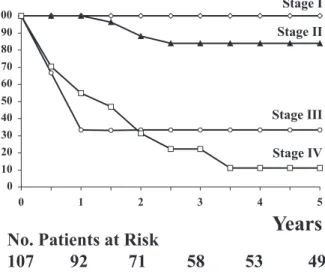
There were no deaths in the imme-diate postoperative period. The pa-tients were followed up over a period of 6 months to 240 months, and 49 of them could be evaluated after a 5-year period. After 5 years, 77.5% of the whole group was alive, with the 84.3% survival rate of the children exceeding the 74.61% of the adults (Fig. 1). Sur-vival rates after 5 years were stage I patients, 100%; stage II, 83.96%; stage
III, 33%; and stage IV, 11.17% (1 pa-tient) (Fig. 2). After 5 years, 100% of the patients with Weiss’s scores of <3 were alive compared to 61.65% of those with Weiss’s score of 4 to 8 (Fig. 3). The weight of 39 tumors with Weiss’s scores of 0 to 3 varied from 2.5 g to 190 g, with an average of 23.38 ± 41.36 g and a median weight of 12 g, whereas the weight of 31 tumors with Weiss’s scores of 4 to 8 varied from 4 g to 2600 g with an average of 376.13 ± 538.76 g and a median weight of 160 g, with a statistically significant differ-ence between the groups (P <0.0001) (Fig. 4). The size of 39 tumors with Weiss’s scores of from 0 to 3 was 1 cm to 13 cm, with an average of 3.67 ± 2.2 cm and a median size of 3 cm. The size of 47 tumors with Weiss’s scores of 4 to 8 varied from 1.5 cm to 30 cm with an average of 9.64 ± 5.8 cm and a me-dian size of 9 cm, with a statistically significant difference between the 2 groups (P <0.0001) (Fig. 5).
DISCUSSION
The normal adrenal cortex and the adrenal tumor secrete 3 main groups of hormones: mineralocorticoids, glucocorticoids, and sexual hormones
than 5 cm22, there have been cases of
tumors 3 cm long23 or 40 g in weight24
that produced metastases and were therefore correctly classified as carci-nomas. It should be noted that in the study mentioned above, the 40 g tumor was initially classified incor-rectly based on its histology as an ad-enoma24. Neither does the functional
status serve as a prognostic factor, be-cause patients with both functioning and nonfunctioning carcinomas had similar survival curves21,25. Although
the 24-hour urinary free cortisol and serum lactate dehydrogenase levels tended to be higher among patients with carcinoma and Cushing’s syn-drome, no significant statistical differ-ence was found when comparing ad-enomas and carcinomas16. Helicoidal
computerized tomography provides acceptable sensitivity and specificity in the differentiation between adeno-mas and nonadenoadeno-mas, but the lack of long-term follow up leads to the pos-sible persistence of diagnostic error26.
The same may be said of scintigraphy with selenium cholesterol13. In this
study, all the patients with tumors in the adrenal cortex—excluding those with primary aldosteronism—that had Weiss’s scores of less than 4 at the his-topathological examination of the ad-renal tumor tissue were still alive after 5 years of follow up; thus the tumors behaved benignly as if they were true adenomas. On the other hand, the sur-vival curve of patients having tumors with Weiss’s scores of 4 to 8 fell over time, suggesting possible malignant behavior for this group. Another inter-esting aspect is that there was a statis-tically significant difference between the sizes and weights of the tumors with Weiss’s scores of less than 4 (which behave benignly) and of those with Weiss’s scores of 4 to 8 (which behave with apparent malignancy), thus supporting the idea that even small non-functioning tumors should be considered for laparoscopic removal Figure 2 - Kaplan-Meier Analysis of Overall Survival among 107 patients with adrenal cortical
tumor, according to the stage.
Figure 3 - Kaplan-Meier Analysis of Overall Survival among 107 patients with adrenal cortical tumor, according to the score of Weiss.
(androgens and estrogens). The tumors of the glomerulosa zone, which is physiologically responsible for aldos-terone synthesis, behave differently from cortical tumors: usually they are small and functioning13 and are rarely
malignant14,15. On the other hand,
cor-tical tumors may frequently be nonfunctioning, as is true of the incidentalomas17, and more often than
the aldosterone-producing tumors may behave malignantly16. For these
rea-sons, adrenocortical tumors that pro-duce only aldosterone and which vir-tually always have excellent
progno-sis15 have been excluded from this
se-ries. The other adrenocortical tumors were also studied together without separation into the so-called adenomas and carcinomas, because it is often difficult or even impossible to make a differential diagnosis for neoplasms limited to the adrenal gland6,18-20 due
to the nonuniform criteria4,5, which are
not given in detail even in recent pub-lications13,16,21. Weight and size have
Figure 4 - Figure 4 - Weight of the adrenal tumors by Weiss’s score ≤
3 and > 3. Each (•) represents one tumor
Figure 5 - Size of adrenocortical tumors by Weiss’s score ≤ 3 and > 3. Each (•) represents one tumor
because of the slight possibility of be-ing malignant1. As has already been
re-ported20, the children in this study
sur-vived longer on average than the adults. The 5-year survival rate of 61.65% for our patients with Weiss’s scores of from 4 to 8 was considerably greater than that of the 26% to 36% reported in contemporary reviews of patients with carcinoma of the adrenal cortex21,27, probably because the
unmentioned criteria for the definition of malignancy were different. As was
to be expected, the 5-year survival rates for stage I (100%) and stage II (83.9%) patients who had tumors cir-cumscribed to the adrenal gland were considerably greater than those with stage III (33.3%) and stage IV (11.17%) tumors, which were certainly carcino-mas. As others have reported28, no
standardized lymphadenectomy was performed (only enlarged and sus-pected lymph nodes were removed), so the pathological staging in I and II may not have been perfect. This may
not have influenced the outcome be-cause lymphadenectomy has not been shown to improve survival or decrease recurrence27.
ACKNOWLEDGMENT
We thank Dr. João Egidio Romão Jr., Dr. Frederico A.Q. Silva, Dra. Ana C. Latrônico and Dr. Eder Quintão for their substantial contributions to this project.
RESUMO RHCFAP/3102
LUCON AM e col - Tumores do córtex da supra-renal: resultados do trata-mento e estudo do escore de Weiss como fator prognóstico Rev. Hosp. Clín. Fac. Med. S. Paulo 57(6): 251-256, 2002.
OBJETIVOS: O diagnóstico dife-rencial entre tumores benignos e ma-lignos do córtex da supra-renal é con-troverso. Cento e sete pacientes com tumores do córtex da supra-renal (ex-cluindo aqueles com hiperaldos-ternismo primário) foram estudados
para avaliar a sobrevida em 5 anos de adultos, de crianças e de acordo com o estadio patológico £ 3 ou >3 segun-do o escore de Weiss.
MÉTODOS: Os pacientes foram avaliados clínica e laboratorialmente. Cento e cinco pacientes foram opera-dos e foram classificaopera-dos em estadios patológicos I, II, III ou IV. Os tumores foram pesados, medidos, classificados de acordo com os critérios de Weiss e divididos em 2 grupos: ³ 3 e >3.
RESULTADOS: Após 5 anos a sobrevida foi de 77,5% para o grupo
cm e 9,64 ± 5,8 cm que são também estatiscamente diferentes.
CONCLUSÃO: O escore de Weiss pode ser um bom fator prognóstico para tumores do córtex da supra-renal. Há também uma diferença estatística
significante entre o peso médio e o tamanho médio dos tumores com comportamento benigno (escore de Weiss ≤ 3) e aqueles com compor-tamento maligno (escore de Weiss >3).
DESCRITORES: Tumores adre-nocorticais. Escore de Weiss. Carci-noma de córtex adrenal. AdeCarci-noma de córtex adrenal. Neoplasia da supra-renal.
REFERENCES
1 . JANETSCHEK G - Surgical options in adrenalectomy: laparoscopic versus open surgery. Curr Opin Urol 1999; 9: 213-218. 2 . LUTON JP, CERDAS S, BILLAUD L et al. - Clinical features of
adrenocortical carcinoma, prognostic factors and the effect of mitotane therapy. N Engl J Med 1990; 322: 1195-201. 3 . WEISS LM - Comparative histologic study of 43 metastasizing
and nonmetastasizing adrenocortical tumors. Am J Surg Pathol 1984; 8: 163-169.
4 . VAN SLOOTEN H, SCHABERG A, SMEENK D et al. -Morphologic characteristics of benign anal malignant adrenocortical tumors. Cancer 1985; 55: 766-773.
5 . HOUGH AJ, HOLLIFIELD JW, PAGE DL et al. - Prognostic factors in adrenal cortical tumors: a mathematical analysis of clinical and morphologic data. Am J Clin Pathol 1979; 72: 390-339. 6 . MEDEIROS LJ & WEISS LM - Adrenal Gland. Tumors and Tumor - like Lesions. The Difficult Diagnosis in Surgical Pathology. Philadelphia; Sauders 1966.
7 . KASPERLIK - ZATUSKA AA, ROSTONOWSKA E, STONVINSKA - SRZEDNICKA J et al. - Incidentally discovered adrenal mass (incidentaloma): investigation and management of 208 patients. Clin Endocrinol 1997; 46: 29-37.
8 . COPELAND PM - The incidentally discoveral adrenal mass. Ann Intern Med 1983; 98: 940-945.
9 . PRINZ RA, BROOKS MH, CHURCHILL R et al. - Incidental asymptomatic adrenal masses detected by computed tomographic scanning: is operation required? JAMA 1982; 248: 701-704.
10.MAC FARLANE DA - Cancer of the adrenal cortex the natural history, prognosis and treatment in a study of fifty-five cases. Ann R Coll Surg Engl 1958; 23: 155-86.
11.KAPLAN EL, MEIER P - Nonparametric estimation from incomplete observations. J Am Stat Assoc 1985; 53: 457-81. 12.DAMIEL WW - Biostatistics: a foundation for analysis in the
sciences. 7th ed. New York: John Wiley, 1999.
13.BARZON L, SCARONI C, SONINO N et al. - Incidentally discovered adrenal tumors: endocrine and scintigraphic correlates. J Clin Endocrinol Met 1988; 83: 55-62. 14.VAUGHAN ED Jr., CAREY RM - Adrenal carcinoma. Adrenal
disorders. New York, Thiene Medical Publishers, 1989. 15.SIREN J, VÄLIMÄKIM, HIUKURI K et al. - Adrenalectomy for
primary aldosteronism long-term follow-up study in 29 patients. World J Surg 1998; 22: 418-422.
16.DAITCH JA, GOLDFARB DA, NOVICK AC - Cleveland Clinic Experience with Adrenal Cushing’s Syndrome. J Urol 1997; 158: 2051-2055.
17.BARZON L, BOSCARO M - Diagnosis and management of adrenal incidentalomas. J Urol 2000; 163: 398-407.
18.LACK EE - Atlas of tumor pathology - tumors of the adrenal gland and extra-adrenal paraganglia. Washington-DC, Published by the Armed Forces Institute of Pathology, 1997. 19.WELLS AS, MERKE DO, CUTLER Jr. GB et al. - The role of
laparoscopic surgery in adrenal disease. J Clin Endocrinol Melabol 1998; 83: 3041-49.
20.MENDONÇA BB, LUCON AM, MENEZES CAV et al. - Clinical hormonal and pathological findings in a comparative study of adrenocortical neoplasia in childhood and adulthood. J Urol 1995; 154: 2004-9.
21.TRITOS NA, CUSHING GW, HEATLEY G et al. - Clinical features and prognostic factors associated with adrenocortical carcinoma: Lahey Clinic Medical Center Experience. Am Surg 2000; 66: 73-79.
22.TANG CK, GRAY GF - Adrenocortical neoplasms. Prognosis and Urology 1975; 5: 691-695.
23.ICARD, LOUVEL A, CHAPNIS Y - Survival rates and prognostic factors in adrenocortical carcinoma. World J Surg 1992; 16: 753-758.
24.GANDOUR MJ, GRIZZLE WE - A small adrenocortical carcinoma with aggressive behavior. An evaluation of criteria for malignancy. Arch Pathol Lab Med 1986; 110: 1076-1079. 25.NADER S, HICHEY RT, SELLIN RV et al. - Adrenal cortical
carcinoma - Study of 77 cases. Cancer 1983; 52: 707-711. 26.SZOLAR DH, KAMMERHUBER F - Quantitative CT evaluation
of adrenal gland masses: a step formed in the differentiation between adenomas and nonadenomas? Radiology 1997; 202: 517-521.
27.HARRISON LE, GAUDIN PB, BRENNAN MF - Pathologic features of prognostic significance for adrenocortical carcinoma after curative resection. Arch Surg 1999; 134: 181-185. 28.LEE JEL, BERGER DH, EL NAGGAR AK et al. - Surgical
management, DNA content, and patient survival in adrenal cortical carcinoma. Surgery 1995; 18:1090-8.