Short Report
Printed in Brazil - ©2013 Sociedade Brasileira de Química0103 - 5053 $6.00+0.00S
*e-mail: [email protected]
Maytensifolone, a New Triterpene from
Maytenus distichophylla
Mart. ex Reissek
Marcelo Cavalcante Duarte,a Josean Fechine Tavares,a Sara Alves L. Madeiro,a
Vicente Carlos O. Costa,a José Maria Barbosa Filho,a Maria de Fátima Agra,b
Raimundo Braz Filhoc and Marcelo Sobral da Silva*,a
aDepartamento de Ciências Farmacêuticas and bCentro de Biotecnologia, Departamento de Biotecnologia,
Universidade Federal da Paraíba, CP 5009, 58051-970 João Pessoa-PB, Brazil
cLaboratório de Ciências Químicas, Universidade Estadual do Norte Fluminense,
Campos dos Goytacazes, 28013-602 Rio de Janeiro-RJ, Brazil
O estudo fitoquímico das folhas de Maytenus distichophylla Mart. ex Reisseklevou ao isolamento de um novo triterpeno 3,16,21-trioxo-6β,12α-dihidroxi-1-en-friedelano, nomeado maytensifolona, juntamente com os triterpenos conhecidos, 3-oxofriedelano, 3,12-dioxofriedelano, 3β-hidroxifriedelano, 3-oxo-29-hidroxifriedelano, 3-oxo-12α-hidroxifriedelano e 3-oxo-30-hidroxifriedelano. A identificação estrutural foi baseada em métodos espectroscópicos e comparação com dados da literatura
Phytochemical study of the leaves of Maytenus distichophylla Mart. ex Reissek led to the isolation of the new triterpene 3,16,21-trioxo-6β,12α-dihydroxy-1-en-friedelane, named maytensifolone, along with the known triterpenes 3-oxofriedelane, 3,12-dioxofriedelane, 3β-hydroxyfriedelane, 3-oxo-29-hydroxyfriedelane, 3-oxo-12α-hydroxyfriedelane and 3-oxo-30-hydroxyfriedelane. Their structural identification was based on spectroscopic methods and comparison with literature data.
Keywords: Celastraceae, Maytenus distichophylla, maytensifolone, friedelane triterpene
Introduction
The family Celastraceae is composed of 90 genera and approximately 1300 species.1 The genus Maytenus
comprises about 80 species distributed throughout Brazil.2 They are chemically characterized mainly by
the presence of flavonoids and pentacyclic triterpenes, which are considered taxonomic markers for this genus.3-5 Various pharmacological activities have been
reported for triterpenes isolated from Maytenus, such as antiulcerogenic and antifungal.6,7
In previous works, we reported the isolation and structural characterization of triterpenes and flavonoids from M. obtusifolia,3 as well as their toxicity and
antiulcerogenic activity.8 In continuing our work on
Maytenus sp., we conducted a phytochemical study of
M. distichophylla Mart. ex Reissek, a species that was not previously subjected to chemical or pharmacological
studies. Accordingly, seven triterpenes of the friedelane group were isolated and characterized (Figure 1), including the new 3,16,21-trioxo-6β,12α -dihydroxy-1-en-friedelane, here named as maytensifolone (1), and known triterpenes 3-oxofriedelane (2),9
3,12-dioxo-friedelane (3),10 3β-hydroxyfriedelane (4),11
3-oxo-29-hydroxyfriedelane (5),12 3-oxo-12α-hydroxy friedelane
(6)13 and 3-oxo-30-hydroxyfriedelane (7)14 which are being
reported for the first time in this species.
Results and Discussion
Compound 1 was isolated in the form of a white amorphous solid, mp 310-312 ºC, [α]D25 +1.4, (c. 0.001 in
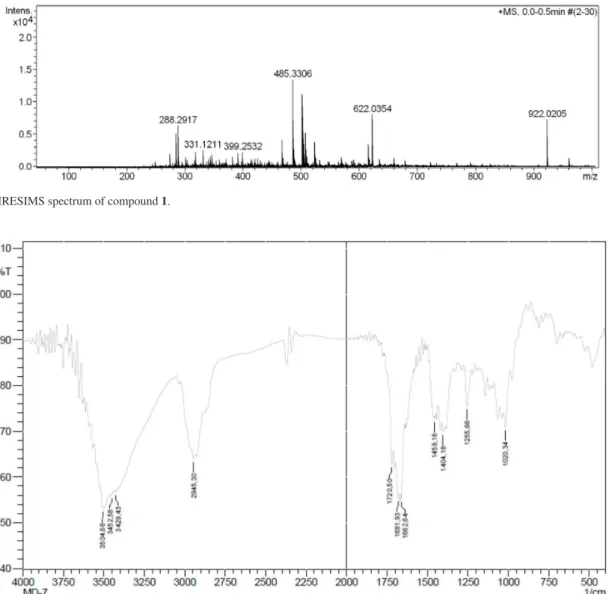
CHCl3). The high resolution mass spectrum utilizing the
ESI+ ionization mode showed a quasi-molecular peak at
m/z 485.3306 [M + H]+, compatible with molecular formula
C30H44O5 (calc. 485.3261). The infrared (IR) spectrum showed absorptions in the region of 3504 cm-1 (hydroxyl
Maytensifolone, a New Triterpene from Maytenus distichophylla Mart. ex Reissek J. Braz. Chem. Soc.
1698
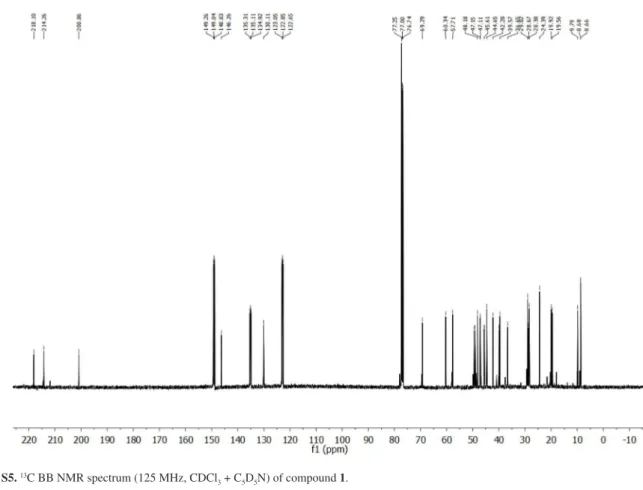
(α,β unsaturated carbonyl). The 13C APT (attached proton
test) NMR spectrum (125 MHz, CDCl3 + C5D5N) showed
29 signals corresponding to 30 carbon atoms: eight methyl, five methylene, eight methine and nine non-hydrogenated, in line with a triterpene skeleton of the friedelane type.4
The signals at dC 200.87, 146.28 and 130.14 were attributed
to C-3, C-1 and C-2, respectively, consistent with an
α,β unsaturated carbonyl system of friedelane triterpenes.9
The signals at dC 77.25 and 69.32 were attributed to C-6 and
C-12, respectively.4,15 The location of the hydroxyl groups
at C-6 and C-12 was corroborated by the chemical shift at 8.69, corresponding to the methyl groups CH3-24 and
CH3-27, both subject to a γ effect. Also, this spectrum
displayed signals at dC 214.24 and 218.13 attributed to
carbons C-16 and C-21.15 The 1H NMR spectrum showed
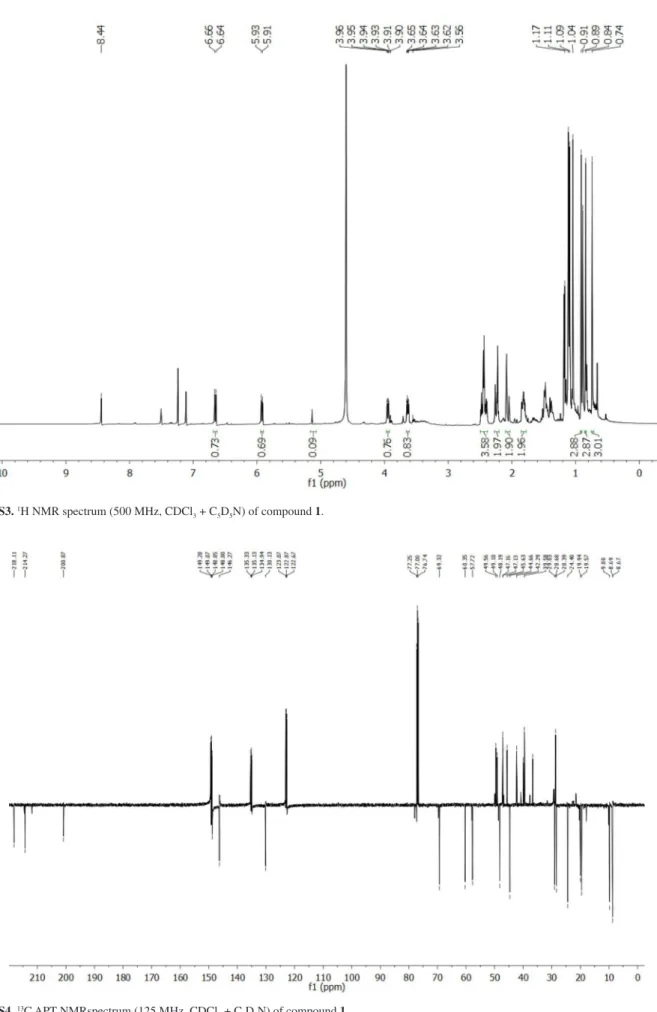
signals at dH 0.74 (s), 0.84 (s), 0.89 (s), 0.91 (s), 1.04 (s),
1.09 (s), 1.11 (s), and 1.17 (d, 1H, J 6.5 Hz), attributed to eight methyl groups. In agreement with literature, the doublet at dH 1.17 is consistent with CH3-23 of ∆
1
friedelanes.16 In addition, signals were observed at d H 6.65
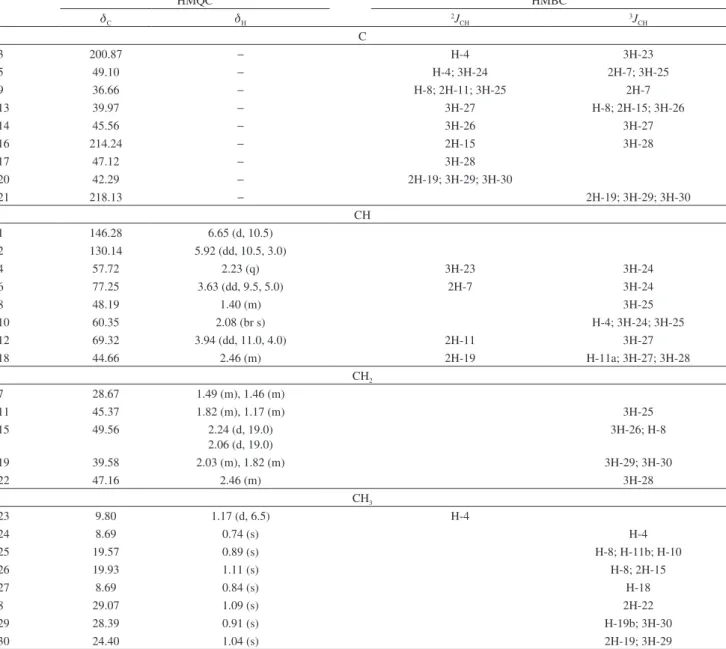
(d, 1H, J 10.5 Hz, H-1), 5.92 (dd, 1H, J 10.5, 3.0 Hz, H-2), 3.63 (dd, 1H, J 9.5, 5.0 Hz, H-6ax) and 3.94 (dd, 1H, J 11.0, 4.0 Hz, H-12ax), thereby inferring the equatorial orientation of the hydroxyl groups bound to C-6 and C-12. Observed HMQC (heteronuclear multiple quantum coherence) correlations are shown in Table 1. In the long-range (HMBC) 1H-13C NMR correlation spectrum, the following
correlations were observed: dH 2.23 (H-4) with carbons
at dC 200.87, 49.10, 60.35, 8.69 and 9.80 confirming
the attributions of C-3, C-5, C-10, CH3-24 and CH3-23,
respectively; dH 0.74 (CH3-24) with carbons at dC 77.25 and
57.72, corresponding to C-6 and C-4, respectively; dH 2.08
(H-10) with the carbon at dC 19.57 (CH3-25) and dH 0.89
(CH3-25) with carbons at dC 48.19, 36.66 and 45.37, which
were attributed to C-8, C-9 and C-11, respectively; dH 1.40
(H-8) with carbons at dC 19.93 and 49.56 (CH3-26 and
C-15), respectively; dH 1.82/1.17 (2H-11) with the carbon
at dC 69.32 (C-12); and dH 0.84 (CH3-27) with carbons at
dC 44.66 (C-18) and 69.32 (C-12). The other correlations
are given in Table 1. The relative stereochemistry was determined by NOESY (nuclear Overhauser effect spectroscopy) and is shown in Figure 2, confirming the equatorial orientation of the hydroxyls at C-6 and C-12. The above findings support the structure of 1 as 3,16,21-trioxo-6β,12α-dihydroxy-1-en-friedelane, a new natural product named as maytensifolone.
The other compounds were identified by comparison of their spectroscopic data with those described in literature, as 3-oxofriedelane (2),9 3,12-dioxofriedelane (3),10
3β-hydroxyfriedelane (4),11 3-oxo-29-hydroxyfriedelane
(5),12 3-oxo-12α-hydroxyfriedelane (6)13 and
3-oxo-30-hydroxy friedelane (7),14 and are reported here for the
first time in M. distichophylla.
Experimental
General experimental procedures
Melting points were determined with a digital apparatus model MQAPF-302 from Microchemical and were not corrected. IR spectra were recorded on a BOMEM-MB 100 spectrophotometer. One-dimensional (1H and 13C) and two-dimensional (gHMQC, gHMBC,
gCOSY and gNOESY) NMR analyses were performed on a Varian-System spectrometer operating at 500 MHz (1H) and 125 MHz (13C). CDCl
3 and C5D5N
were used as solvents with TMS (tetramethylsilane) as an internal standard. HRESIMS (high resolution electrospray ionization mass spectrometry) was obtained using a micrOTOF-II system from Bruker. Silica gel 60 (0.063-0.20 and 0.04-0.063 mm; Merck), was used in column chromatography (CC), whereas silica gel TLC (thin layer chromatography) plates PF254 7749 (Merck) stained with iodine vapor and viewed under UV light (254/366 nm) were used to monitor chromatographic purification procedures.
Figure 1. Triterpene isolated from M. distichophylla.
Plant material
The botanical material utilized was collected in the Matureia city (Paraíba, Brazil) in June 2009, and identified by Prof. Dra. Maria de Fatima Agra. A dried specimen is deposited in the Herbarium Professor Lauro Pires Xavier at Universidade Federal da Paraíba (Paraíba, Brazil) under No. 7448.
Extraction and isolation
The leaves of M. distichophylla (3.5 kg), dried and pulverized, were extracted with 95% ethanol at room
temperature for 3 days. The obtained extract was concentrated in a rotary evaporator under reduced pressure at 40 °C, yielding 685.0 g of ethanolic extract. A portion (100.0 g) was suspended in MeOH:H2O (7:3) and
partitioned successively with n-hexane, CHCl3 and EtOAc
to obtain the n-hexane (2.5 g), chloroform (5.4 g) and ethyl acetate (6.5 g) fractions. The ethyl acetate fraction (5.4 g) was separated by CC, on silica gel 60 (0.063-0.200 mm), eluted with n-hexane, EtOAc and MeOH, pure or in binary mixtures, in increasing order of polarity, resulting in 110 fractions of 100 mL each, which were submitted to analytical NMR. Fraction 14 eluted with n-hexane:EtOAc (7:3) yielded compound2 (50.3 mg). Fractions 1-2 (168.3
Table 1. NMR data for 1a
HMQC HMBC
dC dH 2JCH 3JCH
C
3 200.87 − H-4 3H-23
5 49.10 − H-4; 3H-24 2H-7; 3H-25
9 36.66 − H-8; 2H-11; 3H-25 2H-7
13 39.97 − 3H-27 H-8; 2H-15; 3H-26
14 45.56 − 3H-26 3H-27
16 214.24 − 2H-15 3H-28
17 47.12 − 3H-28
20 42.29 − 2H-19; 3H-29; 3H-30
21 218.13 − 2H-19; 3H-29; 3H-30
CH
1 146.28 6.65 (d, 10.5)
2 130.14 5.92 (dd, 10.5, 3.0)
4 57.72 2.23 (q) 3H-23 3H-24
6 77.25 3.63 (dd, 9.5, 5.0) 2H-7 3H-24
8 48.19 1.40 (m) 3H-25
10 60.35 2.08 (br s) H-4; 3H-24; 3H-25
12 69.32 3.94 (dd, 11.0, 4.0) 2H-11 3H-27
18 44.66 2.46 (m) 2H-19 H-11a; 3H-27; 3H-28
CH2
7 28.67 1.49 (m), 1.46 (m)
11 45.37 1.82 (m), 1.17 (m) 3H-25
15 49.56 2.24 (d, 19.0)
2.06 (d, 19.0)
3H-26; H-8
19 39.58 2.03 (m), 1.82 (m) 3H-29; 3H-30
22 47.16 2.46 (m) 3H-28
CH3
23 9.80 1.17 (d, 6.5) H-4
24 8.69 0.74 (s) H-4
25 19.57 0.89 (s) H-8; H-11b; H-10
26 19.93 1.11 (s) H-8; 2H-15
27 8.69 0.84 (s) H-18
8 29.07 1.09 (s) 2H-22
29 28.39 0.91 (s) H-19b; 3H-30
30 24.40 1.04 (s) 2H-19; 3H-29
aData obtained at 500 MHz in CDCl
Maytensifolone, a New Triterpene from Maytenus distichophylla Mart. ex Reissek J. Braz. Chem. Soc.
1700
mg) were submitted to another CC utilizing similar conditions as before, providing 25 subfractions of 10 mL each. Subfractions 10-15 eluted with n-hexane:EtOAc (8:2) gave the triterpene friedelane 1 (13.4 mg). Fractions 27-35 (99.3 mg) were rechromatographed as before, resulting in 55 subfractions of 10 mL each. Subfractions 33-37 eluted with n-hexane:EtOAc (6:4) yielded 3(26.2 mg).
The chloroform fraction (5.0 g) was submitted to CC, on silica gel 60 (0.063-0.200 mm), eluted with hexane, EtOAc and MeOH, pure or in binary mixtures and with increasing order of polarity, resulting in 110 fractions of 100 mL each, which were concentrated in a rotary evaporator and submitted to analytical NMR. Fractions 42-45 eluted with n-hexane:EtOAc (8:2) provided compound 4 (22.7 mg). Fractions 67-81 (675.3 mg) were submitted to another CC, utilizing a column packed with silica gel 60 (0.04-0.063 mm) and the eluents n-hexane and EtOAc and MeOH, resulting in 53 subfractions of 100 mL each, which were submitted to analytical NMR and combined into 10 groups. Subfractions 2-3 eluted with
n-hexane:EtOAc (85:15) yielded compounds 5(8.5 mg), 6-7 eluted with n-hexane:EtOAc (6:4) yielded compound 6
(5.0 mg) and 9-10 eluted with n-hexane:EtOAc (1:1) yielded compound 7 (9.0 mg).
3,16,21-Trioxo-6β,12α-dihydroxy-1-en-friedelane (1)
White amorphous powder; mp 310-312 ºC; IR (KBr)
νmax/cm-1 at 3504, 1681, 1662; HRESIMS m/z 485.3306
[M + H]+, (calc. for C
30H44O5, 485.3261);
1H NMR
(500 MHz, CDCl3 + C5D5N) and 13C NMR (125 MHz,
CDCl3 + C5D5N), see Table 1.
Supplementary Information
Supplementary data associated with this paper are available free of charge at http://jbcs.sbq.org.br as a PDF file.
Acknowledgments
The authors thank CNPq, CAPES, FAPESQ-PB and INSA for financial support and LMCA-Central Analitica of UFPB for providing the spectra. Dr. A. Leyva helped with English revision.
References
1. Simmons, M. P.; Savolainen, V.; Clevinger, C. C; Archer, R. H.; Davis, J. I.; Mol. Phylogenet. Evol.2001, 19, 353.
2. Oliveira, D. M.; Silva, G. D. de F.; Duarte, L. P.; Vieira Filho, S. A.; Biochem. Syst. Ecol. 2006, 34, 661.
3. Silva, M. S.; Sousa, D. P.; de Medeiros, V. M.; Folly, M. A. B.; Tavares, J. F.; Barbosa-Filho, J. M.; Biochem. Syst. Ecol.2008,
36, 500.
4. Silva, F. C.; Duarte, L. P.; Silva, G. D. F.; Vieira-Filho, S. A; Lula, I. S.; Takahashi, J. A.; Sallum, W. S. T.; J. Braz. Chem. Soc.2011, 22, 943.
5. Niero, R.; Andrade, S. F.; Cechinel-Filho, V.; Curr. Pharm. Des.
2011, 17, 1851.
6. Andrade, S. F.; Comunello, E.; Noldin, V. F.; Monache, F. D.; Filho, V. C.; Niero, R.; Arch. PharmacalRes. 2008, 31, 41. 7. Orabi, K. Y.; Al-Qasoumi, S. I.; El-Olemy, M.; Mossa, J. S.;
Muhammad, I.; Phytochemistry2001, 58, 475.
8. Mota, K. S. L.; Pita, J. C. L. R.; Estevam, E. C.; Medeiros, V. M.; Tavares, J. F.; Agra, M. F.; Diniz, M. F. F. M.; Silva, M. S.; Batista, L. M.; Rev. Bras. Farmacogn. 2008, 18, 442. 9. Sousa, G. F.; Duarte, L. P.; Alcântara, A. F. C.; Silva, G. D. F.;
Vieira-Filho, S. A,; Silva, R. R.; Oliveira, D. M.; Takahashi, J. A.; Molecules2012, 17, 13439.
10. Ming-Xiang, C.; Ding-Yong, W.; Jiao, G.; J. Chem. Res. 2010,
34, 114.
11. Salazar, G. C. M.; Silva, G. D. F.; Duarte, L. P.; Vieira-Filho, S. A.; Lula, I. S.; Magn. Reson. Chem. 2000, 38, 977. 12. Alves, J. S.; Castro, J. C. M.; Freire, M. O.; Cunha, E. V. L.;
Barbosa-Filho, J. M.; Silva, M. S.; Magn. Reson. Chem. 2000,
38, 201.
13. Oliveira, M. L. G.; Duarte, L. P.; Silva, G. D. F.; Vieira-Filho, S. A.; Knupp, V. F.; Alves, F. G. P.; Magn. Reson. Chem. 2007,
45, 895.
14. Magalhães, C. G.; Ferrari, F. C.; Guimarães, D. A. S.; Silva, G. D. F.; Duarte, L. P.; Figueiredo R. C.; Vieira-Filho, S. A.;
Rev. Bras. Farmacogn. 2011, 21, 415.
15. Nozaki, H.; Matsuura, Y.; Hirono, S.; Kasai, R.; Tada, T.; Nakayama, M.; Lee, K. H.; Phytochemistry1991, 30, 3819. 16. Itokawa, H.; Shirota, O.; Ikuta, H.; Morita, H.; Takeya, K.;
Iitaka, Y.; Phytochemistry1991, 30, 3713.
Submitted: May 17, 2013
Supplementary Information
Printed in Brazil - ©2013 Sociedade Brasileira de Química0103 - 5053 $6.00+0.00S
I
*e-mail: [email protected]
Maytensifolone, a New Triterpene from
Maytenus distichophylla
Mart. ex Reissek
Marcelo Cavalcante Duarte,a Josean Fechine Tavares,a Sara Alves L. Madeiro,a
Vicente Carlos O. Costa,a José Maria Barbosa Filho,a Maria de Fátima Agra,b
Raimundo Braz Filhoc and Marcelo Sobral da Silva*,a
aDepartamento de Ciências Farmacêuticas and bCentro de Biotecnologia, Departamento de Biotecnologia,
Universidade Federal da Paraíba, CP 5009, 58051-970 João Pessoa-PB, Brazil
cLaboratório de Ciências Químicas, Universidade Estadual do Norte Fluminense,
Campos dos Goytacazes, 28013-602 Rio de Janeiro-RJ, Brazil
Figure S1. HRESIMS spectrumof compound 1.
Maytensifolone, a New Triterpene from Maytenus distichophylla Mart. ex Reissek J. Braz. Chem. Soc.
S2
Figure S3. 1H NMR spectrum (500 MHz, CDCl
3 + C5D5N)of compound 1.
Figure S4. 13C APT NMRspectrum (125 MHz, CDCl
Figure S6. HMQC NMR spectrum (500 MHz, CDCl3 + C5D5N)of compound 1.
Figure S5. 13C BB NMR spectrum (125 MHz, CDCl
Maytensifolone, a New Triterpene from Maytenus distichophylla Mart. ex Reissek J. Braz. Chem. Soc.
S4
Figure S7. HMBC NMR spectrum (500 MHz, CDCl3 + C5D5N)of compound 1.