Article
Printed in Brazil - ©2013 Sociedade Brasileira de Química0103 - 5053 $6.00+0.00
A
*e-mail: [email protected], [email protected]
Comprehensive Two-Dimensional Gas Chromatography Coupled to
Time of Flight Mass Spectrometry: New Biomarker Parameter Proposition
for the Characterization of Biodegraded Oil
Renata F. Soares,*,a Ricardo Pereira,a Raphael S. F. Silva,a Leonardo Mogollonb and Débora A. Azevedo*,a
aInstituto de Química, Universidade Federal do Rio de Janeiro,
Ilha do Fundão, 21941-909 Rio de Janeiro-RJ, Brazil
bInstituto Colombiano del Petroleo, ECOPETROL S. A., Bucaramanga, Colombia
Cromatografia gasosa bidimensional abrangente acoplada à espectrometria de massas por tempo de voo (GC×GC-TOFMS) é uma técnica apropriada para a elucidação da composição molecular de amostras petroquímicas, como óleos biodegradados. Biomarcadores foram separados, identificados e razões de biomarcadores convencionais foram determinados usando cromatografia gasosa acoplada à espectrometria de massas (GC-MS) e GC×GC-TOFMS. No cromatograma de íons extraídos m/z 123 + 177 + 191, coeluições entre terpanos tricíclicos, hopanos e 25-nor-hopanos com
secohopanos foram resolvidas usando GC×GC-TOFMS. GC×GC-TOFMS permitiu a identificação da série completa dos 25-nor-hopanos, nor-gamacerano, C29 28-nor-espergulano e oleanano, que
não foram identificados por GC-MS. A avaliação dos parâmetros geoquímicos dos óleos estudados indicou uma origem marinha e um ambiente deposicional sob condições anóxicas. A alta resolução cromatográfica e sensibilidade alcançada usando GC×GC-TOFMS permitiram sugerir três novos parâmetros geoquímicos para a caracterização de óleos altamente biodegradados. Estes resultados demonstram a superioridade da técnica GC×GC-TOFMS na separação e identificação de compostos individuais e não-alvos em óleos severamente biodegradados.
Comprehensive two-dimensional gas chromatography with time of flight mass spectrometry (GC×GC-TOFMS) is an appropriate technique for the elucidation of molecular composition of petrochemical samples, such as biodegraded oils. Biomarkers were separated and identified, and conventional biomarker ratios were determined via gas chromatography-mass spectrometry (GC-MS) and GC×GC-TOFMS. In the extracted ion chromatogram m/z 123 + 177 + 191,
coelutions between tricyclic terpanes, hopanes and 25-nor-hopanes with secohopanes were
resolved by GC×GC-TOFMS. GC×GC-TOFMS allowed the identification of complete series of 25-nor-hopanes, nor-gammacerane, C29 28-nor-spergulanes and oleanane not identified by using
GC-MS. The biomarker ratios from the studied oils indicated that they derived from marine source rock deposited under anoxic conditions. The higher chromatographic resolution and sensitivity achieved by using GC×GC-TOFMS allowed for three new parameters to characterize biodegraded oils. These results indicated the superiority of GC×GC-TOFMS for separation and identification of individual and non-target compounds in severely biodegraded oils.
Keywords: heavily biodegraded oils, biomarker, geochemical parameters, comprehensive
two-dimensional gas chromatography, time of flight mass spectrometry
Introduction
Crude oil in subsurface petroleum reservoirs can undergo alteration processes, which results in aerobic and/or anaerobic
degradation promoted by microorganisms.1,2 The final result
Moldowan (PM) biodegradation scale most commonly used.5
The general removal sequence of saturated hydrocarbon compound classes during biodegradation includes the following: n-alkanes, alkylcyclohexanes, acyclic isoprenoid
alkanes, bicyclic alkanes, steranes and hopanes. The generation of other hydrocarbons, such as secohopanes and 25-nor-hopanes, occurs when advanced levels of degradation
are achieved.6 Biodegraded oils represent a significant
fraction of the petroleum in conventional oil reserves, making their molecular composition complex. All biodegraded oils are also mixtures,7 making them even more complicated.
This aspect leads to difficulties in evaluating the molecular composition of biodegraded oil samples.
Gas chromatography-mass spectrometry in tandem (GC-MS/MS) and conventional GC-MS are the chromatographic techniques most commonly used for the chemical and geochemical characterization of the petroleum samples.6,8,9 The main problem in GC-MS analyses is the
coelution, which hampers the correct identification of many compounds, particularly in complex mixtures such as biodegraded oils. This can be solved by using GC-MS/MS through monitoring selective reaction. Full mass spectra of compounds, however, are not obtained with this technique. Mass spectra are particularly interesting when the focus of analysis is not only the search for known compounds but also for the search for new or non-target compounds that can provide new insights into the petroleum system under investigation. Comprehensive two-dimensional gas chromatography with time of flight mass spectrometry (GC×GC-TOFMS) is an option for overcoming the limitations of one-dimensional GC-MS (coelution) and GC-MS/MS (lack of full mass spectra). Thus, GC×GC-TOFMS is an appropriate technique for the elucidation of molecular composition of complex petrochemical samples, such as biodegraded oils. Recently, GC-MS, gas chromatography-mass spectrometry in tandem with multiple reaction monitoring
(GC-MRM-MS) and GC×GC-TOFMS techniques were compared for the biomarker characterization in tertiary oils and rock extracts. In this work,9 the authors emphasize
the outstanding capabilities of GC×GC-TOFMS for the separation of compounds with identical molecular masses and similar MS fragmentation.
The importance of GC×GC-TOFMS is demonstrated in several works in a variety of matrices, e.g., characterization of petrochemical samples and derivatives,10 biodegradation
in petroleum11 and mixtures diesel/biodiesel,12 analysis
of Fischer-Tropsch synthesis products13 and unresolved
complex mixtures of hydrocarbons extracted from late Archean sediments,14 characterization of biomarker in
Brazilian oils,15 in extra heavy gas oil (EHGO),16 and
the study of unresolved complex mixtures (UCM) in the
maltene fractions of hydrothermal petroleum.17
There has only been one report published showing the use of GC×GC-TOFMS applied to biomarker analysis of oils from Colombia,18 in which conventional geochemical
parameters based on biomarker ratios were used to analyze the source and maturity evaluation. Ventura et al.19 was
the first study that used GC×GC-TOFMS in obtaining geochemical parameters. Before that, GC×GC-TOFMS was only used for qualitative biomarker analyses.
Many oils from the Colombian Basin are considered heavily biodegraded based on biomarker composition. As already presented, a full biomarker characterization of these oils is hard to obtain only via GC-MS and GC-MS/MS. Thus, the aim of our work is to show the usage of GC×GC-TOFMS for the analysis of biomarkers in heavily biodegraded oils from Colombia and the determination of conventional biomarker ratios based on GC-MS and GC×GC-TOFMS results. Last but not least, based on the same experiments, new biodegradation biomarker parameters are proposed.
Experimental
Samples and sample preparation
Four crude oil samples from Colombia were submitted to liquid chromatography. The samples were supplied by Ecopetrol (Bucaramanga, Colombia), and named Oils #1, #2, #3 and #4. The crude oil samples (ca. 100 mg) were dissolved in 0.5 mL of hexane and applied to the top of a mini-column (150 × 10 mm) containing 2.5 g of activated silica gel (120 ºC overnight) and further rinsed with more 0.5 mL of the hexane and transferred to the column and this procedure was repeated 3 times. Then, samples were fractioned into saturated and aromatic hydrocarbons and polar compounds using n-hexane (8 mL), n-hexane:dichloromethane
(8:2, v:v, 10 mL) and dichloromethane:methanol (9:1, v:v, 10 mL), respectively. The solvent from each fraction was evaporated and 500 µL of dichloromethane added. Saturated hydrocarbon fractions (1 µL) were analyzed by using GC-MS and GC×GC-TOFMS. Further details were previously reported.20-22 The percentage of saturated
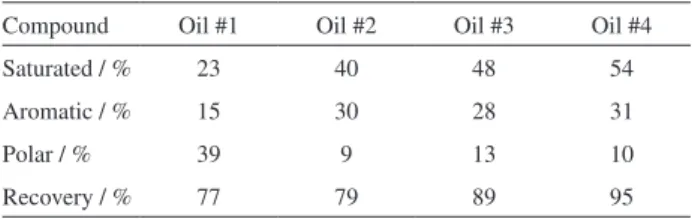
hydrocarbons, aromatic hydrocarbons and polar compounds (SAP results), as calculated from the quantity weigh-out of the respective fractions, are presented in Table 1.
Chromatographic conditions
GC-FID
chromatograph coupled to a flame ionization detector. Separation was achieved with a HP5 fused silica column (30 m × 0.25 mm i.d., 0.25 µm film thickness). The GC oven operating conditions were 40 to 320 ºC (10 min) at 6 °C min-1. H
2 was used as carrier gas. Samples were
injected in splitless mode with the injector temperature at 290 °C and detector temperature at 340 °C. The crude oil samples (10 mg) were dissolved in 500 µL of dichloromethane and analyzed by GC-FID.
GC-MS
GC-MS analyses were performed with an Agilent Technologies 6890N (Palo Alto, CA, USA) gas chromatograph coupled with the Agilent Technologies 5973 mass spectrometer. Separation was achieved with a HP5 fused silica column (30 m × 0.25 mm i.d., 0.25 µm film thickness). The GC oven operating conditions were 70 (1 min) to 170 ºC at 20 °C min-1 and 170 to 325 ºC
at 2 °C min-1. He was used as carrier gas at a flow of
1.0 mL min-1. Samples were analyzed in single ion
monitoring and scan mode. Samples were injected in splitless mode with the injector temperature at 290 °C. GC-MS was operated in the 70 eV electron ionization (EI) mode with a collected mass range of 50-600 Da.
GC×GC-TOFMS and data processing
GC×GC-TOFMS analyses were performed with a Pegasus 4D system (Leco, St. Joseph, MI, USA) which consists of an Agilent Technologies 6890 gas chromatograph (Palo Alto, CA, USA) equipped with a secondary oven, a non-moving quad-jet dual-stage modulator and a Pegasus III mass spectrometer (Leco, St. Joseph, MI, USA). The data acquisition and processing method were carried out by using ChromaTOF™ software version 4.21 (Leco, St. Joseph, MI, USA). The GC column set consisted of a HP5 (5%-phenyl-95%-methylsiloxane; Agilent Technologies, Palo Alto, CA, USA) column (30 m, 0.25 mm i.d., 0.25 µm film thickness) as the first dimension (1D) and a BPX50 (50%-phenyl-50%-methylsiloxane; SEG, Ringwood, VIC, Australia) column (1.5 m, 0.1 mm i.d., 0.1 µm film thickness) as the second dimension (2D). The second
column was connected to the TOFMS instrument (Leco, St. Joseph, MI, USA) via an uncounted deactivated silica tube (0.5 m × 0.25 mm i.d). The columns and the empty deactivated column were connected by SilTite™ mini-unions and metal ferrules made for 0.10-0.25 mm i.d. GC columns (SEG, Ringwood, VIC, Australia).
The temperature program used in the first column (1D) was: 70 (1 min) to 170 ºC at 20 °C min-1 and 170 to 325 ºC
at 2 °C min-1. The programming for the second column
consisted of a gradient of 10 °C above the first column: 80 (1 min) to 180 ºC at 20 °C min-1 and 180 to 335 ºC at
2 °C min-1. The modulator temperature was 30 °C above the
temperature of the first column and the modulation period was 8 s, with a 2 s cold jet and a 2 s hot jet. He was used as carrier gas at a flow of 1.5 mL min-1. The temperatures
of the transfer line to the mass spectrometer and the ion source were 280 and 230 °C, respectively. The detector was operated at 1650 V and the acquisition rate was 100 spectra s-1. Samples were injected in splitless mode with
the injector temperature at 290 °C. TOFMS was operated in the electron impact ionization mode at 70 eV. The analyzed mass range was 50-600 Da.
Samples were evaluated from total ion chromatograms (TIC) and extracted ion chromatograms (EIC) by using m/z 85 (paraffins), m/z 191 (tri-, tetra- and
pentacyclic terpanes, gammacerane, oleanane), m/z 177
(C10 demethylated tri-, tetracyclic terpanes and 17α
(H)-25-nor-hopanes), m/z 341 (25,28-nor-hopanes), m/z 369
(28-nor-spergulanes), m/z 217 and 218 (ααα and
αββ steranes, respectively), m/z 123 (secohopanes) and m/z
259 (diasteranes and tetracyclic polyprenoids) as diagnostic ions, based on previous works.16,23
After data acquisition and processing by the use of ChromaTOF™ software version 4.21, individual peak areas were automatically acquired and individual compound identification was performed by the comparison with the literature and standard compound mass spectra by examination, interpretation of MS fragmentation patterns, retention time, and elution order of compounds.24-28
Results and Discussion
Initially, the heavily biodegraded whole oil samples from Colombia were analyzed using GC-FID to provide a rapid assessment of oil composition. Then, the saturated hydrocarbon fractions, after fractioning, were analyzed by GC-MS and GC×GC-TOFMS. The whole oil (GC-FID) chromatogram from the oil samples and the GC-MS mass chromatograms from the saturated hydrocarbon fractions are shown in Figure S1 (in the Supplementary Information (SI) section).
Table 1. SAP results. Chemical group-type composition for the samples
Compound Oil #1 Oil #2 Oil #3 Oil #4
Saturated / % 23 40 48 54
Aromatic / % 15 30 28 31
Polar / % 39 9 13 10
Chromatographic aspects
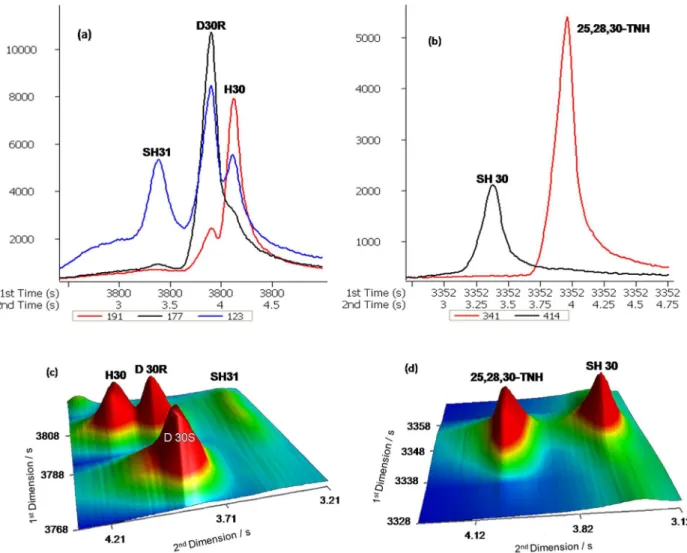
The comparison between GC-MS and GC×GC-TOFMS was performed in order to emphasize the increase in the chromatographic resolution and sensitivity achieved using GC×GC-TOFMS. Because of the complexity of the biodegraded oil samples, no additional chemical information could be obtained from GC-MS due to the large number of components and limited separation capacity. The acquired GC-MS data revealed coelutions that involved important compound classes such as secohopanes, hopanes and demethylated hopanes, as shown in Figure 1, curves a-c. In the two-dimensional chromatogram (Figure 1d), several of these coelutions were resolved, such as 25,28,30-tris-nor-hopane (25,28,30-TNH) from
C30 8,14-secohopane (SH30), and C30 17α(H),21β (H)-30-hopane (H30) from 17α(H),21β(H)-25-nor-30-hopane
(D30R), and C31 8,14-secohopane (SH31), as shown in
Figure 2. The separation between H30 and D30R has
previously been reported,16 but in the present work, it was
also observed the separation of another compound in this region, the C31 8,14-secohopane (SH31). In addition, the structured chromatogram allowed a better identification of compounds by classes in the chromatographic plane, especially the secohopanes, present in low concentrations.
The nor-spergulane and nor-gammacerane were not
detected by GC-MS because of either low concentration or occurrence of possible coelutions. The C29 28-nor
-spergulane (29NSP), the main member of the previously identified series as 28-nor-spergulanes,27 was detected and
recognized using GC×GC-TOFMS, as shown in Figure 3. This compound is a rearranged hopane and exhibits a mass spectrum typical of hopanes, with a base peak at
m/z 191. However, the fragment m/z 369 is more intense
in this compound than in regular hopanes (Figure S4, in the SI section). The compound eluted between the C29 and C30 hopanes (Figure 3). The geochemical implications
of 28-nor-spergulanes are not well-known, even though
they are detected in a large number of oils from different sources. 28-nor-spergulane is particularly abundant in
lacustrine oils from Southeast Asia. This biomarker has also been detected in Brazilian16 and Colombian oils18 by
GC×GC-TOFMS. Another series of rearranged hopanes known as 18α-neohopanes (Ts, C29Ts) were also identified, along with their demethylated products.
Nytoft et al.27 detected a pentacyclic terpane, the last
C29 terpane in the chromatographic run, which eluted after
H30. By examining the mass spectrum in that work,27
this compound was tentatively identified by the authors as 24-nor-gammacerane. But this was, however, based
on a synthetic compound and not on a natural one. In the
present work, a compound was also found eluting after H30 on the second column. It is possible that this compound is 25-nor-gammacerane (Figure 4) as all detected demethylated
hopanoids and tricyclic terpenoids are usually 25-nor.
Why would biodegradation act on C24- and not on the well-known C25-position? For this reason, this compound was tentatively identified as either 25-nor-gammacerane,
or only as nor-gammacerane, as not known for sure the
exact demethylation position. This reinforces the hypothesis that it may be a nor-gammacerane because its precursor
(gammacerane) also interacted more with the 2D column Figure 1. Saturated hydrocarbon fraction from Oil #2: (a) GC-MS m/z 123
mass chromatogram; (b) m/z 191 mass chromatogram; (c) m/z 177 mass chromatogram and (d) GC×GC-TOFMS overlaid EIC m/z 191, 177 and 123 of the same sample, showing the separation and identification of biomarkers and solved coelutions in 2D. Note the separation achieved for hopanes, 25-nor-hopanes and secohopanes
in 2D. DTs: 18α(H),21b(H)-22,25,29,30-tetranorneohopane; DTm: 17α(H),21β(H)-22,25,29,30-tetra-nor-hopane; Ts: 18α(H),21β (H)-22,29,30-trisnorneohopane; Tm: 17α(H),21β
(H)-22,29,30-tris-nor-hopane; 25,28,30-TNH: 17α(H),18α(H),21β (H)-25,28,30-tris-nor-hopane; 25,30-BNH: 17α(H),18α(H),21β
(H)-25,30-bis-nor-hopane; 25,28-BNH: 17α(H),18α(H),21β(H)-25,28-bis-nor -hopane; H28: 17α(H),18α(H),21β(H)-28,30-bis-nor-hopane; 25-NH: 17α(H),21β(H)-25-nor-hopane; H29: 17α(H),21β (H)-30-nor-hopane; C29Ts: 18α(H),21β(H)-30-nor-neohopane; TPP: Tetracyclic polyprenoid; M29: 17β(H),21α(H)-30-nor-hopane;
H30: C30 17α(H),21β(H)-hopane; Hn: Cn hopane; D30: demethylated C31
Figure 2. GC×GC-TOFMS m/z 191, 177 and 123 EIC of saturated hydrocarbon fraction from Oil #2, showing the separation and identification of biomarkers and solved coelution problems: (a) and (b) expansion chromatograms in the first dimension; (c) and (d) tri-dimensional chromatograms.
Figure 3. GC×GC-TOFMS EIC m/z 191 of saturated hydrocarbon fraction from Oil #2, showing the identification of hopanes, with details for 28-nor-spergulane and oleanane at low abundances.
25-NH: 17a(H),21b(H)-25-nor-hopane; Tm: 17α(H),21β (H)-22,29,30-trisnorhopane; H29: 17α(H),21β(H)-30-nor-hopane; TPP: tetracyclic
polyprenoid; H30: C30 17α(H),21β(H)-hopane; Hn: Cn hopane;
Gam: gammacerane; Ol: oleanane; 29NSP: C29 28-nor-spergulane. To
abbreviation identifications see also Table S1 (in the SI section).
Figure 4. GC×GC-TOFMSEIC m/z 177 of saturated hydrocarbon fraction from Oil #2, showing the identification of demethylated hopanes (25-nor-hopanes), with details for nor-gammacerane identification. 25,30-BNH: 17α(H),18α(H),21β(H)-25,30-bis-nor
-hopane; 25-NH: 17α(H),21β(H)-25-nor-hopane; NG: nor-gammacerane; D30: demethylated C31 hopane, Dn: demethylated Cn+1 hopane. To
due to differences in chemical structure: gammacerane is a hexacyclic terpenoid while hopane is a pentacyclic terpenoid. Thus, the separation in the second dimension allowed one to distinguish between hopane and gammacerane families in the chromatographic plane (Figure 5).
Geochemical interpretation
Geochemical parameters are used to provide maximum geological interpretations to help solving problems in the production, development, exploration, environmental and archaeological problems. Thus, geochemical correlations using biomarkers provide a better understanding of the relationship of the reservoir, thereby improve the exploration success by establishing possible routes of oil migration. For this reason, the identification of biomarkers is widely used in oil-oil correlation and oil-source rock, being a powerful tool in oil exploration. Furthermore, the use of biomarker ratios provides important information concerning the origin, thermal maturation and biodegradation of oils. The characterization of depositional environments of petroleum source rocks using biomarker parameters provides criteria for distinguishing source rocks deposited in different environments, such as lacustrine and marine. The thermal maturity term refers to the thermal reactions resulting from the progress of increase in temperature that leads to the conversion of organic material in sedimentary oil. The biodegradation of the oil consists of a series of biological processes that cause preferential removal of some compounds attacked by microorganisms, altering the composition of petroleum. The quality of the oil and its liquid volume decreases with an increase in biodegradation.
Thus, it can significantly impact the economic value and production of oil.
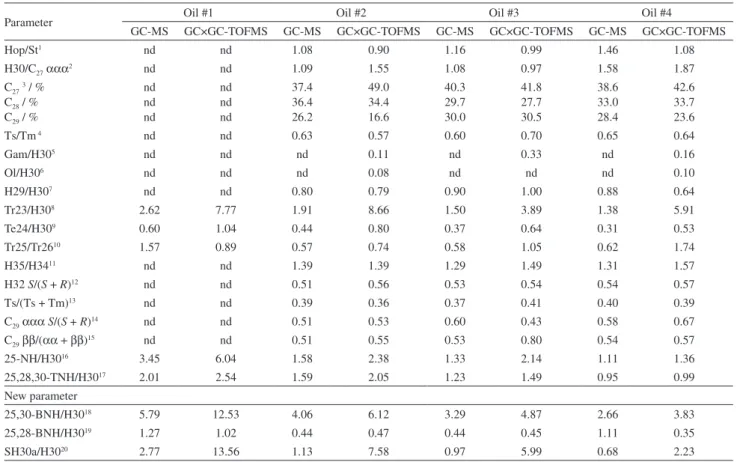
The geochemical parameters calculated for the samples using GC-MS and GC×GC-TOFMS are given in Table 2.
Depositional environment
Parameters such as Hop/St (1, Table 2), H30/C27 ααα (2), percentage of steranes (3), Ts/Tm (4), Te24/H30 (9) and H35/H34 (11) were obtained in order to evaluate the depositional environment. The hopane/steranes (Hop/St) ratio obtained from Oils #2, #3 and #4 ranged from 0.9 to 1.08 as measured by GC×GC-TOFMS, and between 1.08 to 1.46 as measured by GC-MS (Table 2). This indicates marine organic matter deposition revealed by both techniques (Hop/St < 4.0). The finding is consistent with the predominance of C27 steranes over homologue C29 and with
the presence of C30 sterane. Low concentrations of Tr19 and Tr20 compared to Tr23 in all samples are also indicative of marine oils.6,29 The Ts/Tm ratios of the Oils #2, #3 and
#4 using GC-MS and GC×GC-TOFMS were below 1, indicating a marine carbonate or evaporate depositional environment.29
High H35/H34 ratios (> 1) revealed the selective preservation of the C35 homologue and indicate that the
oils were derived from a marine source rock deposited under low redox conditions.5 High concentrations of C35
homohopane in Oils #2, #3 and #4 using both GC-MS and GC×GC-TOFMS are indicative of anoxic conditions during source-rock deposition.6 The presence of 25,28,30-TNH in
all samples indicates that the oil samples are most likely derived from anoxic marine depositional environment oils.6
The C24 tetracyclic terpane/hopane ratio (Te24/H30)
increases in more mature source rocks and oils as a result of the greater stability of the tetracyclic terpanes. They also appear more resistant to biodegradation than hopanes6. For
these reasons, they can be used in correlations of altered petroleum. The presence of C24 tetracyclic terpanes for all of the oil samples are thought to be common in carbonate and evaporite depositional environments.29,30
Other pentacyclic terpanes, such as gammacerane and oleanane, were also identified using GC×GC-TOFMS (Figure 3) but not detected via GC-MS. These compounds are highly resistant to biodegradation.26 However,
Oils #2, #3 and #4 showed Gam/H30 ratios higher than 0.11, indicating salinity and water column stratification in the source rock depositional environment. This was also used as an indicator of carbonate and evaporitic environments.29 In addition, high Ol/H30 ratio is indicative of
terrestrial environments.6 Low Ol/H30 ratios were found for
Oils #2 and #4, suggesting marine depositional environments. Figure 5. GC×GC-TOFMSEIC m/z 191 and 177 of saturated hydrocarbon
fraction from Oil #2, showing the distinction between the homohopane and gammacerane families. H30: C30 17α(H),21β(H)-hopane; Hn: Cn
hopane; Gam: gammacerane NG: nor-gammacerane; D30: demethylated
Table 2. Geochemical data showing selected source, thermal evolution and biodegradation parameters of samples via GC-MS and GC×GC-TOFMS
Parameter Oil #1 Oil #2 Oil #3 Oil #4
GC-MS GC×GC-TOFMS GC-MS GC×GC-TOFMS GC-MS GC×GC-TOFMS GC-MS GC×GC-TOFMS
Hop/St1 nd nd 1.08 0.90 1.16 0.99 1.46 1.08
H30/C27ααα2 nd nd 1.09 1.55 1.08 0.97 1.58 1.87
C273 / %
C28 / % C29 / %
nd nd nd nd nd nd 37.4 36.4 26.2 49.0 34.4 16.6 40.3 29.7 30.0 41.8 27.7 30.5 38.6 33.0 28.4 42.6 33.7 23.6
Ts/Tm 4 nd nd 0.63 0.57 0.60 0.70 0.65 0.64
Gam/H305 nd nd nd 0.11 nd 0.33 nd 0.16
Ol/H306 nd nd nd 0.08 nd nd nd 0.10
H29/H307 nd nd 0.80 0.79 0.90 1.00 0.88 0.64
Tr23/H308 2.62 7.77 1.91 8.66 1.50 3.89 1.38 5.91
Te24/H309 0.60 1.04 0.44 0.80 0.37 0.64 0.31 0.53
Tr25/Tr2610 1.57 0.89 0.57 0.74 0.58 1.05 0.62 1.74
H35/H3411 nd nd 1.39 1.39 1.29 1.49 1.31 1.57
H32 S/(S + R)12 nd nd 0.51 0.56 0.53 0.54 0.54 0.57
Ts/(Ts + Tm)13 nd nd 0.39 0.36 0.37 0.41 0.40 0.39
C29αααS/(S + R)14 nd nd 0.51 0.53 0.60 0.43 0.58 0.67
C29ββ/(αα + ββ)15 nd nd 0.51 0.55 0.53 0.80 0.54 0.57
25-NH/H3016 3.45 6.04 1.58 2.38 1.33 2.14 1.11 1.36
25,28,30-TNH/H3017 2.01 2.54 1.59 2.05 1.23 1.49 0.95 0.99
New parameter
25,30-BNH/H3018 5.79 12.53 4.06 6.12 3.29 4.87 2.66 3.83
25,28-BNH/H3019 1.27 1.02 0.44 0.47 0.44 0.45 1.11 0.35
SH30a/H3020 2.77 13.56 1.13 7.58 0.97 5.99 0.68 2.23
nd: not detected; 1Calculated from peak areas of ΣH29-H35 hopanes in the m/z 191 chromatogram over peak areas of ΣC
27-C29 steranes in the m/z 217
chromatogram. Hop/St: (H29-H35)/[C27,C28,C29ααα (20S + 20R) and αββ (20S + 20R)] (m/z 191 and 217). 2Calculated from peak area of C
30 17α(H),21β
(H)-30-hopane in the m/z 191 chromatogram over peak areas of C27 5α(H),14α(H),17α(H)-cholestanes (20S + 20R) in the m/z 217 chromatogram. H30/C27 ααα:
(H30)/C27ααα (20S + 20R). 3Calculated from % C
27 sterane (m/z 217):100 [C27ααα (20S + 20R) + C27αββ (20S + 20R)] / [(C27ααα (20S + 20R) + C27αββ
(20S + 20R) + C28ααα (20S + 20R) + C28αββ (20S + 20R) + C29ααα (20S + 20R) + C29αββ (20S + 20R)]. 4Calculated from peak area of 18α(H), 21β
(H)-22,29,30-tris-nor-neohopane (Ts) over peak area of 17α(H),21β(H)-22,29,30-tris-nor-hopane (Tm) in the m/z 191 chromatogram. 5Calculated from peak
area of gammacerane (Gam) over peak area of C30 17α(H),21β(H)-30-hopane (H30) in the m/z 191 chromatogram. 6Calculated from peak area of oleanane
(Ol) over peak area of C30 17α(H),21β(H)-30-hopane (H30) in the m/z 191 chromatogram. 7Calculated from peak area of 17α(H),21β(H)-29-hopane (H29)
over peak area of C30 17α(H),21β(H)-30-hopane (H30) in the m/z 191 chromatogram. 8Calculated from peak area of C
23 tricyclic terpane (Tr23) over peak
area of C30 17α(H),21β(H)-30-hopane (H30) in the m/z 191 chromatogram. 9Calculated from peak area of C
24 tetracyclic terpane (Te24) over peak area
of C30 17α(H),21β(H)-30-hopane (H30) in the m/z 191 chromatogram. 10Calculated from peak area of C
25 tricyclic terpane (Tr25) over peak area of C26
tricyclic terpanes (Tr26) in the m/z 191 chromatogram. 11Calculated from peak area of 17α(H),21β(H)-tetrakishomohopane (22S + 22R) (H34) over peak
areas of 17α(H),21β(H)-pentakishomohopane (22S + 22R) (H35) in the m/z 191 chromatogram. H34/H35: [H34 (22S + 22R) / H35 (22S + 22R)] (m/z 191). 12Calculated from peak areas of H32 17a(H),21b(H)-bishomohopane (22S + 22R) in the m/z 191 chromatogram. 13Calculated from peak areas of 18α(H),
21β(H)-22,29,30-tris-nor-neohopane (Ts) and 17α(H),21β(H)-22,29,30-tris-nor-hopane (Tm) in the m/z 191 chromatogram. 14Calculated from peak areas
of C29 5α(H),14α(H),17α(H)-24-ethyl-cholestane (20S + 20R) in the m/z 217 chromatogram. 15Calculated from peak areas of C
29 5α(H),14α(H),17α
(H)-24-ethyl-cholestane (20S + 20R), and C29 5α(H),14α(H),17α(H)-24-ethyl-cholestane (20S + 20R) in the m/z 217 chromatogram. 16Calculated from peak
area of 25-nor-hopane (25-NH) in the chromatogram m/z 177 over peak area of C30 17α(H),21β(H)-30-hopane (H30) in the m/z 191 chromatogram. 17Calculated from peak area of 25,28,30-tris-nor-hopane (25,28,30-TNH) in the m/z 177 chromatogram over peak area of C
30 17α(H),21β(H)-30-hopane
(H30) in the m/z 191 chromatogram. 18Calculated from peak area of 25,30-bis-nor-hopane (25,30-BNH) in the m/z 177 chromatogram over peak area of
C30 17α(H),21β(H)-30-hopane (H30) in the m/z 191 chromatogram. 19Calculated from peak area of 25,28-bis-nor-hopane (25,28-BNH) in the m/z 177
chromatogram over peak area of C30 17α(H),21β(H)-30-hopane (H30) in the m/z 191 chromatogram. 20Calculated from peak area of C
30 8,14-secohopane
(SH30a) in the m/z 123 chromatogram over peak area of C30 17α(H),21β(H)-30-hopane (H30) in the m/z 191 chromatogram.18,19,20 Proposed new geochemical
parameters for heavy biodegradation.
Maturity
Parameters such as H32 S/(S + R) (12, Table 2),
Ts/(Ts + Tm) (13), C29 ααα S/(S + R) (14) and
C29ββ/(αα + ββ) (15) steranes were obtained in order to
evaluate the thermal maturity.
The H32 S/(S + R) ratio increases from zero to
approximately 0.6, with equilibrium values in the range from 0.57 to 0.62 during thermal maturation.6,31 Samples
GC×GC-TOFMS. The values observed for Oils #2 and #4 via GC×GC-TOFMS, however, indicate that the principal
step of oil generation was reached. But, this parameter should be carefully analyzed because biodegraded oils could have a lower abundance of the R isomer, which is more susceptible to biodegradation. The homohopane H32 in the Oils #1 was not detected. This is suggested as being due to the severe biodegradation. The values observed for the H32 S/(S + R) ratio showed no significant differences between
the samples, and also between the two chromatographic techniques, GC-MS and GC×GC-TOFMS, with values between 0.51-0.54 and 0.54-0.57, respectively. This was also observed in a previous study in which the authors9
compared three techniques: GC-MS, GC-MRM-MS and GC×GC-TOFMS.
The Ts/(Ts + Tm) ratios are often used as a parameter of thermal maturity for the evaluation of oils from the same origin. The values observed for the Ts/(Ts + Tm) ratios showed no significant differences, varying from 0.37 to 0.4 via GC-MS and 0.36 and 0.41 by using GC×GC-TOFMS, with no distinction between both techniques. This can be explained by the fact that these two isomers, during a biodegradation process, are removed at the same rate, maintaining the initial ratio.6 Values around 1 for this ratio
indicate that the oil has highlo thermal maturity.6 Thus, the
values found for the Oils #2, #3 and #4 indicate that they have low thermal maturity or were possibly influenced by the biodegradation process.
T h e i s o m e r i z a t i o n a t C - 2 0 i n t h e C2 9
5α(H),14α(H),17α(H)-steranes increases from zero to approximately 0.5, with the equilibrium value between 0.52 to 0.55 with the increasing maturity.6,32 The R
configuration at C-20 occurs in steroid precursors existing in living organisms, and this is gradually converted during burial maturation to a mixture of the R and S sterane
configurations.6 Data from Oil #2 using GC-MS and Oil
#3 via GC×GC-TOFMS barely entered the oil generation range, while Oil #2, via GC×GC-TOFMS, reached the equilibrium value. Partial sterane biodegradation of oil can result in an increase of aaα 20S/(20S + 20R) sterane ratios
(C27, C28 and C29) to above 0.55, which was observed in Oils
#3 and #4 via GC-MS, and Oil #4 using GC×GC-TOFMS. This was due the selective removal of the aaα 20R epimer
by bacteria.33 The greater stability of the 20S epimer
compared to 20R is the main reason for increasing
20S/(20S + 20R) ratios with thermal maturity,34 and there is
no evidence for equilibration of 20S and 20R epimers. This ratio depends partly on the source rock and can decrease at high maturity.35 Differential stability of epimers and
generation of additional material from the kerogen may affect this ratio.36 Other factors, such as organofacies
differences, weathering and biodegradation can affect the sterane isomerization ratios.6
The isomerization at the C-14 and C-17 positions in the 20S and 20R C29 regular steranes causes an increase
in the ββ/(αα + ββ) from zero to approximately 0.7, with equilibrium value between 0.67 and 0.71, with the increasing maturity.6,32 This ratio appears to be independent
of source organic matter input and is somewhat slower to reach equilibrium than the 20S/(20S + 20R) ratio,
thus making it effective at higher levels of maturity. The increase in ββ/(αα + ββ) ratio, as observed in Oil #3 via GC×GC-TOFMS (Table 2), indicates the loss by thermal degradation of the aaα isomer. This is due to the fact that aaα isomers are degraded more rapidly than abβ isomers.37
Some studies6,37 indicate that changes in source and
maturation parameters, traditionally associated with isomerization, are due to a combination of three processes: generation from kerogen, cracking and secondary isomerization.
Several factors, such as source of organic matter, lithology and depositional conditions, can influence biomarker maturation parameters.6 The factor of
greatest importance for the variance is attributed to the biodegradation. However, it is difficult to determine the maturity parameters by using only hydrocarbon biomarker parameters that may have been altered by biodegradation.
Biodegradation
The biomarker composition of the oils in terms of relevant compound classes was estimated and assigned to the Peter & Moldowan (PM) scale, presented in Table 3. Based on these scales, the four oil samples can be classified as severely biodegraded (PM rank ≥ 6), mainly because of the presence of the 25-nor-hopane and 25-nor-tricyclic
terpane series in addition to that of nor-gammacerane.
The samples have distinct characteristics concerning to biodegradation, which can influence parameters related to thermal evolution and origin. Two distinct fingerprints, associated to degrees of alteration, were defined on the basis of biomarker composition (Figure 6). One of them is related to the presence of tetracyclic terpanes, steranes, hopanes (C28-C30), homohopanes (C31-C35), bis-nor-hopanes
(BNH), 25,28,30-tris-nor-hopane (TNH), 25-nor-hopanes
(C26-C34), nor-gammacerane, secohopanes and abundant
n-alkanes. It includes the Oils #2, #3 and #4, with
compounds except for n-alkanes, hopanes (C28-C29),
homohopanes (C31-C35) and steranes, and includes only Oil #1. This sample is highly biodegraded, as evidenced by the predominant unresolved compound mixture (UCM), and absence of n-alkanes in the whole oil analysis
(Figure S1 in the SI section). There is also a complete loss of n-alkanes, hopanes, homohopanes and steranes from
the total ion chromatogram for Oil #1 (Figures 6b and 6d).
The absence of these compounds is characteristic of a severely biodegraded oil, and is consistent with residual material from the severe weathering and biodegradation of crude oil.38
The tricyclic terpanes have advantages when used in correlations because they are less affected by maturation and biodegradation than hopanes and steranes.6 The tricyclic/
hopane ratio increases with the elevation of thermal Table 3. Biomarker composition of the oils and Peter & Moldowan scale
Compound/Class Oil # 1 Oil # 2 Oil # 3 Oil # 4 PM Scale
n-Alkanes (GC-FID) – – + ++ 1 slight
Isoprenoids (GC-FID) – – + ++ 3 moderate
C29 17α(H),21β(H)-25-nor-Hopane (GC-MS and GC×GC-TOFMS) ++ ++ ++ ++ 4 heavy
25-nor-Hopanoid series (GC-MS and GC×GC-TOFMS) ++ ++ ++ ++ 5 heavy
nor-Gammacerane (GC×GC-TOFMS) + + + + > 6 severe
25-nor-Tricyclic terpanes (GC-MS and GC×GC-TOFMS) + ++ ++ ++ > 6 severe
Hopanes destroyed (GC-MS) + – – – > 6 severe
Steranes destroyed (GC-MS) + – – -– > 6 severe
25,30-Bis-nor-hopane (GC×GC-TOFMS) ++ ++ ++ ++
25,28-Bis-nor-hopane (GC×GC-TOFMS) ++ ++ ++ ++
25,28,30-Tris-nor-hopane (GC×GC-TOFMS) ++ ++ ++ ++
PM Scale > 6 > 6 > 6 > 6
severe severe severe severe –: not detected; +: detected; ++: detected in higher abundance then +.
maturity and biodegradation because the tricyclic terpanes are more resistant to biodegradation. In highly biodegraded oils when hopanes are removed, there is a rise in the relative abundance of the tricyclic compounds, increasing the values observed for the ratio tricyclic/hopane. The compound Tr23 is the most widely used on the tricyclic terpane ratio. The high values for the Tr23/H30 ratio (8, Table 2) in all samples are indicative of severe biodegradation.
The secohopanes are derived from the hopane or moretane series via the opening of the C-ring during the early stages of maturation and degradation of hydrocarbons6. These compounds are highly resistant to
biodegradation.5,6 There are six possible configurations
because of the stereochemistry of carbons 8 and 14, but all six secohopane configurations were not observed. This was most likely due to coelution combined with the low concentrations of these compounds in the oils. In this study, it was possible to identify secohopanes C27 to C33, with the highest concentrations observed in secohopanes C29,
C30 and C31 (mass spectra in Figure S4 in the SI section).39
The detection of 25-nor-tricyclic terpanes, 25-nor
-tetracyclic terpanes and 25-nor-hopanes was performed by
monitoring the EIC m/z 177 (Figure 4). The complete series
of 25-nor-hopanes (C26-C34 25-nor-hopanes) was observed
in all samples, including the C24 demethylated tetracyclic
terpane (DTe23) and the demethylated Ts, Tm and βTm. In addition, 25,30-BNH, 25,28-BNH and 25,28,30-TNH were also identified, with 25,30-BNH (mass spectrum in Figure S4 in the SI section) being the most intense at EIC m/z 177 (Figure 4). These compounds are indicative
of severely biodegraded oil samples. This suggests that the hydrocarbons were exposed to severe conditions of biodegradation.6,25,40
As already described, an important separation observed by GC×GC-TOFMS occurred between the isomers H30 and D30R.16 H30, the hopane found in most oils,
decreases in concentration during biodegradation, while D30R is an intermediate of homohopane H31R degradation.
If the H30 concentration decreases and the concentration of D30R increases due to oil biodegradation, this can mask
the actual concentration of H30, which is widely used in the characterization of oils with respect to biodegradation using the 25-NH/H30 ratio, maturity and source parameters.6 The
separation of these and other biomarkers is a favorable result of using GC×GC-TOFMS for oil characterization.
Many authors agree that 25-nor-hopanes indicate
heavy biodegradation.5,6 The 25-nor-hopanes are a series
of compounds, typical of many, but not all, heavily biodegraded oils. These compounds appear to result from the bacterial removal of the methyl group at C10 from the regular hopanes.5 Many biodegraded oils reported in the
literature contain abundant 25-nor-hopanes, evidence of
severe biodegradation (rank ≥ 6).6
The 25-nor-hopane/hopane (25-NH/H30) ratio (16,
Table 2) increases with the extent of biodegradation. Thus, it was possible to distinguish the degree of biodegradation of the samples based on the increasing 25-NH/H30 ratio, which had values between 1.36 and 6.04 as measured by GC×GC-TOFMS, and between 1.11 and 3.45 as measured by GC-MS (Table 2). As a result of the better chromatographic separation between 25,28,30-TNH from SH30, H30 and D30R from SH31 were achieved using
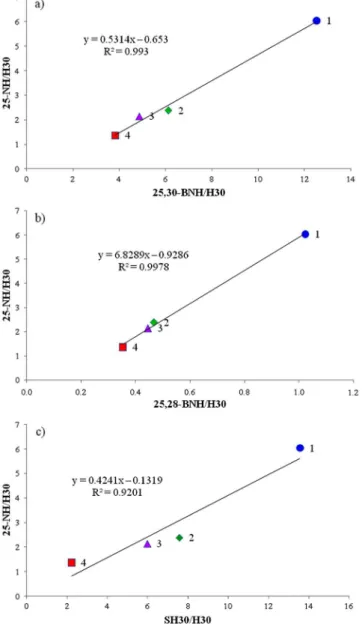
GC×GC-TOFMS. Because of the detection of many abundant demethylated terpanes, three new parameters were proposed for the characterization of severe biodegradation: 25,28-BNH/H30 (18), 25,30-BNH/H30 (19) and SH30/H30 (20). These proposed biodegradation parameters showed a trend of biodegradation between the studied samples, indicating a decreasing order of biodegradation: Oil #1 > Oil #2 > Oil #3 > Oil #4. This demonstrates the same trend as the 25-NH/H30 ratio exhibited between the samples, which is the parameter usually employed for characterization of biodegraded oils.
The relation graphic between 25-NH/H30 with 25,30-BNH/H30, 25,28-BNH/H30 and SH30/H30 ratios, showed good correlation (R2 greater than 0.9) between
25-NH/H30 with 25,30-BNH/H30, 25-NH/H30 with 25,28-BNH/H30, and 25-NH/H30 with SH30/H30 ratios, which can be observed across the correlation coefficient of 0.993, 0.9978 and 0.9201 respectively, as shown in Figure S3 in the SI section. According to the results obtained in this work, three new promising parameters may be proposed, but further investigation based on a larger number of severely biodegraded oils is required in order to verify and finally include them as biodegradation parameters. After the confirmation, the compounds 25,28-BNH, 25,30-BNH and SH30, and consequently the three new promising parameters on which they are based, 25,28-BNH/H30, 25,30-BNH/H30 and SH30/H30, should be routinely employed in future investigation, mainly for severely biodegraded oils. Thus, the potential of GC×GC-TOFMS to provide new biodegradation parameters is demonstrated in these results.
Origin and maturation ratios, as Hop/St, H30/C27ααα,
Ts/Tm, Ts/(Ts + Tm), H32 S/(S + R), C29αααS/(S + R) and
C29ββ/(αα + ββ), did not vary significantly for these
may also be applied routinely, beside the commonly used 25-NH/H30, 25,28,30-BNH/H30.
Conclusion
The oils from Colombia under investigation showed complete series of 25-nor-hopanes, some
demethylated tricyclic terpanes, nor-gammacerane,
C29 28-nor-spergulanes, 25,30-BNH, 25,28-BNH,
25,28,30-TNH and 8,14-secohopanes, which resulted from the heavy biodegradation that occurred in the reservoirs.
The higher chromatographic resolution and sensitivity of the GC×GC-TOFMS allowed for the separation and identification of individual compounds, which normally coelute in conventional GC-MS analyses. This contributes to a better characterization of the oil fractions. As result of the chromatographic separation between 25,28,30-TNH and
SH30; H30, D30R, and SH31 by GC×GC-TOFMS, it
was possible to propose three new parameters for heavy biodegradation: 25,28-BNH/H30, 25,30-BNH/H30 and SH30/H30. These proposed parameters showed a trend of biodegradation between the studied samples, indicating a decreasing order of biodegradation: Oil #1 > Oil #2 > Oil #3 > Oil #4. In addition, geochemical parameters such as origin, thermal maturity and environment deposition were calculated, demonstrating the applicability of GC×GC-TOFMS in biomarker ratios. So, the use of GC×GC-TOFMS in geochemical analyses can easily support oil exploration.
The samples showed a Hop/St ratio < 4, the predominance of C27 steranes over C29 homologous, the presence of C30
steranes, low concentration of Tr19 and Tr20 when compared to Tr23, a condition which is indicative of marine oils. Moreover, the samples also showed H35/H34 ratio > 1 and the presence of 25,28,30-TNH signifying an anoxic depositional environment. The presence of Te24, gammacerane and Ts/Tm ratio < 1 suggests a carbonate or evaporitic depositional environment.
Supplementary Information
Supplementary information (Figure S1-S4 Table S1 in the SI section) is available free of charge at http://jbcs.org.br as a PDF file.
Acknowledgments
The authors thank Capes and CNPq (Brazilian research councils) for fellowships and financial support. Acknowledged is ICP-Ecopetrol for providing samples and Petrobras for their financial support.
References
1. Aitken, C. M.; Jones, D. M.; Larter, S. R.; Nature2004, 431, 291.
2. Jones, D. M.; Head, I. M.; Gray, N. D.; Adams, J. J.; Rowa, A. K.; Aitken, C. M.; Bennett, B.; Huang, H.; Brown, A.; Bowler, B. F. J.; Nature2007, 451, 176.
3. Wenger, L. M.; Davis, C. L.; Isaksen, G. H.; SPE Reservoir. Eval. Eng. 2002, 5, 375.
4. Larter, S.; Huang, H.; Adams, J.; Bennett, B.; Snowdon, L. R.;
Org. Geochem.2012, 45, 66.
5. Peters, K. E.; Moldowan, J. M.; The Biomarker Guide, 1st ed.;
Prentice Hall: New York, USA, 1993.
6. Peters, K. E.; Walters, C. C.; Moldowan, J. M.; The Biomarker Guide: Biomarkers and Isotopes in Petroleum Exploration and
Earth History, vol. 2, 1st ed.; Cambridge University Press:
Cambridge, UK, 2005.
7. Head, I. M.; Jones, D. M.; Larter, S. R.; Nature2003, 46, 344.
8. Springer, M. V.; Garcia, D. F.; Gonçalves, F. T. T.; Landau, L.; Azevedo, D. A.; Org. Geochem. 2010, 41, 1013.
9. Eiserbeck, C.; Nelson, R.K.; Grice, K.; Curiale, J.; Reddy, C. M.; Geochim. Cosmochim. Acta2012, 87, 299.
10. von Mühlen, C.; Zini, C. A.; Caramão, E. B.; Quim. Nova2006,
29, 765.
11. Tran, T. C.; Logan, G. A.; Grosjean, E.; Ryan D.; Marriott, P. J.;
Geochim. Cosmochim. Acta2010, 74, 6468.
12. Moraes, M. S. A.; Zini, C. A.; Gomes, C. B.; Bortoluzzi, J. H.; von Mühlen, C.; Caramão, E. B.; Quim. Nova2011, 34,
1188.
13. Silva, R. S. F.; Tamanqueira, J. B.; Dias, J. C. M.; Passarelli, F. M.; Bidart, A. M. F.; Aquino Neto, F. R.; Azevedo, D. A.;
J. Braz. Chem. Soc.2011, 22, 2121.
14. Ventura, G. T.; Kenig, F.; Reddy, C. M.; Frysinger, G. S.; Nelson, R. K.; Mooy, B. V.; Gaines, R. B.; Org. Geochem.2008, 39,
846.
15. Aguiar, A.; Silva Jr., A. I.; Azevedo, D. A.; Aquino Neto, F. R.;
Fuel2010, 89, 2760.
16. Ávila, B. M. F.; Aguiar, A.; Gomes, A. O.; Azevedo, D. A.; Org. Geochem.2010, 41, 863.
17. Ventura, G. T.; Simoneit, B. R. T.; Nelson, R. K.; Reddy, C. M.;
Org. Geochem.2012, 45, 48.
18. Silva, R. S. F.; Aguiar, H. G. M.; Rangel, M. D.; Azevedo, D. A.; Aquino Neto, F. R.; Fuel2011, 90, 2694.
19. Ventura, G. T.; Raghuraman, B.; Nelson, R. K.; Mullins, O. C.; Reddy, C. M.; Org. Geochem. 2010, 41, 1026.
20. Grice, K.; Alexander, R.; Kagi, R. I.; Org. Geochem.2000, 31,
67.
21. Azevedo, D. A.; Tamanqueira, J. B.; Dias, J. C. M.; Carmo, A. P. B.; Landau, L.; Gonçalves, F. T. T.; Fuel2008, 87, 2122. 22. Silva, T. F.; Azevedo, D. A.; Rangel, M. D.; Fontes, R. A.;
23. Oliveira, C. R.; Ferreira, A. A.; Oliveira, C. J. F.; Azevedo, D. A.; Santos Neto, E. V.; Aquino Neto, F. R.; Org. Geochem.
2012, 46, 154.
24. Frysinger, G. S.; Gaines, R. B.; J. Sep. Sci.2001, 24, 87.
25. Nytoft, H. P.; Bojesen-Koefoed, J. A.; Christiansen, F. G.; Org. Geochem.2000, 31, 25.
26. Nytoft, H. P.; Bojesen-Koefoed, J. A.; Christiansen, F. G.; Fowler, M. G.; Org. Geochem.2002, 33, 1225.
27. Nytoft, H. P.; Lutnaes, B. F.; Johansen, J. E.; Org. Geochem.
2006, 37, 772.
28. Wang, Z.; Stout, S. A.; Fingas, M.; Environ. Forensics2006, 7, 105.
29. Hegazi, A. H.; El-Gayar, M. Sh.; J. Pet. Geol.2009, 32, 343. 30. Clark, J. P.; Philp, R. P.; Bull. Can. Petrol. Geol.1989, 37, 401.
31. Seifert,W. K.; Moldowan, J. M.; Phys. Chem. Earth1980, 12, 229.
32. Seifert,W. K.; Moldowan, J. M. In Methods in Geochemistry and Geophysics; Johns, R. B., ed.; Elsevier: Amsterdam, The
Netherlands, 1986, ch. 24, p. 261.
33. Seifert,W. K.; Moldowan, J. M.; Demaison, G. J.; Org. Geochem. 1984, 6, 633.
34. Requejo, A. G.; Allan, J.; Creaney, S.; Gray, N. R.; Cole, K. S.;
Org. Geochem. 1992, 22, 441.
35. Peter, K. E.; Moldovan, J. M; Sundararaman, P.; Org. Geochem.
1990, 15, 249.
36. Dzou, L. I.; Noble, R. A.; Senftle, J. T.; Org. Geochem.1995,
23, 681.
37. Farrimond, P.; Taylor, T.; Telnaes, N.; Org. Geochem.1998, 29, 1181.
38. Fazeelat, T.; Alexander, R.; Kagi, R. I.; Org. Geochem.1994,
21, 257.
39. Wang, T. G.; Simoneit, B. R. T.; Philp, R. P.; Yu, C. P.; Energy Fuels1999, 4, 177.
40. Fazeelat, T.; Alexander, R.; Kagi, R. I.; Org. Geochem. 1995,
23, 641.
Submitted: January 22, 2013
Supplementary Information
0103 - 5053 $6.00+0.00S
I
*e-mail: [email protected], [email protected]
Comprehensive Two-Dimensional Gas Chromatography Coupled to
Time of Flight Mass Spectrometry: New Biomarker Parameter Proposition
for the Characterization of Biodegraded Oil
Renata F. Soares,*,a Ricardo Pereira,a Raphael S. F. Silva,a Leonardo Mogollonb and
Débora A. Azevedo*,a
aInstituto de Química, Universidade Federal do Rio de Janeiro,
Ilha do Fundão, 21941-909 Rio de Janeiro-RJ, Brazil
bInstituto Colombiano del Petroleo, ECOPETROL S. A., Bucaramanga, Colombia
Table S1. Table of abbreviations
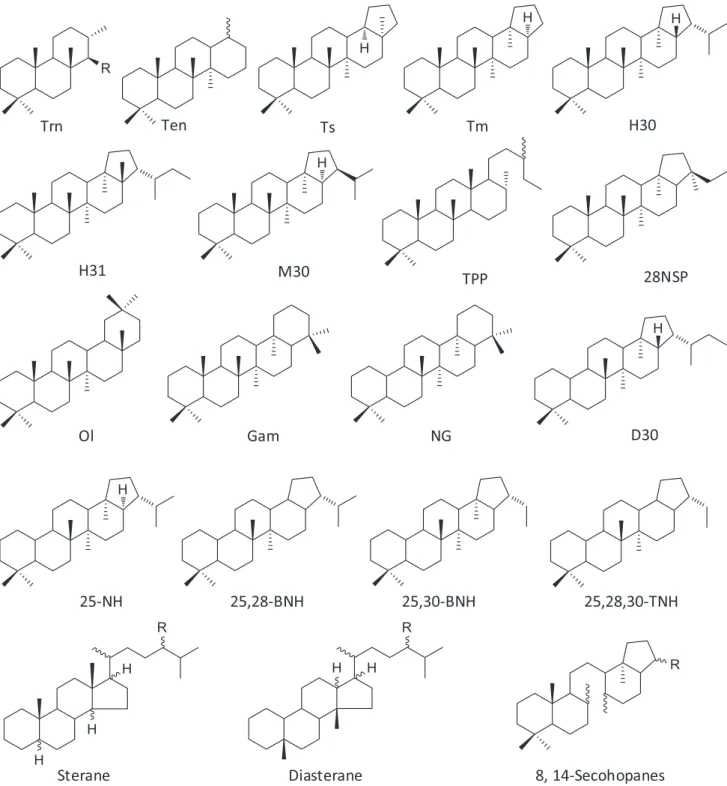
Trn Cn tricyclic terpane Ten Cn tetracyclic terpane
Ts 18α(H),21β(H)-22,29,30-tris-nor-neohopane Tm 17α(H),21β(H)-22,29,30-tris-nor-hopane
DTs demethylated Ts; 18α(H),21β
(H)-22,25,29,30-tetra-nor-neohopane
DTm demethylated Tm; 17α(H), 21β
(H)-22,25,29,30-tetra-nor-hopane
H28 17a(H),18a(H),21b(H)-28,30-bis-nor-hopane
H29 17A(H),21B(H)-30-nor-hopane
C29Ts 18α(H),21β(H)-30-nor-neohopane
H30 C30 17a(H),21b(H)-30-hopane
H31 17α(H),21β(H)-30-homohopane (22S + 22R)
H32 17α(H),21β(H)-30,31-bishomohopane (22S + 22R) H33 17α(H),21β(H)-30,31,32-trishomohopane (22S + 22R) H34 17α(H),21β(H)-30,31,32,33-tetrakishomohopane
(22S + 22R)
H35 17α(H),21β(H)-30,31,32,33,34-pentakishomohopane (22S + 22R)
D30 17α(H),21β(H)-25-nor-30-homohopane (22S + 22R) D31 17α(H),21β(H)-25-nor-30,31-bishomohopane
(22S + 22R)
D32 17α(H),21β(H)-25-nor-30,31,32-trishomohopane
(22S + 22R)
D33 17α(H),21β(H)-25-nor -30,31,32,33-tetrakishomohopane (22S + 22R) D34 17α(H),21β(H)-25-nor
-30,31,32,33,34-pentakishomohopane (22S + 22R) M29 17B(H),21A(H)-30-nor-hopane M30 C30 17B(H),21A(H)-hopane
NH30 17α(H),30-nor-29-homohopane 29NSP C29 28-nor-spergulane
NG nor-gammacerane
25-NH C29 17α(H),21β(H)-25-nor-hopane
TPP tetracyclic polyprenoid Gam gammacerane
OL oleanane
25,28-BNH 17α(H),18α(H),21β(H)-25,28-bis-nor-hopane 25,30-BNH 17α(H),18α(H),21β(H)- 25,30-bis-nor-hopane 25,28,30-TNH 17α(H),18α(H),21β(H)-25,28,30-tris-nor-hopane SH secohopane
St sterane
Cn ααα(S+R) Cn sterane ααα (C27-C30) (S + R)
Cn αββ(S+R) Cn sterane αββ (C27-C30) (S + R)
Comprehensi
ve
Tw
o-Dimensional Gas Chromatograph
y Coupled to
T
ime of Flight Mass Spectrometry
J. Br
az. Chem. Soc.
Figure S4. Mass spectra of: (a) C29 28-nor-spergulane, (b) nor-gammacerane, (c) 25,30-bis-nor-hopane (25,30-BNH), (d) 25,28-bis-nor-hopane