Rev Bras Cir Plást. 2012;27(2):290-3
290
Tavares Filho JM et al.
Supplementary implants in breast reconstruction
Implantes complementares na reconstrução mamária
ABSTRACT
Background: Depression in the anterior wall of the axilla following mastectomy is dis tressing to patients when they wear summer clothing and may also cause difficulty in raising the arm if there are adhesions and retractions in the region. In these patients, we use supplementary implants that reconstitute the local anatomy in a satisfactory manner and which offer functional benefits by removing cicatricial adhesions. These implants are available in several sizes and volumes, and it is possible to use more than one prosthesis in the same location, if needed. The aim of this study is to report the experience of the Plastic Surgery Unit of the Federal University of Rio de Janeiro (Rio de Janeiro, RJ, Brazil) with the use of supplementary implants in breast reconstruction after mastectomy to improve the aesthetic appearance and function of the axillary region. Methods: Supplementary silicone implants were inserted for breast reconstruction following mastectomy in 6 female patients, aged 34 to 75 years. The volume of the implants ranged from 20 mL to 120 mL. The width, length, and depth of the axillary region were measured to define the volume and dimensions, as well as the number of implants to be used. The implants were inserted through the scar from the prior breast reconstruction. Results: The followup period ranged from 6 months to 8 years, and no capsular contracture was observed. All patients reported functional improvement in arm movement, as well as satisfaction with the aesthetic result, which allowed them to wear more revealing clothing. Conclusions: The inclusion of semilunar silicone implants as a refinement in breast reconstruction is easy to perform, has predictable results, and requires only one surgical procedure. The implants may be replaced, augmented, or removed, as required.
Keywords: Breast implantation. Breast implants. Prostheses and implants. Mammaplasty.
RESUMO
Introdução: A depressão na parede anterior da axila pósmastectomia gera insatisfação das pacientes ao vestirem roupas mais decotadas; além disso, pode haver diiculdade na elevação do braço quando há aderências e retrações nessa região. Nessas pacientes, utilizamos implan tes complementares, que reconstituem a anatomia local de forma satisfatória, oferecendo benefícios funcionais ao remover bridas cicatriciais. Esses implantes estão disponíveis em variados tamanhos e volumes, podendo ser empregada mais de uma prótese no mesmo local, se necessário. O objetivo deste estudo é demonstrar a experiência da Disciplina de Cirurgia Plástica da Universidade Federal do Rio de Janeiro (Rio de Janeiro, RJ, Brasil) com o emprego de implantes complementares na reconstrução mamária pósmastectomia, buscando melhorar os aspectos estético e funcional da região axilar. Método: A inclusão de implantes de silicone complementares para reconstrução mamária pósmastectomia foi realizada em 6 pacientes do sexo feminino, com idade entre 34 anos e 75 anos. O volume Study conducted at the
Hospital Universitário da Universidade Federal do Rio de Janeiro (University Hospital of the Federal University of Rio de Janeiro), Rio de Janeiro, RJ, Brazil.
Submitted to SGP (Sistema de Gestão de Publicações/Manager Publications System) of RBCP (Revista Brasileira de Cirurgia Plástica/Brazilian Journal of Plastic Surgery).
Study awarded with the Georges Ariê prize during the 48th Brazilian Congress of Plastic Surgery, in Goiânia, GO, Brazil, from 11 to 15 November 2011.
Article received: December 2, 2011 Article accepted: April 11, 2012
1. Doctor and Master in Plastic Surgery at the Universidade Federal do Rio de Janeiro (Federal University of Rio de Janeiro) – UFRJ, full member of the Sociedade Brasileira de Cirurgia Plástica (Brazilian Society of Plastic Surgery) – SBCP, Rio de Janeiro, RJ, Brazil.
2. Plastic Surgeon, full member of SBCP, Rio de Janeiro, RJ, Brazil.
3. Doctor, Adjunct Professor of Plastic Surgery at UFRJ, full member of SBCP, Rio de Janeiro, RJ, Brazil. 4. Resident in Plastic Surgery at UFRJ, associate member of the SBCP, Rio de Janeiro, RJ, Brazil.
5. Resident Physician in Plastic Surgery at UFRJ, member in training of the SBCP, Rio de Janeiro, RJ, Brazil. 6. Doctor, Full Professor in Plastic Surgery at UFRJ, full member of SBCP, Rio de Janeiro, RJ, Brazil.
João Medeiros Tavares
Filho1
Manoel Belerique2
diogo Franco3
guilherMe arBex4
Marcio arnauT Junior5
TaliTa Franco6
Franco T et al.
Vendramin FS et al.
Rev Bras Cir Plást. 2012;27(2):290-3 291 Supplementary implants in breast reconstruction
dos implantes variou de 20 ml a 120 ml. Largura, comprimento e profundidade da área da axila a ser preenchida foram mensurados, para deinir volume, dimensões e número de implantes que seriam utilizados. A via de acesso utilizada para inserção dos implantes foi a cicatriz da reconstrução mamária. Resultados: O seguimento pósoperatório variou de 6 meses a 8 anos, não sendo observada contratura capsular em nenhum caso. Todas as pacientes referiram melhora funcional na movimentação do braço, bem como satisfação com o resultado estético pela possibilidade de uso de roupas mais decotadas. Conclusões: A inclusão de implantes de silicone de formato semilunar no reinamento da reconstrução mamária é um método simples e de fácil realização, com resultados bastante previsíveis, necessitando apenas de uma cirurgia. Os implantes podem ser substituídos, aumentados ou removidos, se necessário.
Descritores: Implante mamário. Implantes de mama. Próteses e implantes. Mamoplastia.
INTRODUCTION
Surgeons who perform breast reconstructions are moti vated to develop solutions to patients’ requests for better results, within the limitations imposed by the mastectomy. The main focus is modeling the new breast to suit the body of the patient, and it often happens that the infraclavicular depression and/or the absence of the anterior axillary crease, which occur in many cases, are not considered.
Depression in the anterior wall of the axilla is often a complaint from patients, both because it becomes visible with the use of lighter clothing and because it may cause dif iculties when raising the arm if there are adhesions and retractions in the region.
At present, adipose tissue laps are the most commonly used method of repairing the infraclavicular depression1,2. In axillary wall deformities, repair with adipose tissue laps is hindered because of cicatricial adhesions and extensive depression; this may lead to unsatisfactory results. In these cases, premade semilunarshaped implants may be used3,4. Also called supplementary implants, they reconstitute the lo cal anatomy and provide additional functional beneit of eliminating adhesions between the skin and the deeper plane, thus improving the extension of the arm. These supplemen tary implants are available in several sizes and volumes, and more than one implant may be used in the same place.
The aim of this study is to report the experience of the Plastic Surgery Unit of the Federal University of Rio de Ja neiro (Rio de Janeiro, RJ, Brazil) with the use of supple mentary implants in breast reconstruction after mastectomy to improve the aesthetic appearance and function of the axillary region.
METHOD
Insertion of semilunarshaped supplementary breast im plants (Silimed, Rio de Janeiro, RJ, Brazil) was performed
in 6 female patients aged 34 to 75 years undergoing post mastectomy breast reconstruction using a myocutaneous lap from either the rectus abdominis muscle (2 cases) or the latissimus dorsi (4 cases).
Seven implants were used; one patient received 2 implants. The volume of the implants ranged from 20 mL to 120 mL.
Surgical Procedure
The width, length, and depth of the axillary area to be illed were measured to deine the volume, the dimensions, and the number of implants to be used.
As the procedure may be performed under local anes thesia, the area was marked and was then iniltrated with saline solution, epinephrine, and xylocaine.
The implants were inserted through the scar from the breast reconstruction, superimposing the dissection plane on the remaining chest muscles or on the rib cage, with the aim being to have the thickest possible layer of subcutaneous tissue over the implant.
The subcutaneous detachment was 0.5 cm to 1 cm larger than the size of the implant.
The volume of the implant was determined intraoperati vely, using casts or expanders.
Sutures were placed in 2 or 3 planes, and a drain was placed for 24 to 48 hours.
RESULTS
In the immediate postoperative period, one patient deve loped a hematoma, which resolved after needle aspiration.
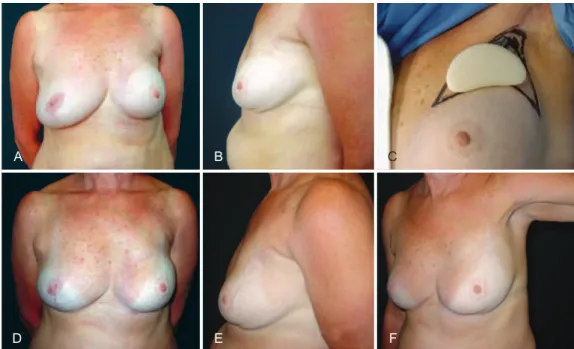
The postoperative followup period ranged from 6 months to 8 years; there were no complaints of capsular contracture (Figure 1).
All patients noted functional improvement when raising the arm and expressed satisfaction with the possibility of wearing lighter, more revealing clothing.
Rev Bras Cir Plást. 2012;27(2):290-3
292
Tavares Filho JM et al.
In the patient for whom 2 implants were used, the second one served as a complement of the projection and was inserted 3 months after the irst implant, using the same technical principles.
DISCUSSION
Although the results of wellperformed breast recons tructions bring great satisfaction to patients, many complain of the loss of the anterior axillary wall and of the depression in the infraclavicular region, which become visible in lighter clothing. This region should also be corrected as part of reconstruction procedures.
Adipose laps have frequently been used, particularly for the correction of infraclavicular depression5. However, this procedure requires a donor area with suficient adipose tissue, and several procedures may be needed to complete the illing of the depression when it is impossible to predict the percentage of integration of the laps. Moreover, liponecrosis may occur and may have a suspicious appearance during routine mammography1,2,6.
Placement of the AlloDerm membrane or Sculptra (po lyLlactic acid) has been suggested712, but these products do not allow for large volumes (they average 2 to 3 mm) and they can be expensive8,10.
The depression is usually pronounced in the anterior axil lary wall deformity, requiring a larger illing volume. Local adhesions may hinder or prevent adipose tissue injection.
Repair of these deformities by using a semilunarshaped silicone gel implant facilitates immediate reconstruction that is predictable in its inal volume because it is possible to use casts both preoperatively and intraoperatively. In cases where a larger projection is needed, more than one implant may be used in the same place, during the same surgical procedure or at different times.
In the infraclavicular position, the implants may be no ticeable because of the limited subcutaneous tissue left by the mastectomy13. However, in the anterior axillary wall, the result is satisfactory because the subcutaneous tissue is thicker and the localization of the implant is deeper, usually over the pectoralis minor muscle or the rib cage.
This procedure may be performed under local or general anesthesia, and does not interfere with management of the breast disease.
Moreover, this procedure offers aesthetic, social, and func tional advantages because it improves the appearance, enables patients to wear clothing that is more appropria te in warm weather, and allows for better movement of the arms.
CONCLUSIONS
Insertion of semilunar silicone supplementary implants in breast reconstruction is a simple method, easy to execute, and of predictable outcome, that may be performed in a single surgical procedure. The volume may be evaluated
A
D
B
E
C
F
Figure 1 – In A and B, preoperative appearance of semilunar silicone supplementary implants. In C, preoperative planning and measurements. In D, E, and F, postoperative appearance, 3 years after
Rev Bras Cir Plást. 2012;27(2):290-3 293 Supplementary implants in breast reconstruction
preoperatively or intraoperatively. The implants may be ex changed, added, or removed as needed.
The aesthetical and functional beneits provided by se milunar silicone supplementary implants make them an im portant part of breast reconstructions after mastectomy.
REFERENCES
1. Chan CW, McCulley SJ, Macmillan RD. Autologous fat transfer: a review of the literature with a focus on breast cancer surgery. J Plast Reconstr Aesthet Surg. 2008;61(12):143848.
2. Spear SL, Wilson HB, Lockwood MD. Fat injection to correct contour deformities in the reconstructed breast. Plast Reconstr Surg. 2005; 116(5):13005.
3. Hodgkinson DJ. The management of anterior chest wall deformity in patients presenting for breast augmentation. Plast Reconstr Surg. 2002; 109(5):171423.
4. Gatti JE. Poland’s deformity reconstruction with a customized, extrasoft silicone prosthesis. Ann Plast Surg. 1997;39(2):12230.
5. Rigotti G, Marchi A, Stringhini P, Baroni G, Galiè M, Molino AM, et al. Determining the oncological risk of autologous lipoaspirate grafting
for postmastectomy breast reconstruction. Aesthetic Plast Surg. 2010; 34(4):47580.
6. Hyakusoku H, Ogawa R, Ono S, Ishii N, Hirakawa K. Complications after autologous fat injection to the breast. Plast Reconstr Surg. 2009; 123(1):36070.
7. Newman MI, Samson MC, Berho M. AlloDerm in breast reconstruction: 2 years later. Plast Reconstr Surg. 2009;123(6):205e6e.
8. Ulacker AB, Janis JE. The use of acellular dermal matrix in the correc
tion of visible parasternal deformities after breast reconstruction. Plast Reconstr Surg. 2010;126(1):34e6e.
9. Losken A. Early results using sterilized acellular human dermis (Neo form) in postmastectomy tissue expander breast reconstruction. Plast Reconstr Surg. 2009;123(6):16548.
10. Bindingnavele V, Gaon M, Ota KS, Kulber DA, Lee DJ. Use of acellu lar cadaveric dermis and tissue expansion in postmastectomy breast reconstruction. J Plast Reconstr Aesthet Surg. 2007;60(11):12148. 11. Maxwell GP, Gabriel A. Use of the acellular dermal matrix in revisionary
aesthetic breast surgery. Aesthet Surg J. 2009;29(6):48593. 12. Schulman MR, Lipper J, Skolnik RA. Correction of chest wall defor
mity after implantbased breast reconstruction using polyLlactic acid (Sculptra). Breast J. 2008;14(1):926.
13. Marks MW, Argenta LC, Izenberg PH, Mes LG. Management of the chestwall deformity in male patients with Poland’s syndrome. Plast Reconstr Surg. 1991;87(4):67481.
Correspondence to: João Medeiros Tavares Filho