Mixed Valence Model for Superconductivity
Sven Larsson
Department of Chemistry, Chalmers University of Technology
SE-41296 G¨oteborg, Sweden
Received on 23 May, 2003.
Superconductivity often occurs in crystals with one active electron per site with charge density wave (CDW) or spin density wave (SDW) as ’mother state’. It is proposed that superconductivity is possible when the differences in equilibrium geometry and energy between the diabatic CDW and SDW states are so small that there is interaction between them via the zero point vibrations. Electron pairing in real space is directly related to oxidation states being different in two units. Three valence states in succession have to be stable (ground state or low-energy excited states) and we therefore refer to this mixed valence model as the MV-3 model. Examples are chosen from bismuthates, cuprates, and fullerides. The theory is simple and straightforward and offers solutions to other important problems as well, for example forA3C60(A= K, Rb), that (1) there are
no magnetic moments in crystal phase, and (2) that these systems are superconducting metals whileA4C60are
insulators.
1
Introduction
Since small coherence length characterizes ’exotic’ super-conductivity, it is possible to start out a theoretical descrip-tion from local electronic structure and electron-nuclear in-teractions, and later extend the system and wave function to the infinite crystal. If we do so we obtain a highly ’chemi-cal’ description of moving electron pairs [1,2]. The concept of oxidation state is relevant here; in particular the existence of oxidation states of atoms or molecules that are different in two units, since this obviously has to do with electron pairing. Crystalline systems with on the average one elec-tron per site, but with alternating valency, are called charge density wave (CDW), ’negative-U’, or mixed valence (MV) states. The MV states of relevance here may be obtained in the following disproportionation reaction:
2Mn+↔M(n+1)++M(n−1)+ (1)
On the left side there is one electron per site. If anti-ferromagnetic this state is referred to as a spin density wave (SDW) state. Successful theories for mixed valence systems have existed for a long time [4] and have been connected to [5] theories for electron transfer (ET) [6] and transport [7] and superconductivity [2,3,8-11], even before the advent of highTc superconductors [8]. This theory allows a quan-tum mechanical treatment of nuclear motion, including the coupling between nuclear and electronic motion (electron-phonon interaction) [12-13]. ET mixes two successive va-lence states while electron pair transfer (EPT) mixes two valence states different in two units. A non-trivial theorem states that the free energy of reaction (1) has to be close to zero(∆G0 ∼0)to permit electron pairs to be transported
without activation energy [3]. Hence three valence states in
succession have to be involved. The two MV cases will be called MV-2 and MV-3 systems, respectively. If in addition to the condition∆G0 ∼ 0 the equilibrium geometries of
the CDW and SDW states are similar, new vibronic states are formed with components from both CDW and SDW di-abatic states. In this limit the electron pairs are delocalised. The free motion of electron pairs is without resistance since there is an energy gap to the first excited state. Furthermore the difference in oxidation state is no longer observable. Un-fortunately the latter fact has lead to some confusion on the connection between superconducting and MV systems. A theory for electronic localization has been set up [14-16] on the basis of coupling between electronic and nuclear mo-tion. In this theory reorganization energyλ’competes’ with coupling energy∆. ∆ = 2t, where t is the coupling. λis unrelated to U of Mott theory. Localization cannot be due to purely electronic effects, although it may look like that by the way the wave function is expressed mathematically, or by the fact that the wave function is not sufficiently accu-rate. A well-known example is K-shell ionisation in a homo-nuclear diatomic molecule. The unrestricted Hartree-Fock method leads to symmetry breaking with a localized hole [17]. However, the symmetrized wave function is obviously more accurate and has a symmetric (delocalised) 1s-hole. The hole cannot be localized to a single atom in a homo-nuclear diatomic molecule since symmetry is conserved un-der the only degree of freedom (bond length). Concerning U, it is an experimental parameter (U = I - A) without pre-dictive capability. A theory based onλand∆, on the other hand, can predict localization in for example:
1. [(N H3)5Ru−pyrazine−Ru(N H3)5]5+
Localization by modification of the RuN bond lengths has equal chance in the two complexes. Creutz showed ex-perimentally that system 1. with a pyrazine bridge is de-localised [18] with equal Ru valencies(Ru2.5+−Ru2.5+),
sinceλ <∆. In system 2. with the longer dipyridine bridge, λ >> ∆, and the valencies localized(Ru2+−Ru3+). A
quantum chemical calculation of wave function and geom-etry gives the same result, of course. The mentioned delo-calisation concept may be extended to infinite systems [16]. Only two parameters are needed to decide whether the sys-tem is localized or delocalised: reorganization energy (λ)
and effective coupling(∆/2).λand∆may be calculated in the finite dimer and monomer systems, respectively. Below we will sketch MV-3 theory as applied to superconductiv-ity. Subsequently examples will be given from three large groups of exotic superconductors: bismuthates, cuprates, and fullerides. We will emphasize that the same theory can be used for these rather different examples taken from
inor-ganic as well as orinor-ganic chemistry.
2
Theory
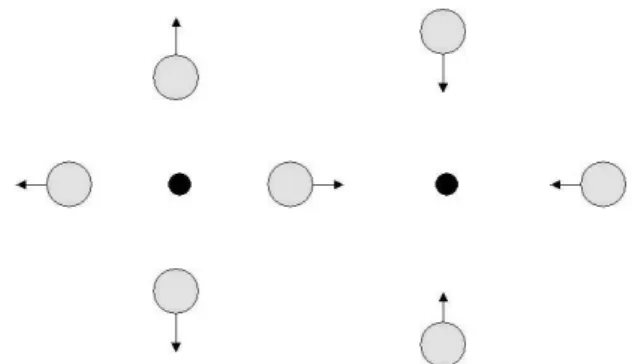
Atoms or molecules in different oxidation states are com-pletely different chemical species that are stable in differ-ent environmdiffer-ents. In the case of superconductivity we are concerned with transfer of two electrons from one site to another, in a delocalised fashion. The vibrational motion connected to this distortion is illustrated in Fig. 1. If the dis-tortion of the nuclear sites is large there will be an activation barrier, destructive for superconductivity. A small distortion on the other hand leads to a coupling between electron and nuclear motion, promoting superconductivity. Potential en-ergy surfaces are seen in Figs. 2 and 3. The reorganization energyλis a measure of the distortion which may be calcu-lated as follows:
⌋
λ=X
i
1 2kiδd
2
i ≈
(
15P
M Lbondsδd
2
i (eV) (metal complexes)
24P
CCbondsδd
2
i (eV) (organic π−systems)
(2)
⌈
δdi ( ˚A) is the change in the i’th bond length. The summa-tion extends over all bonds in donor and acceptor, but the important ones will be metal-ligand (ML) bonds in metal complexes and carbon-carbon (CC) bonds in organic π -systems. Approximate values are given in the two cases, where ‘normal’ bond strength applies. For example if two bonds change by 0.1 ˚A in a metal complex, the reorgani-zation energyλ ∼ 0.3eV. In other cases described below the changes may be considerably larger, say 0.2 ˚A in twelve bonds, six on each site. We then obtainλ ∼7.2eV. Since the activation energy isλ/4[6] we obtain barriers of<0.1 and 1.8 eV in the two cases, leading to very different be-haviour. In the case of organic π-systems we usually ob-tain λ < 0.4 eV. When interactions between the sites are ’switched on’ the potential energy surface (PES) intersec-tions become avoided crossings (Figs.2,3). In the MV-2 case where the valence state changes by one unit [6], the activa-tion barrierEadecreases fromλ/4if|∆|is increased from zero, and vanishes forλ=|∆|:
Ea= ( λ−|∆|)2
4λ , if |∆|< λ (3) In the MV-3 case the situation is more complicated. The coupling between the two-electron PES’s is very small and this necessitates the SDW PES to intersect (Fig.3) the CDW diabatic states [3]. When the barrier vanishes the valen-cies are delocalized and the character of the visible spec-trum tends to change to black. It should be noted that mixed valence theory is completely consistent with the ordinary quantum mechanical approach used in chemistry (’quantum chemistry’). Bond length changes and reorganization
en-ergy may be calculated in principle. The PES given in Figs. 1 and 2 are Born-Oppenheimer PES. There are no pairing forces other than those normally included in the electronic Hamiltonian. The connection to the BCS model [19] may be realized if a k-space expansion is performed.
Figure 1. Active vibrational modes for electron pair transfer.
3
Electron pairing in real space
Figure 2. Potential energy curves in the MV-2 case. λis the reor-ganization energy. The left parabola corresponds to the oxidation states v and v+1 on the two sites and the right parabola to oxidation states v+1 and v.
Figure 3. Potential energy curves in the MV-3 case.λ1andλ2are
reorganization energies for transfer of one or two electrons, respec-tively. v is the valence state of the comproportionated state and v-1 and v+1 of the disproportionated state. The latter state is assumed to be lower in energy in the figure (negative-U state).
electrons can change without a great change of structure. Alsons2ornp2pairs of electrons have been implicated. In
planarM gB2bothσandπelectrons are involved [20].
Be-low we will choose examples from three major groups of exotic superconductors and find that the same MV-3 theory may be applied.
3.1
6
s
2electron pairs in bismuthates
A typical example is BaBiO3. This system becomes
su-perconducting if doped, as BaP bxBi1−xO3 (x ∼ 0.3)
[21] andBa1−xKxBiO3 (x ∼ 0.4)[22]. The Bi sites in
BaBiO3are alternatingBi3+ andBi5+, i e with the sites
occupied by a6s2 pair or unoccupied, respectively. Since
the 6s orbital has a quite large extension the BiO distance has to be larger in theBi3+case than in theBi5+case. The enlargement region is roughly where the 6s orbital is local-ized. This CDW system needs to interact with a SDW state with single electron occupancy, i e Bi4+ sites [3].
Dop-ing leads to decreased differences in bond length [23] and this makes superconductivity possible [3]. There is general agreement that superconductivity in BaP bxBi1−xO3 and
Ba1−xKxBiO3can be explained as indicated above
[2,3,9-11]. The absence of superconductivity in the CDW case Cs2SbCl6 [24] is also easily explained as due to too large
activation energy, which in its turn depends on great differ-ence in bond lengths between theSb3+andSb5+sites.
3.2
3
d
2hole pairs in cuprates
Cu, Ag, and Au are often stable in two or three oxidation states. In square planar geometry the ground states forCu2+
andCu3+ correspond to one or two missing electrons,
re-spectively, in the antibonding molecular orbital (MO) with
3d(x2 −y2) character. The Jahn-Teller theorem implies
smaller CuO distances in the xy-plane with slightly longer bond length for Cu2+ than for Cu3+. Consistency with
theory would require that Cu+ can exist at a near
octa-hedral geometry with not too different bond lengths, mak-ing the CDW state reasonably stable. The one electron per site case, corresponding to Cu2+, is antiferromagnetic in
La2−xBaxCuO4(x= 0)andY Ba2Cu3O7−x(x= 0.5), but for somewhat larger average oxidation state than +2 both systems become superconducting [25,26]. This suggests, in the same way as for bismuthates, that the energy difference between the SDW and CDW states depends on doping and (hypothetically) tends to zero in certain doping ranges. In most Cu2+ systems the SDW state (or paramagnetic spin
states) are more stable than the disproportionated state for Cu2+ oxides and halides. In the cuprates it seems
reason-able that theCuO2 layer has its oxidation level fine tuned
from the intervening layer, which thus regulates also the rel-ative energies of the CDW and SDW states. In the case of silver and gold, the disproportionated mixed valence state tends to be more stable. Still, however,AgF2has a stable
phase at low temperature calledα−AgF2. It has a
typi-cal Jahn-Teller distortion with four short bonds (2.07 ) and two long bonds (2.58 ). Contrary to the case inCuF2 the
structure is a puckered sheet. The spin structure is compli-cated [27]. β−AgF2is stable at a higher temperature and
has mixed valence with a CDW ground state [28]. The two phases have very different structures. There is a phase tran-sition at elevated temperatures. Since the energies of the SDW and CDW states are not the same at low temperature and the geometries very different, superconductivity cannot occur. In the layered compounds CsAuX3 or Cs2AuX4
semiconductors (at low pressure) with large activation en-ergy [30,31]. The conductivity is increased by several orders of magnitude at high pressures of a few GPa [30-33], but su-perconductivity has not been reported. High pressure leads to decreased activation barrier (see below) and at the same time to an insulator to metal transition, of obvious relevance also to superconductivity [3,16]. Well’s salt,CsAuCl3, is
probably the first and best-known example of disproportion-ation in gold compounds [29-33]. At normal pressure the distances of the xy-plane are 0.4 smaller in Au(III)-Cl than corresponding distances for Au(I)-Cl. Along the z-axis only Au(I) forms a bond to Cl−. The distances are 2.31 for Au(I)-Cl and 3.13 for Au(III)-Cl [29]. In CsAuCl3 the
activation barrier for direct electron pair transfer (EPT) is hence very large. Pressure forces the geometric differences between different oxidation states to become smaller which means that the parabolas in Fig. 3 come closer to each other and hence that the activation barrier becomes smaller. The increase of ∆ as the distance between the metal atoms is decreased is of less importance in this ase. Since AAuX3
andA2AuX4(A=alkali atom) compounds are iso-structural
with BaBiO3 [33], superconductivity might be expected.
An important difference to the bismuthates is the larger dis-tance differences and that there does not seem to be any doped Au compound, which would provide a greater pos-sibility for superconductivity. The doping could be with P t2+ ions, which are also d8 systems with low spin, but
this has probably never been tried. Since Jahn-Teller ef-fects act differently on different oxidation states, only sys-tems where they ’cooperate’ can be superconducting. In the planar cuprate case the hole state is always in the CuO2
-plane forCu2+andCu3+. Essentially only four bonds are
changed and no bond angles, and henceλis quite small.
3.3
t
21u
electron pairs in fullerides
In fullerenes the interactions between the atoms of the same site (disregarding the alkali ions) are covalent while the in-teractions between the sites are very small. The band-width, corresponding to interaction between the lowest unoccupied molecular orbital (LUMO) on different sites is in the range 0.1 - 0.2 eV [34]. Hence a localized model should be par-ticularly favourable in this case as a zero-order approxima-tion. The fullerenes themselves usually Jahn-Teller distort to a non-degenerate ground state and hence they are not su-perconducting, in accordance with the model [3]. There is general agreement that alkali atoms donate their electrons to the fullerene molecules in, for example, superconducting K3C60 (Tc ∼ 30K)[35] and insulatingK4C60 [36]. In
C60the donated electrons enter a three-fold degenerate MO
of symmetryt1u. This MO is thus half filled inK3C60and
2/3 filled in K4C60. According to the elementary Hund’s
rule, high spin would be expected to prevail, but it does not. Both K3C60 andK4C60 are without magnetic moment at
a low temperature [37]. Since the C603− molecule ion by
itself in any case must have a magnetic moment, K3C60
would be expected to be ferro- or antiferro-magnetic, but
is a metal, superconducting below about∼30 K. Band the-ory, of course, predicts metals in both cases, since the Fermi level is in the valence band. To explain thatK4C60 is not
a metal one has resorted to the Mott theory for metal - in-sulator transitions [38]. Han and Gunnarsson point out that the Mott electron repulsion parameter U is about the same inK3C60 andK4C60[37], so why is notK3C60 an
insu-lator? They argued that Jahn-Teller effects are stronger in low-spin than in high spin, concluding that low spin should be favoured in both cases. They give no particularly clear-cut explanation for the metal - insulator problem [37]. A rather extensive study of reorganization energy and Jahn-Teller effect has been carried out for the fullerenes [39]. It was found that the Jahn-Teller effects are usually small and supporting low spin. This agrees with the conclusion in ref.[37] although it appears less likely that these small corrections can explain the large difference in localization properties betweenK3C60andK4C60. It is also probable
that the Jahn-Teller effects are too small to explain even the low spin problem. In fact Han and Gunnarsson [37] have neglected electron correlation which in this case completely off-sets Hund’s rule [40]. Correlation effects are thus the most important reason why low spin prevails.
It still remains to explain why the spin ofK3C60is
ex-actly zero (at a low temperature) and why it is a supercon-ducting metal whileK4C60is an insulator. This explanation
is simple and was suggested more than ten years ago [40], but apparently this has passed unnoticed. (In fact MV the-ories seem to be virtually unknown in the physics commu-nity!) In the case ofK3C60the disproportionation reaction
is:
2C603−→C602−+C604− (4)
C602− and C604− should be low spin for the reasons stated above [40], also consistent with experimental data [41]. This makes it very likely thatC602− andC604− also exist (proba-bly delocalised) inK3C60and that disproportionation is the
explanation whyK3C60 is without magnetic moment and
superconducting. In this case the geometric differences be-tweenC602−,C603−, andC604−are small and lead to small
re-organization energies of less than 0.1 eV [39]. The coupling for this reason can be allowed to be quite small to achieve a delocalising interaction between CDW, SDW and vibra-tional zero point motions. It is this interaction that implies that the whole system is without moments. Accurate cal-culations can be done in principle to calculate coupling and reorganization energy. It should be mentioned that also the alkali ions are likely to leave a contribution to the reorga-nization energy. This part can also be calculated, although it is difficult. It is certain that the positional variation, de-pending on the charges of the surroundingC60molecules,
is greater for the smaller alkali ions. Hence the contribution to the reorganization energy is much larger for the smaller alkali ions. This may partly explain whyN a3C60 is not
superconducting [41,42]. This explanation is supported by the fact that N a3C60 appears to be phase separated into
N a2C60andN a6C60[41]. However, there are many other
fullerides and superconductivity. We refer to a recent pa-per by Margadonna and Prassides [43]. Ifλis quite large compared to ∆, then, at a high temperature the electrons would not be delocalised by the ordinary mechanism. Here again accurate calculations are necessary. ProbablyK3C60
is delocalised on account of the disproportionation mecha-nism eq.(2), whileK4C60 (andN a2C60 [42,44]) remains
a semiconductor. The latter mechanism also explains why K3C60is a superconductor. To use Mott theory to explain
thatA3C60is a metal is doubtful in the mind of the present
author, and superconductivity does not follow as a corollary of course. Why are other fullerides not superconducting? The answer is probably that the doping has to be done in such a way that the cubic (or possibly tetragonal) structure is maintained. At the same time the number of added elec-trons in LUMO (or possibly subtracted in HOMO) should allow a degeneracy to remain to permit formation of CDW and SDW states. These are severe conditions but there seem to be no compelling reasons why other doped fullerenes than those containingK3C60cannot be superconductors.
4
Conclusions
We have discussed a theory for superconductivity [2,3] on local concepts used in chemistry, emanating from mixed va-lence theory [4-11]. As a result we can rather well under-stand why superconductivity appears in some systems but not in others. Since the theoretical treatment starts from a local treatment, it has been possible to use total energy po-tential surfaces. Non-observables or irrelevant observables (‘Mott-Hubbard U’) were avoided in the definition of a rea-sonable delocalisation concept [16]. The concepts used are standard in modern theoretical chemistry but are surpris-ingly neglected among theoretical solid-state physicists. In fact it is somewhat disturbing that many words and mean-ings are different in the two sub-fields. Take for example ‘Mott-Hubbard U’, either defined as I-A or as a Coulomb repulsion. In empty space, the energy of the disproportion-ation reaction of eq.(1) is equal to U, which mathematically is always positive. The disproportionated state is thus pre-dicted as energetically forbidden, in obvious disagreement with experiments. In the condensed phase U cannot be taken from experiments. The Coulomb repulsion is used in a num-ber of other contexts, for example explaining why the Mott insulators are non-conducting. This U is also positive and large, and this is contradictory to the celebrated ‘negative U’ scenario for superconductivity. As a result a lot of theoret-ical effort has gone into explaining reduction of U by some means, for example by electron correlation effects. Cuprates and other highTcsystems are therefore said to be ’strongly correlated’ in spite of the fact that electron correlation ef-fects are not especially large in these systems.
In superconductivity electron pairs move without activa-tion energy. A ground state must be formed in which pairs of electrons move without resistance. This is only possible if the SDW and CDW are both involved and interact via the
vibrational motions. The final ground state vibronic wave function is delocalized and has an energy gap to the first excited state. Other possible ground states are the mixed valent CDW state with quite normal vibrational spectra, or the mono-valent SDW state, also with a normal vibrational spectrum. Softening or disappearance of modes should char-acterize vibrational spectra of superconductors, as been dis-cussed for cuprates by Prassides [10].
Acknowledgement
This work was supported by VR, the Swedish Scientific Research Council.
References
[1] A.W. Sleight, Science 242, 1519 (1988); A.W Sleight in Chemistry of High-Temperature Superconductors, Eds.: D.L. Nelson, M.S. Witting-ham, T.F. George (American Chemi-cal Society), Washington, DC, 1987, pp. 2-12; A.W. Sleight, Acc. Chem. Research 28, 103 (1995).
[2] S. Larsson, Chem. Phys. Lett. 157, 403 (1989).
[3] S. Larsson, Chem. Phys. 236, 133 (1998); S. Larsson, Inorg. Chim. Acta 250, 189 (1996); S. Larsson and A. Klimkans, Int. J. Quant. Chem. 75, 543 (1999); A. Klimkans and S. Larsson, J. Mol. Structure (Theochem.) 527, 203 (2000); S. Larsson, Int. J. Quant. Chem. 90, 1457 (2002).
[4] M.B. Robin and P. Day, Adv. Inorg. Radiochem. 10, 361 (1967).
[5] N.S. Hush, Progr. Inorg. Chem. 8, 391 (1967); G.C. Allen and N.S. Hush, Progr. Inorg. Chem. 8, 357 (1967).
[6] R.A. Marcus, Adv. Phys. Chem. 15, 51 (1964).
[7] T. Holstein, Ann. Phys. 8, 343 (1959).
[8] “Mixed-Valence Compounds; Theory and Applications in Chemistry, Physics, Geology, and Biology” Proceedings of the NATO Advanced Study Institute held at Oxford, England, September 9-21, 1979, Editor David B. Brown (D. Reidel Publishing Company, Dordrecht, Boston, London).
[9] “Mixed Valency Systems: Applications in Chemistry, Physics and Biology” Proceedings of the NATO Advanced Workshop on Mixed Valency Compounds held at Aghia Pelaghia, Crete, Greece, June 10-16, 1990, Editor K. Pras-sides, NATO ASI Series, vol. 343 (D. Reidel Publishing Company, Dordrecht, Boston, London).
[10] K. Prasssides, page 201 in ref. 8.
[11] L.J. de Jongh, page 223 in ref. 8.
[12] S.B. Piepho, E.R. Krausz, and P.N. Schatz, J. Am. Chem. Soc. 100, 2996 (1978).
[13] K. Prassides, P.N. Schatz, K.Y. Wong, and P. Day, J. Phys. Chem. 90, 5588 (1986).
[14] N.S. Hush, Chem. Phys. 10, 361 (1975).
[15] N.S. Hush in ref.7, p.151-188
[17] P.S. Bagus and H.F. Schaefer III, J. Chem. Phys. 56, 224 (1972).
[18] C. Creutz, Progr. Inorg. Chem. 30, 1 (1983); and further ref-erences therein.
[19] J. Bardeen, L.N. Cooper, and J.R. Schrieffer, Phys. Rev. 108, 1175 (1957).
[20] S. Souma, Y. Machida, T. Sato, T. Takahashi, H. Matsui, S.-C. Wang, H. Ding, A. Kaminski, J.S.-C. Campuzano, S. Sasaki, and K. Kadowaki, Nature 423, 65 (2003).
[21] A.W. Sleight, J.L. Gillson, and P.E. Bierstedt, Solid State Commun. 17, 27 (1975).
[22] R.J. Cava, B. Batlogg, J.J. Krajewski, R. Farrow, L.W. Rupp, A.E. White, K. Short, W.F. Peck, and T. Kometani, Nature 332, 814 (1988).
[23] D.E. Cox and A.W. Sleight, Solid State Commun. 19, 969 (1976); B. Batlogg, R.J. Cava, L.F. Schneemeyer, and G.P. Espinosa, IBM Jour. Res. Develop. 33, 208 (1989).
[24] K. Prassides and P. Day, J. Chem. Soc. Faraday Trans. 2, 80, 85 (1984).
[25] J.G. Bednorz and K.A. M¨uller, Z. Phys B 64, 189 (1986).
[26] C.W. Chu, P.H. Hor, R.L. Meng, L. Gao, Z.J. Huang, and Y.Q. Wang, Phys. Rev. Lett. 58, 405 (1987); M.K. Wu, J.R. Ash-burn, P.H. Torng, P.H. Hor, R.L. Meng, L. Gao, Z.J. Huang, Y.Q. Wang, and C.W. Chu, Phys. Rev. Lett. 58, 908 (1987).
[27] W. Grochala and R. Hoffmann, Angew. Chem. 113, 2816 (2001); Angew. Chem. Int. Ed. 40, 2742 (2001).
[28] C. Shen, B. Zemva, G.M. Lucier, O. Graudejus, J.A. Allman, and N. Bartlett, Inorg. Chem. 38, 4570 (1999).
[29] N. Elliot and L. Pauling, J. Am. Chem. Soc. 60, 1846 (1938); J.C.M. Tindemans-v. Eijndhoven and G.C. Verschoor, Mater. Res. Bull. 9, 1667 (1974); A.F. Wells, Structural Inorganic Chemistry, third edition, page 374 (Clarendon Press, Oxford 1962).
[30] R. Keller, J. Fenner, and W.B. Holtzapfel, Mater. Res. Bull. 9, 1363 (1974).
[31] P. Day, C. Vettier, and G. Parisot, Inorg. Chem. 17, 2319 (1978).
[32] W. Denner, H. Schulz, and H. D’Amour, Acta Cryst. A35, 360 (1979).
[33] N. Kojima, H. Kitagawa, T. Ban, F. Amita and M. Nakahara, Solid State Commun. 73, 743 (1990); H. Kitagawa, H. Sato, N. Kojima, T. Kikegawa, and O. Shimomura, Solid State Commun. 78, 989 (1991); N. Kojima and H. Kitagawa, J. Chem. Soc. Dalton Trans. 1994, 327-331.
[34] W.L. Yang, V. Brouet, X.J. Zhou, H.J. Choi, S.G. Louie, M.L. Cohen, S.A. Kellar, P.V. Bogdanov, A. Lanzara, A. Goldoni, F. Parmigiani, Z. Hussain, and Z.-X. Shen, Science 300, 303 (2003).
[35] A.F. Hebard, M.J. Rosseinsky, R.C. Haddon, D.W. Murphy, S.H. Glarum, T.T.M. Palstra, A.P. Ramirez, and A.R. Kortan, Nature 350, 600 (1991).
[36] D.W. Murphy, M.J. Rosseinsky, R.M. Fleming, R. Tycko, A.P. Ramirez, R.C. Haddon, T. Siegrist, G. Dabbagh, J.C. Tully, and R.E. Wahlstedt, J. Phys. Chem. Solids 53, 1321 (1992).
[37] J.E. Han and O. Gunnarsson, Physica B 292, 196 (2000).
[38] N.H. Mott, Metal-Insulator Transitions (Taylor and Francis, 1990).
[39] G. Duskesas and S. Larsson, Theoret. Chim. Acta 97, 110 (1997).
[40] S. Larsson in Chemical Physics of Intercalation II, (Plenum Press, New York and London, 1993), Eds. P. Bernier, J.E. Fischer, S. Roth, and S.A. Solin, NATO ASI Series; Series B: Physics, Vol. 305, p. 227-231; S. Larsson and L. Rodr´ıguez-Monge, Int. J. Quant. Chem. Symp. 27, 655 (1993).
[41] A.P. Ramirez, Supercond. Rev. 1, 1 (1994); M.P. Gelfand, Su-percond. Rev. 1, 103 (1994), and further references therein.
[42] V. Brouet, H. Alloul, S. Garaj, and L. Forr ¨o, Phys. Rev. B 66, 155122 (2002).
[43] S. Margadonna and K. Prassides, J. Solid St. Chem. 168, 639 (2002).