Article
Printed in Brazil - ©2016 Sociedade Brasileira de Química0103 - 5053 $6.00+0.00*e-mail: [email protected]
Synthesis and Antifungal Activity Against
Candida
Strains of Mesoionic System
Derived From 1,3-Thyazolium-5-thiolate
Isabelle N. Peixoto,a Helivaldo D. S. Souza,a Bruno F. Lira,a Daniele F. Silva,b
Edeltrudes O. Lima,b José M. Barbosa-Filhob and Petrônio F. de Athayde-Filho*,a
aDepartamento de Química and bDepartamento de Ciências Farmacêuticas, Universidade Federal
da Paraíba, 58051-900 João Pessoa-PB, Brazil
A series of ten new compounds have been synthetized in satisfactory yields (85-95%) through the treatment of isopropyl mesoionic 1,3-thiazolium-5-thiolate with 2-chloro-N-arylacetamides and characterized by elemental analysis, infrared (IR), 1H and 13C nuclear magnetic resonance (NMR)
spectroscopies. The newly synthesized compounds were evaluated as new drug candidates in in silico study and for their antifungal activity against several strains of Candida albicans. In silico study indicates that no compound has potential to be a new drug while four compounds showed medium to strong activity with minimum inhibitory concentration (MIC) range of 256-1024 µg mL-1.
Keywords: isopropyl mesoionic derivatives, antifungal activity, in silico
Introduction
Mesoionic compounds have a special place in medicinal chemistry, as they present a wide range of biological activities such as analgesic, antimicrobial, anti-inflammatory, anticancer, antiplatelet, antihypertensive, trombolytic, trypanocidal and leishmanicidal activities.1-7
Such applications could be attributed to their peculiar chemical characteristics such as their betainic and planar characters, which allow strong interactions with biomolecules, their relatively small size, and the separation of the electron density (positive in the ring and negative in the exocyclic side chain), giving them amphiphilic properties.8
Among all those applications, the antimicrobial activity has been highlighted in the last decades especially due to the development of resistant fungus strains associated with drugs that are no longer effective. Because of this, nowadays, an increase in research for new antimicrobial agents is observed, in an attempt to control the significant increase of fungus infection in recent years, which has resulted in morbidity and mortality.9,10
In the present study, the potential of mesoionic derivatives of 1,3-thiazolium-5-thiolate system (specifically 2-(p-chlorophenyl)-3-methyl-4-(p
-isopropylphenyl)-1,3-thiazolium-5-(N-arylacetamide)thio chloridrates) 7a-j
against five strains of Candida albicans was evaluated, as
well as their theoretical potential as new drug candidates through in silico studies evaluating Lipinski’s rule of
five, topological surface area (TPSA), solubility (log S), adsorption percentage (%ABS), drug likeness and drug score.
Experimental
Chemistry
All used reagents and solvents were purchased from Sigma-Aldrich, and used without further purification. The purification of compounds mesoionic isopropyl 1,3-thiazolium-5-thiolate 5 and 2-chloro-N-arylacetamides
6a-j were performed by re-crystallization in ethanol and water (1:1). The structures of the new compounds 7a-j were confirmed by elemental analysis on an Carlo Erba EA1110 elemental analyzer; infrared spectra (IR) on a Shimadzu IRPrestige-21 FTIR spectrometer (using KBr pellets);
1H and 13C nuclear magnetic resonance (NMR) spectra
obtained on a Varian Mercury 200 MHz; and melting range on an MQAPF-3 hotplate. Deuterated chloroform (CDCl3)
was used as the solvent and tetramethylsilane (TMS) was used for the internal standard. Chemical shifts (d) were measured in parts per million (ppm), and the coupling
Intermediate compounds - synthetic procedures
All intermediate compounds 2-6, although not unprecedented, were isolated and characterized (Supplementary Information). Their synthetic procedures are described as follows:
N-Methyl-C-p-isopropylphenylglycine 211
Potassium cyanide (16.5 g, 250 mmol) and methylammonium chloride (16.87 g, 250 mmol) were dissolved in 100 mL of distilled water and left under vigorous stirring until complete dissolution. Then,
p-isopropylbenzaldehyde (37 g, 250 mmol), previously
dissolved in 100 mL of methanol, was slowly added into the aqueous solution. After 2 h, 250 mL of water and toluene were added in the mixture. The organic phase was washed with distilled water and extracted with 6 mol L-1 HCl
(3 × 100 mL). The combined acid extract was refluxed for 8 h giving the desired product (white crystals on cooling).
N-p-Chlorobenzoyl-N-methyl-C-p-isopropylphenylglycine
311
N-Methyl-C-p-isopropylphenylglycine 2 (2.0 g, 9.66 mmol) was dissolved in 50 mL of 10% NaOH aqueous solution and left under vigorous stirring for 2 h. Still under stirring, p-chlorobenzoyl chloride (2.01 g, 9.66 mmol)
was dropwise added and the system was left stirring for another 2 h. Then, the reaction mixture was neutralized with 10% HCl aqueous solution and extracted with chloroform (3 × 300 mL). The organic phase was concentrated under reduced pressure giving a sticky white mass.
Mesoionic 2-(p-chlorophenyl)-3-methyl-4-(p -isopropyl-phenyl)-1,3-thiazolium-5-thiolate 511
N-p-Chlorobenzoyl-N-methyl-C-p
-isopropylphenyl-glycine 3 (0.5 g, 1.4 mmol) was dissolved in 5.0 mL of acetic anhydride and heated, with stirring, at 55 °C for 1 h. After this time, 10 mL of carbon disulfide were added and heated at the same temperature for another hour. At this point, the reaction mixture had a reddish color characteristic of mesoionic compounds. The system was left under light protection for 48 h and then was concentrated at reduced pressure to remove the excess of carbon disulfide. A solution of 10% NaOH aqueous solution was added until the precipitation of the mesoionic (red solid), which was recrystallized in a mixture of ethanol/water, giving orange-red crystals.
2-Chloro-N-arylacetamides 6a-j - general procedure12
In an ice bath, substituted aniline (20 mmol) was dissolved along with triethylamine (24 mmol) in 20 mL of
dichloromethane (DCM) at 0 °C, and then 2-chloroacetyl chloride (24 mmol) was slowly added. The ice bath was removed and the reaction was kept stirring for 20 h at room temperature. After this time, the reaction mixture was concentrated at reduced pressure, the residue was washed with cold water (3 × 20 mL) and the precipitate was filtered. The product was recrystallized with ethanol/water.
General procedure for the preparation of ten newly synthetized compounds - 2-(p -chlorophenyl)-3-methyl-4-(p-isopropylphenyl)-1,3-thiazolium-5-(N-arylacetamide)thio chloridrates 7a-j
Mesoionic 2-(p-chlorophenyl)-3-methyl-4-(p
-isopropylphenyl)-1,3-thiazolium-5-thiolate 5 (278 mmol) was dissolved in hot ethanol and then 2-chloro-N
-arylacetamides 6a-j (278 mmol) were added. The system was refluxed for 4 h and then concentrated at reduced pressure, giving a yellow-orange solid.
Antifungal activity
Microorganism
The microbiological assays used five strains of Candida
albicans (American Type Culture Collection (ATCC)
76645, ATCC 76485, LM 178, LM 615 and LM 37) acquired from Instituto Adolfo Lutz, São Paulo-SP, and Laboratórios de Micologia e Microbiologia, Departamento de Ciências Farmacêuticas, Universidade Federal da Paraíba, João Pessoa-PB, Brazil. The fungal strains were maintained in appropriate medium, Sabouraud dextrose agar (SDA) (Difco Laboratories), and stored at 4 and 35 °C. The suspension of microorganisms was prepared according to the 0.5 McFarland scale tube, and adjusted by means of spectrophotometry (Leitz-Photometer 340-800) to 90% transmittance (530 nm) corresponding to approximately 106 colony forming unit (CFU) mL-1.13-15
Culture medium
The maintenance of strains and antifungal activity assays were performed in SDA and Roswell Park Memorial Institute (RPMI) 1640 broth (Acumedia), which were prepared and used according to the manufacturer’s instructions.
dispensed into the wells of the first line of the plate. By means of serial dilution at a ratio of two, we obtained concentrations from 1024 to 8 µg mL-1, so that in the first
row of the plate was the highest concentration, and in the last, the lowest concentration. Finally, 10 µL of inoculum were added to the wells where each column of the plate referred specifically to a strain. The same was also done in the culture medium with fungal drug fluconazole (100 µg mL-1) as a comparative measure with those obtained
by the tested substances. The plates were sealed and incubated at 35 °C for 24-72 h. For each strain, the MIC was defined as the lowest concentration able to inhibit fungal growth visually observed in the wells, when compared to the control. All tests were performed in triplicate, and the results were expressed as the geometric mean of the MIC values obtained in the three trials.16,17
Results and Discussion
Chemistry
The synthesis of the new mesoionic derivatives from the 1,3-thiazolium-5-thiolates systems 7a-j was carried out in five synthetic stages, which are outlined in Scheme 1.
The first step was to synthesize the mesoionic 2-(p-chlorophenyl)-3-methyl-4-(p
-isopropylphenyl)-1,3-thiazolium-5-thiolate 5 following a well-known route of four stages:11 first, N-methyl-C-p-isopropylphenylglycine 2 was
obtained via Strecker reaction of p-isopropylbenzaldehyde
1 with potassium cyanide and methylammonium chloride, followed by its aroylation to give N-p-chlorobenzoyl-N
-methyl-C-p-isopropylphenylglycine 3. Then, the free base mesoionic compounds were obtained via cycledehydration by acetic anhydride (4), cycloaddition and 1,3-dipolar cycloreversion induced by CS2 with CO2 elimination (5).
Then, substituted acetamides 6 were synthesized via conversion of various amines with 2-chloroacetyl chlorides in basic medium and dichloromethane as solvent.12 The last
step was the mesoionic 5 conversion in its respective salt 7 by treatment with the synthesized substituted acetamides. The ten novel synthesized compounds 7a-j contained varied electron-donating and electron-withdrawing groups linked to the aromatic ring (p or m-position) at the
acetamide portion (Scheme 1).
Characterization of the final product
The structures of the compounds were fully characterized and confirmed by using various spectral techniques (IR,
1H NMR, 13C NMR-attached proton test (APT)).
The 13C NMR-APT spectra for all derivatives 7a-j
presented 20 signals when R2 = H (7a-h) and 22 signals
Scheme 1. Synthetic route for the synthesis of new mesoionic derivatives 7a-j. Reagents and conditions: (a) (i) KCN, CH3NH3+Cl–, stirring (2 h), (ii) HCl
(6 mol L-1), reflux (6 h); (b) p-chlorobenzoyl chloride, NaOH (10%), stirring (24 h); (c) CS
when R2 ≠ H (7i,j). Those signals were attributed as
follows: four signals in aliphatic region, three downward and one upward as two of trihydrogenated carbons (C-10, C-16 and C-16’), two sp3, one mono hydrogenated (C-15)
and another bihydrogenated (C-17). In 7c and 7g, two more signals appeared in this region due to ethyl and isopropyl radicals, respectively, whereas in 7d and 7h one more signal was identified due to methyl and methoxy radicals, respectively. Twelve signals in aromatic region for those with R2 = H (7a-h) - seven monohydrogenated
and five non-hydrogenated aromatic sp2 for 7a and six
monohydrogenated and six non-hydrogenated aromatic sp2 for 7b-h - appeared as well. Fourteen signals in
aromatic region for those with R2 ≠ H (7i,j) - seven
monohydrogenated and seven non-hydrogenated aromatic sp2 - were also found. Still in the aromatic region four
upward signals appear: one signal characteristic of C=O amide group (C-18) and three signals of the mesoionic ring (C-2, C-4 and C-5).
Despite the challenge, the assignments of the mesoionic ring carbon atoms (C-2, C-4 and C-5), are of special importance to elucidate the mesoionic structure unequivocally and were determinated based on literature data.18,19 As 5 is a classical mesoionic compound, C-2, C-4
and C-5 present chemical shifts (d 152, 142 and 160 ppm, respectively) characteristic of a region influenced by a great charge distribution: a negative charge around C-4 and the sulfur side chain, leaves C-5 twice deshielded, while C-4, besides the intense negative charge due to the electron delocalization, presents lower chemical shift than the expected due to the shield caused by the electron-donating group attached to the benzene ring. Also, C-2 is highly deshielded due to the electron delocalization and the positive charge located in the lowest unoccupied molecular orbital (LUMO) region between electronegative elements as the nitrogen atom (N-3), sulfur (S-2) and the benzene ring, all attached to C-2.
When converting the mesoionic compound into its salts, the compound chemical structure changes: the side chain sulfur loses the resonance distributed in the highest occupied molecular orbital (HOMO) region, a double bond is formed between C-4 and C-5, and the negative charge and the electron delocalization between those two atoms no longer exist. This change results in a considerable shielding effect into C-5, decreasing the chemical shift to approximately d 131-137 ppm. A similar effect is observed in C-2, however, now, it is the opposite: a deshielding effect caused by a slightly higher amount of positive change density, resulting in an increase in chemical shift to approximately d 170 ppm. C-4 also suffers with this conversion: the side chain sulfur pushes a pair of electron
to the carbon chain, then this pair of electron enters into resonance with the benzene ring which results in a positive mesomeric effect (M+). With this, the side chain is polarized, C-4 becomes more deshielded and its chemical shift increases to the range of d 152-155 ppm.
The 1H NMR spectra presented in the aliphatic
region two intense singlets with d 1.19-1.27 ppm with integral for six hydrogens (H-16 and H-16’), one septet with d 2.22-2.97 ppm integrating for one hydrogen (H-15), both from the isopropyl group, two singlets with
d 3.60-3.95 ppm with integral for two and three hydrogens, respectively (H-17 and H-10). In 7c, due to R1 = CH2CH3, the CH3 and the CH, from the isopropyl group, appear as
a double doublet and a multiplet, respectively. In 7d, one more signal appears as a singlet around d 2.25 ppm due to the methyl group from the R2 = CH3. In 7g, the integrals
for the isopropyl group (H-15, H-16 and H-16’) are for twelve hydrogens for CH3 and two hydrogen for CH due
to R1 = CH(CH3)2. In 7h, one more signal appears around d 3.75 ppm with integral for three hydrogens from the methoxy group in R1. An expansion of spectrum in the
aromatic region and absorptions analysis of the free base mesoionic from the literature15 and from the 2-chloro-N-arylacetamides 6a-j were indispensable to elucidate all the aromatic hydrogens. For all compounds, a singlet around d 10.81-11.61 ppm with integral for one hydrogen concerning the amide hydrogen (H-19) is observed.
Although the IR spectra are not very helpful to elucidate mesoionic structures, they are helpful to identify the presence of groups that could be characteristic of these systems.
In the IR spectra of all mesoionic derivatives, it is possible to observe the total disappearance of the C–S– band
(around 1290 cm-1) in the mesoionic free base 5 and C Alif.–Cl
band (around 1200-1300 cm-1) in the substituted acetamides
6, which indicate the conversion of the mesoionic free base 5 in its respective salt 7.
In all compounds 7a-j, the presence of NH group was indicated by multiple bands in the 3427-3181 cm-1 region,
resulted from the free stretching and the out-of-plane NH wagging in the 800-700 cm-1 region. C=O absorption
appears around 1670 cm-1 due to aromatic group linked
to the amide portion. The presence of aromatic group was indicated by C–H stretching around 3170-3003 cm-1 along
with out-of-plane C–H bending around 1090-820 cm-1;
2999-2860 cm-1, aliphatic group by C–H stretching; 1612
and 1483 cm-1, C=C and C=N stretchings of aromatic and
mesoionic rings, respectively; and 1492-1408 cm-1, N–C
stretching of N–CH3.
The nitro-aromatic group in meta and para positions
stretchings, one around 1542 and 1513 cm-1, due to
asymmetric deformation, and another around 1351 and 1334 cm-1, due to symmetric deformation of the N=O
bond. The chlorine atom bonded in para position of
aromatic ring is indicated by the CAr.–Cl absorption around
1118-1053 cm-1 assigned to compounds 7f and 7j. Compound
7h, with the methoxy group bonded in para position of the
aromatic ring, presented two absorptions, characteristic of C–O–C symmetric and asymmetric wagging, one around 1250 cm-1 and the other in 1022 cm-1, respectively.
In silico study
Due to the easiness of oral drug administration, a good oral bioavailability is essential and frequently evaluated during the drug development process. Considering that this property can only be measured in vivo and, when
the data for human intestinal absorption show inaccurate estimation,20in silico prediction model is often used.
Lipinski et al.21 established a controversial rule for
drug design, known as “Lipinski’s rule” or “rule of five”, using membrane permeability and oral bioavailability as molecular properties associated with basis molecular descriptors, such as partition coefficient (log P), molecular weight (MW), and hydrogen bonding acceptor (HBA) and donor (HBD). For a compound to be orally bioavailable, it must obey at least three of four of the following criteria: log P ≤ 5, MW ≤ 500, HBA ≤ 10 and HBD ≤ 5.
Drug log S is another important factor that should be investigated since this affects the drug movement in the blood and can disturb the oral bioavailability.22
In this work, in silico study for Lipinski parameters
was carried out using the OSIRIS Property Explorer
software,23 MolSoft Molecules in Silico24 and ALOGPS 2.1
programs25,26 in order to verify the theoretical oral
bioavailability potential of mesoionic derivatives 7a-j. TPSA, %ABS, log S, drug likeness and drug score, representing the combined physicochemical, pharmacokinetic and pharmacodynamic effect, as well as lipophilicity, were also included. It is important to highlight that the absorption percentage was calculated using the expression %ABS = 109 – 0.345TPSA.27
According to the in silico results presented in Table 1,
only compounds 7a, 7b, 7h and 7i obey Lipinski’s rule of five and should present good oral bioavailability. Besides this, all compounds showed lower values than the threshold (140 Å2), which indicates good cellular
plasma membrane permeability, reflecting in a moderate (60-80%) absorption.
As most commercial drugs,28 all compounds presented
log S higher than –4.00, indicating good solubility and the positive drug likeness value indicates that the compounds tested contain common fragments such as those present in most used drugs. As the drug score combines lipophilicity, aqueous solubility, molecular weight, drug likeness and risk of toxicity, its values are often used to predict the potential of the tested compounds as new drugs and, since the mesoionic derivatives showed small values, it is suggested that they are not good candidates.
Antifungal activity
The in vitro antifungal activities of compounds
7a-j were evaluated by the microdilution method for five strains of pathogenic fungi: Candida albicans
ATCC 76645, ATCC 76485,LM 178, LM 615 andLM 37,
Table 1.In silico studies evaluating Lipinski’s rule of five, topological surface area (TPSA), solubility (log S), adsorption percentage (%ABS), drug
likeness and drug score of the compounds 7a-j
Compound Lipinski’s parameter log S TPSA / Å2 %ABS Drug likeness Drug score
HBA HBD MW milog P nViol
7a 3 1 528 4.75 1 –7.06 86.52 79.41 –0.47 –0.27
7b 5 1 573 4.71 1 –7.52 132.30 63.35 –14.00 0.18
7c 3 1 556 5.67 2 –7.56 86.52 79.41 0.96 0.22
7d 3 1 542 5.20 2 –7.41 86.52 79.41 –0.22 0.25
7e 3 1 606 5.56 2 –7.90 86.52 79.41 –0.79 0.11
7f 3 1 562 5.43 2 –7.80 86.52 79.41 1.62 0.29
7g 3 1 570 6.26 2 –7.93 86.52 79.41 1.08 0.25
7h 4 1 558 4.81 1 –7.08 95.75 75.97 0.02 0.27
7i 5 1 591 4.80 1 –7.84 132.30 63.35 –10.20 0.17
7j 5 1 607 5.32 2 –8.26 132.30 63.35 –7.60 0.16
and using fluconazole as the drug standard (Table 2). The compounds were tested at concentrations from 8 to 1024 µg mL-1, and solubilized in dimethylsulfoxide
(DMSO, Merck) to 2%, to avoid interferences with the microorganisms. The antifungal activity of the products was interpreted, and considered active or not, according to the following parameters: 50-500 µg mL-1 = good
activity; 600-1500 µg mL-1 = moderate activity; greater than
1500 µg mL-1 = low activity or inactive product.
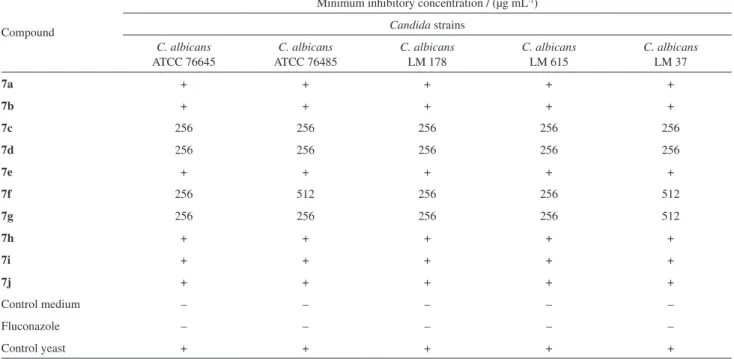
Among the ten compounds tested, only compounds 7c, 7d, 7f and 7g showed inhibitory effect against the growth
of Candida albicans in the bioassays. These compounds,
at concentrations of 1024, 512 and 256 µg mL-1, produced
inhibition in a proportion of 63 to 100%. The results, therefore, were considered between good to moderate in terms of biological activity, taking into account the parameters established.29 The results show that the
compounds 7c, 7d, 7f and 7g may be considered promising for possible development of new antifungal agents.
The results presented in Table 2 show that mesoionic derivatives with electron-donating groups at the acetamide portion (7c, 7d, 7f and 7g) were active against
Candida albicans, suggesting that the introduction of
these types of groups could have a great influence in the antimicrobial activity. Compounds 7f and 7g showed lower activity than 7c and 7d for, respectively, two types (ATCC 76485 and LM 37) and one (LM 37) of
Candida albicans strains.
Conclusions
In this work, ten derived mesoionics were synthesized from 1,3-thiazole-5-thiolate systems and their structures confirmed by IR, 1H and 13C NMR spectroscopic techniques.
The in silico investigation presented different results: four
compounds (7a, 7b, 7h and 7i) obeyed Lipinski’s rule, i.e., should present good oral bioavailability; all compounds 7a-j should present a good solubility (log S > 4.00) while the drug score, that combines different parameters to indicate the potential as new drug, suggested that no compound tested is a good candidate.
Confirming one result of the in silico study and
disagreeing with another, the in vitro activity showed
good to moderate activity of compounds 7c, 7d, 7f and 7g against Candida albicans strains, producing inhibition in a
proportion of 63 to 100% with MIC of 256-1024 µg mL-1.
It is interesting to highlight the differences between the two investigations: while the in silico study indicated that
mesoionic derivatives with electron-withdrawing groups could be good new drugs, the in vitro study was positive
for mesoionic derivatives with electron-donating groups. This discrepancy is probably not caused by the lipophilic/ hidrophobic character of the p-substituents in the acetamide
portion, but due to the influence of these substituents in the mesoionic ring. To prove this theory and to better understand the relationship between the physicochemical properties and the biological activity observed in the Table 2. Minimum inhibitory concentration (MIC) of mesoionics derived from 1,3-thiazole-5-thiolate systems 7a-j against strains of Candida albicans
Compound
Minimum inhibitory concentration / (µg mL-1)
Candida strains C. albicans
ATCC 76645
C. albicans
ATCC 76485
C. albicans
LM 178
C. albicans
LM 615
C. albicans
LM 37
7a + + + + +
7b + + + + +
7c 256 256 256 256 256
7d 256 256 256 256 256
7e + + + + +
7f 256 512 256 256 512
7g 256 256 256 256 512
7h + + + + +
7i + + + + +
7j + + + + +
Control medium – – – – –
Fluconazole – – – – –
Control yeast + + + + +
in vitro study, a structure-activity relationship study is
under development.
Supplementary Information
Supplementary data are available free of charge at http://jbcs.sbq.org.br as PDF file.
Acknowledgments
This work was supported by the following Brazilian agencies: CNPq and CAPES.
References
1. Senff-Ribeiro, A.; Enchevarria, A.; Silva, E. F.; Franco, C. R. C.; Veiga, S. S.; Oliveira, M. B. M.; Br. J. Cancer2004, 91, 297. 2. Rodrigues, F. R.; Silva, E. F.; Enchevarria, A.; Fajardo-Bonin,
R.; Amaral, V. F.; Leon, L. L.; Canto-Cavalheiro, M. M.; Eur. J. Med. Chem.2007, 47, 1039.
3. Rodrigues, R. F.; Castro-Pinto, D.; Enchevarria, A.; Reis, C. M.; Del Cistia, C. N.; Sant’Anna, C. M. R.; Teixeira, F.; Castro, H.; Canto-Cavalheiro, M.; Leon, L. L.; Tomás, A.; Bioorg. Med. Chem.2012, 20, 1760.
4. Cavalcante, K. L. M.; Correia, N. A.; Dias, K. L. G.; Silva, D. F.; Silva-Filho, J. C.; Araújo, I. G. A.; Lira, B. F.; Athayde-Filho, P. F.; Medeiros, I. A.; J. Pharmacol. Sci.2009, 110, 29. 5. Rehse, K.; Ciborski, T.; Müller, B.; Arch. Pharm.1995, 328,
125.
6. Kier, L. B.; Roche, E. B.; J. Pharm. Sci.1967, 56, 149.
7. Oliveira, C. S.; Falcão-Silva, V. S.; Siqueira-Júnior, J. P.; Harding, D. P.; Lira, B. F.; Lorenzo, J. G. F.; Barbosa-Filho, J. M.; Athayde-Filho, P. F.; Molecules2011, 16, 2023. 8. Athayde-Filho, P. F.; Simas, A. M.; Miller, J.; Synthesis2000,
11, 1565.
9. Scotti, L.; Scotti, M. T.; Lima, E. O.; Silva, M. S.; Lima, M. C. A.; Pitta, I. R.; Moura, R. O.; Oliveira, J. G. B.; Cruz, R. M. D.; Mendonça Jr., F. J. B.; Molecules2012, 17, 2298.
10. Simoens, S.; Pharmaceuticals 2010, 3, 1348.
11. Luis, J. S. A.; Aquino, T. M.; Athayde-Filho, P. F.; Scotti, M. T.; Scotti, L.; Moura, R. O.; Mendonça Jr., F. J. B.; Acta Pharm.
2014, 64, 233.
12. Ma, L.; Li, S.; Zheng, H.; Chen, J.; Lin, L.; Ye, X.; Chen, Z.; Xu, Q.; Chen, T.; Yang, J.; Qiu, N.; Wang, G.; Peng, A.; Ding, Y.; Wei, Y.; Chen, L.; Eur. J. Med. Chem.2011, 46, 2003.
13. National Committee for Clinical and Laboratory Standards (NCCLS); PerfomanceStandards for Antimicrobial Disk Susceptibility Tests, 7th ed.; NCCLS: Villanova, 2000. 14. Hadacek, F.; Greger, H.; Phytochem. Anal. 2000, 11, 137.
15. Cleeland, R.; Squires, E. In Evaluation of New Antimicrobials In Vitro and in Experimental Animal Infections; Lorian, V., ed.;
Antibiotics in Laboratory Medicine, Lippincott Williams & Wilkins: Baltimore, 1991, p. 739.
16. Eloff, J. N.; Planta Med.1978, 64, 711.
17. Souza, E. L.; Stamford, T. L. M.; Lima, E. O.; Trajano, V. N.;
Food Control2007, 18, 409.
18. Lira, B. F.; Miller, J.; Simas, A. M.; Athayde-Filho, P. A.; Dias, A. F.; Silva, R. O.; Oliveira, V. C.; ARKIVOC2004, vi, 12.
19. Athayde-Filho, P. F.; Miller, J.; Simas, A. M.; Lira, B. F.; Luis, J. A. S.; Zuckerman-Schpector, J.; Synthesis2003, 5, 685.
20. Zhu, J.; Wang, J.; Yu, H.; Li, Y.; Hou, T.; Comb. Chem. High Throughput Screening2011, 14, 362.
21. Lipinski, C. A.; Lombardo, F.; Dominy, B. W.; Feeney, P. J.;
Adv. Drug Delivery Rev.1997, 23, 3.
22. Rajanarendar, E.; Rama Krishna, S.; Nagaraju, D.; Govardhan Reddy, K.; Kishore, B.; Reddy, Y. N.; Bioorg. Med. Chem. Lett.
2015, 25, 1630.
23. Organic Chemistry Portal, OSIRIS Property Explorer, http:// www.organic-chemistry.org/prog/peo/ accessed in February 2016.
24. MolSoft Molecules in Silico, http://molsoft.com/mprop/ accessed in February 2016.
25. Tetko, I. V.; Gasteiger, J.; Todeschini, R.; Mauri, A.; Livingstone, D.; Ertl, P.; Palyulin, V. A.; Radchenko, E. V.; Zefirov, N. S.; Makarenko, A. S.; Tanchuk, V. Y.; Prokopenko, V. V.; J. Comput.-Aided Mol. Des.2005, 19, 453.
26. Virtual Computational Chemistry Laboratory (VCCLAB), ALOGPS 2.1, http://www.vcclab.org/lab/alogps/ accessed in February 2016.
27. Oliveira, C. S.; Lira, B. F.; Falcão-Silva, V. S.; Siqueira-Junior, J. P.; Barbosa-Filho, J. M.; Athayde-Filho, P. F.; Molecules2012,
17, 5095.
28. Schlecker, R.; Thieme, P. C.; Tetrahedron1988, 44, 3289. 29. Holetz, F. B.; Howes, M. J.; Lee, C. C.; Steventon, G.; Mem.
Inst. Oswaldo Cruz2002, 97, 1027.