Complex Oscillations in an Electrically
Stimulated Membrane Model
E.J. Delgado
a*, and A.F. Münster
ba
Department of Physical Chemistry, Facultad de Ciencias Químicas,
Casilla 160-C, Universidad de Concepción - Concepción, Chile b
Institut für Physikalishe Chemie, Universität Würzburg, Marcusstrasse 9-11,
97070 Würzburg, Germany
Este artigo investiga, teoricamente, a dinâmica de um modelo de membrana sob estimulação elétrica externa. Este sistema mostra vários tipos de respostas oscilatórias no potencial da membrana, quando uma corrente sinoidal AC é superposta à corrente DC aplicada através da membrana. À medida que a frequência da corrente AC varia, este comportamento varia de oscilações periódicas, P1, até oscilações do tipo explosivas, através de regiões de quase-periodicidade. As séries temporais que apresentam estes comportamentos são caracterizadas usando métodos de Teoria de Sistemas Dinâmicos, a saber: mapas de retorno, expoentes de Lyapunov, espectro de potências e dimensão de capacidade. Os resultados são discutidos em relação a membranas biológicas sob condições similares.
In this paper we theoretically investigate the dynamics of a membrane model under external electric stimulation. The system shows various types of oscillatory responses in the membrane potential when a sinusoidal AC electric current is superimposed on the DC current applied across the membrane. The behavior goes from periodic oscillations, P1, to bursting type oscillations via quasiperiodicity, when the frequency of the AC current is varied. The time series displaying these behaviors are characterized using the methods of Dynamical System Theory, namely, return map, Lyapunov exponents, power spectrum and capacity dimension. The results are discussed in relation to biological membranes under similar conditions.
Keywords: membrane oscillations, nonlinear phenomena, quasiperiodicity, bursting, sinusoidal stimulation
Introduction
The effect of periodic perturbations on the dynamics of oscillatory chemical system has been extensively studied both theoretically and experimentally in the last decade1-4,
mainly on the famous Belousov-Zhabotinskii reaction, the cerium ion catalyzed oxidation of malonic acid by bromate. This interest has been motivated mainly by the desire to understand excitability and signal transmission in biologi-cal systems, for example, the synaptic transmission in the central nervous system; the excitation and contraction of cardiac muscle5,6.
In the case of oscillations in artificial membranes the research has been also motivated by its implications in biological systems. A number of important biological phe-nomena are rhytmical and appear to result from the
oscil-latory interaction of a membrane with its environment, namely: sustained oscillations in neurons and pacemaker cells in the heart and secretory glands. Although the scale and the mechanisms of the processes in artificial mem-branes may not be close to those found in real biological systems, it is expected that they give fundamental informa-tion useful in elucidating the oscillainforma-tion processes at biomembranes in living organisms.
Periodic perturbations of membrane systems have not been studied nearly as much as chemical systems, however there is a fair amount of published work on the subject7-10.
The studies in this field have been focused on bifurcations, or transitions to complex oscillations and chaos that caused by the application of periodic or quasi-periodic stimulations to an excitable cell in a self-sustained state of periodic oscillatory behavior. In this paper, by using a broad pore
membrane model, we report complex dynamics (bursting and quasiperiodicity) in the membrane potential when the system is driven by a periodic stimulating current. This is achieved perturbing the direct current applied across the membrane by superimposing a small amplitude sinusoidal AC electric current.
Model Equations
The model is an electrochemical device that consists of a highly porous ion-exchanger membrane which separates two electrolyte solutions of different and constant concen-trations, permitting a steady diffusion process. Oscillations of the electrical voltage across the membrane and hydro-static pressure occur when the membrane is polarized by an electrical current. The oscillations are brought about by periodic transitions of the salt content in the membrane caused by the antagonistic action of the hydrostatic and electro-osmotic pressure across the membrane. In this membrane oscillator system there are three kinds of driving forces: the membrane voltage, the difference of hydrostatic pressure and the gradient of concentration between the boundaries of the membrane. The equations governing the dynamics of the system are11:
Electrical voltage
du
dτ= (i −u) ( u i −fc) [
1 1 − fc
ln(i − u)(f0− fc)
(u − ifc)(1 − f0) −
fy0kd (σu − p) ]
Hydrostatic pressure
dp
dτ=ktkd (σu −p)
where u and i are the voltage and electrical current imposed accross the membrane, respectively; p is the hydrostatic pressure difference arising from the difference of the levels of the solutions, and τ is time. The parameters have the same meaning and values given in elsewhere11, namely: ratio of
concentrations, fc = 0.1; sign of fixed charges, σ = -1;
drift-parameter, kd = 0.1; time-parameter, kt = 1; and the
electrical membrane resistance at vanishing volume flux f0 = 0.2558. All variables and parameters in the above
equations are in dimensionless form.
In most studies on oscillations in membrane systems, both experimental and theoretical, the electrical current applied through the membrane is constant. However, there exist experimental evidence in artificial and biological membranes9,12,13 showing complex dynamics other than
simple P1 oscillations, such as bursting, quasi-periodicity and chaos, when a periodic stimulating current is applied across the membrane. aiming at reproducing this complex
behavior observed experimentally we have added a sinusoi-dal forcing term in the electric current, namely:
i = iDC + A sin(ωτ)
where A is the amplitude and ω is the frequency of the superimposed AC current, respectively. The analysis of this driven system requires necessarily the reconstruction of the attractor from the time series, because only two dynamical variables are directly accessible. In order to avoid this we have transformed the above driven system into an autonomous one adding the following two equations:
dφ dτ = ν
dν dτ = −ωφ
whose solution with proper initial conditions, namely φ(0) = 0, is the forcing term in the current, i.e. φ = Asin (ωτ). This new four equation autonomous system is equivalent to the original one and allows the computation of dimensions and Lyapunov exponents without the reconstruction of the attractor. The frequency ω was used as control bifurcation parameter.
Results and Discussion
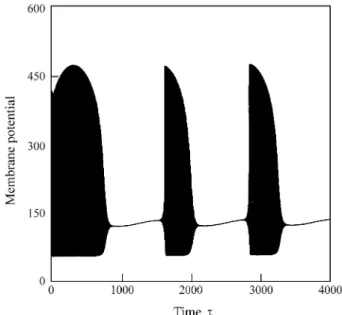
The model equations exhibit various types of oscillatory responses in the membrane potential as the frequency ω of the periodic stimulation (AC current), superimposed on the DC current, is varied. The behavior goes from periodic to bursting via quasi-periodicity. Thus in the range 0.86 ≤ ω ≤ 1.0 the system displays periodic behavior (P1), Fig. 1. This periodic behavior is confirmed quantitatively by its maximum Lyapunov exponent equal to zero (indicating that the limit cycle conserves its information in time), its single main frequency (0.0156) in the power spectrum and its correlation dimension equal to one.
At frequencies below 0.85 the system shows quasi-pe-riodicity. The transition from quasi-periodicity to limit cycle occurs in a somewhat unusual way. Normally one would expect a torus (secondary Hopf) bifurcation where two Floquet multipliers simultaneously intersect the unit circle in the plane of complex numbers. In fact, a torus bifurcation occurs at a frequency of ω = 1.03, as determined using the program package CONT14. At ω = 0.8525,
how-ever, the period-one limit cycle undergoes a saddle-node bifurcation where one non-trivial floquet multiplier inter-sects the unit circle at 1. It therefore looses stability by collision with an unstable limit cycle. This saddle-node bifurcation of limit cycles collides with a torus in analogy to the well-known sniper-bifurcation where a saddle-node of stationary states collides with a limit cycle15. As a
con se quen ce the mo du la ti on pe ri od of the qua si pe ri o dic os cil la ti ons ap pro a ches in fi nity as the for cing fre quency is in cre a sed to wards the cri ti cal va lue of ω = 0.8525, Fig. 2. The emer ging to rus is des pic ted in Fig. 3. The qua si pe ri o -dic sta te is con fir med by the po wer spec trum and the re turn map. In the first one it is pos si ble to ob ser ve two main fre -quen ci es in non-integer ra tio, in the se cond one it is a clo sed cur ve is ob ta i ned, Fig. 4. Both fe a tu res, along with a ca pa city di men si on clo se to 2.00 and a ma xi mum Lya pu nov ex -po nent equal to zero, con firm qua si pe ri o di city. With a furt her de cre a se of the fre quency, ω < 5 x 10⁻³, the systems dyna mics switch to burst type os cil la ti ons. Such an evo lu ti on ma ni fests it self on the pha se por tra it and the Po -in ca ré sec ti on as an -in cre a se of the glo bal size of the
to rus at the ex pen se of the size of its in ner part which shrinks to a thin tube. On the po wer spec tra, this sce na rio is as so ci a ted with a de cre a se of the se con dary fre quency, which me ans that the thin ner the cen ter hole, the lar ger the du ra ti on of time spent by the tra jec tory in si de the hole. As a con se quen ce, the time se ri es dis plays lar ger and lar ger win -dows of ne arly sta ti o nary be ha vi or, Fig. 5. In Fig. 6, the win dow length of the ne arly sta ti o nary sta tes as func ti on of the dri ving fre quency is shown.
The res pon ses of the se mo del equa ti ons to the si nu so i -dal sti mu la ti on have clo se si mi la ri ti es with ex pe ri men tal re sults re por ted pre vi ously for both ar ti fi ci al and bi o lo gi cal
Fi gu re 2. Incre a se of mo du la ti on pe ri od clo se to li mit po int for the same pa ra me ters va lu es gi ven in Fig. 1.
Fi gu re 1. Time se rie of mem bra ne po ten ti al for DC cur rent in ten sity iCD = 500, AC cur rent am pli tu de A = 25 and fre quency ω = 0.90.
Fi gu re 4. The re turn map of the at trac tor in Fig. 3 shows a clo sed cur -ve as would be ex pec ted for a qua si pe ri o dic at trac tor.
membranes under similar conditions. The rhythm of autonomous biological oscillators can be markedly affected by periodic perturbation. Thus, this forcing can lead to quasiperiodicity, intermittency, chaos and bursting type oscillations. Many nerve cells in both vertebrate and inver-tebrate nervous systems display the behavior known as bursting. This consists of the generation of membrane action potentials in regular sequences of “bursts” which are separated by periods of inactivity during which the cell membrane may be hyperpolarized. Among the more com-monly studied nerve cells which display this behavior are abdominal ganglion cells of molluscs16,17, cardiac
pace-maker, stomatogastic ganglion cells of crustacea18,19, and
electrical activity in pancreatic β-cells20. Bursting is
impor-tant for two reasons21. First, it is a relatively simple neural
pattern and yet one which is involved in the control of many physiological and behavioral activities such as blood circu-lation, respiration, mastication and locomotion. Second, nerve cells involved in epileptic seizure activity have been observed to burst during interictal (i.e. between seizures) states.
Finally, it is important to stress that a knowledge of the mechanisms underlying this complex behavior may lead to an increased understanding of the basic physico-chemical phenomena that occur during biological membrane oscilla-tions.
Acknowledgment
Finantial support from Dirección de Investigación de la Universidad de Concepción, Grant P.I.No. 97.22.13-1.2, is gratefully acknowledged.
References
1. Rehmus, P.; Ross, J. Oscillations and Traveling Waves in Chemical Systems; Wiley-Interscience; New York, p. 287, 1984.
2. Schneider, F.W. Ann. Rev. Phys. Chem.1985,36, 347. 3. Markman, G.; Bar-Eli, K. J. Phys. Chem. 1994, 98,
12248.
4. Förster, A.; Hauck, T.; Schneider, F.W. J. Phys. Chem. 1994, 98, 184.
5. Dolnik, M.; Marek, M. J. Phys. Chem.1991, 95, 7267. 6. Dolnik, M., Marek, M.; Epstein, I.R. J. Phys. Chem.
1992, 96, 3218.
7. Saida, Y.; Matsuno, T.; Toko, K.; Yamafuji, K. Jpn. J. Appl. Phys. 1993, 32, 1859.
8. Aihara, K.; Matsumoto, G.; Ichikawa, M. Phys. Lett. 1985, A111, 251.
9. Aihara, K.; Numajiri, T.; Matsumoto, G.; Kotani, M. Phys. Lett. 1986, A116, 313.
10. Aihara, K.; Matsumoto, G. In Chaos in Biological Systems; H. Degn, A.V. Holden, L.F. Olsen, Eds.; Plenum; New York, p. 121, 1987.
11. Drouin,H.R.L. Ber. Bunsenges. Phys. Chem. 1995, 99, 164.
12. Hayashi, H.; Ishizuka, S.; Ohta, M.; Hirakawa, K. Phys. Lett. 1982, A88, 435.
13. Chialvo, D.R.; Gilmour Jr., R.F.; Jalife, J. Nature 1990, 343, 653.
14. Marek, M.; Schreiber, I. Chaotic Behaviour of Deter-ministic DissipativeSystems; Academia; Prague, Ap-pendix B, 1991.
15. Noszticzius, Z.; Wittmann, M.; Stirling, P. J. Chem. Phys. 1987, 86, 1922.
Vol. 10, No. 6, 1999 Delgado & Münster 495
Figure 6. Window length of the nearly stationary states as function of the driving frequency.
Figure 5. Bursting type oscillations for the same parameters values given
16. Gorman, A.L.F.; Thomas, M.V. J. Physiol.(London) 1978, 275, 357.
17. Junge, D.; Stephens, C.L. J. Physiol.(London) 1973, 235, 155.
18. Selverston, A.I.; Russell, D.F.; Miller, J.P.; King, D.C. Prog. Neurobiol.1976, 7, 215.
19. Watanabe, A.; Obara, S.; Akiyama, T. J. Gen. Physiol. 1967, 50, 839.
20. Atwater, I.; Dawson, C.M.; Scott, A.; Eddlestone, G.; Rojas, E. In Biochemistry and Biophysics of the Pancre-atic Beta Cell; Georg Thieme; New York, p. 100, 1980. 21. Plant, R.E. J. Math. Biology 1981, 11, 15.