Study of Analytical On-line Pyrolysis of Oils from Macauba Fruit
(Acrocomia sclerocarpa M) via GC/MS
I.C.P. Fortes
a, and P.J. Baugh
ba
Departamento de Química, ICEx, Universidade Federal de Minas Gerais,
31270-901 Belo Horizonte - MG, Brazil b
Department of Chemistry and Applied Chemistry, University of Salford,
Salford M5 4WT, UK
Estudos pirolíticos dos óleos vegetais das partes (endocarpo mais mesocarpo e epicarpo) do fruto da Macauba (Acrocomia sclerocarpa M.) foram realizados sob atmosfera de hélio usando-se um pirolisador de filamento modelo Girdel 75 -Py -1, conectado diretamente a um CG/EM.
Os experimentos foram realizados em diferentes temperaturas e tempos de pirólise, para avaliar como estes parâmetros afetam o processo pirolítico de obtenção dos produtos bem como a sua reprodutibilidade.
A pirólise dos óleos gerou grande número de compostos tais como hidrocarbonetos, aldeídos e ácidos carboxílicos, este último refletindo a composição original dos óleos.
A identificação de alguns compostos foi feita com o uso de um banco de dados , dos padrões de fragmentação das classes de compostos e dos cromatogramas de massas de alguns íons específicos tais como m/z 83, 85 e 60.
O modo de ionização química positiva foi utilizado para confirmar as massas molares dos constituintes gerados a partir das pirólises, tendo como gás reagente, o metano, (CH4-CI).
Pyrolytic studies of vegetable oils of Macauba (Acrocomia sclerocarpa M.) fruit’s parts (endocarp plus mesocarp and epicarp) were undertakenunder a helium atmosphere using a filament pyrolyser, Girdel Pyrolyzer 75-PY-1, coupled directly to a GC/MS.
The investigation was performed using different temperatures and pyrolysis times to evaluate how these parameters affect the yield products and the reproducibility of the pyrolytic process.
The pyrolysis of both oils yields a large number of compounds such as hydrocarbons, aldehydes and carboxylic acids, the latter reflecting the original composition of the oils.
The identification of some compounds was carried out using a mass spectral library data base search (NIST) together with recognition of fragmentation pattern and mass chromatograms of some specific ions such as m/z 83, 85 and 60.
The CH4-CI mode was used to confirm molecular weights of the constituents generated from pyrolysis, in some instances.
Keywords: PY/GC/MS, Macauba fruit (Acrocomia sclerocarpa M.), on-line pyrolysis,
vegetable oils
Introduction
The need for different alternative sources of energy and technology using Brazilian natural resources have moti-vated many studies of biomass as a renewable energy source1. In addition, biomass is the only renewable source of raw material to the chemical industry and represents the only long term source of carbon2. Therefore it is important, in order to preserve in some ways our environment, to direct
our efforts towards developing new technology to increase the use of derivatives from biomass in the chemical indus-try.
Biomass is, however, generally poorly suited for direct energy use and pre-treatment is necessary to change its physical and chemical forms1.
concerning the chemical composition of the volatile com-pounds obtained were not completed, owing to the limita-tion in instrumental and analytical methods3. The direct thermal cracking of fatty acids (FFAs) and triglycerides (TGs) in the presence or absence of a catalyst, such as bentonite4, lignin5, calcium oxide6-8 and zeolites9-10 has been reported. During the last decade, the research into new concepts and processes for higher oil yields and new ana-lytical techniques to elucidate the mechanisms of formation and constitution of the resulting pyrolysates has undergone a technological renaissance of the investigations in the area of pyrolysis1,11.
A natural source of a composite mixture of triglycerides (TGs) is the oleaginous plants, which comprises a large part of the vast and diversified flora of Brazil. The plant of interest here is the Macauba tree (Acrocomia sclerocarpa M), in particular, the oils from the Macauba fruit. This tree is native to different regions in Brazil, which are located mainly in the centre of the country and, in particular, in the state of Minas Gerais8.
We report herein a study carried out with a filament pyrolyser coupled to a GC/MS, using a flash pyrolysis procedure, employing the oils from Macauba fruit to inves-tigate the effects of pyrolysis time and temperature on the yields of a particular pyrolysate composition. Experiments were performed to obtain information on the influence of these parameters upon the mechanism of pyrolysis of these oils, which is still largely unknown.
Materials and Analysis
Sampling
The Macauba fruit has a spherical slightly flattened shape with an external diameter in the range of 3 to 6 cm and colour of the fruit varying from brownish to yellowish green12-13.
The fruit comprises an epicarp or external shell, a meso-carp or pulp and an epimeso-carp or kernel which envelopes one or two nuts12-13.
The Macauba fruit was divided into two parts. The outer part comprised a mixture of external shell and pulp and the inner part, the endocarp nut. Both were dried at 80 °C to constant weight, ground into powder, extracted with hex-ane under a Soxhlet reflux for 72 h and concentrated by distillation to give the vegetable oil extracts8.
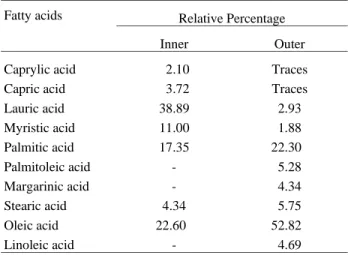
The composition of each oil, obtained after their esteri-fication with BF3 in methanol is summarised in Table 1.
Conditions and methodology
Pyrolysis was performed using a Girdel Pyrolyser 75-Py-1, a filament pyrolyser connected to a GC/MS (Finnigan Mat 1020). A gas and power control unit, a cable and a probe comprise the Girdel Pyrolyser 75-Py-1. Helium was used as the carrier gas. The system was purged for a short
time (30 s) with the carrier gas before each injection and the probe connected directly to the GC injector. The sample was dispensed, as a thin film onto the filament and the solvent was allowed to evaporate before starting the pyro-lysis procedures. The carrier gas was diverted through the control unit and probe ensuring that the volatile pyrolysate wad transferred from this device to the GC/MS equipment without any loss.
Preliminary experiments were performed in triplicate using different temperatures (400 to 1000 °C) and pyrolysis times (10, 20 and 30 s). Further experiments were carried out at a given temperature (700-800 °C) and different pyrolysis times (10, 20 and 30 s) to study the behaviour , reproducibility of the pyrolytic process.
GC/MS analysis
Electron impact (EI) mode
General profiles of the pyrolysates were carried out using EI mode. Analyses were conducted on a Finnigan Mat model 1020 automated GC/MS using a fused capillary column (14 m x 0.25 mm; df = 0.15 µm; DB1, J & W Scientific) with dimethylsiloxane as the stationary phase. Helium was used, as the carrier gas, at a flow rate of 1 mL/min. Aliquots of 1 µL of the sample in hexane to-gether with 1µL of a mixture of standard compounds (d10 -biphenyl, d10 - anthracene, d10 - pyrene) at 100 µg/mL as internal standard were spread onto the filament for pyro-lysis. This set was employed as a parameter to locate the molecular weights of the compounds when the library search was performed as well as to confirm the reproduci-bility of the pyrograms.
The injection mode was short splitless with a 1s delay. The column was held at 35 °C for 2 min and then heated to 300 °C, at 20 °C/min. The final temperature was held constant for 2 min.
Table 1. Composition in percentage of fatty acids present in inner and outer oils from Macauba Fruit (Acrocomia sclerocarpa M).
Fatty acids Relative Percentage
Inner Outer
Caprylic acid Capric acid Lauric acid Myristic acid Palmitic acid Palmitoleic acid Margarinic acid Stearic acid Oleic acid Linoleic acid
2.10 3.72 38.89 11.00 17.35
-4.34 22.60
-Traces Traces 2.93 1.88 22.30
5.28 4.34 5.75 52.82
Chemical Ionisation (CI) mode
Analyses, in a PCI (positive chemical ionisation) mode, were carried out on a GC model HP 5890 series II and MS model VG Trio 1000, using a fused capillary column (11 m x 0.32 mm, df = 0.25 µm, DB5, J &W Scientific), and helium as the carrier gas and methane as the reagent gas. The GC conditions used were the same as for EI mode.
Compounds identification
The presence of different classes of compound from pyrolysates was confirmed using the total ion chromato-gram (TIC) and mass chromatochromato-gram (MC) analyses, in addition to fragmentation patterns16-19 and library search (NIST). Identification was carried out according to pre-es-tablished criteria for the analysis of the data17.
Data analysis
To obtain the data from the different experiments the following steps were undertaken:
• TIC of each experiment at a specific condition : mode of injection, temperature and pyrolysis time;
• Preliminary identification of the main peaks using the computer library data. The peaks were considered identi-fied when the library response for purity was > 900 and fit was > 975. Positive chemical ionization (CH4- CI) was also used in an attempt to confirm the molecular weight of compounds;
• Identification of classes of compounds to which the main peaks belonged;
• A specific m/z characteristic of each class of com-pound was selected, for instance, alkane (m/z 85), alkene (m/z 83), alkynes or dienes (m/z 81), fatty acids (m/z 60 and 73), derivatives of cyclohexene (m/z 54 and 67);
• Identification of the target compounds (however, in some cases only the base peak was identified);
• Quantification of the peaks in terms of relative per-centage was done using a software from the data system: SR and QL-QR-MQ-EQL;
• The resulting data from quantification were compared for all replicate experiments, by a Fortran programme, at a given condition such as mode of injection, temperature and pyrolysis time;
• Answers are registered into new files called RE-SULTS which were transferred to a spreadsheet. Statistical parameters such as mean, standard deviation, variance and error were calculated;
• Each class of compound was classified according to its characteristic m/z and after that, constituents which belong to each class were added up to give a global view of the yield of products obtained.
Results and Discussion
Studies were carried out to evaluate the influence of the temperature and pyrolysis time on the behaviour and repro-ducibility of the process as well as the changes in the yield of products of both oils from Macauba fruit.
It has been reported7,14,15 that a mixture of triglycerides submitted to a thermal cracking process, should undergo to decarboxylation, disproportionation and successive elimi-nation of ethylene molecules yielding to some classes of compounds such as hydrocarbons and carbonylic com-pounds. In addition, the sample can undergo many different reactions such as hydrogenation and oxidation, the latter one providing the greatest difference between the cracking of vegetable oils and petroleum as the latter does not generate carbonyl groups in products14,15.
Preliminary studies
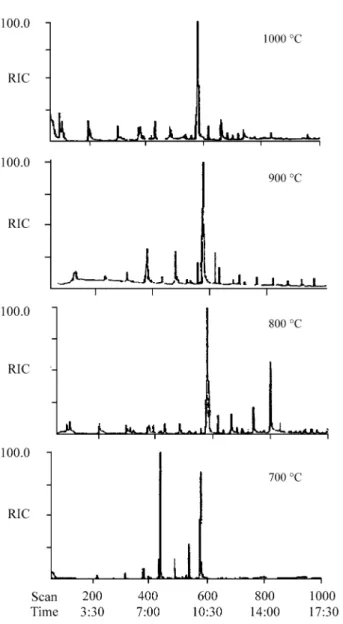
It was observed that the samples underwent a desorption like process rather than pyrolysis at lower temperatures (400 °C to 600 °C) and fixed pyrolysis time. The real pyrolytic process took place in the temperature range be-tween 700 °C and 1000 °C, which could be observed by the changes in the total ion chromatogram (TIC), which be-come more complex as the temperature was increased, as shown in Fig. 1.
The pulp and nut oils only underwent partial pyrolysis. The pulp was more resistant to this process probably due to higher degree of unsaturation. Both oils led to carboxylic acids compounds generated from triglycerides of which the original oil is composed (see Table 1). A major peak (m/z 44), at the beginning of the chromatographic run, indicated the presence of carbon dioxide, probably originated from decarboxylation of fatty acids9.
A general feature of the pyrolysates of the pulp and nut oils is summarised in Fig. 2 , which shows the presence of several compounds, some of which were identified as indi-cated in Tables 2 e 3.
Analysis by EI mode
The driving force in the cracking of the pulp oil under helium atmosphere was the formation of aldehydes, cy-cloalkanes, alkenes, and dienes. The paramount product generated was 2-propenal or acrolein, a known product when triglycerides are pyrolysed15. Some compounds clas-sified as unknown were also detected, which exhibited different base peaks and are reffered to as unknown m/z 55 and unknown m/z 67. In addition, the presence of small amounts of alkanes, alkenynes, alkylbenzene and cy-cloalkene were also evident (see Table 4).
67, which are here classified here as unknown. These compounds are considered to be associated with cyclo-hexene derivatives20-22. Other constituents with base peaks, m/z 55 and m/z 57 were also noticed.
Some classes of compounds are common to pyro-lysates products such as aldehyde, cycloalkane, alkene , alkane and those reffered as unknown/55 but others are not. These differences should be associated to the com-position of the original oils.
The products generated by the pyrolytic process from both oils when compared to their respective cal-cium soap pyrolysates, are quite different8,14,15. In the latter case the main products are comprised of homo-logue series of n-alkane, 1- alkene and some car-bonylic compounds.
Analysis by CI Mode
The crucial problem with the analysis in EI mode is the lack of molecular weight data for many of the compounds, which made the identification more difficult. CH4-CI/MS was used to overcome this problem in an attempt to match the identification and the molecular weight of the pound identified using EI mode. To ensure that the com-pound in EI mode was the same in CI mode the relative Figure 1. Comparison between pyrogram profiles at different pyrolysis
temperatures (700-1000 °C)and the same pyrolysis time(30 s) by PI/CG/MS for nut oil.
retention time to biphenyl (tR = 6,74 min) was used as a reference.
Pyrolysis behaviour
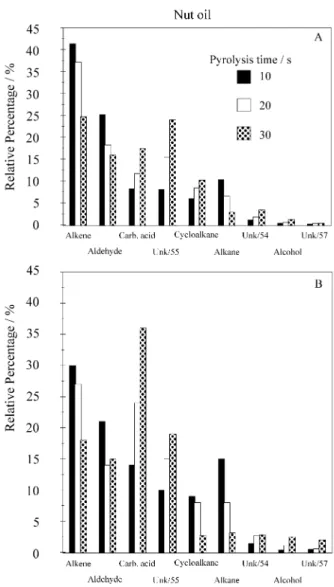
Studies of the behaviour of the pulp and nut oils at different temperatures and pyrolysis time have shown different trends in profile (see Figs. 3 and 4, and Tables 4 and 5).
Pulp oil
The products of the pyrolysate can be classified into three categories: main products (> 10%), secondary prod-ucts (3%-10%) and tertiary prodprod-ucts (< 3%). The overall trend was the same for both worked temperatures. At 700 °C the main products (aldehyde, cycloalkane, alkene and diene) correspond to 71-79% of the total products; the secondary products (unknowns/55, 67 and others and alkyl-benzene) ranging between 19 to 26% and the remaining Table 2. Some identified constituents of pulp oil pyrolysate.
No. Class of compounds Identification Relative tR tR MW B.Pk Formula
1 2 3 4 5 6 7 8 9 10 11 12 13 14 15 16 17 18 19 20 21 22 23 24 25 26 27 28 29 30 31 32 33 34 35 36 37 aldehyde alkene(diene) alkene cycloalkane alkene(diene) unknown alkene alkene alkylbenzene alkene(diene) unknown alkene(diene) alkene cycloalkane alkylbenzene alkene(bycyclo) cycloalkene aldehyde unknown unknown cycloalkane cycloalkane cycloalkane cycloalkane alkene alkenyne alkenyne unknown unknown alkene unknown alkane unknown unknown alkene(diene) unknown unknown 2-propenal 1-3cyclohexadiene 1-penten-2-methyl cycloalkane(isomerC7H14)
1-4-heptadiene-3-methyl unknown 1-octene 1-heptene-3-methyl propylbenzene 1.3nonadiene(-E) unknown 2-4nonadiene(E-E) 1-nonene cyclopentane-1-methyl-2propyl butylbenzene bycyclo[2.2.1]heptene-2-2dimethyl cyclodecene(-E)-isomers 2-nonenal unknown unknown cyclopropane-1-ethenyl-2hexene isomer isomer isomer 1-undecene 5-dodecen-7yne(E) 5-dodecen-7-yne(Z) unknown unknown 1-dodecene unknown decane2-4dimethyl unknown unknown 1-2tridecadiene unknown unknown 0.043 0.052 0.057 0.089 0.115 0.129 0.144 0.172 0.218 0.256 0.290 0.325 0.391 0.457 0.494 0.537 0.586 0.655 0.667 0.695 0.710 0.727 0.753 0.770 0.779 0.822 0.868 0.914 0.934 0.046 1.138 1.170 1.227 1.236 1.336 1.526 1.629 0.263 0.315 0.350 0.543 0.700 0.788 0.875 1.050 1.330 1.558 1.768 1.978 2.380 2.783 3.010 3.273 3.570 3.990 4.060 4.235 4.323 4.428 4.585 4.690 4.743 5.005 5.285 5.565 5.688 6.370 6.930 7.123 7.473 7.525 8.138 9.293 9.923 56 80 84 98 110 110 112 112 --124 --124 126 126 134 136 138 140 --150 150 150 150 154 164 164 164 --168 --170 --18O ---- 41 79 56 56 81 67 55 55 91 55 54 81 55 55 91 79 67 55 67 67 79 79 79 79 55 79 79 81 55 55 67 57/43 67 67 67 67 67
C3H7O
C6H8
C6H12
C7H14
C8H14
C8H14
C8H16
C8H16
---C9H16
---C9H16
C9H18
C9H18
C10H14
C10H16
C10H18
C9H10O
--- ---C11H18
C11H18
C11H18
C11H18
C11H22
C12H20
C12H24
--- ---C12H24
---C12H26
--- ---C13H24
---products (alkenyne, alkane, cycloalkene) from 3 to 4%. At higher temperature ,however, it was noticed a slight de-crease in the main products (61-76%), and a slight inde-crease in the secondary products were noticed (22-34%). The percentage of tertiary products remained constant.
According to Table 4 and Fig. 3. it can be observed that short a pyrolysis time (5 s) tends to favour cyclization and generation of multiple bonds whereas a longer pyrolysis time favours secondary reactions. These trends may be explained by the extent to which the sample underwent secondary reactions (see Table 4).
Nut Oil
In this sample, the composition of the whole pyrolysate was distributed in the following way: main products (alde-hyde, alkene and carboxylic acid) corresponding to 59-74%; secondary products (cycloalkane, alkane and unknown/55) varying between 24-37% and tertiary
prod-ucts (unknown/54 and 57 and alcohol) ranging between 5-7%.
The relative percentage of carboxylic acids and un-known/55 increased when the pyrolysis time was raised in both worked temperatures. Other products, such as alkene, aldehyde and alkane have a tendency to decrease (see Fig. 4 and Table 5). This suggests that the generation of these classes of compounds is dependent on the cracking of carboxylic acids whereas the formation of unknown/55 is not. Additional trend is that classes of compounds present in less quantities of the total pyrolysate (unknown/54 and 57 and alcohol) increased with temperature and pyrolysis time enhancement. This fact can be explained by secondary reactions, which should be easier to occur under these conditions.
Short pyrolysis time (10 s) at both temperatures leads to a high amount of alkanes, alkenes and aldehydes instead of carboxylic acids. On the other hand, higher temperature and long pyrolysis time did not favour an extensive pyro-Table 3. Some identified constituents of nut oil pyrolysate.
No. Class of Compounds Identification tR MW B.Pk Formula
01 02 03 04 05 06 07 08 09 10 11 12 13 14 15 16 17 18 19 20 21 22 23 24 25 26 27 28
aldehyde alkene alkane cycloalkane
alkane alkene alkane unknown cycloalkane
alkane alkene alkene alkane unknown unknown carboxylic acid
aldehyde aldehyde aldehyde alcohol carboxylic acid
caboxylic acid unknown
alkane carboxylic acidcarboxylic acid
unknown unknown
2 - propenal 1- pentene - 2 methyl
n-hexane cycloalkane (isomer C7H14)
heptane/ hexane- 3 methyl
1-heptene 3 - methyl or cyclopropane 1,2-diethyl octane/hexane 2,4 dimethyl or hexane,3-ethyl
unknown
cyclopentane 1-methyl 2- propyl chain alkane(isomer C9H20)
1-decene 1-undecene n-undecane unknown unknown nonanoic acid
2-undecenal undecenal 2-dodecenal 1-dodecanol undecanoic acid dodecanoic acid
unknown tetradecane,6-methyl
tetradecanoic acid hexadecanoic acid
unknown unknown
0.282 0.371 0.438 0.577 0.598 1.068 1.114 1.715 1.890 2.250 3.325 4.410 4.568 4.725 5.303 5.390 5.728 6.055 6.493 6.788 6.790 8.050 8.663 8.803 9.153 10.203 11.078 11.200
56 84 86 98 100 112 114 126 126 128 140 154 156 ---- 158 168 170 182 186 186 200 --212 228 256
-41 56 57 56 57/43
55 57/43
56 56 57/43 56/41 55/41 57/43 54/67 54/67 60 70 55/43
70 60 55 60 57 57 60 60 55 55
C3H4O
C6H12
C6H14
C7H14
C8H16
C8H16
C8H18
C9H18
C9H18
C9H20
C10H20
C11H22
C11H24
---C9H18O2
C11H20O
C11H22O
C12H22O
C11H22O2
C12H26O
C12H24O2
---C15H32
C14H28O2C
16H32O2
---ly sis o f th is m ater ial. I n th is c ase , th e d eso rp tio n lik e p ro cess b eco m es m o re lik el y th an th e p y ro ly tic p ro cess. Re p ro d u cib ility o f th e p yro lytic p ro cess Th e c ritic al p ro b le m with th e PI /GC /MS tec h n iq u e is th e re p ro d u cib ility o f th e ex p er im en ts. T h er e ar e se v er al pa ra me te rs w h ic h s h o u ld be co nt ro lle d d u ring t h e ex pe ri -ment
s such as
fi
la
ment
homogenei
ty and t
emperat ur e, q u an titativ e tr an sf er o f th e p y ro ly sate m ater ial, am o u n t o f th e m ate ria l d isp en se d o n th e f ila m en t e tc. All th es e p a-ra m eter s co u ld af fe ct in so m e wa y th e r ep ro d u cib ility , esp ec ially in th e q u an titativ e asp ec t. To e n su re th e r ep ro d u cib ility asp ec t o f th e ex p er im en ts pe rd or me d a va ri o u s t emp er at u re s an d py ro ly si s tim es a Fi gure 3. Com p ari son be twe en profi le s a t a give n pyrolys is te m p er at ure and di ffere nt pyrolys is ti m es
for pulp oil
.(A) 700 °C ; (B) 800 °C. 10, No. 6, 1999 On-l ine Pyrol y si s 475
Table 4. Composition of the Pulp Oil pyrolysate at a given pyrolysis temperature and different pyrolysis times.
T = 700 °C
Pyrolysis time (s) Aldehyde Cyclo alkane Alkene Diene Unknown/55 Unknown/67 Unknown/others Alkylbenzene Alkenyne Alkane Cycloalkene
5 10 20 30
34 ± 2 34 ± 3 29 ± 2 32 ± 4
21 ± 2 23 ± 1 24 ± 4 23 ± 3
11.1 ± 0.5 13 ± 1 13 ± 3 10 ± 1
10.7 ± 0.8 8.5 ± 0.4 7.3 ± 0.3 5.8 ± 0.4
9 ± 1 7,2 ± 0.5 7.3 ± 0.2 6.9 ± 0.7
5.5 ± 0.4 6.1 ± 0.5 7.3 ± 0.8 5.86 ± 0.05
2.7 ± 0.5 2.8 ± 0.2 3.4 ± 0.2 5.6 ± 0.4
2.8 ± 0.1 3.2 ± 0.2 6 ± 1 7.4 ± 0.6
2.58 ± 0.06 2.30 ± 0.05 0.9 ± 0.2 1.8 ± 0.3
0.9 ± 0.4 0.48 ± 0.04
0.6 ± 0.1 0.16 ± 0.02
0.7 ± 0.2 1.1 ± 0.2 1.2 ± 0.5 1.48 ± 0.05
T = 800 °C
Pyrolysis time (s) Aldehyde Cyclo alkane Alkene Diene Unknown/55 Unknown/67 Unknown/others Alkyl-benzene Alkenyne Alkane Cycloalkene
5 10 20 30
35 ± 3 26 ± 3 25 ± 3 22 ± 3
20 ± 2 19 ± 1 18 ± 1 23 ± 1
8 ± 1 8 ± 1 9 ± 1 6.4 ± 0.5
13 ± 2 16 ± 1 14 ± 1 10 ± 1
11.0 ± 0.6 9.6 ± 0.3 7.7 ± 0.4 8.2 ± 0.8
4.2 ± 0.4 5.3 ± 0.6 7.9 ± 0.5 8.9 ± 0.7
2.25 ± 0.08 6.9 ± 0.3 7,8 ± 0.4 8.2 ± 1
4,1 ± 0,3 6.8 ± 0.3 8,2 ± 0.3 9 ± 1
0.9 ± 0.1 1.0 ± 0.2 0.9 ± 0.2 1.9 ± 0.4
1.4 ± 0.4 1,3 ± 0,2 0.9 ± 0.3 0.8 ± 0.3
0.5 ± 0.1 0.46 ± 0.04
number of observations were made: (1) reproducibility of the caracteristic features of the pyrograms for each pyro-lysate; (2) reproducibility of the trends for the applied conditions; (3) reproducibility in terms of semi-quantitative analysis of the products (classes of compounds) obtained during the pyrolytic process.
To verify the first assumption a set of internal standards comprising biphenyl, anthracene and pyrene) was used which were pyrolysed together with the samples. The chro-matographic features were quite reproducible as illustrated in Fig. 2.
The second assumption was studied after obtaining the semi quantitative data presented in Tables 4 and 5 and Figs. 3 e 4, in an analogous manner the previously described procedure. These data allowed the evaluation of the ob-served trend of the yield of products when temperature and pyrolysis time were varied. The pyrolysate composition at each set of conditions was found to be quite reproducible. This means that the parameters of the pyrolysis systemati-cally affected the pyrolytic process.
The third assumption was verified by calculation of the relative errors from replicate analysis. In the less repre-sentative classes of compounds the estimated errors were > 20% and for the main classes these values were ranging between 4 and 20%.
Conclusion
The technique of PY/GC/MS has been demonstrated to be a good analytical tool for identifying the main constitu-ents generated from pyrolysis of the original oils from macauba fruit using the direct analysis with capillary GC/MS in EI and PCI modes. It was shown that the tech-nique could be used to investigate the associated mecha-nism of the pyrolysis process.
Table 5. Composition of the Nut Oil pyrolysate at a given pyrolysis temperature and different pyrolysis times.
T = 700 °C
Pyrolysis Time (s)
Alkene Aldehyde Carboxylic
acid
Unknown/ m/z 55
Cyclo alkane
Alkane Unknown/
m/z 54
Alcohol Unknown/
m/z 57
10 20 30
41 ± 3
37 ± 3
25 ± 3
25 ± 4
18 ± 1
16 ± 1
8.2 ± 0.4
11.7 ± 0.7
17.4 ± 0.9
8 ± 2
16 ± 1
24 ± 2
6.0 ± 0.9
8.4 ± 0.8
10.2 ± 0.7
10.3 ± 0.6
6.5 ± 0.4
2.9 ± 0.6
1.1 ± 0.4
1.8 ± 0.6
3.4 ± 0.4
0.4 ± 0.2
0.5 ± 0.2
1.0 ± 0.4
0.15 ± 0.02
0.33 ± 0.03
0.34 ± 0.02
T = 800 °C
Pyrolysis Time (s)
Alkene Aldehyde Carboxylic
acid
Unknown/ m/z 55
Cyclo alkane
Alkane Unknown/
m/z 54
Alcohol Unknown/
m/z 57
10 20 30
30 ± 6
27 ± 5
18 ± 2
21 ± 3
14 ± 3
15 ± 1
14 ± 1
24 ± 4
36 ± 3
10 ± 2
15 ± 3
19 ± 3
9 ± 1
8 ± 1
2.7 ± 0.3
15 ± 3
8 ± 2
3.1 ± 0.2
1.4 ± 0.3
2.7 ± 0.4
2.8 ± 0.2
0.32 ± 0.06
1.1 ± 0.4
2.5 ± 0.3
0.49 ± 0.07
0.57± 0.03
2.01 ± 0.6
Under the conditions employed both oils undergo a pyrolytic process to a limited extent, generating a consid-erable amount of carboxylic acid component from the origi-nal oils.
The process as a whole was shown to be reasonably reproducible.
Acknowledgements
One of us (I.C.P.Fortes) would like to thank CAPES for the financial support to carry on this work.
References
1. Soltes, E.J.; Milne, T.A. Pyrolysis Oils Biomass: Pro-ducing, Analyzing and Upgrading, American Chemi-cal Society, Division of Fuel Chemistry Abstracts, NY, 1988.
2. Carioca, J.O.B.; Arora,H. Biomassa: Fundamentos e Aplicações Tecnológicas; UFC, 1985.
3. Hsu, H.L.; 0sburn, J.O.; Grove, C.S.Jr. Ind.Eng.Chem 1950, 42, 2141.
4. Jurg, J.W.; Eisma, E. Science (Washington DC) 1964, 144, 151.
5. Trailer, H.; Kratzl, K. J.Am.Oil.Chem.Soc. 1980, 57, 153.
6. Craveiro, A.A.; Matos, F.J.A.; Alencar, J.W.; Silveira E.R. Energia: Fontes Alternativas 1981, 3, 44. 7. Craveiro, A.A.; Rodrigues, A.S.; Andrade, C.H.S.;
Matos, F.J.A.; Alencar, J.W.; Machado, M.I.L. J.Nat.Prod. 1981, 44, 602.
8. Fortes, I.C.P. Estudo Químico da Pirólise dos Sabões de Cálcio da Macaúba; Universidade Federal de Mi-nas Gerais, Belo Horizonte, 1987.
9. Williams, P.T.; Nittaya, H. Patrick A. Biomass Gasif. Pyrolysis, [Conf], Bridgwater; AV. CPL Press; New-bury, UK, p. 422, 1997.
10. Williams, P.T.; Nittaya, H.; Patrick , A. Fuel 1995, 74, 1839.
11. Alencar, J.W.; Alves, P.B.; Craveiro, A.A.; J. Agric. Food Chem. 1983, 31, 1268.
12. Novaes, R.J. Contribuição para o estudo do côco macaúba; Escola Superior de Agricultura Luiz de Queiroz; São Paulo, 1952.
13. Markley, K. Economic Botany 1956, 10, 3.
14. Fortes, I.C.P; Baugh, P.J. J .Anal. Appl. Py. 1994, 29,153.
15. Fortes, I.C.P. Analytical Pyrolysis and GC/MS of vegetable oils (and their calcium soaps) from Ma-cauba palm (Acrocomia sclerocarpa M); University of Salford; Salford, UK, 1994.
16. Silverstein, R.M.; Bassler, G.C.; Morril, T.C. Spectro-metric Identification of Organic Compounds; Willey & Sons Inc, Singapore, 1991.
17. Lafferty, F.M.Mc.; Turecek, F. Interpretation of Mass Spectra; University Sciences Books; Mill Valley, California, 1993.
18. Fleming, I.A.M.; Williams, D.H. Spectroscopic Meth-ods in Organic Chemistry; McGraw Hill; New York, 1980.
19. Jennings, W. Qualitative Analysis of Flavour and Fragance Volatiles by Capillary Gas Chromatogra-phy; Academic Press; New York, 1980.
20. Widmann, G.; Reisen, R. Thermal Analysis: terms, methods and applications; Heidelberg; Hüthig, 1987. 21. Budzikiewicz, H.; Djerassi, C.; Williams, D.H. Mass Spectrometry of Organic Compounds; Holden-Day Inc.; San Francisco, 1967.
22. Beynon, J.H. Mass Spectrometry and its Applications to Organic Chemistry; Elsevier; Amsterdan, 1960.