854 Brazilian Journal of Physics, vol. 36, no. 3B, September, 2006
Electron g-Factor and Cyclotron Effective Mass in Semiconductor Quantum Wells Under
Growth-Direction Applied Magnetic Fields
M. de Dios-Leyva1, N. Porras-Montenegro2, H. S. Brandi3,4, and L. E. Oliveira5
1Dept. of Theor. Physics, Univ. of Havana, San L ´azaro y L, Vedado 10400, Havana, Cuba 2Departamento de F´ısica, Universidad del Valle, AA 25360, Cali - Colombia 3Instituto de F´ısica, Univ. Federal do Rio de Janeiro, Rio de Janeiro - RJ, 21945-970, Brazil
4Inmetro, Campus de Xer´em, Duque de Caxias - RJ, 25250-020, Brazil 5Instituto de F´ısica, Unicamp, CP 6165, Campinas - SP, 13083-970, Brazil
Received on 8 December, 2005
The Ogg-McCombe effective Hamiltonian for the electron in the conduction band together with the non-parabolic and effective-mass approximations were used in a theoretical study of the cyclotron effective mass and electron effective Land´e gk-factor in semiconductor GaAs-Ga1−xAlxAs quantum wells under an applied
magnetic field parallel to the growth direction of the quantum well. Calculations are performed as a function of the applied magnetic field, and for different widths of the GaAs-Ga1−xAlxAs quantum wells. Results for the
electron cyclotron effective mass and gk-factor are found in quite good agreement with experimental data.
Keywords: g-factor; Cyclotron effective mass; Quantum wells; Magnetic field
The understanding of the physics of semiconductor sin-gle and multiple quantum wells (QWs), quantum-well wires (QWWs), quantum dots (QDs), and superlattices (SLs) has been of great interest, and several studies have been per-formed to elucidate the physical properties of these systems [1–6]. The possible use of electron spins in the architecture of a solid-state based quantum computer has raised special attention in the study of the behavior of the electron spin coupled with an external magnetic field. In the single qubit operation it is of fundamental importance to have pure spin states in order to guarantee that no losses occur when the spins transport information [1]. This goal may be achieved by manipulating the electron g-factor in semiconductor het-erostrucures and designing appropriate external gate control devices. The cyclotron effective mass and electronicg-factor are of importance in possible applications and in the inter-pretation of experimental data in specific research fields such as magneto-optical and magneto-transport studies, optically detected nuclear-resonance experiments, spin electronics and quantum beats measurements, and in the fractional and integer quantum Hall effects [2–6].
The appropriate calculation of the electrong-factor and cy-clotron effective mass depends on the detailed understand-ing of the interaction between the externally applied magnetic field and electronic states of the semiconductor heterostruc-ture. Techniques such as electron spin resonance, Hanle ef-fect, spin quantum beats, spin flip Raman scattering experi-ments, and capacitance and energy spectroscopies [4–10] have been used to measure the electron g-factor in semiconductor systems. Lattice effects on the orbital contribution, quantum-confinement, and application of hydrostatic-pressure and ex-ternal electric/magnetic fields may considerably modify the conduction-electron g-factor, in both magnitude and sign, in different semiconductor heterostructures. On the other hand, experimental measurements of both the Land´e g-factor and cyclotron effective mass provide an excellent tool for test-ing theoretical predictions of band-structure electronic calcu-lations in low-dimensional semiconductor heterostructures. In
that respect, in this study we present a theoretical model which is used to give a proper physical and quantitative explanation of a series of experiments involving quantum beats and op-tically detected cyclotron resonance (ODCR) techniques ap-plied in the measurements ofg-factors and cyclotron effec-tive masses of semiconductor GaAs-Ga1−xAlxAs QWs under
growth-direction applied magnetic fields [2–5].
The Ogg-McCombe Hamiltonian, acting in the two-fold Γ6c spin-degenerate conduction band of the bulk materials
of the GaAs-Ga1−xAlxAs QW under an applied magnetic
field parallel to the growth z-direction, is obtained within the effective-mass approximation and in fourth-order ofk.p per-turbation theory as [11–18]
ˆ
H = ~
2
2 Kˆ 1 m∗KˆˆI+
1
2gµBBσˆz+Γσˆ·τˆ+a1Kˆ 4ˆ
I+a2 lB4 ˆ
I
+ a3£©Kˆx2,Kˆy2
ª +©ˆ
Kx2,Kˆz2ª+©ˆ
Ky2,Kˆz2ª¤ˆI
+ a4BKˆ2σˆz+a5©σˆ·K,ˆ KˆzBIˆª+a6BσˆzKˆz2
+ V(z)ˆI, (1)
where ˆIis the 2 x 2 unit matrix, ˆK=kˆ + eA/ˆ ~c, ˆk =−i∇, and the Landau gauge is used for the vector potential A = −yBˆx. Theai,i=1−6, are appropriate constants taken from
Golubevet al[14] and with equal values for the well and bar-rier materials. V(z) is the square-well confining barrier po-tential, taken as 60% of the Ga1−xAlxAs and GaAs band-gap
offset [19], andm∗andgare thezgrowth-direction position-dependent conduction-electron effective mass and Land´e g -factor, respectively [20]. The constant Γis associated with the cubic Dresselhaus [21] spin-orbit term (due to the fact that GaAs has no inversion symmetry),lB=
q ~c
eB is the
Lan-dau length,µBis the Bohr magneton, ˆσ= (σˆx,σˆy,σˆz), where
the ˆσiare the Pauli matrices, and ˆτis a vector operator with
components given as ˆτx=KˆyKˆxKˆy−KˆzKˆxKˆzand
M. de Dios-Leyva et al. 855
effects of non-parabolicity by taking into account the coupling between the lowestΓ6cconduction band,Γ7vandΓ8vvalence
bands, and theΓ7candΓ8cp-antibonding conduction bands.
This Hamiltonian is expected to give a realistic description of the conduction-band Landau levels in zincblende-type semi-conductors, semiconductor QWs, heterostructures, and so on. The second term in the RHS of (1) is the Zeeman contribu-tion, the second-order in Kspin-dependent terms (with the factorsa4,a5, anda6) together with the third one (the spin-orbit Dresselhaus interaction), of third order inK, contribute to changes in the heterostructure effectiveg-factor. The terms ina1anda3 govern the energy dependence of the cyclotron effective mass, whereas the term with the factora2gives the diamagnetic shift of the Landau electronic levels.
Note that kx is a good quantum number (as ˆH does not
explicitly depend on x) and the eigenfunctions of ˆH may be chosen as ψ(r) =ϕ(y,z)eikxx/√L
x, where Lx is the QW
length along the x direction and ψ(r) and ϕ(y,z) are two-component wavefunctions. We now write the Hamiltonian as
ˆ
H=Hˆ0+Wˆ, where ˆW may be neglected, as it may be shown to contribute only small corrections to the energy levels [22] (details of the calculation will be published elsewhere [23]). The eigenfunctions of ˆH(or ˆH0) may then be written as
|+>=ψ+(r) =exp√(ikxx) Lx
Φn(y)fn+,m(z)
0
(2)
|−>=ψ−(r) =exp√(ikxx) Lx
µ 0 Φn(y)fn−,m(z)
¶ (3)
where the±symbols correspond to↑spin up or↓spin down states, respectively, with the eigenfunctionsΦn(y)of the
one-dimensional (1D) harmonic oscillator [24] given by
Φn(y) =
1 p
n! 2nl
B√π
e−
(y−y0)2 2lB2 H
n(
y−y0 lB
), (4)
where theHnare the Hermite polynomials, y0=kxlB2 is the
orbit-center position, andEn=~ωc(n+12), withn= 0,1,2,..., and wc= meB∗c, are the corresponding 1D energies. Notice
that the subindex m = 1,2,3,..., in both fn±,m(z) and the as-sociated electronic levels En±,m, indicates the m-th QW con-fined energy state, and n = 0,1,2,..., for a given m, repre-sents the corresponding Landau subband energy levels [25]. The functions fn±,m(z)andEn±,mLandau energy levels may be obtained in a straightforward way [23] for a semiconductor GaAs-Ga1−xAlxAs QW. Of course, in the absence of the
ap-plied magnetic field, there are no Landau levels, the subband electronic states are only labelled bym, the problem reduces to that of confined electrons in a QW, andEn±,m=Em±, with mbeing the subband index of the energy levels in a GaAs-Ga1−xAlxAs QW.
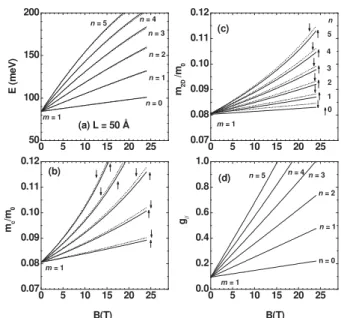
In order to compare our theoretical results with avail-able experimental measurements, we present calculations per-formed for GaAs-Ga0.65Al0.35As QWs. Figure 1 displays the
0 5 10 15 20 25
0.07 0.08 0.09 0.10 0.11 0.12
0 5 10 15 20 25
50 100 150 200
0 5 10 15 20 25
0.07 0.08 0.09 0.10 0.11 0.12
0 5 10 15 20 25
0.0 0.2 0.4 0.6 0.8 1.0
m = 1
(b)
mc /m0
B(T) m = 1
n = 0
n = 1
n = 2
n = 3
n = 4
n = 5
(a) L = 50 Å
E
(
m
eV
)
m = 1
0 3 2 1 4 n 5 (c) m2D /m 0
m = 1
n = 5 n = 4n = 3
n = 2
n = 1
n = 0
(d)
g//
B(T)
FIG. 1: (a) Electronic Landau levels, (b)m↑c,↓ cyclotron effective
mass, (c)m↑2,D↓2D cyclotron effective mass, and (d)g||-factor, in an L = 50 ˚A GaAs-Ga0.65Al0.35As QW as functions of the
growth-direction applied magnetic field. Full (dotted) lines correspond to spin up↑(down↓) electron Landau levels.
0 20 40 60 80 100 120 0.00
0.03 0.06 0.09 0.12
Ga0.65Al0.35As
theory
GaAs
mc /mo
well width (Å)
FIG. 2: Cyclotron effective mass for GaAs-Ga0.65Al0.35As QWs as a
function of the well widths. Present theoretical results are given as a full curve, and experimental data are represented as an open triangle and open circles, from experimental measurements by Singletonet al[2] and Michelset al[3], respectively. The arrow at the left (right) vertical axis indicates the value of themccyclotron effective mass
corresponding to bulk Ga0.65Al0.35As (bulk GaAs).
magnetic-field dependence of theEn,m± electronic Landau lev-els, the cyclotron effective mass
m↑c,↓= (~eB/c)/[E↑,↓
n+1(B)−En↑,↓(B)], (5)
the two-dimensional (2D) cyclotron effective mass m↑2,D↓= (~eB/c)(n+1/2)/[E↑,↓
n (B)−En↑,↓(B=0)], (6)
and parallel g factor,
g||= [En↑(B)−En↓(B)]/(µBB), (7)
for an L = 50 ˚A GaAs-Ga0.65Al0.35As QW. The definition
com-856 Brazilian Journal of Physics, vol. 36, no. 3B, September, 2006
0 50 100 150 200 -0.4
-0.2 0.0 0.2 0.4 0.6 Ga0.65Al0.35As
GaAs
gII
well width (Å)
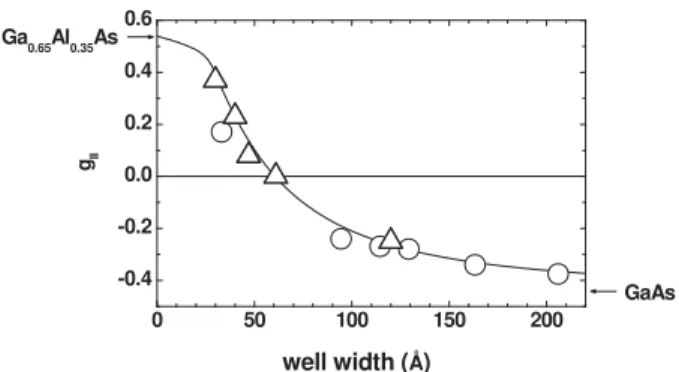
FIG. 3: gk-factor for GaAs-Ga0.65Al0.35As QWs as a function of the
well widths. Present theoretical results are given as a full curve, and experimental data are represented as open triangles and circles, from experimental measurements by Le Jeuneet al[4] and Malinowskiet al[5], respectively. The arrow at the left (right) vertical axis indicates the value of theg||-factor corresponding to bulk Ga0.65Al0.35As (bulk
GaAs).
parison with experimental measurements involving transitions between consecutive Landau levels, whereas them↑2,D↓ 2D cy-clotron effective mass is appropriate for experiments associ-ated with, for instance, resonant magnetotunneling in double barrier heterostructures [26]. Results shown in Figure 1 corre-spond to calculations associated to the electronic levels of the firstm= 1 subband of Landau states. The nonlinear behavior of theEn,m± =1 Landau electronic levels in Fig. 1(a) is due to the presence of non-parabolic terms in the Hamiltonian, and it is apparent that the effects of nonlinearity are stronger for the highest Landau levels and large values of the applied mag-netic field, as compared with the effects on the lowest Landau states. The above mentioned properties of the Landau energy levels lead to the behavior of the cyclotron masses as shown in Figs. 1(b) and 1(c), which evolve from an essentially lin-ear function of the applied magnetic field, for the lowest levels and small values of B, to a strong nonlinear behavior as a func-tion of B, for the highest Landau levels and large values of the applied field. The field-dependence of theg||-factor [cf. Fig. 1(d)] is due both to the magnetic-field effect on the electronic Landau levels as well as to the confinement/barrier penetration of the electron envelope wave function due to the presence of the Ga0.65Al0.35As barriers. Although not shown here, for
large values of the QW width, e.g., L&200 ˚A, the influence of the barriers on the Landau levels is negligible as compared to that of the magnetic field, the electronic envelope wave func-tions essentially do not penetrate in the Ga0.65Al0.35As
barri-ers, and theg||field dependence, forn=0, on the QW width is small. Calculated results for themccyclotron effective mass
as a function of the width of the GaAs-Ga0.65Al0.35As QW are
depicted in Fig. 2 and compared with experimental results by Singletonet al[2] and Michelset al[3]. Theoretical results are for small values of the applied magnetic field (B≈0), and
for them= 1,n= 0 Landau level. As one may see from Fig. 2, the agreement with experimental data by Michelset al[3] is excellent, and we find a fair only agreement with the open tri-angle value by Singletonet al[2]. Figure 3 shows the present theoretical results for theg||-factor, in the case of them= 1, n= 0 Landau level, as a function of the GaAs-Ga0.65Al0.35As
QW width. Again, calculated results are for small values of the growth-direction applied magnetic field (B≈0 - 4 T), and
are compared with the experimental data by Le Jeuneet al[4] (for B in the range from 1 T to 4 T), and Malinowskiet al[5] (for B = 4 T). Notice that, for large QW widths, the value of theg||-factor approaches theg= - 0.44 value of bulk GaAs, as expected. Also, it is apparent in Fig. 3 that the present theo-retical calculations are in excellent agreement with the exper-imental measurements.
Summing up, we have used the effective-mass approxima-tion and taken into account the non-parabolic-band effects via the Ogg-McCombe effective Hamiltonian, to theoreti-cally evaluate the electronic Landau levels, cyclotron effec-tive masses and gk-factors of GaAs-Ga1−xAlxAs
semiconduc-tor QWs. The characteristic problem of the Ogg-McCombe Hamiltonian is solved by expressing the corresponding spin ↑ and ↓ envelope wave functions as products of harmonic-oscillator and QW wave functions. We have obtained them↑c,↓
cyclotron effective mass, them↑2,D↓ and the gk-factor as func-tions of the QW widths and growth-direction applied mag-netic fields, with the calculated results exhibiting a noticeable dependence on the strength of the applied magnetic field. Fi-nally, present theoretical calculations for the Land´e cyclotron effective mass and gk-factor in isolated GaAs-(Ga,Al)As QWs were found in quite good agreement with the experimental measurements reported by Singletonet al[2], Michelset al [3], Le Jeuneet al[4] and Malinowskiet al[5].
Acknowledgments
The authors would like to thank the Colombian COLCIEN-CIAS Agency (under Grant No. 1106-05-13828) and Brazil-ian Agencies CNPq, FAPESP, FAPERJ, FUJB, Rede Nacional de Materiais Nanoestruturados/CNPq, and MCT - Millenium Institute for Quantum Computing/MCT for partial financial support. MdDL and NPM wish to thank the warm hospital-ity of the Institute of Physics, State Univershospital-ity of Campinas, Brazil, where part of this work was performed.
[1] I. Zutic, J. Fabian, and S. Das Sarma, Rev. Mod. Phys.76, 323 (2004).
[2] J. Singleton, R. J. Nicholas, and D. C. Rogers, Surf. Sci.196, 429 (1988).
[3] J. G. Michels, R. J. Warbuton, R. J. Nicholas, J. J. Harris, and
C. T. Foxon, Physica B184, 159 (1993).
[4] P. Le Jeune, D. Robart, X. Marie, T. Amand, M. Brosseau, J. Barrau, V. Kalevich, and D. Rodichev, Sem. Sci. Tech.12, 380 (1997).
M. de Dios-Leyva et al. 857
[6] Y. K. Kato, R. C. Myers, A. C. Gossard, and D. D. Awschalom, Science306, 1910 (2004).
[7] M. Dobers, K. von Klitzing, and G. Weimann, Phys. Rev. B38, 5453 (1988).
[8] V. F. Sapega, T. Ruf, M. Cardona, K. Ploog, E. L. Ivchenko, and D. N. Mirlin, Phys. Rev. B50, 2510 (1994).
[9] G. Medeiros-Ribeiro, M. V. B. Pinheiro, V. L. Pimentel, and E. Marega, Appl. Phys. Lett.80, 4229 (2002).
[10] A. S. Bracker, E. A. Stinaff, D. Gammon, M. E. Ware, J. G. Tischler, A. Shabaev, Al. L. Efros, D. Park, D. Gershoni, V. L. Korenev, and I. A. Merkulov, Phys. Rev. Lett.94, 047402 (2005).
[11] N. R. Ogg, Proc. Phys. Soc.89, 431 (1966). [12] B. O. McCombe, Phys. Rev.181, 1206 (1969). [13] M. Braun and U. Rossler, J. Phys. C18, 3365 (1985).
[14] V. G. Golubev, V. I. Ivanov-Omskii, I. G. Minervin, A. V. Osutin, and D. G. Polyakov, Sov. Phys. JETP61, 1214 (1985). [15] G. Lommer, F. Malcher, and U. R¨ossler, Superlatt. and
Mi-crostruct.2, 273 (1986).
[16] M. de Dios-Leyva, J. Lopez-Gondar, and J. Sabin del Valle, Phys. Stat. Sol. (b)148, K113 (1988); J. Sabin del Valle, J. Lopez-Gondar, and M. de Dios-Leyva, Phys. Stat. Sol. (b)151, 127 (1989).
[17] E. L. Ivchenko and A. A. Kiselev, Sov. Phys. Semicond.26, 827
(1992).
[18] A. Bruno-Alfonso, L. Diago-Cisneros, and M. de Dios-Leyva, J. Appl. Phys.77, 2837 (1995).
[19] E. H. Li, Physica E5, 215 (2000).
[20] Here we use the following bulk values of GaAs:mc= 0.0665m0
and g(GaAs) = - 0.44, and of Ga0.65Al0.35As:mc= 0.1034m0
and g(Ga0.65Al0.35As) = + 0.54. The g-factor values are from
Le Jeuneet al[4] and the conduction-band masses were taken from Li [19].
[21] G. Dresselhaus, Phys. Rev.100, 580 (1955).
[22] Here we refer to de Dios-Leyvaet al[16] for the expressions of ˆ
H0and ˆW.
[23] M. de Dios-Leyva, N. Porras-Montenegro, H. S. Brandi, and L. E. Oliveira, J. Appl. Phys. (submitted for publication). [24] It is straightforward to show that the operator ˆN=aˆ+aˆ−+12,
with ˆa±=−√lB
2(Kˆx±iKˆy), commutes with ˆHand, therefore, it
is possible to find a complete set of common eigenfunctions of both ˆNand ˆH.
[25] One should notice that the electronic Landau energies are inde-pendent of they0orbit-center position, due to the translational
invariance of the Hamiltonian in the in-planeydirection. [26] E. E. Mendez, L. Esaki, and W. I. Wang, Phys. Rev. B33, 2893