
Printed in Brazil - ©2005 Sociedade Brasileira de Química 0103 - 5053 $6.00+0.00
Article
* e-mail: [email protected]
Understanding the Induction Period of the Belousov-Zhabotinsky Reaction
Ariel Cadena, Néstor Pérez, Jesús A. Ágreda and Daniel Barragán*
Laboratorio de Calorimetría y Dinámica Química No-Lineal (451-217), Departamento de Química, Universidad Nacional de Colombia, Carrera 30 No. 45-03, Bogotá, Colombia
No presente estudo apresentamos a dependência do tempo de indução da reação Belousov-Zhabotinsky (BZ) em função da concentração inicial do ácido malonico, bromato e cerium. Os resultados mostram que o tempo de indução aumenta com o aumento da concentração de bromato e tal comportamento não coincide com o mecanismo proposto para as reações BZ. Propomos então que uma competição cinética entre a bromação do ácido malonico e a oxidação dos ácidos bromomalonico e malonico seja o caminho para entender este mecanismo. Cáculos usando modelos GTF e MBM apoiam a proposição sugerida.
In this paper we present the dependence of the induction time of the Belousov-Zhabotinsky reaction (BZ) on the initial concentrations of malonic acid, bromate and cerium. The experimental results show that the induction time gets larger with bromate increasing and this behaviour does not agree with the mechanistic explanations based on the models proposed for the BZ reaction. We propose that a kinetic competition between the bromination of malonic acid and the oxidation of bromomalonic and malonic acids is a way to understand this behaviour. Model calculations using the GTF and MBM models support the propose explanation.
Keywords: Induction period, Belousov-Zhabotinsky reaction, oscillating chemical reactions
Introduction
The Belousov-Zhabotinsky reaction (BZ) has been studied in detail,1,2 however still some features have to be
understanding. One of the principal characteristics of the BZ reaction and the BZ type oscillators3 is a pre-oscillatory
period called the induction period.4 This period is nearly
always present in a BZ reaction, but a complete explanation of it is not know. The more accepted hypothesis to explain the induction period is that a crucial concentration of the organic brominated species is necessary for the onset of the oscillatory regime.5,6
The Györgyi-Turányi-Field (GTF) model7 is one of the
most complete mechanism for the BZ reaction, which is consistent with the hypothesis of a crucial concentration of the organic brominated species for the end of the induction period. According to the GTF model the induction period gets shorter as the bromate concentration increases, mainly because an increase in the bromate concentration involves an increase in the bromomalonic acid (BrMA) production via the reactions, (we use in this paper the notation of the original GTF model7):
(R1, R2): HOBr + Br- + H+↔ Br 2 + H2O k1 forward: 2.3×10
9 (mol L-1)-2 s-1 ; k
2 reverse: 2.0 s -1
(R5, R6): BrO3- + Br - + 2H+↔ HOBr + HBrO 2 k5 forward: 2.0 (mol L-1)-3 s-1 ; k
6 reverse: 3.3 (mol L -1) -1s-1
(R15, R16): MA ↔ MA(enol)
k15 forward: 3.0×10 -3 s-1 ; k
16 reverse: 200 s -1
(R17): MA(enol) + Br2→ BrMA + Br- + H+
k17 forward: 1.91×10⁶ (mol L-1) -1s-1
(R26, R45): Ce4+ + MA ↔ Ce3+ + MAº + H+ k26 forward: 0.23 (mol L
-1) -1s-1 ; k
45 reverse: 1.7×10
4 (mol L-1) -2s-1
(R56): MAº + Br2→ BrMA + Brº
k56 forward: 1.5×10⁸ (mol L-1) -1s-1
mechanism models proposed for the BZ reaction, the GTF and the MBM models.7,8
Experimental
Chemicals
Sulfuric acid (Merck 95-98 % extra pure), KBrO3 (Carlo Erba Milano ACS Titolo min 99.8 %), Ce(SO4)2.4H2O (Merck zur Analyse > 98 %), Malonic acid (Merck zur synthese), were used as received. All solutions were prepared with deionised water.
Analytical method
To following the reaction a air thermostated (25.0 ± 0.2 C) Ocean Optics visible UV-spectrophotometer, with magnetic stirring, was used. The spectrophotometer is provided with storing data digitally and it was set to a 317 and 400 nm wavelength to monitoring the Ce4+ absorbance.
Experimental results
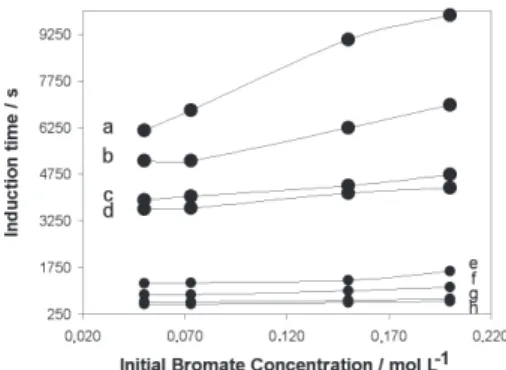
Figure 1 shows that the induction time depends on the initial concentrations of cerium, malonic acid and bromate in the following way: it gets shorter with increasing the initial concentrations of cerium and malonic acid, but it gets larger with increasing the initial bromate concen-tration. A set of additional not reported experiments were carried out in order to ensure the reproducibility of the results; in these experiments potentiometric measurements were done with platinum and bromide ion selective electrodes obtaining the same dependence of the induction time on the initial concentrations of reagents.
The observed dependence of the induction time on the initial concentrations of malonic acid and cerium agree with the mechanistic explanations based on FKN4 and
GTF7,9 models, but is not in agreement with the
expla-nations for the dependence on the initial bromate concentration. In the following sections we show that still there are unknow kinetic details in the mechanistic models proposed to explain the dynamic behaviour of the Belousov-Zhabotinsky reaction.
Discussion
Model calculations
In a way to understand the experimental results, we carried out numerical simulations with the chemical models proposed for the BZ reaction, the GTF and the MBM models. Is our intention to show that changing some kinetic constants of these models is possible to get qualitative explanations for the relation between the bromate concentration and the induction time.
The GTF model
First, we took the complete GTF model. Using the model as in the original paper,7 it is not possible to
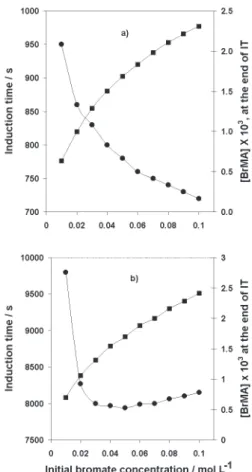
reproduce the experimentally observed behaviour. By way of numeric exploration and trying to find some explanation to the observed behaviour some of the key rate constants of the original GTF model were changed. The increase in the induction period as the initial bromate concentration increases can be obtained changing a single rate constant, that of the following reaction:
(R26): Ce4+ + MA → Ce3+ + MAº + H+ k
26 = 0.23 (mol L -1)-1s-1
but a dramatic change in the rate constant was necessary, 100 times less than the experimentally obtained data;7
see Figure 2, where the simulation with the modified k26 rate constant (Figure 2b) is compared with the unmodified GTF model (Figure 2a). Although the qualitative behaviour is obtained in the simulations, the length of the induction period is larger than the experimental one. At this point, we highlight the qualitative agreement, because it shows the key role of the oxidation process of MA, in the kinetic control of the induction period of the BZ reaction. In Figure 2 we include the calculated BrMA concentration at the end of the induction time because of the well established hypothesis of a crucial BrMA concentration necessary for the onset of the oscillatory regime.2 In agreement with this hypothesis the crucial
Figure 1. The length of the induction period as function of the initial concentrations of malonic acid, bromate and cerium in sulfu-ric acid 1.0 mol L-1. The two sets of experiments are classified according to the initial concentration of cerium; curves a-d with [Ce(SO4)2]0 = 0.00549 mol L-1 and curves e-h with [Ce(SO
4)2]0 = 0.050 mol L-1 . The initial malonic acid concentration changes in the following way; a and e with [MA]0 = 0.050 mol L-1,. b and f with [MA]0 = 0.073 mol L-1, c and g with [MA]
0 = 0.150 mol L
BrMA concentration increases with bromate concen-tration increasing.
A more close adjust to the experimental conditions is obtained changing the next three rate constants (including the last one), in a dramatic way too:
(R17): MA(enol) + Br2→ BrMA + Br- + H+ GTF k17 : 1.91×10⁶ (mol L-1) -1s-1; suggested k
17: 1.91x10
2 (mol L-1) -1s-1
(R25): Ce4+ + BrMA → Ce3+ + BrMAº + H+ GTF k25: 0.09 (mol L
-1)-1s-1; suggested k
25: 900 (mol L -1)-1s-1
(R26): Ce4+ + MA → Ce3+ + MAº + H+ GTF k26: 0.23 (mol L-1)-1s-1; suggested k
26: 0.0023 (mol L -1)-1s-1
Doing these changes it was possible to obtain again the qualitative and go closer to the quantitative behaviour in the bromate concentration and in the length of the induction period, see Figure 3. An additional result of our previous numerical explorations, is the lower concentration
of BrMA necessary to obtain the start of the oscillations (slow production, fast consumption), respect to the original GTF model. This is a parallel evidence of the control of the oxidation process during the induction period, then is expected that the bromination is not the kinetic relevant process.
From the simulations it is clear that at low initial bromate concentration a decrease in the induction period as bromate concentration increases is produced, see Figures 2b and 3a, because the bromate concentration increases the rate of BrMA production, by means of the reactions:
(R26): Ce4+ + MA → Ce3+ +MAº + H+ k26 = 0.23 (mol L-1)-1s-1,
(R56): MAº + Br2→ BrMA + Brº
k56 = 1.5x10⁸ (mol L-1)-1s-1,
R44 MAº + Brº → BrMA,
k44 = 1.0x10⁹ (mol L-1)-1s-1. Figure 2. The length of the induction period as function of the initial
bromate concentration. Simulation results; a) GTF, original rate con-stants values; b) GTF model changing only the k26 rate constant from 0.23 to 0.0023 (mol L-1)-1s-1. z Induction period length, Bromo-malonic acid concentration at the end of the induction period. [MA]o=0.026 mol L-1, [Ce4+]
o=0.05 mol L
-1 and sulfuric acid 1.0 mol L-1.
Figure 3 The length of the induction period as function of the initial bromate concentration. Simulation results: a) GTF model changing the rate constants k17 from 1.91×10⁶ to 1.91×10² (mol L-1)-1s-1, k
25 from 0.09 to 900 (mol L-1)-1s-1 and k
26 from 0.23 to 0.0023 (mol L-1)-1s-1; b) MBM model. z Induction period length, Bromo-mal-onic acid concentration at the end of the induction period. [MA]o=0.026 mol L-1, [Ce4+]
o=0.05 mol L
Where R26 is fast because the high concentrations of Ce4+ and MA respect to the MAº, Br
2 and Brº. The Br2 is
produced through R5 and R1 . Then when the BrO3
-increases, the Br2 production increases because the rate of this reactions increases too (bromination process); but, when the initial bromate concentration is high enough, the following set of reactions
(R8): BrO3- + HOBr + H+→ 2HBrO 2 ,
(R9): BrO3- + HBrO 2 + H
+→ Br
2O4 + H2O,
(R11): Br2O4→ 2BrO2º , (R13): Ce3+ + BrO
2º + H
+→ HBrO
2 + Ce 4+,
is more important than the bromination process, and then less BrMA is produced and the induction period is extended as the initial bromate concentration increases. In the oxidation of MA and BrMA process there is no important production of Br2, because the Br- was consumed
almost totally, in part by the highest concentration of BrO3–
and HBrO2 (R5 and R3).
(R3): HBrO2 + Br- + H+→ 2HOBr
Therefore, if the bromate concentration is high the system needs more time to produce Br2, which is necessary to produce BrMA. On the other hand, the results of the simulations with the change in the above rate constants (k17, k25 and k26), indicate a clear competition between the bromination of MA and the oxidation of BrMA and MA: All what was made was to diminish the rate of production of BrMA as it can be seen by the decreasing of the rate constants of the reactions R17, and R26, and the increase in the rate of oxidation of BrMA by means of the increasing of the rate constant k25. The previous explanation is supported in Figure 4, where calculated reaction rates during the induction time are shown. It is clear from this figure, that in the original GTF model the rates always increase as the bromate concentration increases, but in the modified model this behaviour changes as bromate becomes near 0.03 mol L-1. This change in the behaviour
of the reaction rates (except for the reaction R26 ), produce finally the observed behaviour in the induction period. Otherwise,it was found that with the GTF rate constants, the BrMA concentration rises as the initial bromate concentration increases, but in the GTF modified model, the BrMA concentration increase is not so steep as the original one; Figures 2 and 3. This is other way to show the change in the qualitative behaviour of the BZ reaction necessary to reproduce the experimental results.
Obviously, there are other ways to obtain the observed behaviour, the one presented here is just one of them.
The MBM model
Another option is to change the mechanism, as the most recent proposed model for the BZ reaction, the
Missoula-Budapest-Marburg (MBM) 8 model does it.
Using the MBM model, the experimental results are found without any change in the rate constants, although the length of the induction period is longer than the experimental one, Figure 3b. To change the model used for simulations is equivalent to change the rate constants of the GTF model, and it shows that some processes are more important than others. In our case, the changes in the GTF model can be resumed as the competition between the processes of bromination and oxidation, and in the MBM model, the new characteristic of the radical recombination looks like the principal source of the change in the qualitative behaviour. It can not be forgotten either, that the new reactions of the inorganic subset
HBrO2 + H+ → H 2BrO2
+,
HBrO2 + H2BrO2+→ HOBr + BrO 3
– + 2H+,
Figure 4. The reaction rates of the: a) (R5 + R6): BrO3- + Br- + 2H+ → HOBr + HBrO2, b) (R17): MA(enol) + Br2 → BrMA + Br- + H+. z GTF, original rate constants values, GTF, modified rate constants k17, k25 and k26. [MA]o=0.026 mol L-1, [Ce4+]
2BrO3– + 2H+→ 2HBrO 2 + O2 ,
BrO2º → 1/2 Br2 + O2,
and the changes in various of the rate constants of the common reactions as R1, R2, R3 and so on, can be the reason of the change in the behaviour of the MBM respect to the GTF model and particularly in the change of the behaviour respect to the matter of this paper, the induction period.
Additionally, we carried out numeric explorations with the reduced version of the GTF mechanism.9 This one is a
42-reaction and 22-species mechanism which contains the bromide and the organic radical control as negative feedbacks. There are some important features in the GTF-42 mechanism: first, the disproportionation is dominant for reactions between organic free radicals; and second, there are two important reaction steps to ensure the oscillatory dynamic:
(R38): BrMAº + Ce4+ + H
2O → Ce
3+ + BrTTA + H+
k38 = 1.0x10⁷ (mol L-1)-1s-1 ,
(R61): MAº + BrMA → MA + BrMAº
k61 = 1.0x10⁵ (mol L-1)-1s-1.
The GTF-42 mechanism has been tested successfully by modeling different experimental situations,10,11 but we
were not able to simulate under our experimental initial conditions the experimental behaviour reported in this paper. We explored without success a wide range of initial Figure 5. Simulation of the induction time in function of the bro-mate concentration when [MA]o=0.026 mol L-1, [Ce3+]
o = 0.001 mol L-1, [H
2SO4]o = 1.0 mol L
-1. a) Reduced GTF-42 mechanism, b) c Reduced GTF-42 mechanism and modified with the inorganic sub-set of the MBM mechanism, c) z Reduced GTF-42 mechanism and modified with the inorganic subset and the radical addition reac-tions of the MBM mechanism, d) S Extended GTF mechanism, e) * MBM model.
concentrations for malonic acid, bromate and Ce4+, but
when we replace in the simulations the initial concentration of Ce4+ by Ce3+, we found that the GTF-42 is able to simulate
qualitatively the observed experimental behaviour for the induction time (Figure 5a). The curve shows two regimes: one is when the bromate concentration is smaller than 0.01mol L-1. In this case, not oscillations are observed and
the induction time decreases when the bromate concentration increases. The other one is when the bromate concentration is bigger that 0.01 mol L-1, oscillations are
observed and the induction time of the reaction increases lightly when the bromate concentration increases. Figure 5b shows higher values of the induction time when the GFT-42 mechanism is modified with the inorganic subset of the
MBM mechanism
Finally, we made simulations with a modified GTF-42 model using the inorganic subset and the radical recombinations reactions of the MBM model (Figures 5c), and intermediate values for the length of the induction time were found. We also made simulations with a extended GTF mechanism (Figure 5d) and with the MBM model (Figure 5e). The lowest values for the length of the induction time were found with the complete GTF model, but a very different behaviour was found with the MBM model. After an extensive numerical explorations with the MBM we found that, independently of the initial concentrations of reactants, the length of the induction time increases when the bromate concentration increases, contrary to the GTF model. This means that for the MBM model is not possible a decrease in the induction period as the bromate concentration increases.
The last interesting observation was the behaviour of the BrMA crucial concentration depends of the model, Figure 6. The BrMA always increases, no matter which model we use and in agree with the hypothesis of a crucial BrMA concentration at the end of the induction period, but the rate of the increase is different between models, which shows the importance of the bromination process in every model and then, obviously, how the changes in the reactions and in the rate constants used, can modified the behaviour of the induction period as the bromate concentration rises.
Conclusions
the hypothesis of a competition between the bromination process of MA and the oxidation process of BrMA and MA. Each process was manipulated changing the rate constant value of the reactions R17, R25 and R26 of the GTF model, in this way: decreasing the reactions that produce BrMA (R17 and R26) and increasing the reaction of oxidation of BrMA (R25).
The essence of the MBM model, the recombination (and may be, the additional reactions respect the GTF model and the revised values of some rate constants), make it able to reproduce qualitatively the experimentally observed behaviour, indicating that there is more than one way to explain the experimental behaviour, and showing that an absolute mechanism to the BZ reaction is still in construction, because of the high complexity of this marvelous reaction.
It is notable that with the MBM model is not possible to decrease the induction period with the increase in the bromate concentration, contrary to the GTF model, where for low concentration of bromate, this behaviour is
possible. This is the main difference found in this work between the two models.
In conclusion, with this work we have showed that still there are many unknow kinetic details in order to explain any dynamic behaviour of the Belousov-Zhabotinsky.
Acknowledgments
This work was partially supported by grants DIB 803638 and DINAIN D100C397, of the Universidad Nacional de Colombia.
References
1. Epstein, I.; Pojman, J.; An Introduction to Nonlinear Chemical Dynamics, Oxford University Press: New York, 1998. 2. Field, R.; Burger, M.; Oscillations and Traveling Waves in
Chemical Systems, John Wiley & Sons: New York, 1985. 3. Berenstein, I.; Agreda, J.; Barragán, D.; Phys. Chem. Chem.
Phys.1999, 1, 4601.
4. Field, R.; Körös, E.; Noyes, R.; J. Am. Chem. Soc. 1972, 94, 8649.
5. Körös, E.; Burger, M.; Friedrich, V.; Ladányi, L.; Nagy, Zs.; Orbán, M.; Faraday Symp. Chem. Soc.1974, 9, 28. 6. Sirimungkala, A.; Försterling, H.; Dlask, V.; Field, R.; J. Phys.
Chem.1999, 103, 1038.
7. Györgyi, L.; Turányi, T.; Field, R.; J. Phys. Chem. 1990, 94, 7162.
8. Hegedus, L.; Wittman, M.; Noszticzius, Z.; Yan, Sh.; Sirimungkala, A.; Försterling, H.; Field, R.; Faraday Discuss. 2002, 120, 21.
9. Turányi, T.; Gyorgyi, L.; Field, R.; J. Phys. Chem.1993, 97, 1931.
10. Ruoff, P.; Forsterling, H.; Gyorgyi, L.; Noyes, R.; J. Phys.
Chem.1991, 95, 9314.
11. Berenstein, I.; Agreda, J.; Barragán, D.; J. Phys. Chem A. 1999, 103, 9780.
Received: January 19, 2004
Published on the web: February 23, 2005 Figure 6. Simulation of the bromomalonic acid crucial
concentra-tion in funcconcentra-tion of the bromate concentraconcentra-tion when [MA]o=0.026 mol L-1, [Ce3+]
o=0.001 mol L -1, [H
2SO4]o=1.0 mol L

![Figure 5. Simulation of the induction time in function of the bro- bro-mate concentration when [MA] o =0.026 mol L -1 , [Ce 3+ ] o = 0.001 mol L -1 , [H 2 SO 4 ] o = 1.0 mol L -1](https://thumb-eu.123doks.com/thumbv2/123dok_br/18990807.460584/5.892.95.381.597.845/figure-simulation-induction-time-function-bro-mate-concentration.webp)
