Marginal zones of lentic or lotic environments, as well as swampy environments, are considered ecotones between terrestrial and aquatic environments, being characterized by communities marked by the presence of aquatic macrophytes. The submerged parts of macrophytes provides substrates for the development of periphyton, which acts as food resource and support a complex community of aquatic invertebrates (TAKEDAet al. 2003). This phytophilous fauna has been the fo-cus of growing attention, as the comprehension of its role in the energy flow of aquatic ecosystems increases. The impor-tance of this community in water quality evaluation is high, considering that marginal zone of aquatic environments has been subject to extensive morphological modifications deriv-ing from human activities (MARGARITORAet al. 2003).
The water-land ecotone regions usually present a higher species richness than the open water environments. The higher complexity of microenvironments, generated by the presence of several species of macrophytes, seems to be the factor re-sponsible for this increase in richness (NOGUEIRAet al. 2003).
Cladocerans comprise a major part of the diverse littoral community (DODSON & FREY 2001). Littoral species include truly
filter feeders, such as some sidids (Ctenopoda) and some moinids and daphniids (Anomopoda Sars, 1865), as well scraper feeders, such as macrothricids and chydorids (Anomopoda). In the later case, animals typically feed by crawling along surfaces or through mud and scraping up or filtering food (FRYER 1968, 1974), being specialized in exploring the several microhabitats created by the submerged parts of the macrophytes. It cannot be attributed to a random event the fact that these two families correspond to about 60% of all known cladoceran species diversity (KOROVCHISNKY 1996). The Paranã River basin has 5.940.382 ha, and it is a de-pression between the Central Goiano Plateau and the plateau representing the São Francisco and the Tocantins divide (13°20’-15°40’S, 46°35’-47°30’W) (SILVA & SCARIOT 2003). Like in most parts of the Central Brazilian Plateau, the cladoceran fauna of this region is still unknown (ELMOOR-LOUREIRO 2000).
As part of the PROBIO project “Assessment Survey of the Aquatic Biota with Conservation and Sustainable Use Intent of the Cerrado Biome (Paranã River Mountain Range and Valley)”, this study aimed to survey the cladoceran species associated with macrophytes of permanent and temporary freshwater environments of this region.
fr
fr
fr
fr
from Par
om Par
om Par
om Par
om Paranã Riv
anã Riv
anã Riv
anã Riv
anã River
er V
er
er
er
V
V
V
Valle
alle
alle
alle
alley
y
y,,,,, Goiás,
y
y
Goiás,
Goiás, Br
Goiás,
Goiás,
Br
Br
Brazil
Br
azil
azil
azil
azil
Lourdes M. A. Elmoor-Loureiro
Laboratório de Zoologia, Universidade Católica de Brasília. QS 7 lote 1, Bloco M, sala 331, 71966-700 Taguatinga, Distrito
Federal, Brasil. E-mail: [email protected]
ABSTRACT. A rapid assessment survey identified 39 phytophilous cladocerans species from littoral zones of
rivers, permanent and temporary lagoons, and swamps of the Paranã River Valley, Goiás, Brazil, 22 are registered
for the first time in Central Brazil. Aspects of the taxonomy of some of these species are discussed. Cluster
analysis (UPGMA) revealed two phytophilous cladoceran assemblages, characterized by higher or lower richness
and relative abundance of species of the families Daphniidae and Moinidae (filter feeders), in comparison with
the dominant families Chydoridae and Macrothricidae (scraper feeders).
KEY WORDS. Cladocera; cluster analysis; phytophilous fauna; species richness.
RESUMO. Cladócer
Cladócer
Cladócer
Cladócer
Cladóceros
os
os
os
os fffffitóf
itóf
itóf
itóf
itófilos
ilos
ilos
ilos
ilos (Cr
(Crustacea
(Cr
(Cr
(Cr
ustacea
ustacea
ustacea
ustacea, Anomopoda
Anomopoda
Anomopoda
Anomopoda
Anomopoda and
and
and
and
and Ctenopoda)
Ctenopoda) do
Ctenopoda)
Ctenopoda)
Ctenopoda)
do
do
do
do v
vv
vvale
ale
ale
ale do
ale
do
do
do
do Rio
Rio Par
Rio
Rio
Rio
Par
Par
Paranã
Par
anã
anã
anã
anã, Goiás
Goiás
Goiás
Goiás
Goiás,
Br
Br
Br
Br
Brasil.
asil.
asil.
asil.
asil. Através de amostragens rápidas, levantou-se as espécies de cladóceros fitófilos presentes em zonas
litorâ-neas de rios, lagoas e brejos permanentes e temporários do vale do Rio Paranã, Goiás, Brasil. Foram encontradas
39 espécies, das quais 22 são registradas pela primeira vez na região central do Brasil. São discutidos aspectos da
taxonomia de algumas dessas espécies. A análise de agrupamento (UPGMA) dos pontos de amostragem
mos-trou dois tipos de associações de espécies de cladóceros fitófilos, caracterizadas pela maior ou menor riqueza e
abundância relativa das espécies das famílias Daphniidae e Moinidae (filtradoras), em contraste com as famílias
dominantes Chydoridae e Macrothricidae, tipicamente raspadoras do substrato.
345
Phytophilous cladocerans from Paranã River Valley, Goiás, Brazil
MATERIAL AND METHODS
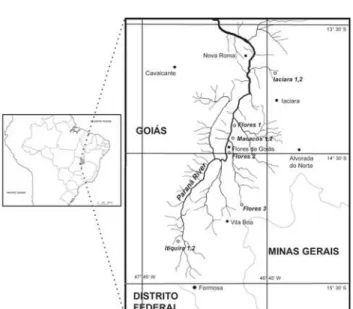
The Paranã River Basin (Fig. 1) is located in the Central Brazil, and the regional climate has two well-defined periods: a cool, dry winter (from May to September) and a warm, rainy summer (from October to April). Sample collection occurred during rapid sampling expeditions conducted throughout the wet season (2003 and 2005) and, in case of perennial water bodies, also in the dry season (2003 and 2004). Although 30 sampling points were defined for the PROBIO project, for the present work it was selected only the water bodies where an expressive macrophyte community existed or where other ap-propriate substrates for cladoceran colonization were present (e.g. submerged terrestrial plants) (Tab. I, Figs 2-5).
For specimens sampling, it was used a plankton net with mesh size of 130 µm, which was large enough to reduce the sediment in the samples, yet small enough to hold adult cla-docerans (eventually, the youngest individuals could be lost). The net had its opening protected by a grating (1 cm mesh), in order to avoid the introduction of large fragments. The net was introduced among the macrophytes and the filtered con-tent was fixed in 4% formalin. Animals were sorted and counted under a stereomicroscope. When few specimens were present, entire samples were counted, but when samples were very rich, successive sub-samples were examined until the cumulative richness remained stable (at least five sub-samples without the addition of new taxons). The relative abundance of each taxon was registered, with the intention of identifying the dominant
species (approximately 50% of the relative abundance). Voucher specimens are deposited at the Laboratory of Zoology of Univer-sidade Católica de Brasília.
In order to compare the cladoceran fauna among the sam-pling points, a cluster analysis (UPGMA, mean character differ-ence) was conducted using PAUP 4 (SWOFFORD 1999). The data
Table I. Position and characterization of the phytophilous cladoceran sampling points in the Paranã River Valley, Goiás, Brazil. Sampling points Coordinates Type of substrate
Iaciara 1 Temporary flood area, road GO110,
Iaciara County 13°49'35.2"S; 46°38'54.5"W Dense emergent macrophytes Iaciara 2 Water pond for cattle, 100 m from point
Iaciara 1 13°49'35.2"S; 46°38'54.5"W Spaced emergent macrophytes
Itiquira 1
Natural lagoon with elevated water level created by a dam, near Salto de Itiquira, road GO116, Formosa County
15°09'15.8"S; 47°28'04.7"W Dense submerged macrophytes
Itiquira 2 Temporary flood area, between point
Itiquira 1 and road 15°09'15.8"S; 47°28'04.7"W Submerged grass in decomposition
Flores 1
Temporary swamp between the Macacos and Correntes Rivers, road GO236, Flores de Goiás County
14°18'23.9"S; 46°57'34.0"W Emergent and a few floating macrophytes
Flores 2
Flooded areas along the right (point Flores 2d) and left (point Flores 2e) margins of road GO114 way to Flores de Goiás
15°09'15.8"S; 47°28'04.7"W Submerged macrophytes
Flores 3
Natural lagoon, BR020, near the intersection of road GO114, Flores de Goiás County
14°54'56.0"S; 46°57'02.9"W Submerged and dense floating macrophytes
Macacos 1 Macacos River, Flores de Goiás County 14°27'42.9"S; 47°00'15.2"W Spaced grass and phylamentous algae Macacos 2 Backwater of Macacos River, Flores de
Goiás County 14°27'42.9"S; 47°00'15.2"W Submerged tree limbs and leaves
matrix was constructed coding for presence (1) and absence (0) of each species in the samples using the software MacClade 3.04 (MADDISON & MADDISON 1992). For this analysis, data from the sampling repetitions were combined. For perennial water bod-ies, the Sørensen coefficient was calculated to estimate the simi-larity between community in dry and wet season.
RESULTS AND DISCUSSION
A total of 39 cladoceran species were identified (Tab. II), of which 22 were registered for the first time for this region of Central Brazil – Distrito Federal/Goiás (cf. ELMOOR-LOUREIRO 2000, ELMOOR-LOUREIROet al. 2004). Since the majority of these species possess an ample distribution, their occurrence in the Brazil-ian Midwest is predictable. No endemic species to this region were identified.
In the last two decades, several Neotropical species of cla-docerans were the object of taxonomical reviews (e.g. FREY 1993, SINEV 1998, 2001a, b, SILVA-BRIANOet al. 1999, DUMONT & SILVA-BRIANO 2000, DUMONTet al. 2002, KOTOVet al. 2002), supporting even more the idea that species once considered cosmopolitan, actu-ally represent species complexes (FREY 1995, KOROVCHINSKY 1996, DUMONT 1997). The taxonomy of some of these complexes is not
entirely elucidated, being the case of Latonopsis australis-group (KOROVCHINSKY 1992), Ephemeroporus barroisi-group (FREY 1982) and Simocephalus acutirostratus-group (ORLOVA-BIENKOWSKAJA 2001).
Several species identified in this study were the object of recent reviews, therefore, they were not included in ELMOOR -LOUREIRO (2000), or were presented in different genera. These species are illustrated and aspects of their taxonomy are dis-cussed below.
Alona dentifera (Sars, 1901) (Figs 6 and 7) was originally described in the Alonella genus, but was recently transferred to Alona Baird, 1843, particularly because of its trunk limbs char-acteristics, which are typically of the Aloninae type (SINEVet al. 2004). These authors, based on the detailed comparisons, also affirm that Alonella brasiliensis Bergamin, 1935 is a junior syn-onym of A. dentifera.
Alona verrucosa Sars, 1901 (Figs 8 and 9), due to the pres-ence of two median cephalic pores, was transferred to the Biaper-tura Smirnov, 1971. SINEV & HOLLWEDEL (2002) presented this species once again in the Alona genus, following the tendency to abandon the Biapertura genus, now considered an artificial taxon.
347
Phytophilous cladocerans from Paranã River Valley, Goiás, Brazil
Table II. Cladoceran species from flooded areas and marginal zones of aquatic environments of the Paranã River Valley and mountain range. The first records of occurrence in Central Brazil are indicated by (*). Species that had a relative abundance close or superior to 50%, characterizing strong community dominance are indicated by (xx). (Flor) Flores, (Itiq) Itiquira, (Iaci) Iaciara, (Mac) Macacos.
Taxa Wet season 2003 Dry season 2003-4 Wet season 2005 Itiq1 Itiq2 Mac1 Mac2 Flor1 Itiq1 Mac1 Iaci1 Iaci2 Flor2d Flor2e Flor3 Ctenopoda
Sididae Baird, 1850
Diaphanosoma brevireme Sars 1901 x x x x
Diaphanosoma spinulosum Herbst, 1967 x
Latonopsis australis-group x x x x x xx
*Pseudosida ramosa (Daday, 1904) x x x
Anomopoda
Daphniidae Straus, 1820
Ceriodaphnia cornuta Sars, 1886 x x x xx xx
*Scapholeberis armata (Herrick, 1882) x
*Simocephalus acutirostratus-group x xx x
*Simocephalus latirostris Stingelin, 1906 x x
Moinidae Goulden, 1968
*Moina reticulata (Daday, 1905) x
Moina micrura Kurz, 1874 x
*Moinodaphnia macleayi (King, 1853) x x xx x
Ilyocryptidae Smirnov, 1992
Ilyocryptus spinifer Herrick, 1882 x x x x x x x x x
Macrothricidae Norman & Brady, 1867
Macrothrix elegans Sars, 1901 x x x x x x x x x x
Macrothrix squamosa Sars, 1901 x x x x x
Macrothrix paulensis (Sars, 1900) x
Streblocerus pygmaeus Sars, 1901 x x x
Chydoridae Stebbing, 1902
*Alona dentifera (Sars, 1901) x x
Alona guttata Sars, 1862 x
*Alona monacantha Sars, 1901 x x
*Alona ossiani Sinev, 1998 x
*Alona verrucosa Sars, 1901 x x x x x x x
Alonella dadayi Birge, 1910 x x x
*Chydorus dentifer Daday, 1905 x x x x
Chydorus eurynotus Sars, 1901 x
*Chydorus nitidulus (Sars, 1901) x x x x x
Chydorus pubescens Sars, 1901 x x x x x x
Chydorus sp. x x x
*Dadaya macrops (Daday, 1898) x x
*Dunhevedia odontoplax Sars, 1901 x x
Ephemeroporus barroisi-group x x x x
*Ephemeroporus hybridus (Daday, 1905) x x x x x x
*Ephemeroporus tridentatus (Bergamin, 1931) x x x x
Euryalona orientalis (Daday, 1898) x
*Graptoleberis occidentalis Sars, 1901 x
*Karualona mülleri (Richard, 1897) x x x x x x x x
*Leydigiopsis megalops Sars, 1901 x x x
*Nicsmirnovius cf incrediblis (Smirnov, 1984) x
*Notalona sculpta (Sars, 1901) x
*Oxyurella longicaudis (Birge, 1910) x x x
349
Phytophilous cladocerans from Paranã River Valley, Goiás, Brazil
ralona dadayi (e.g. ELMOOR-LOUREIRO 1998), other times as Phryxura dadayi (e.g. LIMAet al. 2003). The proposed synonymy between Disparalona Fryer, 1968 and Phryxura Müller, 1867 was rejected by the suppression of the latter name (ICZN 2001). Indepen-dently of this fact, SMIRNOV (1996) suggested the reallocation of this species in the Alonella Sars, 1862 genus until further stud-ies are conducted. In fact, some details of A. dadayi morphol-ogy suggest that it does not belong to Disparalona, such as its not elongated shape, the better development of the labral plate and absence of the robust seta on gnathobase of trunk limb 3 directed along food groove.
DUMONT & SILVA-BRIANO (2000) discussed the particular char-acteristics the Alona karua-group (or Biapertura karua-group), con-cluding that all the species should be transferred to the new ge-nusKarualona, and showing that each one has a restricted distri-bution to one continent. In Brazil, Karualona mülleri (Richard, 1897) (Figs 12 and 13) was reported from the Pantanal of Mato Grosso (HOLLWEDELet al. 2003), creating the possibility that pre-vious reports of Alona karua in Brazil were actually this species. SARS (1901) described Graptoleberis occidentalis (Fig. 14) as a subspecies of Graptoleberis testudinaria (Fischer, 1851). How-ever, the growing evidences of the non-cosmopolitanism of Chydoridae sustain the separation of the two species, already in use by PAGGI (1995).
Alona incredibilis Smirnov, 1984 is distributed throughout the Amazon, and was recently transferred to the Nicsmirnovius Chiambeng & Dumont, 1999 genus (KOTOV 2003), based on its head pore arrangement, postabdomen and trunk limbs charac-teristics. The observed specimens (Fig. 15) presented few differ-ences in relation to Nicsmirnovius incredibilis, demanding addi-tional studies to confirm the identification.
Macrothrix squamosa Sars, 1901 (Fig. 16) has been pre-sented as a junior synonym of Macrothrix spinosa King, 1853 (SMIRNOV 1992). However, evidences of the non-cosmopolitan distribution of species belonging to this genus (SILVA-BRIANOet al. 1999, DUMONTet al. 2002) raise doubts about the synonymy betweenM. spinosa, originally described from Australian speci-mens, and M. squamosa, from the Neotropics. The proposed synonymy was based on superficial similarities, such as the general aspect of the carapace, antennule, and postabdomen. However, the taxonomical revisions of Macrothrix laticornis group (SILVA-BRIANO et al. 1999) and Macrothrix rosea-triserialis group (DUMONTet al. 2002) revealed the importance of the trunk limbs morphology in defining species. Thus, until M. spinosa andM. squamosa could be properly studied, it is recommended that they be treated as separate species.
(ELMOOR-LOUREIRO 2000), this is the first record of its hairy mor-phs from Brazil. According to BERNER (1985), such hairy morphs are common and found primarily in littoral habitats. I observed two different patterns: fine haired specimens, generally associ-ated with the rigaudi form (Figs 17-19) and coarse haired speci-mens (pilosity similar to spines), generally found in the cornuta form (Figs 20 and 21).
The most frequent species were Ilyocryptus spinifer Herrick, 1882,Karualona mülleri, and Alona verrucosa, which were found in more than 50% of the samples. Latonopsis australis,Chydorus pubescens Sars, 1901, and Ephemeroporus hybridus (Daday, 1905), occurred in 50% of the samples.
In a few samples, the species Ceriodaphnia cornuta, Moino-daphnia macleayi (King, 1853), Simocephalus acutirostratus-group andLatonopsis australis were particularly abundant, with an estimated relative abundance of nearly 50% (Tab. II).
Comparison of the communities between wet and dry seasons was only possible in two perennial sampling points (points Itiquira 1 and Macacos 1). A small variation in total richness was verified, but the species composition of the com-munities were variable (Sørensen coefficient between wet and dry season for point Itiquira 1 = 0.65; point Macacos 1 = 0.40). Some of the observed species cannot be considered to be truly phytophilous, given that they are typical filter feeders from the planktonic community, this being the case of Diaphanosoma brevireme Sars, 1901, Diaphanosoma spinulosum Herbst, 1967, and Moina micrura Kurz, 1874. These species were found in environ-ments where emergent macrophytes were present, or where open water occurred among the plants, which suggests that their oc-currence in the samples was accidental. An alternative hypoth-esis would be the occurrence of a migration from the limnetic zone, as a strategy to escape from predators, already verified in other species (STANSFIELDet al. 1997).
Higher species richness occurred in environments where submerged macrophytes (points Itiquira 1 and Flores 2), or flooded terrestrial vegetation (point Macacos 2) were predonant. These substrates seem to support a greater variety of mi-crohabitats than emergent or floating macrophytes, favoring exploration by a larger number of species.
The cluster analysis of the sampling points (Fig. 22) indi-cates the existence of two types of associations of phytophilous cladoceran species in the aquatic environments of the Paranã River Valley. The first association (group A) is related to environ-ments with the predominant presence of emergent macrophytes (points Iaciara 1, Iaciara 2, Macacos 1, and Flores 1), which leads to the occurrence of open water among the substrates (Figs 2 and 3). In this association, a greater number and relative abun-dance of species of the families Daphniidae and Moinidae (filter feeders) occur than in the second type of association. This is not caused only by the presence of planktonic species, but also by the typical filter feeders from the littoral zone, for example Moinodaphnia macleayi and the Simocephalus species (FRYER 1991). The second association (group B) occurs in environments
that are dominated by submerged macrophytes (Figs 4 and 5), being characterized by a greater richness and elevated relative abundance of the families Chydoridae and Macrothricidae, typically substrate scraper feeders.
The point Macacos 2 is distinguished from the two pre-vious associations (Fig. 22), and it has the highest number of species (Tab. II). The considerable mass of free water between the abundant submerged material (shrubs and tree limbs) cre-ated a peculiar and intermediate condition between the two previously described types of environments, which could ex-plain its higher richness.
The results of the cluster analysis, however suggestive, must be considered as preliminary, given that sampling effort was punctual and the abundance of the present taxa was not considered.
ACKNOWLEDGEMENTS
I thank the biology students from Universidade Católica de Brasília, particularly Rogéria de Alcântara Sodré, Alline Raulino Zeni, and Luciana Barros de Carvalho. To Eduardo Santos for English translation and comments to the manuscript. Financial support: PROBIO/CNPq/MMA.
REFERENCES
BERNER, D.B. 1985. Morphological differentiation among species in the Ceriodaphnia cornuta complex (Crustacea, Cladocera).
Verhandlungen Internationale Vereinigung für theoretische und angewandte Limnologie 22: 3099-3103.
DODSON, S.I. & D.G. FREY. 2001. Cladocera and Other Branchio-poda, p. 849-913. In: J.H. THORP & A.P. COVICH (Ed). Ecology and Classification of north American freshwater
351
Phytophilous cladocerans from Paranã River Valley, Goiás, Brazil
brates. San Diego, Academic Press, 2nd ed., XVI+1056p. DUMONT, H.J. 1997. Cladoceran studies: where do we go from
here?Hydrobiologia 360: 301-303.
DUMONT, H.J. & M. SILVA-BRIANO. 2000. Karualona n. gen. (Anomo-poda: Chydoridae), with a description of two new species, and a key to all known species. Hydrobiologia 435: 61-82. DUMONT, H.J.; M. SILVA-BRIANO & K.K. SUBHASH BABU. 2002. A
re-evaluation of the Macrothrix rosea-triserialis group, with the description of two new species (Crustacea: Anomopoda: Macrothricidae).Hydrobiologia 467: 1-44.
ELMOOR-LOUREIRO, L.M.A. 1998. Branhiopoda. Freshwater Cladocera, p. 15-41. In: P.S. YOUNG (Ed.). Catalogue of
Crus-tacea of Brazil. Rio de Janeiro, Museu Nacional, XVII+718p. ELMOOR-LOUREIRO, L.M.A. 2000. Brazilian cladoceran studies:
where do we stand? Náuplius 8: 117-131.
ELMOOR-LOUREIRO, L.M.A.; L. MENDONÇA-GALVÃO & C. PADOVESI -FONSECA. 2004. New cladoceran records from Lake Paranoá, Central Brazil. Brazilian Journal of Biology 64 (3A): 415-422.
FREY, D.G. 1982. Relocation of Chydorus barroisi and related species (Cladocera, Chydoridae) to a new genus and descrip-tion of two new species. Hydrobiologia 86: 231-269. FREY, D.G. 1993. Species of Pleuroxus (Anomopoda, Chydoridae)
from subantartic islands and southernmost South America: a partial unrevealing of the Pleuroxus aduncus problem.
Hydrobiologia 262: 145-188.
FREY, D.G. 1995. Changing attitudes toward chydorids anomopods since 1769. Hydrobiologia 307: 43-55. FRYER, G. 1968. Evolution and adaptive radiation in the
Chydoridae (Crustacea: Cladocera): a study in comparative functional morphology and ecology. Philosophical Transactions of the Royal Society of London, B 254: 221-385.
FRYER, G. 1974. Evolution and adaptive radiation in the Macrothricidae (Crustacea: Cladocera): a study in comparative functional morphology and ecology. Philosophical Transactions of the Royal Society of London (B) 269: 137-274.
FRYER, G. 1991. Functional morphology and adaptive radiation of the Daphniidae (Branchiopoda: Anomopoda). Philoso-phical Transactions of the Royal Society of London (B)
331: 1-99.
HOLLWEDEL, W.; A.A. KOTOV & G.O. BRANDORFF. 2003. Cladocera (Crustacea: Branchiopoda) from the Pantanal (Brazil).
Arthropoda Selecta 12 (2): 67-93
ICZN (International Commission of Zoological Nomenclature). 2001. Opinion 1967 – Disparalona Fryer, 1968 (Crustacea, Branchiopoda): conser ved. Bulletin of Zoological Nomenclature 58 (1): 68-69.
KOROVCHINSKY, N.M. 1992. Sididae and Holopedidae. Amster-dam, SPB Academic Publishing, IV+82p.
KOROVCHINSKY, N.M. 1996. How many species of Cladocera are there?Hydrobiologia 321: 191-204.
KOTOV, A.A. 2003. Notes on Aloninae Dybowski & Grochowski, 1894 emend. Frey, 1967 (Cladocera: Anomopoda: Chydo-ridae). 1. Translocation of Alona incredibilis Smirnov, 1984 to the genus Nicsmirnovius Chiambeng & Dumont, 1999.
Arthropoda Selecta 12 (3-4): 167-170.
KOTOV, A.A.; H.J. DUMONT & K. VAN DAMME. 2002. Redescription ofIlyocryptus sarsi Stingelin, 1913. Hydrobiologia 472: 207-222.
LIMA, A.F.; F.A. LANSAC-TÔHA; L.F.M. VELHO; L.M. BINI & A.M. TAKEDA. 2003. Composition and abundance of Cladocera (Crustacea) assemblages associated with Eichhornia azurea (Swartz) Kunth stands in the Upper Paraná River floodplain. Acta Scientiarum: Biological Sciences 25 (1): 41-48.
MADDISON, W.P. & D.R. MADDISON. 1992. MacClade: analysis of
phylogeny and character evolution, Version 3.04. Sunder-land, Sinauer.
MARGARITORA, F.G.; M. BAZZANTI; O. FERRARA; L. MASTRANTUONO; M. SEMINARA & D. VAGAGGINI. 2003. Classification of the ecological status of volcanic lakes in Central Italy. Journal of Limnology 62 (Suppl. 1): 49-59.
NOGUEIRA, M.G.; D.G. GEORGE & A. JORCIN. 2003. Estudo do zooplâncton em zonas litorâneas lacustres: um enfoque metodológico, p. 83-127. In: R. HENRY (Ed.). Ecótonos nas
interfaces dos ecossistemas aquáticos. São Carlos, Editora Rima, VIII+349p.
ORLOVA-BIENKOWSKAJA, M. 2001. Cladocera: Anomopoda
(Daphniidae: genus Simocephalus). Leiden, Backhuys Publishers, VIII+128p.
PAGGI, J.C. 1995. Crustacea – Cladocera, p. 909-951. In: E.C. LOPRETTO & G. TELL (Eds). Ecossistema de aguas continentales:
metodo-logias para su estudio. La Plata, Ediciones Sur, Tomo III. SARS, G.O. 1901. Contribution to the knowledge of the
fresh-water Entomostraca of South America. Part I. Cladocera.
Archiv for Mathematik og Naturvidenskab 23 (3): 1-102. SILVA, L.A. & A. SCARIOT, 2003. Composição florística e estrutura da comunidade arbórea em uma floresta estacional decidual em afloramento calcário (Fazenda São José, São Domingos, GO, Bacia Do Rio Paranã). Acta Botânica Brasílica 17 (2): 305-313.
SILVA-BRIANO, M.; N.Q. DIEU & H.J. DUMONT. 1999. Redescription ofMacrothrix laticornis (Jurine, 1820) and description of two new species of the M. laticornis-group.Hydrobiologia 403: 39-61.
SINEV, A.Y. 1998. Alona ossiani sp. n., a new species of the Alona affinis complex from Brazil, deriving from the collection og G. O. Sars (Anomopoda: Chydoridae). Arthropoda Selecta 7 (2): 103-110.
SINEV, A.Y. 2001a. Redescription of Alona glabra Sars, 1901, a South American species of the pulchella-group (Branchiopoda: Anomopoda: Chydoridae). Arthropoda Selecta 10 (4): 273-280.
species related to A. rustica Scott, 1895. Hydrobiologia 464: 113-119.
SINEV, A.Y. & W. HOLLWEDEL. 2002. Alona brandorffi sp.n. (Crustacea: Anomopoda: Chydoridae) – a new species from Brazil, related to A. verrucosa Sars, 1901. Hydrobiologia 472: 131-140.
SINEV, A.Y.; A.A. KOTOV & K. VAN DAMME. 2004. Morphology of a Neotropical cladoceran Alona dentifera (Sars, 1901), and its position within the Chydoridae Stebbing, 1902 (Branchio-poda: Anomopoda). Arthropoda Selecta 13 (3): 99-107. SMIRNOV, N.N. 1992. The Macrothricidae of the world.
Amsterdam, SPB Academic Publishing, VIII+143p. SMIRNOV, N.N. 1996. Cladocera: the Chydorinae and Sayciinae
(Chydoridae) of the world. Amsterdam, SPB Academic
Received in 21.VI.2006; accepted in 30.IV.2007.
Publishing, VI+197p.
STANSFIELD, J.H.; M.R. PERROW; L.D. TENCH; A.J.D. JOWITT & A.A.L. TAYLOR. 1997. Submerged macrophytes as refuges for grazing Cladocera against fish predation: observations on seasonal changes in relation to macrophyte cover and predation pressure.Hydrobiologia 342/343: 229-240.
SWOFFORD, D.L. 1999. PAUP: phylogenetic analysis using
parsi-mony and other methods, version 4. Sunderland, Sinauer. TAKEDA, A.M.; G.M. SOUZA-FRANCO; S.M. MELO & A. MONKOLSKI. 2003. Invertebrados associados às macrófitas aquáticas da planície de inundação do alto rio Paraná (Brasil), p. 260.243. In: S.M. THOMAZ & L.M. BINI (Eds). Ecologia e manejo de