Original Article
2 9 3 Arq Bras Oftalmol. 2014;77(5):293-6 http://dx.doi.org/10.5935/0004-2749.20140074
INTRODUCTION
Sinusitis is a common disease and is typically managed without complications. In some cases, infection can spread to the orbit. If left untreated, several complications of orbital cellulitis can manifest including blindness, meningitis, and even death(1). Kanra et al.
repor-ted that orbital cellulitis was caused by sinusitis in 43% of cases(2).
Other etiologies were dacryocystitis, orbital foreign body, periocular trauma, history of surgery, odontogenic infection, endophthalmitis, orbital tumors, and local skin inflammation(2,3). Before the antibiotic
era, 20% of patients with periorbital cellulitis had permanent loss of vision, and 17% died(1). Nowadays, the vision loss has improved (3 to
11%) and mortality rates have declined (1 to 2.5%)(4). Because of the
urgent situation in orbital infections, a multidisciplinary approach is needed.
The orbital septum originates from the periosteum and, arising from the anterior extension of the periosteum from the orbital mar-gins into the eyelids, separates the superficial portion of eye (presep-tal region) from the deeper orbi(presep-tal structures (postsep(presep-tal region)(5).
Chandler et al. described orbital complications as five stages(1):
preseptal cellulitis (stage I), orbital cellulitis (stage II), subperiosteal abscess (stage III), orbital abscess (stage IV), and cavernous sinus thrombosis (stage V). However, identifying the stages in children with
Managment of orbital complications of sinusitis
Tratamento das complicações orbitais da sinusite
Fazıl EmrE Ozkurt1, zEynEp GursEl Ozkurt2, aylın Gul1, mEhmEt akdaG1, EnGın sEnGul1, BEyhan yılmaz1, harun yuksEl2, Faruk mErıc1
Submitted for publication: June 27, 2014 Accepted for publication: August 20, 2014
Study conducted at Dicle University.
1 Department of Otorhinolaryngology, Dicle University Medical Faculty, Diyarbakir, Turkey. 2 Department of Ophthalmology, Dicle University Medical Faculty, Diyarbakir, Turkey.
Funding: No specific financial support was available for this study.
Disclosure of potential conflicts of interest: None of the authors have any potential conflicts of interest to disclose.
Corresponding author: Fazil Emre Ozkurt. Dicle University Medical Faculty - Department of
Oto-laryngology - 21080 Diyarbakır, Turkey
Approval of the research ethics committee: Dicle University Medical Faculty Ethics Committee for Noninterventional Studies-2014/139.
ABSTRACT
Purpose: We reported on the clinical approaches of ophthalmology and otorhino-laryngology departments in the treatment of the orbital complications of sinusitis. We also included an in-depth literature review.
Methods: We retrospectively reviewed the medical files of 51 patients from Ja-nuary 2008 to JaJa-nuary 2014. The records were evaluated for age, gender, type of orbital complications, symptoms, predisposing factors, imaging studies, medical and surgical management, culture results, and follow-up information. SPSS version 15.0 software (Statistical Analysis, The Statistical Package for Social Sciences Inc, Chicago, IL) was used for the statistical analysis.
Results: Fifty-one patients met the criteria, with available medical records, for the study (29 male, 22 female). Thirty-two (62.7%) were diagnosed with preseptal cellulitis and 19 (37.3%) with postseptal cellulitis. After a detailed evaluation, 15 were diagnosed with a subperiosteal abscess (SPA), and 4 were diagnosed with orbital cellulitis. The age and gender was similar for the two groups. Five patients with medial SPA were treated with endoscopic sinus surgery, one patient with inferior SPA was treated with external surgery, and six patients with other localiza-tions were treated with a combination of endoscopic sinus surgery and external surgery. All patients presented with periorbital erythema and edema. The length of hospitalization and duration of symptoms were similar in both groups. Visual acuity was between 1/10 to 10/10 (mean 7/10) and statistically significant for pre-septal and postpre-septal cellulitis groups (p<0.001). All patients received intravenous antibiotics upon the first day of admission.
Conclusion: Orbital complications of acute sinusitis required intensive follow-up and a multidisciplinary approach. A contrast-enhanced paranasal sinus compu-terized tomography (CT ) scan can detect the extent of the infection. An initial trial of intravenosus (IV) antibiotics may be appropriate when close monitoring is possible. Surgery may be indicated when there has been no improvement within 48 hours of intravenous treatment, loss of visual acuity (under 8/10), and a non-medial abscess.
Keywords: Sinusitis/complications; Orbital diseases/etiology;Abscess
RESUMO
Objetivo: Relatamos abordagens clínicas dos departamentos de oftalmologia e otorrinolaringologia para tratar complicações orbitais da sinusite. Uma revisão em profundidade literatura é discutida.
Métodos: Foram analisados retrospectivamente os prontuários de 51 pacientes no período de janeiro de 2008 a janeiro de 2014. Os registros foram avaliados quanto à idade, sexo, tipo de complicação orbital, sintomas, fatores predisponentes, estudos de imagem, tratamento médico e cirúrgico, resultados da cultura microbiológica e segui-mento. Foi utilizado o programa SPSS versão 15.0 (Statistical Analysis, The Statistical Package for Social Sciences Inc, Chicago, IL) para a análise estatística.
Resultados: Cinquenta e um pacientes preencheram os critérios, com os registros médicos disponíveis, para o estudo (29 do sexo masculino, 22 do sexo feminino). Trinta e dois (62,7%) foram diagnosticados com celulite presseptal e 19 (37,3%), com celulite posseptal. Depois de uma avaliação detalhada, 15 foram diagnosticados como abscesso subperiosteal (SPA), 4 eram celulite orbitária. A idade e sexo foi similar para ambos os grupos. Cinco pacientes com abscesso subperiosteal medial foram tratados com cirurgia endoscópica, um paciente com abscessso subperiosteal inferior foi tratado com cirurgia externa, 6 pacientes com outras localizações foram tratados com a combinação de cirurgia endoscópica e cirurgia externo. Todos os pacientes apresentaram eritema e edema periorbital. Tempo de internação hospitalar e a duração dos sintomas foi similar em ambos os grupos. A acuidade visual foi entre 1/10 a 10/10 (média de 7/10) e estatisticamente significante para os grupos celulite presseptal e posseptal (p<0,001). Todos os pacientes receberam antibióticos por via intravenosa, no primeiro dia de admissão.
Conclusão: A complicação orbital da sinusite aguda exige um acompanhamento intensivo e multidisciplinar. A tomografia computadorizada dos seios paranasais com contraste pode detectar a extensão da infecção. Uma tentativa inicial com o uso de antibióticos intravenosos é adequada quando um acompanhamento rigoroso é possível. A cirurgia é indicada quando não houver melhora dentro de 48 horas de tratamento clínico, diminuição da acuidade visual (em 8/10) e abscesso não-medial.
Managment of orbital complications of sinusitis
294 Arq Bras Oftalmol. 2014;77(5):293-6
swollen and/or painful eyes can be more ambiguous. To simplify the classification criteria, complications of the orbital septum including preseptal cellulitis and postseptal infections have been proposed(6).
When sinusitis is the primary cause, infection usually spreads from the ethmoid sinuses; however, infection can also spread through the floor of the frontal sinus or the roof of the maxillary antrum(7-9). The
orbital complications may be a result of extension of the infection through bony defects, osteitic bone destruction, or through throm-bophlebitis of the communicating veins(10).
In this study, we have discussed the clinical approaches for ophthal mology and otorhinolaryngology, and their use in treating and managing orbital complications of sinusitis. We also completed a literature review.
METHODS
We retrospectively reviewed the medical files of 51 patients who had been followed at Dicle University Medical School Department of Otorhinolaryngology and Opthalmology with a diagnosis of or-bital inflammation secondary to acute sinusitis from January 2008 to January 2014. The study protocol was approved by the ethics committee. The records were evaluated for age, gender, type of or-bital complication, symptoms, predisposing factors, imaging studies, medical and surgical management, culture results, and follow-up information. The diagnosis of acute sinusitis with orbital complica-tions was based on clinical symptoms and signs as well as laboratory tests and imaging. Sinusitis was defined by the presence of sinus opacification or air-fluid levels using computerized tomography (CT) imaging. Ophthalmologic and otorhinolaryngologic examinations and CT scans were obtained on all patients. The patients were grouped according to the basic classifications of preseptal and postseptal cellulitis. Patients with evidence of a subperiosteal mass were treated with surgery (endoscopic sinus and/or external surgery) or medical therapy. In addition, patients with systemic diseases and/or edema or erythema arising from an etiology other than sinusitis were excluded from the study.
SPSS version 15.0 software (Statistical Analysis, The Statistical Package for Social Sciences Inc, Chicago, IL) was used for the statisti-cal analysis. Descriptive statistics were used for the data, chi-square test was used for the comparison of categorical variables, and the Mann-Whitney U test was used to compare the numeric values. The results were considered significant if the p value was less than 0.05.
RESULTS
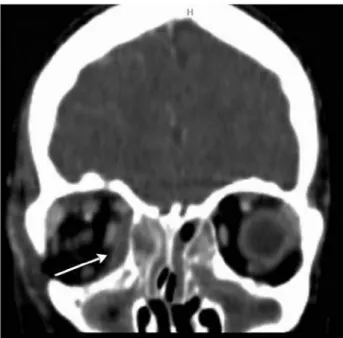
Fifty-one patients met the criteria for the study and had available medical records (29 male, 22 female). Thirty patients were treated on the otorhinolaryngology service and twenty-one patients were treated on the opthalmology service. The age range was 1 to 63 years (mean, 19.92 ± 17.98). Approximately 70% patients (n=36) were younger than 18 years of age. Thirty-two (62.7%) were diagnosed with preseptal cellulitis and 19 (37.3%) were diagnosed with post-septal cellulitis. After detailed evaluations, 15 were diagnosed with a subperiosteal abscess (SPA) and 4 with orbital cellulitis. No one had an intraorbital abscess or a cavernous sinus thrombosis. The age and gender was similar for the two groups. SPA was localized as medial (n=8) (Figure 1), superiomedial (n=4) (Figure 2), inferior (n=1) (Fi-gure 3), and inferiomedial (n=1) (Fi(Fi-gure 4). In the postseptal cellulitis group, bilateral pansinusitis was found in 5, unilateral pansinusitis in 6, unilateral maxillary, ethmoid, and frontal sinusitis in 5, unilateral maxillary and ethmoid sinusitis in 2, and unilateral maxillary sinusitis in 1. In the preseptal cellulitis group, bilateral pansinusitis was pre-sent in 9, unilateral pansinusitis in 10, unilateral maxillary, ethmoid, and frontal sinusitis in 4, unilateral maxillary, ethmoid sinusitis in 5, and unilateral ethmoid sinusitis in 4 patients. Five patients with medial SPA were treated with endoscopic sinus surgery, one patient with
inferior SPA was treated with external surgery, and six patients with other localizations were treated with combination of endoscopic sinus surgery and external surgery. The seasonal distribution of this pathology is shown in figure 5.
The right side was involved in 27 patients and left side was invol-ved in 24. All patients presented with periorbital erythema and ede-ma. In postseptal cellulitis group, 13 (68.4%) patients had additional proptosis, 17 (89.4%) had limited eye movements, 15 (78.9%), and 15 (78.9%) had visual loss (under 8/10). The average length of hospita-lization was 8.94 ± 3.93 (range 4 to 20 d) for all patients. The mean duration of symptoms before admission was 5.69 ± 3.19 days (range, 2 to 15 d). The length of hospitalization and duration of symptoms were similar in both groups. Visual acuity was between 1/10 to 10/10 (mean 7/10) and statistically significant for both the preseptal and postseptal celulitis groups (p<0.001). In the preseptal group, only one patient had a visual acuity less than 8/10. This patient was 63 years
Figure 1. Coronal CT scan of the right medial SPA in a 15 years old patient.
Ozkurt FE, et al.
295
Arq Bras Oftalmol. 2014;77(5):293-6
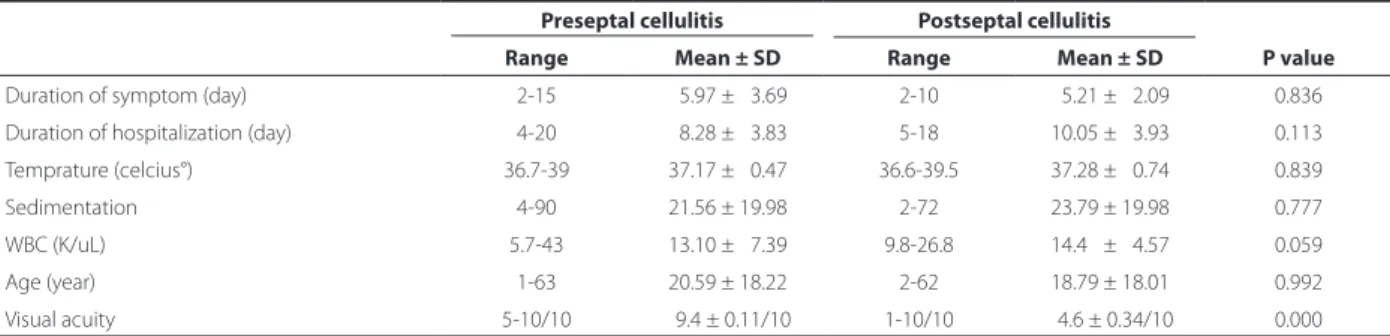
Multiple antibiotics were used in 72.5% of patients. Purulent material was analyzed from 9 patients and blood cultures were analyzed from 12 patients. Cultures were inoculated and bacterial growth was not observed. Patients were discharged on oral antibiotic treatment to be completed in the 2 weeks following the office visit. Other findings are presented in table 1.
DİSCUSSİON
The cause of 74% of orbital infections is sinusitis(11). Infections
mostly originate from ethmoid sinuses; however, other sinuses may also be involved(12). In the presence of ethmoiditis, the infection
spreads to the orbital region through the bony dehiscences, neu-rovascular foramina, or by septic thrombophlebitis of ophthalmic venous system(12). In our series, most of the infected sinuses were the
ethmoid sinus (98%).
If left untreated, complications of orbital infections can cause blindness, meningitis, brain abscess, and death(1). Visual loss may
be secondary to the elevation of the intraorbital pressure resulting in retinal ischemia or optic neuritis due to the spread of infection(3).
Medial SPA is the most common postseptal orbital complication of sinusitis(13). In our study, medial SPA was observed in 53.4% of the
cases.
Patients with preseptal or orbital cellulitis present with similar symptoms, like periorbital swelling and fever. In preseptal cellulitis, the patients have intact extraocular movements and proptosis yet, visual loss is not seen. Conversely, orbital cellulitis is pronounced by decreased extraocular movements, proptosis, and loss of vision(14-16).
The distinction between preseptal cellulitis and orbital involvement is important and can not be shown with clinical examination alone. Rahbar et al. presented three cases of a SPA (15.7%) with periorbital cellulitis, without any proptosis, restriction of gaze, or vision chan-ges(17). All of the patients in our study had eyelid edema and
erythe-ma. Other ophthalmologic manifestations included protosis (33.4%), visual loss less than 8/10 (31.3%), and limited ocular motility (29.4%).
The length of hospital stay in preseptal infections and postseptal infections was similar (8.28 and 10.05 d). A similar result was reported by Souliere et al. and Liu et al.(18-19).
Streptococcus species are more frequently seen in preseptal and orbital cellulitis(20). In an analysis of 30 patients with orbital SPA,
the predominant pathogens were S. pneumoniae, S pyogenes, and H. influenza(21). Anaerobic organisms are generally associated with
chronic sinusitis(22). In our studies, purulent material from 9 patients,
and blood cultures from 12 patients were analyzed but no bacterial growth was seen. The reason may be due to the use of antibiotics before the sample cultures were taken.
According to Howe et al., a CT scan was necessary if an evaluation of the eye was not possible because of gross edema. In addition, patients with proptosis, ophthalmoplegia, impaired visual acuity, or central symptoms may require a CT scan(23). But in some cases
Figure 3. Coronal CT scan of the left inferior SPA in a 8 years old patient.
Figure 4. Coronal CT scan of the right inferiomedial SPA in a 62 years old patient.
Table 1. Clinical and laboratory indings. Mann-Whitney U test had been used for comparing data
Preseptal cellulitis Postseptal cellulitis
P value Range Mean ± SD Range Mean ± SD
Duration of symptom (day) 2-15 05.97 ± 03.69 2-10 05.21 ± 02.09 0.836
Duration of hospitalization (day) 4-20 08.28 ± 03.83 5-18 10.05 ± 03.93 0.113
Temprature (celcius°) 36.7-39 37.17 ± 00.47 36.6-39.5 37.28 ± 00.74 0.839
Sedimentation 4-90 21.56 ± 19.98 2-72 23.79 ± 19.98 0.777
WBC (K/uL) 5.7-43 13.10 ± 07.39 9.8-26.8 14.40 ± 04.57 0.059
Age (year) 1-63 20.59 ± 18.22 2-62 18.79 ± 18.01 0.992
Visual acuity 5-10/10 09.4 ± 0.11/10 1-10/10 04.6 ± 0.34/10 0.000
WBC= white blood cell; SD= standard deviation.
Managment of orbital complications of sinusitis
296 Arq Bras Oftalmol. 2014;77(5):293-6
of an SPA, there will be no proptosis, restriction of gaze, or vision changes(17). Therefore, close follow-up will be needed in all patients
with orbital infections. We routinely obtained CT scans of all patients. The combination of ampicillin-sulbactam or ceftriaxone-metra-nidazole is the advised antibiotic therapy for preseptal and orbital cellulitis(24). Other suggested initial intravenous antibiotics for orbital
cellulitis are ampicillin(25), cefuroxime(16), ampicillin and nafcillin(26),
ampicillin and methicillin(25), ampicillin and chloramphenicol(11),
van-comycin and chloramphenicol(15), cloxacillin and chloramphenicol(15),
or imipenem and vancomycin(27). Multiple antibiotics were used in
72.5% of our patients and the most common combination was ceftria-xone and metronidazole.
According to Oxford et al., the criteria for medical management of medial SPA were the absence of vision loss, a normal pupillary reflex, no retinal pathologies, no restricted directions of gaze, intraocular pressure <20 mmHg, proptosis of 5 mm or less, and width of 4 mm or less on CT(28). In our study, 3 of 15 (20%) subperiosteal abscesses (SPA)
were treated with antibiotics, while others were treated with surgery. The indication for surgery in our patients was visual loss (under 4/10), and unresponsive towards antibioterapy for 48 hours.
Historically, the classic external approach for SPA is the external ethmoidectomy via a Lynch incision(29). In 1993, Manning reported
drainage via an intranasal, endoscopic approach(13). Since then, many
studies have confirmed the endoscopic approach as the most used method for the management of SPA(29). In medial or medial-inferior
SPA, a transnasal endoscopic approach is possible, but in superior or bital abscess an external incision is required(3). In our study, five
pa-tients with medial SPAs were treated with endoscopic sinus surgery, one patient with an inferior SPA was treated with external surgery, and six patients with other localizations were treated with a combina-tion of endoscopic sinus surgery and external surgery.
In the study of Devrim et al., they found an relationship between seasonal distrubition and the orbital complication of sinusitis but we did not find any relationship(30).
CONCLUSION
The orbital complication of the acute sinusitis requires an inten-sive follow-up and multidisciplinary approach by a pediatrician, otolaryngologist, and ophthalmologist to avoid undesirable com-plications. The clinical findings in patients with preseptal cellulitis or orbital cellulitis/abscess do not always correlate with each other. The-refore a contrast-enhanced paranasal sinus CT scan can be useful to detect the extent of the infection through the orbit. An initial trial of IV antibiotics can be appropriate when close monitoring is possible. Loss of visual acuity (under 8/10) and non-medial abscess appear to be indicators for surgical treatment. Surgery may also indicated when there is no improvement within 48 hours of IV treatment. In medial or mediale inferior SPA, a transnasal approach is possible, but in superior and inferior orbital abscesses, an external approach is required.
ACKNOWLEDGEMENT
We are grateful to Dicle University DUBAP for their sponsorship for the English editing of this manuscript.
REFERENCES
1. Chandler JR, Langenbrunner DJ, Stevens ER. The pathogenesis of orbital complica-tions in acute sinusitis. Laryngoscope. 1970;80(9):1414-28. Comment in: Ann Otol Rhinol Laryngol. 1977;86(Pt 1):616-22; Laryngoscope. 1997;j107(4):441-6.
2. Kanra G, Secmeer G, Gonc EN, Ceyhan M, Ecevit Z. Periorbital cellulitis: a comparison of different treatment regimens, Acta Paediatr Jpn. 1996;38(4)339-42.
3. Vairaktaris E, Moschos MM, Vassiliou S, Baltatzis S, Kalimeras E, Avgoustidis D, et al. Orbital cellulitis, orbital subperiosteal and intraorbital abscess: report of three cases and review of the literature. J Craniomaxillofac Surg. 2009;37(3):132-6.
4. Younis RT, Lazar RH, Bustillo A, Anand VK. Orbital infection as a complication of sinu-sitis: are diagnostic and treatment trends changing? Ear Nose Throat J. 2002;81(11): 771-5.
5. Soon VT. Pediatric subperiosteal orbital abscess secondary to acute sinusitis: a 5-year review. Am J Otolaryngol. 2011;32(1):62-8.
6. Sobol SE, Marchand J, Tewfik TL, Manoukian JJ, Schloss MD. Orbital complications of sinusitis in children. J Otolaryngol. 2002;31(3):131-6.
7. Swift AC, Charlton G. Sinusitis and the acute orbit in children. J Laryngol Otol. 1990;104(3):213-6.
8 Wald ER, Pang D, Milmore GJ, Schramm VL Jr. Sinusitis and its complications in pae-diatric patients. Paediat. Clin North Am. 1981;28(4):777-96.
9. Uzcategui N, Warman R, Smith A, Howard CW. Clinical practice guideline for the anagement of orbital cellulitis. J Paediatr Ophhalmol Strabismus. 1998;35(2):73-9; quizz 110-1.
10. Suhaili DN, Goh BS, Gendeh BS. A ten year retrospective review of orbital complica-tions secondary to acute sinusitis in children. Med J Malaysia. 2010;65(1):49-52. 11. Schramm VL Jr, Curtin HD, Kennerdell JS. Evaluation of orbital cellulites and results
of treatment. Laryngoscope. 1982;92(7):732-8.
12. Noordzij JP, Harrison SE, Mason JC, Hashisaki GT, Reibel JF, Gross CW. Pitfalls in the endoscopic drainage of subperiosteal orbital abscesses secondary to sinusitis. Am J Rhinol. 2002;16(2):97-101.
13. Manning SC. Endoscopic management of medial subperiosteal orbital abscess. Arch Otolaryngol Head Neck Surg. 1993;119(7):789-91.
14. Donahue SP, Schwartz G. Preseptal and orbital cellulitis in childhood. A changing microbiologic spectrum. Ophthalmology. 1998;105(10):1902-6; discussion 1905-6. 15. Noel LP, Clarke WN, MacDonald N. Clinical management of orbital cellulitis in children.
Can J Ophthalmol. 1990;25(1):11-6.
16. Lessner A, Stern GA. Preseptal and orbital cellulitis. Infect Dis Clin North Am. 1992; 6(4):933-52.
17. Rahbar R, Robson CD, Petersen RA, DiCanzio J, Rosbe KW, McGill TJ, et al. Manage-ment of orbital subperiosteal abscess in children. Arch Otolaryngol Head Neck Surg. 2001;127(3):281-6.
18. Souliere CR Jr, Antoine GA, Martin MP, Blumberg AI, Isaacson G.. Selective non-surgical management of subperiosteal abscess of the orbit: computerized tomography and clinical course as indication for surgical drainage. Int J Pediatr Otorhinolaryngol. 1990;19(2):109-19. Commnet in: Int J Pediatr Otorhinolaringol. 1993;25(1-3):277-8; Int J Pediatr Otorhinolaringol. 1991;21(3):277-9.
19. Liu CH, Lin CD, Cheng YK, Lin HC, Tsai MH. Orbital complications of acute sinusitis in children. Mid Taiwan J Med. 2005;10(3):144-9.
20. Schwartz GR, Wright SW. Changing bacteriology of periorbital cellulitis. Ann Emerg Med. 1996;28(6):617-20.
21. Dudin A, Othman A. Acute periorbital swelling: evaluation of management protocol. Paediatr Emerg Care 1996;12(1):16-20.
22. Frederick J, Braude AI. Anaerobic infections of the paranasal sinusues. N Engl J Med. 1974;290(3):135-7.
23. Howe L, Jones NS. Guidelines for the management of periorbital cellulitis/abscess. Clin Otolaryngol Allied Sci. 2004;29(6):725-8.
24. American Academy of Pediatrics. Subcommittee on Management of Sinusitis and Committee on Quality Improvement. Clinical practice guideline: management of sinusitis. Pediatrics. 2001;108(3):798-808. Erratum in: Pediatrics. 2002;109(5):40; Pediatrics. 2001;108(5):A24. Comment in: Pediatrics. 2003;111(4 Pt 1):922; Pediatrics. 2002;109(3):557-8; Pediatrics. 2002;110(1 Pt 1):192-3; author reply 192-3; Pediatrics. 2002;110(1 Pt 1):195; author reply 195.
25. Smith TF, O’Day D, Wright PF. Clinical implications of preseptal (periorbital) cellulitis in childhood. Pediatrics. 1978;62(6):1006-9.
26. Goldberg F, Berne AS, Oski FA. Differentiation of orbital cellulitis from preseptal cellulitis by computed tomography. Pediatrics. 1978;62(6):1000-5.
27. Duarte Reis M, Freitas IP, Sousa Coutinho V, Guerra Rodrigo F. Facial and periorbital cellulitis with orbital involvement. J Eur Acad Dermatol Venereol. 2002;16(2):156-8. 28. Oxford LE, McClay J. Medical and surgical management of subperiosteal orbital
abscess secondary to acute sinusitis in children. Int J Pediatr Otorhinolaryngol. 2006; 70(11):1853-61.
29. Fakhri S, Pereira K. Endoscopic management of orbital abscesses. Otolaryngol Clin North Am. 2006;39(5):1037-47.