ABSTRACT: Objective: To assess the prevalence of disability and its association with social capital among community‑dwelling elderly. Methods: The study was based on 2nd Health Survey of Belo Horizonte Metropolitan
Region – 2010, that included 1,995 community‑dwelling elderly, randomly sampled. The exposure of interest was social capital, measured by conidence in neighborhood, perception of the physical environment, sense of cohesion in housing, and neighborhood perception of help. Socio‑demographic variables, health conditions and use of health services were considered in the analysis with the purpose of adjustment. Results: Approximately one third of participants (32.6%) were unable to at least one instrumental activity of daily living (IADL) and/or basic activity of daily living (ADL); the prevalence of disability in ADL/IADL was 18.1%, and only in IADL was 14.6%. Elderly with functional disabilities had higher odds of poor social capital, but only the sense of cohesion in housing neighborhood showed to be independently associated with functional disability (OR = 1.80; 95%CI 1.12 – 2.88). Conclusions: Our results show the importance of social capital in research on associated factors of functional disability and indicate the need to implement public policies for social and environmental areas, since the needs of the elderly require measures beyond those typical of the health sector.
Keywords: Disabled Persons. Social capital. Health of the elderly. Health surveys. Elderly. Epidemiology.
Association between disability and social
capital among community‑dwelling elderly
Associação entre incapacidade funcional e
capital social em idosos residentes em comunidade
Cristina Franco GontijoI, Juliana Vaz de Melo MambriniII, Tatiana Chama Borges LuzII, Antônio Ignácio de Loyola FilhoII,III
IGraduate Program in Health Sciences, Centro de Pesquisas René Rachou, Fundação Oswaldo Cruz – Belo Horizonte (MG), Brazil. IICenter of Studies in Public Health and Aging, Centro de Pesquisas René Rachou, Fundação Oswaldo Cruz and Universidade Federal
de Minas Gerais – Belo Horizonte (MG), Brazil.
IIIDepartament of Applied Nursing, School of Nursing, Universidade Federal de Minas Gerais – Belo Horizonte (MG), Brazil.
Corresponding author: Antônio Ignácio de Loyola Filho. Avenida Augusto de Lima, 1715, Barro Preto, CEP: 30190‑002, Belo
Horizonte, MG, Brasil. E‑mail: [email protected]
Conlict of interests: nothing to declare – Financial support: Health Care Bureau, Ministry of Health.
INTRODUCTION
Aging may lead to the development of functional disability, which consists of the diiculty or need of help for the individual to perform typical self‑care activities (basic activity of daily living, or ADL) or more complex ones (instrumental activity of daily living, or IADL), as well as in the impairment of physical mobility, they are important for independent living in society1. To Verbrugge and Jette2, the incapacitating process of the individuals may be determined by predisposing factors (sociodemographic char‑ acteristics), intraindividual (lifestyle, behavior, or diseases), and extraindividual ones (interventions from health services, use of medication, external support, in addition to physical and social environments).
Several epidemiological studies, in different populations, have been associating functional disability to predisposing (gender and age) and intraindividual character‑ istics (self‑evaluation of health and history of diagnosis for chronic diseases, such as hypertension, diabetes, and arthritis)1,3,4. In relation to the extraindividual factors, the role of social environment and of social relations in determining disability has been demonstrated in longitudinal5 and cross‑sectional4,6,7 studies, as the limitations in social relations may generate inequalities in health, preventing social control and hindering decision making in health.
As for social relations, the social capital is an important outcome in health. Social capi‑ tal may be deined as “characteristics of social organizations such as trust, rules, and social
RESUMO:Objetivo: Estimar a prevalência da incapacidade funcional e sua associação com o capital social entre idosos residentes na comunidade. Metodologia: O estudo foi baseado nos dados do Segundo Inquérito de Saúde da Região Metropolitana de Belo Horizonte ‑ 2010, coletados junto a 1.995 idosos residentes em comunidade, amostrados probabilisticamente. A exposição de interesse foi o capital social, considerando os itens coniança na vizinhança, percepção do ambiente físico, sensação de coesão ao bairro de moradia e percepção de ajuda. Foram consideradas na análise, com o propósito de ajustamento, variáveis sociodemográicas, descritoras de condições de saúde e de utilização de serviços de saúde. Resultados: Cerca de 1/3 dos participantes (32,6%) apresentou‑se incapaz para pelo menos uma das atividades instrumentais de vida diária (AIVD) e/ou atividades básicas de vida diária (ABVD); a prevalência da incapacidade para ABVD/AIVD foi de 18,1% e da incapacidade exclusiva para AIVD foi de 14,6%. Os idosos incapazes para AIVD e para AIVD/ABVD apresentaram chances mais elevadas de pior capital social, mas apenas o elemento de sensação de coesão ao bairro de moradia mostrou‑se independentemente associado à incapacidade funcional (OR = 1,80; IC95% 1,12 – 2,88). Conclusões: Nossos resultados evidenciaram a importância do capital social na investigação dos fatores associados à incapacidade funcional e apontam para a necessidade de que outras políticas públicas sejam implementadas, nas áreas social e ambiental, visto que as necessidades dos idosos demandam medidas que vão além daquelas próprias do setor saúde.
networking which facilitate coordinates actions and generate beneits”8, and it can be accessed through social relations9. Their study allows deeper understanding of the health relations of the population with the individual particularities, their ability to face the environmental challenges and the social dynamics of the community in which they are inserted9.
A discussion that permeates the social capital is the individual‑collective opposition, regarding its measuring10. Those who see it as an attribute of the individual, use the individ‑ ual level of analysis. In it, each person is treated as a unit of analysis and personal indexes of social capital are built and analyzed, considering their behavior, perception, and attitude in the midst of social groups or neighborhood11.
The investigations about the relations between social capital and health began at the end of the last century, when Kawachi et al.12 studied the role of social capital in mortality. Since then, some researches have been ofering evidence of the relation of the social capital and health conditions13,14, but the ones speciically focused on the relations between social capi‑ tal and functional disability are still scarce15,16. This investigation becomes, then, important as the knowledge of their determinants may reduce the negative aspects of the limitations or dependencies, such as expenses and overload of the health system and also about the community and the elderly individuals or caregiver.
Considering what was exposed so far, this study had the objective of estimating the prevalence of functional disability and investigating the association between social capital among community‑dwelling elderly.
METHODS
AREA AND POPULATION OF STUDY
The study was carried out in the Metropolitan Region of Belo Horizonte (RMBH), state of Minas Gerais, in Southeastern Brazil, which is the third greatest urban concentration in the country, with a population of 4.9 million inhabitants, of which 10% are 60 years old or older17. It is based on the data collected in the Second Health Survey of RMBH, con‑ ducted between May 1st and July 31st 2010, a supplementary questionnaire to the Job and Unemployment Survey in RMBH (Pesquisa de Emprego e Desemprego da RMBH: PED–RMBH), which is coordinated by the João Pinheiro Foundation, a government agency of the state of Minas Gerais18. The investigation was approved by the Research Ethics Committee René Rachou, Oswaldo Cruz Foundation, protocol number 10/2009.
VARIABLES OF THE STUDY
The dependent variable was the functional disability of the elderly, measured by the answer to the question “What degree of diiculty do you have to perform the following activities?” formu‑ lated for each of the six ADL and the ive IADL researched. The irst ones included feeding, transferring from bed to chair, getting dressed, walking between two rooms on the same loor, using the toilet, and taking a shower; the last ones covered preparing their own meal, taking care of their own money, performing household chores, taking medicine, and shopping. The possible answers were: no diiculty, some diiculty, a lot of diiculty, and not able to perform it without help. Elderly who reported any degree of diiculty to perform at least one of the activities mentioned were considered incapable seniors. According to the answers provided, the elderly were classiied into one of the three categories:
1. able,
2. incapable only of IADL, and 3. incapable of ADL and IADL.
All elderly who reported diiculty in performing any ADL also did so in relation to an IADL and, as a result, were placed in the same group.
The exposure of interest was the social capital, measured by four indicators: trust in the neighborhood, perception of the physical environment, sense of cohesion to the house, and perception of help20, were built by seven questions of the questionnaire. Given the dichoto‑ mous nature of these seven questions, the matrix of tetrachoric correlation to evaluate the correlation between them was used, an analysis which justiied the deinition of the com‑ position of each one of the indicators, as described below.
To compose the indicator “trust in the neighborhood,” the participant was asked whether they could or could not trust most people, and for the composition of “help perception,” it was asked whether or not the elderly thought their neighbors helped each other. In each of these questions, the negative answer characterized, respectively, low trust in the neighborhood and absence of per‑ ception of help. The indicator “perception of the physical environment” consisted of two questions: “Are you satisied with the way your block is taken care of ?” and “Do you think your neighborhood is good for children and teenagers?” The negative answer to at least one of these questions charac‑ terized worse perception of the physical environment. The composition of the “sense of cohesion to the neighborhood” was based on three questions, being, whether or not they felt comfortable in the neighborhood where they live, whether or not they liked their neighborhood, and if they would like to stay in the place where they live. Similarly, the worse sense of cohesion was determined by the negative answer to at least one of these questions. As well as in other studies20,21, the low trust in the neighborhood, the absence of help perception, and worse perception of the physical envi‑ ronment and sense of cohesion indicate low levels of social capital.
widowed, or single/divorced), and if they lived alone. For the set of health conditions, the number of chronic diseases (0, 1, 2, and 3 or more), based on the report of medical diagnosis for the following diseases: arthritis, cancer, hypertension, asthma, diabetes, coronary diseases, stroke, depression, and kidney and spine diseases was considered. Also among health condi‑ tions, the health self‑evaluation (very good/good, fair, and poor/very poor) was used. As for the describing variables of the use of health services, the number of medical appointments (0 to 1, 2 to 4, and 5 or more) and the history of hospitalization within the last 12 months, in addition to the coverage by health insurance, were the variables chosen.
DATA ANALYSIS
The incapable seniors for IADL and the incapable ones for both ADL and IADL were compared, simultaneously, with those who do not have diiculties in ADL nor in IADL (capable seniors), by the χ2 test of Pearson, in relation to all the aforementioned covariables.
The multivariate analysis of the association between social capital and functional disabil‑ ity was performed using the model of multinomial logistic regression, which estimates the
odds ratios (OR) and the respective 95%conidence interval (95% CI). The inal multivariate model includes the four indicators of social capital. For the selection of the covariates to be included in the multivariate model, the statistical signiicance level p < 0.20 was adopted, considering that the signiicance level p < 0.05 is the criterion to identify the independent variables associated to functional disability. The appropriateness of the adjustment of the multivariate model was evaluated through the generalized Hosmer–Lemeshow test.
The analyses were conducted using the Stata® software, version 13 (Stata Corp), consider‑ ing the technical procedures adopted for populational surveys with complex sample designs.
ETHICAL CONSIDERATIONS
The Adult Health Survey of the metropolitan area of Belo Horizonte in 2010, protocol number 10/2009, was approved by the Research Ethics Committee of the Institute René Rachou, Oswaldo Cruz Foundation, Belo Horizonte, Minas Gerais.
RESULTS
Variables
Total
population Able
Unable only to IADL
Unable to
ADL/IADL p-value
(n = 1,995) % (n = 1,343) % (n = 292) % (n = 360) %
Gender
Male 38.3 43.1 32.5 25.2
< 0.001
Female 61.7 56.9 67.5 74.8
Age (in years)
60 to 69 55.8 64.4 42.6 34.3
< 0.001
70 to 79 30.2 28.2 35.2 33.6
80 or more 14.0 7.4 22.2 32.1
Education (in years)
< 4 26.3 20.0 38.5 40.1
< 0.001
4 to 7 37.8 37.5 35.4 40.8
8 to 11 24.9 28.2 20.6 16.0
12 or more 11.0 14.3 5.5 3.1
Marital status
Married 49.9 56.1 42.1 32.7
< 0.001
Widowed 32.5 25.2 43.3 51.2
Single/divorced 17.6 18.7 14.6 16.1
Living alone
No 84.6 57.3 12.6 14.6
0.196
Yes 15.4 10.0 2.0 3.4
No. of chronic diseases
0 27.8 33.5 17.6 14.7
< 0.001
1 33.7 36.1 31.0 27.3
2 22.2 19.4 26.0 29.4
3 or more 16.3 11.0 25.4 28.6
Self-perception of health
Very good/good 58.1 69.4 43.6 28.0
< 0.001
Fair 32.5 26.9 44.6 43.5
Bad/very bad 9.4 3.7 11.8 28.5
No. of medical appointments
0 to 1 37.8 43.3 27.9 25.0
< 0.001
2 to 4 39.7 38.9 43.8 39.1
5 or more 22.5 17.8 28.3 35.9
History of hospitalization
No 90.6 94.1 87.0 80.6
< 0.001
Yes 9.4 5.9 13.0 19.4
Health insurance
No 53.9 35.6 8.0 102.2
0.421
Yes 46.1 31.9 6.6 7.7
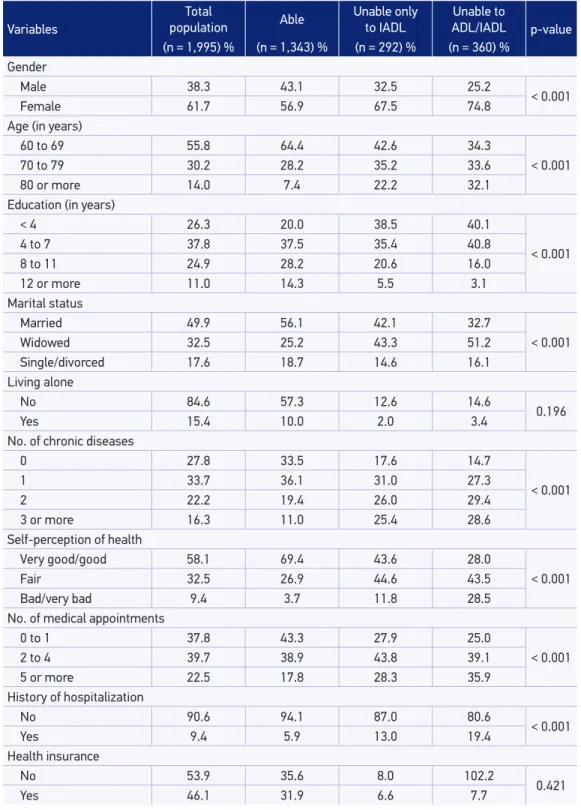
Table 1. Characteristics of the studied population and their distribution according to the functional disability among elderly (60 years of age or more), living in the metropolitan area of Belo Horizonte, 2010.
married and 15.4% lived alone. In relation to health conditions, 72.2% of them had at least one chronic disease and more than half of them (58.1%) evaluated health as good or very good. The characterization of the population of the study and the results of the univariate analy‑ sis of the characteristics associated to functional disability may be seen in details in Table 1. With the exception of living alone and coverage by health insurance, the remaining variables were associated to functional disability, with p < 0.05.
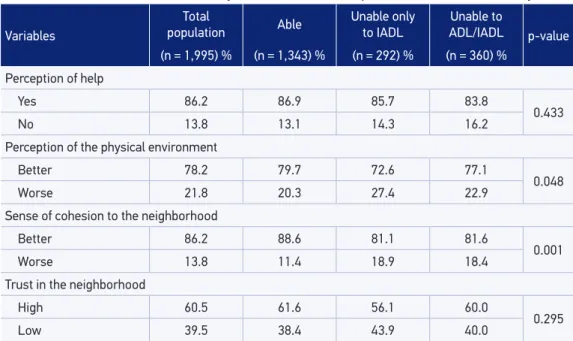
Every one‑third of the participants (32.7%) were incapable of at least one IADL and/or ADL; the prevalence of disability for ADL was 18.1% and the exclusive disability for IADL was 14.6%, considering that the elderly with disability for ADL were also incapable of at least one IADL. Considering that the indicators which dimensions the social capital, the proportion of elderly who did not notice help from the neighborhood, is case they needed, and with worse sense of cohesion to the neighborhood reached approximately 14%. With more elevated proportions, the ones with worse perception of the environment reached 21.8%, and 39.5% had low trust in the people of the neighborhood.
In Table 2, it is possible to see the results of the univariate analysis of the association between the social capitals and functional disability. The elderly incapable of IADL and inca‑ pable of both IADL and ADL showed higher proportions of worse social capital, but only the perception of the physical environment and the sense of cohesion of the neighborhood were signiicantly associated to the functional disability (p < 0.05).
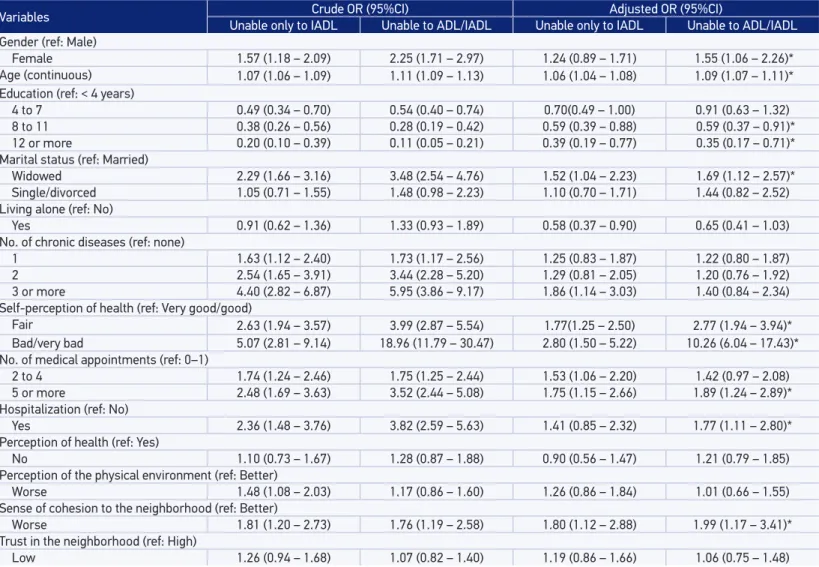
The inal results of the multivariate analysis of the factors associated with functional dis‑ ability are presented in Table 3. Only the indicator of sense of cohesion to the neighborhood kept a signiicant and independent association of the variables of adjustment, with OR = 1.80
Variables
Total
population Able
Unable only to IADL
Unable to
ADL/IADL p-value
(n = 1,995) % (n = 1,343) % (n = 292) % (n = 360) %
Perception of help
Yes 86.2 86.9 85.7 83.8
0.433
No 13.8 13.1 14.3 16.2
Perception of the physical environment
Better 78.2 79.7 72.6 77.1
0.048
Worse 21.8 20.3 27.4 22.9
Sense of cohesion to the neighborhood
Better 86.2 88.6 81.1 81.6
0.001
Worse 13.8 11.4 18.9 18.4
Trust in the neighborhood
High 60.5 61.6 56.1 60.0
0.295
Low 39.5 38.4 43.9 40.0
Table 2. Results of the univariate analysis between social capital and functional disability.
Variables Crude OR (95%CI) Adjusted OR (95%CI)
Unable only to IADL Unable to ADL/IADL Unable only to IADL Unable to ADL/IADL
Gender (ref: Male)
Female 1.57 (1.18 – 2.09) 2.25 (1.71 – 2.97) 1.24 (0.89 – 1.71) 1.55 (1.06 – 2.26)*
Age (continuous) 1.07 (1.06 – 1.09) 1.11 (1.09 – 1.13) 1.06 (1.04 – 1.08) 1.09 (1.07 – 1.11)*
Education (ref: < 4 years)
4 to 7 0.49 (0.34 – 0.70) 0.54 (0.40 – 0.74) 0.70(0.49 – 1.00) 0.91 (0.63 – 1.32)
8 to 11 0.38 (0.26 – 0.56) 0.28 (0.19 – 0.42) 0.59 (0.39 – 0.88) 0.59 (0.37 – 0.91)*
12 or more 0.20 (0.10 – 0.39) 0.11 (0.05 – 0.21) 0.39 (0.19 – 0.77) 0.35 (0.17 – 0.71)*
Marital status (ref: Married)
Widowed 2.29 (1.66 – 3.16) 3.48 (2.54 – 4.76) 1.52 (1.04 – 2.23) 1.69 (1.12 – 2.57)*
Single/divorced 1.05 (0.71 – 1.55) 1.48 (0.98 – 2.23) 1.10 (0.70 – 1.71) 1.44 (0.82 – 2.52)
Living alone (ref: No)
Yes 0.91 (0.62 – 1.36) 1.33 (0.93 – 1.89) 0.58 (0.37 – 0.90) 0.65 (0.41 – 1.03)
No. of chronic diseases (ref: none)
1 1.63 (1.12 – 2.40) 1.73 (1.17 – 2.56) 1.25 (0.83 – 1.87) 1.22 (0.80 – 1.87)
2 2.54 (1.65 – 3.91) 3.44 (2.28 – 5.20) 1.29 (0.81 – 2.05) 1.20 (0.76 – 1.92)
3 or more 4.40 (2.82 – 6.87) 5.95 (3.86 – 9.17) 1.86 (1.14 – 3.03) 1.40 (0.84 – 2.34)
Self-perception of health (ref: Very good/good)
Fair 2.63 (1.94 – 3.57) 3.99 (2.87 – 5.54) 1.77(1.25 – 2.50) 2.77 (1.94 – 3.94)*
Bad/very bad 5.07 (2.81 – 9.14) 18.96 (11.79 – 30.47) 2.80 (1.50 – 5.22) 10.26 (6.04 – 17.43)*
No. of medical appointments (ref: 0–1)
2 to 4 1.74 (1.24 – 2.46) 1.75 (1.25 – 2.44) 1.53 (1.06 – 2.20) 1.42 (0.97 – 2.08)
5 or more 2.48 (1.69 – 3.63) 3.52 (2.44 – 5.08) 1.75 (1.15 – 2.66) 1.89 (1.24 – 2.89)*
Hospitalization (ref: No)
Yes 2.36 (1.48 – 3.76) 3.82 (2.59 – 5.63) 1.41 (0.85 – 2.32) 1.77 (1.11 – 2.80)*
Perception of health (ref: Yes)
No 1.10 (0.73 – 1.67) 1.28 (0.87 – 1.88) 0.90 (0.56 – 1.47) 1.21 (0.79 – 1.85)
Perception of the physical environment (ref: Better)
Worse 1.48 (1.08 – 2.03) 1.17 (0.86 – 1.60) 1.26 (0.86 – 1.84) 1.01 (0.66 – 1.55)
Sense of cohesion to the neighborhood (ref: Better)
Worse 1.81 (1.20 – 2.73) 1.76 (1.19 – 2.58) 1.80 (1.12 – 2.88) 1.99 (1.17 – 3.41)*
Trust in the neighborhood (ref: High)
Low 1.26 (0.94 – 1.68) 1.07 (0.82 – 1.40) 1.19 (0.86 – 1.66) 1.06 (0.75 – 1.48)
Table 3. Results of the multivariate analysis of the association between social capital and functional disability.
OR: odds ratio, estimated by the multinominal logistic regression model. Reference category: independently for IADL and ADL. Adjusted OR for all the variables described
(95%CI 1.12 – 2.88) for exclusive inability of IADL and OR = 1.99 (95%CI 1.17 – 3.41) for association of disability of ADL/IADL, indicating that elderly with worse perception of their neighborhood have higher chances of disability of IADL/ADL.
All the variables included in the inal model for adjustment are presented independently associated with the exclusive inability of IADL and/or inability of ADL/IADL. Female elderly, older widowers, in worse health conditions (with three or more chronic diseases or who evaluated negatively their own health) and who used more health services (ive or more medical appointments and history of hospitalization within the last 12 months) had more chances of presenting one of the disabilities, whereas among the elderly with educa‑ tion equal to or longer than 8 years, the chances of disability were lower.
DISCUSSION
Our results showed that one‑third of the elderly presented themselves incapable to per‑ form at least one IADL and/or ADL, and that the chances of functional disability were higher among elderly with lower level of social capital, although among the indicators of this later one, only the perception of cohesion to the neighborhood was independently associated with disability.
The prevalence of disability observed in this study (32.7%) was slightly lower than the one detected (35.8%) in a study carried out among elderly living in the RMBH in 200322, which measured the functional disability with identical criteria to the ones used here. When compared with other studies, it was proven to be higher than the 22.7% ver‑ ified among Brazilian elderly participating in the National Survey by Household Sample (Pesquisa Nacional por Amostras de Domicílio: PNAD) 200323 and to the 25% observed among Iranian elderly7. However, in the study of the PNAD23, the measure of func‑ tional disability restricted themselves to the activity of walking about 100 m and the inability of ADL, among the Iranians, was evaluated. The prevalence was lower, how‑ ever, than the one found among Spanish elderly (71.7%)24, but in this study the measure of disability was broader, covering not only the ADL and IADL, but also activities of mobility. Therefore, the prevalence of disability among the elderly in the RMBH was higher than the one observed in studies in which its operation was proven to be more restricted in terms of activities, and lower than the studies in which a broader criterion to measure disability was adopted.
consequences about the health system and about the quality of life of the individual and their family25. From the perspective of the objective of our study, considering the IADL along with the ADL in the estimates of functional disability was particularly relevant, as the variable of exposure of interest was the social capital and the instrumental activities are strongly connected to the social participation and to the life outside the household.
In this study, the functional disability was shown positively associated to the low level of social capital. Our results corroborate indings of international studies carried out in the higher income countries15,26,27. In addition to that, our results showed that not all elements of the social capital are associated to the functional disability, as its association was restricted to the indicator of cohesion to the household. Also in this aspect, our results are consistent with the literature. For example, among Japanese elderly women, the association between social capital and functional disability was limited to two elements of the former, in this case, trust and social participation15. In England26, in a sample of elderly aged 65 years or older, the social support and participation in groups were the dimensions of the social capital, which were statistically associated with the functional disability. In the cities of Denmark, the indicators of social capital signiicantly associated with the disability were the diversity in social relations, the social participation, and the social support27. In Brazil, Ferreira et al.28 observed that only the component called perception of the physical environment was asso‑ ciated with the functional disability of elderly in the RMBH, Minas Gerais.
It is highlighted that the indicator of perception of cohesion to the neighborhood por‑ trays the sense of comfort with the place of residence and whether the individuals think that a speciic neighborhood is a good place to live. Probably, the elderly with high perception of cohesion to their neighborhood adopt healthier behaviors, even regarding their prevention of the onset of disabilities and they beneit from the efects of belonging to a community that shares the same interests and feelings, cultural activities, and recreation29. Given the lack of studies on speciic efects of cohesion perception about the functional disability and even about other health events, new investigations on this theme are necessary. In general, it is possible that the high level of social capital interferes in the health of the individuals by improving the possibilities of access to several kinds of resources, dissemination of infor‑ mation, organizations of the community, social control, satisfaction, and quality of life, inluencing the health of the members of the society and the health actions brought before these individuals in a positive way30.
The functional capacity is one of the most relevant issues in public health, because of its dimensional aspect and for allowing aging with quality of life; its study and understanding are conigured as one of the main objectives of health professionals and health services. The iden‑ tiication of associated factors that causes functional disability of elderly provides relevant elements for the prevention and for the intervention strategies and it is essential to avoid or lessen the damages to the individuals, the family, and the society. From what is known, few studies have been examining social factors as the determinants of functional disability15,27.
manifested, especially the functional disability, and how they may be better addressed, direct‑ ing the focus of health professionals, policies, and the community members themselves, in favor of aging with quality of health31.
The multiple deinitions, the diferent options of measuring, and the data analysis ham‑ per the research of the social capital in populational studies. Thus, recognizing their diverse and multidimensional nature, we use measures of social capital that are able to express the degree of interpersonal relation and the satisfaction with the place of residence and with neighbors, which are also used in other investigations performed with elderly living in the RMBH29. Another diiculty arises from the absence of a consensus on which would be the appropriate level of social capital, if either the individual or aggregate one32. In relation to the unit of analysis, we have chosen to measure the social capital at an individual level, once it was originally considered and deined as a good thing of the individual and not inducing to ecological fallacy33,34.
An important limitation of this study is its cross‑sectional design, which makes it impos‑ sible to establish a distinction, in time, between exposure end events. It sets up then, the possibility of occurrence of reverse causality, that is, the low level of social capital being a consequence of functional disability. On the other hand, the study shows qualities that reinforce it, such as being population based, allowing the inference of its results for one of the most populous metropolitan areas in Brazil, in addition to the methodological rigor in its conduction, which support its internal validity.
CONCLUSION
In conclusion, our study showed high prevalence of functional disability, especially in the group of IADL and their association with the social capital. Elderly with low levels of social capital had more chances of presenting some kind of diiculty in performing the IADL/ ADL, particularly regarding the perception of cohesion of their neighborhood. The future populational researches on functional disability should not neglect the role of the social context for a broader understanding of this complex and dynamic phenomenon. It is also expected that coping with the disability is not limited to speciic health actions, but it also contemplates the implementation of other public policies, in social and environmental areas, once the needs of elderly demand measures beyond those speciic to the health ield.
ACKNOWLEDGMENT
1. Alves LC, Leite IC, Machado CJ. Conceituando e mensurando a incapacidade funcional da população idosa: uma revisão de literatura. Ciênc Saúde Coletiva 2008; 13(4): 1199‑207.
2. Verbrugge LM, Jette AM. The disablement process. Soc Sci Med 1997; 38(1): 1‑14.
3. Nikolova R, Demers L, Béland F, Giroux F. Transitions in the functional status of disabled community‑living older adults over a 3‑year follow‑up period. Arch Gerontol Geriatr 2011; 52(1): 12‑7.
4. Giacomin KC, Peixoto SV, Uchoa E, Lima‑Costa MF. Estudo de base populacional dos fatores associados à incapacidade funcional entre idosos na Região Metropolitana de Belo Horizonte, Minas Gerais, Brasil. Cad Saúde Pública 2008; 24(6): 1260‑70.
5. Rodrigues MA, Facchini LA, Thumé E, Maia F. Gender and incidence of functional disability in the elderly: a systematic review. Cad Saúde Pública 2009; 25(Suppl 3): S464‑76.
6. Oliveira PH, Mattos IE. Prevalência e fatores associados à incapacidade funcional em idosos institucionalizados no Município de Cuiabá, Estado de Mato Grosso, Brasil, 2009‑2010. Epidemiol Serv Saúde 2012; 21(3): 395‑496.
7. Adib‑Hajbaghery M. Evaluation of old‑age disability and related factors among an Iranian elderly population. East Mediterr Health J 2011; 17(9): 671‑8.
8. Putnam R. The prosperous community: social capital and public life. Am Prospect 1993; 13: 35‑42.
9. Han S. Compositional and contextual associations of social capital and self‑rated health in Seoul, South Korea: a multilevel analysis of longitudinal evidence. Soc Sci Med 2012; 80: 113‑20.
10. Poortinga W. Social relations or social capital? Individual and community health efects of bonding social capital. Soc Sci Med 2006; 63(1): 255‑70.
11. Macinko J, Starield B. The utility of social capital in research on health determinants. Milbank Q 2001; 79(3): 387‑428.
12. Kawachi I, Kennedy BP, Lochner K, Prothrow‑Stith D. Social capital, income inequality and mortality. Am J Public Health 1997; 87(9): 1491‑8.
13. Tomita A, Burns JK. A multilevel analysis of association between neighborhood social capital and depression: evidence from the irst South African National Income Dynamics Study. J Afect Disord 2013; 144(1‑2): 101‑5.
14. Furuta M, Ekuni D, Takao S, Suzuki E, Morita M, Kawachi I. Social capital and self‑rated oral health among young people. Community Dent Oral Epidemiol 2012; 40(2): 97‑104.
15. Aida J, Kondo K, Kawachi I, Subramanian SV, Ichida Y, Hirai H, et al. Does social capital afect the incidence of functional disability in older Japanese? A prospective population‑based cohort study. J Epidemiol Community Health 2012; 67(1): 42‑7.
16. Pollack CE, von dem Knesebeck O. Social capital and health among the aged: comparisons between the United States and Germany. Health Place 2004; 10(4): 383‑91.
17. Instituto Brasileiro de Geografia e Estatística. Indicadores sociais municipais: uma análise dos resultados do universo do Censo Demográico 2010. Disponível em: http://www.ibge.gov.br/home/ estatistica/populacao/censo2010/indicadores_sociais_ municipais/default_indicadores_sociais_municipais. shtm (Acessado em: 12 de dezembro de 2013).
18. Fundação João Pinheiro. Pesquisa de Emprego e Desemprego na Região Metropolitana de Belo Horizonte (PED/RMBH). Belo Horizonte: Sistema Nacional de Emprego; 2010.
19. Lima‑Costa MF. Saúde dos Adultos em Belo Horizonte. Belo Horizonte: Núcleo de Estudos em Saúde Pública e Envelhecimento da Fundação Oswaldo Cruz e Universidade Federal de Minas Gerais; 2012. 120p.
20. Luz TC, Loyola Filho AI, Lima‑Costa MF. Social capital and under‑utilization of medication for financial reasons among elderly women: evidence from two Brazilian health surveys. Ciênc Saúde Coletiva 2013; 18(12): 3721‑3730.
21. Baron‑Epel O, Weinstein R, Haviv‑Mesika A, Garty‑Sandalon N, Green S. Individual‑level analysis of social capital and health: a comparison of Arab and Jewish Israelis. Soc Sci Med 2008; 66(4): 900‑910.
22. Fialho CB, Lima‑Costa MF, Giacomin KC, Loyola Filho AI. Capacidade funcional e uso de serviços de saúde por idosos da Região Metropolitana de Belo Horizonte, Minas Gerais, Brasil: um estudo de base populacional. Cad Saúde Pública 2014; 30(3): 599‑610.
23. Parahyba MI, Veras R. Diferenciais sociodemográicos no declínio funcional em mobilidade física entre os idosos no Brasil. Ciênc Saúde Coletiva 2008; 13(4): 1257‑64.
24. Guallar‑Castillón P, Sagardui‑Villamor J, Banegas JR, Graciani A, Fornés NS, López García EL, et al. Waist circumference as a predictor of disability among older adults. Obesity 2007; 15(1): 233‑44.
25. Ferreira OGL, Maciel SC, Silva AO, Santos WS, Moreira MASP. O envelhecimento ativo sob o olhar de idosos funcionalmente independentes. Rev Esc Enferm USP 2010; 44(4): 1065‑9.
26. Andrew MK. Social capital, health, and care home residence among older adults: a secondary analysis of the Health Survey for England 2000. Eur J Ageing 2005; 2(2): 137‑48.
27. Avlund K, Lund R, Holstein BE, Due P. Social relations as determinant of onset of disability in aging. Arch Gerontol Geriatr 2004; 38(1): 85‑99.
28. Ferreira FF, César CC, Camargos VP, Lima‑Costa MF, Proietti FA. Ag ing and urbanization: the n e i g h b o r h o o d p e r c e p t i o n a n d f u n c t i o n a l performance of elderly persons in Belo Horizonte metropolitan area, Brazil. J Urban Health 2010; 87(1): 54‑66.
29. Luz TC, Loyola Filho AI, Lima‑Costa MF. Perceptions of social capital and cost‑related non‑adherence to medication among the elderly. Cad Saúde Pública 2011; 27(2): 269‑76.
30. Borgonovi F. A life‑cycle approach to the analysis of the relationship between social capital and health in Britain. Soc Sci Med 2010; 71(11): 1927‑34.
31. Pattussi MP, Moysés SJ, Junges JR, Sheiham A. Capital social e a agenda de pesquisa em epidemiologia. Cad Saúde Pública 2006; 22(8): 1525‑46.
32. Rostila M. The facets of social capital. J Theory Soc Behav 2010; 41(3): 308‑26.
33. Portes A. Social capital: its origins and applications in modern sociology. Annu Rev Sociol 1998; 24(1): 1‑24.
34. Lillbacka R. Measuring social capital: assessing construct stability of various operationalizations of social capital in a Finnish sample. Acta Sociol 2006; 49(2): 201‑20.
Received on: 11/19/2014
Final version presented on: 07/02/2015 Accepted on: 09/15/2015
DOI: 10.1590/1980-5497201700040016
ERRATA / CORRECTION
CORRECTION / ERRATA
In the article “Association between disability and social capital among community‑dwelling elderly”DOI number: 10.1590/1980‑5497201600030001, published in the Rev. bras. epide‑ miol. 2016; 19(3): 471‑83, on page 471:
Where it reads:
Tatiana Chama Borges da Luz Read: