ISSN 0104-6632 Printed in Brazil
www.abeq.org.br/bjche
Vol. 34, No. 01, pp. 283 - 293, January - March, 2017 dx.doi.org/10.1590/0104-6632.20170341s20150547
Brazilian Journal
of Chemical
Engineering
AN ALTERNATIVE ROUTE TO PRODUCE
STANDARDS FOR GEL PERMEATION
CHROMATOGRAPHY USING NITROXIDE
MEDIATED POLYMERIZATION
C. P. R. Malere and L. M. F. Lona
*School of Chemical Engineering, University of Campinas, Campinas - SP, Brazil. Phone: + 55 19 3521-3954
E-mail: [email protected]
(Submitted: August 31, 2015 ; Revised: December 13, 2015 ; Accepted: January 8, 2016)
Abstract - All over the world standards for Gel Permeation Chromatography (GPC) are produced using ionic polymerization. Standards are commercialized in a broad range of molecular weight and their dispersity (Ð) must be lower than 1.1. This work proposes the synthesis of polystyrene standards using Nitroxide Mediated Polymerization (NMP), an alternative technique to produce controlled polymers that is much more robust when compared to ionic polymerization. Standards with different ranges of molecular weights were obtained, all of them with very narrow molecular weight distribution (MWD) and dispersity (Ð) lower than 1.10. In order to do that, several combinations of different initiators were tested. Advanced GPC Triple Detector was used to obtain important properties, such as absolute number and weight average molecular weights, dispersity and intrinsic viscosity. The analytical method used in the characterization of the samples was in-house validated in terms of linearity, accuracy, precision, repeatability and robustness. The validation study demonstrated the quality of the measurements and ensured that the information obtained for a given analyte by the GPC technique is reliable.
Keywords:GPC polystyrene standard; Nitroxide mediated polymerization; Mixture of initiators.
INTRODUCTION
In the last two decades, reversible-deactivation radical polymerization, before called controlled radi-cal polymerization or living radiradi-cal polymerization, has been used to produce polymers with highly trolled microstructure. A polymer is considered con-trolled if it exhibits: a) a linear evolution of ln[1/(1-conversion)] versus time, (b) a linear increase of the number-average molar mass (Mn) versus conversion and (c) dispersity indexes (Ð) lower than 1.5. Re-search in this area usually follows one of the three techniques: Atom Transfer Radical Polymerization
(ATRP), Reversible Addition-Fragmentation Chain-Transfer (RAFT) and Nitroxide Mediated Polymeri-zation (NMP). In all the three cases there is a reversi-ble equilibrium during the whole polymerization be-tween the active species and dormant species, reduc-ing the concentration of free radicals and, conse-quently, minimizing the irreversible termination step.
Nitroxide Mediated Polymerization involves the addition of a controller or trapping agent (stable ni-troxide radical) to capture the growing chain.
Solo-mon et al. (1986) were the first researchers to use
weight. Georges et al. (1993) published one of the most cited papers related to NMP. After that, many studies have been conducted in the NMP area with dif-ferent purposes such as to better understand the ki-netic mechanism (Hawker et al., 2001; Veregin et al., 1996; Bonilla et al., 2002), to enhance the rate and control the polymerization (Nabifar et al., 2009; Wong et al., 2011; Harrison et al., 2012; Dias et al., 2007), to produce copolymers (Hlalele and Klumper-man, 2011; Alison et al., 2014) and to functionalize polymers (Harrison et al., 2011; Cai et al., 2006; Ruehl et al., 2008). Charleux et al. (2007) gave an im-portant contribution using different kinds of control-lers (SG1-based alkoxyamines), in order to make NMP possible at lower temperature. Although the dis-persity obtained in all these studies was lower than 1.5, usually the values were higher than 1.1 and the focus of these works was not to produce controlled polymers in a broad range of molecular weight.
Nitroxide Mediated Polymerization is successfully applied to produce polystyrene and the polymer pro-duced using this route is very pure. Since the most used polymer for standards in GPC is polystyrene and the standards must be very pure, this present work aims to develop polystyrene standards using Nitrox-ide Mediated Polymerization, a robust and innovative technique compared with ionic polymerization, cur-rently used to obtain GPC standards. NMP is simpler and cheaper, no complicated purification steps are needed, and controlled radical reactions require less stringent conditions for impurities and temperature.
The high quality of standards in the GPC technique is very important to obtain reliable results, since the standards are necessary to build the calibration curves needed to acquire quantitative and qualitative data.
The calibration of a GPC column is performed by injecting polymer standards of known molecular weights and the calibration method can be performed in three different ways: i) Conventional calibration, in whichonly one concentration detector is used (refrac-tive index or ultraviolet); ii) Universal calibration, in which two detectors are used (refractive index or ul-traviolet and a viscosity-detector); and iii) Triple
de-tector calibration, in which the integrated detectors
used are refractive index or ultraviolet, viscosity de-tector and light scattering dede-tector.
Conventional and universal calibrations require the use of at least 8 standards (between 8 and 12 stand-ards), with different and clearly defined molecular weights, all of them with dispersity close to 1 (ranging between 1 and 1.10), in order to construct a calibration curve which is used as a reference for polymer analy-sis. In triple detector calibration a well characterized single standard is needed, with accurate information
of molecular weight, intrinsic viscosity and dispersity, in order to calibrate a few constants for each detector used.
The experiments reported in this paper used a mix-ture of initiators with different decomposition con-stants, in order to obtain polymers of different molec-ular weights. The initiators used in this work were TBEC (tert -butylperoxide -2-ethylhexyl carbonate), Trigonox C (tert-butylperoxy benzoate), Trigonox 101 (2,5-dimethyl-2,5-di(tert-butylperoxy) hexane) and Perkadox L-W75 (benzoyl peroxide). Mixtures of these initiators were also used.
The purity of the controlled polymers synthesized was confirmed by Fourier Transform Infrared Spec-troscopy analysis.
A detailed validation in terms of Linearity, Accu-racy, Precision, Repeatability and Robustness for the analytical method was performed, in order to guaran-tee that the information obtained from GPC is reliable.
MATERIALS AND METHODS
Polymerization Method
The synthesis of polystyrene was carried out in sealed glass ampoules. In this technique, the monomer must be purified of any inhibitor added by the manu-facturer, so the styrene (Acros Organics, 99%) was washed three times with 10% NaOH solution fol-lowed by twice with deionized water. After that, the solution was dried over calcium chloride. The control-ler TEMPO (Acros Organics, 98%) and the initiators TBEC (Sigma-Aldrich, 95%), PERKADOX L-W75 (Akzo Nobel, 75%), TRIGONOX C (Akzo Nobel, 99%) and TRIGONOX 101 (Akzo Nobel, 92%) were used as received.
Desired aliquots of monomer, mixture of initiator and controller were weighed, mixed, and added into glass ampoules. The ampoules were sealed after re-moval of oxygen (inhibitor agent) by three successive freeze-thaw cycles under vacuum (0.03 mbar). Finally the ampoules were placed in an oil circulating bath heated at 135 °C to carry out the polymerizations.
After the polymerization time, the ampoules were weighed and broken. The polymer/monomer was re-moved from ampoules, dissolved in tetrahydrofuran (THF) and precipitated with ethanol.
Polymer Characterization
GPC Analysis
The number and weight average molecular weight (Mn and Mw) and dispersity of the polymers obtained were characterized by GPC. The equipment used was a Viscotek TDA 302 chromatograph equipped with re-fractive index, right angle light scattering (RALLS) and intrinsic viscosity (IV-DP) detectors, equipped with two Viscogel I-series columns, 300 x 7.5 mm, particle size 10 μm and pores 106
and 103 (Viscotek). Two columns were used instead of three because, by comparison, we observed that two columns provided a good resolution, showing effective results for the commercial standard (Viscotek). The use of two col-umns instead of three minimizes time and cost of anal-ysis, which is important for a commercial product. Tetrahydrofuran HPLC grade was used as mobile phase (40 °C) and sample eluent. The calibration was carried out using polystyrene standards for triple de-tector GPC calibration (Viscotek).
Infrared Analysis
The polymer was characterized by FT – Infrared Spectroscopy, measuring range 4000 – 450 cm-1, on samples prepared using KBr plates. The equipment employed was a Spectrum One FT-IR Spectrometer (Perkin Elmer).
Validation of Analytical Methodology
In this work an in-house validation of the GPC method was also performed. Validation of analytical methodology for characterization of polystyrene sam-ples was intended to verify the reliability of the anal-ysis method, since such samples will be used as the standard in the GPC technique. This study evaluated the parameters linearity, accuracy, precision, repeata-bility and robustness.
The Linearity was evaluated from the linear
re-gression of an analytical curve obtained by a series of 5 injections of solutions with different concentrations of a sample analyte, in this case a sample synthesized in this work. A calibration curve was built correlating signals from the refractive index detector and the con-centrations of the solutions at each point. The correla-tion coefficient (r) of this straight line was used to evaluate the quality of the calibration curve.
In order to evaluate the Accuracy of the analytical method, the agreement between data obtained experi-mentally and the reference value (the one accepted as true) was verified. In order to obtain the experimental
data, injection in triplicate of 3 preparations of a standard sample was considered, since the GPC analy-sis usually requires 3 replicates of each sample.
The reference values were the nominal values of polystyrene standard (NIST - Traceable) informed by the manufacturer (Viscotek): Mn 5870, Mw 6220, Mz 6040, PDI 1.06 and IV 0.0698. Mean and standard deviation values obtained for each triplicate were compared to the nominal values.
The Precision parameter was evaluated by
repeat-ing injections of the same sample in order to verify the dispersion of Mn, Mw, Mz, Mp and PDI (measure-ment precision). The dispersion of the results obtained in different preparations (method precision) was also evaluated. For the precision test three preparations of a polymer sample were performed with concentra-tions 1.5; 3.5 and 5.5 mg / ml.
According to Ribani et al. (2004), the precision parameter is evaluated by the calculation of the ab-solute standard deviation, which uses a significant number of samples (more than 20). However, the number of samples needed for the validations meth-ods is usually small, and the validation can be per-formed using 9 samples (3 levels of concentration in triplicates).
In the injection Repeatability study, values of re-tention volume and standard deviations (%) were evaluated for injections in triplicate of a commercial standard sample (Viscotek, Mw 6040 and PDI 1.06) at a concentration of 3 mg/ml.
A method is considered robust when it is not af-fected by a slight modification of its parameters such as concentration of the organic solvent, pH, ionic strength of the mobile phase in liquid chromatography and temperature. The Robustness was analyzed by in-jecting in triplicate samples obtained in this work at concentrations 1.5; 3.5 and 5.5 mg / ml.
RESULTS AND DISCUSSION
and Robustness, in order to guarantee that the infor-mation obtained from GPC is reliable.
Synthesizing Different Polymers to Be Used as GPC Standards
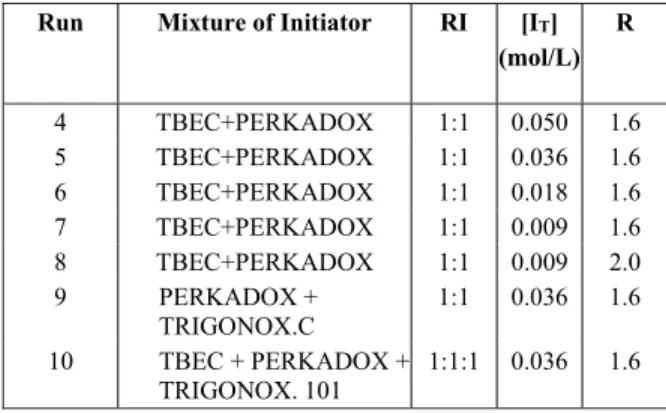
Table 1 shows the initiators used in this work as well as their characteristics. All experimental con-ditions used in this work are summarized in Tables 2 and 3.
Table 1: Molecular weight, activation energy (Ea), pre-exponential factor (kdo) of the initiators.
Initiator (I) Molecular Weight (g/mol)
Ea (kJ/mol)
kdo
(s-1)
TBEC 246.40 131.86 6.98 x 10⁻⁸
PERKADOX LW75 242.25 122.35 6.47 x 10⁻⁵
TRIGONOX C 194.23 151.59 3.04 x 10⁻⁵
TRIGONOX 101 290.40 152.69 3.50 x 10⁻⁹
(Data Akzo Nobel Company)
Runs 1, 2 and 3 (Table 2) were performed using only one initiator. In runs 1 and 2, it was chosen to work with TBEC as initiator, because it allows obtain-ing controlled polymers with faster reactions when compared to PERKADOX as initiator (Nogueira et al. (2010)). PERKADOX used in run 3 is able to provide polymer with very low dispersity; however, when it is used, the polymerization rate is much slower than the one obtained with initiators with lower decomposition rate constants (kd), like TBEC, for example. In this work mixtures of initiators (see Table 3) with different decomposition constants (kd) were also analyzed.
All polymerization reactions were performed at 135 °C. It is well known that NMP using TEMPO re-quires high temperature (between 125 – 145 °C). The temperature 135 °C was chosen based on the previous study conducted in our research group (Nogueira et al., 2010), regarding the best operating temperature to maintain the highest polymerization rates for the NMR process using TBEC or PERKADOX-LW75 as initiators.
Table 2: Polymerization conditions using TEMPO as controller.
Run Initiator (I)
[I]
(mol/L) R*
1 TBEC 0.036 1.3
2 TBEC 0.036 1.6
3 PERKADOX 0.036 1.6
* R = [controller]/[initiator]
Table 3: Polymerization conditions using TEMPO as controller, where RI=[I1]:[I2] is the initiator
ra-tio, [IT] is the total concentration of initiator in the
reaction, and R=TEMPO]:[I] is the [controller]/[ini-tiator] ratio.
Run Mixture of Initiator RI [IT]
(mol/L) R
4 TBEC+PERKADOX 1:1 0.050 1.6
5 TBEC+PERKADOX 1:1 0.036 1.6
6 TBEC+PERKADOX 1:1 0.018 1.6
7 TBEC+PERKADOX 1:1 0.009 1.6
8 TBEC+PERKADOX 1:1 0.009 2.0
9 PERKADOX +
TRIGONOX.C
1:1 0.036 1.6
10 TBEC + PERKADOX +
TRIGONOX. 101
1:1:1 0.036 1.6
Effect of [TEMPO]/[I] Molar Ratio
Figure 1 (a), (b) and (c) show conversion, number average molecular weight and dispersity profiles for runs 1 and 2, in order to evaluate the effect of [TEMPO]/[TBEC] ratio on the dispersity values. It was possible to verify that keeping the concentration of TBEC (0.036 M) and increasing the [TEMPO]/ [TBEC] ratio from 1.3 to 1.6, the induction time in-creases (Figure 1a); however, much lower dispersity values were obtained (Figure 1c).
These results are in accord with the kinetic model studied by Veregin et al. (1996), where the authors re-ported that an increase in the initial concentration of TEMPO leads to a decrease in dispersity. The disper-sity values obtained in a NMP process are inversely proportional to the exchange rate between the active species by the release and capture of the controller during the polymerization.
Results show that the use of high [TEMPO]/[I] molar ratio, greater than 1.3, generates a reduction of dispersity, which is essential for the production of GPC standards. In this way the ratio [TEMPO]/[I] used in the next experiments was 1.6.
Effect of Mixture of Initiators in the Polymeriza-tion ReacPolymeriza-tions
polymeric chains. When using PERKADOX (which has faster decomposition rate compared to TBEC) pure or in combination with TBEC, the reaction rate becomes slower; however, higher molecular weight is obtained, keeping low values for dispersity. For the mixture of initiators (run 5), dispersity lower than 1.10 is observed even at high conversion. The molecular weight versus conversion profiles for runs 3 and 5 showed very similar behavior.
In Figure 2a, it was expected that the polymeriza-tion rate for run 5 (that uses the mixture TBEC + PERKADOX) would be greater than the one for the run 3 (PERKADOX), since the lower kd of TBEC makes controlled polymerization faster. However, the polymerization rate for run 5 was similar to the one for run 3. This suggests that the polymerization rate was mainly influenced by the initiator that has the higher kd value, in this case, PERKADOX.
Figure 1: Effect of [TEMPO]/[TBEC] ratio for runs 1 and 2 using TBEC at 135 °C. (a) conversion versus time, (b) ln(1/(1-C)) versus time, (c) dispersity versus conversion, and (d) molecular weight versus conversion.
Figure 3 shows the conversion, number average molecular weight and dispersity profiles for runs 4, 5 and 6, where the mixture of initiators TBEC+PERKA-DOX was used at concentrations 0.050, 0.036 and 0.018 M, respectively. For all three cases the mixture of initiators promoted a very low dispersity, ranging between 1.03 and 1.11, independent of the concentra-tion of initiator used. The molecular weight profiles increase linearly with the conversion for the three cases, which represents a good control of the polymeri-zation process. It can also be seen that higher concen-tration of initiator promotes a lower molecular weight, since the monomer has to be incorporated in a bigger amount of growing chains.
From the results obtained, it is possible to see that the mixture of initiator has a great potential to produce GPC standards, because polymers with dispersity lower than 1.1 of different molecular weights can be produced.
In order to obtain polymers with molecular weight ever higher, the concentration of initiator was reduced to 0.009 mol/L (runs 7 and 8). Figure 4 shows that, keeping the [TEMPO]/[I] molar ratio equal 1.6, poly-mers with molecular weight up to 56,000 g/mol were obtained. Roa-Luna et al. (2007) used different TEMPO/BPO molar ratios (0.9, 1.1, 1.2 and 1.5) to produce controlled polystyrene, and also observed that high molecular weights are obtained when the controller/initiator ratio decreases.
Figure 3: Effect of mixture of initiator and TEMPO concentration on (a) conversion versus time, (b) Mn versus conversion and (c) polydispersity versus conversion profiles for runs 4, 5 and 6 using the [TEMPO]/[I] molar ratio = 1.6 at T = 135 °C.
Run 7 demonstrated a lower dispersity compared to conventional polymerization, because most of the dis-persity values are very close to the limit value (1.5). However, the Mn versus conversion profile is not typi-cal for a controlled polymerization, indicating an inade-quate control for a GPC standard. The polymers ob-tained in runs 7 and 8 were not used as GPC standards.
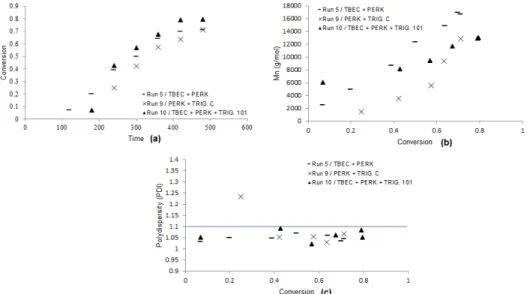
In order to analyze different kinds of mixtures of initiators, runs 5, 9 and 10 were taken into account, as described in Table 3. In all cases the same final con-centration of initiator (0.036M) and [TEMPO]/[I] mo-lar ratio (1.6) were used. Figure 5 displays the results.
It was found that mixtures of different types of in-itiator were able to produce polymers with dispersity smaller than 1.10 for all the three cases.
Results show that mixtures of initiators PERKA-DOX + TRIGONOX C and PERKAPERKA-DOX + TBEC + TRIGONOX 101 are also effective alternatives to ob-tain controlled structure polymer to be applied as GPC
standard, because Mn can vary depending on the mix-ture of initiator used, always keeping dispersity lower than 1.10.
Evaluation of Polymer Purity by Infrared Spec-troscopy
Fourier transform infrared spectroscopy (FT-IR) analysis was performed for a commercial polystyrene (American Polymer) and for a sample synthesized in this work. Through the spectra it was possible to eval-uate if the NMP method was effective to obtain poly-styrene with the purity degree needed for a commer-cial standard.
Table 4 summarizes the absorption frequency ranges corresponding to the functional groups for the polystyrene obtained in this work and for the polysty-rene of a commercial standard. Figure 6 displays the overlay of FT-IR spectra.
Figure 5: Effect of different types of mixtures of initiator on (a) conversion versus time, (b) Mn versus conversion and (c) polydispersity versus conversion profiles for runs 5, 9 and 10 using the [I] = 0.036 M, [TEMPO]/[I] molar ratio = 1.6 at T = 135 °C.
Table 4: FT-IR absorption frequency ranges corresponding to the functional groups for polystyrene.
Bond Functional Group Absorption Frequency range
(cm-1)
Commercial Standard
(cm-1)
Synthesized Sample
(cm-1)
-CH- alkenes, aromatics 3100 – 3000 3030 3025
-CH- aliphatic alkanes 2960 – 2850 2885 2849
-C=C- Aromatics 1600 – 1450 1495 1492
-CH2- 1470 – 1430 1455 1452
-CH- Mono subst out of plane bending
Figure 6: FT-IR overlay spectra for commercial standard and synthesized polystyrene.
The overlay of FT-IR spectrum of the commercial and synthesized samples confirms that the experi-mental method used in this work to synthesize the polymer is effective, since the band positions for both samples show good agreement.
Evaluation of Synthesized Samples in the GPC Calibration Method
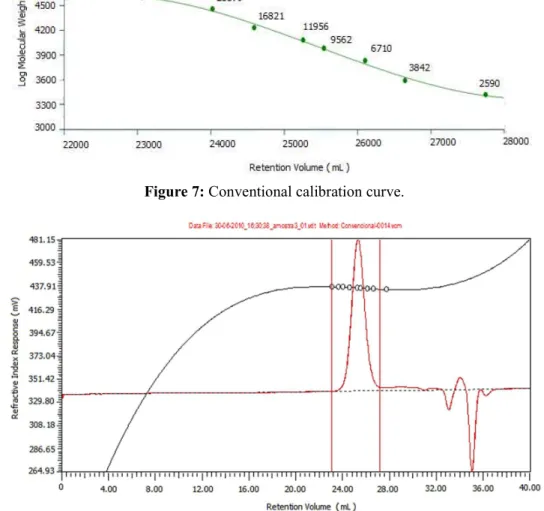
First of all a Conventional Calibration Curve was obtained using samples of different runs and different degrees of conversion. The samples chosen to build the Conventional Calibration Curve are shown in Table 5 and Figure 7.
The calibration curve was obtained using Omnisec 4.1 (Viscotek) software and a TDA 302 Triple Detec-tor Chromatograph, where only the refraction index detector was used.
The experimental points were fitted to a polyno-mial of degree five (or a quintic function) and the line-ar region was the pline-art of the curve used to measure the
molecular weight of samples. It was also observed that the linear range of the calibration curve had a line-ar coefficient (r2) equal 0.995, which is a satisfactory result, since the curve should have a value equal or greater than 0.950.
Figure 8 shows a polystyrene sample analyzed with the conventional calibration curve obtained (Figure 7).
In order to verify the effectiveness of the calibra-tion curve, an analysis of a polystyrene sample with predefined values of molecular weight, viscosity and dispersity was performed considering both conven-tional and triple detector calibration. Results are com-pared in Tables 6 and 7.
Triple detection calibration used refractive index, viscosity and light scattering detectors and the com-mercial standard Viscotek 115 K for triple detector (NIST-Traceble). The Viscotek 115 K standard nomi-nal values informed by the manufacturer were: Mn = 113 g/mol, Mw = 114 g/mol, Mz = 115 g/mol, disper-sity = 1.009 and IV = 0.516 dL/g.
Table 5: Synthesized polymers to be applied on conventional calibration curve.
Synthesized Polystyrene
Mn (g/mol) Mw (g/mol) Mp (g/mol) Ð(Mw/Mn) IV (dl/g)
1 2352 2582 2590 1.098 0.0498
2 3842 4008 3842 1.043 0.0553
3 6105 6359 6710 1.042 0.0720
4 8808 9275 9562 1.053 0.0954
5 11568 12043 11956 1.041 0.1050
6 15875 16344 16821 1.030 0.1246
7 28468 26624 28379 1.069 0.1863
Figure 7: Conventional calibration curve.
Figure 8: Chromatography profile of a conventional calibration.
The commercial standard and synthesized samples were compared by the response of analysis of a spe-cific sample in conventional and triple detector cali-brations. The objective was to determine if the synthe-sized samples used in conventional calibration were capable to show the same response that a commercial standard used in triple detector calibration shows.
It was observed that the responses obtained by the triple detector calibration are the same or very close to the ones obtained by the conventional calibration that uses the standards produced in this work. These results show that the standards produced were very ef-fective for the GPC calibration, since the Triple De-tection calibration is known to be an effective and pre-cise method that uses one single commercial standard to calibrate a few constants for each detector used.
The relative errors er (%) of each measurement were less than 10 %, which is an expected value for GPC analysis, and shows that the samples produced, when applied in conventional calibration, were able to
respond very well compared to a Triple Detection cali-bration.
Table 6: Mn, Mw, Mz, Mp and PDI results ob-tained for a sample in a conventional calibration (homopolymers).
Peak RV (ml)
Mn (Daltons)
Mw (Daltons)
Mz (Daltons)
Mp (Daltons)
Mw/Mn
26,803 3,748 4,296 5,011 4,073 1.146
Table 7: Mn, Mw, Mz, Mp and PDI results ob-tained for a sample in a triple detector calibration (homopolymers).
Peak RV (ml)
Mn (Daltons)
Mw (Daltons)
Mz (Daltons)
Mp (Daltons)
Mw/Mn
26,803 3,460 4,126 4,657 4,252 1.539
for samples with molecular weight lower than 40,000 g/mol if Conventional or Universal calibration meth-ods are used. However, any controlled polymer pro-duced in this work (with dispersity lower than 1.1) could be used as standard for samples with any molecular weight if Triple Detector calibration is considered. This is because the Triple Detector cali-bration only needs standards with dispersity lower than 1.1 and well defined values of Mw, Mz and Mp and IV.
Validation of the Analytical Method
The validation of the analytical method was done in terms of Linearity, Accuracy, Precision, Repeata-bility and Robustness.
Linearity: It was observed that the refractive index
signals vary in a linear way with the concentration values of the eight different samples, with correlation coefficient (r2) equal to 0.9989.
Accuracy: It was observed that the method showed
relative error values ranging from 0.0093 to 3.5945% for each sample injected in triplicate. Such accuracy percentage values are considered satisfactory for GPC analysis, because they should not exceed 10%.
Precision: The relative standard deviation (%)
cal-culated for the results of the injections in triplicate demonstrated that they are very close, with values ranging from 0.033 to 0.7950. This results validate the precision parameter of the instrument due to consecu-tive injections of the same sample, since deviations in the GPC analyses are expected to be lower than 3%. Also the relative standard deviation for the arithmetic mean did not exceed 3%, proving the method has pre-cision.
Repeatability: In the injection repeatability study,
the retention volume values and the standard devia-tions (%) were evaluated for triplicate injecdevia-tions of a commercial standard sample (Viscotek – Mp 6040 and PDI 1.06). For each of the triplicate injections the retention volume (mL) was 16.93, 16.91 and 16.89, and the standard deviation was 0.1183, which demon-strated that the method has good repeatability.
Robustness: The method can be considered robust,
because it was not affected by changes in concentra-tion of the sample.
CONCLUSION
Although the NMP technique has long been stud-ied in the controlled polymerization area, until the moment, to the best of our knowledge, this technique has not been used to produce standards for GPC, such
standards being synthesized by ionic polymerization. In this study polymers ranging from 2000 to 40000 g/mol with dispersity values lower than 1.10 were produced using different mixtures of initiators and TEMPO as controller. Regarding the conventional and universal calibrations, the standards synthesized in this work could be applied to samples with mo-lecular weight lower than 40000 g/mol. However, the standards synthesized in this work could certainly be used to analyze samples of any molecular weight if a Triple Detector calibration is considered, since this method needs only a single standard with well defined values of molecular weight, dispersity and intrisic vis-cosity.
The FT-IR analysis for commercial and synthe-sized polymer confirmed that the experimental method used in this work is effective, since the band positions for both samples showed a good agreement. The GPC method was in-house developed and validated and showed that the polymers analyzed by this technique could certainly be used as standards, since the validation of the linearity, accuracy, preci-sion, repeatability and robustness parameters con-firms that it is reliable.
NMP using a mixture of initiators proved to be a good alternative to produce GPC standards, because it is a simple and low cost method, requires little space, no complex and expensive equipment is needed, and the reagents are commercially available.
ACKNOWLEDGMENTS
The authors acknowledge the financial support from FAPESP and very thankful to the Akzo Nobel Company that kindly provided the initiators PERKA-DOX L-W75, TRIGONOX C and TRIGONOX 101 used in this study.
REFERENCES
Alison, J. S., Nabifar, A., Hernandez-Ortiz, J. C., McManus, N. T., Vivaldo-Lima, E., Pendilis, A., Crosslinking nitroxide-mediated radical copoly-merization of styrene with divinylbenzene. Euro-pean Polymer Journal, 51, 87-111 (2014). Bonilla, J., Saldivar, E., Flores, A., Vivaldo L. E.,
Pfa-endner, R., Ticareno, L., Detailed modeling, simu-lation and parameter estimation of nitroxide medi-ated living free radical polymerization of styrene. Polymer Reaction Engineering, 10(4), 227-263, (2002).
and Cheng, R., Synthesis of two-end-functional-ized copolymer of styrene and methyl methacry-late via living radical polymerization. Journal of Applied Polymer Science, 102(4), 3118-3122 (2006).
Charleux, B., Nicolas, J., Water-soluble SG1-based alkoxyamines: A breakthrough in controlled/living free-radical polymerization in aqueous dispersed media. Polymer, 48, 5813-5833 (2007).
Dias, R. S., Gonçalves, M. C., Lona, L. M., Vivaldo-Lima, E., McManus, N. T., Penlidis, A., Nitroxide-mediated radical polymerization of styrene using mono-and di-functional initiators. Chemical Engi-neering Science, 62(18), 5240-5244 (2007). Georges, M. K., Veregin, R. P. N., Kasmaier, P. M.,
Hamer, G. K., Narrow molecular weight resins by a Free Radical Polymerization Process. Macro-molecules, 26, p. 2987-2988 (1993).
Harrison, S., Couvreur, P., Nicolas, J., SG1 nitroxide-mediated polymerization of isoprene: Alkoxy-amine structure control relationship and α, ω – chain-end functionalization. Macromolecules, 44(23), 9230-9238 (2011).
Harrison, S., Couvreur, P., Nicolas, J., Use of solvent effects to improve control over nitroxide mediated polymerization of isoprene. Macromolecular Rapid Communications, 33(9), 805-810 (2012). Hawker, C. J., Bosman, A. W., Harth, E., New
poly-mer synthesis by nitroxide mediated living radical polymerizations. Chemical Reviews, 101(12), 3661-3688 (2001).
Hlalele, L., Klumperman, B., In situ NMR and mod-eling studies of nitroxide mediated copolymeriza-tion of styrene and n-butyl acrylate. Macromole-cules, 44(17), 6683-6690 (2011).
Nabifar, A., McManus, N. T., Vivaldo-Lima, E., Lona, L. M., Penlidis, A., Thermal polymerization of
sty-rene in the presence of TEMPO. Chemical Engi-neering Science, 64(2), 304-312 (2009).
Nogueira, T. R., Goncalves, M. C., Lona, F., Maria, L., Vivaldo-Lima, E., McManus, N., Penlidis, A., Effect of initiator type and concentration on polymerization rate and molecular weight in the bimolecular nitroxide-mediated radical polymeri-zation of styrene. Advances in Polymer Techno-logy, 29(1), 11-19 (2010).
Ribani, M., Botolli, C. B. G., Collins, C. M., Jardim, I. C. S. F., Validação em Métodos Cromatográficos e Eletroforéticos. Química Nova, 27(5), 771-780 (2004). (In Portuguese).
Roa-Luna, M., Nabifar, A., Díaz-Barber, M. P., Mcmanus, N. T., Vivaldo-Lima, E., Lona, L. M., Penlidis, A., Another Perspective on the Nitroxide Mediated Radical Polymerization (NMRP) of Styrene Using 2, 2, 6, 6-Tetramethyl-1-Piperi-dinyloxy (TEMPO) and Dibenzoyl Peroxide (BPO). Journal of Macromolecular Science, Part A, Pure and Applied Chemistry, 44(3), 337-349 (2007). Ruehl, J., Morimoto, C., Stevens, D. J., Braslau, R.,
Carboxylic acid-and hydroxy-functionalized alkoxy-amine initiators for nitroxide mediated radical polymerization. Reactive and Functional Poly-mers, 68(11), 1563-1577 (2008).
Solomon, D. H., Rizzardo, E., Cacioli, P., Polymeri-zation process and polymers produced thereby. US 4.581.429, CSIRO (1986).
Veregin, R. P., Odell, P. G., Michalak, L. M., Georges, M. K., Mechanism of rate enhancement using or-ganic acids in nitroxide-mediated living free-radi-cal polymerizations. Macromolecules, 29(11), 4161-4163 (1996).
![Figure 2: Effect of the type of initiator on (a) conversion versus time, (b) M n versus conversion and (c) polydispersity versus conversion profiles for runs 1, 3 and 5 using the [TEMPO]/[I] molar ratio = 1.6 at T = 135 °C](https://thumb-eu.123doks.com/thumbv2/123dok_br/18897309.426736/5.918.202.730.686.995/figure-effect-initiator-conversion-conversion-polydispersity-conversion-profiles.webp)
![Figure 3: Effect of mixture of initiator and TEMPO concentration on (a) conversion versus time, (b) M n versus conversion and (c) polydispersity versus conversion profiles for runs 4, 5 and 6 using the [TEMPO]/[I] molar ratio](https://thumb-eu.123doks.com/thumbv2/123dok_br/18897309.426736/6.918.194.720.722.1012/figure-initiator-concentration-conversion-conversion-polydispersity-conversion-profiles.webp)